

Europe Industry 5.0 Market Size & Forecast:
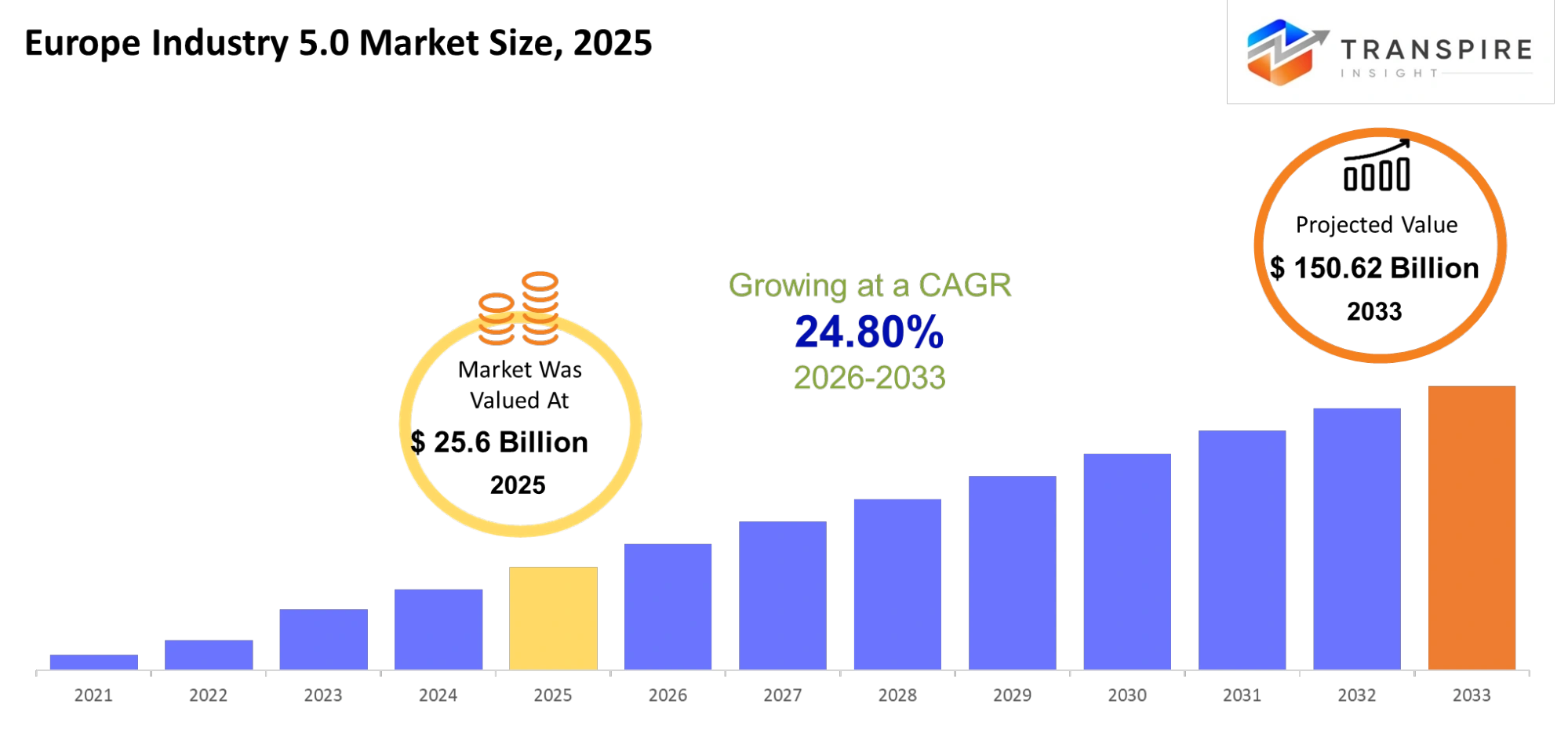
- Europe Industry 5.0 Market Size 2025: USD 25.6 Billion
- Europe Industry 5.0 Market Size 2033: USD 150.62 Billion
- Europe Industry 5.0 Market CAGR: 24.80%
- Europe Industry 5.0 Market Segments: By Type (Collaborative Robots, AI Systems, Digital Twins, Edge Computing, Others); By Application (Manufacturing, Healthcare, Logistics, Automotive, Electronics, Energy, Others); By End-User (Enterprises, SMEs, Manufacturing Firms, Healthcare Providers, Logistics Companies, Government, Others); By Technology (AI, IoT, Robotics, Big Data, Cyber-Physical Systems, Others)
To learn more about this report,  Download Free Sample Report
Europe Industry 5.0 Market Summary:
The Europe Industry 5.0 Market size is estimated at USD 25.6 Billion in 2025 and is anticipated to reach USD 150.62 Billion by 2033, growing at a CAGR of 24.80% from 2026 to 2033.
The European Industry 5.0 market operating within the manufacturing and industrial technology sector establishes its foundation on human-centric partnerships which connect workers with advanced automation systems. The demand for customized products from consumers leads factories to change their digital tool usage and their implementation of adaptive robotics. The development of artificial intelligence together with interconnected machines and data monitoring systems will drive continuous industrial workflow changes throughout Europe. The European Union's new regulations promote safer manufacturing practices and responsible use of intelligent technologies in industrial facilities. The upcoming years will see industrial networks across regions develop through three main areas which include flexible manufacturing methods and workforce development and improved human-machine interaction through digital system integration.
What Has the Impact of Artificial Intelligence Been on the Europe Industry 5.0 Market?
The artificial intelligence system develops operational intelligence and decision-making capabilities in European industry 5.0 markets, which enhances data processing and data utilization for industrial applications. The European industry 5.0 market currently utilizes AI-powered market research tools together with machine learning models to help businesses monitor changing consumer preferences and analyze intricate industrial data. Europe industry 5.0 market uses artificial intelligence to develop predictive analytics and smart automation systems which organizations use for their strategic planning processes that help them achieve faster decision-making results.
Artificial intelligence in the European industry 5.0 market uses its advanced capabilities to transform demand forecasting through pattern detection which analyzes both past and present data to create better production estimates. Organizations are using intelligent systems to streamline supply chain flows, improve resource allocation, and reduce operational inefficiencies. The technological improvements enable companies to respond quickly to market changes while they maintain precise execution and decrease disruptions that affect their interconnected systems.
The European industry 5.0 market will continue to develop because artificial intelligence creates customized manufacturing solutions and enhances human-machine interactions on factory floors. The European industry 5.0 market uses artificial intelligence to create adaptive systems that improve workflow through dynamic refinement, which helps organizations win in data-driven industrial environments.
Key Market Trends & Insights:
- The European Industry 5.0 market is mainly controlled by Western Europe, which will achieve a market share of about 42% by 2025, because of its sophisticated industrial automation systems.
- The period from 2025 until 2030 shows Northern Europe as the most rapidly developing area because businesses increasingly adopt AI-driven smart factories and digital twin technology.
- The European Industry 5.0 market currently receives its strongest regional deployment from Germany, which builds on its existing Industry 4.0 systems.
- European Industry 5.0 market Smart automation solutions, which account for approximately 38% of market share, receive extensive implementation throughout manufacturing facilities.
- Robotics systems represent the second-largest segment, which manufacturers use extensively for precision manufacturing and adaptive production lines.
- The manufacturing optimization process holds the most significant market presence in Europe, with a market share of almost 45% because most industries have adopted digital technologies.
- Supply chain intelligence, which employs AI forecasting together with real-time analytics, represents the application that experiences the most rapid growth rate.
- The automotive and aerospace industries hold a market share of 40% in the European Industry 5.0 market, which drives their demand for end-user products.
- The healthcare manufacturing sector is currently experiencing rapid growth, which the industry attributes to the rising popularity of customized manufacturing and smart device technology.
- The combination of continuous product development together with regional market development throughout Europe enables businesses to strengthen their competitive position while they implement new technologies across various sectors.
Europe Industry 5.0 Market Segmentation
By Type:
The study divides its segments into various types which include Collaborative Robots and AI Systems and Digital Twins and Edge Computing and Other technologies. Collaborative robots support shared human-machine tasks in production lines. The AI systems work to process extensive data sets which enable real-time decision making. Virtual factory operations can be tested through digital twins which enable manufacturers to simulate their processes. The technology of edge computing enables speedy data processing because it operates at the source location which leads to decreased waiting times and enhanced system performance.
By Application:
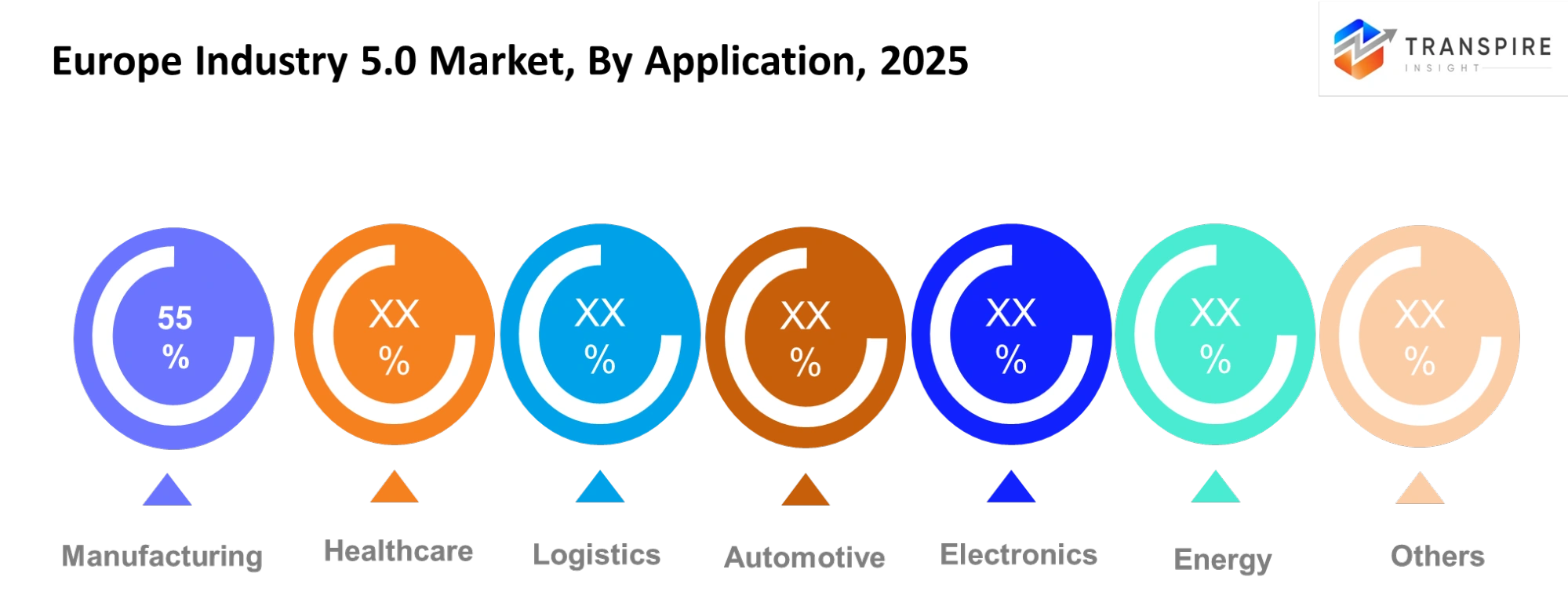
Manufacturing serves as the primary application sector because it enables businesses to implement automation and maintain adaptable manufacturing systems. Smart systems enables healthcare facilities to manage equipment better and develop patient-centered production technologies. The logistics industry benefits from its ability to track shipments quickly while optimizing delivery paths. The energy sector requires precise systems for monitoring which help decrease operational waste but the automotive and electronics sectors need high precision systems.
To learn more about this report, Download Free Sample Report
By End-User:
The segments approach their end-user markets which include enterprises and SMEs and manufacturing firms and healthcare providers and logistics companies and government agencies and all other organizations. Large enterprises lead adoption because their higher investment capacity enables them to purchase advanced technologies. The SME market shows gradual growth because solutions have become more affordable and accessible to businesses. Manufacturing companies need to achieve higher efficiency through automation technologies. Healthcare providers use smart tools to enhance their service delivery capabilities. Logistics companies track their shipments through connected systems while government initiatives help industries modernize and adopt digital technologies.
By Technology:
The technology segments include AI and IoT and Robotics and Big Data and Cyber-Physical Systems and other technologies. Artificial intelligence enhances production systems through its decision-making and predictive capabilities. IoT enables machine and device connection which allows real-time communication and monitoring. Robotics technology creates precise results which decreases the need for workers to perform the same task repeatedly. Big data enables organizations to analyze their extensive industrial data collection which leads to more effective planning. Cyber-physical systems enable organizations to create integrated digital and physical environments which enhance machine and human operational coordination.
What are the Main Challenges for the Europe Industry 5.0 Market Growth?
The European Industry 5.0 Market encounters technical and operational challenges which prevent smooth implementation throughout industrial systems. The implementation process for advanced robotics systems and AI technology and connected infrastructure encounters performance problems because of existing legacy systems. The European Industry 5.0 Market experiences scalability problems because small pilot projects cannot develop into comprehensive industrial operations due to system incompatibility and data synchronization issues.
The European Industry 5.0 Market faces additional constraints because manufacturing and commercialization difficulties create obstacles for companies which must manage complex setup processes and comply with European industrial regulations throughout their operations. The combined effect of compliance requirements and increased production expenses creates market entry delays for advanced solutions. The European Industry 5.0 Market faces challenges because industrial validation processes take extended periods and continuous system evaluations must occur before organizations can implement their solutions at higher industrial capacity.
Digital infrastructure development hinders the Europe Industry 5.0 Market because organizations cannot establish necessary infrastructure components while they wait for complete digital infrastructure development. The implementation process experiences delays because organizations lack professionals with expertise to operate AI-based systems and intelligent automation technologies. The limited funding available for small and mid-sized enterprises creates barriers which prevent businesses from expanding their market presence in various sectors.
The European Industry 5.0 Market faces multiple dangers because of market competition and changing technological requirements. The rapid pace of technological progress forces businesses to continually update their systems while their profit margins decline because customers choose other automation solutions.
The Europe Industry 5.0 Market will face ongoing adoption difficulties because regulatory changes and cybersecurity issues will affect its development as industries adopt advanced connected and intelligent manufacturing systems.
Regional Insights
The Europe Industry 5.0 Market shows distinct regional differences which result from the industrial capacity and digital development of each area. Western Europe controls the market because of its sophisticated manufacturing facilities and its highly developed research ecosystem and its historical adoption of automated technologies. The European market for Industry 5.0 development receives support from Germany and France through their investments in intelligent factories and worker-centered production systems.
Northern Europe is experiencing rapid growth in the Europe Industry 5.0 Market because it possesses excellent digital infrastructure and has implemented AI industrial technologies since the beginning. The industry adopts new technologies because companies prioritize green operations and sustainable production methods. The government-funded innovation programs will drive the use of smart production technologies which will enhance operational performance and facilitate the growth of the European Industry 5.0 Market.
The Europe Industry 5.0 Market sees Southern and Eastern Europe Regions slowly adopting the technology because their industries lack modernization and they face financial restrictions. The region will experience growth through international investments and technological collaboration between companies. The adoption of industrial upgrades and workforce development initiatives will progress at a measured pace which will eventually lead these areas to become significant participants in the European Industry 5.0 market.
Recent Development News
In March 2026, Siemens AG showcased new smart manufacturing solutions at Global Industrie 2026 in Paris, focusing on AI-powered industrial automation designed for human-centric production systems. The update highlighted stronger integration of predictive maintenance and digital factory tools within the evolving europe industry 5.0 market, supporting more flexible and efficient production environments. https://www.siemens.com
In March 2026, SAP SE announced expanded AI-driven industrial analytics capabilities aimed at improving real-time decision-making across manufacturing networks. The initiative focused on strengthening data intelligence and supply chain coordination within the europe industry 5.0 market, enabling more adaptive and efficient industrial operations. https://www.sundarammutual.com
|
Report Metrics |
Details |
|
Market size value in 2025 |
USD 25.6 Billion |
|
Market size value in 2026 |
USD 31.95 Billion |
|
Revenue forecast in 2033 |
USD 150.62 Billion |
|
Growth rate |
CAGR of 24.80% from 2026 to 2033 |
|
Base year |
2025 |
|
Historical data |
2021 - 2024 |
|
Forecast period |
2026 - 2033 |
|
Report coverage |
Revenue forecast, competitive landscape, growth factors, and trends |
|
Regional scope |
Europe (Germany, United Kingdom, France, Italy, Spain, Rest of Europe) |
|
Key company profiled |
Siemens, ABB, Schneider Electric, Rockwell Automation, IBM, Microsoft, SAP, Oracle, Bosch, Honeywell, Emerson, Fanuc, KUKA, Dassault Systèmes, Hitachi |
|
Customization scope |
Free report customization (country, regional & segment scope). Avail customized purchase options to meet your exact research needs. |
|
Report Segmentation |
By Type (Collaborative Robots, AI Systems, Digital Twins, Edge Computing, Others); By Application (Manufacturing, Healthcare, Logistics, Automotive, Electronics, Energy, Others); By End-User (Enterprises, SMEs, Manufacturing Firms, Healthcare Providers, Logistics Companies, Government, Others); By Technology (AI, IoT, Robotics, Big Data, Cyber-Physical Systems, Others) |
How Can New Companies Establish a Strong Foothold in the Europe Industry 5.0 Market?
New companies entering the europe industry 5.0 market will need a clear focus on niche positioning and problem-specific solutions to stand out in a highly competitive industrial space. The success of entry strategies for the europe industry 5.0 market will require identification of manufacturing and healthcare and logistics optimization areas where current solutions do not meet existing needs. Wandelbots shows through its German operations that robotics software innovation enables easy machine programming which enhances human-machine collaboration to support flexible industrial adoption.
The European Industry 5.0 market will use partnership-driven expansion to establish its market presence through credibility building. New companies will gain access to market entry resources through their partnerships with established manufacturers and research institutes and technology providers. Helsing provides an example of how advanced analytics and machine learning can use AI-based industrial and defense intelligence systems to solve operational challenges which arise in complex environments.
The European Industry 5.0 market needs technology differentiation to achieve sustainable market presence. New companies will need to focus on scalable AI systems, edge computing, and predictive automation tools that directly improve efficiency in manufacturing and healthcare production systems. The european industry 5.0 market ecosystem will experience faster adoption through organizations which combine their innovation strategies with sustainability targets and automation solutions that support employment.
Key Europe Industry 5.0 Market Company Insights
The European Industry 5.0 market faces intense competition between international technology companies and local manufacturing companies which deliver smart manufacturing products. Major companies spend large amounts of money on artificial intelligence-powered automation systems together with robotic solutions and digital technology platforms to boost their operational productivity. The European Industry 5.0 market will experience strong competition between companies which will compete through their ability to develop new products and their efficiency at controlling expenses and their capacity to integrate different systems.
The established companies which operate in the European Industry 5.0 market establish new business relationships with industrial manufacturers to research partners which enables them to develop their market presence. Through collaboration, organizations can advance their technological implementation efforts in the automotive, healthcare, and logistics industries. The market experiences competitive pressure because companies continuously enhance their predictive analytics capabilities together with their smart automation systems which enable quicker decision-making and better industrial results throughout their manufacturing operations.
The Europe Industry 5.0 Market faces competitive pressure from new market entrants who develop special solutions which include AI monitoring systems and adaptable robotic systems. The new market entrants provide industrial solutions which can be implemented more quickly and require less operational complexity. The Europe Industry 5.0 Market will maintain its competitive environment because industrial ecosystems use digital capabilities and integration strength to determine their future market positions.
Company List
- Siemens
- ABB
- Schneider Electric
- Rockwell Automation
- IBM
- Microsoft
- SAP
- Oracle
- Bosch
- Honeywell
- Emerson
- Fanuc
- KUKA
- Dassault Systèmes
- Hitachi
What are the Key Use-Cases Driving the Growth of the Europe Industry 5.0 Market?
The Europe Industry 5.0 Market shows increasing progress because actual case studies demonstrate human-centered automation and advanced production systems work together. The industrial sector benefits from improved operational efficiency through its widespread use of intelligent robots and decision-making systems that are powered by artificial intelligence. The Europe Industry 5.0 Market will keep growing because companies need production systems which enable human workers to operate together with automated technology.
The Europe Industry 5.0 Market receives its main thrust from manufacturing applications which use predictive maintenance and smart quality control to decrease machine downtime while maintaining product quality. Advanced robotics and digital twins enable the automotive and electronics sectors to evaluate their production lines before they begin their operations. The healthcare sector is expanding its use of smart technology to support medical device manufacturing and customized equipment development which drives the European Industry 5.0 Market forward.
The Europe Industry 5.0 Market experiences strong growth through logistics and supply chain optimization because AI technology enables better delivery performance and inventory management through its tracking systems. Retailers and businesses use data-driven forecasting systems to synchronize their production schedules with the actual demand patterns occurring at that time. The use cases will promote industrial expansion through automated systems which help organizations boost their operational performance while maintaining human control throughout the European Industry 5.0 Market system.
Europe Industry 5.0 Market Report Segmentation
By Type
- Collaborative Robots
- AI Systems
- Digital Twins
- Edge Computing
- Others
By Application
- Manufacturing
- Healthcare
- Logistics
- Automotive
- Electronics
- Energy
- Others
By End-User
- Enterprises
- SMEs
- Manufacturing Firms
- Healthcare Providers
- Logistics Companies
- Government
- Others
By Technology
- AI
- IoT
- Robotics
- Big Data
- Cyber-Physical Systems
- Others
Frequently Asked Questions
Find quick answers to common questions.
The approximate Europe Industry 5.0 Market size for the market will be USD 150.62 Billion in 2033.
Key segments for the Europe Industry 5.0 Market are By Type (Collaborative Robots, AI Systems, Digital Twins, Edge Computing, Others); By Application (Manufacturing, Healthcare, Logistics, Automotive, Electronics, Energy, Others); By End-User (Enterprises, SMEs, Manufacturing Firms, Healthcare Providers, Logistics Companies, Government, Others); By Technology (AI, IoT, Robotics, Big Data, Cyber-Physical Systems, Others).
Major Europe Industry 5.0 Market players are Siemens, ABB, Schneider Electric, Rockwell Automation, IBM, Microsoft, SAP, Oracle, Bosch, Honeywell, Emerson, Fanuc, KUKA, Dassault Systèmes, Hitachi.
The Europe Industry 5.0 Market size is USD 25.6 Billion in 2025.
The Europe Industry 5.0 Market CAGR is 24.80%.
- Siemens
- ABB
- Schneider Electric
- Rockwell Automation
- IBM
- Microsoft
- SAP
- Oracle
- Bosch
- Honeywell
- Emerson
- Fanuc
- KUKA
- Dassault Systèmes
- Hitachi
Recently Published Reports
-
Apr 2026
3D Optical Profiler Market
3D Optical Profiler Market Size, Share & Analysis Report By Type (Desktop 3D Optical Profiler, and Portable 3D Optical Profiler), By Technology (Confocal Technology, and White Light Interference), By End-Use Industry (Manufacturing, Research Institutions, Automotive, Aerospace and Defense, Medical Devices, and Other), and Geography (North America, Europe, Asia-Pacific, Middle East and Africa, South and Central America), 2021 - 2031
-
Apr 2026
Depth Sensor Market
Depth Sensor Market Size, Share & Analysis Report By Type (Infrared Depth Sensors, Time-of-Flight (ToF) Sensors, Stereo Vision Sensors, Structured Light Sensors, Ultrasonic Depth Sensors), By Application (Automotive, Robotics, Gaming, Consumer Electronics, Industrial Automation, Healthcare, Security & Surveillance, Others), By End Users (Automotive Manufacturers, Consumer Electronics Companies, Healthcare Providers, Industrial Companies, Security Agencies, Gaming Companies, Robotics Companies, Others), and Geography (North America, Europe, Asia-Pacific, Middle East and Africa, South and Central America), 2021 – 2031
-
Apr 2026
Digital Manufacturing Market
Digital Manufacturing Market Size, Share & Analysis Report By Component (Hardware, Software, and Services), By Technology (Robotics, 3D Printing, Internet of Things (IoT), and Others), By Application (Automotive and Transportation, Aerospace and Defense, Consumer Electronics, Industrial Machinery, and Others), By Process Type (Computer-Based Designing, Computer-Based Simulation, Computer 3D Visualization, Analytics, and Others), and Geography (North America, Europe, Asia-Pacific, Middle East and Africa, South and Central America), 2021 – 2031
-
Apr 2026
Digital Visa Services Market
Digital Visa Services Market Size, Share & Analysis Report By Type (Individual Travelers, Group Travelers), By Application (Tourism, Business Travel, Others), and Geography (North America, Europe, Asia-Pacific, Middle East and Africa, South and Central America), 2021 – 2031