
Europe In-Memory Computing Market Size & Forecast:
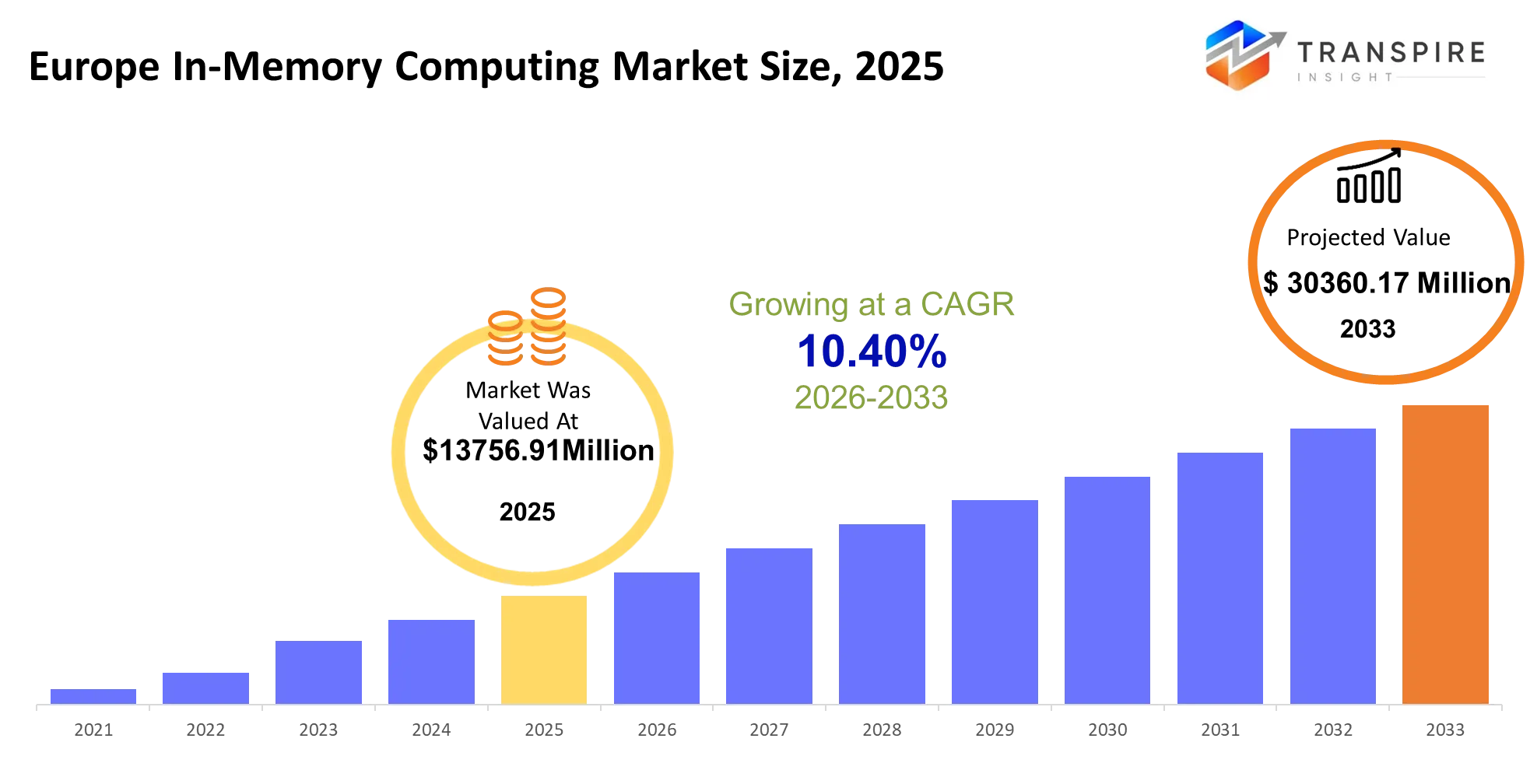
- Europe In-Memory Computing Market Size 2025: USD 13756.91 Million
- Europe In-Memory Computing Market Size 2033: USD 30360.17 Million
- Europe In-Memory Computing Market CAGR: 10.40%
- Europe In-Memory Computing Market Segments: By Type (IMDB, IMDG, Data Processing Platforms, Real-time Engines, Others); By Application (Real-time Analytics, Transaction Processing, Risk Management, Fraud Detection, Data Streaming, Others); By End-User (Enterprises, BFSI, Retail, IT & Telecom, Healthcare, Government, Others); By Deployment (Cloud, On-premise, Hybrid, Others)
To learn more about this report,  Download Free Sample Report
Europe In-Memory Computing Market Summary
The Europe In-Memory Computing Market was valued at USD 13756.91 Million 2025. It is forecast to reach USD 30360.17 Million by 2033. That is a CAGR of 10.40% over the period.
The Europe in-memory computing market enables companies to process created data in real-time throughout their manufacturing lines and financial trading systems and telecom networks. This solution provides a solution to two problems which traditional disk-based systems cannot solve because they require storage times of less than one second for critical applications such as fraud detection and production optimization.
The last three to five years have witnessed a fundamental transformation in deployment methods due to the adoption of hybrid and edge-integrated systems. The transition happened because enterprises had to follow General Data Protection Regulation requirements which enforced stricter data sovereignty regulations that required companies to process their data within their own country borders. Supply chain interruptions during semiconductor production showed how hardware-based scaling methods were vulnerable to operational breakdowns.
Organizations have started to spend money on distributed in-memory systems which offer high efficiency while meeting compliance standards. This trend has resulted in businesses adopting these systems more strategically and maintaining their use throughout multiple fields of work.
Key Market Insights
- European countries achieve more than 30 percent market share in 2025 because of their strict implementation of General Data Protection Regulation combined with their active digital transformation efforts.
- The Asia-Pacific region experiences its fastest growth rate because it will achieve more than 20 percent compound annual growth rate until 2030 driven by its rapid investments in cloud and AI infrastructure.
- In Europe In-Memory Computing Market the In-memory databases hold the top position with approximately 45 percent market share because businesses utilize SAP HANA and similar platforms.
- Organizations that move to unified analytics and streaming data architectures find data processing platforms to be their second most popular choice.
- The real-time engines show the most rapid growth path which will continue until 2028 because of rising demand from IoT and 5G technologies.
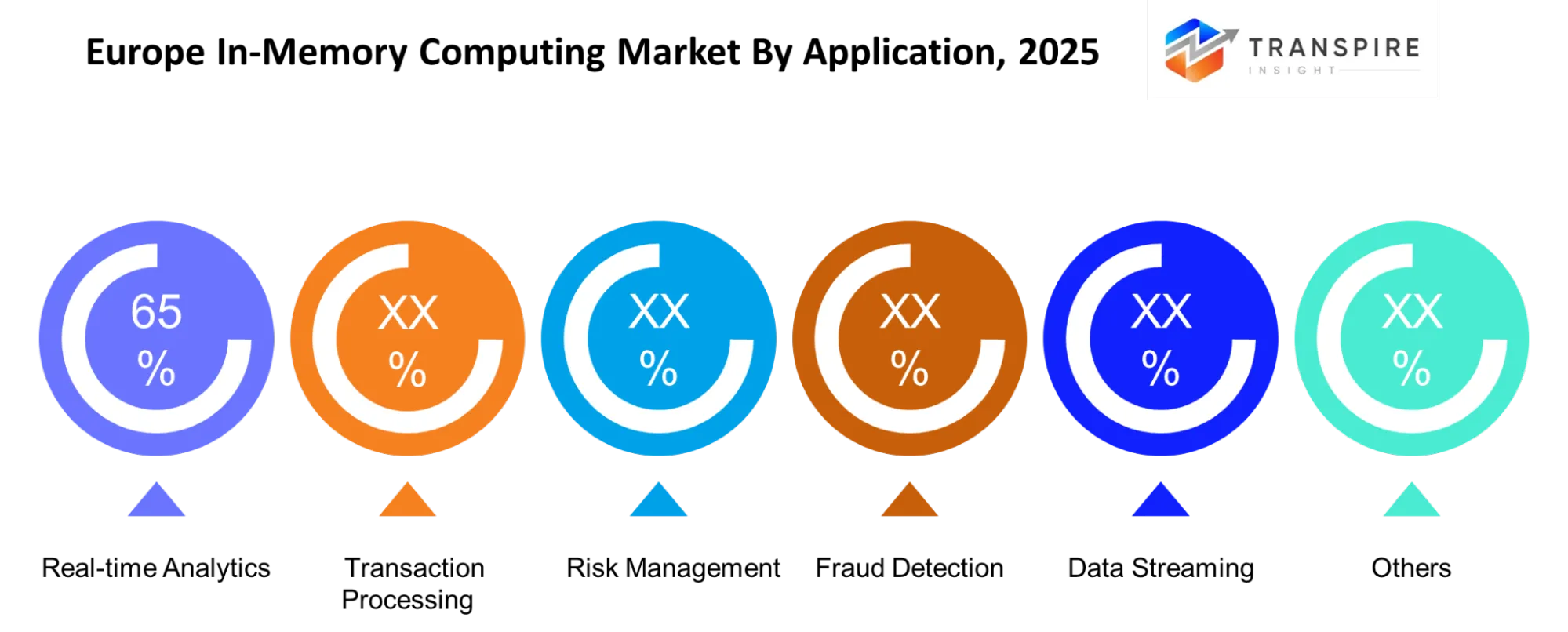
- Real-time analytics dominates applications with over 35% share because enterprises need immediate operational insights to improve their efficiency and revenue performance.
- Data streaming stands as the fastest-growing application because the telecom and logistics industries need systems that can process data continuously with minimal time delays.
- More than 40% of total demand comes from enterprises which demonstrates that financial and manufacturing and supply chain operations have widely adopted the solution.
- The healthcare sector experiences its fastest growth through real-time patient data processing under strict compliance standards which creates an increasing need for healthcare solutions.
- Modern businesses achieve competitive advantage through integrated ecosystems that merge cloud technology with AI and in-memory processing to create scalable and compliant systems.
What are the Key Drivers, Restraints, and Opportunities in the Europe In-Memory Computing Market?
The European Union General Data Protection Regulation together with related national regulations has created new privacy and data sovereignty requirements that lead to business growth. The regulations require companies to handle sensitive information within specific geographic areas which drives the need for in-memory systems that enable businesses to perform instant data analysis without needing to transfer data across borders. Since 2023 organizations have accelerated their adoption of new technology because they need to update their IT infrastructure for compliance purposes while still delivering efficient results. The current trend results in increased investments toward unified systems which consolidate all storage and computation and analytical functions into one memory system.
The main restriction exists because organizations need advanced semiconductor supply chains to access high-performance memory components. Currently DRAM production together with newer memory technologies depends on a small group of companies that operate throughout the world which makes it vulnerable to both geopolitical conflicts and production limitations. The existing bottleneck creates additional costs for systems which results in extended delays for enterprise deployments especially in large-scale operations. The result is reduced adoption by mid-sized companies because they find it hard to handle price changes and they cannot obtain steady supply contracts.
Federated data ecosystems create new collaboration possibilities for organizations to work together without losing their vital data. Technologies which combine in-memory processing with secure data sharing frameworks enable organizations to perform real-time analytics across different countries while remaining compliant with regulations. The development of industrial data space initiatives together with healthcare data networks has started to create new development opportunities which generate additional revenue streams for vendors who can create systems for decentralized data networks.
What Has the Impact of Artificial Intelligence Been on the Europe In-Memory Computing Market?
The development of artificial intelligence technology enables real-time monitoring and control of scrubber performance systems which enhances automation processes in exhaust gas cleaning technology. Operators now deploy AI-enabled control layers on platforms such as SAP HANA to process sensor data from pumps, washwater systems, and emission outputs instantly. The system automates compliance tracking which monitors sulfur emissions to meet regulatory requirements while reducing the need for human work and decreasing the chances of breaking the law. Fleet operators experience better operational performance because automated adjustments keep their scrubbers operating at peak efficiency.
Organizations utilize machine learning models to enhance their ability to predict marine emission control system performance. The algorithms use historical and real-time operational data to calculate component wear rates and optimize fuel-air mixtures and forecast emission spikes. The method increases operational availability while achieving fuel efficiency improvements that typically result in single-digit percentage gains throughout entire fleets. Predictive maintenance reduces repair costs while extending equipment lifespan which leads to better returns on investment.
Artificial intelligence implementation faces its most significant obstacle because the sector lacks sufficient top-quality training data which should come from actual maritime operations. The model's performance suffers because of two factors: the unpredictable nature of ocean conditions and the problems with maintaining internet connection during maritime activities.
Key Market Trends
- The European Union General Data Protection Regulation requires stricter data sovereignty rules which enterprises now fulfill through hybrid systems with edge computing and in-memory processing.
- The manufacturing and BFSI sectors have transitioned from using batch analytics to continuous real-time processing because they need systems that deliver instant decisions instead of traditional reporting methods.
- Since 2024, SAP and other vendors have integrated artificial intelligence into their in-memory platforms, which now operate as autonomous decision-support systems instead of traditional databases.
- The demand for energy-efficient architectural solutions has increased because European energy costs began rising in 2022 which forced data centers to implement power-saving methods for handling memory-intensive tasks.
- Organizations use hybrid deployments more than before because they want to meet regulatory requirements while Microsoft provides them with scalable solutions.
- The competitive landscape has shifted from software-based competition to ecosystem-based competition because cloud providers and chip manufacturers and artificial intelligence companies started forming partnerships after 2025.
- The 5G network slicing and real-time traffic orchestration needs of telecom operators have driven their adoption of in-memory processing since 2025 because this technology replaces outdated systems that create processing delays.
- Financial institutions have increased spending on in-memory fraud detection systems since 2024, responding to stricter EU compliance mandates and rising real-time transaction volumes.
- Supply chain concerns have intensified since 2023, as advanced semiconductor materials become necessary for in-memory computing vendors who face production constraints and geopolitical threats.
Europe In-Memory Computing Market Segmentation
By Type:
The most significant market share belongs to in-memory databases because these systems get used in enterprise environments which demand rapid transactional and analytical capabilities. The combination of SAP HANA and Oracle Database In-Memory establishes market control through their ability to process data within storage systems. The market for data processing platforms and real-time engines grows because businesses need streaming services and event-driven systems. In-memory data grids offer distributed computing solutions which require system expansion to maintain their operational functions.
Unified data architectures which solve storage latency problems between storage and computation drive this market segment forward. Real-time engines are increasingly adopted by telecom companies and financial institutions because they enable organizations to process data within milliseconds. The upcoming period will see AI integration with existing products which will lead to vendors creating more efficient memory systems and better distributed processing functions. The new technology will drive funding towards hybrid systems which integrate different in-memory solutions.
By Application:
The application sector sees real-time analytics as its leading use case because businesses need immediate insights for their decision-making process. In-memory systems enable financial institutions and manufacturers to process large data volumes instantly which helps them with forecasting and operational control. The transaction processing market experiences rapid growth because businesses need systems that can handle multiple transactions at high velocity without losing operational efficiency. Financial markets see expanded fraud detection and risk management activities because regulatory requirements keep increasing.
The segment experiences growth because businesses now recognize the rising importance of time-sensitive data for their competitive operations. The expansion of Internet of Things systems and interconnected infrastructure in telecom and logistics sectors drives higher demand for data streaming applications. The future will see platforms create combined environments which will enable users to perform analytics and streaming operations and transactional work. The convergence will determine how vendors develop their business strategies while driving buyers to choose solutions which can function across multiple purposes.
To learn more about this report, Download Free Sample Report
By End-User:
The enterprise sector represents the highest market share because organizations use the technology for various operational departments which involve their financial and supply chain and customer management tasks. The BFSI sector follows with strong demand for low-latency systems that support trading, compliance, and fraud prevention. IT and telecom sectors deliver major benefits through their network optimization efforts and their improvements to service delivery. Retail and healthcare segments show steady growth as digital transformation initiatives expand.
The different sectors display distinct growth patterns because BFSI requires businesses to meet regulatory requirements and reduce operational risks while telecom needs to manage high-speed data traffic resulting from 5G technology. Healthcare adoption needs organizations to handle patient information through secure methods which protect personal data under strict guidelines. The forecast period will see increased demand for specific industry solutions which will lead vendors to create products that match particular industry needs. The trend will lead to the emergence of dedicated platforms which will solve specific business problems.
By Deployment:
Organizations prefer cloud deployment because it delivers better scalability and operational flexibility while requiring smaller initial financial investment. The managed in-memory services which Amazon Web Services and Microsoft Azure provide through their cloud platforms attract more users to their services. Organizations in government and finance sectors which need strong data protection must use on-premise deployment as their deployment method. Organizations are adopting hybrid models because they want to achieve both optimal performance and regulatory requirements.
The segment growth derives from two factors which include the need to meet data sovereignty requirements and the demand for adaptable infrastructure solutions. Hybrid deployment is gaining traction as it enables localized processing alongside cloud scalability. The forecast period will see hybrid architectures become the preferred model which will lead vendors to develop solutions that enable their products to work together while allowing data to flow smoothly. The buying process will change because of this development which will lead to more partnerships between cloud service providers and enterprise software companies.
What are the Key Use Cases Driving the Europe In-Memory Computing Market?
The primary application of SAP HANA systems in large enterprises revolves around their ability to provide real-time analytics for business operations. Industries such as manufacturing and finance rely on instant processing of transactional and operational data to optimize supply chains, detect fraud, and support dynamic pricing. The business case which generates maximum demand because it affects both revenue streams and regulatory reporting precision.
Telecom and retail sectors develop new applications which use in-memory systems to handle their fast-moving data operations. The telecom industry uses this technology to optimize their network operations while managing 5G data traffic, whereas retailers implement it to achieve personalized customer experiences and track their stock levels. Businesses are increasingly adopting these solutions because providing excellent customer service together with continuous operational performance creates advantages over their competitors.
Healthcare and energy sectors develop new applications which require secure analytics that operate with minimal delays. Hospitals use in-memory platforms to monitor patients in real time while following strict data protection regulations, and power companies utilize them to manage their intelligent grids. The digital infrastructure in these sectors remains in its development phase, yet it demonstrates strong future growth potential.
|
Report Metrics |
Details |
|
Market size value in 2025 |
USD 13756.91 Million |
|
Market size value in 2026 |
USD 15187.27 Million |
|
Revenue forecast in 2033 |
USD 30360.17 Million |
|
Growth rate |
CAGR of 10.40% from 2026 to 2033 |
|
Base year |
2025 |
|
Historical data |
2021 - 2024 |
|
Forecast period |
2026 - 2033 |
|
Report coverage |
Revenue forecast, competitive landscape, growth factors, and trends |
|
Regional scope |
Europe (Germany, United Kingdom, France, Italy, Spain, Rest of Europe) |
|
Key company profiled |
SAP, Oracle, IBM, Microsoft, Redis Labs, VMware, Amazon, Google, Hazelcast, Teradata, TIBCO, Software AG, Altibase, GridGain, MemSQL |
|
Customization scope |
Free report customization (country, regional & segment scope). Avail customized purchase options to meet your exact research needs. |
|
Report Segmentation |
By Type (IMDB, IMDG, Data Processing Platforms, Real-time Engines, Others); By Application (Real-time Analytics, Transaction Processing, Risk Management, Fraud Detection, Data Streaming, Others); By End-User (Enterprises, BFSI, Retail, IT & Telecom, Healthcare, Government, Others); By Deployment (Cloud, On-premise, Hybrid, Others) |
Which Regions are Driving the Europe In-Memory Computing Market Growth?
Europe maintains its position as the leading market for in-memory computing because of strong regulatory requirements which promote data sovereignty and privacy protection through General Data Protection Regulation frameworks. Governments and enterprises require data to be processed within their borders which creates a growing need for in-memory systems that deliver real-time analytics without needing to move data across international borders. The region benefits from its extensive network which includes enterprise software companies, cloud computing services, and semiconductor research organizations. European nations maintain their position as industry leaders because of their combination of policy enforcement activities and digital infrastructure developments and industrial demand.
North America follows with a different strength profile built on hyperscale cloud dominance and private sector innovation rather than regulatory pressure. Amazon Web Services and Microsoft create market demand by offering scalable cloud platforms which include in-memory capabilities. The market maintains its strength because enterprises continue to spend money on IT while companies start using AI-based solutions. Data center infrastructure maintains its stability because of strong capital resources and ongoing improvements in data center systems.
The Asia-Pacific region is developing into the fastest-growing area because of its quick digital transformation and its government-supported development of essential infrastructure. China and India are making significant investments in smart city projects and 5G network development and their local cloud environments which require efficient data handling with minimal latency. The government has changed its policies to support data localization and domestic semiconductor production which has led to an increase in technology usage. This period of growth presents a significant chance for vendors and investors who wish to establish their businesses before 2033 while they work to establish digital transformation initiatives with national stakeholders.
Who are the Key Players in the Europe In-Memory Computing Market and How Do They Compete?
The European in-memory computing market shows moderate competition because only a few enterprise software and hardware companies control its main infrastructure while smaller companies serve specific market segments. Companies that exist in the market today protect their business territory by adding in-memory technology to their cloud and AI systems instead of creating products that work independently. European clients now base their technology selection on data governance compliance and system integration capabilities because they need to process data in real time using sovereign and hybrid systems.
SAP achieves deep integration of in-memory computing within its ERP stack through its HANA platform which enables real-time analytics directly inside transactional systems. The company distinguishes itself through its ability to integrate with enterprise workflows and its high usage rates among industries that operate under European regulatory standards. The company expands its business operations through partnerships in industrial AI and partnerships in sovereign cloud to establish greater control over regional markets.
Oracle uses engineered systems that combine database, hardware, and cloud services to create solutions optimized specifically for in-memory workloads. The company achieves its competitive edge through vertical integration combined with performance tuning, which benefits enterprises that operate at large-scale. IBM promotes its hybrid cloud solution by integrating in-memory processing into its AI and data platforms through its established connections with the finance and government sectors. Redis distinguishes itself in the market by offering high-performance data structures that developers prefer while the company expands its business through partnerships with cloud marketplaces to reach modern application developers who create low-latency services.
Company List
- SAP
- Oracle
- IBM
- Microsoft
- Redis Labs
- VMware
- Amazon
- Hazelcast
- Teradata
- TIBCO
- Software AG
- Altibase
- GridGain
- MemSQL
Recent Development News
In April 2026, SAP announced new AI-powered supply chain and manufacturing solutions built on its in-memory platform. The launch embeds agentic AI directly into real-time enterprise workflows, reinforcing the role of in-memory computing in operational decision-making across European industrial sectors. https://news.sap.com
In November 2025, SAP partnered with Deutsche Telekom, NVIDIA, Siemens, and others to launch the Industrial AI Cloud project. The initiative establishes a sovereign European AI infrastructure leveraging in-memory computing for real-time analytics, strengthening regional control over data and accelerating industrial AI adoption. https://news.sap.com
What Strategic Insights Define the Future of the Europe In-Memory Computing Market?
The Europe in-memory computing market will undergo a structural transition during the next 5 to 7 years because AI workloads and data sovereignty requirements have begun to merge. The need for high-speed energy-efficient computing will increase as businesses establish local processing centers to meet new privacy regulations. The rising need for special semiconductor supply chains creates a hidden danger because geopolitical conflicts and production blockages will limit industry expansion despite evident market demand. Cross-border federated data ecosystems present new business opportunities in regulated fields such as healthcare and finance, which allow in-memory computing to provide real-time analytics while protecting confidential information. Market participants should establish strategic partnerships with regional chipmakers and cloud-edge integrators to maintain supply resilience, which will help them succeed in decentralized data infrastructure markets.
Europe In-Memory Computing Market Report Segmentation
By Type
- IMDB
- IMDG
- Data Processing Platforms
- Real-time Engines
- Others
By Application
- Real-time Analytics
- Transaction Processing
- Risk Management
- Fraud Detection
- Data Streaming
- Others
By End-User
- Enterprises
- BFSI
- Retail
- IT & Telecom
- Healthcare
- Government
- Others
By Deployment
- Cloud
- On-premise
- Hybrid
- Others
Frequently Asked Questions
Find quick answers to common questions.
The Europe In-Memory Computing Market size is USD 30360.17 Million in 2033.
Key segments for the Europe In-Memory Computing Market are By Type (IMDB, IMDG, Data Processing Platforms, Real-time Engines, Others); By Application (Real-time Analytics, Transaction Processing, Risk Management, Fraud Detection, Data Streaming, Others); By End-User (Enterprises, BFSI, Retail, IT & Telecom, Healthcare, Government, Others); By Deployment (Cloud, On-premise, Hybrid, Others).
Major Europe In-Memory Computing Market players are SAP, Oracle, IBM, Microsoft, Redis Labs, VMware, Amazon, Google, Hazelcast, Teradata, TIBCO, Software AG, Altibase, GridGain, MemSQL.
The Europe In-Memory Computing Market size is USD 13756.91 Million in 2025.
The Europe In-Memory Computing Market CAGR is 10.40% from 2026 to 2033.
- SAP
- Oracle
- IBM
- Microsoft
- Redis Labs
- VMware
- Amazon
- Hazelcast
- Teradata
- TIBCO
- Software AG
- Altibase
- GridGain
- MemSQL
Recently Published Reports
-
Apr 2026
3D Optical Profiler Market
3D Optical Profiler Market Size, Share & Analysis Report By Type (Desktop 3D Optical Profiler, and Portable 3D Optical Profiler), By Technology (Confocal Technology, and White Light Interference), By End-Use Industry (Manufacturing, Research Institutions, Automotive, Aerospace and Defense, Medical Devices, and Other), and Geography (North America, Europe, Asia-Pacific, Middle East and Africa, South and Central America), 2021 - 2031
-
Apr 2026
Depth Sensor Market
Depth Sensor Market Size, Share & Analysis Report By Type (Infrared Depth Sensors, Time-of-Flight (ToF) Sensors, Stereo Vision Sensors, Structured Light Sensors, Ultrasonic Depth Sensors), By Application (Automotive, Robotics, Gaming, Consumer Electronics, Industrial Automation, Healthcare, Security & Surveillance, Others), By End Users (Automotive Manufacturers, Consumer Electronics Companies, Healthcare Providers, Industrial Companies, Security Agencies, Gaming Companies, Robotics Companies, Others), and Geography (North America, Europe, Asia-Pacific, Middle East and Africa, South and Central America), 2021 – 2031
-
Apr 2026
Digital Manufacturing Market
Digital Manufacturing Market Size, Share & Analysis Report By Component (Hardware, Software, and Services), By Technology (Robotics, 3D Printing, Internet of Things (IoT), and Others), By Application (Automotive and Transportation, Aerospace and Defense, Consumer Electronics, Industrial Machinery, and Others), By Process Type (Computer-Based Designing, Computer-Based Simulation, Computer 3D Visualization, Analytics, and Others), and Geography (North America, Europe, Asia-Pacific, Middle East and Africa, South and Central America), 2021 – 2031
-
Apr 2026
Digital Visa Services Market
Digital Visa Services Market Size, Share & Analysis Report By Type (Individual Travelers, Group Travelers), By Application (Tourism, Business Travel, Others), and Geography (North America, Europe, Asia-Pacific, Middle East and Africa, South and Central America), 2021 – 2031