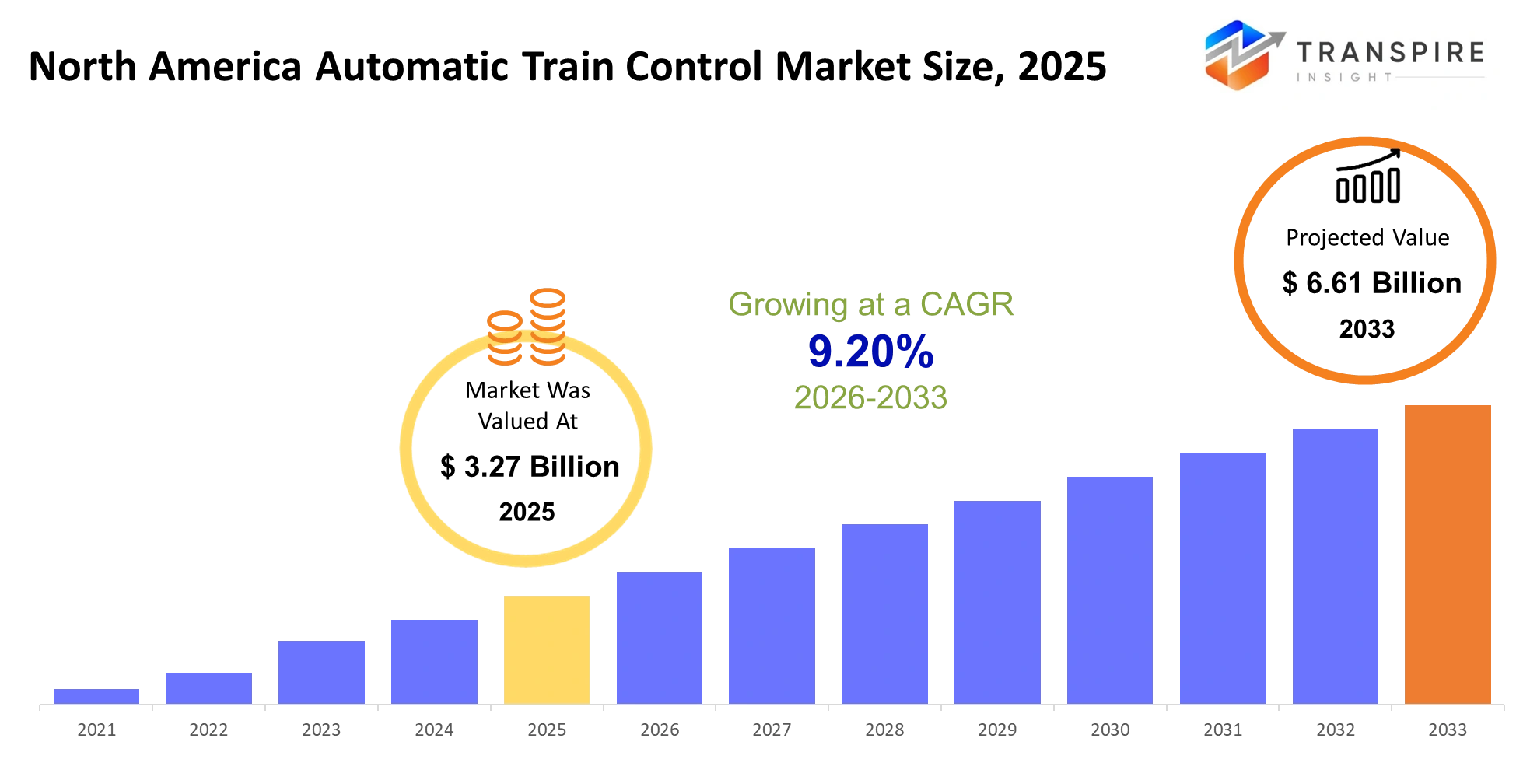
North America Automatic Train Control Market Size & Forecast:
- North America Automatic Train Control Market Size 2025: USD 3.27 Billion
- North America Automatic Train Control Market Size 2033: USD 6.61 Billion
- North America Automatic Train Control Market CAGR: 9.20%
- North America Automatic Train Control Market Segments: By Type (Automatic Train Protection, Automatic Train Operation, Automatic Train Supervision, CBTC, ETCS, Others), By Application (Urban Rail, High-speed Rail, Freight Rail, Metro, Suburban Rail, Others), By End-User (Rail Operators, Govt, Transport Authorities, Logistics, Infrastructure, Others), By Component (Hardware, Software, Services, Sensors, Communication Systems, Others).
To learn more about this report,  Download Free Sample Report
North America Automatic Train Control Market Summary:
The North America Automatic Train Control Market size is estimated at USD 3.27 Billion in 2025 and is anticipated to reach USD 6.61 Billion by 2033, growing at a CAGR of 9.20% from 2026 to 2033. The North America Automatic Train Control Market is experiencing strong growth because rail operators prioritize development of secure systems which will execute safe train operations through real-time train control.
The United States and Canada are experiencing a boost in advanced signaling and automation system adoption because of rising investments to develop new railway infrastructure in their countries. Automatic Train Control (ATC) solutions enable organizations to decrease human mistakes while they enhance train scheduling procedures and boost operational system dependability. Digital control systems are being installed across rail networks because cities need better safety systems and smoother rail operations to handle increased passenger demand.
Government programs that aim to modernize railways and develop smart transportation systems drive market growth which results in rapid market expansion. TThe rail industry employs Positive Train Control (PTC) and Communication-Based Train Control (CBTC) technologies to improve network safety and operational efficiency of trains.The North America Automatic Train Control Market experiences positive growth because transportation systems now prioritize environmentally friendly energy-saving solutions. Rail operators are implementing intelligent automation systems which will create sustained demand for ATC technologies that will drive growth in both freight and passenger rail operations.
What Has the Impact of Artificial Intelligence Been on the North America Automatic Train Control Market?
Artificial Intelligence is transforming the North America Automatic Train Control Market through its capabilities to make better decisions and create safer systems and run trains at their highest operational effectiveness. The North America Automatic Train Control Market currently uses AI integration to change how rail operators examine live rail operations which helps them use predictive analytics for reducing delays and selecting optimal train routes.
Companies use artificial intelligence on North America Automatic Train Control Market platforms to improve their ability to forecast demand and analyze market trends which helps them better allocate resources and plan their infrastructure. Machine learning-based smart automation system enhances signal accuracy while decreasing human reliance which leads to better operation reliability throughout railway systems.
AI-driven innovations in the North America Automatic Train Control Market create improvements to production efficiency and supply chain management. Intelligent algorithms allow stakeholders to achieve maintenance cost reductions while equipment failure prediction and system uptime enhancements are accomplished.
Rail operators now possess a competitive edge because AI technologies in the North America Automatic Train Control Market enable them to create customized control systems and develop dynamic traffic management solutions. The North America Automatic Train Control Market uses artificial intelligence technology to create permanent growth and innovation which results in safer railway systems that enable better digital transformation throughout the region.
Key Market Trends & Insights:
- The entire North America Automatic Train Control Market is controlled by the United States which holds approximately 70% market share because of its superior rail system modernization efforts.
- Canada leads all other North American regions because its Automatic Train Control Market expansion is driven by smart mobility projects and rail safety system improvements.
- The North America Automatic Train Control Market experiences increased demand through cross-border rail connectivity projects which connect major transportation corridors.
- The North America Automatic Train Control Market gives the biggest market share to signaling and control systems because rail systems implement automation improvements.
- The Communication-Based Train Control (CBTC) system has emerged as the fastest-growing market segment because it enables real-time tracking and operational efficiency improvements.
- Positive Train Control (PTC) systems represent a strong second-largest segment in the North America Automatic Train Control Market landscape.
- The North America Automatic Train Control Market allocates almost 60% market share to passenger rail systems because urban transit networks have expanded.
- The freight rail industry experiences its most rapid growth through automated systems which enable smarter cargo transportation methods and better logistical management.
- Rail operators remain the leading end-user segment in the North America Automatic Train Control Market because they prioritize operational safety and system performance.
- Smart rail infrastructure systems deployment and compliance system implementation see their fastest growth through government transport authorities.
North America Automatic Train Control Market Segmentation
By Type
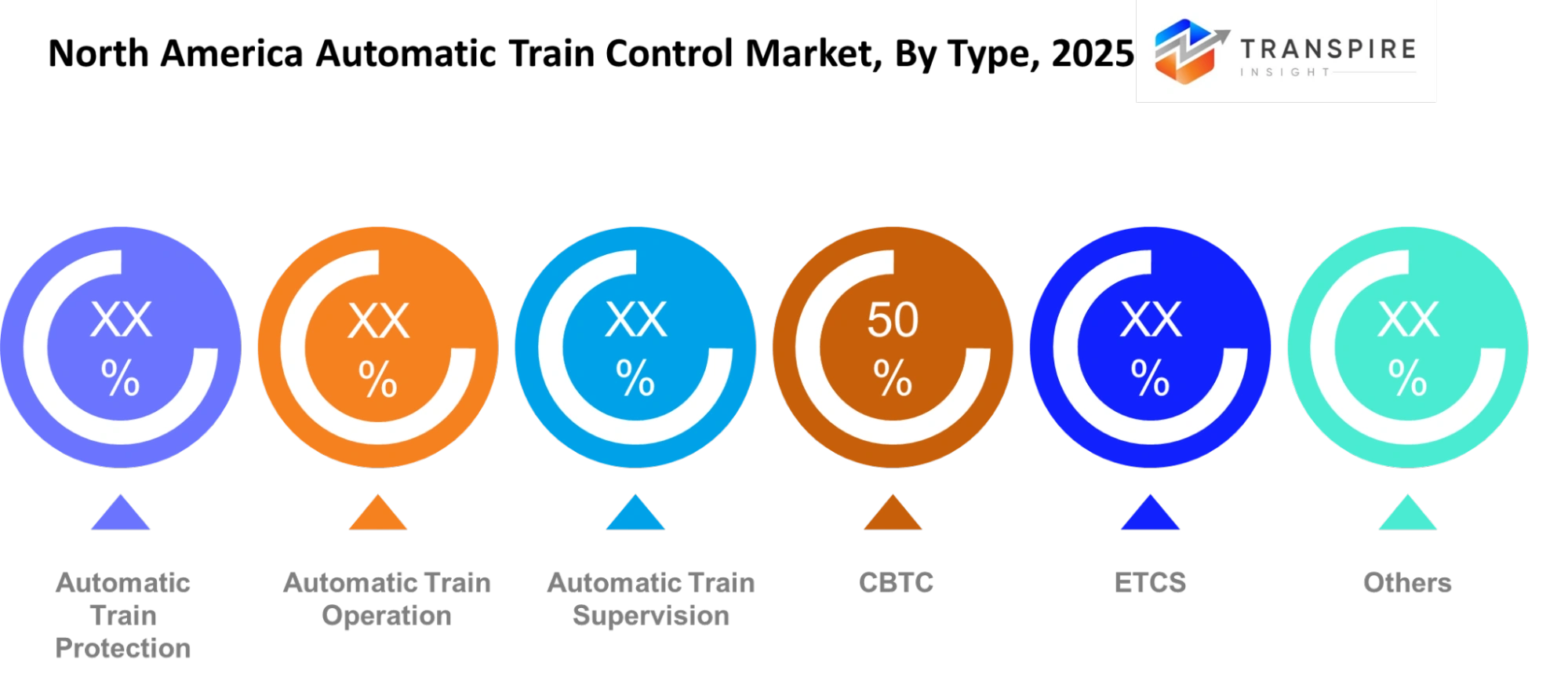
The Automatic Train Protection systems which operate in North America train safety systems achieve critical significance for rail safety operations. The advanced control systems enable operators to track train movements with high precision which reduces the likelihood of train collisions.
The growing requirement for digital rail security systems drives increasing adoption of Communication-Based Train Control and European Train Control System technologies. The North America Automatic Train Control Market experiences expansion because urban and intercity rail systems show strong demand for automated signaling system upgrades. The Automatic Train Operation and Automatic Train Supervision systems create better train scheduling which results in better train flow management for railways.
The CBTC solutions provide better train tracking capabilities which enable metro systems to operate at increased train frequencies. ETCS integration provides standardized rail communication which enables different rail networks to operate together throughout various territories. The North America Automatic Train Control Market expansion across all type-based segments results from strong market demand for automated safety and efficiency solutions.
To learn more about this report, Download Free Sample Report
By Application
Urban rail applications dominate due to rising congestion in major metropolitan cities and growing reliance on mass transit systems. Metro systems need accurate train timetable systems together with sophisticated train control systems to handle their passenger transportation needs. High-speed rail development results in increased requirements for dependable automation systems which enable speedier travel while maintaining safety controls. North America Automatic Train Control Market adoption rises strongly across urban mobility infrastructure upgrades.
Freight rail applications show steady expansion because of rising logistics requirements and improvements in supply chain efficiency. Suburban rail systems enable commuters to travel to work while they require effective systems for managing train operations. High-speed rail corridors create opportunities for developing sophisticated communication and control technologies. The ongoing process of upgrading transportation infrastructure leads to consistent market expansion which covers all segments of the North America Automatic Train Control Market.
By End-User
The North America Automatic Train Control Market needs rail operators as its primary users because they continuously invest in operational safety and automation efficiency. Transport authorities focus on modernization of signaling systems to reduce delays and improve passenger experience. Government agencies support funding programs that upgrade national rail networks with digital control systems. The North America Automatic Train Control Market expansion depends on public sector infrastructure initiatives.
Logistics companies use automation systems to achieve two main goals which include better freight movement accuracy and shorter transit times. Infrastructure developers use advanced control technologies to enhance efficiency of their new rail projects. Rail modernization policies encourage wider adoption of automated train control solutions. The North America Automatic Train Control Market experiences steady growth because institutional support and operational demand create market expansion for every end-user segment.
By Component
The Automatic Train Control market in North America depends on hardware components which include onboard control units and signaling equipment as essential elements for rail automation systems. The sensors monitor train speed and track conditions and the precise location of trains. The communication systems enable trains to share operational data with control centers which enhances safety procedures. The Automatic Train Control market in North America experiences rising demand because of ongoing infrastructure digitization initiatives.
Rail networks use software solutions to provide predictive analytics and scheduling optimization and system performance monitoring capabilities. The operational stability of systems requires services which include installation and maintenance and system integration. Advanced communication technologies enable different rail segments to achieve better coordination results. The North America Automatic Train Control market experiences improved performance, thanks to constantly evolving software and hardware systems.
What are the Main Challenges for the North America Automatic Train Control Market Growth?
Rail networks currently experience operational difficulties which halt development progress in the North America Automatic Train Control Market because of problems that arise when combining old rail systems with new automated technology. The existing rail network system faces problems because most of its tracks were built before digital control systems existed. The existence of complex system architecture in both signaling and communication components creates issues which result in higher maintenance costs and restrict system expansion capabilities.
The North America Automatic Train Control Market faces operational issues because accurate real-time data needs to operate while system stability needs to function as a primary challenge for organizations that want to implement large-scale systems. The North America Automatic Train Control Market experiences manufacturing and commercialization difficulties because companies need to spend substantial money for product development while having to meet strict regulations.
The length of rail safety certification processes creates delays for product launches which extends the time required to bring advanced control solutions to market. The financial constraints that manufacturers face create additional challenges which prevent quick development of new products while making it difficult to produce goods at a large scale. The North America Automatic Train Control Market faces multiple obstacles that hinder the process of adopting new technologies for implementation across various rail systems.
The North America Automatic Train Control Market faces two major obstacles to its expansion because of adoption challenges and infrastructure limitations which affect areas with limited modernization funding. Rail operators today face two main challenges which include insufficient financial resources and their need for specialized personnel who can implement and operate these systems. The uneven distribution of digital infrastructure throughout different areas hampers the progress of implementing next-generation control technologies.
The North America Automatic Train Control Market experiences ongoing adoption problems because operators face difficulties in implementing the technology across their entire railway system. The North America Automatic Train Control Market experiences market competition because new technological threats emerge while companies develop budget-friendly signaling systems and alternative automation technologies.
Global suppliers use aggressive price strategies which force companies to lower their product costs, resulting in decreased profit margins that affect their capacity to make long-term investments. Businesses face difficulties in maintaining their systems because of rapid technological advancements which affect system compatibility and upgrade processes. The North America Automatic Train Control Market experiences market limitations which lead to operational risks that will affect the growth of the market in the future.
Regional Insights
United States: United States maintains leading status in North America Automatic Train Control Market because the country operates extensive rail modernization initiatives while spending heavily on modern signaling technology. The ongoing use of CBTC and PTC systems results in better protection and operational management throughout both passenger and freight transportation networks. The combination of federal infrastructure funding with modernization policies results in continuous system enhancements which boost operational effectiveness while extending the train network throughout essential transportation corridors.
Canada: Canada demonstrates consistent development within the North America Automatic Train Control Market because of its active smart rail initiatives and growing urban public transportation systems. Major cities continue adopting automated signaling and control technologies to improve train scheduling accuracy and passenger safety. The government-funded infrastructure projects enable metro and commuter rail systems to implement modern technologies which enhance operational performance and promote digital rail systems to become standard practice throughout important transportation areas.
Mexico: Mexico shows developing market opportunities within North America Automatic Train Control Market because the country slowly builds its rail system while freight logistics needs increase. The need for efficient rail operations has grown because cross-border transportation activities between countries have increased. The system needs advanced technology but funding shortages and slow adoption rates limit its broad implementation. The market will continue to grow when connectivity improves and trade-related rail movements increase.
Recent Development News
In April 2026, Alstom awarded a five-year contract extension to operate and maintain the Plane Train at Hartsfield-Jackson Atlanta International Airport: Alstom, a global leader in smart and sustainable mobility, announced that it has received a five-year contract extension to operate and maintain the Innovia automated people mover (APM) at Hartsfield-Jackson Atlanta International Airport (ATL). The agreement, valued at approximately 140 million euros ($160 million USD), continues a partnership that dates to the debut of the airport’s Plane Train in 1980.
Source: https://www.alstom.com
In April 2026, Alstom will upgrade the Skyway at Houston Intercontinental Airport and continue operations and maintenance for 15 years: Alstom, a global leader in smart and sustainable mobility, has been selected by George Bush Intercontinental Airport (IAH) in Houston, Texas, to replace its existing Skyway automated people mover (APM) system and provide operations and maintenance services for 15 years. The contract includes a new Operations Control Center, upgraded Automatic Train Control and communications systems, 16 new Innovia APM R vehicles, modernised station doors across all terminals and continued operations and maintenance of the system. The total contract value is approximately 380 million euros [1] (437 million dollars).
Source: https://www.alstom.com
|
Report Metrics |
Details |
|
Market size value in 2025 |
USD 3.27 Billion |
|
Market size value in 2026 |
USD 3.57 Billion |
|
Revenue forecast in 2033 |
USD 6.61 Billion |
|
Growth rate |
CAGR of 9.20% from 2026 to 2033 |
|
Base year |
2025 |
|
Historical data |
2021 – 2024 |
|
Forecast period |
2026 – 2033 |
|
Report coverage |
Revenue forecast, competitive landscape, growth factors, and trends |
|
Country scope |
North America (Canada, The United States, and Mexico) |
|
Key company profiled |
Siemens, Alstom, Hitachi Rail, Thales, Bombardier, CAF, Wabtec, Toshiba, Mitsubishi Electric, Huawei, Cisco, ABB, NEC, Indra Sistemas, Kapsch. |
|
Customization scope |
Free report customization (country, regional & segment scope). Avail customized purchase options to meet your exact research needs. |
|
Report Segmentation |
By Type (Automatic Train Protection, Automatic Train Operation, Automatic Train Supervision, CBTC, ETCS, Others), By Application (Urban Rail, High-speed Rail, Freight Rail, Metro, Suburban Rail, Others), By End-User (Rail Operators, Govt, Transport Authorities, Logistics, Infrastructure, Others), By Component (Hardware, Software, Services, Sensors, Communication Systems, Others). |
How Can New Companies Establish a Strong Foothold in the North America Automatic Train Control Market?
New companies can establish a strong position in the North America Automatic Train Control Market by focusing on niche innovation in smart rail safety, predictive maintenance, and AI-based signaling solutions.
The North America Automatic Train Control Market will provide advantages to early-stage players who focus on solving specific system integration issues with legacy rail infrastructure which they will achieve by implementing real-time analytics to minimize equipment downtime.RailVision Analytics and IntelliTrack Systems demonstrate how targeted technological solutions can solve efficiency problems which exist in urban transit and freight networks.
Rail operators and government transport agencies and established technology vendors should form strategic partnerships to establish their credibility in the North America Automatic Train Control Market. New companies can show their abilities through pilot projects which demonstrate their required improvements in scheduling accuracy and safety compliance and cost savings. In the North America Automatic Train Control Market, companies that align with smart city initiatives and digital mobility programs gain faster access to large-scale infrastructure contracts and long-term deployment opportunities.
Key North America Automatic Train Control Market Company Insights
Through its advanced signaling systems and urban rail project CBTC deployment capability Siemens Mobility leads North America Automatic Train Control Market operations. Digital rail infrastructure and automation platforms and integrated traffic control solutions require continuous funding to guarantee operational safety and scheduling accuracy enhancements. North America Automatic Train Control Market will achieve long-term competitive advantage through smart rail technology development.
Alstom extends its North America Automatic Train Control Market presence through extensive Positive Train Control deployment which covers both freight and passenger train routes. The organization aims to enhance rail safety compliance while increasing system reliability and network interoperability. The North America Automatic Train Control Market experiences steady growth from ongoing modernization contracts and automation upgrades which improve efficiency while decreasing operational risks.
Hitachi Rail establishes a competitive edge in the North America Automatic Train Control Market through its artificial intelligence-powered rail monitoring systems and predictive maintenance solutions. The organization uses smart automation platforms to improve its capacity for real-time rail tracking and operational decision-making. The North America Automatic Train Control Market benefits from digital transformation and integrated rail control solutions which enable organizations to achieve better operational performance and efficiency results.
Wabtec: Wabtec controls most of the North America Automatic Train Control Market through its freight rail automation systems and digital control upgrades. The system improves freight movement efficiency through its three main features which include performance optimization and real-time diagnostics and advanced signaling integration. The company establishes its future position in the North America Automatic Train Control Market through its ongoing investments in intelligent rail technologies and system updates.
Company List
- Siemens
- Alstom
- Hitachi Rail
- Thales
- Bombardier
- CAF
- Wabtec
- Toshiba
- Mitsubishi Electric
- Huawei
- Cisco
- ABB
- NEC
- Indra Sistemas
- Kapsch
What are the Key Use-Cases Driving the Growth of the North America Automatic Train Control Market?
The North America Automatic Train Control Market receives its strongest support from urban rail modernization which cities use to provide their citizens safer and faster public transit. Metro networks use automated signaling and real-time train coordination to manage high passenger volumes and reduce delays. The North American Automatic Train Control Market receives advantages from CBTC and AI control systems which enhance both operational frequency and precision and passenger movement through busy city areas.
The upgrades assist intelligent city transportation planning while delivering benefits for infrastructure efficiency. The North America Automatic Train Control Market receives its primary growth driver from freight and logistics optimization which has become essential for businesses needing effective supply chain operations. Rail operators use automated systems for monitoring cargo which enables them to decrease delivery times while increasing operational efficiency across their extended rail networks.
The North America Automatic Train Control Market supports predictive maintenance applications which enable businesses to decrease equipment failures and maximize their asset effectiveness. The system improves operational dependability while decreasing expenses for rail networks that handle high freight volumes. High-speed rail development and cross-border connectivity projects provide additional support for North America Automatic Train Control Market adoption.
Automated train control systems provide high-speed trains with reliable performance which meets all required safety regulations. Smart automation systems combined with live tracking systems create better energy savings while decreasing the need for human operators. The North America Automatic Train Control Market is advancing toward modern digital rail systems which have expandable infrastructure solutions that can meet future requirements.
North America Automatic Train Control Market Report Segmentation
By Type
- Automatic Train Protection
- Automatic Train Operation
- Automatic Train Supervision
- CBTC
- ETCS
- Others
By Application
- Urban Rail
- High-speed Rail
- Freight Rail
- Metro
- Suburban Rail
- Others
By End-User
- Rail Operators
- Govt
- Transport Authorities
- Logistics
- Infrastructure
- Others
By Component
- Hardware
- Software
- Services
- Sensors
- Communication Systems
- Others
Frequently Asked Questions
Find quick answers to common questions.
The approximate North America Automatic Train Control Market size for the market will be USD 6.61 Billion in 2033.
The key segments of the North America Automatic Train Control Market are By Type (Automatic Train Protection, Automatic Train Operation, Automatic Train Supervision, CBTC, ETCS, Others), By Application (Urban Rail, High-speed Rail, Freight Rail, Metro, Suburban Rail, Others), By End-User (Rail Operators, Govt, Transport Authorities, Logistics, Infrastructure, Others), By Component (Hardware, Software, Services, Sensors, Communication Systems, Others).
Major players in the North America Automatic Train Control Market are Siemens, Alstom, Hitachi Rail, Thales, Bombardier, CAF, Wabtec, Toshiba, Mitsubishi Electric, Huawei, Cisco, ABB, NEC, Indra Sistemas, Kapsch.
The current market size of the North America Automatic Train Control Market is USD 3.27 Billion in 2025.
The North America Automatic Train Control Market CAGR is 9.20%.
- Siemens
- Alstom
- Hitachi Rail
- Thales
- Bombardier
- CAF
- Wabtec
- Toshiba
- Mitsubishi Electric
- Huawei
- Cisco
- ABB
- NEC
- Indra Sistemas
- Kapsch
Recently Published Reports
-
Apr 2026
ATV & UTV Market
ATV & UTV Market Size, Share & Analysis Report By Type (ATV, and UTV), By Variants (Less Than 400 CC, 400 CC To 800 CC, and More Than 800 CC), and Geography (North America, Europe, Asia-Pacific, Middle East and Africa, South and Central America), 2021 - 2031
-
Apr 2026
Automotive Central Gateway Module Market
Automotive Central Gateway Module Market Size, Share & Analysis Report By Type (Ethernet Central Gateway Module, CAN Central Gateway Module, LIN Central Gateway Module, and FlexRay), By Application (Powertrain Control, Body Control, Infotainment System, Advanced Driver Assistance Systems (ADAS), and Others), By End User (Passenger Vehicles, and Commercial Vehicles), and Geography (North America, Europe, Asia-Pacific, Middle East and Africa, South and Central America), 2021 - 2031
-
Apr 2026
Automotive Engine Oil Filter Market
Automotive Engine Oil Filter Market Size, Share & Analysis Report By Filter Type (Fuel Filter, Engine Oil Filter, Hydraulic Oil Filter, and Others), By Filter Media (Cellulose, Synthetic, and Micro), By Sales Channel (OEMs, and Aftermarket), By Vehicle Type (Passenger Cars, Light Commercial Vehicles, Heavy Duty Trucks, Buses and Coaches, and Off-road Vehicles), and Geography (North America, Europe, Asia-Pacific, Middle East and Africa, South and Central America), 2021 - 2031
-
Apr 2026
Automotive Parts Aluminium Die Casting Market
Automotive Parts Aluminium Die Casting Market Size, Share & Analysis Report By Production Process (Pressure Die Casting, Vacuum Die Casting, Squeeze Die Casting, Gravity Die Casting), By Application (Body Parts, Engine Parts, Transmission Parts, Battery And Related Components, Other Application Types), and Geography (North America, Europe, Asia-Pacific, Middle East and Africa, South and Central America), 2021 - 2031
Our Clients