
Europe Green Hospitals Market Size & Forecast:
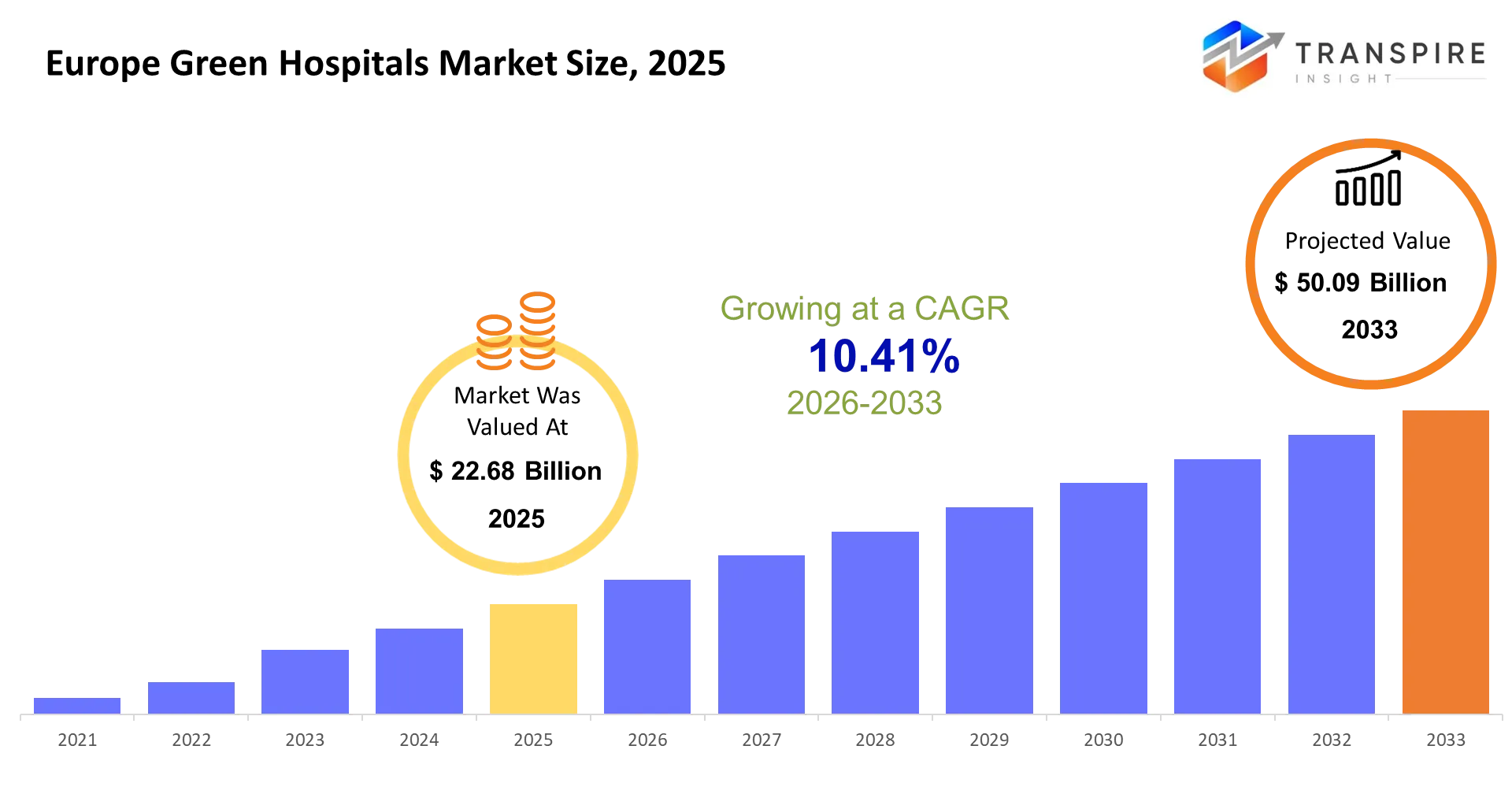
- Europe Green Hospitals Market Size 2025: USD 22.68 Billion
- Europe Green Hospitals Market Size 2033: USD 50.09 Billion
- Europe Green Hospitals Market CAGR: 10.41%
- Europe Green Hospitals Market Segments: By Type (Green Building Infrastructure, Energy-efficient Systems, Waste Management Systems, Water Management Systems, Smart Hospital Systems, Others); By Application (Energy Efficiency, Sustainability, Waste Reduction, Patient Care Improvement, Smart Monitoring, Others); By End-User (Hospitals, Clinics, Healthcare Providers, Government Healthcare, Others); By Technology (Smart Systems, IoT Integration, Renewable Energy, AI-based Monitoring, Others)
To learn more about this report,  Download Free Sample Report
Europe Green Hospitals Market Summary
The Europe Green Hospitals Market was valued at USD 22.68 Billion in 2025. It is forecast to reach USD 50.09 Billion by 2033. That is a CAGR of 10.41% over the period.
The Europe Green Hospitals Market focuses on reducing the environmental and operational burden of healthcare facilities while improving energy efficiency, waste management, patient safety, and long-term cost control. European hospitals are implementing infrastructure upgrades through the installation of low-emission HVAC systems and renewable energy systems and smart water management systems and sustainable medical waste processing systems. The market developed during the past five years from separate sustainability initiatives to comprehensive decarbonization solutions which European climate regulations and healthcare facility upgrades required. The healthcare sector experienced a major shift towards energy-efficient hospital buildings because the Russia-Ukraine conflict created an energy crisis which resulted in skyrocketing electricity and heating expenses for hospitals. The shift in procurement priorities across public and private healthcare systems resulted in increased spending on smart building technologies and digital energy monitoring systems and green-certified construction materials. Hospitals increasingly consider sustainability investments as financial risk mitigation tools because operating expenses fluctuate throughout the year.
Key Market Insights
- The Europe Green Hospitals Market in 2025 witnessed Western Europe controlling 57% of the market share because of its advanced healthcare infrastructure development.
- The regional adoption of hospital decarbonization programs together with public sustainability funding initiatives establishes Germany and France as the leading countries.
- The Northern European region will experience its most rapid market expansion until 2032 because of its commitment to carbon-neutral healthcare construction and renewable energy deployment projects.
- The Scandinavian healthcare systems accelerated their smart hospital retrofitting projects after energy price fluctuations created new operational cost challenges during 2022 and 2023.
- The Europe Green Hospitals Market derived 31% of its revenue from energy-efficient HVAC systems which hospitals used to address their high energy requirements in 2025.
- The second-largest segment in new healthcare infrastructure projects consists of green building materials and sustainable construction services.
- The period from 2026 to 2032 saw smart energy management systems becoming the fastest-growing segment because AI-based building optimization solutions became widely used.
- The market share for hospital infrastructure modernization reached 42% in 2025 because European hospitals needed to upgrade their energy systems.
- Public hospitals controlled more than 64% of the Europe Green Hospitals Market because government funding for sustainability and regulatory compliance requirements supported their operations.
- The private healthcare sector experiences its most rapid growth through end-user groups which focus on decreasing their operational costs through extended time frames.
What are the Key Drivers, Restraints, and Opportunities in the Europe Green Hospitals Market?
The combination of strict European decarbonization policies and ongoing hospital energy cost increases after 2022 serves as the primary driver that powers the Europe Green Hospitals Market. Healthcare facilities operate continuously and consume large amounts of electricity and heating and ventilation and water resources which makes energy efficiency essential for their financial survival. The European Green Deal regulations together with national carbon reduction targets required public healthcare systems to upgrade their outdated facilities by installing smart HVAC systems and renewable power systems and digital energy management systems. The transition generated higher procurement activities in construction and facility automation and sustainability consulting services while establishing permanent revenue streams through maintenance and monitoring services for technology vendors.
The primary structural obstacle in hospital building upgrades exists because hospitals need to spend large amounts of money to update their old facilities while still maintaining function. Most European hospitals continue to use infrastructure from past decades which lacks the capability to accommodate modern energy solutions and digital control systems and environmentally friendly building materials. The public healthcare sector encounters two main challenges which include lengthy procurement processes and time-consuming administrative approvals that both hinder equipment and engineering firms from generating revenue through modernization projects.
The use of AI-based energy optimization systems in hospitals creates a significant opportunity for business expansion throughout Northern and Central Europe.Healthcare operators increasingly invest in predictive facility management systems that automatically regulate ventilation, lighting, and thermal loads based on occupancy and clinical demand patterns. The Swedish and Dutch countries establish beneficial conditions through their funding programs for green infrastructure and their commitment to building carbon-neutral healthcare facilities which create appealing business prospects for energy service companies and smart building technology providers.
What Has the Impact of Artificial Intelligence Been on the Europe Green Hospitals Market?
The combination of artificial intelligence together with advanced digital technologies enables green hospital operations to achieve automated energy management and predictive maintenance and real-time sustainability monitoring systems. Hospitals use AI-powered building management systems to control HVAC systems and optimize lighting and balance ventilation and monitor water usage throughout their energy-intensive areas which include surgical units and intensive care units. Smart control systems decrease energy waste through their ongoing evaluation of which areas are occupied and which indoor air quality and electricity usage patterns exist while they preserve essential clinical safety requirements. European healthcare providers achieved double-digit reductions in their energy costs after they implemented automated energy optimization systems within their hospital facilities.
Machine learning models now enable predictive maintenance of essential hospital equipment, which includes both cooling systems and backup generators and medical ventilation systems. Predictive analytics platforms help hospitals identify equipment failure risks before operational disruption occurs, which enables hospitals to decrease unplanned downtime while maintaining dependable facility operations. The AI-based carbon monitoring systems assist emissions forecasting together with sustainability compliance reporting under the changing European environmental regulations. Digital twins and simulation tools now provide healthcare facilities with a method to enhance their thermal performance and design their infrastructure through extended infrastructure planning for their new low-carbon facilities.
European hospitals that possess older infrastructure face challenges to adopt AI because they need to pay high costs for system integration.Even today, numerous buildings find themselves stuck with dated building-management systems that are incompatible with cloud-based analytics and real-time automation platforms available through a major rebuild.
Key Market Trends
- The public hospitals of Germany and France raised their energy-efficiency retrofitting budgets after electricity prices increased during the years 2022 and 2023.
- The building management platforms which use AI technology enabled hospitals to decrease their energy usage through two systems which balanced HVAC operations and used occupancy data to optimize energy use.
- Healthcare operators increasingly replaced gas-based heating systems with renewable-powered thermal infrastructure to comply with European decarbonization mandates which became effective after 2021.
- Schneider Electric and Johnson Controls developed smart hospital partnerships which offered digital energy management services and predictive maintenance solutions.
- The Scandinavian healthcare systems initiated their carbon-neutral hospital construction programs because of increased government funding for green infrastructure between 2023 and 2025.
- Hospitals began to adopt medical waste processing technologies because EU disposal regulations became stricter and required compliance from their outdated waste management systems.
- Hospitals started to use digital twins and AI simulation platforms for their facility planning processes because these technologies helped them decrease their energy waste during operations.
- The supply chain problems which occurred between 2021 and 2023 prevented healthcare operators from completing sustainable construction projects thus requiring them to develop alternative methods for obtaining environmentally friendly materials.
- Private healthcare organizations increased their funding for solar power production facilities and energy storage systems which help them control their electricity expenses over time.
- The procurement processes of institutional investors who provided infrastructure financing became more dependent on green-certified hospital buildings because these buildings showed measurable sustainability results.
Europe Green Hospitals Market Segmentation
By Type:
Energy-efficient systems dominate the market because hospitals require high electricity usage while facing continuous demands to cut their operational expenses. The market experiences significant procurement activity through HVAC optimization platforms and smart lighting systems and energy recovery systems which are used in both new construction projects and retrofitting projects. Healthcare facilities invested more in intelligent thermal management systems after 2022 because rising electricity prices created urgent needs to maintain continuous climate control for safe patient care and dependable medical equipment operation. Large public hospitals continue prioritizing these systems because energy savings directly improve long-term budget stability.
Carbon-neutral healthcare construction initiatives and digital modernization programs sustain market dominance for green building infrastructure and smart hospital systems. Waste management and water management systems gained momentum after stricter environmental disposal standards and resource efficiency regulations increased compliance requirements across European healthcare networks. AI-enabled building automation systems and integrated sustainability platforms will establish the upcoming investment preferences because healthcare operators require both measurable emissions reduction and operational efficiency enhancements. Technology developers who create interoperable systems together with low-disruption retrofit solutions will experience growing demand throughout the upcoming period.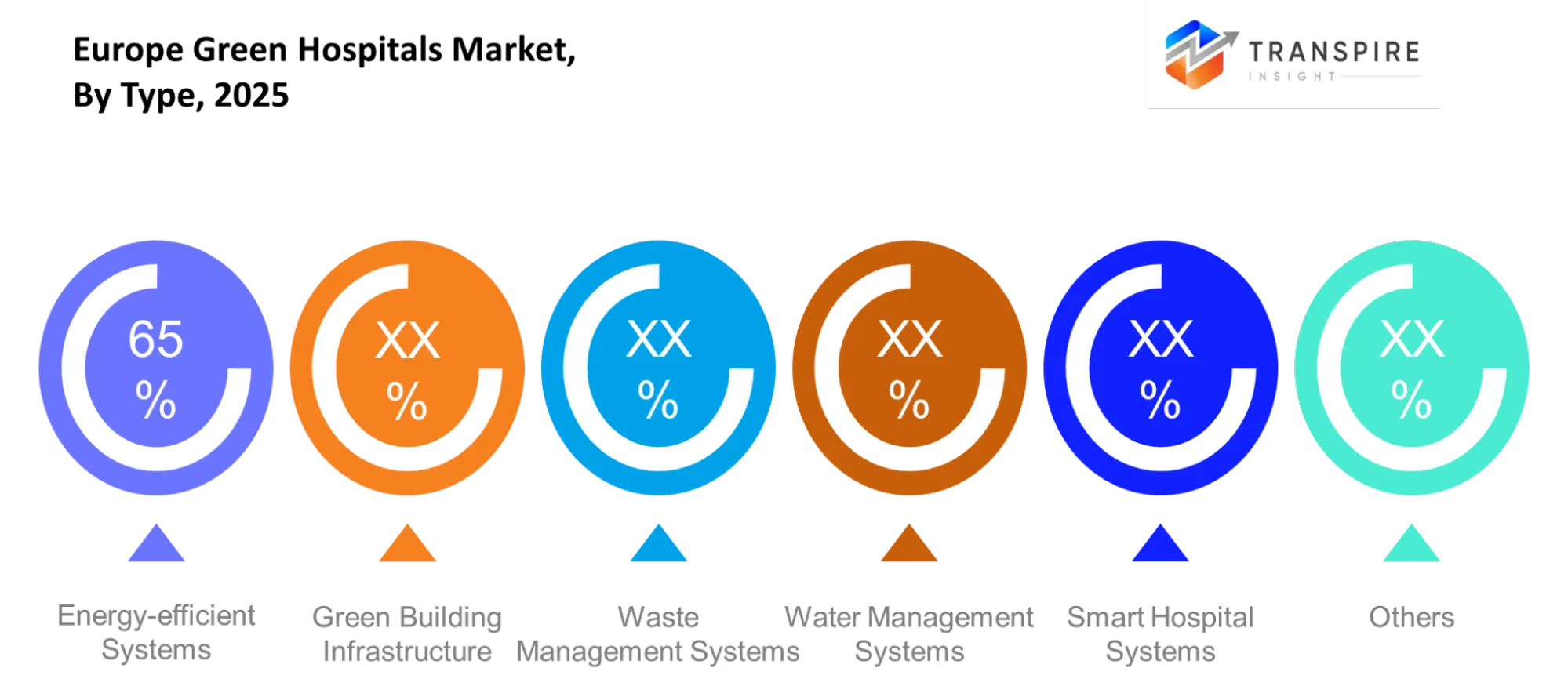
To learn more about this report, Download Free Sample Report
By Application:
The primary application segment focuses on energy efficiency because hospitals require continuous operations and need to power their facilities with extensive electricity and heating and cooling and ventilation systems. Public healthcare operators increasingly allocate infrastructure budgets toward energy optimization projects to offset utility cost volatility and comply with national decarbonization targets. Smart HVAC systems and automated lighting controls together with digital energy monitoring platforms continue to find widespread implementation throughout major urban healthcare facilities. The main reason customers in this sector buy products stems from their ability to decrease operational expenses.
The implementation of stricter carbon accounting and environmental reporting standards by European healthcare systems led to major growth in sustainability and waste reduction programs. Medical waste treatment modernization and water recycling systems gained stronger investment support due to rising regulatory oversight and landfill disposal costs. Healthier indoor air quality systems together with smart environmental monitoring technologies have advanced patient care improvement applications. Future market expansion will likely favor integrated sustainability ecosystems capable of balancing operational efficiency, emissions reduction, and patient safety outcomes within a unified infrastructure framework.
By End-User:
The main reason hospitals occupy most of the healthcare sector because their large patient treatment facilities require high energy consumption and they must meet strict operational standards. Major healthcare campuses keep spending their funds on new low-carbon technologies and renewable energy systems and advanced building management systems to achieve cost savings during their operational phase. Government-backed modernization funding programs across Western Europe further strengthened procurement activity among public hospital networks. Larger hospitals use AI-powered building analytics because their complex systems need to meet stricter environmental reporting requirements.
Healthcare providers and clinics increasingly invest in modular sustainability systems that improve energy performance without requiring extensive infrastructure reconstruction. Government healthcare organizations continue to play a vital role in national healthcare decarbonization efforts because they support public-sector retrofitting projects which reduce carbon emissions. Private healthcare groups accelerated their adoption of renewable power systems and predictive maintenance technology to enhance their financial performance and sustainability reputation. The expansion of smaller healthcare facilities will depend on technologies that enable flexible building upgrades and affordable financial solutions which make installation more affordable.
By Technology:
Smart systems currently dominate the technology segment because automated facility controls improve energy efficiency, environmental monitoring, and operational reliability across complex healthcare environments. Integrated building management systems support real-time optimization of lighting, ventilation, temperature control, and occupancy management within energy-intensive clinical spaces. After the 2022 energy crisis hospitals began increasing their investments in connected sensors and cloud-based monitoring infrastructure which resulted in rapid expansion of IoT integration. Real-time operational visibility now plays a critical role in reducing utility waste and improving sustainability compliance reporting accuracy.
The healthcare industry currently experiences its most rapid growth through two technology areas which include renewable energy systems and AI-based monitoring technologies because of increasing demands for carbon-neutral operations. Hospitals utilize predictive analytics tools to estimate maintenance needs and electricity consumption and backup power system operations. AI-enabled platforms improve infrastructure planning through their use of digital twins and scenario-based energy modeling applications. Technology providers who develop unified healthcare management platforms through their automation and renewable energy integration and predictive intelligence capabilities will establish better competitive advantages during the forecast period.
What are the Key Use Cases Driving the Europe Green Hospitals Market?
Energy optimization remains the primary use case driving adoption across large public hospitals and university medical centers. The continuous operations of healthcare facilities necessitate stable temperature control systems together with ventilation systems and lighting systems, which make AI-enabled HVAC optimization and smart energy management vital for organizations that need to control their operational expenses while achieving European emissions reductions.
Government healthcare networks and private hospital groups are increasingly adopting medical waste reduction strategies and smart water management solutions. The EU implemented stricter environmental disposal regulations, which required healthcare operators to upgrade their sterilization and recycling and wastewater treatment facilities, especially in high-volume urban healthcare campuses.
The development of new applications includes carbon-neutral hospital planning through digital twins and AI-based predictive maintenance platforms, which support critical facility infrastructure. Northern European healthcare systems increasingly test integrated renewable microgrids and battery storage systems to improve energy resilience and reduce dependence on volatile external power markets over long operating cycles.
|
Report Metrics |
Details |
|
Market size value in 2025 |
USD 22.68 Billion |
|
Market size value in 2026 |
USD 25.04 Billion |
|
Revenue forecast in 2033 |
USD 50.09 Billion |
|
Growth rate |
CAGR of 10.41% from 2026 to 2033 |
|
Base year |
2025 |
|
Historical data |
2021 - 2024 |
|
Forecast period |
2026 - 2033 |
|
Report coverage |
Revenue forecast, competitive landscape, growth factors, and trends |
|
Regional scope |
Europe (Germany, United Kingdom, France, Italy, Spain, Rest of Europe) |
|
Key company profiled |
Siemens Healthineers, Philips, GE Healthcare, Schneider Electric, ABB, Honeywell, Johnson Controls, IBM, Oracle, Cisco, Hitachi, Toshiba, Siemens, Veolia, Suez |
|
Customization scope |
Free report customization (country, regional & segment scope). Avail customized purchase options to meet your exact research needs. |
|
Report Segmentation |
By Type (Green Building Infrastructure, Energy-efficient Systems, Waste Management Systems, Water Management Systems, Smart Hospital Systems, Others); By Application (Energy Efficiency, Sustainability, Waste Reduction, Patient Care Improvement, Smart Monitoring, Others); By End-User (Hospitals, Clinics, Healthcare Providers, Government Healthcare, Others); By Technology (Smart Systems, IoT Integration, Renewable Energy, AI-based Monitoring, Others) |
Which Regions are Driving the Europe Green Hospitals Market Growth?
Market leadership belongs to Western Europe because its healthcare system modernization programs and strict carbon emission reduction requirements produced persistent investment growth which benefited public hospital systems. Germany and France and the Netherlands continue to invest in extensive hospital modernization initiatives which aim to improve energy performance and digital facility management and adopt environmentally sustainable building techniques. European climate regulations enforce strict compliance requirements which drive healthcare facilities to acquire AI-based building management systems and renewable energy solutions. The regional market maintains its leadership position through the established network of engineering companies and intelligent infrastructure vendors and sustainability advisory firms and public funding organizations.
Although Northern Europe serves as the second biggest contributor to regional expansion, the area grows through its capacity to maintain operations over extended periods rather than through new infrastructure development. The healthcare industry in Sweden and Denmark and Norway developed carbon-neutral hospital design methods before most other European countries established their own sustainable development procedures. Healthcare facilities in Sweden Denmark and Norway established carbon-neutral hospital design systems before other European nations developed their own sustainable development procedures. The adoption of smart monitoring systems and renewable microgrids and predictive maintenance platforms gained momentum through two factors: continuous public funding for healthcare services and visible implementation of environmental regulations. The need for emergency retrofitting work decreased which resulted in a better procurement framework that technology suppliers and energy service companies could use.
The region of Central and Eastern Europe currently experiences its fastest economic growth because of two factors which include improved healthcare systems and increased European Union funding for infrastructure development that started after 2022. The countries of Poland, Romania, and Czech Republic dedicated more funding to build energy-efficient healthcare facilities, which helped them decrease their operational expenses while meeting EU sustainability requirements. The combination of rising electricity costs and outdated hospital systems prompted governments to undertake extensive modernization projects which included implementing smart energy solutions and upgrading to environmentally sustainable buildings. The period from 2026 to 2033 will create major business prospects for infrastructure construction companies and renewable energy firms and AI-based building management organizations throughout this area.
Who are the Key Players in the Europe Green Hospitals Market and How Do They Compete?
The Europe Green Hospitals Market maintains moderate consolidation because major building technology companies and healthcare infrastructure companies control essential public-sector development work while local engineering firms provide tailored retrofit solutions. Digital energy optimization and integrated facility management and operational cost reduction solutions have become the primary competitive factors in the market after equipment pricing lost its importance. Established companies continue to defend their market position through building platforms that use AI technology and predictive maintenance systems and expertise in carbon-neutral infrastructure solutions. The smaller companies that enter the market focus on specialized areas such as smart monitoring systems and renewable energy integration and modular sustainability retrofitting for mid-sized healthcare facilities.
Schneider Electric develops smart energy management systems which enable hospitals to control their energy use through real-time system monitoring and automatic HVAC balancing and sustainability tracking functions. The company's extensive knowledge of connected building systems provides it with a competitive edge when executing large-scale healthcare transformation projects throughout Western Europe. Johnson Controls uses its predictive maintenance platform together with its energy-efficient healthcare control systems to create a unique product for hospitals that need smart building functionality. The company achieved service revenue growth through its Central European expansion which included building partnerships with healthcare facility operators for ongoing maintenance contracts.
Siemens Healthineers creates a solution that combines medical technology with smart hospital infrastructure to help healthcare operators achieve their energy efficiency goals through their clinical operations management system.Honeywell competes through its advanced indoor air quality systems and its automated building analytics solutions which enhance operational reliability for essential medical facilities. ENGIE achieved better competitive advantage through its renewable energy partnerships and energy-as-a-service solutions which decrease initial infrastructure costs needed by public hospitals.
Company List
- Siemens Healthineers
- Philips
- GE Healthcare
- Schneider Electric
- ABB
- Honeywell
- Johnson Controls
- IBM
- Oracle
- Cisco
- Hitachi
- Toshiba
- Siemens
- Veolia
- Suez
Recent Development News
In May 2026, Johnson Controls announced the expansion of its engineering, production, and customer centers in Denmark. The investment increased European heat pump production capacity and strengthened sustainable infrastructure solutions for hospitals, universities, and public healthcare facilities pursuing decarbonization targets.
https://www.johnsoncontrols.com
In March 2026, Siemens Healthineers launched the “Foundation for Sustainable Healthcare” in partnership with University Hospital Erlangen with funding support of €250,000 over five years. The initiative supports sustainability-focused medical research and strengthens low-carbon healthcare innovation across European hospital systems.
https://www.med.fau.de
What Strategic Insights Define the Future of the Europe Green Hospitals Market?
The Europe Green Hospitals Market is evolving toward complete carbon-neutral healthcare systems which utilize integrated energy systems and digital technologies and clinical operations through their interconnected intelligence systems. The next five to seven years will see organizations invest in AI-based facility management systems and renewable energy solutions and predictive asset maintenance because of increasing decarbonization requirements and unpredictable electricity prices and decreasing public healthcare funding. Hospitals will increasingly evaluate sustainability technologies based on measurable operational savings and resilience performance rather than standalone environmental targets.
The supply chain for advanced building automation components and semiconductors and specialized HVAC technologies creates an underrecognized risk because of its high concentration on these items. The future will bring project delays and infrastructure cost increases because the current system relies on a few suppliers who control essential resources needed for operation. The Central and Eastern European region has an important new opportunity through modular microgrid systems that use battery storage and on-site solar power and AI-based load balancing technology. Technology providers and investors should build their digital platforms through interoperable systems because these platforms will help hospitals upgrade their old systems with lower costs for both implementation and maintenance in the future.
Europe Green Hospitals Market Report Segmentation
By Type
- Green Building Infrastructure
- Energy-efficient Systems
- Waste Management Systems
- Water Management Systems
- Smart Hospital Systems
- Others
By Application
- Energy Efficiency
- Sustainability
- Waste Reduction
- Patient Care Improvement
- Smart Monitoring
- Others
By End-User
- Hospitals
- Clinics
- Healthcare Providers
- Government Healthcare
- Others
By Technology
- Smart Systems
- IoT Integration
- Renewable Energy
- AI-based Monitoring
- Others
Frequently Asked Questions
Find quick answers to common questions.
The Europe Green Hospitals Market size is USD 50.09 Billion in 2033.
Key Segments for the Europe Green Hospitals Market are By Type (Green Building Infrastructure, Energy-efficient Systems, Waste Management Systems, Water Management Systems, Smart Hospital Systems, Others); By Application (Energy Efficiency, Sustainability, Waste Reduction, Patient Care Improvement, Smart Monitoring, Others); By End-User (Hospitals, Clinics, Healthcare Providers, Government Healthcare, Others); By Technology (Smart Systems, IoT Integration, Renewable Energy, AI-based Monitoring, Others)
Major Europe Green Hospitals Market Players are Siemens Healthineers, Philips, GE Healthcare, Schneider Electric, ABB, Honeywell, Johnson Controls, IBM, Oracle, Cisco, Hitachi, Toshiba, Siemens, Veolia, Suez.
The Current Europe Green Hospitals Market size is USD 22.68 Billion in 2025.
The Europe Green Hospitals Market CAGR is 10.41% from 2026 to 2033.
- Siemens Healthineers
- Philips
- GE Healthcare
- Schneider Electric
- ABB
- Honeywell
- Johnson Controls
- IBM
- Oracle
- Cisco
- Hitachi
- Toshiba
- Siemens
- Veolia
- Suez
Recently Published Reports
-
Apr 2026
Handling and Lifting Equipment Market
Handling and Lifting Equipment Market Size, Share & Analysis Report By Product (Cranes and Hoists, Forklifts, Conveyor Systems, Aerial Work Platforms, Others), By Application (E-Commerce, Automotive and Railway, Food and Beverages, Aviation, Others), and Geography (North America, Europe, Asia-Pacific, Middle East and Africa, South and Central America), 2021 - 2031
-
Apr 2026
HVAC Equipment Market
HVAC Equipment Market Size, Share & Analysis Report By Heating Equipment Type (Boilers and Furnaces, Heat Pumps, and Unitary Heaters), By Ventilation Equipment (Air Handling Units, Humidifiers and Dehumidifiers, Air Filters, and Fan Coiling Units), By Air Conditioning Equipment (Unitary Air Conditioners, Room Air Conditioners, Packaged Terminal Air Conditioners, and Chillers), By End User (Commercial, Residential, Industrial, and others), and Geography (North America, Europe, Asia-Pacific, Middle East and Africa, South and Central America), 2021 – 2031
-
Apr 2026
Refrigeration Valves Market
Refrigeration Valves Market Size, Share & Analysis Report By Type (Solenoid Valves, Expansion Valves, Check Valves, Service Valves, Others), By Application (Commercial Refrigeration, Industrial Refrigeration, Transport Refrigeration, Residential Refrigeration, Air Conditioning Systems), By End User (Food and Beverage Industry, Pharmaceutical Industry, HVAC Industry, Chemical Industry, Others), and Geography (North America, Europe, Asia-Pacific, Middle East and Africa, South and Central America), 2021 – 2031
-
Apr 2026
E-Commerce Packaging Materials Market
E-Commerce Packaging Materials Market By Material Type (Corrugated Boxes, Paper & Paperboard, Foam & Cushioning Materials, Plastic Packaging, Flexible Packaging, Protective Packaging, Others), By Product(Primary Packaging, Secondary Packaging, Tertiary Packaging), By Packaging Function (Protective Packaging, Branding & Presentation Packaging, Transit & Logistic Packaging, Sustainable Packaging, Tamper Evidence Packaging), By End-User (Retail & Consumer Goods, Electronic Appliances, Food & Beverages, Healthcare & Pharmaceutical, Fashion & Apparel, Home & Furnishing, Others); By Industry Analysis, Size, Share, Growth, Trends, and Forecasts 2021-2033