

Europe Game Engine Market Size & Forecast:
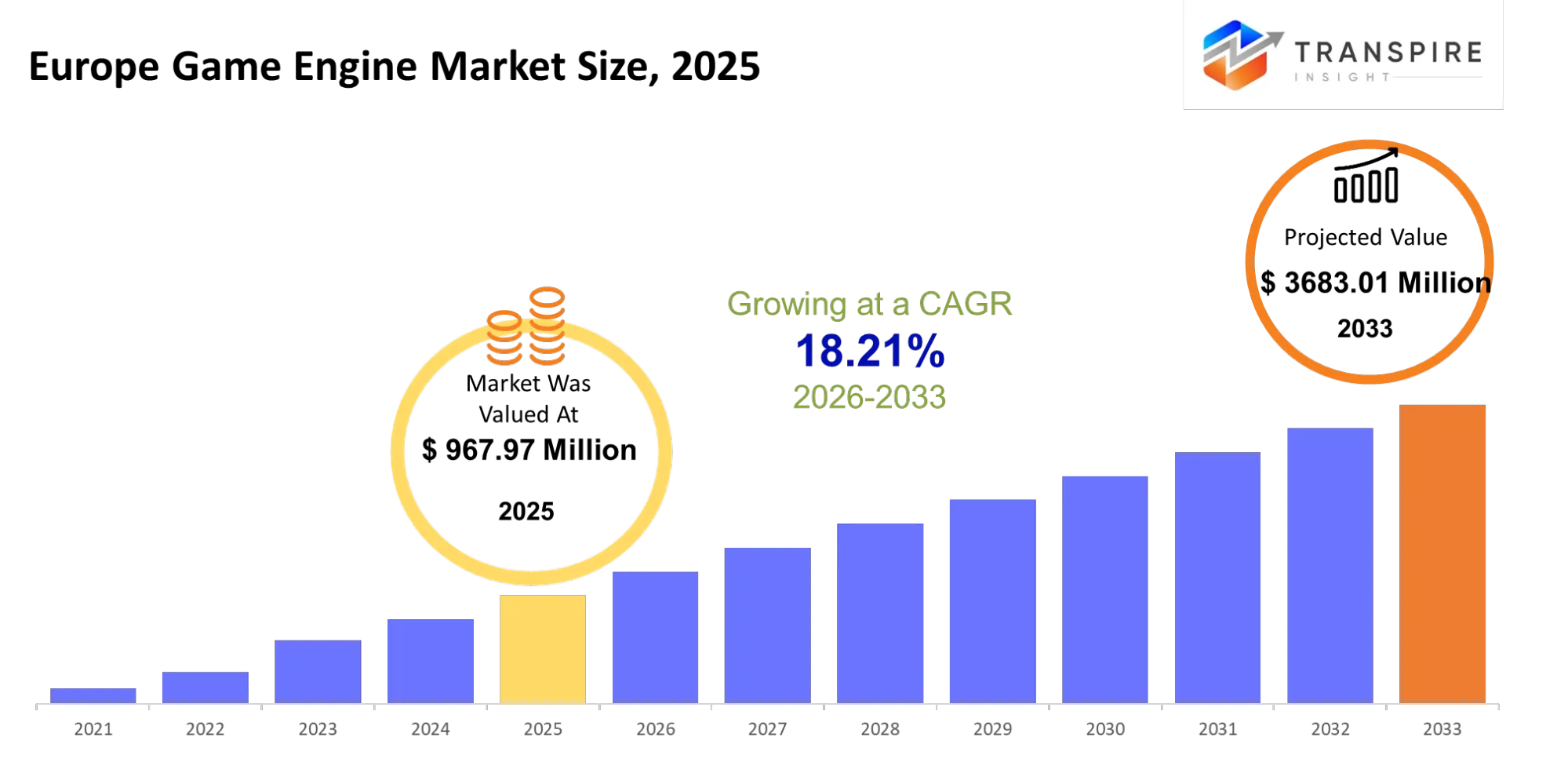
- Europe Game Engine Market Size 2025: USD 967.97 Million
- Europe Game Engine Market Size 2033: USD 3683.01 Million
- Europe Game Engine Market CAGR: 18.21%
- Europe Game Engine Market Segments: By Type (2D Engines, 3D Engines, VR Engines, Others), By Application (Gaming, Simulation, AR/VR, Others), By End-User (Game Developers, Studios, Enterprises, Others), By Platform (PC, Console, Mobile, Others).
To learn more about this report,  Download Free Sample Report
Europe Game Engine Market Summary:
The Europe Game Engine Market size is estimated at USD 967.97 Million in 2025 and is anticipated to reach USD 3683.01 Million by 2033, growing at a CAGR of 18.21% from 2026 to 2033. The European Game Engine Market has expanded its services from traditional video game development to support the entire digital content industry which now includes automotive simulation and virtual production and architectural visualization and industrial training and interactive retail experiences. Game engines now serve as real-time rendering platforms which enable businesses to decrease their development timelines and minimize their prototyping expenditures while building interactive digital environments that span various sectors.
The market has experienced a fundamental transformation during the past three to five years because businesses started using virtual reality technologies which enabled simultaneous 3D development on multiple platforms to become standard operating procedures. The COVID-19 pandemic increased remote work which led businesses to spend money on virtual design and simulation and digital twin technology which opened up new uses for game engines beyond their traditional entertainment purposes.
The combination of improved cloud computing capabilities with enhanced GPU technologies has created easier access for both small studios and industrial users to use advanced technological solutions. Organizations are now increasing their licensing revenues through subscription services and enterprise partnerships as they search for scalable solutions which help them create interactive content and use simulation tools for making business decisions.
Key Market Insights
- western European countries established themselves as the dominant force in the Europe Game Engine Market during 2025 because they held 58% market share which stemmed from their numerous gaming studios and advanced digital systems.
- The Eastern European market will experience its highest growth rates until 2030 because indie developers expand their businesses while production costs decrease.
- Automotive simulation and industrial metaverse projects help Germany retain a major market position because they drive enterprises to adopt engine technology.
- The United Kingdom serves as a key center for innovation because it develops cloud gaming and virtual production technology while investing in AAA game development.
- The Europe Game Engine Market experienced its major growth through 3D game engines which generated 67% of total revenue in 2025 because users demanded immersive gaming experiences.
- Studios use cross-platform engines as their second most important engine type because they need to release their products on multiple platforms including PC and console and mobile and AR/VR systems.
- The period between 2026 and 2030 will see cloud-based game engine platforms become the fastest-growing market segment because they enable remote teams to work together while providing flexible rendering options.
- Developers now prefer subscription-based licensing models because they offer predictable costs for operations while users receive ongoing software updates.
- The gaming industry holds 61% of the market share in 2025 because high-budget AAA games and multiplayer ecosystems have expanded throughout the industry.
- Virtual production and cinematic rendering are emerging as the fastest-growing applications because their usage in film and advertising has become more widespread.
- Industrial simulation and digital twin technology are establishing a new demand trend which manufacturers and aerospace companies and automotive engineers will start to adopt.
- The development of AR/VR content progresses forward because businesses implement immersive training and real-time visualization technologies for their operations.
What are the Key Drivers, Restraints, and Opportunities in the Europe Game Engine Market?
The leading factor that drives market expansion of the Europe Game Engine Market operates through the increasing adoption of real-time 3D production technologies across multiple sectors which include gaming, filmmaking, automotive manufacturing, and industrial simulation. The transition accelerated after both cloud infrastructure costs decreased and GPU processing capabilities became available to mid-sized studios and enterprises. Game engines have evolved into tools that companies now use for multiple purposes beyond creating entertainment products. Automotive manufacturers now depend on real-time rendering technology to create digital twins and virtual prototypes while production studios employ engines to develop live cinematic environments. The unified platform now generates additional licensing revenue together with enterprise subscription sales which provide engine providers with predictable revenue streams. Non-gaming industries now adopt engines at higher rates because they have access to more affordable commercial visualization solutions which were previously reserved for expensive proprietary systems.
The market’s biggest structural restraint is the shortage of highly specialized real-time graphics developers and technical artists across Europe. Rendering pipelines AI-assisted animation and physics simulation combined with cross-platform optimization demand advanced engine deployment expertise. The existing educational system which includes universities and training programs fails to produce enough qualified talent to satisfy current industry needs. The skills gap prevents organizations from completing their projects which results in higher expenses and restricts smaller studios and industrial companies from using new technologies. Organizations postpone their immersive projects because they lack the necessary resources which leads to decreased revenue potential.
European industrial metaverse investments create a major opportunity which industrial metaverse investments in Germany and Nordic countries. Manufacturing companies increase their funding for simulation-based design and remote maintenance training and digital factory operations. Game engines which support AI and IoT and spatial computing tools will secure enterprise contracts which extend beyond their original gaming market.
What Has the Impact of Artificial Intelligence Been on the Europe Game Engine Market?
The Europe Game Engine Market experiences transformation through artificial intelligence and advanced digital technologies which enhance content production capabilities and rendering performance and real-time simulation processes. AI-assisted procedural generation tools become essential for developers who use them to create terrain and animate characters and map textures and script dialogues which speeds up their work on extensive projects. Studios achieve cost savings and improved operational efficiency through real-time engines that use machine learning to forecast rendering problems and distribute GPU resources and enhance frame rate performance on different devices.
Predictive AI models are also reshaping industrial and enterprise applications built on game engines. Automotive and manufacturing companies use simulation platforms powered by machine learning to forecast system failures and optimize digital twin performance and test virtual prototypes before physical production. The abilities of these technologies decrease engineering changes while they speed up product development processes. AI-driven rendering pipelines in virtual production settings enable faster scene processing while they decrease the need for manual editing which results in quicker delivery times for cinematic content and immersive advertising.
AI adoption encounters a major obstacle that prevents organizations from using it. Advanced AI systems need organizations to establish high-performance computing environments and acquire extensive training data and hire dedicated personnel with specialized skills. Smaller European studios face challenges with system implementation because they need to streamline existing development processes while handling costs which leads to delays in adopting AI technologies.
Key Market Trends
- Unreal Engine-based digital twins have become standard virtual prototyping tools which European automotive manufacturers began using for their factory simulation workflows in 2022.
- Developers now face subscription-based systems which include cloud components because Unity and Epic Games changed their pricing and monetization methods after 2023.
- Streaming platforms began investing in real-time cinematic environments which resulted in increased virtual production expenditure across the United Kingdom and Germany.
- Low-code development tools experienced growing popularity among independent studios during the period from 2021 to 2025 because these tools enabled studios to finish mobile projects 30% faster than before.
- The pandemic disrupted studio workstation operations which led mid-sized studios to establish cloud-based rendering systems that enhance remote teamwork.
- AI-assisted procedural generation tools became popular in 2024 because they enable developers to automate character animation and environment creation and dialogue scripting.
- European developers required cross-platform deployment as a standard purchasing criteria because they developed games for PC and console and mobile and VR platforms.
- Eastern European production centers serve as strategic outsourcing centers because their labor costs remain 35% to 45% lower than those of Western European production centers.
- Aerospace and defense and advanced manufacturing companies adopted real-time 3D engines to create training simulations which their employees used for training purposes.
- After commercial pricing policy changes in 2023 open-source and customizable engines became popular with smaller studios because studios wanted to control their licensing expenses.
Europe Game Engine Market Segmentation
By Type
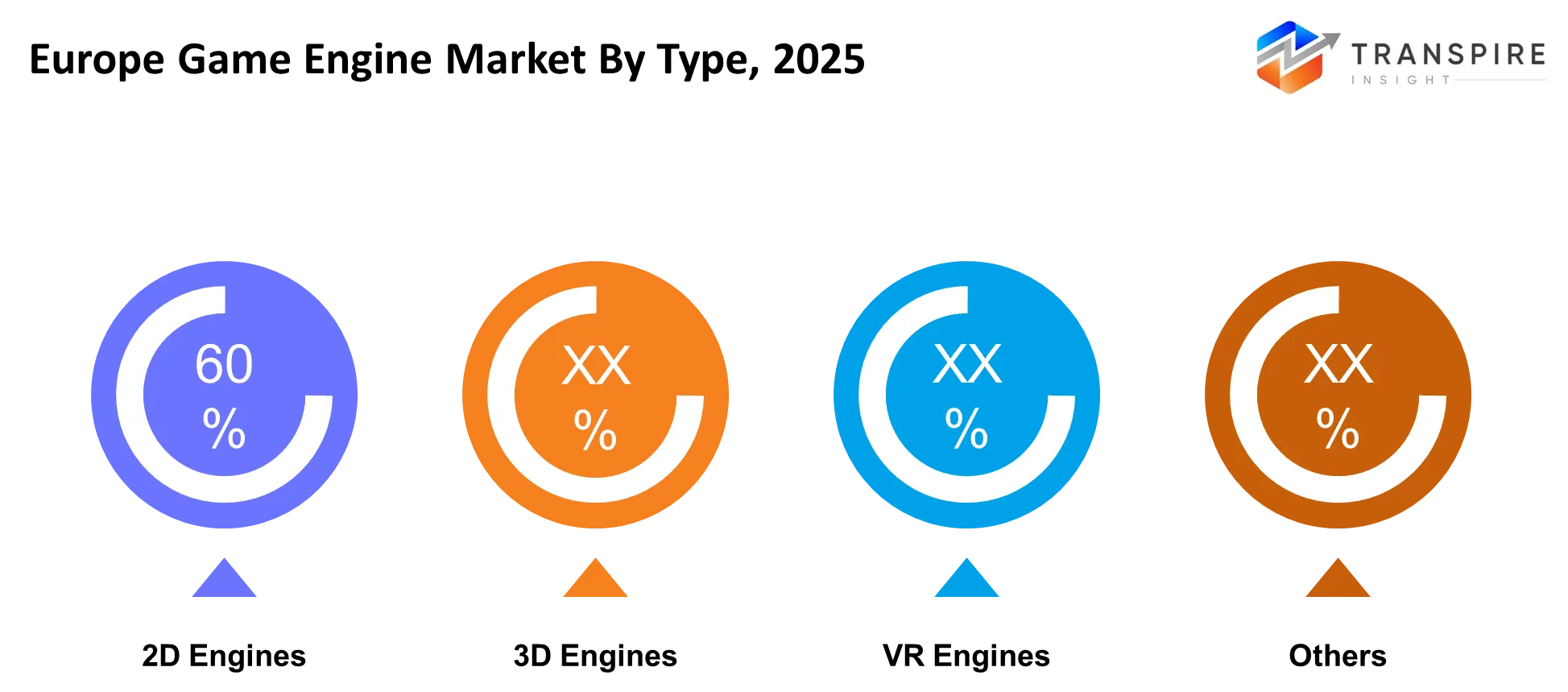
Large studios and automotive firms and virtual production companies use 3D engines because these engines offer them both photorealistic rendering and real-time simulation capabilities. The growing demand for immersive gaming and industrial digital twins and cinematic visualization drives more people to use advanced 3D development environments. VR engines are expanding because more people can afford headsets and companies are using VR for training in manufacturing and healthcare. Indie developers and mobile game creators still use 2D engines because these engines enable them to produce games at lower costs and complete their projects in less time.
Niche simulation and educational applications use specialized engines for their needs yet these engines cannot scale as well as mainstream platforms. The upcoming competitive landscape in this segment will focus on three main technologies which include AI-assisted rendering and cloud-native deployment and industrial software ecosystem interoperability. The next ten years will see vendors who develop cross-platform optimization and scalable subscription systems achieve better customer retention from both enterprises and developers.
To learn more about this report, Download Free Sample Report
By Application
The application market remains dominated by gaming applications because AAA studios and mobile publishers demand rendering technology and multiplayer functionality and live content operations. The gaming industry generates strong revenue through its online gaming platforms and esports investments which leads to increased usage of gaming engines throughout Europe. The aviation and defense and automotive industries are driving continuous growth for simulation applications because they use real-time visualization during their design validation and operational training processes. The AR and VR applications show accelerated market expansion because more businesses adopt immersive retail experiences and virtual collaboration tools and industrial maintenance simulations.
The immersive content market faces technical limitations which small developers find difficult to overcome because of hardware fragmentation and the need for extensive device optimization. The commercial usage of real-time 3D environments for architectural visualization and educational platforms has made these applications vital for organizations. The future market direction will depend on enterprise digital transformation spending which leads engine providers to develop products that function as industrial visualization solutions instead of gaming technologies.
By End-User
The independent creators and mid-sized studios show their largest user basewhile developers use commercial game engines to make their work easier and complete their projects faster. The major expenses of large game studios come from their high-budget console and multiplayer gameswhich need both scalable rendering systems and sophisticated physics engines. Interactive simulation tools help organizations in automotive manufacturing and media industries to deliver product development and training and customer engagement solutions which drive enterprise adoption.
Educational institutions and research organizations are beginning to increase their spending on real-time content platforms which they use for technical education and visualization applications. The smaller studios face difficulties because their expenses rise from both advanced licensing systems and cloud-based infrastructure needs. End-user market growth will benefit companies which provide modular pricing models and AI development tools and complete cloud-based collaboration solutions that serve both creative studios and industrial users.
By Platform
PC platforms keep dominating their platform segment because their advanced hardware capabilities enable users to create high-quality graphics and work in open development environments while using their systems in various ways. Console platforms maintain strong market influence due to stable consumer demand for AAA gaming titles and optimized user experiences. Mobile platforms experience their fastest expansion because smartphone gaming revenues increase and developers create games that function on multiple platforms. Mobile device performance has improved because 5G connectivity now allows handheld devices to support complex real-time graphics and multiplayer features. Other platforms, including cloud gaming systems and standalone VR devices, gradually transform distribution systems by decreasing the need for specialized local hardware.
Development teams face increased difficulties in optimization because operating system and hardware architecture fragmentation creates additional challenges which they must resolve. Future platform competition will increasingly revolve around three essential factors which include cloud integration and low-latency streaming performance and seamless device interoperability. Vendors who provide unified development workflows for PC, console, mobile, and immersive systems will gain advantages that help them maintain market strength over time.
What are the Key Use Cases Driving the Europe Game Engine Market?
The European gaming industry requires AAA studios and mobile publishers to use their engine because these studios and publishers need real-time rendering and multiplayer capabilities and live content updates. Consumers who spend money on online gaming and esports activities have created a strong need for online development platforms which can handle high-volume user demand.
Game engines now function as digital twin simulation software which factories and automotive and manufacturing companies use for employee training purposes. Real-time rendering technologies now enable film production studios to design virtual sets which decrease post-production time needed for streaming media content.
The creation of AI-based industrial metaverse spaces and virtual healthcare training environments for surgical education and remote collaboration systems has commenced. Smart city planners and defense organizations are currently testing real-time 3D visualization systems which they use for infrastructure modeling and operational planning and scenario-based training systems throughout the upcoming forecast period.
|
Report Metrics |
Details |
|
Market size value in 2025 |
USD 967.97 Million |
|
Market size value in 2026 |
USD 1142.21 Million |
|
Revenue forecast in 2033 |
USD 3683.01 Million |
|
Growth rate |
CAGR of 18.21% from 2026 to 2033 |
|
Base year |
2025 |
|
Historical data |
2021 - 2024 |
|
Forecast period |
2026 - 2033 |
|
Report coverage |
Revenue forecast, competitive landscape, growth factors, and trends |
|
Regional scope |
Europe (Germany, United Kingdom, France, Italy, Spain and Rest of Europe) |
|
Key company profiled |
Unity Technologies, Epic Games, Crytek, Amazon Lumberyard, Cocos, Godot Engine, GameSalad, Buildbox, Autodesk, Havok, Valve, Sony, Microsoft, Apple, NVIDIA |
|
Customization scope |
Free report customization (country, regional & segment scope). Avail customized purchase options to meet your exact research needs. |
|
Report Segmentation |
By Type (2D Engines, 3D Engines, VR Engines, Others), By Application (Gaming, Simulation, AR/VR, Others), By End-User (Game Developers, Studios, Enterprises, Others), By Platform (PC, Console, Mobile, Others) |
Which Regions are Driving the Europe Game Engine Market Growth?
The digital infrastructure and gaming ecosystems of Germany and the United Kingdom and France combine to create a strong digital infrastructure which drives Western Europe to lead the market. The major studios and cloud service providers together with virtual production companies maintain their commitment to extensive investment in developing real-time 3D capabilities throughout the entire region. The public funding programs that support digital media and artificial intelligence and immersive technologies create a framework for permanent adoption in both gaming and industrial applications. The strong cooperation between universities and software companies and enterprise users creates an innovation ecosystem that enables ongoing product development and maintains a pipeline of skilled workers.
Northern Europe stands as the second largest regional contributor to growth which differs from Western Europe because enterprise technology stability drives its adoption pattern.Sweden and Finland and Denmark continue their ongoing support for cloud gaming infrastructure together with industrial simulation platforms and advanced connectivity networks. The industries of manufacturing and defense and media show consistent demand for interactive visualization technologies because of their strong purchasing power and stable regulatory environments. The regional companies of the area focus on building environmentally friendly digital operations and remote collaboration systems which results in a consistent need for scalable game engine platforms and cloud-based rendering tools.
The independent game development studios in Eastern Europe keep growing which makes this region the fastest expanding area, while Western European publishers increase their outsourcing activities.
Who are the Key Players in the Europe Game Engine Market and How Do They Compete?
The market remains moderately competitive because a small number of engine makers control most of the European market for commercial video games and corporate visualization projects. The competition now focuses on rendering speed and artificial intelligence development tools and the ability to operate on different platforms and connect to cloud services instead of just pricing. Established vendors protect their market positions by expanding their product ecosystems and providing developers with ongoing support, while new companies focus on developing specialized solutions for low-code platforms and open-source solutions and industrial simulation software. The enterprise market outside the gaming industry drives market disruption because automotive and manufacturing and virtual production sectors demand scalable platforms for real-time 3D content.
The development platform of Unity Technologies enables developers to create mobile applications and launch their products on multiple platforms. The company follows a unique business model which combines effective advertising solutions with multiple distribution methods that work on mobile devices and console systems and augmented reality platforms and industrial systems. Epic Games competes with its Unreal Engine product through its ability to deliver highly realistic visual effects and its ability to create fully interactive cinematic experiences. The strategic partnerships that Unreal Engine established with automotive companies and broadcasters and film studios enabled the technology to reach digital twin and virtual production fields beyond its original gaming applications.
The company Crytek maintains its specialized niche by developing advanced visual rendering systems and environmental simulation technologies which serve demanding simulation needs and graphics intensive applications. The company establishes itself as a unique business in defense and industrial visualization because it possesses strong expertise in creating realistic lighting systems and terrain design. The deep cloud infrastructure integration of Amazon Lumberyard improves its competitive position because it enables developers to create multiplayer environments and streaming capabilities that they can expand without difficulty. The no-code and low-code development tools offered by Buildbox and other smaller providers enable independent creators and rapid mobile game production teams to create games with less technical expertise.
Company List
- Unity Technologies
- Epic Games
- Crytek
- Amazon Lumberyard
- Cocos
- Godot Engine
- GameSalad
- Buildbox
- Autodesk
- Havok
- Valve
- Sony
- Microsoft
- Apple
- NVIDIA
Recent Development News
In February 2026, Unity Shares Drop After Weak 2026 Revenue Forecast: Unity Software reported weaker-than-expected Q1 2026 revenue guidance, triggering a sharp market reaction and raising concerns about slowing demand for real-time 3D development platforms across gaming and simulation sectors in Europe. The update also highlighted growing competitive pressure from AI-driven content creation technologies impacting the game engine ecosystem.
Source: https://www.reuters.com
In March 2026, Unity Releases 2026 Game Development Report Highlighting Tool Efficiency Demand: Unity Technologies released its 2026 Game Development Report showing studios increasingly prioritising operational efficiency, rapid prototyping, and lower-cost production pipelines. European developers were among the major contributors to the surveyed trends, reflecting broader demand for scalable engine technologies and live-service optimisation tools.
Source: https://www.gamesmarket.global
What Strategic Insights Define the Future of the Europe Game Engine Market?
The market will undergo a fundamental transformation during the next 5 to 7 years because it will move away from developing entertainment content for video games to creating real-time simulation systems that meet enterprise standards. The industry will experience its next phase of growth through automotive engineering and industrial digital twins and defense training and virtual production rather than depending on traditional game publishing. The shift occurs because AI content creation systems and cloud rendering technology and spatial computing systems work together to make real-time 3D platforms suitable for business use in different sectors.
The industry faces a danger because it increasingly relies on a few major game engine companies and their associated cloud service systems. The upcoming pricing changes and licensing conflicts together with increased platform control will create operational challenges for both small studios and large enterprise developers who depend on their proprietary workflows. The concentration risk prevents independent European software vendors from developing new products in their markets.
Eastern Europe presents a new investment opportunity because its low production costs and growing technical workforce have attracted industrial simulation and immersive training development. Companies entering the market should adopt AI-based cross-industry platforms while establishing partnerships with regional developers to establish their long-term market position before enterprise adoption reaches its next stage.
Europe Game Engine Market Report Segmentation
By Type
- 2D Engines
- 3D Engines
- VR Engines
- Others
By Application
- Gaming
- Simulation
- AR/VR
- Others
By End-User
- Game Developers
- Studios
- Enterprises
- Others
By Platform
- PC
- Console
- Mobile
- Others
Frequently Asked Questions
Find quick answers to common questions.
The approximate Europe Game Engine Market size for the market will be USD 3683.01 Million in 2033.
The key segments of the Europe Game Engine Market are By Type (2D Engines, 3D Engines, VR Engines, Others), By Application (Gaming, Simulation, AR/VR, Others), By End-User (Game Developers, Studios, Enterprises, Others), By Platform (PC, Console, Mobile, Others).
Major players in the Europe Game Engine Market are Unity Technologies, Epic Games, Crytek, Amazon Lumberyard, Cocos, Godot Engine, GameSalad, Buildbox, Autodesk, Havok, Valve, Sony, Microsoft, Apple, NVIDIA.
The current market size of the Europe Game Engine Market is USD 967.97 Million in 2025.
The Europe Game Engine Market CAGR is 18.21%.
- Unity Technologies
- Epic Games
- Crytek
- Amazon Lumberyard
- Cocos
- Godot Engine
- GameSalad
- Buildbox
- Autodesk
- Havok
- Valve
- Sony
- Microsoft
- Apple
- NVIDIA
Recently Published Reports
-
Apr 2026
3D Optical Profiler Market
3D Optical Profiler Market Size, Share & Analysis Report By Type (Desktop 3D Optical Profiler, and Portable 3D Optical Profiler), By Technology (Confocal Technology, and White Light Interference), By End-Use Industry (Manufacturing, Research Institutions, Automotive, Aerospace and Defense, Medical Devices, and Other), and Geography (North America, Europe, Asia-Pacific, Middle East and Africa, South and Central America), 2021 - 2031
-
Apr 2026
Depth Sensor Market
Depth Sensor Market Size, Share & Analysis Report By Type (Infrared Depth Sensors, Time-of-Flight (ToF) Sensors, Stereo Vision Sensors, Structured Light Sensors, Ultrasonic Depth Sensors), By Application (Automotive, Robotics, Gaming, Consumer Electronics, Industrial Automation, Healthcare, Security & Surveillance, Others), By End Users (Automotive Manufacturers, Consumer Electronics Companies, Healthcare Providers, Industrial Companies, Security Agencies, Gaming Companies, Robotics Companies, Others), and Geography (North America, Europe, Asia-Pacific, Middle East and Africa, South and Central America), 2021 – 2031
-
Apr 2026
Digital Manufacturing Market
Digital Manufacturing Market Size, Share & Analysis Report By Component (Hardware, Software, and Services), By Technology (Robotics, 3D Printing, Internet of Things (IoT), and Others), By Application (Automotive and Transportation, Aerospace and Defense, Consumer Electronics, Industrial Machinery, and Others), By Process Type (Computer-Based Designing, Computer-Based Simulation, Computer 3D Visualization, Analytics, and Others), and Geography (North America, Europe, Asia-Pacific, Middle East and Africa, South and Central America), 2021 – 2031
-
Apr 2026
Digital Visa Services Market
Digital Visa Services Market Size, Share & Analysis Report By Type (Individual Travelers, Group Travelers), By Application (Tourism, Business Travel, Others), and Geography (North America, Europe, Asia-Pacific, Middle East and Africa, South and Central America), 2021 – 2031