
Europe Freight Trucking Market Summary
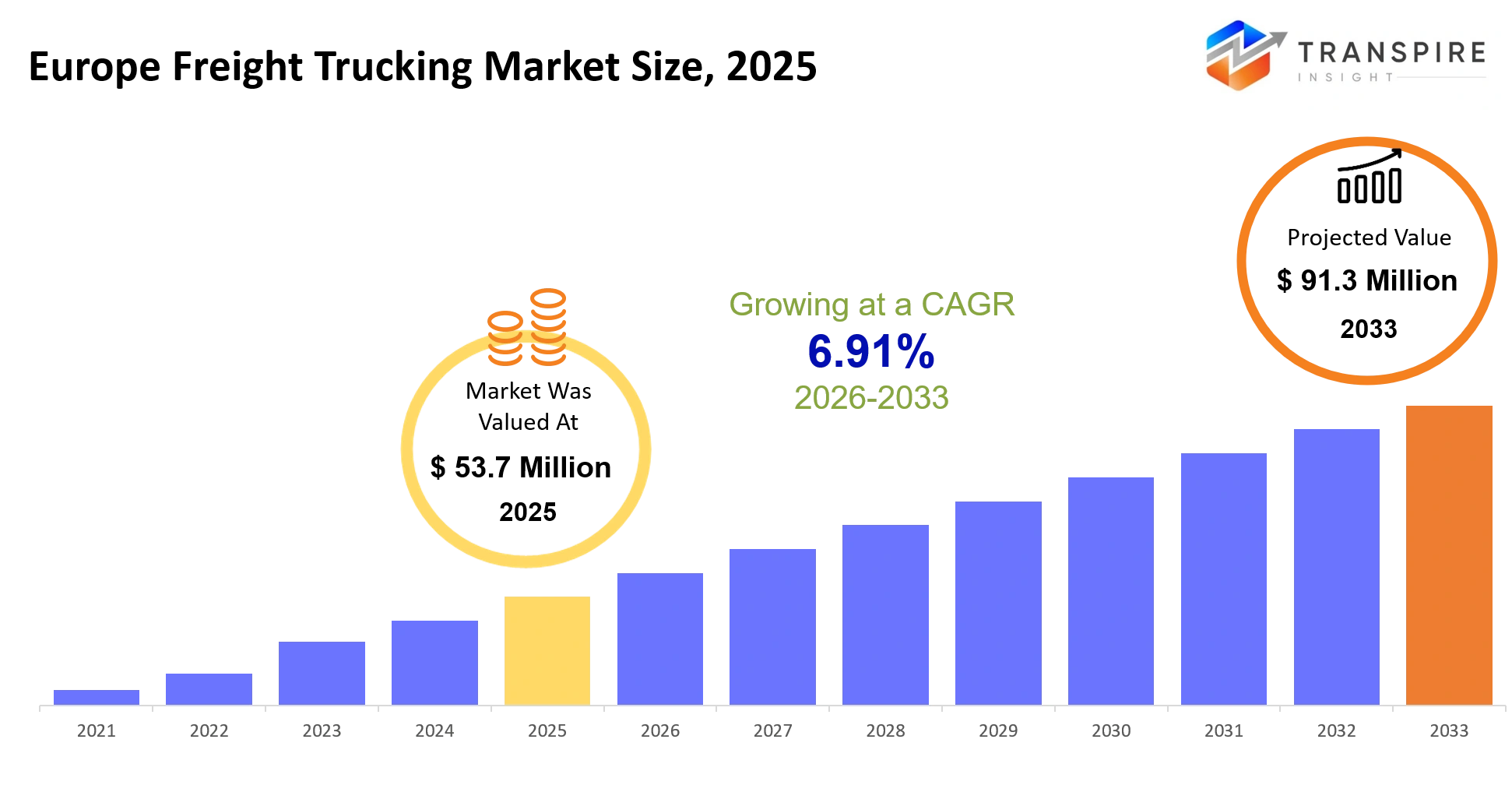
As per Transpire Insight Analysis the Europe Freight Trucking Market size is estimated at USD 53.7 Million in 2025 and is anticipated to reach USD 91.3 Million by 2033, growing at a CAGR of 6.91% from 2026 to 2033.
Freight Trucking keeps the flow of goods going between manufacturers, distribution centers, retailers, ports , and end users, so it becomes this kind of key thread in regional industrial and commercial supply chains. Road freight trucking makes it possible to deliver on time , even when routes are inside a country or across borders. That matters a lot for sectors like automotive , food and beverage, construction, pharmaceuticals, and e-commerce. When road freight services are dependable, companies can keep their production routines on track, manage stock levels better , and react fast when customers change their needs.
In the last three to five years the market kinda moved more and more toward digitally connected, and lower-emission transport operations. Fleet operators started adopting telematics, route planning platforms, and vehicles that run on alternative fuels. This shift got stronger after the COVID-19 period , when supply chain disruptions showed how fragile things can be, and then later geopolitical tensions added more pressure to logistics networks. Businesses then leaned harder into supply chain resilience and delivery visibility, so money went into fleet modernization plus transport management tools. All of that has helped in improving asset utilization, cutting delivery waste, and also opening up new revenue angles via premium logistics offerings and more advanced, higher-value freight management capabilities.
Europe Freight Trucking Market Size & Forecast:
- Europe Freight Trucking Market Size 2025: USD 53.7 Million
- Expected Market Value 2033: USD 91.3 Million
- Forecast CAGR: 6.91%
- Leading region in 2025: Western Europe
- Fastest Growing region: Central and Eastern Europe
- Key Profile: DHL, DB Schenker, DSV, Kuehne+Nagel, XPO Logistics, GEODIS, Raben Group, Girteka Logistics, Dachser, FM Logistic, Waberer's, Ewals Cargo Care, Hellmann Worldwide Logistics, FERCAM, CMA CGM Logistics
Key Market Insights
- Western Europe is basically leading the Europe Freight Trucking Market in 2025, holding something like 58% market share, and yeah it’s backed by those dense logistics corridors and pretty advanced freight infrastructure.
- Central and Eastern Europe, meanwhile, looks set to be the fastest-growing regional market over 2025–2033, because manufacturing relocation keeps happening and cross border distribution networks are getting bigger, bit by bit.
- When it comes to services, Full Truckload, or FTL, is still out in front with close to 61% market share in 2025, mostly supported by high-volume industrial moves and automotive logistics.
- Less Than Truckload (LTL) stays in the #2 position as retailers and SMEs increasingly consolidate shipments, to squeeze better transportation efficiency out of it.
- Also, electric and alternative fuel freight transportation is expected to become the fastest-growing service segment by 2033, fueled by fleet decarbonization policies, and those charging infrastructure investments that keep scaling.
- For applications, manufacturing logistics is the biggest piece, with around 38% market share in 2025, which ties back to Europe’s strong industrial production, and the export activity that follows.
- E-commerce and retail distribution are forecast to show the quickest application growth through 2033, helped by shorter delivery windows and fulfillment networks that keep expanding.
- For end users, manufacturing companies keep being the leading group, taking nearly 35% market share, and they lean on scheduled freight movements for production continuity.
- Retail and e-commerce operators are the fastest-growing end-user category as omnichannel distribution rolls out across European markets, more and more.
What are the Key Drivers, Restraints, and Opportunities in the Europe Freight Trucking Market?
The main force pushing the Europe Freight Trucking Market forward is fleet digitalization, mixed with European emissions rules. Corporate sustainability aims, tighter CO₂ requirements, and electronic freight papers have nudged carriers to modernize vehicles and logistics systems. With real-time fleet sight, operators can use assets more efficiently, while route tuning helps curb fuel use and those unnecessary empty runs. These on-the-ground improvements back carrier margins, make it easier to sell higher-end logistics services, and generally help transport volumes rise across manufacturing and retail supply chains.
Still, the biggest structural wall is driver shortages, plus those swings in operating costs. Getting the right drivers takes years of workforce building, meanwhile fuel volatility and compliance costs keep squeezing freight margins. From the Transpire Insight view of regional procurement notices and launch timing, supply chain concentration continues to be the main execution risk. Fleet growth initiatives often stall because vehicle deliveries, charging coverage, and component lead-times are not evenly distributed across Europe. All of this dampens revenue pathways and slows the pace of expanding service.
Looking ahead, the most compelling opportunity lies in connected freight ecosystems—powered by electric trucks, AI supported fleet control, and digital freight exchanges. Heavy investment across Central and Eastern Europe is building logistics corridors and warehouse capacity. Firms that pair predictive analytics with zero-emission transport networks should see better delivery consistency, lower day-to-day costs, and stronger chances to win cross-border freight agreements through the next ten years.
What Has the Impact of Artificial Intelligence Been on the Europe Freight Trucking Market?
Artificial intelligence and digital technologies are, like really, changing freight transport across Europe by upping fleet visibility, dispatch efficiency, and compliance management. In practice logistics operators are using AI powered transport management systems more and more, to handle route planning in a semi automated way, track vehicle performance, check driver compliance, and also fine tune how cargo gets placed. It’s basically less manual routing, yet it still manages to raise delivery accuracy even when international transport routes get complicated.
There’s also machine learning which tends to support predictive choices better over time. Fleet operators look at engine diagnostics , tire conditions, braking behavior, weather forecasts, and shifting freight demand to line up maintenance before failures happen. At the same time they can assign vehicles more efficiently. Predictive maintenance cuts down on surprise downtime, and AI helped demand forecasting makes it easier for carriers to place assets nearer to what’s likely needed in the next shipping wave.
On top of that, digital optimization delivers results you can actually measure. Selecting routes more smartly reduces deadhead distance, makes vehicle utilization improve, lowers fuel use, and boosts on time delivery outcomes. Even paperwork gets faster, because automated documentation helps speed up customs procedures and keeps cross border freight moving without as many delays.
Still, there are hurdles and AI rollouts don’t magically solve everything. Bringing older fleet management systems together with newer analytics platforms takes real money and technical know how. Data quality also isn’t the same everywhere, while connectivity can be spotty across remote corridors, so real time decision accuracy suffers. So yeah, even with strong long term business upside, these practical issues keep full scale adoption from happening as quickly as people would hope.
Key Market Trends
- Since 2022 , logistics companies have kinda sped up their investments in telematics platforms, aiming to get better route efficiency , higher fleet utilization, and clearer shipment visibility all over Europe.
- Cross-border freight networks also kept expanding after manufacturers leaned into nearshoring, between 2023 and 2025, which helped reinforce Central and Eastern European logistics corridors.
- Electric heavy-duty truck deployments rose too, mostly because governments rolled out funding programs and some charging infrastructure along key freight corridors starting in 2024.
- Meanwhile AI driven route optimization platforms are cutting down empty mileage and nudging up fleet productivity , so more and more big logistics providers are putting money into new tech.
- Digital freight exchanges keep swapping out manual booking workflows, allowing quicker capacity matching , and in the process transport efficiency gets better for both small carriers and large ones.
- Big players like DHL Freight, DB Schenker, and DSV are still widening their low carbon logistics services, plus they keep extending integrated digital transport platforms across Europe.
- Warehouse automation together with transport management software has been getting closely stitched together since 2023, which helps with inventory synchronization and delivery timing, pretty directly.
- Electronic freight documentation adoption has accelerated as well, because regulatory harmonization reduces those annoying administrative delays during international road freight operations.
- Alternative fuels—battery-electric and hydrogen powered trucks especially—are starting to move from pilot projects into more commercial fleet expansion, as infrastructure coverage keeps improving.
Europe Freight Trucking Market Segmentation
By Truck Type :
Heavy Trucks take the largest share, mostly because long-distance freight movement, industrial transport, and cross-border trade really do rely on high payload capacity plus a lower cost per shipment. In day to day terms, manufacturing, automotive, construction, and logistics companies keep leaning on heavy trucks for the steady movement of raw materials, and also finished products. Fuel efficiency improvements, more advanced safety systems, and digital fleet management have made operations feel smoother , better, if that makes sense. Plus, big logistics contracts usually prefer heavy trucks too, because doing fewer trips can cut overall transportation expenses.
Refrigerated Trucks are honestly one of the fastest-growing categories, since food, pharmaceutical, and healthcare supply chains need strict temperature control throughout the journey. The need for fresh food distribution and biologics logistics keeps expanding across Europe. Light Trucks still have solid demand for urban deliveries, and Medium Trucks help with regional distribution routes and similar coverage. Flatbed, Tanker, and Container Trucks remain kind of essential for specialized freight work across various industrial sectors , even when the demand shifts.
By Service Type :
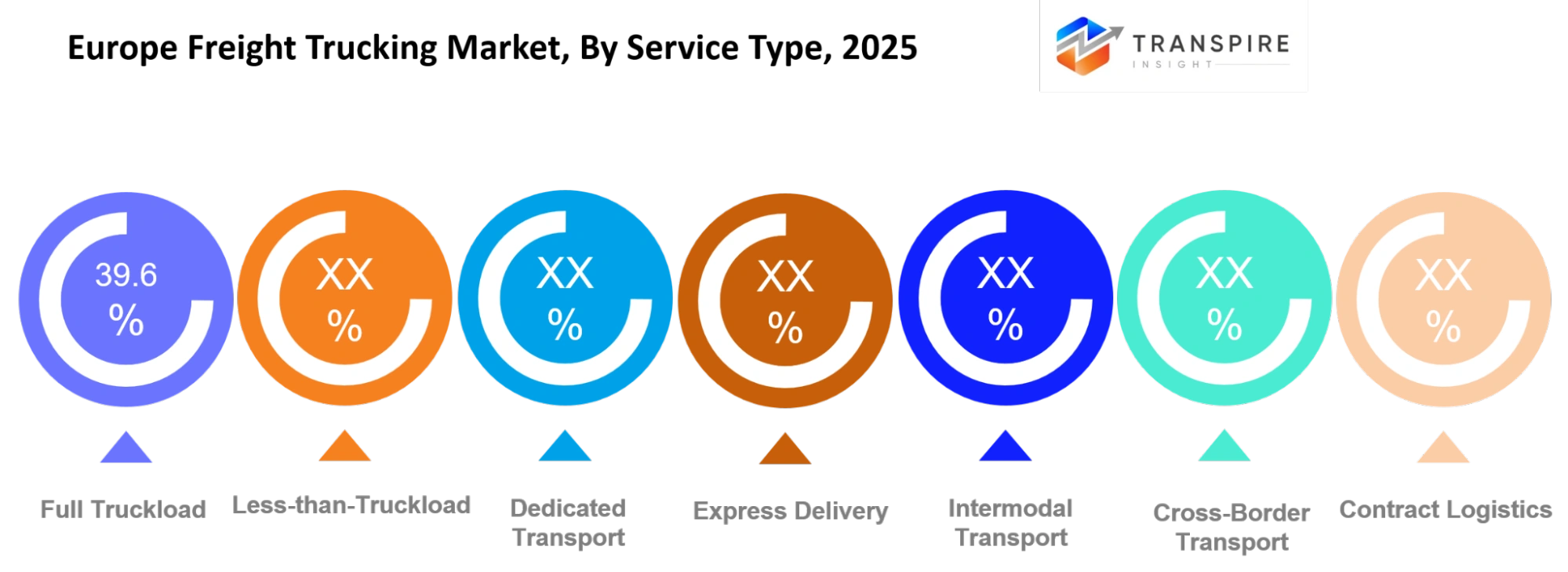
Full Truckload sort of leads the service landscape since manufacturers, and big retailers, often send high shipment volumes on fixed schedules. With direct transportation there is less extra handling, transit time feels shorter and the risk of cargo damage is lower. Because industrial production stays stable, and long term logistics contracts are still in place, this segment keeps getting support. At the same time digital freight platforms help with vehicle utilization and route planning, which makes Full Truckload work even smoother.
Less-than-Truckload still matters a lot for small and medium sized businesses that ship smaller cargo volumes. Express Delivery keeps expanding, especially because online retail keeps demanding tight delivery windows and dependable last mile connections. Cross-Border Transport also benefits from ongoing trade activity within the European Union, while Contract Logistics keeps growing as companies decide to outsource transport oversight to specialized providers. Then there is Intermodal Transport, it gets more attention too, due to improved coordination between road, rail, and port facilities.
By End User :
Manufacturing takes the largest share since factories kind of rely on scheduled transportation not just for raw materials but also for production inputs and then of course the finished goods. Ongoing production cycles mean you need reliable freight services with pretty predictable delivery times, and that becomes the whole point. Automotive, machinery, and industrial equipment manufacturers produce a big chunk of transportation volumes across Europe, it adds up fast. Plus modern logistics planning kind of helps maintain efficient inventory control across manufacturing sites, not only shipment routes.
Retail sees strong growth because omnichannel commerce pushes more product movement between warehouses, fulfillment centers and stores too. Food & Beverage keeps steady freight demand from daily distribution of both packaged and fresh products. Healthcare transport keeps climbing as pharmaceutical distribution expands, along with medical supply needs. Construction and Chemicals stay fairly stable in freight volume, due to infrastructure development and industrial activity.
By Cargo Type :
Dry Goods keep the leading share, because packaged products, consumer merchandise industrial supplies and retail inventory basically go on moving nonstop across regional distribution networks. There is strong commercial activity that kind of backs up frequent transportation of nonperishable cargo, between production facilities and warehouses. Standard trailers bring operational flexibility and, they also help push down transportation costs a bit for these shipments. And the efficient handling, well it improves delivery schedules too across multiple industries, without much drama.
Perishable Goods are, one of the fastest growing cargo categories these days, since fresh food, dairy products, frozen products and pharmaceutical products need temperature-controlled logistics. Consumer Goods are still expanding, especially through online retail distribution channels. Industrial Equipment keeps fairly steady freight activity, because manufacturing investment supports the movement of equipment. Hazardous Materials along with Bulk Goods, still matter a lot for chemical processing, energy, and heavy industrial operations.
By Ownership :
Third-Party Logistics Providers take the lead in the ownership segment, because more and more businesses choose to hand off transportation in order to get better operational flexibility and also keep logistics costs more in check. They use advanced fleet management systems, benefit from wider transportation networks, and tie in warehousing too, which overall helps their competitive positioning. On top of that, long-term contracts with manufacturers as well as retailers give a pretty steady flow of business volume. Meanwhile, technology investments keep improving shipment visibility and fleet efficiency across those regional operations, even when conditions shift a bit.
Private Fleets still matter a lot for firms that want a direct handle on delivery schedules and the consistency of service quality. Contract Carriers keep growing, mostly through dedicated transportation agreements made with industrial customers. Leasing Companies help with fleet modernization, by cutting down on upfront capital for transport operators, so they can refresh assets faster. Freight Brokers, on the other hand, enhance capacity utilization by acting as a connector, matching shippers with carriers that are currently available within regional freight networks.
What are the Key Use Cases Driving the Europe Freight Trucking Market?
Full truckload transportation still ends up being the main use, really, because manufacturers need dependable movement of big shipment volumes between plants, distribution centers, and export hubs. Automotive, machinery, and industrial goods producers buy these services so production calendars stay on track, handling gets reduced, and just-in-time inventory control works better across European supply lines.
At the same time, other use cases keep widening, notably in food and beverage distribution, plus healthcare logistics. Temperature controlled freight backs up food processors, supermarket chains, pharmaceutical makers, and hospital supply networks, where they must follow tight product condition rules and transport regulations. Retailers and e-commerce players also rely on adaptable transport services to restock regional fulfillment centers and help with fast order dispatch.
More recently, emerging applications are forming around zero-emission freight corridors and digitally linked cross border transport. Public infrastructure funding and low emission transport rules are pushing pilot runs, using battery-electric trucks, and hydrogen-powered units, for regional hauling. Digital freight platforms that handle carrier pairing and shipment paperwork automatically, seem to have solid long term value for boosting logistics performance.
|
Report Metrics |
Details |
|
Market size value in 2025 |
USD 53.7 Million |
|
Market size value in 2026 |
USD 57.2 Million |
|
Revenue forecast in 2033 |
USD 91.3 Million |
|
Growth rate |
CAGR of 6.91% from 2026 to 2033 |
|
Base year |
2025 |
|
Historical data |
2021 - 2024 |
|
Forecast period |
2026 - 2033 |
|
Report coverage |
Revenue forecast, competitive landscape, growth factors, and trends |
|
Regional scope |
Europe (Germany, United Kingdom, France, Italy, Spain and Rest of Europe) |
|
Key company profiled |
DHL, DB Schenker, DSV, Kuehne+Nagel, XPO Logistics, GEODIS, Raben Group, Girteka Logistics, Dachser, FM Logistic, Waberer's, Ewals Cargo Care, Hellmann Worldwide Logistics, FERCAM, CMA CGM Logistics. |
|
Customization scope |
Free report customization (country, regional & segment scope). Avail customized purchase options to meet your exact research needs. |
|
Report Segmentation |
By Truck Type (Light Trucks, Medium Trucks, Heavy Trucks, Refrigerated Trucks, Flatbed Trucks, Tanker Trucks, Container Trucks, Others); By Service Type (Full Truckload, Less-than-Truckload, Dedicated Transport, Express Delivery, Intermodal Transport, Cross-Border Transport, Contract Logistics, Others); By End User (Retail, Manufacturing, Construction, Healthcare, Automotive, Food & Beverage, Chemicals, Others); By Cargo Type (Dry Goods, Perishable Goods, Hazardous Materials, Bulk Goods, Consumer Goods, Industrial Equipment, Agricultural Products, Others); By Ownership (Private Fleets, Third-Party Logistics Providers, Contract Carriers, Owner Operators, Leasing Companies, Freight Brokers, Cooperative Fleets, Others). |
Which Regions are Driving the Europe Freight Trucking Market Growth?
Western Europe sits around 58% of the regional revenue, mainly because Germany, France, the Netherlands, Belgium and Italy back the most freight activity. You can point to strong transport regulations , plus connected highway networks, and mostly harmonized cross-border trade policies that help movement stay quick across the big logistics corridors. Big global logistics providers, advanced distribution hubs, and modern warehousing facilities, along with large manufacturing clusters, reinforce the regional supply chain. And really, ongoing support for digital freight platforms, low-emission transport, and fleet modernization should keep the region in a leadership position for the whole forecast time.
Northern Europe is a bit different, more like a distinct contribution, driven by highly efficient logistics operations, fairly stable economic conditions, and transport regulations that don’t swing too much. The digital infrastructure here supports dependable freight planning, shipment visibility, and customs handling across both domestic paths and international routes. Industrial exports, renewable energy projects, and advanced manufacturing keep freight volumes steady even when economic conditions shift around. Also stable public investment, plus long-term logistics planning, makes Northern Europe a reliable recurring revenue source for transportation services.
Central and Eastern Europe kind of shows up as the fastest-growing regional market, because manufacturing expansion and nearshoring strategies have, I mean shifted freight activity toward Poland, the Czech Republic, Romania and Hungary. In recent years investment in highways, logistics parks, intermodal terminals, and cross-border infrastructure has strengthened freight capacity along the main trade corridors around the region. At the same time industrial modernization, plus fresh distribution facilities keep pulling in transport providers looking for extra freight volumes. And the strong investment conditions spanning 2026–2033 should open quite attractive chances for fleet expansion, technology deployment, and brand-new logistics partnerships.
Who are the Key Players in the Europe Freight Trucking Market and How Do They Compete?
Competition in the Europe Freight Trucking Market still feels pretty moderately fragmented, you know, with big international logistics firms showing up next to regional carriers and also more specialized transport outfits. In practice, it often comes down to service quality, network reach, digital capability, cost effectiveness , and these low-emission transportation options that customers keep asking for. The established names are still trying to beef up their integrated logistics platforms, but at the same time, technology-first transport providers are moving fast with things like digital booking, fleet optimization, and real-time shipment visibility, just to grab fresh business.
DHL Freight tends to stand out thanks to broad European road coverage, plus they keep putting money into digital freight visibility and low-carbon transport solutions. DB Schenker really leans into technology-enabled logistics, and it’s backed by fleet electrification along with integrated supply chain services that are meant to raise operational efficiency for industrial customers. DSV also expands its competitive footprint through acquisitions and network blending, so cross-border freight services can feel smoother across a range of European markets.
GEODIS holds and strengthens its position using customized contract logistics, and multimodal transportation that’s tailored for manufacturing, retail, and healthcare. XPO Logistics, meanwhile, pushes advanced route optimization, automated freight management, and data-led operational planning to improve fleet utilization and delivery results. In general, strategic investment in digital platforms, sustainability moves, and cross-border service growth helps these players lock in longer-term contracts while they adapt to shifting customer expectations and regulatory standards, even when the market keeps changing around them.
Company List
- DHL
- DB Schenker
- DSV
- Kuehne+Nagel
- XPO Logistics
- GEODIS
- Raben Group
- Girteka Logistics
- Dachser
- FM Logistic
- Waberer's
- Ewals Cargo Care
- Hellmann Worldwide Logistics
- FERCAM
- CMA CGM Logistics
Recent Development News
In June 2026, DHL Group announced an investment of approximately EUR 160 million in France for 2026–2027 to expand logistics infrastructure, modernize fleets, and accelerate clean transport initiatives. The investment strengthens European freight capacity and supports lower-emission road freight operations across the region.
Source: https://group.dhl.com/
In April 2025, DSV completed the acquisition of DB Schenker from Deutsche Bahn in a transaction valued at approximately EUR 14.3 billion. The merger created one of the world's largest transport and logistics companies, significantly expanding European road freight coverage and integrated logistics capabilities.
Source: https://investor.dsv.com/
What Strategic Insights Define the Future of the Europe Freight Trucking Market?
Over the next five to seven years, the Europe Freight Trucking Market will shift toward more interconnected, lower emission and data driven freight networks, mostly because transport digitalization, fleet modernization, and those more resilient regional supply chains are changing where investors look. Instead of winning just by raw fleet size, the edge will come from operational intelligence, smoother cross border movement, and the kind of service reliability that keeps shippers calm.
There’s also a risk that is not as obvious, market concentration is rising, so the bigger logistics groups end up with stronger pricing power and preferred access to digital freight platforms. That can make it much harder for smaller operators to expand, even if they’re efficient.
At the same time, a real opportunity is starting to form around cross border zero emission freight corridors. These corridors are meant to connect Central and Eastern Europe with Western manufacturing hubs, and they’re helped along by infrastructure investment plus transport policies that keep evolving.
Firms that blend alternative fuel fleets with AI enabled transport management, predictive maintenance, and more integrated logistics partnerships should be in a better spot. They can secure long term contracts more consistently, and they can protect profitability across the whole forecast window.
Europe Freight Trucking Market Report Segmentation
By Truck Type
- Light Trucks
- Medium Trucks
- Heavy Trucks
- Refrigerated Trucks
- Flatbed Trucks
- Tanker Trucks
- Container Trucks
By Service Type
- Full Truckload
- Less-than-Truckload
- Dedicated Transport
- Express Delivery
- Intermodal Transport
- Cross-Border Transport
- Contract Logistics
By End User
- Retail
- Manufacturing
- Construction
- Healthcare
- Automotive
- Food & Beverage
- Chemicals
By Cargo Type
- Dry Goods
- Perishable Goods
- Hazardous Materials
- Bulk Goods
- Consumer Goods
- Industrial Equipment
- Agricultural Products
By Ownership
- Private Fleets
- Third-Party Logistics Providers
- Contract Carriers
- Owner Operators
- Leasing Companies
- Freight Brokers
- Cooperative Fleets
Frequently Asked Questions
Find quick answers to common questions.
The expected Europe Freight Trucking Market size for the market will be USD 91.3 Million in 2033.
Key segments for the Europe Freight Trucking Market are By Truck Type (Light Trucks, Medium Trucks, Heavy Trucks, Refrigerated Trucks, Flatbed Trucks, Tanker Trucks, Container Trucks, Others); By Service Type (Full Truckload, Less-than-Truckload, Dedicated Transport, Express Delivery, Intermodal Transport, Cross-Border Transport, Contract Logistics, Others); By End User (Retail, Manufacturing, Construction, Healthcare, Automotive, Food & Beverage, Chemicals, Others); By Cargo Type (Dry Goods, Perishable Goods, Hazardous Materials, Bulk Goods, Consumer Goods, Industrial Equipment, Agricultural Products, Others); By Ownership (Private Fleets, Third-Party Logistics Providers, Contract Carriers, Owner Operators, Leasing Companies, Freight Brokers, Cooperative Fleets, Others).
Major Europe Freight Trucking Market players are DHL, DB Schenker, DSV, Kuehne+Nagel, XPO Logistics, GEODIS, Raben Group, Girteka Logistics, Dachser, FM Logistic, Waberer's, Ewals Cargo Care, Hellmann Worldwide Logistics, FERCAM, CMA CGM Logistics.
The Europe Freight Trucking Market size is USD 53.7 Million in 2025.
The Europe Freight Trucking Market CAGR is 6.91% from 2026 to 2033.
- DHL
- DB Schenker
- DSV
- Kuehne+Nagel
- XPO Logistics
- GEODIS
- Raben Group
- Girteka Logistics
- Dachser
- FM Logistic
- Waberer's
- Ewals Cargo Care
- Hellmann Worldwide Logistics
- FERCAM
- CMA CGM Logistics
About the Authors

Mayur Shinde
I am Mayur Shinde, a Senior Research Analyst at Transpire Insight, specializing in the Automotive & Transportation and Information & Communication Technology (ICT) Industry. My work focuses on analyzing emerging market trends, technological advancements, competitive landscapes, and industry developments to deliver accurate, data-driven insights. I am passionate about transforming complex market information into clear, actionable content that helps businesses, professionals, and decision-makers stay informed and make confident strategic decisions.

Chakradhar Khansole
Chakradhar serves as the Research Director at Transpire Insight, bringing over 8 years of experience in technology, innovation, and strategic market intelligence. He specializes in transforming complex market data into actionable business insights that enable organizations to make informed, growth-oriented decisions. Recognized for his strategic vision and analytical expertise, Chakradhar leads high-impact research initiatives, delivering comprehensive market assessments, competitive intelligence, and forward-looking industry analysis.
Recently Published Reports
-
Apr 2026
ATV & UTV Market
ATV & UTV Market Size, Share & Analysis Report By Type (ATV, and UTV), By Variants (Less Than 400 CC, 400 CC To 800 CC, and More Than 800 CC), and Geography (North America, Europe, Asia-Pacific, Middle East and Africa, South and Central America), 2021 - 2031
-
Apr 2026
Automotive Central Gateway Module Market
Automotive Central Gateway Module Market Size, Share & Analysis Report By Type (Ethernet Central Gateway Module, CAN Central Gateway Module, LIN Central Gateway Module, and FlexRay), By Application (Powertrain Control, Body Control, Infotainment System, Advanced Driver Assistance Systems (ADAS), and Others), By End User (Passenger Vehicles, and Commercial Vehicles), and Geography (North America, Europe, Asia-Pacific, Middle East and Africa, South and Central America), 2021 - 2031
-
Apr 2026
Automotive Engine Oil Filter Market
Automotive Engine Oil Filter Market Size, Share & Analysis Report By Filter Type (Fuel Filter, Engine Oil Filter, Hydraulic Oil Filter, and Others), By Filter Media (Cellulose, Synthetic, and Micro), By Sales Channel (OEMs, and Aftermarket), By Vehicle Type (Passenger Cars, Light Commercial Vehicles, Heavy Duty Trucks, Buses and Coaches, and Off-road Vehicles), and Geography (North America, Europe, Asia-Pacific, Middle East and Africa, South and Central America), 2021 - 2031
-
Apr 2026
Automotive Parts Aluminium Die Casting Market
Automotive Parts Aluminium Die Casting Market Size, Share & Analysis Report By Production Process (Pressure Die Casting, Vacuum Die Casting, Squeeze Die Casting, Gravity Die Casting), By Application (Body Parts, Engine Parts, Transmission Parts, Battery And Related Components, Other Application Types), and Geography (North America, Europe, Asia-Pacific, Middle East and Africa, South and Central America), 2021 - 2031
Our Clients



