

Europe Fluorosurfactant Market Size & Forecast:
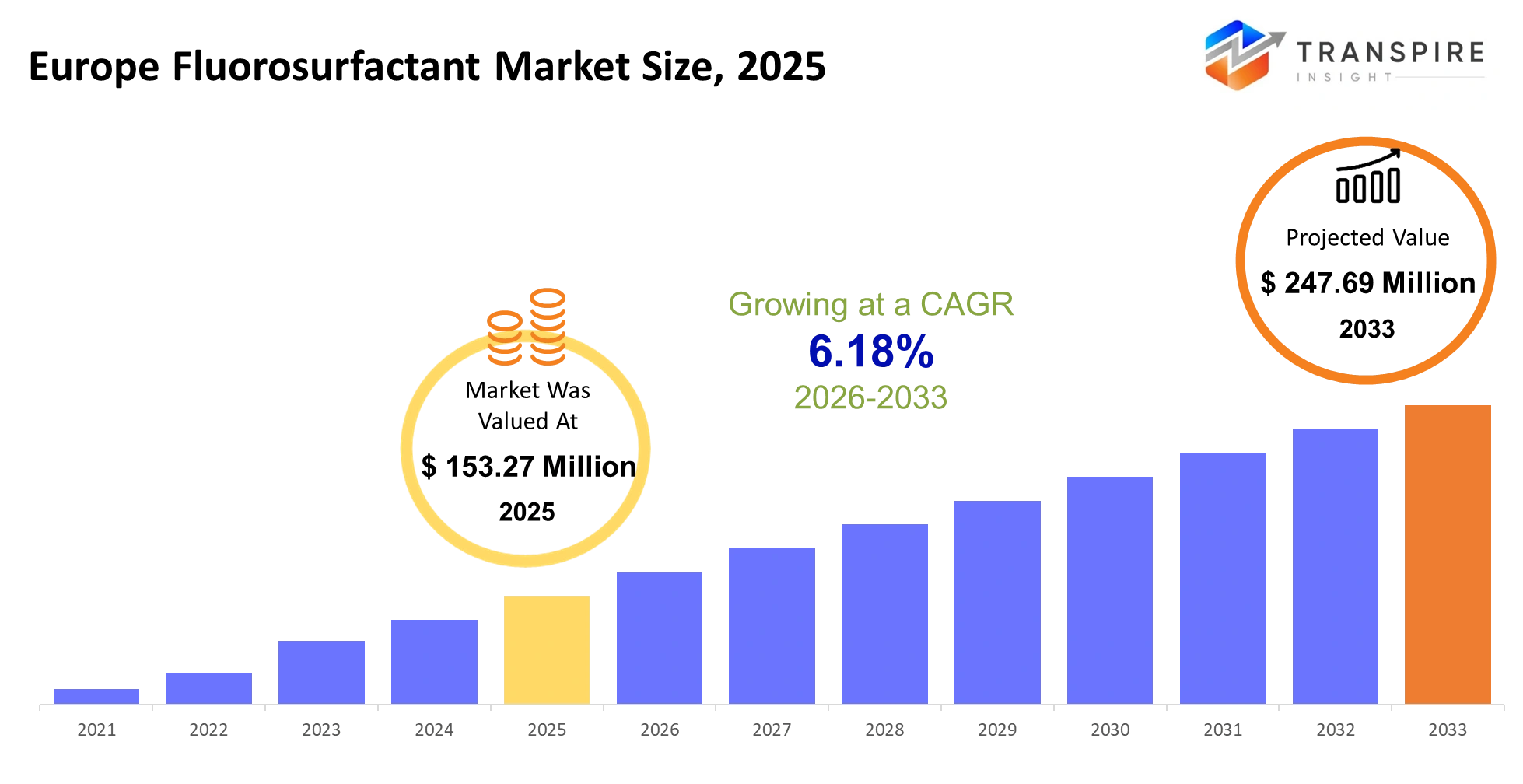
- Europe Fluorosurfactant Market Size 2025: USD 153.27 Million
- Europe Fluorosurfactant Market Size 2033: USD 247.69 Million
- Europe Fluorosurfactant Market CAGR: 6.18%
- Europe Fluorosurfactant Market Segments: By Type (Non-ionic, Anionic, Cationic, Amphoteric, Others); By Application (Coatings, Firefighting Foams, Oil & Gas, Electronics, Others); By End-User (Chemical Industry, Oil & Gas, Electronics Industry, Others); By Form (Liquid, Powder, Others).
To learn more about this report,  Download Free Sample Report
Europe Fluorosurfactant Market Summary
The Europe Fluorosurfactant Market was valued at USD 153.27 Million in 2025. It is forecast to reach USD 247.69 Million by 2033. That is a CAGR of 6.18% over the period.
The Europe fluorosurfactant market supports industrial systems that need exact surface control for their operations which include high-performance coatings and semiconductor manufacturing and firefighting foam production and specialized chemical processing. The chemicals create a practical application which allows liquids to spread across surfaces while protecting against impurities and maintaining product stability under extreme conditions that require high manufacturing standards and safety requirements.
The European Union has established stricter PFAS regulations which have compelled manufacturers to develop new surfactant systems because these regulations prevent them from using existing surfactant systems. The policy change prompted Solvay and Arkema to reformulate their products while the industry moved toward alternatives which produced low emissions and did not use fluorinated compounds. The semiconductor industry experienced growth in Germany and the Netherlands which resulted in increased demand for ultra-pure surfactants while changing the way these products would be used.
The combination of regulatory enforcement and pandemic-related supply chain disruptions has resulted in supply chain changes which now serve as the main driving force behind market changes. Buyers now prioritize compliance-ready formulations and supply stability over cost efficiency which leads them to adopt advanced specialty fluorosurfactants while establishing long-term contracts with certified European manufacturers.
Key Market Insights
- Western Europe dominates the Europe Fluorosurfactant Market with nearly 45% share in 2025 due to strong chemical hubs in Germany, Netherlands, and Belgium.
- The Eastern Europe market shows highest growth potential until 2026–2033 because battery and electronics manufacturing move their operations to this area.
- Non-ionic fluorosurfactants lead product segmentation with over 50% share because they provide better stability compared to other materials used in coatings and electronics formulations.
- EU PFAS regulations force all industrial applications to reformulate their products which makes specialty hybrid surfactants the fastest growing product segment.
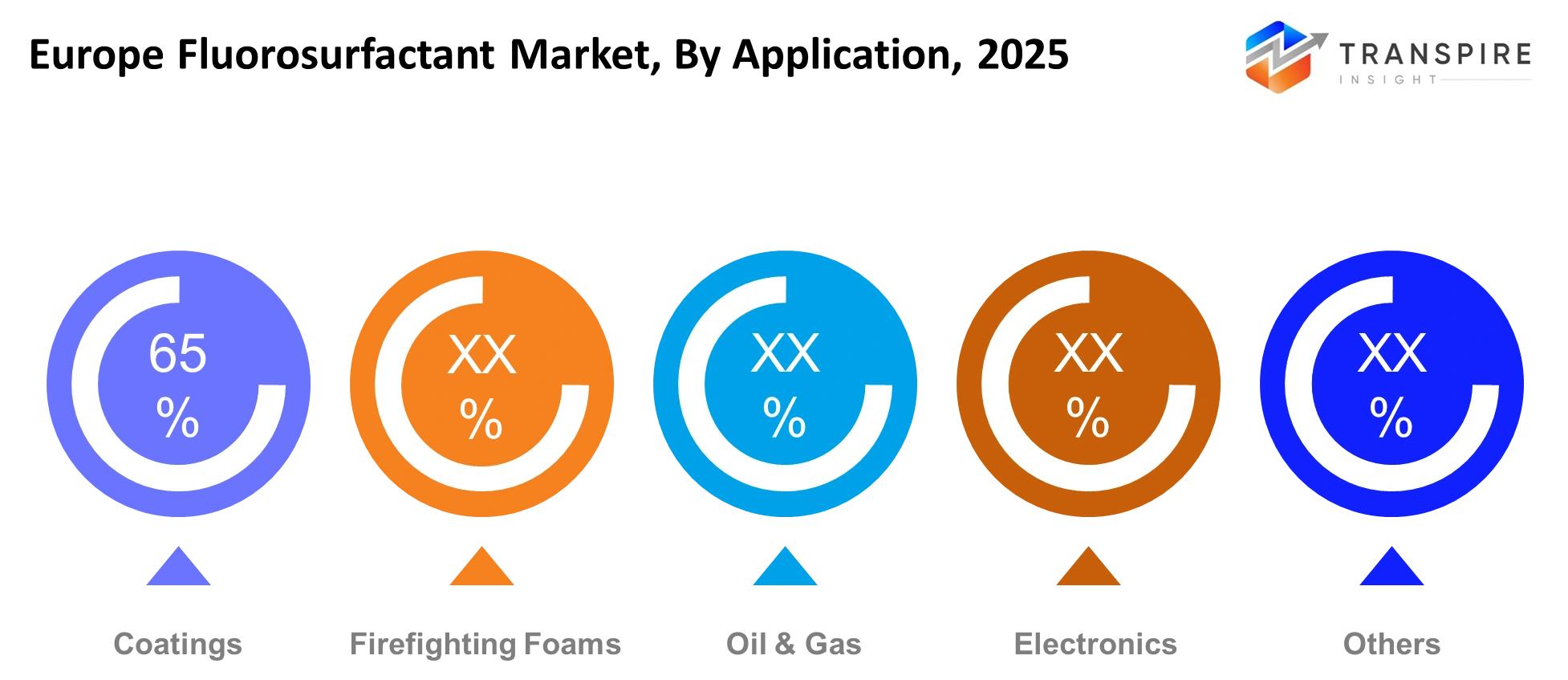
- The Europe Fluorosurfactant Market shows its highest demand from coatings application which accounts for almost 40% market share because of automotive and construction requirements.
- The fastest growing electronics applications between now and 2030 will result from semiconductor fabrication expansion in Germany France and the Netherlands.
- The chemical industry functions as the primary end-user because its production systems require substantial chemical consumption for their operations.
- Electronics end-users show the highest growth rate because they need to produce precision products under contamination-free manufacturing standards.
- Industrial facilities prefer liquid form because it integrates better with automated dosing systems than powder form does.
- Solvay develops PFAS-free surfactant solutions to meet EU regulatory requirements while preserving its leadership position in the coatings market.
What are the Key Drivers, Restraints, and Opportunities in the Europe Fluorosurfactant Market?
The primary factor which determines the European fluorosurfactant market development operates through new EU chemical safety regulations which prohibit the use of PFAS substances that remain in the environment. The new product development process for surfactant chemistries used in coatings and electronics and fire safety systems became necessary because of the 2023 implementation of new restrictions. Solvay and Arkema started developing new low-emission products which led to increased demand from semiconductor and industrial coating customers who needed compliance materials. The environmental performance requirements which new regulations create convert directly into financial benefits for suppliers who can establish their capacity to meet these requirements.
The primary limitation in high-performance applications results from the fundamental need to use expensive fluorinated chemical production methods which current technologies lack the ability to replace. Manufacturers face financial challenges because they must operate expensive fluorination equipment and maintain rigorous safety procedures which restrict their ability to produce products at competitive prices. The electronics industry and firefighting foam applications face technical difficulties when trying to substitute existing materials because any performance drop will not be tolerated. The combination of these two factors creates longer product adoption periods while it prevents industrial users in Southern and Eastern Europe from accessing new markets which operate at lower price points.
The development of battery manufacturing and advanced energy storage production activities creates a new economic opportunity which will benefit Poland and Hungary and Germany. The supply chain for electric vehicle production is experiencing rapid growth because the European Union invests in green transition certification and local gigafactory construction projects. Fluorosurfactants serve as essential materials which enable consistent electrode coating and maintain electrolyte stability to deliver next-generation battery performance capabilities.The growing battery material ecosystems between 2026 and 2030 will provide suppliers who establish early partnerships with these ecosystems the opportunity to secure long-term contracts and guarantee ongoing business.
What Has the Impact of Artificial Intelligence Been on the Europe Fluorosurfactant Market?
The use of artificial intelligence has become more common through its application in industrial chemical processes and marine emission control systems which create a rising need for fluorosurfactants throughout Europe. The AI-based control platforms of scrubber performance systems which ship and industrial cleaning operations use, continuously modify chemical dosing and airflow to achieve maximum surface activity and pollutant capture rates. The systems enable better reagent usage while they cut down on chemical waste which leads to direct changes in downstream formulations that depend on fluorosurfactant consumption. Northern European ports have started using digital monitoring systems which measure their compliance with the new EU emission regulations that have become more stringent.
Machine learning models have become standard tools for predicting maintenance needs in exhaust gas cleaning systems which operate on vessels that comply with IMO 2020 sulfur limits. The models use sensor data analysis to predict fouling and corrosion and efficiency decrease, which enables operators to plan maintenance work before their systems reach performance decline. The initial deployments have demonstrated that unplanned downtime has decreased while fuel efficiency improvements have reached double-digit percentages because of better cleaning cycle management. The stable operating conditions of chemical suppliers create more predictable demand patterns which help their business operations.
The adoption process has encountered a major obstacle because ships experience inconsistent onboard connectivity while their fleets use different sensor technologies. The process of AI optimization through real-time systems becomes ineffective when maritime operations experience open-sea conditions which prevent data transmission from reaching its complete capacity. The situation requires human operators to use hybrid systems for decision making since complete machine control is not possible through automated systems.
Key Market Trends
- The European Union implemented more strict PFAS regulations which will become active after 2024. This new regulation requires manufacturers to develop new coating and industrial product formulas which use alternative materials to fluorosurfactants.
- Solvay and Arkema changed their production procedures between 2024 and 2025 to create PFAS-free surfactant systems. This change in production affected their supplier assessment methods which they used throughout Europe.
- The electronics industry increased its use of fluorosurfactants during 2025 because German and Dutch semiconductor production facilities required flawless production results.
- The use of firefighting foam decreased during 2025 because airports and defense operators stopped using outdated foam formulations which did not comply with new EU environmental safety requirements.
- The European distribution network of Daikin expanded through new 2025 partnerships which showed the company now focuses on building local supply chains instead of growing its production capacity.
- AGC Inc. developed its specialty electronics business during 2026 by using fluorosurfactant research to advance its battery and display material supply chain operations.
- The chemical industry experienced increased investment from buyers who established production operations in Poland and Hungary after 2025 because of both cost savings and flexible regulatory requirements.
- The industrial sector saw a rise in demand for liquid products during 2025 because automated systems eliminated the need for workers to handle powder materials in manufacturing plants.
- After 2024 companies started to differentiate their products through non-ionic products and hybrid chemistries because customers demanded environmentally stable solutions which met European Union environmental regulations.
Europe Fluorosurfactant Market Segmentation
By Type:
The European fluorosurfactant market sees non-ionic fluorosurfactants as its most competitive segment because these materials work effectively with coatings and electronics and cleaning systems. The molecules display constant performance through both acidic and alkaline conditions which makes them the optimal choice for industrial operations that need to follow governmental regulations. The manufacturers selected their materials because they wanted to maintain performance level through the European Union chemical regulations which bring about stricter testing requirements. The stability problems of anionic and cationic types limit their applications because sensitive formulations need to maintain their protection.
The electronics manufacturing industry drives demand for non-ionic products which high-performance coatings require because they need uniform surface properties. Amphoteric and specialty types gain traction in niche applications such as fire suppression systems and biomedical coatings, where tailored interfacial behavior is required. The segments receive advantages through customized solutions while their customers opt for standard solutions. The companies use molecular engineering to create different performance features which will operate in various end-use settings.
The upcoming market growth will benefit non-ionic products and specialty hybrid chemical products because regulations will restrict the usage of high-reactivity surfactants. The product developers create alternatives especially designed for low residue and PFAS compliance which will still deliver full operational capacity. Product developers see advanced formulations as superior profit generators compared to basic surfactant products. The technological progress of production companies drives industry consolidation through their advanced capabilities.
By Application:
The European fluorosurfactant market sees its largest application segment through coatings which receive strong demand from automotive and construction and industrial equipment sectors. The applications need accurate surface tension management to create consistent film development which results in lasting durability.
The combination of emission standards and coating efficiency requirements creates a need for high-performance formulations in manufacturing processes. This situation establishes a consistent need which creates permanent business opportunities.Regulatory standards on emissions and coating efficiency reinforce adoption of high-performance formulations. This creates a stable and recurring demand base.
The application domains develop distinct growth patterns because of electronics and firefighting foam products. The electronics manufacturing sector depends on fluorosurfactants to produce semiconductors and displays without defects because contamination control represents an essential requirement. Firefighting foams maintain relevance in aviation and industrial safety despite environmental scrutiny, as replacement chemistries require performance parity. The oil and gas industry shows consistent demand but experiences gradual replacement challenges.
Future demand shifts toward electronics and specialty coatings as sustainability regulations reshape foam chemistry usage. Coatings manufacturers develop low-VOC systems which show EU standards compliance through their use of fluorosurfactants. Investors focus on industry sectors which support advanced manufacturing technologies instead of traditional industrial operations. The transition strengthens competition among technology-based suppliers.
To learn more about this report, Download Free Sample Report
By End-User:
The chemical industry accounts for the largest end-user share in the Europe fluorosurfactant market due to its role as both producer and consumer of specialty formulations. Integrated manufacturing facilities use these chemicals in intermediate processing steps for coatings, polymers, and surfactant blends. The company maintains market leadership because of its manufacturing capabilities and ability to create products in-house. Electronics industry follows closely, driven by precision manufacturing requirements.
The strict contamination control requirements which semiconductor and display fabrication industry needs have led to faster adoption rates among electronics end-users. Oil and gas companies keep their cleaning and flow enhancement product usage at constant levels because regulations prevent them from expanding their operations. The textile industry and specialty material producers together create demand which remains constant but smaller than other markets. Fluorinated chemistry usage in different segments shows different tolerance limits.
Future demand concentration moves toward electronics and high-value chemical processing sectors. Buyers in these industries prioritize supply reliability and compliance certification over cost optimization. The electronic supply chain regulations provide chemical producers with regulated access to electronics supply chains which helps them develop stronger pricing power. Procurement practices throughout Europe experience transformation because of this development.
By Form:
The Europe fluorosurfactant market is dominated by liquid fluorosurfactants because they integrate easily into industrial formulations and cleaning systems and coatings. The liquid form of a substance enables manufacturers to achieve uniform distribution while simplifying their operational procedures. Most end-use industries prefer ready-to-use solutions rather than handling powders. The multiple applications create consistent demand which supports the product.
The specialty and powder forms experience increasing demand because they provide storage stability and transport efficiency for remote industrial facilities and large-scale chemical blending operations. Powder formats also enable controlled dosing in high-precision formulations used in electronics and specialty coatings. The adoption of this technology is limited because of its solubility issues and challenges linked to its physical handling. The selection of forms requires deep understanding of end-use process requirements.
Future growth favors liquid formulations which achieve better stability and reduced environmental impact through their improved formulations. Manufacturers invest in hybrid delivery systems which drop handling risk yet maintain their performance standards. Buyers increasingly demand formulations which automated production systems can use for their production needs. This situation enables liquid formats to maintain their market position while advanced alternative formats can develop in specialized areas.
What are the Key Use Cases Driving the Europe Fluorosurfactant Market?
European markets require fluorosurfactants because electronics and advanced coatings create their primary demand. The three industries of semiconductor fabrication display manufacturing and high-performance industrial coatings use these substances to create products that possess both low surface tension and flawless exterior finishes. The EU establishes material purity standards which force manufacturers to develop high-efficiency products that minimize contamination dangers within their precision work environments. The most reliable base for electronic device usage emerges from electronics-related applications.
Aerospace maintenance and oil and gas facilities use firefighting foams and industrial cleaning solutions as their secondary applications which continue to grow. These applications require substances that can penetrate surfaces effectively to help remove dangerous materials and enhance safety protocols. The need for defense agencies and airport operators to meet new environmental and safety requirements drives demand within this market. The market sees ongoing demand because industrial services continue to adopt this technology.
Battery production for electric vehicles and energy storage systems which use specialized membranes represent new applications that are emerging. The applications demand precise control of surface activity to enhance ion movement and maintain material integrity. High-performance outdoor equipment displays early adoption of water-repellent textile technology.
|
Report Metrics |
Details |
|
Market size value in 2025 |
USD 153.27 Million |
|
Market size value in 2026 |
USD 162.74 Million |
|
Revenue forecast in 2033 |
USD 247.69 Million |
|
Growth rate |
CAGR of 6.18% from 2026 to 2033 |
|
Base year |
2025 |
|
Historical data |
2021 - 2024 |
|
Forecast period |
2026 - 2033 |
|
Report coverage |
Revenue forecast, competitive landscape, growth factors, and trends |
|
Regional scope |
Europe (Germany, United Kingdom, France, Italy, Spain, Rest of Europe) |
|
Key company profiled |
Chemours, 3M, Solvay, Arkema, Daikin, AGC Chemicals, Dongyue Group, DIC Corporation, Dynax, Merck, Pilot Chemical, Asahi Glass, Halocarbon, Maflon, Hubei Everflon. |
|
Customization scope |
Free report customization (country, regional & segment scope). Avail customized purchase options to meet your exact research needs. |
|
Report Segmentation |
By Type (Non-ionic, Anionic, Cationic, Amphoteric, Others); By Application (Coatings, Firefighting Foams, Oil & Gas, Electronics, Others); By End-User (Chemical Industry, Oil & Gas, Electronics Industry, Others); By Form (Liquid, Powder, Others). |
Which Regions are Driving the Europe Fluorosurfactant Market Growth?
Western Europe controls the entire European fluorosurfactant market because its chemical manufacturing sector operates at high capacity while the EU chemical safety rules enforce strict regulations. The advanced downstream industries of coatings, electronics, and specialty materials in Germany, France, the Netherlands, and Belgium require high-performance surfactants which they use for their operations. The strong port infrastructure of Rotterdam and Antwerp enables efficient import operations for fluorochemical intermediates while it supports the export of finished products. The ecosystem establishes a supply chain which functions as an interconnected network that links producers with formulators and end users.
Northern Europe contributes a more stable but structurally different demand base compared to Western Europe. The United Kingdom and Nordic countries depend on aerospace coatings and offshore energy applications and industrial maintenance chemicals which they use for their operations instead of producing large volumes of chemical products. Demand growth here emerges through long-term procurement contracts which establish gradual regulatory alignment while industrial development progresses at a slower pace. The region maintains stable revenue generation which continues to operate even when European industrial cycles experience their peak periods and downturns.
Eastern Europe has become the fastest-growing fluorosurfactant market because Western European manufacturing facilities have moved their operations to Eastern Europe while foreign direct investment in the chemical and advanced materials sectors has increased. Poland, the Czech Republic, and Hungary are attracting new automotive battery and electronics supply chain investments that require specialized surface-active agents. The recent infrastructure improvements at Gdansk logistics hubs and the increased EU funding for industrial modernization projects have resulted in greater chemical consumption growth.This momentum creates a strong entry window for suppliers, as early positioning in these emerging industrial clusters can secure long-term supply agreements through 2033.
Who are the Key Players in the Europe Fluorosurfactant Market and How Do They Compete?
The European fluorosurfactant market shows moderate consolidation because only a few global fluorochemical manufacturers control most of the market while specialty formulators serve specific market needs. The EU PFAS restrictions create new competitive dynamics which force existing companies to develop new chemical solutions instead of using their traditional surfactant products. The company gains its advantage through regulatory compliance which enables its materials to perform better than competitors in high-end applications such as semiconductors and coatings and fire-fighting foams and through its capacity to develop new products in a rapid manner.
Solvay develops PFAS-free surfactant systems which enable customers to meet regulatory requirements while maintaining their desired performance through its technology-focused development of replacement chemistries. Arkema creates a competitive edge by moving its PVDF production to non-fluorinated surfactant processes which enhance its regulatory compliance and attract battery and membrane manufacturers who want environmentally friendly supply chains. Chemours uses its manufacturing capabilities and its expertise in fluorine chemistry to provide industrial clients with high-performance fluorosurfactants through its extensive production facilities.
Daikin Industries competes with its high-purity fluorochemical manufacturing operations which maintain strict quality standards for electronics-grade products while expanding its distribution network through partnerships across Europe. AGC Inc. focuses on specialty electronics and energy sectors by developing application-specific products and partnering with European device manufacturers to achieve design-in status.
Company List
- Chemours
- 3M
- Solvay
- Arkema
- Daikin
- AGC Chemicals
- Dongyue Group
- DIC Corporation
- Dynax
- Merck
- Pilot Chemical
- Asahi Glass
- Halocarbon
- Maflon
- Hubei Everflon
Recent Development News
In April 2025, Arkema announced that it fully transitioned its Kynar® PVDF production in Europe to non-fluorinated surfactant-based processes. This industrial shift replaces traditional fluorinated surfactants across its PVDF manufacturing network and strengthens compliance with tightening European PFAS regulations.
Source: https://www.arkema.com
What Strategic Insights Define the Future of the Europe Fluorosurfactant Market?
The Europe Server Operating System Market will achieve complete hybrid and cloud-native infrastructure within the next 5 to 7 years because enterprises continue to move away from their traditional on-premise systems. The current trend shows that sovereign cloud initiatives will expand while container-first architectural standards become common in regulated industries, which together create new methods for selecting and managing operating systems.
The hidden danger of cloud ecosystems arises from growing vendor concentration, which enables hyperscalers to control OS compatibility standards and deployment methods. The concentration of systems will create systems that require specific components, which will make it harder for enterprises to share information and lead to higher expenses from vendor lock-in despite immediate gains in productivity.
AI-native server operating systems that support autonomous workload management will create new possibilities in Northern European edge and telecom environments through their integration with edge and telecom systems. The trend is developing through 5G expansion and industrial IoT deployment because it has not yet reached its full potential. Market participants need to develop operating system platforms that combine artificial intelligence management systems with cross-cloud functions because business success in the future will depend on these systems.
Europe Fluorosurfactant Market Report Segmentation
By Type
- Non-ionic
- Anionic
- Cationic
- Amphoteric
- Others
By Application
- Coatings
- Firefighting Foams
- Oil & Gas
- Electronics
- Others
By End-User
- Chemical Industry
- Oil & Gas
- Electronics Industry
- Others
By Form
- Liquid
- Powder
- Others
Frequently Asked Questions
Find quick answers to common questions.
The Europe Fluorosurfactant Market size is USD 247.69 Million in 2033.
Key segments for the Europe Fluorosurfactant Market are By Type (Non-ionic, Anionic, Cationic, Amphoteric, Others); By Application (Coatings, Firefighting Foams, Oil & Gas, Electronics, Others); By End-User (Chemical Industry, Oil & Gas, Electronics Industry, Others); By Form (Liquid, Powder, Others).
Major Europe Fluorosurfactant Market players are Chemours, 3M, Solvay, Arkema, Daikin, AGC Chemicals, Dongyue Group, DIC Corporation, Dynax, Merck, Pilot Chemical, Asahi Glass, Halocarbon, Maflon, Hubei Everflon.
The Europe Fluorosurfactant Market size is USD 153.27 Million in 2025.
The Europe Fluorosurfactant Market CAGR is 6.18% from 2026 to 2033.
- Chemours
- 3M
- Solvay
- Arkema
- Daikin
- AGC Chemicals
- Dongyue Group
- DIC Corporation
- Dynax
- Merck
- Pilot Chemical
- Asahi Glass
- Halocarbon
- Maflon
- Hubei Everflon
Recently Published Reports
-
Apr 2026
Healthcare Polymer Packaging Market
Healthcare Polymer Packaging Market Size, Share & Analysis Report By Packaging Type (Syringes, IV Bottles and Pouches, Clamshells, Blisters, Bottles & Jars, Containers, Tubes, IV Parental Packaging, Others), By Type (Regulated, Non-regulated), By Polymer Type (LDPE (Low-Density Polyethylene), HDPE (High-Density Polyethylene), Homo-polymer (Homo), Random Copolymer (Random), Block Copolymer (Block), PET, Polystyrene, Polyvinyl Chloride, Polyamide/EVOH, Others), and Geography (North America, Europe, Asia-Pacific, Middle East and Africa, South and Central America), 2021 - 2031
-
Apr 2026
Hydrophilic Tape (Waterstop) Market
Hydrophilic Tape (Waterstop) Market Size, Share & Analysis Report By Type (Bentonite-Based Hydrophilic Tape, Rubber-Based Hydrophilic Tape), By Application (Residential Buildings, Commercial Buildings, Infrastructure Projects), and Geography (North America, Europe, Asia-Pacific, Middle East and Africa, South and Central America), 2021 - 2031
-
Apr 2026
Metalens Market
Metalens Market Size, Share & Analysis Report By Type (Visible Light Metalens, and Infrared Metalens), By Application (Consumer Electronics, Automotive Electronics, Industrial, Medical, and Others), and Geography (North America, Europe, Asia-Pacific, Middle East and Africa, South and Central America), 2021 - 2031
-
Apr 2026
PBT Resin Market
PBT Resin Market Size, Share & Analysis Report By Type (Reinforced PBT Resin, Unreinforced PBT Resin), By Processing Method (Injection Molding, Extrusion, Blow Molding, Others), By End-User (Automotive, Electrical & Electronics, Consumer Appliances, Industrial Machinery, Medical Devices, Packaging, Others), and Geography (North America, Europe, Asia-Pacific, Middle East and Africa, South and Central America), 2021 - 2031