Europe Electrostatic Face Mask Market Size & Forecast:
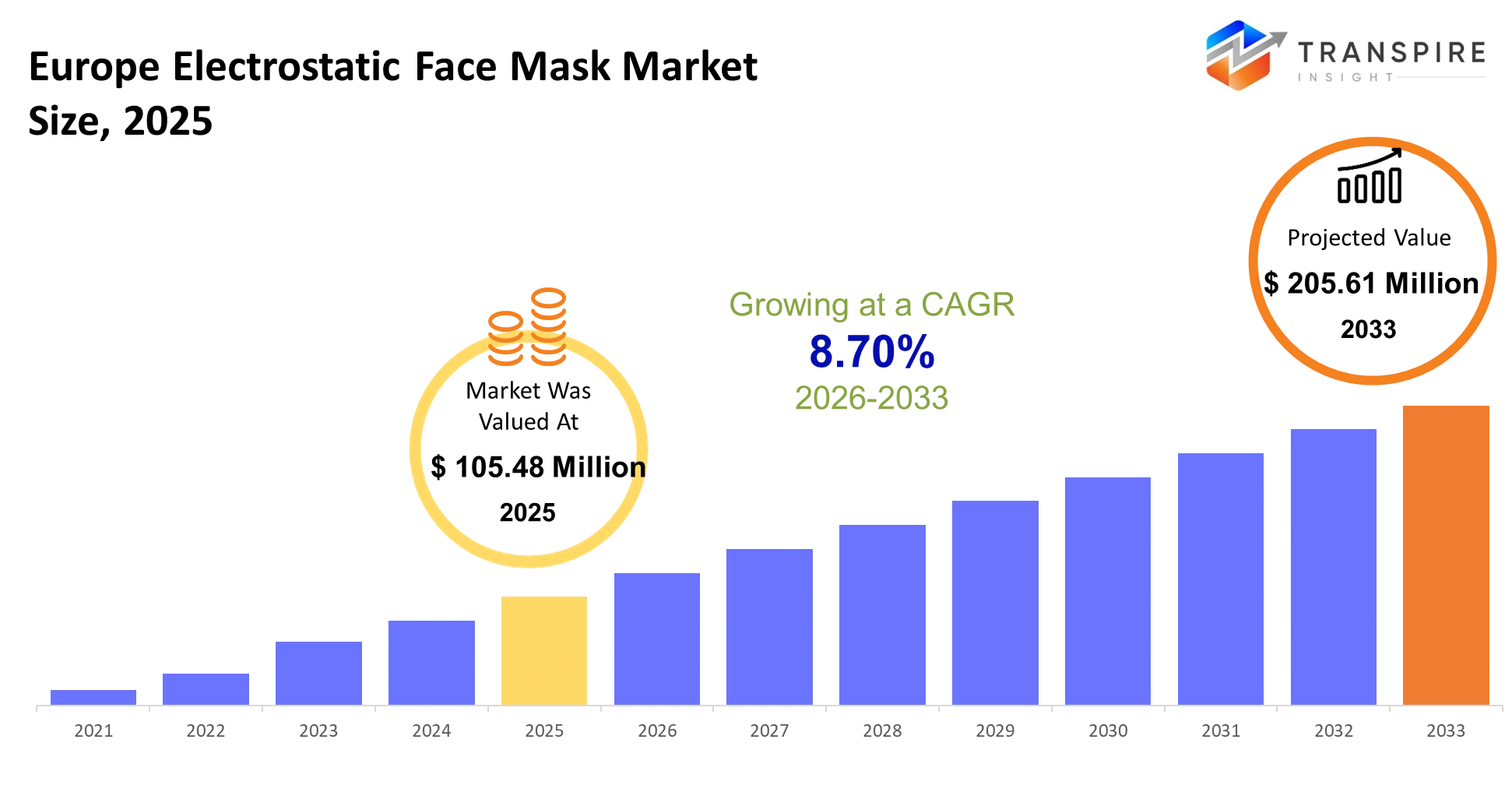
- Europe Electrostatic Face Mask Market Size 2025: USD 105.48 Million
- Europe Electrostatic Face Mask Market Size 2033: USD 205.61 Million
- Europe Electrostatic Face Mask Market CAGR: 8.70%
- Europe Electrostatic Face Mask Market Segments: By Type (N95 Masks, Surgical Masks, KN95 Masks, Cloth Masks, Others), By Application (Healthcare, Industrial Safety, Personal Use, Pollution Protection, Others), By End-User (Hospitals, Industries, Individuals, Government, Others), By Distribution (Online, Retail, Pharmacy Stores, Others).
To learn more about this report,  Download Free Sample Report
Europe Electrostatic Face Mask Market Summary:
The Europe Electrostatic Face Mask Market size is estimated at USD 105.48 Million in 2025 and is anticipated to reach USD 205.61 Million by 2033, growing at a CAGR of 8.70% from 2026 to 2033. The Europe Electrostatic Face Mask Market exists to protect industrial workplaces and healthcare systems and public transportation systems and urban areas with high exposure through its ability to filter tiny airborne particles while maintaining easy airflow. The masks became essential for two purposes because they helped stop infections while enabling factories and logistics centers and laboratories and hospitals to keep running their operations because employee safety determined their production levels and regulatory requirements.
The market has reached a new stage because emergency-related buying patterns have changed into a new buying behavior that focuses on product performance which has lasted for five years. Buyers now prioritize filtration efficiency, breathability, reusable designs, and certified compliance standards rather than stockpiling low-cost disposable products. The COVID-19 pandemic served as the main catalyst which changed how people bought products because it showed European nations relied on foreign protective equipment imports which led to more regional production facilities and stricter safety rule enforcement for personal protective equipment.
The establishment of this system has improved supply chain resilience while promoting the development of long-term contracts for institutional customers. Businesses now depend on industrial safety improvements and healthcare readiness initiatives and environmental health standards to drive their revenue growth instead of relying on temporary increases in product demand during pandemics.
Key Market Insights
- The Germany Electrostatic Face Mask Market obtained market leadership in Europe during 2025 because of its 28% market share which resulted from its strong healthcare system and industrial use of personal protective equipment.
- The French market will experience its fastest growth until 2030 because hospitals will upgrade their procurement systems and new regulations will improve respiratory safety in workplaces.
- Hospitals and manufacturing facilities prefer disposable electrostatic face masks because these masks provide operational convenience and ensure hygiene compliance which resulted in these masks achieving more than 55% of the market share during 2025.
- Reusable electrostatic masks achieved the second-largest market position because their sustainable design and reduced long-term purchasing expenses made them more sustainable.
- Smart filtration and nanofiber-based electrostatic masks will become the fastest-growing segment between 2026 and 2030 because they provide better efficiency in filtering particles.
- The European electrostatic filtration mask market found its main focus in healthcare applications which accounted for approximately 42% market share because hospitals used the masks to prevent infections and hospitals used the masks to prepare for emergencies.
- The industrial manufacturing sector experienced its fastest expansion as factories developed stronger protective measures for their employees against dust and fumes and airborne contaminants.
- The European Electrostatic Face Mask Market recorded its highest revenue from hospitals and healthcare institutions which made up almost 40% of total revenue in 2025.
- Construction and logistics companies emerged as a new end-user group which will continue to expand because safety audits now require workers to use certified respiratory protection equipment.
- Advanced electrostatic filtration systems currently enhance both breathing capacity and particle removal performance which results in increased demand for new equipment throughout the healthcare and industrial markets.
What are the Key Drivers, Restraints, and Opportunities in the Europe Electrostatic Face Mask Market?
The strongest force accelerating the Europe Electrostatic Face Mask Market exists because workplace respiratory protection requirements have become stricter across all healthcare and manufacturing and construction and logistics operations. The COVID-19 pandemic outbreak created a hazardous situation which led to the urgent need for improved emergency protection equipment and better workplace security systems. . European regulators and employers established two requirements because they both needed better filtration systems and larger stockpiling capabilities. Hospitals and pharmaceutical plants and industrial production facilities increased their certified electrostatic mask purchasing through ongoing procurement contracts. The result is a transition from temporary emergency purchasing toward stable, compliance-driven replacement cycles that generate more predictable long-term revenue streams for manufacturers.
The market’s biggest structural barrier remains price pressure from low-cost imported disposable masks, particularly from Asian suppliers. European manufacturers face higher labor, certification, and raw material costs, making local production less price competitive in mass-volume procurement tenders. The challenge exists because it connects to both manufacturing economics and regional supply chain problems which exist across different areas. The result is that multiple buyers still choose products with lower initial costs instead of advanced filtration systems which restrict market access to high-end items and reduce revenue for companies with distinct technological advantages.
The next significant business expansion for the company will occur through the development of reusable electrostatic masks which have replaceable filtration components. The healthcare systems and industrial companies of Germany, France and the Nordic countries now assess total lifecycle procurement expenses instead of evaluating products at their individual unit costs. Companies that invest in nanofiber filtration systems and lightweight reusable respirators will experience increased demand for their high-end products which serve industries that need constant respiratory protection throughout the day.
What Has the Impact of Artificial Intelligence Been on the Europe Electrostatic Face Mask Market?
The European Electrostatic Face Mask Market experiences transformation through artificial intelligence and digital technologies that enhance manufacturing accuracy and stock management and filter testing and performance evaluation. Manufacturers are increasingly using AI-enabled quality inspection systems to detect microscopic defects in electrostatic filtration layers during high-speed production. The automation system operates in certified PPE manufacturing environments to decrease material waste and enhance batch production and decrease product rejection rates. European manufacturers use digital production monitoring systems to improve their energy efficiency and production capacity in their facilities.
The application of machine learning models enables organizations to predict their procurement patterns and institutional usage trends, which they especially use for hospitals and pharmaceutical companies and industrial safety distributors. The suppliers use infection trend analysis together with workplace safety compliance data and seasonal pollution level data to improve their inventory forecasts, which enables them to avoid supply shortages and excessive production. Some manufacturers are also integrating testing systems which use sensors to measure filtration efficiency and airflow resistance and product durability because these systems enable faster product development and regulatory certification.
The new technologies improve operational performance because they reduce downtime and shorten lead times while keeping supply chain operations at their current level. The AI implementation process encounters a major obstacle because most mid-sized European PPE manufacturers lack essential digital systems and historical production data which are necessary for building effective predictive models.
Key Market Trends
- European hospitals achieved decreased usage of imported PPE between 2021 and 2025 through their development of permanent purchasing contracts with local manufacturers and approved suppliers.
- The COVID-19 pandemic caused Germany and France to boost their domestic production of electrostatic masks because the outbreak revealed weaknesses in their healthcare system that relied on Asian imports.
- Manufacturing facilities adopted reusable electrostatic respirators starting in 2023 because these devices helped them reduce both multi-year procurement costs and waste management expenses.
- 3M and Honeywell and other manufacturers dedicated their funding to lightweight filtration solutions which enable better air flow while maintaining their capacity to capture particles.
- European workplace regulators enhanced respiratory safety inspection procedures after 2022 which resulted in increased certified mask replacement intervals for logistics operations and pharmaceutical distribution and construction activities.
- Institutional purchasers shifted their procurement practices after 2021 when they began to value EN-certified filtration capabilities more than they valued selecting the lowest-priced bids.
- European PPE factories implemented digital quality inspection systems between 2022 and 2025 which resulted in decreased defects of filtration materials and production errors.
- Industrial demand in chemical mining and metal fabrication industries rose because these sectors implemented stricter worker exposure rules which took effect after 2023.
- Nordic healthcare systems allocated more funding to reusable filtration systems and recyclable PPE materials because these investments helped them decrease future medical waste disposal expenses.
- Competitors now establish their market presence through combined testing of filtration performance and personnel comfort and local production capabilities instead of using emergency-based manufacturing methods.
Europe Electrostatic Face Mask Market Segmentation
By Type
Healthcare facilities and pharmaceutical operations plus industrial workforces choose N95 masks as their primary face mask solution because these masks meet their need for certified high-filtration respiratory protection in controlled work environments. The market for surgical masks continues to thrive because these masks offer a cost-effective solution which functions effectively in outpatient treatment, laboratory use and employment at public-facing facilities. The European certification requirements made KN95 masks difficult to market during the pandemic when they became popular because N95 products developed higher demand.
Procurement decisions now prioritize medical-grade filtration standards, which caused cloth masks to lose their market share. Customers now prefer reusable electrostatic masks that come with replaceable filters because they want to spend less money over time while generating less waste. Manufacturers create new lightweight filtration materials together with ergonomic designs to help users achieve better comfort during extended usage periods. The type segment will experience future growth through the development of premium reusable respirators and advanced nanofiber filtration technologies, which will create better business opportunities for specialized manufacturers, who will develop products that have higher profit margins.

To learn more about this report, Download Free Sample Report
By Application
Healthcare applications maintain their lead in the application market because hospitals and diagnostic centers and eldercare facilities follow strict infection prevention measures while their equipment needs replacement at regular intervals. Industrial safety applications represent the fastest-growing category as construction mining and chemical and metal processing industries improve their compliance with occupational exposure regulations. The demand for personal use products has decreased since the pandemic peak but it remains higher than pre-2020 levels because of pollution concerns and seasonal respiratory protection practices in urban areas.
Major European cities gained visibility for pollution protection applications because airborne particulate exposure affects transportation workers and outdoor labor-intensive industries. Each application category has its own demand drivers which lead healthcare providers to focus on certification and reliability while industrial users need durability and breathing comfort for their extended work periods. Product development strategies increasingly target application-specific performance requirements which result in manufacturers expanding their product ranges. The future market will grow through multi-use filtration technologies which provide medical and industrial solutions that maintain compliance with regulatory standards.
By End-User
The main user group for hospitals exists because their centralized procurement systems and required PPE stockpiles lead to continuous procurement of high-volume purchasing agreements.The second largest user group for companies occurs because manufacturing, logistics, and heavy engineering industries now enforce stricter workplace respiratory protection standards. Government agencies also maintain an important role through emergency preparedness programs and strategic stockpile investments designed to avoid supply disruptions during future public health events. Individual consumers created significant product demand during pandemic years, but their buying behavior changed to include only essential items for use in crowded transport systems and polluted urban areas.
Different end-user groups apply distinct purchasing criteria, with hospitals prioritizing certified performance, industries emphasizing operational comfort, and governments focusing on supply reliability and domestic production capacity.The future will bring business opportunities through supply partnerships that combine PPE manufacturers with healthcare systems and industrial safety organizations throughout Europe.
By Distribution
The period after 2020 saw rapid growth of online distribution channels because both institutional buyers and individual consumers started using digital procurement platforms which provided them with quicker access to products and better options to compare items. Pharmacy stores continue to hold a strong position because healthcare professionals and consumers trust regulated retail channels for certified respiratory protection products. The retail sector showed varying business results because emergency demand decreased and customers began purchasing through dedicated healthcare distribution channels. Large manufacturing companies started using direct industrial procurement channels to establish long-term supply agreements which included their specific needs for respiratory protection equipment.
Companies now design distribution systems to achieve complete inventory visibility through distribution centers which enable them to fulfill customer orders at high speeds because prior supply chain disruptions showed how traditional procurement methods failed to protect them. Institutional customers now use digital platforms to access bulk purchasing analytics and automated replenishment systems and compliance tracking features. The future of distribution competition will benefit suppliers who possess complete omnichannel systems and regional delivery networks and who maintain strong partnerships with both healthcare procurement organizations and industrial safety supply distributors.
What are the Key Use Cases Driving the Europe Electrostatic Face Mask Market?
The primary application of electrostatic face masks throughout Europe is in healthcare environments because hospitals and clinics and eldercare facilities apply strict rules for controlling airborne infections. The need for institutional buyers to acquire medical supplies arises from two factors which include their continuous contact with patients and the requirement to replace personal protective equipment at scheduled times.
Workers in construction chemical processing mining and metal fabrication facilities now have access to industrial safety applications which protect them from extended contact with dust and fumes and airborne particles. Certified respiratory protection is now being adopted by logistics operators and public transportation staff who work in high-density urban environments which have more stringent workplace safety regulations.
The market for reusable electrostatic respirators will emerge in pharmaceutical cleanrooms while advanced filtration masks will protect against pollution in major European cities. The research laboratories and biotechnology facilities are developing demand because operators need to control contamination while ensuring that users can wear their equipment for extended periods.
|
Report Metrics |
Details |
|
Market size value in 2025 |
USD 105.48 Million |
|
Market size value in 2026 |
USD 114.66 Million |
|
Revenue forecast in 2033 |
USD 205.61 Million |
|
Growth rate |
CAGR of 8.70% from 2026 to 2033 |
|
Base year |
2025 |
|
Historical data |
2021 - 2024 |
|
Forecast period |
2026 - 2033 |
|
Report coverage |
Revenue forecast, competitive landscape, growth factors, and trends |
|
Regional scope |
Europe (Germany, United Kingdom, France, Italy, Spain and Rest of Europe) |
|
Key company profiled |
3M, Honeywell, Kimberly-Clark, Ansell, Moldex, Alpha Pro Tech, Lakeland, Uvex, Drager, Medline, Cardinal Health, Prestige Ameritech, Shanghai Dasheng, Winner Medical, BYD |
|
Customization scope |
Free report customization (country, regional & segment scope). Avail customized purchase options to meet your exact research needs. |
|
Report Segmentation |
By Type (N95 Masks, Surgical Masks, KN95 Masks, Cloth Masks, Others), By Application (Healthcare, Industrial Safety, Personal Use, Pollution Protection, Others), By End-User (Hospitals, Industries, Individuals, Government, Others), By Distribution (Online, Retail, Pharmacy Stores, Others) |
Which Regions are Driving the Europe Electrostatic Face Mask Market Growth?
The market reaches its highest point in Northern Europe because Germany, France and the Nordic countries operate as the main market force through their implementation of strict workplace respiratory safety rules and their development of advanced industrial compliance systems. The healthcare system and pharmaceutical production capacity of this region enable hospitals and medical facilities to obtain high-performance electrostatic filtration masks throughout their operations. The regulatory authorities in this area establish EN certification requirements that enforce strict testing standards which results in customers choosing expensive certified goods instead of cheaper products. The industrial ecosystem of the region includes chemical processing facilities and automated manufacturing plants which create permanent institutional requirements and enduring relationships with suppliers.
The secondary market area of Western Europe consists of the United Kingdom, Belgium and the Netherlands which maintain their market position because of their economic strength and their capacity to produce different types of industrial output. The region depends on permanent corporate purchasing procedures from its logistics operations, aviation support services and port-based operations because it does not have the Nordic countries' strict regulatory system. The extensive shipping and freight operations at Rotterdam and Antwerp generate ongoing demand for respiratory protection equipment which is needed in both handling and warehousing operations. Regional shipowners and industrial operators choose to establish reliable supply contracts and standardized products instead of adopting new technologies that emerge at a fast pace. The stable business environment generates consistent income streams that increase at a steady pace throughout each period.
The Southern and Eastern European region has become the fastest developing area because both industrial modernization initiatives and European Union occupational safety regulations have recently been implemented.
Who are the Key Players in the Europe Electrostatic Face Mask Market and How Do They Compete?
The Europe Electrostatic Face Mask Market shows a moderately consolidated top tier which is dominated by global PPE manufacturers while mid-sized European producers compete across regional contracts. The competition tests three aspects which include certified filtration performance under EN standards and pricing efficiency and long-term institutional supply agreements. Incumbents sustain their market share through their existing healthcare procurement networks while smaller companies create market pressure through their ability to produce goods locally and provide flexible delivery options.
3M develops electrostatic filtration technology through its research which combines modern melt-blown materials with respirators that achieve European EN certification standards for hospital and industrial applications. Honeywell uses its industrial-strength durability and logistics-capacity supply agreements to create customer demand from manufacturing hubs. Moldex creates a competitive advantage through its ergonomic reusable mask products which enable extended usage in work environments. Kimberly-Clark uses its distribution relationships with healthcare organizations to connect with hospitals and clinics while using institutional procurement systems to broaden its market access.
Uvex Group develops premium electrostatic filtration masks which fulfil industrial standards required for the automotive and chemical industries. Dräger establishes its market dominance through its complete respiratory protection solutions which industrial and emergency personnel need for dangerous work situations. Both companies expand through EU regulatory alignment programs and direct partnerships with industrial safety distributors across Central Europe.
Company List
- 3M
- Honeywell
- Kimberly-Clark
- Ansell
- Moldex
- Alpha Pro Tech
- Lakeland
- Uvex
- Drager
- Medline
- Cardinal Health
- Prestige Ameritech
- Shanghai Dasheng
- Winner Medical
- BYD
Recent Development News
In April 2026, Honeywell Expands Industrial Safety Portfolio While Reorganizing Industrial Automation Unit: Honeywell reported strong industrial automation performance while continuing portfolio restructuring, which includes its safety and PPE-adjacent product lines used in European industrial environments. The company emphasized continued investment in advanced safety technologies across regulated markets.
Source: https://investor.honeywell.com
In April 2026, Drägerwerk AG & Co. KGaA: Dräger with strong first quarter in 2026: Lübeck – Drägerwerk AG & Co. KGaA further increased its order intake in the first quarter of 2026 thanks to good demand. At around EUR 865 million, order intake exceeded the high prior-year figure by around EUR 4 million (3 months 2025: EUR 860.8 million). Net sales rose by around EUR 26 million to around EUR 756 million (3 months 2025: EUR 730.3 million).
Source: https://www.eqs-news.com
What Strategic Insights Define the Future of the Europe Electrostatic Face Mask Market?
The Europe Electrostatic Face Mask Market is moving toward a technology-driven system which requires strict compliance where organizations now select their products based on filtration performance and total cost of ownership and regulatory compliance instead of their price. The enforcement of stricter occupational safety regulations across healthcare and industrial sectors combined with institutional buyers establishing respiratory protection standards for their long-term risk management programs drives this transition. The upcoming demand for the next 5 to 7 years will focus on reusable electrostatic filtration systems which provide high efficiency and form part of comprehensive workplace safety programs instead of individual PPE purchases.
The industrial workplaces face hidden danger which comes from companies implementing integrated air purification systems together with engineering controls to reduce their need for personal respiratory protection throughout time. The supply chain relies on specialized filtration media which makes it open to price fluctuations that affect raw materials especially melt-blown and nanofiber materials.
The market presents an opportunity for digitally traceable smart respirators that enable hospitals and industrial operators in Germany and the Nordics to monitor usage while maintaining compliance. The market participants should make early investments in certified reusable electrostatic platforms which contain compliance tracking features because this will help them win institutional contracts while establishing competitive advantages through upcoming data-driven regulatory requirements.
Europe Electrostatic Face Mask Market Report Segmentation
By Type
- N95 Masks
- Surgical Masks
- KN95 Masks
- Cloth Masks
- Others
By Application
- Healthcare
- Industrial Safety
- Personal Use
- Pollution Protection
- Others
By End-User
- Hospitals
- Industries
- Individuals
- Government
- Others
By Distribution
- Online
- Retail
- Pharmacy Stores
- Others
Frequently Asked Questions
Find quick answers to common questions.
The approximate Europe Electrostatic Face Mask Market size for the market will be USD 205.61 Million in 2033.
The key segments of the Europe Electrostatic Face Mask Market are By Type (N95 Masks, Surgical Masks, KN95 Masks, Cloth Masks, Others), By Application (Healthcare, Industrial Safety, Personal Use, Pollution Protection, Others), By End-User (Hospitals, Industries, Individuals, Government, Others), By Distribution (Online, Retail, Pharmacy Stores, Others).
Major players in the Europe Electrostatic Face Mask Market are 3M, Honeywell, Kimberly-Clark, Ansell, Moldex, Alpha Pro Tech, Lakeland, Uvex, Drager, Medline, Cardinal Health, Prestige Ameritech, Shanghai Dasheng, Winner Medical, BYD.
The current market size of the Europe Electrostatic Face Mask Market is USD 105.48 Million in 2025.
The Europe Electrostatic Face Mask Market CAGR is 8.70%.
- 3M
- Honeywell
- Kimberly-Clark
- Ansell
- Moldex
- Alpha Pro Tech
- Lakeland
- Uvex
- Drager
- Medline
- Cardinal Health
- Prestige Ameritech
- Shanghai Dasheng
- Winner Medical
- BYD
Recently Published Reports
-
Apr 2026
AI in Diabetic Retinopathy Market
AI in Diabetic Retinopathy Market Size, Share & Analysis Report By Type (Screening AI Systems, Diagnostic AI Systems, and Predictive AI Models), By Application Segment (Hospitals, Ophthalmology Clinics, Diagnostic Centers, and Research and Development), and Geography (North America, Europe, Asia-Pacific, Middle East and Africa, South and Central America), 2021 - 2031
-
Apr 2026
Psychometric Tests Market
Psychometric Tests Market Size, Share & Analysis Report By Type (Personality Tests, Ability/Aptitude Tests, Skill/Knowledge Tests, and Others), By Application (Talent Acquisition and Talent Management), and Geography (North America, Europe, Asia-Pacific, Middle East and Africa, South and Central America), 2021 – 2031
-
Apr 2026
Rare Biological Sample Collection Market
Rare Biological Sample Collection Market Size, Share & Analysis Report By Type (Isolation Kits & Reagent, Blood Collection Tubes, and Others), By Application (Oncology, Transcriptomics, Pharmacogenomics, and Others), and Geography (North America, Europe, Asia-Pacific, Middle East and Africa, South and Central America), 2021 – 2031
-
Apr 2026
Patient Lift Pendant Market
Patient Lift Pendant Market By Product Type (Wired Pendants, Wireless, Programmable), By Operation Type(Manual, Electric), By End-Users (Healthcare Professionals, Patients), By Application (Hospitals, Homecare, Rehabilitation Centers, Others), By Industry Analysis, Size, Share, Growth, Trends, and Forecasts 2021-2033
Our Clients
.jpg)