

Europe Chelating Agents Market Summary
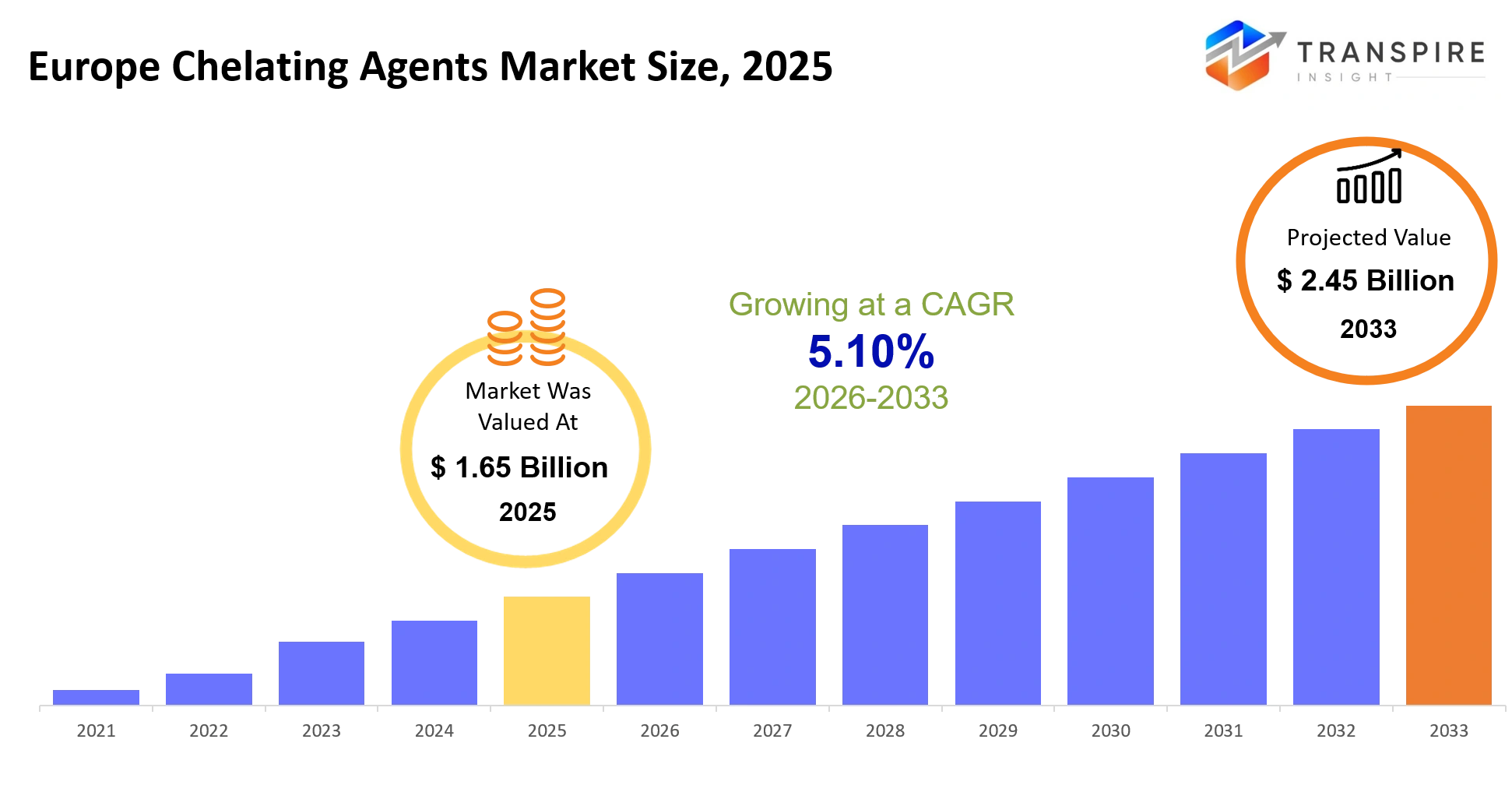
As per Transpire Insight Analysis the Europe Chelating Agents Market size is estimated at USD 1.65 Billion in 2025 and is anticipated to reach USD 2.45 Billion by 2033, growing at a CAGR of 5.10% from 2026 to 2033.
Chelating agents kinda help industries keep unwanted metal ions in check, because those ions can mess up equipment, lower how well processes run, or even change product quality across water treatment, cleaning, manufacturing, and marine operations. In real practice, these chemicals back corrosion control, scale prevention, and more stable industrial routines where metal contamination turns into day to day operational trouble. The European Chelating Agents Market has evolved significantly over the past few years, as many industries have been leaning toward biodegradable and lower-impact formulations, partly because environmental regulations have tightened and sustainability targets have become more stringent. A big trigger was the European Union’s stricter chemical regulations, which basically nudged manufacturers to reformulate their products and switch to safer alternatives. Also, supply chain disruptions mattered, since companies tried to lock in consistent sourcing , and at the same time they optimized how much chemical they actually used. Market growth is tied to industrial users wanting practical metal management solutions, ones that satisfy compliance requirements while also supporting stronger operational performance and long run cost efficiency.
Europe Chelating Agents Market Size & Forecast:
- Europe Chelating Agents Market Size 2025: USD 1.65 Billion
- Expected Market Value 2033: USD 2.45 Billion
- Forecast CAGR: 5.10%
- Leading country in 2025: Germany
- Fastest-growing country: France
- Key Profile: BASF, Nouryon, Dow, Kemira, LANXESS, Innospec, Mitsubishi Chemical, Ascend Performance Materials, Protex International, Jungbunzlauer, Akzo Nobel, Solvay, Merck KGaA, Shandong IRO Chelating Chemical, Aditya Birla Chemicals.
Key Market Insights
- In 2025 Western Europe sort of dominated the market with about 58% share, mostly because Germany, France ,and UK industrial use cases kept pushing demand.
- Meanwhile, Eastern Europe is expected to grow the quickest in 2025–2033 with infrastructure improvements in Poland and Romania in particular.
- When it comes to products , aminopolycarboxylic acids were leading, taking nearly 45% share in 2025, and that was tied to both wide industrial use, plus agricultural needs.
- Phosphonates then held the second-largest slice of the pie, mainly supported by water treatment work and detergent-related applications across Europe.
- For segment growth, biodegradable chelating agents look set to be the fastest-moving through 2033, since regulations keep nudging companies toward more sustainable chemical adoption.
- On the application side, water treatment was in front in 2025 at roughly 35% share, pushed by stricter European wastewater rules and enforcement.
- Pharmaceutical and personal care areas will see the fastest adoption too, as specialty formulations expand after 2026, sort of gradually.
- In end users, industrial manufacturing stayed on top with close to 40% share, largely due to metal control requirements.
- Agriculture is the fastest-growing end-user category, helped by precision farming uptake and also micronutrient fertilizer demand.
- Lastly, BASF kept expanding specialty chemical solutions via investments in sustainable formulation, aiming to strengthen its position in the European market.
What are the Key Drivers, Restraints, and Opportunities in the Europe Chelating Agents Market?
Primary growth in the Europe Chelating Agents Market is, sort of driven by stricter environmental rules and industrial efficiency requirements that came in through European chemical policies. Basically the restriction of persistent chemical substances, under these regulatory frameworks has pushed faster adoption of biodegradable alternatives, so manufacturers are moving toward more advanced aminopolycarboxylate and phosphonate formulations. As a result product uptake has been better in water treatment, agriculture and industrial processing, because companies still want solutions that keep performance steady while they hit compliance targets. That whole transition from conventional formulations to sustainable chelating technologies is generating new revenue chances for chemical producers and it is also pulling more investment into research and development efforts.
The big restraint however is the high cost of switching away from traditional formulations to these advanced biodegradable alternatives. Chemical producers often deal with complex reformulation work, plus extra testing requirements, and then there are certification timelines before anything is commercially deployed. These hurdles can slow down product launches and they tend to reduce adoption among small to medium sized manufacturers. Based on a Transpire Insight review of regional procurement announcements and launch schedules, supply chain concentration remains the main execution risk. In practice dependence on a few specialty chemical suppliers makes procurement less predictable and that can lead to delays in industrial applications.
The next, growth opportunity kinda comes from smart chemical management systems that are tied in with digital monitoring tech, you know, the kind that keeps watch all the time. So when firms put money into automated water treatment facilities, plus precision farming platforms across Germany, the Netherlands, and the Nordic countries, that will start driving demand for chelating solutions that are somehow better tuned. Also the producers who manage to build low-impact formulations with real-time application monitoring features will likely get a firmer competitive edge during the next stretch of market expansion.
What Has the Impact of Artificial Intelligence Been on the Europe Chelating Agents Market?
Artificial intelligence plus digital technologies are slowly messing around with chemical production, quality control, and supply management across the European chelating agents industry. Manufacturers are starting to wire in AI driven monitoring systems, so they can keep production tracking automated, spot process deviations, and also make regulatory compliance reporting a bit less painful and more consistent. At the same time, digital platforms allow chemical plants to sift through operational data from reactors, storage systems, and treatment facilities, which helps keep product quality steady and cuts down on those repetitive manual checks.
Machine learning models are also being used for demand forecasting, inventory optimization, and predictive maintenance of the manufacturing equipment. In practice, these models read past production rhythms, customer purchasing cycles, and equipment performance signals, then try to guess when servicing will be needed. This approach is meant to reduce that annoying unexpected downtime. On top of that, advanced analytics can raise operational effectiveness by tuning raw material usage, improving production dependability, and supporting quicker decision making across the chemical supply chain network.
Still, AI adoption is not everywhere, because the implementation costs can be high , and the industrial data setup is kind of fragmented. A lot of smaller producers don’t have the connected systems needed for accurate machine learning outputs. There are also data quality gaps , plus uneven reporting habits, so the AI tools struggle to give reliable predictions in these complicated manufacturing situations. But even with all that, digital transformation will keep nudging specialty chemical operations across Europe, and it will probably keep doing so in the near future too.
Key Market Trends
- From 2022 to 2025, European regulators kinda sped up chemical sustainability expectations, so manufacturers were encouraged to come up with biodegradable chelating alternatives, and yes it did feel faster than before.
- In Germany, after 2023, specialty chemical investments climbed too, which helped local production strength, and it also eased dependence on imported formulations, a bit.
- After 2024, biodegradable chelators really got more traction, since companies shifted toward safer options for industrial wastewater uses, not just lip service. Meanwhile during 2023–2025, digital monitoring adoption expanded, improving chemical dosage accuracy and dialing back some operational inefficiencies , that part mattered.
- Also, after 2022, precision agriculture solutions increased, which created fresh demand for chelating agents inside micronutrient fertilizer systems.
- Across Europe, water treatment upgrades accelerated after 2021, pushed by tougher wastewater management rules and infrastructure modernization that just kept rolling.
- Chemical manufacturers also expanded partnerships between 2023 and 2025, to move sustainable formulation research along and get commercialization going sooner, or at least with more coordination.
- After 2022, supply chain diversification became a priority, because European producers were trying to manage raw material availability risks.
- And then after 2024, pharmaceutical applications rose, backed by advanced formulations that need better metal ion control tech, basically more refined management.
Europe Chelating Agents Market Segmentation
By Product Type:
EDTA continues to be used a lot because its chelation is, well, pretty strong when it comes to metal binding across a range of industrial applications. NTA and DTPA keep being adopted in more specialized formulations, where mineral control and process stability are kind of the main thing. GLDA and IDS are also getting attention now, since some manufacturers are switching toward safer chemical options, with better environmental outcomes overall.
Citric Acid-based Chelating Agents are picking up speed because there’s more demand for renewable and biodegradable options. Other product groups support those more niche needs across several industries too. What gets picked next, in Europe, will likely depend on product innovation, regulatory compliance, and sustainability targets for the Chelating Agents Market applications.
By Application:
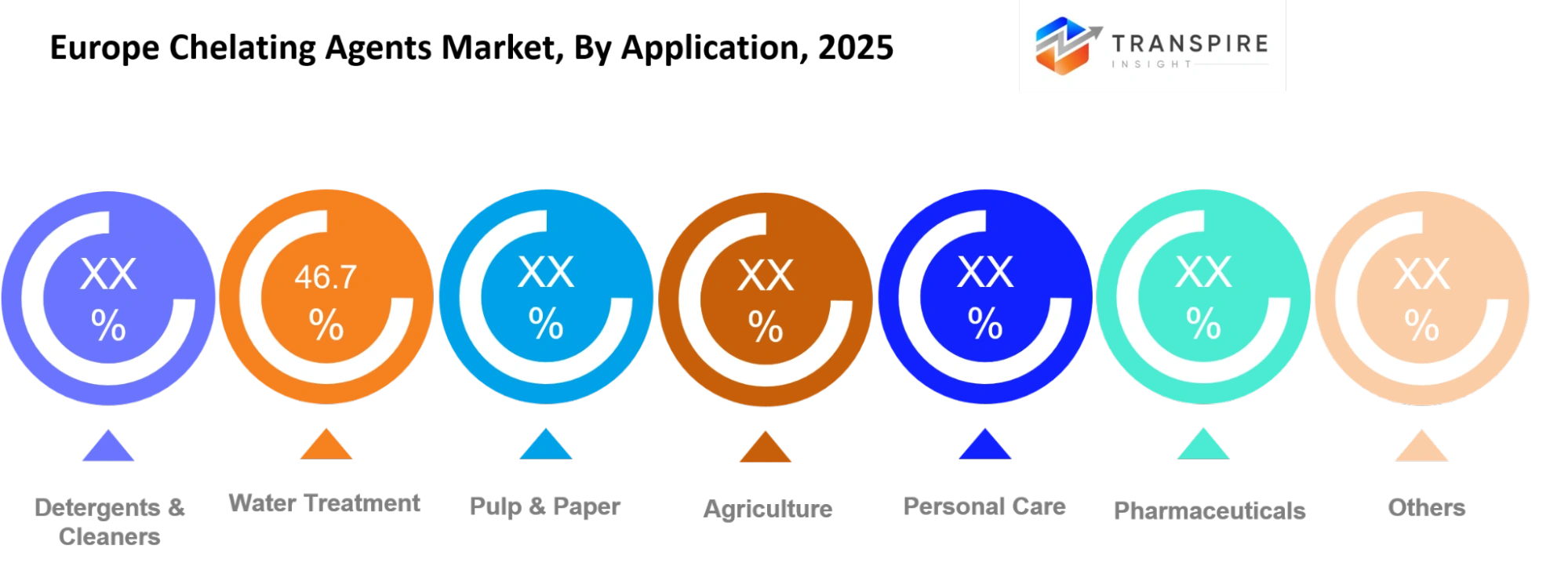
Detergents & Cleaners is a big application area, mostly because chelating solutions help cleaning performance and they also help reduce mineral scale or deposits. Water Treatment is growing as municipalities and companies upgrade their treatment systems, to satisfy tighter quality requirements. In Pulp & Paper operations, chelating agents are used for process control and, in general, for better production efficiency.
Agriculture uses are rising as micronutrient fertilizers are being used more, along with newer crop nutrition products. Personal Care and Pharmaceuticals still need specialized formulations that support product stability and quality improvement. Other applications continue to carry demand through industrial, and specialty chemical uses, in a more steady way.
By End User:
The Chemical Industry keeps being a big end-user segment, mainly because chelating agents are used everywhere, in manufacturing processes, formulation development, and day to day industrial operations , so yeah it’s hard to replace. Water Utilities are also leaning in more as wastewater management standards tighten up across many European countries. In Agriculture, chelating solutions are being applied to boost nutrient availability and improve crop performance, you know.
Personal Care Manufacturers and Healthcare companies often pick specialized chelating ingredients to maintain formulation stability and support quality control, which matters a lot. There are also other end users that take part at smaller or more practical levels, meaning smaller scale industrial and commercial applications. Over time, changing regulations and evolving production standards will keep directing end-user buying behavior in one direction or another.
By Source:
For the product types, synthetic chelating agents still hold a solid position, mostly because the production methods are already in place, the performance stays consistent, and the industry accepts them, with very low friction. Meanwhile Bio-Based chelating agents are getting more attention, since manufacturers are focusing on sustainable chemistry and on solutions with lower environmental impact. Citric acid based approaches and other renewable sources back this shift toward greener chemical production.
Looking ahead, Research spending and regulatory pressure should keep pushing more bio-based alternatives forward. Other sources bring additional options when people need something specialized for particular industrial applications. Ultimately, source selection will come down to what performance is required, the cost side of things, and sustainability goals, although it varies a bit from case to case.
By Distribution Channel:
Direct Sales still feels like an important way of distribution for big industrial buyers, especially when they need customized supply agreements and some kind of technical backing. Chemical Distributors basically open up a broader market reach through their established networks, across Germany, France the United Kingdom, Italy and also other European countries. Online Procurement is moving forward too, because digital purchasing platforms keep getting better at making chemical sourcing more efficient, in a sort of smoother way.
Then there are other distribution channels, they tend to support regional buyers and more specialized requests. In the end supply chain reliability delivery speed, and the supplier relationship side will steer what channel gets chosen. Digital platforms may also bring more chances for quicker procurement steps across the chemical industry, almost like less friction overall.
What are the Key Use Cases Driving the Europe Chelating Agents Market?
Water treatment still feels like the main thing pushing demand in the Europe Chelating Agents Market. Municipal water utilities, industrial treatment operators, and chemical processors buy chelating solutions, to keep metal ions under control , boost overall treatment efficiency and also to satisfy the tight European wastewater requirements.
Then you have detergent manufacturers too. They use chelating agents to improve cleaning performance a bit more, and to lessen mineral interference inside both household and industrial products. In agriculture, companies are increasingly switching to chelated micronutrient solutions , in order to improve fertilizer effectiveness and support precision farming approaches.
More recent uses are showing up as well. Think about advanced pharmaceutical formulations, and sustainable personal care products that use bio based chelating agents. Also, the growing regulatory emphasis on safer chemicals will likely open up opportunities for manufacturers aiming at cleaner production methods.
|
Report Metrics |
Details |
|
Market size value in 2025 |
USD 1.65 Billion |
|
Market size value in 2026 |
USD 1.73 Billion |
|
Revenue forecast in 2033 |
USD 2.45 Billion |
|
Growth rate |
CAGR of 5.10% from 2026 to 2033 |
|
Base year |
2025 |
|
Historical data |
2021 - 2024 |
|
Forecast period |
2026 - 2033 |
|
Report coverage |
Revenue forecast, competitive landscape, growth factors, and trends |
|
Country scope |
Europe (Germany, United Kingdom, France, Italy, Spain and Rest of Europe) |
|
Key company profiled |
BASF, Nouryon, Dow, Kemira, LANXESS, Innospec, Mitsubishi Chemical, Ascend Performance Materials, Protex International, Jungbunzlauer, Akzo Nobel, Solvay, Merck KGaA, Shandong IRO Chelating Chemical, Aditya Birla Chemicals. |
|
Customization scope |
Free report customization (country, regional & segment scope). Avail customized purchase options to meet your exact research needs. |
|
Report Segmentation |
By Product Type (EDTA, NTA, DTPA, GLDA, IDS, Citric Acid-Based Chelating Agents, Others); By Application (Detergents & Cleaners, Water Treatment, Pulp & Paper, Agriculture, Personal Care, Pharmaceuticals, Others); By End User (Chemical Industry, Water Utilities, Agriculture, Personal Care Manufacturers, Healthcare, Others); By Source (Synthetic, Bio-Based, Others); By Distribution Channel (Direct Sales, Chemical Distributors, Online Procurement, Others). |
Which Regions are Driving the Europe Chelating Agents Market Growth?
Western Europe kind of holds the dominant position in the Europe Chelating Agents Market, with around 58% market share in 2025. A lot of the pull comes from strict environmental regulations , more advanced wastewater treatment requirements, and industrial compliance rules that make adoption feel almost automatic across Germany, France , and the United Kingdom. The region also has an edge because established chemical manufacturers are already there, plus they run advanced production facilities and supply routes that connect well with multiple end use industries. And because companies keep investing in sustainable chemicals and general industrial modernization, Western Europe is likely to keep the lead up through 2033.
Southern Europe brings in stable revenue, mostly from steady demand tied to agriculture, food processing, and industrial manufacturing. Italy and Spain , for example, keep consumption steady because of well rooted farming practices , and also because water management systems keep improving. With regulatory alignment to broader European chemical standards, market conditions stay pretty predictable, so long term investments feel easier to justify. Overall, the region stays a dependable contributor, supported by balanced industrial work and a gradual uptake of newer technologies.
Eastern Europe looks like the fastest growing region, especially as Poland , Romania, Hungary, and the Czech Republic push out industrial infrastructure and upgrade wastewater treatment facilities. There have been new investments in manufacturing capacity and environmental initiatives, which means adoption of more advanced chemical solutions keeps rising. Industrial output is moving up, and modernization programs are opening fresh possibilities for suppliers. From 2026 to 2033, growth in Eastern Europe should keep drawing market entrants who want expansion chances and additional, emerging revenue streams.
Who are the Key Players in the Europe Chelating Agents Market and How Do They Compete?
Competition in the Europe Chelating Agents Market still looks pretty moderately consolidated, meaning big global chemical producers hang side by side with more specialized manufacturers. In practice, they do not only chase pricing, it is more like sustainable product development, formulation technology, dependable supply, plus how strong their regional distribution network is. Established suppliers try to guard their market position by pushing greener alternatives into the mix , while specialized producers keep showing up with new bio based solutions and sometimes more curious functional angles.
BASF boosts its competitiveness via sustainable chemical innovation and also by widening specialty formulation abilities. Their research and development spending helps create advanced chelating solutions meant for industrial , and agricultural applications. Nouryon keeps focus on environmentally improved formulations along with technical know how, so customers can shift toward safer chemical processes with less friction.
Dow fights back using technology led solutions and product development that really leans into specific applications across industrial markets. LANXESS expands further by putting money into specialty chemistry, with offerings aimed at water treatment and industrial use cases. Taken together, these moves build real differentiation through innovation, regulatory support, and customer specific technical services , not just broad commodity style competition.
Company List
- BASF
- Nouryon
- Dow
- Kemira
- LANXESS
- Innospec
- Mitsubishi Chemical
- Ascend Performance Materials
- Protex International
- Jungbunzlauer
- Akzo Nobel
- Solvay
- Merck KGaA
- Shandong IRO Chelating Chemical
- Aditya Birla Chemicals
Recent Development News
In 2025, Nouryon launched the Dissolvine® MAX range of sustainable chelating agents at the SEPAWA Congress. The technology launch introduced chelating solutions with 100% renewable carbon content and ISCC PLUS certification, targeting lower-carbon detergent formulations across European home care and industrial cleaning markets.
Source: https://www.nouryon.com/
In April 2025, BASF launched Trilon® G chelating agent based on GLDA (glutamic acid diacetate) chemistry. The product launch expanded BASF’s sustainable chelating agent portfolio with a partially biobased and readily biodegradable solution designed to improve cleaning performance in home care and industrial applications.
Source: https://www.basf.com/
What Strategic Insights Define the Future of the Europe Chelating Agents Market?
Over the next 5–7 years the Europe Chelating Agents market is likely headed toward more higher value and sustainable formulations, even if at the moment some players are still unsure. This shift is being pushed by tougher environmental standards , growing demand for biodegradable inputs, and industrial users wanting better process efficiency, not just “good enough” performance. There is also a bit of a hidden risk here: dependency on raw material sources for bio-based chelating agents. If supply gets disrupted or pricing pressure shows up on renewable feedstocks , adoption could slow even while the broader growth signals look strong.
At the same time, there’s a developing opportunity that feels pretty clear: more advanced biodegradable chelates, especially for water treatment and specialty agriculture uses. European sustainability regulations and circular chemistry initiatives are backing that movement, and it makes the whole direction harder to ignore. Market participants should focus on investing in certified green product development, improving and strengthening regional supply networks, and building partnerships with end users. That last part matters because it helps secure long term positioning as the application segments continue to evolve.
Europe Chelating Agents Market Report Segmentation
By Product Type
- EDTA
- NTA
- DTPA
- GLDA
- IDS
- Citric Acid-Based Chelating Agents
By Application
- Detergents & Cleaners
- Water Treatment
- Pulp & Paper
- Agriculture
- Personal Care
- Pharmaceuticals
By End User
- Chemical Industry
- Water Utilities
- Agriculture
- Personal Care Manufacturers
- Healthcare
By Source
- Synthetic
- Bio-Based
By Distribution Channel
- Direct Sales
- Chemical Distributors
- Online Procurement
Frequently Asked Questions
Find quick answers to common questions.
The expected Europe Chelating Agents Market size for the market will be USD 2.45 Billion in 2033.
Key segments for the Europe Chelating Agents Market are By Product Type (EDTA, NTA, DTPA, GLDA, IDS, Citric Acid-Based Chelating Agents, Others); By Application (Detergents & Cleaners, Water Treatment, Pulp & Paper, Agriculture, Personal Care, Pharmaceuticals, Others); By End User (Chemical Industry, Water Utilities, Agriculture, Personal Care Manufacturers, Healthcare, Others); By Source (Synthetic, Bio-Based, Others); By Distribution Channel (Direct Sales, Chemical Distributors, Online Procurement, Others).
Major Europe Chelating Agents Market players are BASF, Nouryon, Dow, Kemira, LANXESS, Innospec, Mitsubishi Chemical, Ascend Performance Materials, Protex International, Jungbunzlauer, Akzo Nobel, Solvay, Merck KGaA, Shandong IRO Chelating Chemical, Aditya Birla Chemicals.
The Europe Chelating Agents Market size is USD 1.65 Billion in 2025.
The Europe Chelating Agents Market CAGR is 5.10% from 2026 to 2033.
- BASF
- Nouryon
- Dow
- Kemira
- LANXESS
- Innospec
- Mitsubishi Chemical
- Ascend Performance Materials
- Protex International
- Jungbunzlauer
- Akzo Nobel
- Solvay
- Merck KGaA
- Shandong IRO Chelating Chemical
- Aditya Birla Chemicals
About the Authors

Pankaj Ghogare Patil
I am Pankaj Ghogare Patil, a Senior Research Analyst at Transpire Insight, specializing in the Pharmaceutical, Chemicals & Materials, Healthcare IT, and Biotechnology industry. My expertise lies in conducting comprehensive market research, analyzing industry trends, evaluating competitive landscapes, and translating complex data into actionable insights. At Transpire Insight, I closely follow emerging technologies, regulatory developments, and market innovations to create accurate, well-researched, and informative content that helps businesses and professionals make informed decisions. I am committed to producing credible, evidence-based articles that reflect industry best practices while making technical topics accessible and valuable for a broad audience.

Chakradhar Khansole
Chakradhar serves as the Research Director at Transpire Insight, bringing over 8 years of experience in technology, innovation, and strategic market intelligence. He specializes in transforming complex market data into actionable business insights that enable organizations to make informed, growth-oriented decisions. Recognized for his strategic vision and analytical expertise, Chakradhar leads high-impact research initiatives, delivering comprehensive market assessments, competitive intelligence, and forward-looking industry analysis.
Recently Published Reports
-
May 2026
Healthcare Polymer Packaging Market
Healthcare Polymer Packaging Market Size, Share & Analysis Report By Packaging Type (Syringes, IV Bottles and Pouches, Clamshells, Blisters, Bottles & Jars, Containers, Tubes, IV Parental Packaging, Others), By Type (Regulated, Non-regulated), By Polymer Type (LDPE (Low-Density Polyethylene), HDPE (High-Density Polyethylene), Homo-polymer (Homo), Random Copolymer (Random), Block Copolymer (Block), PET, Polystyrene, Polyvinyl Chloride, Polyamide/EVOH, Others), and Geography (North America, Europe, Asia-Pacific, Middle East and Africa, South and Central America), 2021 - 2031
-
Apr 2026
Hydrophilic Tape (Waterstop) Market
Hydrophilic Tape (Waterstop) Market Size, Share & Analysis Report By Type (Bentonite-Based Hydrophilic Tape, Rubber-Based Hydrophilic Tape), By Application (Residential Buildings, Commercial Buildings, Infrastructure Projects), and Geography (North America, Europe, Asia-Pacific, Middle East and Africa, South and Central America), 2021 - 2031
-
Apr 2026
Metalens Market
Metalens Market Size, Share & Analysis Report By Type (Visible Light Metalens, and Infrared Metalens), By Application (Consumer Electronics, Automotive Electronics, Industrial, Medical, and Others), and Geography (North America, Europe, Asia-Pacific, Middle East and Africa, South and Central America), 2021 - 2031
-
Apr 2026
PBT Resin Market
PBT Resin Market Size, Share & Analysis Report By Type (Reinforced PBT Resin, Unreinforced PBT Resin), By Processing Method (Injection Molding, Extrusion, Blow Molding, Others), By End-User (Automotive, Electrical & Electronics, Consumer Appliances, Industrial Machinery, Medical Devices, Packaging, Others), and Geography (North America, Europe, Asia-Pacific, Middle East and Africa, South and Central America), 2021 - 2031