

Europe Calcium Bentonite Market Summary
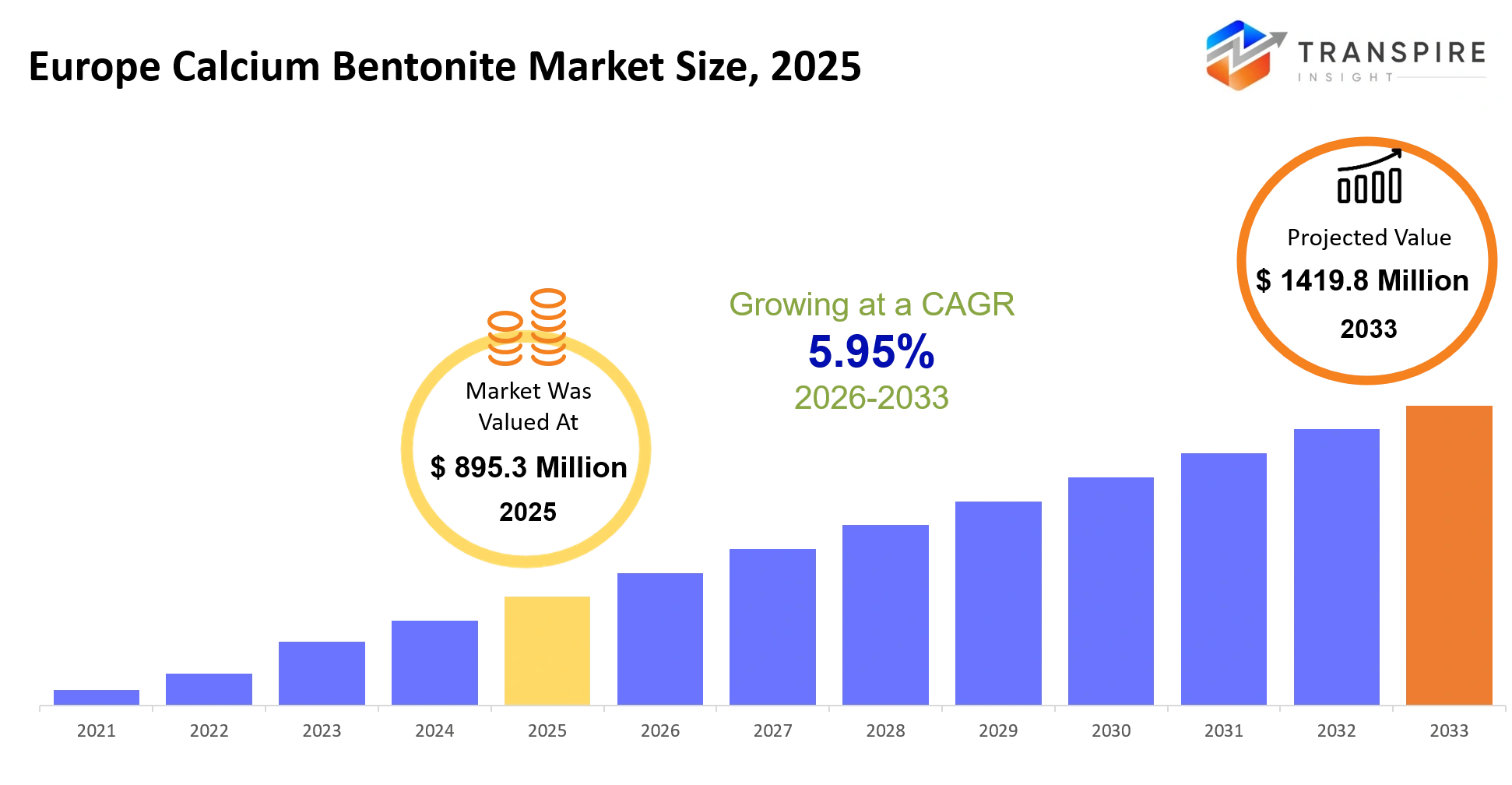
As per Transpire Insight Analysis the Europe Calcium Bentonite Market size is estimated at USD 895.3 Million in 2025 and is anticipated to reach USD 1419.8 Million by 2033, growing at a CAGR of 5.95% from 2026 to 2033.
Europe Calcium Bentonite Market sorta plays a practical role everywhere from industrial sites to environmental work, because it acts as a dependable absorbent, binder, and sealing medium. In day to day operations it helps manufacturing run more smoothly, supports waste management better, and can even improve drilling performance, foundry workflows, and some agricultural needs too. Also, it helps with moisture control, material stabilization, and lowering contamination levels ,so industries that need steady process quality can keep up while still aligning with tighter environmental expectations.
Over roughly the last three to five years, things moved toward higher value, application specific grades. Manufacturers started optimizing mineral performance for more specialized industrial uses, instead of just grabbing standard bulk goods. This shift picked up speed after supply chain problems and energy market turbulence made the sourcing of critical industrial minerals feel a lot riskier than before. Because of that, companies diversified procurement and invested in regional processing capacity, and adoption widened across several sectors at once.
All these shifts should be building longer term revenue upside, mainly by enabling premium product development, strengthening supply resilience, and encouraging wider, more technical use of calcium bentonite in situations where the requirements are pretty demanding.
Europe Calcium Bentonite Market Size & Forecast:
- Europe Calcium Bentonite Market Size 2025: USD 895.3 Million
- Expected Market Value 2033: USD 1419.8 Million
- Forecast CAGR: 5.95%
- Leading region in 2025: Western Europe
- Fastest Growing region: Central and Eastern Europe
- Key Profile: Clariant, Imerys, Ashapura Group, Minerals Technologies, Bentonite Performance Minerals, Wyo-Ben, Tolsa, LKAB Minerals, Laviosa Minerals, CETCO, AMCOL, Black Hills Bentonite, Kutch Minerals, SBC Minerals, Aydın Bentonite
Key Market Insights
- Western Europe was basically leading the market with something like a 46% share in 2025 , and it was backed by newer foundry activity plus construction work, environmental remediation, and drilling related work too.
- Central and Eastern Europe looks like it will be the fastest moving regional market during 2025–2033, pushed by ongoing industrial investments, and also by mineral processing capacity that keeps expanding.
- On the product side, industrial-grade calcium bentonite took the lead with close to 52% market share, which basically shows pretty wide use across foundry, civil engineering, and environmental needs.
- Agricultural-grade calcium bentonite stayed the second biggest segment, mainly because livestock feed additive use kept increasing, along with soil conditioning, across more European farming operations.
- High-purity processed calcium bentonite is expected to grow the quickest through 2033, with the push coming from premium industrial specifications and more engineered material needs.
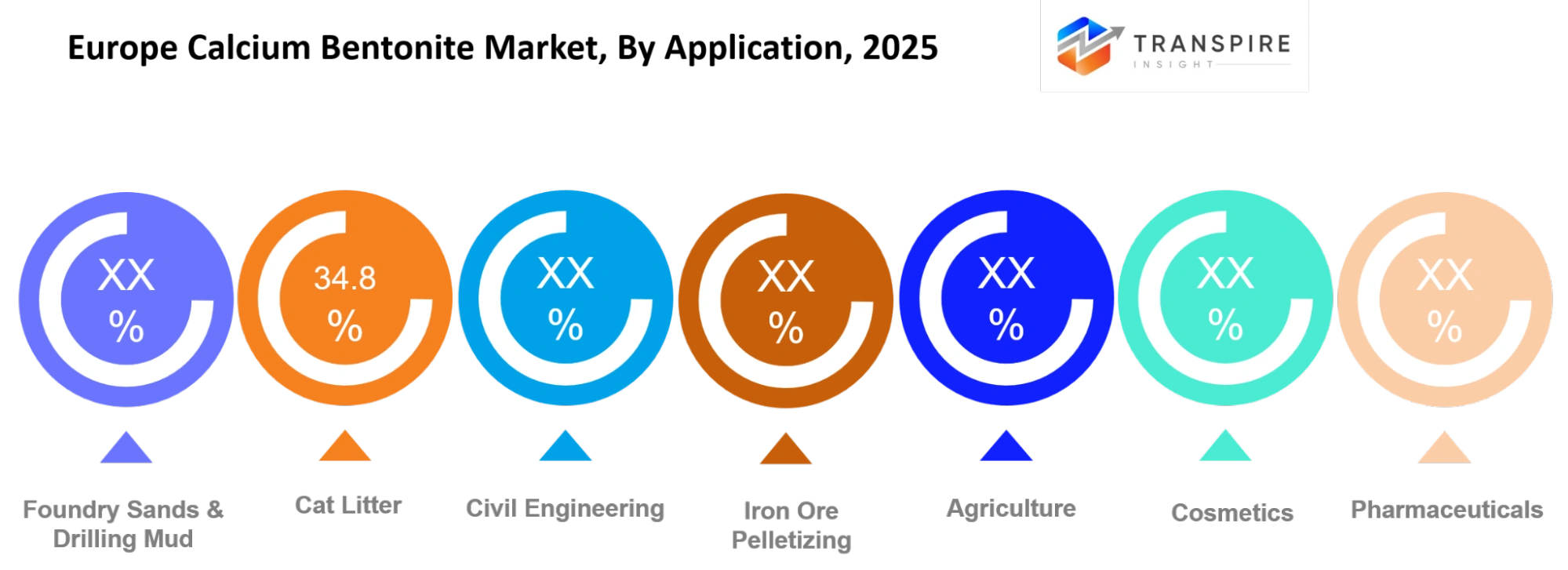
- For applications, foundry usage came in at about 34% market share in 2025 , because stable mold quality stayed kind of non-negotiable for automotive and machinery parts.
- Environmental sealing and waste containment are set to be the fastest-growing application area, supported by stricter landfill engineering requirements, and groundwater protection rules running through the forecast window.
- When you look at end-users, manufacturing and industrial processing stayed on top with roughly 49% share, supported by steady mineral consumption across multiple sectors.
- Environmental engineering companies are also expected to become the fastest-growing end-user group as infrastructure modernization projects spread across Europe through 2033.
What are the Key Drivers, Restraints, and Opportunities in the Europe Calcium Bentonite Market?
The strongest growth driver seems to be the tightening of environmental as well as industrial performance standards across Europe. New landfill engineering rules, infrastructure modernization, and more rigorous quality requirements for foundries and drilling operations have basically pushed buyers to tilt toward higher-performance mineral materials. Process optimization has also turned into a real measurable procurement priority, not just some discretionary investment people mention on slides. Because of that shift, premium product sales have grown, contract values have firmed up, and supplier revenue paths look better for those who can deliver steady mineral quality and certified processing standards.
The big restraint though , is still supply chain concentration around high-quality mineral reserves and the processing facilities themselves. Setting up new extraction sites is not quick, you know, it takes long permitting cycles, environmental assessments, and capital outlay, and in practice it can drag on for several years. From a Transpire Insight review of regional procurement announcements and launch schedules, it looks like this concentration remains the main execution risk. When processing capacity is limited, customer deliveries get delayed, production expansion slows, and pricing volatility shows up— which can end up postponing industrial procurement decisions across multiple sectors.
The strongest opportunity kind of sits in engineered calcium bentonite products, especially when they are meant for environmental infrastructure, but also for advanced industrial uses. Right now, investments in waste containment plants, groundwater protection systems, and specialty building materials are basically opening up new commercial pathways. Also Central and Eastern Europe has favorable conditions, not just because of demand, but more so due to expanding manufacturing investment, logistics improvements, and broader industrial modernization programs. The suppliers that can mix application engineering with regional processing capability will be better placed to lock in longer term supply agreements and grab those higher value market segments, sooner rather than later.
What Has the Impact of Artificial Intelligence Been on the Europe Calcium Bentonite Market?
Artificial intelligence and digital technologies are steadily getting better at mineral extraction, processing, and quality assurance across the European calcium bentonite industry, it kinda feels like it never stops. Mining operators now often use AI monitoring systems to optimize excavation timing, keep an eye on ore quality, automate how equipment is used, and also stay inside environmental operating limits. Alongside that, computer vision setups help with near-real-time checks of processed material, which in practice reduces quality drifting before products reach industrial customers.
Machine learning models are also turning into a real asset for forecasting mineral demand, for foundries , construction firms, environmental engineering projects and agricultural distributors. Predictive maintenance platforms use vibration, temperature, and operating readings from crushers, mills, and other processing equipment. That means maintenance teams can step in earlier, before failures become a full problem. As a result plant availability improves, unexpected stoppages go down , maintenance expenses get lower, and production scheduling becomes more predictable, which helps deliver to customers more consistently.
There are also digital supply chain platforms that make inventory planning and procurement coordination easier across regional processing facilities, at least when the data is actually there. Still, AI adoption has some practical boundaries. The integration costs stay high for older mineral processing plants, and fragmented operational datasets can mess with model accuracy. On top of that, many sites keep running legacy equipment that simply lacks enough sensor connectivity, so predictive analytics doesn’t perform as hoped, and it also slows the wider shift toward digital transformation through the sector.
Key Market Trends
- Since 2022 , manufacturers have been pushing ahead with application-specific processing investments , to deliver more premium industrial grades with tighter quality consistency, kinda like it is expected now.
- In Western Europe, suppliers have broadened regional processing capabilities so they can rely less on long-distance mineral sourcing after the recent logistics disruptions piled up.
- On the environmental side, containment projects have been using engineered bentonite barrier systems more often, mostly after stricter infrastructure and groundwater protection rules came in.
- Since 2023, digital mine monitoring and AI-assisted quality inspection have shown up more frequently, which helps production run smoother and it also reduces material variability.
- Industrial customers are increasingly choosing long-term supply agreements over spot purchasing, to boost procurement certainty during raw material price fluctuations , honestly that s become a big deal.
- Imerys and Sibelco keep investing in advanced mineral processing technologies, aiming to strengthen their premium industrial product lineups across Europe.
- Meanwhile, foundry manufacturers are leaning toward higher-performance bentonite formulations, improving casting consistency while trimming material waste during production cycles.
- Central and Eastern Europe has also pulled in fresh processing investments, as manufacturing activity and infrastructure development speed up across industrial corridors.
- Producers are expanding technical support and application engineering services too, so they can stand apart beyond plain commodity mineral supply , and hold onto customers better.
Europe Calcium Bentonite Market Segmentation
By Application :
Foundry sands seem to keep a leading position, because calcium bentonite helps with mold strength, gives casting accuracy, and ends up improving the surface finish in metal making, it’s kind of the usual combo. There is also stable performance during high temperature operations, which keeps demand moving from automotive, machinery, and industrial part manufacturing. Then drilling mud stays pretty important too, because the material controls fluid loss, helps stabilize boreholes, and supports drilling work that runs more efficiently. On the civil engineering side, calcium bentonite is often used for waterproofing, tunnel construction, landfill liners, and also for sealing foundations in larger infrastructure projects, basically where leak prevention matters.
Cat litter keeps generating a steady consumption, largely due to moisture absorption and odor control properties, you can see it everywhere. Agriculture supports further market growth via soil conditioning and livestock feed uses, which can improve soil quality and help with mineral balance. Iron ore pelletizing benefits from strong binding performance, meaning pellets keep their durability during processing. For cosmetics, pharmaceuticals, and other specialized industries, refined grades are used for certain formulations, where purity and consistent quality still stay important.
By End User :
Construction stays the biggest end-user, since calcium bentonite helps with foundation sealing , waterproof barriers and all those underground structures too, plus environmental containment jobs. And you know, with the ongoing infrastructure upgrades across many European countries, mineral suppliers still get pretty steady opportunities. Meanwhile oil and gas operations go on relying on calcium bentonite in drilling fluids, because it improves well stability and operational efficiency. Mining companies too, just need dependable mineral performance for extraction and the rest of processing work.
On the agriculture side, demand stays fairly stable , mostly because it shows up as feed additives and soil improvement products that help farm productivity. For consumer goods, manufacturers use calcium bentonite in items like cat litter and some household applications, you know, the selected ones. Chemical producers also fold it into industrial formulations where absorbent plus binding properties are needed. In healthcare and other specialized sectors, they keep picking higher-quality grades, mainly for controlled manufacturing requirements.
By Form :
Powder stays the most widely used form ,because processing flexibility makes it easier to blend into industrial formulations and the usual manufacturing systems. A finer particle distribution helps deliver steady performance across foundry , drilling , agricultural and construction uses. Granules keep getting picked, especially where controlled handling matters, dust generation stays lower, and transport is a bit more convenient, so operational efficiency improves. The fine grade products also pull in solid demand for uses that need a consistent particle size ,and dependable overall quality.
Pellets and lumps work well in industries that need controlled material handling, plus careful storage during production. Slurry formulations fit construction and environmental projects too, where direct application actually supports better sealing performance. Coarse grade materials are still suitable for certain engineering and industrial uses that want higher particle stability. Other specialized forms keep expanding as manufacturers build products for very specific industrial requirements, like application after application.
By Distribution Channel :
Direct sales stay as the go-to distribution channel, mainly because industrial customers really like the whole “long run” supply agreements, plus technical support, and the same product availability without interruptions. Big manufacturers often go for customized contracts, this is how they secure supply better, and also keep pricing steadier. Distributors still matter a lot too, they handle regional customers, with flexible inventory management and quicker delivery windows, which helps in day to day operations. Exporters, meanwhile, keep cross border trade moving across most European industrial markets and it just continues to be valuable.
Dealers and wholesalers basically help boost product availability for medium sized buyers across varied industries. Retail suppliers mostly focus on smaller commercial customers, where purchase volumes are lower, and people need products immediately. Online sales continue growing, because digital procurement platforms make ordering easier, they also simplify quotation management ,and inventory planning. There are also other distribution channels that pop up for specialized industries, where customized logistics and technical assistance are required, and that kind of thing can not be treated like a one size fits all arrangement.
By Grade :
Industrial grade kind of takes the biggest slice overall, because manufacturing, construction, foundry, drilling, and environmental applications all lean on dependable performance and still keep the operating costs competitive. So broad industrial usage helps keep consumption fairly steady, across multiple sectors all around Europe, even when things shift. Agricultural grade also holds up, with consistent demand from livestock nutrition and soil conditioning applications , you know. Technical grade products keep showing up for engineering projects where reliable mineral characteristics matter.
Then there is the high purity grade , which is seeing more attention lately. That is mostly because advanced industrial processes demand tighter quality specifications plus consistent material performance. Cosmetic and pharmaceutical grades get used in carefully controlled manufacturing environments, where purity standards remain essential. Food grade products support certain processing applications under strict regulatory requirements, while other specialized grades continue to expand as manufacturers build offerings for industry specific technical needs.
What are the Key Use Cases Driving the Europe Calcium Bentonite Market?
Construction projects are like the biggest use case, because calcium bentonite gives dependable sealing and helps with groundwater protection in foundations, tunnels, retaining structures, and even landfill barriers. Civil engineering contractors, infrastructure developers, and public authorities go for these materials so they can satisfy technical specs and long term performance needs, aligned with European construction standards, pretty much.
Meanwhile foundry manufacturers keep on expanding their usage, partly to boost mold stability, and also to improve casting quality for automotive as well as industrial components. Agricultural businesses, too, take up calcium bentonite, not just as a feed additive, but also as a soil treatment product . And mining operators apply it during mineral processing, where stable binding performance really supports production efficiency, which is what they want in practice.
For the future , environmental remediation looks especially promising, since governments invest in contaminated land restoration and more advanced waste containment systems. There are also growing chances with high purity grades, in specialty industrial formulations, where manufacturers need controlled mineral characteristics, for technically demanding production processes across the forecast period, without cutting corners.
|
Report Metrics |
Details |
|
Market size value in 2025 |
USD 895.3 Million |
|
Market size value in 2026 |
USD 947.2 Million |
|
Revenue forecast in 2033 |
USD 1419.8 Million |
|
Growth rate |
CAGR of 5.95% from 2026 to 2033 |
|
Base year |
2025 |
|
Historical data |
2021 - 2024 |
|
Forecast period |
2026 - 2033 |
|
Report coverage |
Revenue forecast, competitive landscape, growth factors, and trends |
|
Regional scope |
Europe (Germany, United Kingdom, France, Italy, Spain and Rest of Europe) |
|
Key company profiled |
Clariant, Imerys, Ashapura Group, Minerals Technologies, Bentonite Performance Minerals, Wyo-Ben, Tolsa, LKAB Minerals, Laviosa Minerals, CETCO, AMCOL, Black Hills Bentonite, Kutch Minerals, SBC Minerals, Aydın Bentonit. |
|
Customization scope |
Free report customization (country, regional & segment scope). Avail customized purchase options to meet your exact research needs. |
|
Report Segmentation |
By Application (Foundry Sands, Drilling Mud, Cat Litter, Civil Engineering, Iron Ore Pelletizing, Agriculture, Cosmetics, Pharmaceuticals, Others); By End User (Construction, Oil & Gas, Agriculture, Consumer Goods, Chemicals, Healthcare, Mining, Others); By Form (Powder, Granules, Pellets, Lumps, Slurry, Fine Grade, Coarse Grade, Others); By Distribution Channel (Direct Sales, Distributors, Online Sales, Dealers, Wholesalers, Exporters, Retail Suppliers, Others); By Grade (Industrial Grade, Cosmetic Grade, Pharmaceutical Grade, Agricultural Grade, Food Grade, High Purity Grade, Technical Grade, Others). |
Which Regions are Driving the Europe Calcium Bentonite Market Growth?
Western Europe makes up about 46% of the regional market and it stills the biggest part of total revenue. Strict environment rules, higher construction requirements and mature industrial strategies keep pushing steady demand for calcium bentonite across a mix of sectors. There’s also a decent web of mineral processors , foundries, builders, and engineering contractors, which helps keep supply chains steady and makes product availability feel dependable. Ongoing money put into infrastructure refresh and industrial modernization should help it keep this leading spot through the whole forecast period.
Southern Europe is next, but it works more like a different market structure , it leans on construction work, ceramics production, agriculture and mining, instead of a very wide heavy manufacturing base. Regulatory policies that stay stable and long term infrastructure funding give fairly predictable buying behavior across both public and private jobs. Local mineral resources further support nearby processing and limit reliance on imported raw materials for many uses. Because of this more balanced industrial landscape, Southern Europe becomes a steady producer of repeat revenue even if the growth pace stays moderate.
Central and Eastern Europe are basically showing the fastest growing regional market, because manufacturing expansion and infrastructure investment picked up in recent years, a lot more than before. You see industrial modernization programs, logistics upgrades and even increased foreign investment, all that has bolstered demand across construction , foundry operations, and also environmental engineering projects. On top of that, when regional manufacturers expand capacity, local supply gets better and industrial buyers get shorter delivery timelines. Between 2026 and 2033, this growth should translate into pretty interesting openings for suppliers, processors, and investors who want to set up production capacity before industrial demand hits a more mature, maybe slower stage.
Who are the Key Players in the Europe Calcium Bentonite Market and How Do They Compete?
The competitive landscape is still fairly consolidated, with known mineral producers goi ng at it via processing quality, application know-how, where they operate geographically, and how dependable their supply is, not just price. Existing suppliers keep hold of market share by growing their specialty product catalogues and by beefing up technical support for industrial buyers. Lately the fight is less about marketing numbers and more about steady product behavior, meeting regulatory needs, and getting dependable delivery across multiple European industries, all at once, basically.
Imerys puts emphasis on advanced mineral processing and on application specific solutions that push better results for construction, foundry, and environmental customers. They keep investing in product development and processing know-how so they can handle industries with strict quality requirements. Sibelco sets itself apart using a broad processing and distribution footprint across Europe, which helps them deliver reliably and offer more flexible customer service. They are also putting money into processing efficiency, which in turn supports supply resilience in different regional markets.
LKAB Minerals really benefits from strong industrial relationships and a steady technical support kind of approach that helps customers tune mineral performance for specialized uses, like in real world operations. Tolsa also keeps pushing forward by crafting premium industrial grades that are geared toward environmental and engineering projects, where having a consistent product—right down to details—turns into measurable operational value. Laviosa Chimica Mineraria strengthens its competitiveness through specialty mineral formulations and development that’s focused on applications, which lets them expand into higher-value industrial segments where certified quality matters a lot and where customers want customized technical solutions .
Company List
- Clariant
- Imerys
- Ashapura Group
- Minerals Technologies
- Bentonite Performance Minerals
- Wyo-Ben
- Tolsa
- LKAB Minerals
- Laviosa Minerals
- CETCO
- AMCOL
- Black Hills Bentonite
- Kutch Minerals
- SBC Minerals
- Aydın Bentonit
Recent Development News
In January 2025, Imerys formed the Seitim joint venture with circular economy start-up Seitiss to develop mineral-based solutions that convert industrial waste into valuable raw materials. The collaboration strengthens sustainable mineral processing capabilities that support specialty industrial minerals, including bentonite-based applications.
Source: https://www.imerys.com/
In September 2025, Imerys announced a strategic collaboration with Denka to develop lower-carbon solutions for the concrete and mortar industry. The partnership expands advanced mineral technologies for sustainable construction, supporting long-term demand for specialty industrial minerals used across European infrastructure projects.
Source: https://www.imerys.com/
What Strategic Insights Define the Future of the Europe Calcium Bentonite Market?
Europe Calcium Bentonite Market seems like it will drift toward higher-value , more use-case tailored products rather than just chasing raw volume growth during the next five to seven years. In practice, industrial modernization, stricter engineering rules, and a stronger need for dependable mineral performance will nudge buyers to choose processed grades that actually show measurable operational benefits, not just “standard” material.
There is also a less obvious risk, kind of quiet, where the best mineral reserves and the processing capacity are clustered in specific areas. That can make manufacturers more exposed to supply disruptions, permitting delays, and pricing pressure, even if the end-user demand is staying pretty steady.
At the same time , a real opportunity is starting to show up in Central and Eastern Europe. Infrastructure investment, plus environmental containment projects, should pull in new demand for engineered bentonite products. Firms that move early—building regional processing capacity, offering technical assistance, and setting up long-term supply relationships—may end up with an advantage. They can secure those premium contracts sooner and strengthen their position before these applications become broadly adopted.
Europe Calcium Bentonite Market Report Segmentation
By Application
- Foundry Sands
- Drilling Mud
- Cat Litter
- Civil Engineering
- Iron Ore Pelletizing
- Agriculture
- Cosmetics
- Pharmaceuticals
By End User
- Construction
- Oil & Gas
- Agriculture
- Consumer Goods
- Chemicals
- Healthcare
- Mining
By Form
- Powder
- Granules
- Pellets
- Lumps
- Slurry
- Fine Grade
- Coarse Grade
By Distribution Channel
- Direct Sales
- Distributors
- Online Sales
- Dealers
- Wholesalers
- Exporters
- Retail Suppliers
By Grade
- Industrial Grade
- Cosmetic Grade
- Pharmaceutical Grade
- Agricultural Grade
- Food Grade
- High Purity Grade
- Technical Grade
Frequently Asked Questions
Find quick answers to common questions.
The expected Europe Calcium Bentonite Market size for the market will be USD 1419.8 Million in 2033.
Key segments for the Europe Calcium Bentonite Market are By Application (Foundry Sands, Drilling Mud, Cat Litter, Civil Engineering, Iron Ore Pelletizing, Agriculture, Cosmetics, Pharmaceuticals, Others); By End User (Construction, Oil & Gas, Agriculture, Consumer Goods, Chemicals, Healthcare, Mining, Others); By Form (Powder, Granules, Pellets, Lumps, Slurry, Fine Grade, Coarse Grade, Others); By Distribution Channel (Direct Sales, Distributors, Online Sales, Dealers, Wholesalers, Exporters, Retail Suppliers, Others); By Grade (Industrial Grade, Cosmetic Grade, Pharmaceutical Grade, Agricultural Grade, Food Grade, High Purity Grade, Technical Grade, Others).
Major Europe Calcium Bentonite Market players are Clariant, Imerys, Ashapura Group, Minerals Technologies, Bentonite Performance Minerals, Wyo-Ben, Tolsa, LKAB Minerals, Laviosa Minerals, CETCO, AMCOL, Black Hills Bentonite, Kutch Minerals, SBC Minerals, Aydın Bentonite.
The Europe Calcium Bentonite Market size is USD 895.3 Million in 2025.
The Europe Calcium Bentonite Market CAGR is 5.95% from 2026 to 2033.
- Clariant
- Imerys
- Ashapura Group
- Minerals Technologies
- Bentonite Performance Minerals
- Wyo-Ben
- Tolsa
- LKAB Minerals
- Laviosa Minerals
- CETCO
- AMCOL
- Black Hills Bentonite
- Kutch Minerals
- SBC Minerals
- Aydın Bentonit
About the Authors

Pankaj Ghogare Patil
I am Pankaj Ghogare Patil, a Senior Research Analyst at Transpire Insight, specializing in the Pharmaceutical, Chemicals & Materials, Healthcare IT, and Biotechnology industry. My expertise lies in conducting comprehensive market research, analyzing industry trends, evaluating competitive landscapes, and translating complex data into actionable insights. At Transpire Insight, I closely follow emerging technologies, regulatory developments, and market innovations to create accurate, well-researched, and informative content that helps businesses and professionals make informed decisions. I am committed to producing credible, evidence-based articles that reflect industry best practices while making technical topics accessible and valuable for a broad audience.

Chakradhar Khansole
Chakradhar serves as the Research Director at Transpire Insight, bringing over 8 years of experience in technology, innovation, and strategic market intelligence. He specializes in transforming complex market data into actionable business insights that enable organizations to make informed, growth-oriented decisions. Recognized for his strategic vision and analytical expertise, Chakradhar leads high-impact research initiatives, delivering comprehensive market assessments, competitive intelligence, and forward-looking industry analysis.
Recently Published Reports
-
May 2026
Healthcare Polymer Packaging Market
Healthcare Polymer Packaging Market Size, Share & Analysis Report By Packaging Type (Syringes, IV Bottles and Pouches, Clamshells, Blisters, Bottles & Jars, Containers, Tubes, IV Parental Packaging, Others), By Type (Regulated, Non-regulated), By Polymer Type (LDPE (Low-Density Polyethylene), HDPE (High-Density Polyethylene), Homo-polymer (Homo), Random Copolymer (Random), Block Copolymer (Block), PET, Polystyrene, Polyvinyl Chloride, Polyamide/EVOH, Others), and Geography (North America, Europe, Asia-Pacific, Middle East and Africa, South and Central America), 2021 - 2031
-
Apr 2026
Hydrophilic Tape (Waterstop) Market
Hydrophilic Tape (Waterstop) Market Size, Share & Analysis Report By Type (Bentonite-Based Hydrophilic Tape, Rubber-Based Hydrophilic Tape), By Application (Residential Buildings, Commercial Buildings, Infrastructure Projects), and Geography (North America, Europe, Asia-Pacific, Middle East and Africa, South and Central America), 2021 - 2031
-
Apr 2026
Metalens Market
Metalens Market Size, Share & Analysis Report By Type (Visible Light Metalens, and Infrared Metalens), By Application (Consumer Electronics, Automotive Electronics, Industrial, Medical, and Others), and Geography (North America, Europe, Asia-Pacific, Middle East and Africa, South and Central America), 2021 - 2031
-
Apr 2026
PBT Resin Market
PBT Resin Market Size, Share & Analysis Report By Type (Reinforced PBT Resin, Unreinforced PBT Resin), By Processing Method (Injection Molding, Extrusion, Blow Molding, Others), By End-User (Automotive, Electrical & Electronics, Consumer Appliances, Industrial Machinery, Medical Devices, Packaging, Others), and Geography (North America, Europe, Asia-Pacific, Middle East and Africa, South and Central America), 2021 - 2031