

Europe Beauty Tools Market Summary
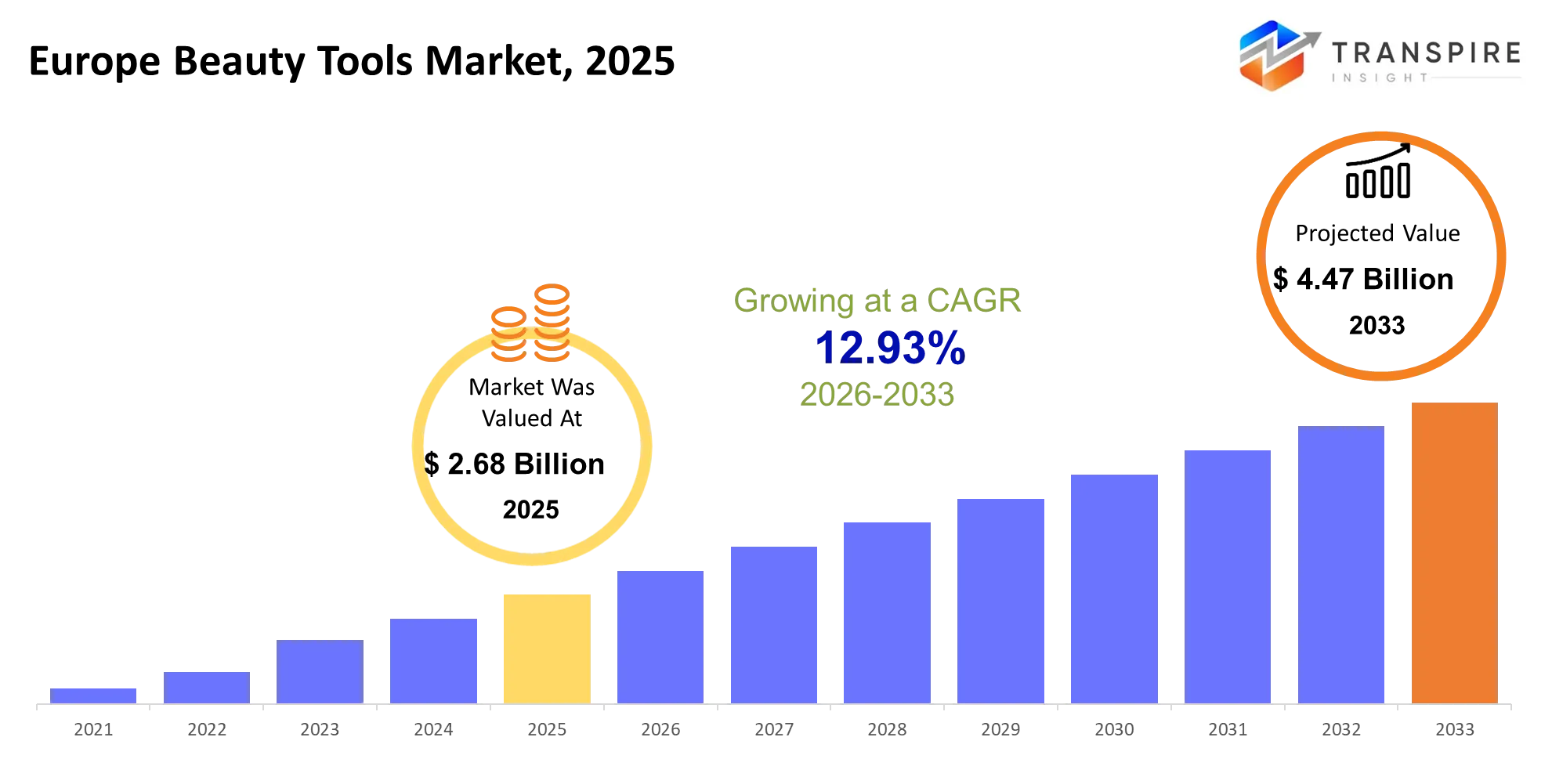
As per Transpire Insight Analysis the Europe Beauty Tools Market size is estimated at USD 2.68 Billion in 2025 and is anticipated to reach USD 4.47 Billion by 2033, growing at a CAGR of 12.93% from 2026 to 2033.
Beauty tools support both home users and pros. They make grooming, hair work, nail care, and other daily routines faster and more even. You can find many types in this area. Hair dryers and straighteners are common. Curlers, trimmers, brushes, and manicure tools are also widely sold. Some buyers even choose connected beauty devices.
In the past three to five years, the market look has changed. It moved from simple wired tools to higher-end options. Many products now are cordless and offer more than one function. Digital features also show up more often. In Europe, buyers often ask for tools that are easy to carry. They also want good heat control and more ways to style hair. Many people want a salon-like finish without going to a salon.
Cordless styling tools are picking up. Better rechargeable batteries help. Smaller, lighter designs also make daily use easier. Online shopping has grown too. This rise followed the buying habits formed during the pandemic period.
Brands now focus on upgrades instead of only cost. They compete with better engineering and steadier temperature settings. Some tools use sensors to guide how they run. Others add multiple functions in one device. Dyson keeps releasing new items, which shows how tech-led styling tools are becoming more common.
Europe Beauty Tools Market Size & Forecast:
- Europe Beauty Tools Market Size 2025: USD 2.68 Billion
- Expected Market Value 2033: USD 4.47 Billion
- Forecast CAGR: 12.93%
- Leading region in 2025: Germany
- Fastest Growing region: Italy
- Key Profile: Dyson, Philips, L'Oréal, Braun, Panasonic, Remington, ghd, BaByliss, Wahl, Conair, Revlon, Foreo, NuFACE, Clarisonic, Beurer
Key Market Insights
- Germany leads in European sales of beauty devices. This is backed by high spending on personal care, solid store networks, and well known brands for beauty appliances.
- Spain is also moving up. Premium hair styling labels are widening what they sell, and more buyers are trying styling tools that use newer tech.
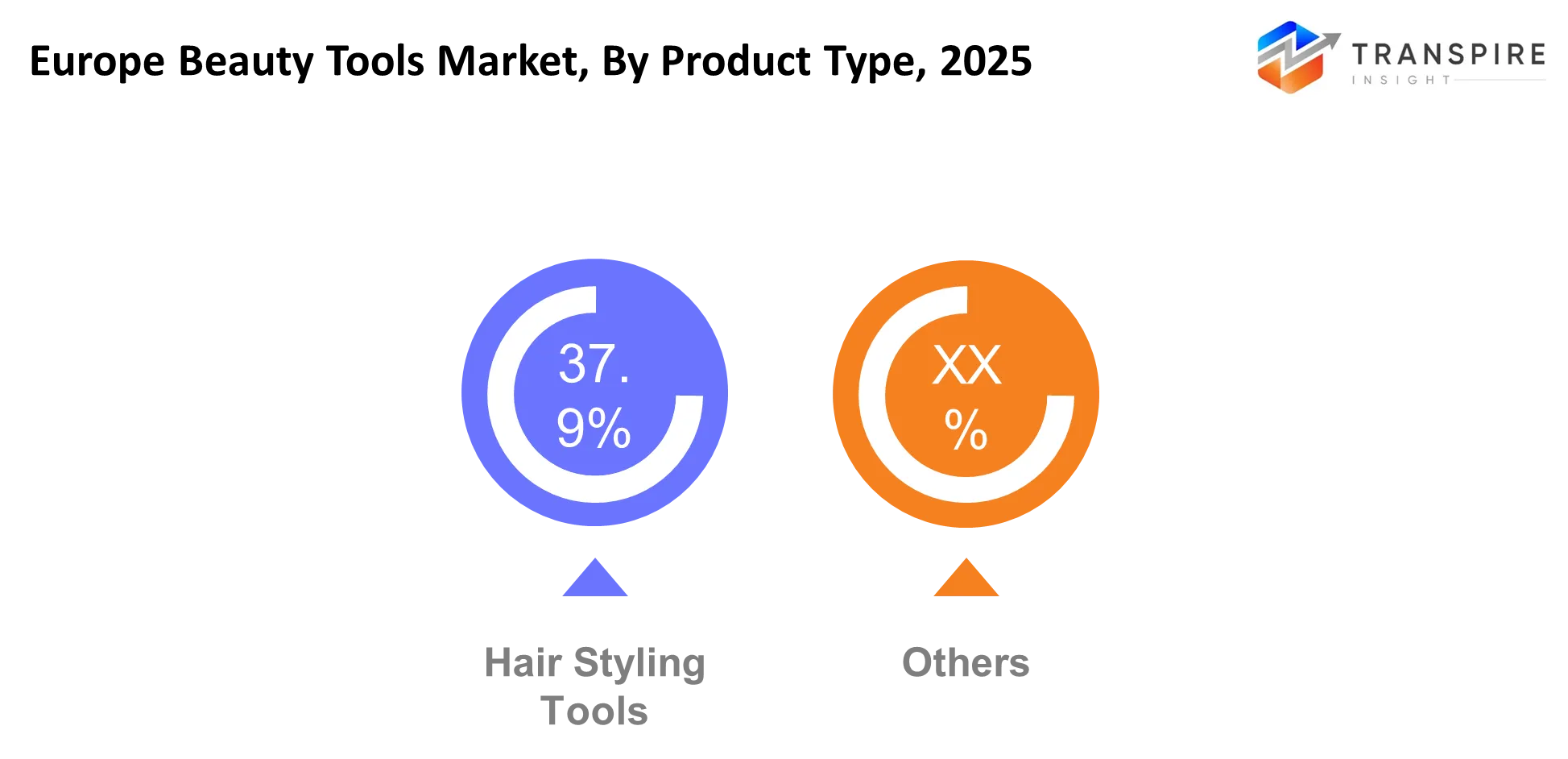
- In 2025, hair straighteners made up 79.84% of revenue for hair styling tools across Europe. The category stays very strong.
- Corded models brought in 67.05% share in 2025. Still, cordless tools are expected to rise by 3.68% CAGR up to 2031.
- Hair styling brushes and combs grew the quickest. They are forecast to expand at a 3.78% CAGR through 2031. Lower heat styling is gaining notice.
- In 2025, women accounted for 67.92% of European hair styling tool revenue. For men, tools are set to grow at 4.12% CAGR.
- Online channels grew the fastest for sales. They are projected to increase at 4.55% CAGR, showing that more Europeans prefer buying online.
- Specialty stores held 48.97% of the distribution share in 2025. Buyers stayed for in store demos, side by side product checks, and staff guidance.
- Dyson, Philips, Panasonic, Spectrum Brands, and Conair go head to head. They focus on premium build quality, cordless options, easy to use design, and wide collections of products.
- Competition is now leaning toward better heat control using sensors. Brands also push multi use styling, smaller form factors, and items sold with hair protection in mind.
What are the Key Drivers, Restraints, and Opportunities in the Europe Beauty Tools Market?
In Europe, the biggest lift for beauty tools comes from people choosing pricier versions. Shoppers are paying more for products that style faster, control heat in a tighter way, run on battery power, and handle more than one task. Mordor Intelligence also lists premium upgrades, cordless designs, and salon-like styling at home as drivers. For that reason, firms can bring in more money by offering improved versions, buying replacements, selling extra add-on tools, and adding newer tech options, instead of trying to grow only by making and selling higher volumes.
Still, durability and high store prices are real limits. To build a premium tool, firms need stronger motors, better batteries, safe heating parts, sensors, and careful electronic control. These pieces lift both production costs and the cost to replace units. Cordless models also rely heavily on battery quality and on how people charge them. At the same time, corded products keep a cheaper path for buyers. On top of that, private-label brands and big mass retailers add heavy pressure and can squeeze pricing power.
One clear chance is in smart, all-in-one beauty tools. These products can mix multiple grooming tasks and include settings tailored to the user. Features like phone connection, heat control based on sensors, automatic temperature changes, and flexible styling methods can help a brand stand out. This premium direction is already visible, including Dyson, which uses sensor based systems and keeps designs compact in newer hair styling tools. In Southern Europe, especially Spain and Italy, there may be further room to grow as premium beauty tech spreads through more stores and online sellers.
What Has the Impact of Artificial Intelligence Been on the Europe Beauty Tools Market?
Beauty tech is starting to shape new tools in more specific ways. It is less about full autonomy and more about tailoring, sensing, and product work based on real usage data. Hair styling devices now often rely on sensors to watch things like heat level, air flow, what attachment is on, and the current operating state. With that input, the device can change its own settings during use. Dyson’s Supersonic r is one example. It detects which accessory is attached and then updates the settings on the fly. This points to a shift toward appliances that adapt while still staying in a defined control loop.
Data work can also help teams improve the product itself. Machine learning can look at styling habits, heat exposure, how long the device runs, and what customers report after use. From those signals, makers can tune temperature curves, battery output, air handling, and attachment design. There are also recommendation systems that match tools to a person’s hair type or routine. That kind of guidance can build a more connected digital experience around the hardware.
People also get practical wins. Heat can be more steady, energy use can be managed better, and the session can be shorter. Personalization may feel more accurate from one user to the next. Even so, there are limits that slow progress. Teams face high costs for development, they lack common datasets from everyday users, and privacy concerns come up. It is also hard to take results from lab tests and make them hold up across many hair textures. Because of these issues, many products today lean on sensor based automation instead of fully AI driven styling.
Key Market Trends
- From 2021 onward, cordless tools have picked up in Europe. Bigger battery capacity and smaller body designs make them easier to carry.Even so, corded models still led in 2025. They held 67.05% of the market.
- Cordless lines kept moving up. Better recharging and newer power systems helped them compete.Premium looks are showing up more often now. Brands like Dyson and other newer rivals push features built around sensors, smart engineering, and compact frames.
- That design push supports multi use performance. It is meant to feel efficient in daily use.Hair brushes and combs are also rising. Their growth is at a 3.78% CAGR, which points to a shift toward softer styling each day.
- Online buying grew fast after the pandemic. Digital sales are expected to rise at a 4.55% CAGR through 2031.
- Men’s grooming tools are moving ahead faster than women’s tools. The men’s segment is forecast at 4.12% CAGR through 2031.
- After 2021, people relied more on influencer picks. This made multi function stylers easier to spot with younger buyers in Europe.
- Smart styling is now less of a novelty. It is used as a way to stand out with auto heat control, sensors, and tailored settings.
- Germany still drives a lot of the influence in the market.Spain is also becoming a strong place for new premium styling ideas.
- Store rivalry is changing, too. Specialists remain important, while online shops take a larger share of beauty appliance purchases.
Europe Beauty Tools Market Segmentation
By Type:
In Europe, beauty tools are commonly sold in these categories. Hair dryers are a popular pick. They help people dry hair quickly. That means styling can start sooner.Straighteners are also in demand. They make hair look smoother. They are easier to work with during styling.Curling irons are used for curls. They can also shape waves.
Clippers and trimmers are bought for grooming. People use them on the face and body. Brushes and combs go with daily hair care. They help people manage and style hair. Manicure and pedicure tools are another common group. Razors are sold for hair removal.Nail files and nail cutters are used for nail care. Cuticle tools round out the list.They help people manage tangles. Nail care tools, including manicure and pedicure items, are for keeping nails in good shape. Razors and the rest of the nail tools support that same upkeep.Razors are mainly for hair removal. Nail files, nail cutters, and cuticle tools help with the finer steps of nail care and salon routines.
Hair straighteners are a big part of this market. Some units are built to do more than one job, so a buyer can straighten hair or make curls and waves without switching appliances. Mordor Intelligence gives hair straighteners a 79.84% share for 2025 in the European hair-styling-tools category.Brushes and combs have been growing faster too. Many shoppers want styling options that use less heat. Companies also keep changing the way these tools are made, with more focus on comfort in the hand, better temperature control, smaller sizes, and designs that can serve more than one purpose
By Distribution Channel:
Shopping across Europe can look very different. Some people go to small specialty stores or to brand shops. Others use hypermarkets or regular supermarkets. You also see pharmacies and drugstores in many areas. Department stores are still common too. Then there is the internet, with online shops and beauty-focused sellers. Some products also move through trade distribution routes.
In a specialty shop, you can usually test products. Workers answer questions because they handle the items every day. In large supermarkets and big box stores, people usually want fast stops and cheaper prices. Drugstores and pharmacies tend to lean more on trust, especially for hair and skin needs. Department stores often carry more premium labels. Brand shops are usually set up with a small footprint, and workers help you find what you need. If you buy online, you can scan a longer list, check costs side by side, see review scores, and get the order dropped at your door.
In 2025, specialty shops accounted for 48.97% of the market. A key reason is that shoppers can pick items up in person and check them right there.
By Application:
Mass-market beauty tools, mid-range tools, premium tools, and luxury tools are built for different buying needs. Mass-market items usually win on price and are easy to find in many stores. Mid-range tools try to fit a tighter budget while still offering solid results and decent wear. Premium tools tend to push further, with better heating, stronger motors, comfy shapes, and extra heads for different tasks. Luxury tools lean more on the brand image and careful engineering. Professional-grade tools focus on steady output over long hours. Smart beauty tools add features like sensors, phone links, custom settings, and digital controls.In Europe, “premium” upgrades have become a key fight for styling appliance makers. Dyson and other newer high-end brands have tried to stand out with design choices, smaller bodies, and control systems that feel more advanced than older models. Costlier tools often bring higher profits. Still, they face tough competition from cheaper options. Mid-range tools are also improving, which makes that pressure stronger. Smart and professional lines can help brands keep higher prices because buyers can point to clear gains in how they work.
By Region:
UK, Germany, France, Spain, Italy, Netherlands, Switzerland, and Sweden are key beauty tool markets in Europe. They do not behave the same way. Buyer tastes and store setups also differ from one country to the next.Germany is a major player in beauty device sales. Personal care spending is steady there. Shops and distribution are well built. Well known brands already have a strong base.The UK leans into hair styling. People there care a lot about how hair looks. There are many specialist stores. Online shopping is also a big part of the market.France tends to back a more premium beauty stance. Consumers in France often pay more for higher end items. That shapes what brands choose to sell
Spain and Italy are seen as growth markets too. Beauty culture is a factor in both places. Tourism helps demand as well. Premium products also get picked up more often.The Netherlands, Switzerland, and Sweden respond well to new tech. Their online retail routes are strong and easy to use. Spain looks like it can grow fast in hair styling tools. One assessment points to a 5.08% CAGR through 2031, based on Mordor Intelligence.
What happens in each country can shift with a few drivers. Premium share matters. Online retail use matters. Household buying power matters. Salon activity plays a role too. Product upgrades can also change results.
What are the Key Use Cases Driving the Europe Beauty Tools Market?
Home styling is still the main reason people buy these products. Many customers want results that look like a salon, but they do not want to book visits every week. Devices like hair dryers, flat irons, curling tools, and all-in-one stylers let people groom their hair each day. They also help reduce how often someone needs a professional appointment. Higher-end lines support this goal with steady heat control, stronger airflow, comfortable shapes, and extra heads. Mordor Intelligence notes that the push for professional-level results at home is a key driver for growth in Europe.
Salons and barbershops come next as other important customers. Their tools run for longer hours each day, so buyers expect reliable output every time. Salons often look for high-power dryers, straighteners, brushes, and cutting tools such as clippers and trimmers. Barbershops tend to choose gear that supports detailed work and tight control. Hotels and spa sites also add compact grooming tools for guest use, wellness areas, and treatment spaces run by staff.
New directions are forming around cordless models, tailored settings, and controls that respond to sensors. People want portable tools for trips and for quick changes at home. Some connected tools can guide styling in a more personal way, such as by adjusting heat. Premium brands are already shifting toward sensor-based designs. That creates a road toward more assisted personalization and wider smart beauty features during the forecast period.
|
Report Metrics |
Details |
|
Market size value in 2025 |
USD 2.68 Billion |
|
Market size value in 2026 |
USD 2.85 Billion |
|
Revenue forecast in 2033 |
USD 4.47 Billion |
|
Growth rate |
CAGR of 12.93% from 2026 to 2033 |
|
Base year |
2025 |
|
Historical data |
2021 - 2024 |
|
Forecast period |
2026 - 2033 |
|
Report coverage |
Revenue forecast, competitive landscape, growth factors, and trends |
|
Regional scope |
Europe |
|
Key company profiled |
Dyson, Philips, L'Oréal, Braun, Panasonic, Remington, ghd, BaByliss, Wahl, Conair, Revlon, Foreo, NuFACE, Clarisonic, Beurer |
|
Customization scope |
Free report customization (country, regional & segment scope). Avail customized purchase options to meet your exact research needs. |
|
Report Segmentation |
By Product Type (Hair Styling Tools, Facial Tools, Makeup Tools, Nail Tools, Hair Removal Tools, Skin Care Devices, Massage Tools, Beauty Accessories); By Technology (Electric, Battery-Powered, Manual, Rechargeable, Smart/Connected, Heat-Based, Sonic/Vibration-Based, LED-Based); By Application (Hair Care, Skin Care, Makeup Application, Nail Care, Facial Treatment, Body Care, Hair Removal, Personal Grooming); By Distribution Channel (Online Retail, Specialty Beauty Stores, Department Stores, Supermarkets & Hypermarkets, Pharmacies, Professional Salons, Brand Stores, Direct Sales); By Consumer Type (Women, Men, Teenagers, Young Adults, Mature Consumers, Professional Beauticians, Salon Professionals, Premium Consumers); By Region (UK, Germany, France, Italy, Spain, Netherlands, Sweden, Switzerland) |
Which Regions are Driving the Europe Beauty Tools Market Growth?
Germany leads the beauty tools market in Europe. People there spend more on personal care. Shops are well set up, and tech products fit easily into daily routines. The country also has a solid mix of makers for appliances, beauty stores, professional salons, and tech suppliers. Because of that mix, companies can offer both higher priced items and budget options. Clear safety rules also matter. Buyers expect tools to work well, so firms push to build stronger designs, longer lasting parts, and small upgrades. All of this helps Germany stay at the top for beauty device income in Europe.
The UK has a more focused path. Beauty retail there is strong, and the styling scene is well established. That helps keep steady demand for hair dryers, straighteners, brushes, and multi-stylers. The UK is not as tied to a wide tech appliance ecosystem as Germany. Still, the UK has good coverage from niche shops, pharmacy groups, department stores, and sales that go straight to customers. The push for ghd items through Boots in 2025 shows this well. Premium brands can ride on existing store reach to sell both online and in person. With that steady retail access, plus a clear link to professional style, the UK stays a dependable revenue source in Europe.
Italy is expected to grow the quickest across the larger European beauty devices space. Growth is driven by more people using beauty devices at home. Younger buyers are also more drawn to new tech style tools. Interest is rising in areas like hair removal, facial care, and more personal beauty devices
Who are the Key Players in the Europe Beauty Tools Market and How Do They Compete?
In the Europe beauty tools market, rivals are split into several lanes. Some sell high-end styling devices. Others focus on everyday appliances. There are also brands that target pros. A few concentrate on grooming items for specific needs.
What really moves buyers is not just cost. People pay attention to how well a tool works. They look at tech, how the brand is seen, and where the product can be found. Because of that, newer brands with a tech-first angle can take space from older appliance firms.Dyson stands out with its engineering focus. The Supersonic line uses a Hyperdymium motor. It also supports RFID-enabled add-ons. These parts help set airflow and heat levels on their own.SharkNinja uses a more all-in-one style with Shark Glam. It pairs air styling with ceramic heating. It also aims at different hair types. It does this through attachments made for those textures.
ghd keeps its focus on salon-grade styling. It leans on smart heat control. It also leans on its salon background to support its premium image. In 2025, it grew in Boots. The move added 34 products and in-store demo stations. That boosted access for UK shoppers across both online and physical stores.Tangle Teezer goes after a clear niche. The brand highlights its patented detangling design. It also uses sustainability-minded materials. BIC owning the brand adds more paths for overseas distribution.Overall, these moves point to how firms grow. They do it through retail links, new product ideas, and care for specific consumer needs, not mainly by undercutting prices.
Company List
- Dyson
- Philips
- L'Oréal
- Braun
- Panasonic
- Remington
- ghd
- BaByliss
- Wahl
- Conair
- Revlon
- Foreo
- NuFACE
- Clarisonic
- Beurer
Recent Development News
- "In March 2026, UKLASH entered a partnership with Tangle Teezer. The collaboration launched a limited-edition Scalp To Strand Set combining UKLASH Hair Growth Serum with Tangle Teezer's Extra Gentle Ultimate Detangler, strengthening cross-category opportunities in haircare and beauty tools. [https://cewuk.co.uk/uklash-and-tangle-teezer-launch-limited-edition-haircare-collaboration/] (CEW UK)."
- "In March 2025, Dyson launched the Supersonic r hair dryer for general consumers. The device uses a Hyperdymium motor and RFID-enabled attachments that automatically adjust airflow and temperature, expanding advanced professional styling technology into the European home-use market. [https://www.dyson.in/discover/introducing-the-new-dyson-supersonic-r-hair-dryer] (Dyson)."
- "In February 2025, Boots entered a partnership with ghd. The agreement added 34 ghd products, including the Chronos Max hair straightener, to Boots' online platform and selected UK stores, expanding premium beauty-tool distribution. [https://www.boots-uk.com/newsroom/news-item/boots-expands-premium-and-professional-haircare-range-with-introduction-of-electrical-beauty-brand-ghd/] (Boots)."
What Strategic Insights Define the Future of the Europe Beauty Tools Market?
In Europe, the beauty tools market is changing. More buyers want premium products that do more in one place. They also want tech features that let them get results that look more like what they would see in a salon. At the same time, many people want fewer items on their counter and more fit for their own needs.
This move favors brands that do not only tweak machines. The winners will mix new device design with smart settings. Comfort matters too, so shapes and grips need to feel right for long use. Strong home performance is key, not just small upgrades to older styles.
There is a risk that comes with all of this. When one device can do many jobs, it may replace several separate tools. That can lead to fewer repeat buys over time. Even so, prices per unit can still rise, which makes the shift feel confusing at first.
Still, there is a clear opening for sensor-led tools. These devices can read hair or skin needs and then adjust things like heat, airflow, or treatment strength. This is not limited to early buyers. The category can grow beyond them.
To act on this, firms can build modular systems. These systems should handle more than one attachment and include smart controls. It also helps to work with the right channels. Partnering with European specialty retailers, salons, and online sellers can speed up take up through 2033.
Frequently Asked Questions
Find quick answers to common questions.
The expected Europe Beauty Tools Market size for the market will be USD 4.47 Billion in 2033.
Key segments for the Europe Beauty Tools Market are By Product Type (Hair Styling Tools, Facial Tools, Makeup Tools, Nail Tools, Hair Removal Tools, Skin Care Devices, Massage Tools, Beauty Accessories); By Technology (Electric, Battery-Powered, Manual, Rechargeable, Smart/Connected, Heat-Based, Sonic/Vibration-Based, LED-Based); By Application (Hair Care, Skin Care, Makeup Application, Nail Care, Facial Treatment, Body Care, Hair Removal, Personal Grooming); By Distribution Channel (Online Retail, Specialty Beauty Stores, Department Stores, Supermarkets & Hypermarkets, Pharmacies, Professional Salons, Brand Stores, Direct Sales); By Consumer Type (Women, Men, Teenagers, Young Adults, Mature Consumers, Professional Beauticians, Salon Professionals, Premium Consumers); By Region (UK, Germany, France, Italy, Spain, Netherlands, Sweden, Switzerland).
Major Europe Beauty Tools Market players are Dyson, Philips, L'Oréal, Braun, Panasonic, Remington, ghd, BaByliss, Wahl, Conair, Revlon, Foreo, NuFACE, Clarisonic, Beurer.
The Europe Beauty Tools Market size is USD 2.68 Billion in 2025.
The Europe Beauty Tools Market CAGR is 12.93% from 2026 to 2033.
- Dyson
- Philips
- L'Oréal
- Braun
- Panasonic
- Remington
- ghd
- BaByliss
- Wahl
- Conair
- Revlon
- Foreo
- NuFACE
- Clarisonic
- Beurer
About the Authors

Chetan Dhatrak
I’m Chetan Dhatrak, a Senior Research Analyst at Transpire Insight, specializing in the Consumer Goods, Foods and Beverages industry. I focus on analyzing market trends, consumer behavior, competitive landscapes, and industry developments to deliver accurate, data-driven insights. My research at Transpire Insight is built on credible sources and in-depth analysis, helping businesses and readers better understand market dynamics, emerging opportunities, and evolving consumer preferences. I’m committed to creating reliable, well-researched content that supports informed decision-making and reflects the latest developments in the consumer goods and food & beverage sectors.

Chakradhar Khansole
Chakradhar serves as the Research Director at Transpire Insight, bringing over 8 years of experience in technology, innovation, and strategic market intelligence. He specializes in transforming complex market data into actionable business insights that enable organizations to make informed, growth-oriented decisions. Recognized for his strategic vision and analytical expertise, Chakradhar leads high-impact research initiatives, delivering comprehensive market assessments, competitive intelligence, and forward-looking industry analysis.
Recently Published Reports
-
Apr 2026
Bottled Water Market
Bottled Water Market Size, Share & Analysis Report By Product Type (Still Bottled Water, Carbonated Bottled Water, Functional Bottled Water, and Others), By Packaging (PET, Cans, and Others), By Sales Channel (Supermarkets/Hypermarkets, Convenience Stores/Drug Stores, Grocery Stores/Club Stores, Foodservice, and Others) and Geography (North America, Europe, Asia-Pacific, Middle East and Africa, South and Central America), 2021 - 2032
-
Apr 2026
Color Cosmetic Packaging Market
Color Cosmetic Packaging Market Size, Share & Analysis Report By Application (Mascara Packaging, Liquid Packaging, and Liquid Face), By Type (Tubes & Bottles, Pens & Markers, Compacts & Containers, and Droppers & Pumps), and Geography (North America, Europe, Asia-Pacific, Middle East and Africa, South and Central America), 2021 - 2031
-
Apr 2026
External Microphone For Camera Market
External Microphone For Camera Market Size, Share & Analysis Report By Type (Shotgun Microphone, Lavalier Microphone, and Others), By Application (Digital Camera, Professional Video Camera, and Others), and Geography (North America, Europe, Asia-Pacific, Middle East and Africa, South and Central America), 2021 - 2031
-
Apr 2026
Foot Orthotic Insoles Market
Foot Orthotic Insoles Market Size, Share & Analysis Report By Type (Pre-fabricated, and Custom-made), By Material (Thermoplastic, Composite Carbon Fiber, and Others), By Distribution Channel (Drug Stores, Hospitals & Clinics, and Others), and Geography (North America, Europe, Asia-Pacific, Middle East and Africa, South and Central America), 2021 - 2031