
Europe Automotive Brake Systems Market Summary
As per Transpire Insight Analysis, the Europe Automotive Brake Systems Market size is estimated at USD 13.8 Billion in 2025 and is anticipated to reach USD 18.5 Billion by 2033, growing at a CAGR of 3.75% from 2026 to 2033.
Europe Automotive Brake Systems Market in a way keeps passenger cars, commercial vehicles ,and now especially electric vehicles safe by delivering dependable stopping performance, helping with vehicle stability, and also enabling advanced driver assistance features even when road conditions get messy. Brake systems, in practice, have turned into one of those central parts of modern vehicle engineering where manufacturers keep pushing for road safety, better energy efficiency, and stronger regulatory compliance. In the last five years the market sort of moved away from conventional hydraulic braking and leaned more toward electronically controlled systems, and then brake by wire technologies, much of it pushed by vehicle electrification plus software-defined vehicle architectures.
At the same time, stricter European safety regulations and emission requirements, plus semiconductor shortages and the usual pandemic related supply chain disruptions, made companies invest harder in localized production and digital manufacturing. That overall direction also nudged automakers toward higher-value braking tech , which then created clearer revenue opportunities for suppliers. It also helped suppliers expand integration with things like autonomous driving functions , predictive maintenance systems, and regenerative braking platforms, since everything is getting more software connected, kind of more intertwined, over time.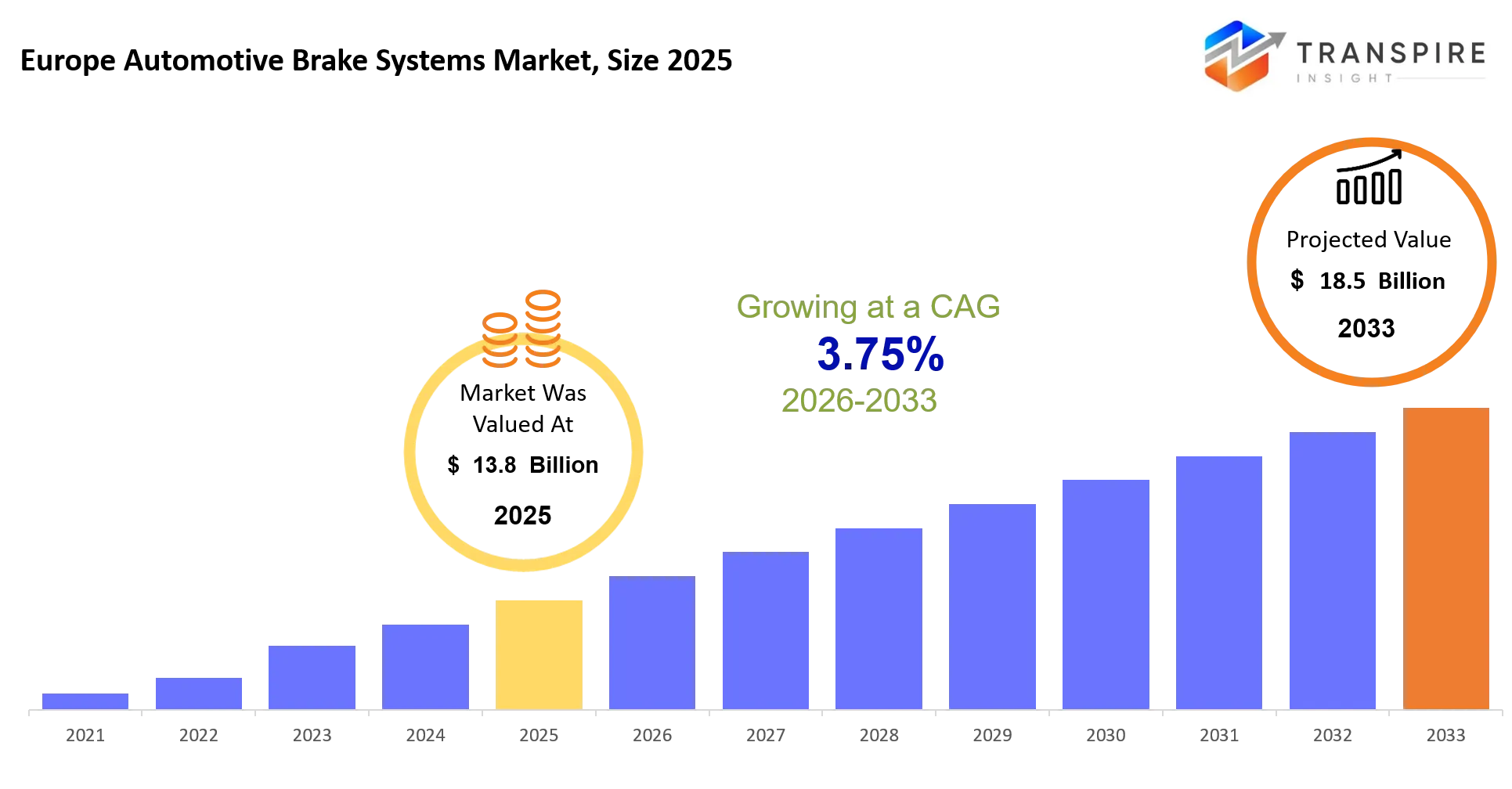
Europe Automotive Brake Systems Market Size & Forecast:
- Europe Automotive Brake Systems Market Size 2025: USD 13.8 Billion
- Expected Market Value 2033: USD 18.5 Billion
- Forecast CAGR: 3.75%
- Leading region in 2025: Germany, France, the United Kingdom
- Fastest Growing region: Poland, Czech Republic, Hungary, Romania, and Slovakia
- Key Profile: ZF Friedrichshafen, Brembo, Continental AG, Bosch, Aisin Corporation, Hitachi Astemo, Knorr-Bremse, Akebono Brake Industry, Nissin Kogyo, ADVICS, Haldex, Tenneco (Federal-Mogul), Mando Corporation, MAT Holdings, Delphi Technologies
Key Market Insights
- Western Europe kinda dominated the industry, taking around 62% market share in 2025, and it was backed by Germany, France and the United Kingdom, mainly through steady vehicle production and premium auto manufacturing.
- Central and Eastern Europe will stay the fastest-growing regional market during 2025–2033, powered by manufacturing capacity that keeps expanding in Poland, Hungary, Slovakia,and the Czech Republic.
- Disc brake systems basically led the product segment with almost 68% market share in 2025, which shows a broader adoption in passenger vehicles, and also in electric vehicle platforms.
- Drum brake systems stayed the second biggest part, since they keep getting used in entry-level passenger cars, plus some chosen rear axle applications in commercial vehicles.
- Electronic brake systems are expected to show the quickest growth all the way through 2033, supported by advanced driver assistance integration,and a software controlled braking setup that’s more and more common.
- Passenger vehicles accounted for roughly 74% market share in 2025. This happened because higher safety specifications pushed installation of newer braking technologies across new vehicle models.
- Electric vehicles are likely the fastest-growing application segment in the forecast years, with regenerative braking integration playing a role,and with tougher European safety rules too.
- Original Equipment Manufacturers led the end-user segment with nearly 79% market share in 2025, as factories keep installing electronically controlled braking systems on a continuous basis.
- The aftermarket will see the fastest expansion through 2033 , because older vehicle fleets end up needing replacement of electronic brake components,and they also require more advanced maintenance services.
What are the Key Drivers, Restraints, and Opportunities in the Europe Automotive Brake Systems Market?
Vehicle electrification still feels like the biggest engine pushing market expansion forward, even if it’s “slower and faster” depending on who you ask. Meanwhile Euro NCAP safety demands, the move toward Euro 7 preparation , and the broader uptake of advanced driver assistance systems have kind of pulled the need for electronically controlled braking solutions along with it. Manufacturers keep swapping out classic hydraulic architectures for integrated brake by wire platforms, which supposedly improves response time , trims down component weight, and also helps regenerative braking work more smoothly. In practice this shift raises system value per vehicle, and it also nudges premium braking upgrades across both passenger and commercial vehicle output.
The main structural restraint is that integration part, where advanced braking electronics has to fit into existing vehicle platforms and the surrounding supply chains. Brake control software needs a lot of validation work, plus cybersecurity testing, and then regulatory certification, before it can actually go commercial. Those steps cannot be rushed, not really, because safety would get compromised. From a Transpire Insight look at regional procurement announcements and launch timings , the concentration across the supply chain stays the most direct execution risk. Semiconductor shortages, and also the availability of specialized sensors, are still delaying some planned vehicle launches, while simultaneously constraining production volumes and, in the end, suppressing the revenue the market could have otherwise captured.
Brake by wire platforms, mixed with a software defined vehicle structure, feels like the best long term bet. In Europe , manufacturers are putting more money into centralized vehicle computing, so braking , steering and stability features can run through unified control units. Places like Germany, Poland, Hungary and Slovakia keep pulling in fresh automotive manufacturing investments, and that really sets up good circumstances for newer brake technologies. On top of that, more electric vehicle production, and also automation enabled driving functions, will push the requirement for intelligent braking systems for the whole forecast period.
What Has the Impact of Artificial Intelligence Been on the Europe Automotive Brake Systems Market?
Artificial intelligence is a kind of reshaping of automotive braking technologies, because it boosts manufacturing quality, operational monitoring, and system validation across European production facilities, in practice. AI enabled inspection systems automatically spot casting defects, machining inconsistencies, and assembly deviations before final vehicle integration, and it helps catch things earlier than expected. Digital twins simulate braking performance under thousands of operating scenarios, lowering development cycles while still supporting regulatory compliance. Machine learning models also optimize inventory planning and production timetables, so manufacturers can react more nimbly when vehicle demand shifts.
Predictive analytics keeps adding strength to the regional industry by tracking brake wear, sensor condition, and actuator behavior during everyday operation. Fleet operators are using connected diagnostics more often to schedule maintenance before failures happen, which improves vehicle availability, and at the same time reduces sudden repair costs. Manufacturers additionally apply artificial intelligence to estimate component needs, tune supplier relationships, and raise production efficiency. In this way waste decreases, lead times get shorter, and factory utilization climbs. Still, wide adoption stays limited by high integration costs, fragmented vehicle data, and the tricky part of validating AI models in all kinds of real world driving conditions across Europe, even when climates are different, road textures vary, and vehicle architectures do not always match.
Key Market Trends
- Brake-by-wire technologies started to gain a little more momentum after 2022, and Bosch, Continental, and ZF basically kept pushing software driven braking platforms for next generation electric vehicles.
- Euro NCAP safety protocols have also pushed the idea of automatic emergency braking forward , so since 2023 you’ve seen more advanced braking systems being installed on a broader set of new passenger cars.
- Regenerative braking integration expanded in a noticeable way as electric vehicle production went up across Germany , France, and the United Kingdom during 2023–2025.
- Meanwhile, lightweight brake discs and aluminum calipers replaced heavier parts in premium vehicles, helping efficiency, while also lowering unsprung mass across new vehicle platforms.
- Between 2023 and 2025 manufacturers increasingly moved to consolidate software and chassis control into centralized vehicle computers, which sort of makes future brake-by-wire integration simpler.
- On the production side , investment shifted toward Central and Eastern Europe. Poland , Hungary, and Slovakia attracted new automotive component manufacturing facilities starting in 2022, and that direction continued.
- Brembo expanded development of intelligent braking technologies, including embedded sensors that support continuous brake condition monitoring. This also strengthens predictive maintenance, in a more proactive kind of sense.
- Continental and ZF, at the same time, increased investment in integrated motion control systems that combine braking, steering, and stability functions into unified vehicle control architectures.
- And after 2023, digital manufacturing using AI driven quality inspection expanded across European brake component plants, which reduced defects while improving production consistency .
Europe Automotive Brake Systems Market Segmentation
By Component
Brake calipers still held a significant role, mainly because modern passenger cars and commercial vehicles needed a reliable clamping force so braking stayed consistent and safe. Brake pads, in the meantime, kept creating strong replacement demand since wear is regular and maintenance schedules across fleets tend to cycle again and again, not just occasionally. Brake rotors helped maintain stable heat dissipation and braking efficiency, so mounting them was common on vehicles that use disc brake systems. Brake drums, however, kept showing up for cost sensitive vehicle categories and for selected rear axle setups where a simpler build is practical.
Master cylinders also maintained steady demand because they provide the hydraulic pressure needed for dependable braking response, even when driving conditions change. Brake boosters improved the whole experience of braking comfort, lowering pedal effort while aligning with modern safety expectations. Other parts like sensors, hoses, valves, and electronic control units also saw broader adoption as braking systems became more intelligent, and more digitally connected. In product development, the focus leaned toward lightweight materials, long service life, and strong compatibility with advanced electronic safety tech, rather than only raw performance.
By Brake Type :
Disc brakes kind of accounted for the largest share because better stopping performance, improved heat management, and stronger compatibility with modern passenger vehicles did help support wider installation. Drum brakes still kept an important position in economical vehicle models and in a few selected commercial applications where lower production costs remained important, because you know cost control. Anti-lock Braking Systems started becoming standard on most new vehicles, mainly due to regulatory requirements and vehicle safety standards that continued to expand. Electronic braking systems also saw stronger adoption since advanced driver assistance technologies became more common across new vehicle platforms.
Regenerative braking opened up new growth opportunities, through more electric vehicle production and improved energy recovery during braking events. The integration between regenerative braking and electronic control systems helped improve vehicle efficiency while also reducing brake component wear. Other braking technologies supported more specialized vehicle requirements and performance driven applications across different automotive categories. Continuous innovation kept pushing manufacturers to introduce software-controlled braking solutions, with faster response and higher operational precision.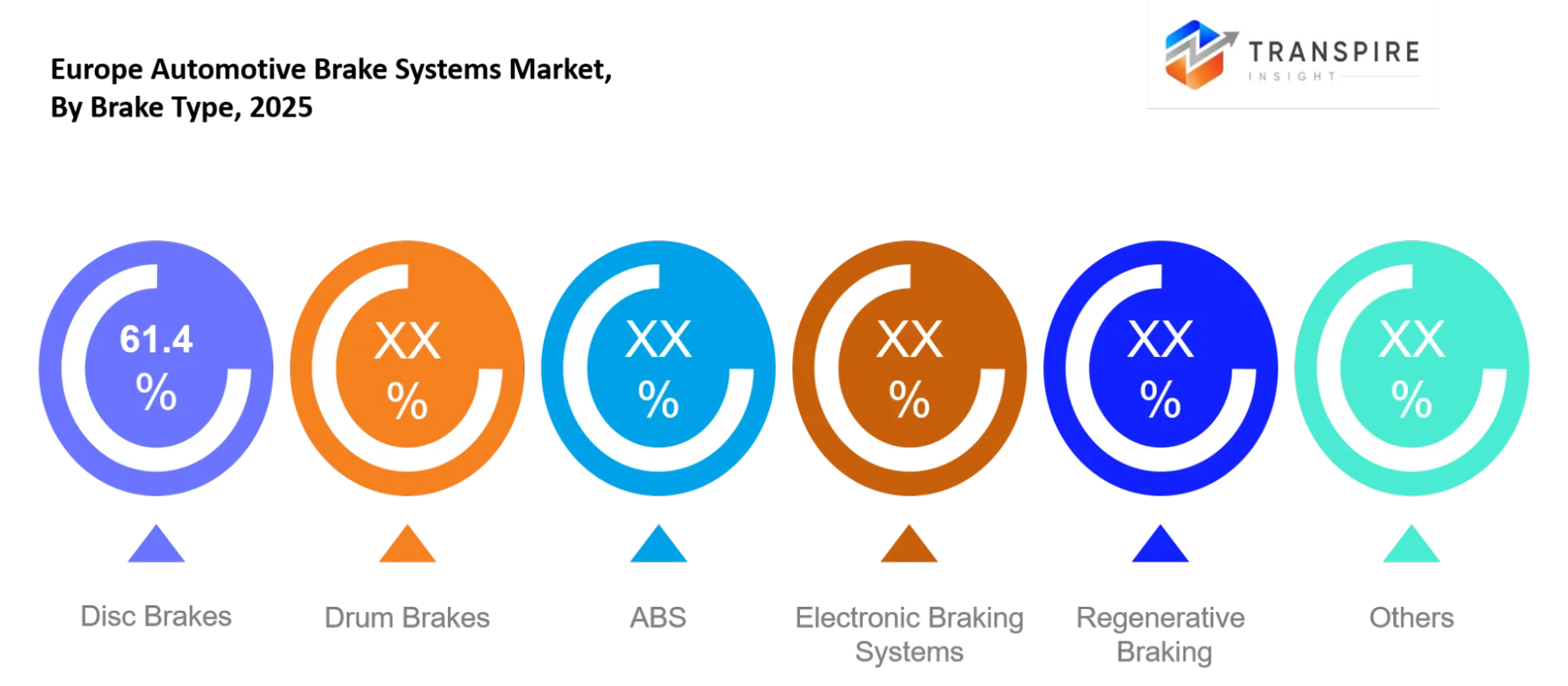
By Vehicle Type :
Passenger cars ended up being the biggest vehicle slice, mostly because production volumes stayed high, and strict safety regulations kept pushing nonstop installation of advanced braking technologies. Light commercial vehicles also kept a steadier level of demand, driven by logistics, urban delivery, and that ongoing e-commerce transportation uptick. Heavy commercial vehicles needed braking systems that were more robust, able to hold consistent performance during rough duty cycles and when carrying heavier loads. Electric vehicles grew the quickest, where regenerative braking plus electronically controlled systems became pretty much standard, especially in new model launches.
Vehicle manufacturers kept rolling out lighter braking components, aiming to boost efficiency while not really lowering safety performance. Adoption of advanced driver assistance systems rose, so intelligent braking technologies got more attention across every vehicle category, and it sort of snowballed. Commercial fleets leaned into modernization programs, which encouraged swaps from older braking systems to electronically managed solutions , since they tend to deliver better reliability. Product development stayed centered on safety, durability, and digital integration, both on conventional vehicles and on electric vehicle platforms.
By Sales Channel :
OEM sales really dominated the market revenue because the factory installed braking systems already hit those strict quality, safety, and performance requirements, before the vehicle ever got delivered. There was also strong automotive manufacturing activity across several big European countries, and this kept supply agreements pretty steady between vehicle makers and braking component suppliers. In turn, long term production contracts basically pushed both sides to put money into advanced braking technologies, plus extra manufacturing capacity. So innovation, it showed up first via original equipment installations, then only later did the broader replacement demand start gaining real momentum.
The aftermarket, meanwhile, kept expanding in a more gradual way. That happened because older vehicle fleets eventually need routine replacements, like brake pads, rotors, calipers and even electronic braking components. Service centers were also investing more, especially into diagnostic tools that can handle modern, electronically controlled braking systems. Besides that, other sales routes covered specialized applications, independent distributors, and performance vehicle modifications. And overall product availability improved, not just through wider distribution networks, but also through growing digital parts procurement platforms.
By End User :
Automotive OEMs stayed the main end user, since ongoing vehicle production needed huge volumes of high-level braking parts that match tight engineering rules , more or less all the time. Fleet operators put more money into durable brake systems because it cut maintenance downtime and kept operations smooth across commercial transport routes. Individual vehicle owners kept up steady replacement needs thanks to everyday servicing and regular brake checks. At the same time, rising safety awareness made many buyers lean toward premium replacement components that offer a longer working life, so to speak.
Other end users included specialized vehicle manufacturers and smaller transportation uses, where they needed tailored braking solutions for odd operating surroundings. Digital diagnostics made maintenance scheduling clearer and reduced surprise component breakdowns across various vehicle classes. Investments in smarter braking technologies also opened up steadier long-term paths for makers and component suppliers. Product development will likely keep emphasizing safety performance, electronic integration, and extended component durability.
What are the Key Use Cases Driving the Europe Automotive Brake Systems Market?
Passenger car manufacturing still feels like the strongest use case for advanced braking systems because automakers have to satisfy tight European safety rules, and also what buyers expect in real life. In practice, Automotive OEMs buy high performance braking technologies so they can raise stopping accuracy, help advanced driver assistance functions work more smoothly, and still pass certification steps before the vehicle is actually delivered.
For light commercial vehicles, and also heavy commercial vehicles, adoption of electronically controlled braking solutions keeps growing. Fleet operators keep putting money into these systems to boost operational dependability, cut down maintenance downtime, and stay aligned with commercial vehicle safety requirements across regional transport corridors and logistics networks.
Looking ahead, brake-by-wire platforms, plus intelligent regenerative braking, feel like very promising direction. Electric vehicle manufacturers, and even automated mobility developers, are still checking those options, in order to increase energy efficiency, tighten software integration, and improve how vehicle control behaves. If investment keeps moving forward into connected vehicle platforms and next generation safety architecture, it should support wider commercial uptake during the forecast period.
|
Report Metrics |
Details |
|
Market size value in 2025 |
USD 13.8 Billion |
|
Market size value in 2026 |
USD 14.3 Billion |
|
Revenue forecast in 2033 |
USD 18.5 Billion |
|
Growth rate |
CAGR of 3.75% from 2026 to 2033 |
|
Base year |
2025 |
|
Historical data |
2021 - 2024 |
|
Forecast period |
2026 - 2033 |
|
Report coverage |
Revenue forecast, competitive landscape, growth factors, and trends |
|
Country scope |
Europe (Germany, United Kingdom, France, Italy, Spain and Rest of Europe) |
|
Key company profiled |
ZF Friedrichshafen, Brembo, Continental AG, Bosch, Aisin Corporation, Hitachi Astemo, Knorr-Bremse, Akebono Brake Industry, Nissin Kogyo, ADVICS, Haldex, Tenneco (Federal-Mogul), Mando Corporation, MAT Holdings, Delphi Technologies . |
|
Customization scope |
Free report customization (country, regional & segment scope). Avail customized purchase options to meet your exact research needs. |
|
Report Segmentation |
By Component (Brake Calipers, Brake Pads, Brake Rotors, Brake Drums, Master Cylinders, Brake Boosters, Others); By Brake Type (Disc Brakes, Drum Brakes, ABS, Electronic Braking Systems, Regenerative Braking, Others); By Vehicle Type (Passenger Cars, Light Commercial Vehicles, Heavy Commercial Vehicles, Electric Vehicles, Others); By Sales Channel (OEM, Aftermarket, Others); By End User (Automotive OEMs, Fleet Operators, Individual Vehicle Owners, Others) |
Which Regions are Driving the Europe Automotive Brake Systems Market Growth?
Western Europe came in at around 62% of the regional revenue, and so yeah it ended up being the main driver for market expansion. There were strict vehicle safety rules, Euro NCAP requirements, and ongoing investment in automotive manufacturing, which together made things feel pretty favorable for advanced braking technologies. Germany, France, and the United Kingdom helped keep a mature ecosystem going—vehicle production sites, component suppliers, engineering centers, and also long term spending on automotive research. The strong need for replacements, electrification that keeps moving forward, and the regular release of advanced driver assistance systems should keep Western Europe on top during the whole forecast window.
Northern Europe held fairly steady too, mostly because the regulations stayed consistent and premium vehicle technologies were adopted in a calm, predictable way across different vehicle types. Sweden, Denmark, Finland, and Norway leaned into vehicle safety, electrification, and long run industrial investment, not so much big scale production expansion. With economic conditions staying fairly normal, purchasing patterns for advanced braking systems remained reliable across both passenger vehicles and commercial fleets. Add continuous investment in sustainable mobility, plus connected vehicle technologies, and the region should keep generating stable revenue in the years ahead.
Central and Eastern Europe kind of showed up as the fastest growing regional market, after the automotive manufacturers started expanding their production facilities around Poland, Hungary, Slovakia, Romania and also the Czech Republic. Newer manufacturing investments, plus industrial modernization programs, and even supply chain diversification, all of that sped up the installation of advanced braking technologies in cars that were newly assembled. The whole story, is that competitive manufacturing costs mixed with more export driven automotive output helped keep the regional momentum steady, for both passenger vehicles and commercial vehicle categories, more or less. Growth over 2026–2033 will likely bring attractive chances for suppliers, technology developers, and component manufacturers, who want to expand capacity and build long-term customer partnerships.
Who are the Key Players in the Europe Automotive Brake Systems Market and How Do They Compete?
Competition still looks fairly consolidated, in the sense that major global automotive component producers take up a big chunk of the advanced braking system output. What really keeps shifting competitive power is mostly technology innovation, software integration, manufacturing quality, and those long-term supply arrangements that everyone keeps leaning on. The established players keep pushing broader portfolios with continued research investment, while the more specialized suppliers seem to concentrate on electronic braking advances and what you might call intelligent vehicle steering and control.
Robert Bosch GmbH, for example, differentiates through brake-by-wire development, and it also deepens driver assistance integration. On top of that, it leans into software-driven vehicle control, meant to support next generation mobility platforms, even if the wording changes a bit across teams. ZF Friedrichshafen AG, tends to focus on integrated chassis technology, blending braking, steering and vehicle dynamics into unified control systems so the coming software defined vehicle architecture is less complicated. Continental AG builds strength with braking intelligence software, digital engineering competence, and it keeps backing automated driving technologies through strategic investment.
Brembo S.p.A. concentrates on lighter braking solutions, plus intelligent brake technologies that include embedded sensing, improving both monitoring and real world performance. Knorr-Bremse AG tightens its commercial vehicle specialization with advanced braking systems made for heavy duty transportation. It also extends into rail integration, and fleet safety applications, where reliability matters a lot. Overall, product upgrades, regional manufacturing expansion, and closer collaboration with vehicle manufacturers keep producing competitive advantages, and they also help long-term business growth keep moving.
Company List
- ZF Friedrichshafen
- Brembo
- Continental AG
- Bosch
- Aisin Corporation
- Hitachi Astemo
- Knorr-Bremse
- Akebono Brake Industry
- Nissin Kogyo
- ADVICS
- Haldex
- Tenneco (Federal-Mogul)
- Mando Corporation
- MAT Holdings
- Delphi Technologies
Recent Development News
In May 2026, Brembo started series production of its Sensify brake-by-wire system for a production vehicle. The launch introduced a fully software-controlled braking platform designed to improve vehicle stability, safety, and support the transition toward software-defined vehicles.
Source https://www.roadandtrack.com/
In February 2025, Robert Bosch GmbH announced completion of testing for its hydraulic brake-by-wire technology and stated that multiple vehicle manufacturer orders had already been secured. The development strengthened commercialization of brake-by-wire systems expected to support millions of vehicles by 2030.
Source https://www.automotivetestingtechnologyinternational.com/
What Strategic Insights Define the Future of the Europe Automotive Brake Systems Market?
The market will be drifting toward software defined braking platforms that kinda mesh electronic control , brake-by-wire architecture, and vehicle intelligence into one overall safety framework. The growth won’t rely so much on more vehicle production though, instead itll be pulled along by rising technology content that gets installed in each vehicle, especially across electric models and the highly automated ones.
A risk that's a little less visible comes from supply chain concentration for semiconductors, sensors, and electronic control modules, where disruptions could end up delaying vehicle launches even if end-market demand still looks strong. Another emerging opportunity should show up through Central and Eastern Europe, as fresh automotive manufacturing investments show up and create demand for locally sourced advanced braking components and engineering know-how.
Firms stepping into this next phase should really put emphasis on partnerships with vehicle manufacturers and software providers while also expanding regional production capacity. putting money early into scalable electronic braking platforms and digital validation capabilities will help strengthen long-term competitiveness, especially since regulatory requirements, and vehicle architectures continue shifting toward the more intelligent mobility solutions.
Europe Automotive Brake Systems Market Report Segmentation
By Component
- Brake Calipers
- Brake Pads
- Brake Rotors
- Brake Drums
- Master Cylinders
- Brake Boosters
By Brake Type
- Disc Brakes
- Drum Brakes
- ABS
- Electronic Braking Systems
- Regenerative Braking
By Vehicle Type
- Passenger Cars
- Light Commercial Vehicles
- Heavy Commercial Vehicles
- Electric Vehicles
By Sales Channel
- OEM
- Aftermarket
By End User
- Automotive OEMs
- Fleet Operators
- Individual Vehicle Owners
Frequently Asked Questions
Find quick answers to common questions.
The Expected Europe Automotive Brake Systems Market size for the Market will be USD 18.5 Billion in 2033.
Key segments for the Europe Automotive Brake Systems Market are By Component (Brake Calipers, Brake Pads, Brake Rotors, Brake Drums, Master Cylinders, Brake Boosters, Others); By Brake Type (Disc Brakes, Drum Brakes, ABS, Electronic Braking Systems, Regenerative Braking, Others); By Vehicle Type (Passenger Cars, Light Commercial Vehicles, Heavy Commercial Vehicles, Electric Vehicles, Others); By Sales Channel (OEM, Aftermarket, Others); By End User (Automotive OEMs, Fleet Operators, Individual Vehicle Owners, Others).
Major Europe Automotive Brake Systems Market players are ZF Friedrichshafen, Brembo, Continental AG, Bosch, Aisin Corporation, Hitachi Astemo, Knorr-Bremse, Akebono Brake Industry, Nissin Kogyo, ADVICS, Haldex, Tenneco (Federal-Mogul), Mando Corporation, MAT Holdings, Delphi Technologies.
The Current Europe Automotive Brake Systems Market size is USD 13.8 Billion in 2025.
The Europe Automotive Brake Systems Market CAGR is 3.75% from 2026 to 2033.
- ZF Friedrichshafen
- Brembo
- Continental AG
- Bosch
- Aisin Corporation
- Hitachi Astemo
- Knorr-Bremse
- Akebono Brake Industry
- Nissin Kogyo
- ADVICS
- Haldex
- Tenneco (Federal-Mogul)
- Mando Corporation
- MAT Holdings
- Delphi Technologies
About the Authors

Mayur Shinde
I am Mayur Shinde, a Senior Research Analyst at Transpire Insight, specializing in the Automotive & Transportation and Information & Communication Technology (ICT) Industry. My work focuses on analyzing emerging market trends, technological advancements, competitive landscapes, and industry developments to deliver accurate, data-driven insights. I am passionate about transforming complex market information into clear, actionable content that helps businesses, professionals, and decision-makers stay informed and make confident strategic decisions.

Chakradhar Khansole
Chakradhar serves as the Research Director at Transpire Insight, bringing over 8 years of experience in technology, innovation, and strategic market intelligence. He specializes in transforming complex market data into actionable business insights that enable organizations to make informed, growth-oriented decisions. Recognized for his strategic vision and analytical expertise, Chakradhar leads high-impact research initiatives, delivering comprehensive market assessments, competitive intelligence, and forward-looking industry analysis.
Recently Published Reports
-
Apr 2026
ATV & UTV Market
ATV & UTV Market Size, Share & Analysis Report By Type (ATV, and UTV), By Variants (Less Than 400 CC, 400 CC To 800 CC, and More Than 800 CC), and Geography (North America, Europe, Asia-Pacific, Middle East and Africa, South and Central America), 2021 - 2031
-
Apr 2026
Automotive Central Gateway Module Market
Automotive Central Gateway Module Market Size, Share & Analysis Report By Type (Ethernet Central Gateway Module, CAN Central Gateway Module, LIN Central Gateway Module, and FlexRay), By Application (Powertrain Control, Body Control, Infotainment System, Advanced Driver Assistance Systems (ADAS), and Others), By End User (Passenger Vehicles, and Commercial Vehicles), and Geography (North America, Europe, Asia-Pacific, Middle East and Africa, South and Central America), 2021 - 2031
-
Apr 2026
Automotive Engine Oil Filter Market
Automotive Engine Oil Filter Market Size, Share & Analysis Report By Filter Type (Fuel Filter, Engine Oil Filter, Hydraulic Oil Filter, and Others), By Filter Media (Cellulose, Synthetic, and Micro), By Sales Channel (OEMs, and Aftermarket), By Vehicle Type (Passenger Cars, Light Commercial Vehicles, Heavy Duty Trucks, Buses and Coaches, and Off-road Vehicles), and Geography (North America, Europe, Asia-Pacific, Middle East and Africa, South and Central America), 2021 - 2031
-
Apr 2026
Automotive Parts Aluminium Die Casting Market
Automotive Parts Aluminium Die Casting Market Size, Share & Analysis Report By Production Process (Pressure Die Casting, Vacuum Die Casting, Squeeze Die Casting, Gravity Die Casting), By Application (Body Parts, Engine Parts, Transmission Parts, Battery And Related Components, Other Application Types), and Geography (North America, Europe, Asia-Pacific, Middle East and Africa, South and Central America), 2021 - 2031
Our Clients



