

Ethanol Market Summary:
According to Transpire Insights, a detailed research report on the market reflects that the transportation fuel application segment dominates the Ethanol Market, accounting for approximately 66% of the total share worldwide. POET, LLC leads the market with approximately (around USD 8.5 billion) in annual revenue and an estimated 12-16% market share, making it a leading contributor to market development, innovation, advanced ethanol production technologies, expanding biofuel manufacturing capacity, and renewable energy growth dynamics.
Market Snapshot
- Market Value (2025): USD 97.5 Billion.
- Expected Market Value (2026): USD 102.7 Billion.
- Estimated Market Value (2033): USD 141.1 Billion.
- Forecast CAGR (2026-2033): 4.60%.
- Leading Region in 2025: North America
- Second-largest Region: Latin America
- Fastest Growing Region: Asia Pacific
Introduction
Overall economic performance assessment of bioethanol and synthetic ethanol production employed in energy, chemicals and consumer goods. There are two types such as ethanol bioethanol (generated through biomass fermentation) and synthetic ethanol (produced via petrochemical methods). Purity grades denatured (mixed with additives for industrial or fuel purposes) and undenatured (a pure product used for human consumption). General definition of ethanol (or ethyl alcohol) as a colorless and transparent chemical compound which could be produced by either fermentation of sugars/starches or petrochemical methods, used as fuel, solvents and food/beverage production components. The Ethanol Market provides important benefits to the environment, economy, and energy security of nations, making it an important part of the renewable fuels industry. Ethanol has reduced greenhouse gas emissions compared to conventional gasoline, thus achieving decarbonization and clean energy goals. Its high octane number helps to improve engine performance, combustion efficiency, and fuel quality, as well as to reduce harmful emissions. Ethanol that is produced from various renewable sources, including corn, sugar cane, and agricultural wastes, helps to reduce dependence on fossil fuels and ensure energy security. In addition, growing ethanol production boosts rural economies, generates jobs, increases agricultural income, and promotes sustainable economic development through the creation of the infrastructure for renewable biofuels.
For instance: Although South Africa is a growing regional opportunity with significant agricultural potential, local investments are hampered by the absence of assured pricing and off-take security.

Market Highlights: -
- North America is expected to grow at a rapid CAGR in the Ethanol Market by holding roughly 42% of the share during the forecast period.
- Latin America is expected to grow at a rapid CAGR in the Ethanol Market by holding around 26% of the share during the forecast period.
- Asia Pacific is anticipated to hold roughly 13% share of the Ethanol Market over the predicted timeframe.
- By source, the Corn-based Ethanol segment dominated the market and holds nearly 48% share in 2025 and is projected to grow at a substantial CAGR during the forecast period.
- By grade, the Food Grade segment dominated the market and holds nearly 41% share in 2025 and is projected to grow at a substantial CAGR during the forecast period.
- By application, the Transportation Fuel segment dominated the market and holds nearly 66% share in 2025 and is projected to grow at a substantial CAGR during the forecast period.
- India: Supporting the Ethanol Interest Subvention Scheme and lower GST on fuel ethanol, the Ethanol Blended Petrol Programme met its 20% blending goal ahead of schedule.
How is Technology Driving Growth in the Ethanol Market?
The ethanol industry is witnessing advancements in production efficiency, sustainability, and product quality, thanks to constant innovations in technology. The usage of advanced enzyme technology and modified microbial strains has significantly raised the ethanol output, with reduced processing time and energy usage. These technologies include new distillation methods, heat integration, and biogas generation technologies that improve production efficiency and lower production costs. The introduction of second-generation cellulosic ethanol produced from agricultural waste is contributing towards the emergence of sustainable biofuels and reducing reliance on food-based feedstock. Ethanol-to-sustainable aviation fuel technologies are helping the emergence of renewable aviation fuels, while the use of carbon capture and sequestration (CCS) and production of high-purity alcohols improve the environmental performance, compliance with regulations, and application in industry.
Market Drivers
The Ethanol Market thrives because of government biofuel blending mandates such as the U.S. Renewable Fuel Standard (RFS) as well as rising levels of E20 ethanol blending targets in nations like India and Brazil. Ethanol use as a clean burning renewable fuel is boosted by ongoing decarbonization efforts and attempts to lessen fossil fuel dependency. Moreover, demand from different industrial sectors like beverage, pharmaceuticals, personal care, chemicals acts as a support to market growth. In addition, innovations in biotechnology that cover such processes as improved fermentation technology and commercialization of ethanol from agricultural wastes ensure the safety and efficiency of the production process. The Ethanol Market provides various benefits for the environment, industry, and economy while helping pave the way towards sustainable energy solutions. Ethanol cuts greenhouse gas emissions due to using it together with conventional gasoline which contributes to worldwide carbon reduction goals. Thanks to its characteristics of high-octane fuel, ethanol improves the performance of engines, and enhances the process of burning thus minimizing detrimental emissions into the atmosphere. Besides the industry of transportation fuels, ethanol is frequently employed in such fields as medicine, cosmetics, disinfectants, solvents, and food production thereby augmenting ethanol’s commercial value. Additionally, the industry provides support for farmers thanks to the constant inquiry for agricultural raw materials such as corn or sugarcane. Moreover, improvements in production of second-generation (2G) ethanol that utilizes agricultural wastes and non-food biomass make this sector more sustainable and environmentally friendly.
For Instance: -
- North American supremacy, blending regulations, and investments in sustainable aviation fuel are major factors driving the worldwide ethanol market. Emerging co-production technology, changing EPA regulations, and U.S. export leadership are important market factors.
- E10 fuel blending regulations, strict EU climate laws, and a deliberate investment shift toward advanced cellulosic and agricultural waste-based feedstocks are the main factors driving the European ethanol sector.
Restrain
The Ethanol Market encounters difficulties posed by unstable pricing of critical feedstock, including corn, sugarcane, and wheat, rising production expenses, and unpredictability of profitability. Issues related to food safety, inadequate infrastructure for the distribution of high-blend ethanol, effects on the environment of intensive agriculture, as well as fast dissemination of electric vehicles, could restrict the growth of the market and diminish demand for fuel ethanol over time.
Analysis of Prices and Consumer Behaviour
The ethanol market is primarily characterized by its application in the transportation fuel sector, which accounts for around 65% of the market overall. The demand for biofuels in accordance with government regulations is driving the market along with the increasing need for renewable energy sources as well as the increasing need from the automotive industry. The cost of advanced low-carbon ethanol that utilizes innovative production methods is believed to be 25-35% higher than that of conventional ethanol due to higher manufacturing expenses and certifications required. Around 95% of ethanol produced worldwide as of now is in liquid state since it is required as a transportation fuel. The transportation industry utilizes around 70% of ethanol that is in demand ly. Moreover, it has been found out through buyers’ behavior analysis that approximately 60% of purchasers are mainly concerned with price, fuel properties, and compliance with laws whereas around 35% of them prefer to sign long-term contracts for supply of ethanol in order to be sure that they are able to buy ethanol at a stable price.
Top Companies in the Ethanol Market
- POET LLC
- Archer Daniels Midland
- Valero Energy
- Green Plains Inc.
- Raízen
- Cristal Union
- Tereos
- Wilmar International
- Flint Hills Resources
- Praj Industries
- CropEnergies
- COFCO Biochemical
- Pacific Ethanol
- Shell, BP
Market Segmentation
The Ethanol Market share is divided into five categories: By source, grade, blend type, application and distribution channel.
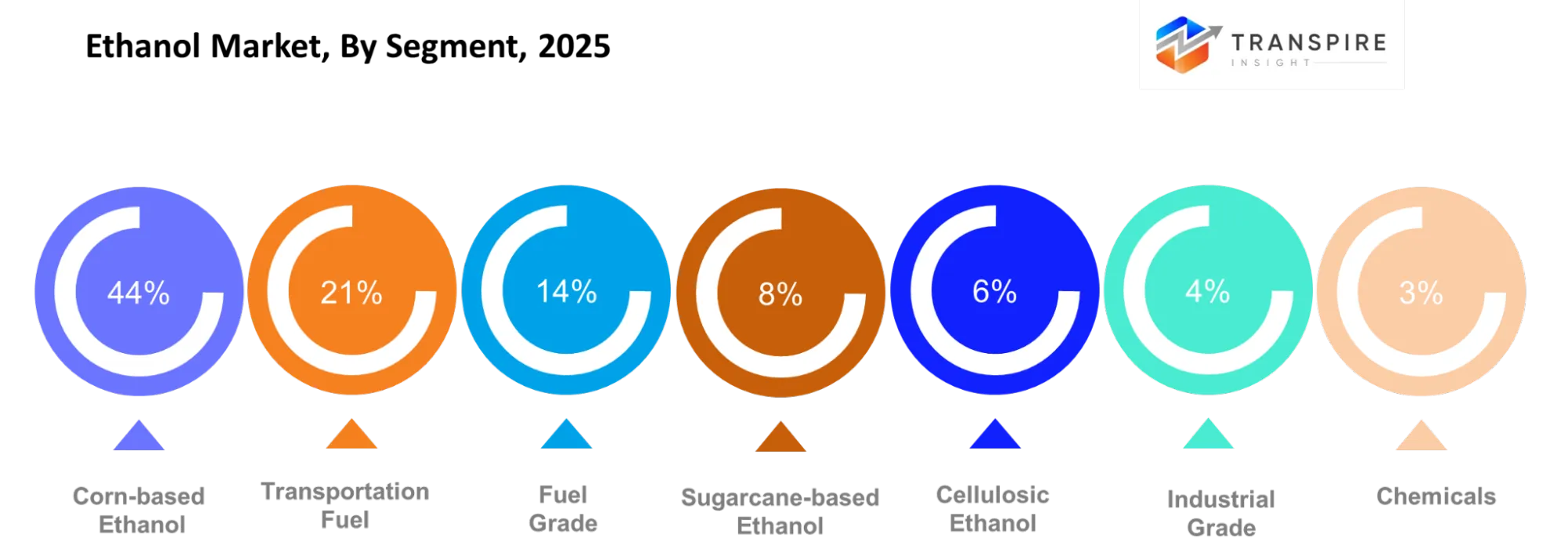
The Corn-based Ethanol dominated the market, accounting for nearly 48% in 2025 and is expected to rise at a significant CAGR during the forecast period.
The Ethanol Market is segmented by source into Corn-based Ethanol, Sugarcane-based Ethanol, Wheat-based Ethanol, Cellulosic Ethanol, Barley-based Ethanol, Molasses-based Ethanol, Cassava-based Ethanol, Others. Among these, the Corn-based Ethanol segment dominated the market, accounting for nearly 48% in 2025 and expected to increase at a significant CAGR during the forecast period. The Corn Ethanol segment was the largest market player, estimated to have captured around 48% of the market share in 2025, primarily due to the availability of large quantities of corn, well-established production facilities, supportive government blending regulations, and demand for renewable fuels. In addition, increasing drive for carbon emission reduction and energy security is resulting in a rise in corn-based ethanol utilization worldwide.
The Food Grade dominated the market, accounting for nearly 41% in 2025, and is expected to rise at a significant CAGR during the forecast period.
The Ethanol Market is segmented by grade into Fuel Grade, Industrial Grade, Pharmaceutical Grade, Food Grade, Beverage Grade, Laboratory Grade, Chemical Grade, Others. Among these, the Food Grade segment dominated the market, accounting for nearly 41% in 2025 and expected to increase at a significant CAGR during the forecast period. The Food Grade section led the market with a share of nearly 41% in 2025 due to the growing requirement from the food and beverage industry, stringent quality measures, and increased consumer inclination towards safe, quality ingredients. Besides, greater use in processed foods, beverages, and nutritional products is helping this segment grow during the said period.
The Transportation Fuel dominated the market, accounting for nearly 66% in 2025 and is expected to rise at a significant CAGR during the forecast period.
The Ethanol Market is segmented by application into Transportation Fuel, Alcoholic Beverages, Pharmaceuticals, Personal Care, Chemicals, Food Processing, Industrial Solvents, Others. Among these, the Transportation Fuel segment dominated the market, accounting for nearly 66% in 2025 and expected to increase at a significant CAGR during the forecast period. The Food Grade section led the market with a share of nearly 41% in 2025 due to the growing requirement from the food and beverage industry, stringent quality measures, and increased consumer inclination towards safe, quality ingredients. Besides, greater use in processed foods, beverages, and nutritional products is helping this segment grow during the said period.
Regional Segment Analysis of the Ethanol Market:
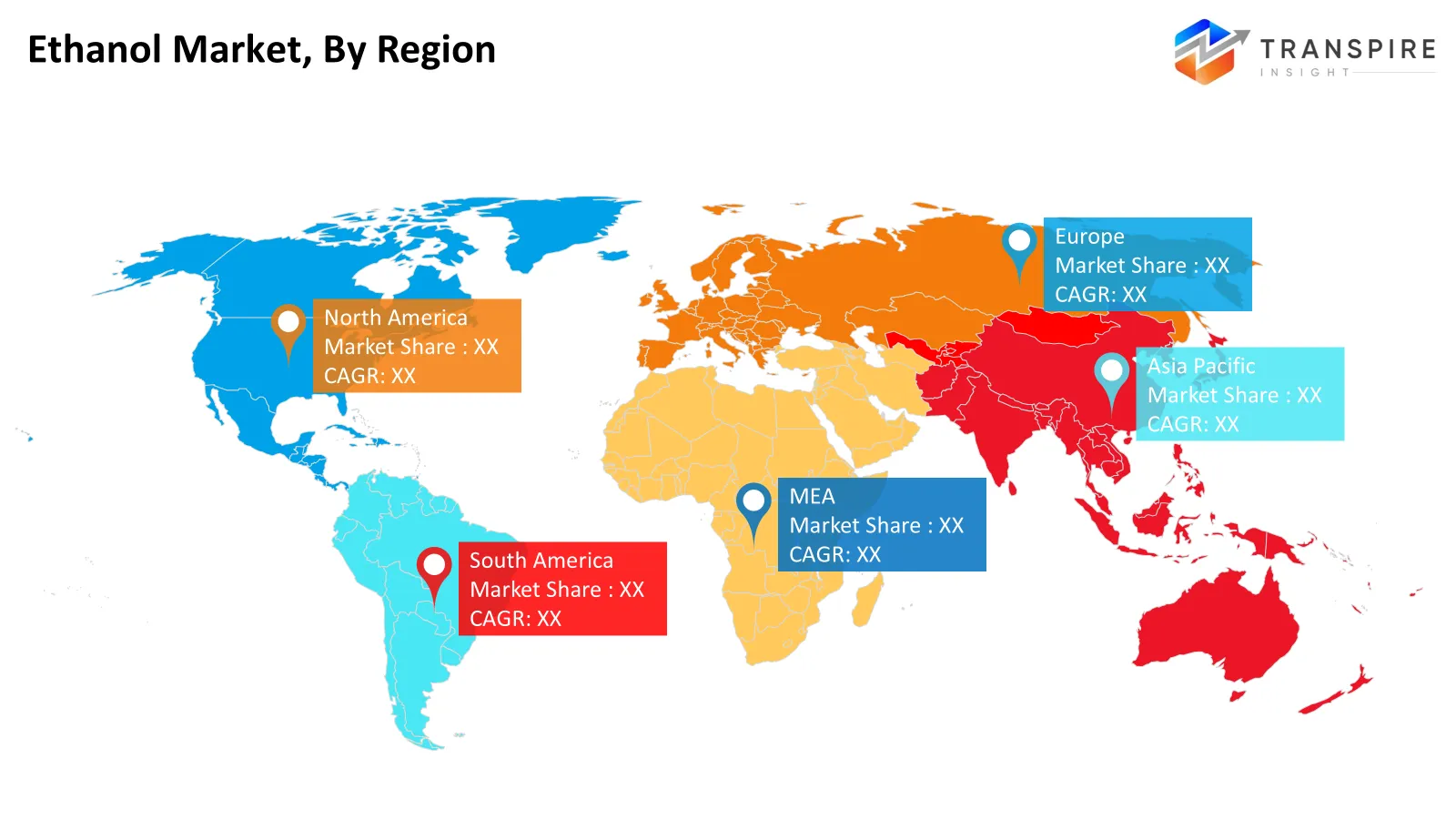
- North America (U.S., Canada, Mexico)
- Europe (Germany, France, U.K., Italy, Spain, Rest of Europe)
- Asia-Pacific (China, Japan, India, Rest of APAC)
- South America (Brazil and the Rest of South America)
- The Middle East and Africa (UAE, South Africa, Rest of MEA)
North America is the fastest-growing region in the Ethanol Market during the period, holding roughly 42% share.
North America is expected to grow at a rapid CAGR in the Ethanol Market holding roughly 42% share during the forecast period. The region experiencing the highest growth rate in the Ethanol Market is North America, as it is capturing about 42% of the market. High investments in biofuels and renewable fuel blends, excellent biofuel policies, and ownership of extensive ethanol production facilities are the main factors driving the success of this region. Successful regional development is supported by the existence of attractive government incentives, increased interest in energy solutions with lower carbon emissions, and progressive agricultural infrastructure.
Latin America is expected to grow at a rapid CAGR in the Ethanol Market, holding around 26% of the share during the forecast period.
Latin America is expected to grow at a rapid CAGR in the Ethanol Market holding around 26% share during the forecast period. In the Ethanol Market, Latin America is projected to witness a high CAGR value over the forecast period, accounting for around 26% of the total market share. Growth in this market can be attributed to numerous agricultural resources, sugarcane-based ethanol production, governmental push in blending policies, and increasing use of renewable energy. The rise in demand for sustainable transportation fuels, carbon emission reduction policies, and the growth of biofuel exports further drive growth in the regional market.
Asia Pacific is the fastest-growing region in the Ethanol Market during the period, holding roughly 13% share.
Asia Pacific is the fastest-growing region in the Ethanol Market during the forecast period, holding roughly 13% share during the forecast period. Asia Pacific is the region with the fastest growth in the Ethanol Market of nearly 13% due to increasing needs for energy, supportive biofuels blending policies, availability of agricultural feedstocks, and investments in the production of renewable energy. The growth of the market is further aided by rapidly growing industrial activities, increasing use of transportation fuels, and government initiatives that support low-carbon energy technology.
Strategies for Market Growth in Non-Leading Regions:
The development of non-lead regions by the means of effective and scalable technologies in ethical product manufacturing will favor small and medium-sized producers in biofuels. The creation of local facilities for ethanol production based on available resources, for example, corn, sugarcane, or agricultural waste, will make it possible to decrease import dependence and improve energy independence while lowering production costs. Building strategic partnerships with regional agrarians, fuel dealers, car manufacturing companies, and energy providing businesses will help reach the markets and strengthen the supply of ethanol on the market. To improve the level of the expertise in ethanol production, fermentation technology, feedstock management, quality assurance, and sustainable practices, it is necessary to elaborate training programs and programs for developing skills. Similarly, flexible financing models will increase the availability of ethanol. Friendliness to the environment of ethanol and easy access to it will be ensured by the schemes of cooperation of government organizations, agricultural societies, renewable energy sector, and the usage of electronic distribution channels.
Future Market Trends for the Ethanol Market: -
- Combining Requirements: Policies established by governments like the Renewable Fuel Standards in the U.S. and aggressive blending of E10/E20 in countries like India and Brazil stimulate great demand within the transport industry.
- New Production and New Products: New innovative methods such as specially engineered strains of yeast are being used by companies to make bio-acetone in addition to producing ethanol.
- Advanced and Waste Feedstocks: The company is moving beyond the first generation of corn and sugar crops and is using microbial fuel cells and advanced filtration technologies to produce renewable ethanol from waste materials from the agricultural sector and wastewater.
- Development of Geographical Approaches: North America and Latin America remain dominant markets however geographical production is diversified with the development of production facilities in Asia-Pacific countries.
Recent Development
- In January 2026: Brazil's biofuel industries have been reaching out to investment opportunities in the alternate feedstock ethanol production. Some of the alternative feedstock ethanol companies, which are investing in the use of alternative biomaterials including cereals and alternative feedstocks, include Be8. These activities have helped in developing the ethanol market as they have created possibilities for altering the flexibility of feedstocks.
- In June 2026: The E85 ethanol-mixed fuel rollout was initiated by the Ministry of Petroleum and Natural Gas in India at some of the retail outlets of Indian Oil Corporation Ltd (IOCL). The rollout will take advantage of the introduction of flex fuel vehicles and motorcycles. The move is aimed at boosting the Ethanol Market by promoting the use of renewable fuels, developing ethanol infrastructure, curbing crude oil dependence, and helping India achieve its sustainable mobility goals.
Market Segment
This study forecasts revenue at , regional and country levels from 2020 to 2033. Transpire Insights has segmented the Ethanol Market based on the below-mentioned segments:
Ethanol Market, By Source
- Corn-based Ethanol
- Sugarcane-based Ethanol
- Wheat-based Ethanol
- Cellulosic Ethanol
- Barley-based Ethanol
- Molasses-based Ethanol
- Cassava-based Ethanol
- Others
Ethanol Market, By Grade
- Fuel Grade
- Industrial Grade
- Pharmaceutical Grade
- Food Grade
- Beverage Grade
- Laboratory Grade
- Chemical Grade
- Others
Ethanol Market, By Blend Type
- E5
- E10
- E15
- E20
- E85
- ED95
- Flexible Fuel Blends
- Others
Ethanol Market, By Application
- Transportation Fuel
- Alcoholic Beverages
- Pharmaceuticals
- Personal Care
- Chemicals
- Food Processing
- Industrial Solvents
- Others
Ethanol Market, By Distribution Channel
- Direct Sales
- Fuel Stations
- Chemical Distributors
- Bulk Suppliers
- Online B2B
- Wholesalers
- Retail Sales
- Others
Ethanol Market, By Regional Analysis
North America
- US
- Canada
- Mexico
Europe
- Germany
- UK
- France
- Italy
- Spain
- Russia
- Rest of Europe
Asia Pacific
- China
- Japan
- India
- South Korea
- Australia
- Rest of Asia Pacific
South America
- Brazil
- Argentina
- Rest of South America
Middle East & Africa
- UAE
- Saudi Arabia
- Qatar
- South Africa
- Rest of the Middle East & Africa
Frequently Asked Questions
Find quick answers to common questions.
Biofuel mandates, renewable energy demand, decarbonization goals, technological advancements, and expanding transportation and industrial applications accelerate ethanol market growth.
Transportation Fuel dominates with 66% share due to blending policies, clean energy adoption, and demand for renewable automotive fuels.
North America leads due to strong biofuel policies, advanced infrastructure, large production capacity, and significant renewable energy investments.
AI optimization, advanced fermentation, cellulosic ethanol, carbon capture, and sustainable aviation fuel technologies improve ethanol production efficiency.
Feedstock volatility, food security concerns, infrastructure limitations, environmental issues, and electric vehicle adoption challenge ethanol market expansion.
- POET LLC
- Archer Daniels Midland
- Valero Energy
- Green Plains Inc.
- Raízen
- Cristal Union
- Tereos
- Wilmar International
- Flint Hills Resources
- Praj Industries
- CropEnergies
- COFCO Biochemical
- Pacific Ethanol
- Shell, BP
About the Authors

Pankaj Ghogare Patil
I am Pankaj Ghogare Patil, a Senior Research Analyst at Transpire Insight, specializing in the Pharmaceutical, Chemicals & Materials, Healthcare IT, and Biotechnology industry. My expertise lies in conducting comprehensive market research, analyzing industry trends, evaluating competitive landscapes, and translating complex data into actionable insights. At Transpire Insight, I closely follow emerging technologies, regulatory developments, and market innovations to create accurate, well-researched, and informative content that helps businesses and professionals make informed decisions. I am committed to producing credible, evidence-based articles that reflect industry best practices while making technical topics accessible and valuable for a broad audience.

Chakradhar Khansole
Chakradhar serves as the Research Director at Transpire Insight, bringing over 8 years of experience in technology, innovation, and strategic market intelligence. He specializes in transforming complex market data into actionable business insights that enable organizations to make informed, growth-oriented decisions. Recognized for his strategic vision and analytical expertise, Chakradhar leads high-impact research initiatives, delivering comprehensive market assessments, competitive intelligence, and forward-looking industry analysis.
Recently Published Reports
-
May 2026
Healthcare Polymer Packaging Market
Healthcare Polymer Packaging Market Size, Share & Analysis Report By Packaging Type (Syringes, IV Bottles and Pouches, Clamshells, Blisters, Bottles & Jars, Containers, Tubes, IV Parental Packaging, Others), By Type (Regulated, Non-regulated), By Polymer Type (LDPE (Low-Density Polyethylene), HDPE (High-Density Polyethylene), Homo-polymer (Homo), Random Copolymer (Random), Block Copolymer (Block), PET, Polystyrene, Polyvinyl Chloride, Polyamide/EVOH, Others), and Geography (North America, Europe, Asia-Pacific, Middle East and Africa, South and Central America), 2021 - 2031
-
Apr 2026
Hydrophilic Tape (Waterstop) Market
Hydrophilic Tape (Waterstop) Market Size, Share & Analysis Report By Type (Bentonite-Based Hydrophilic Tape, Rubber-Based Hydrophilic Tape), By Application (Residential Buildings, Commercial Buildings, Infrastructure Projects), and Geography (North America, Europe, Asia-Pacific, Middle East and Africa, South and Central America), 2021 - 2031
-
Apr 2026
Metalens Market
Metalens Market Size, Share & Analysis Report By Type (Visible Light Metalens, and Infrared Metalens), By Application (Consumer Electronics, Automotive Electronics, Industrial, Medical, and Others), and Geography (North America, Europe, Asia-Pacific, Middle East and Africa, South and Central America), 2021 - 2031
-
Apr 2026
PBT Resin Market
PBT Resin Market Size, Share & Analysis Report By Type (Reinforced PBT Resin, Unreinforced PBT Resin), By Processing Method (Injection Molding, Extrusion, Blow Molding, Others), By End-User (Automotive, Electrical & Electronics, Consumer Appliances, Industrial Machinery, Medical Devices, Packaging, Others), and Geography (North America, Europe, Asia-Pacific, Middle East and Africa, South and Central America), 2021 - 2031