
Asia Pacific Beverage Closures Market Summary
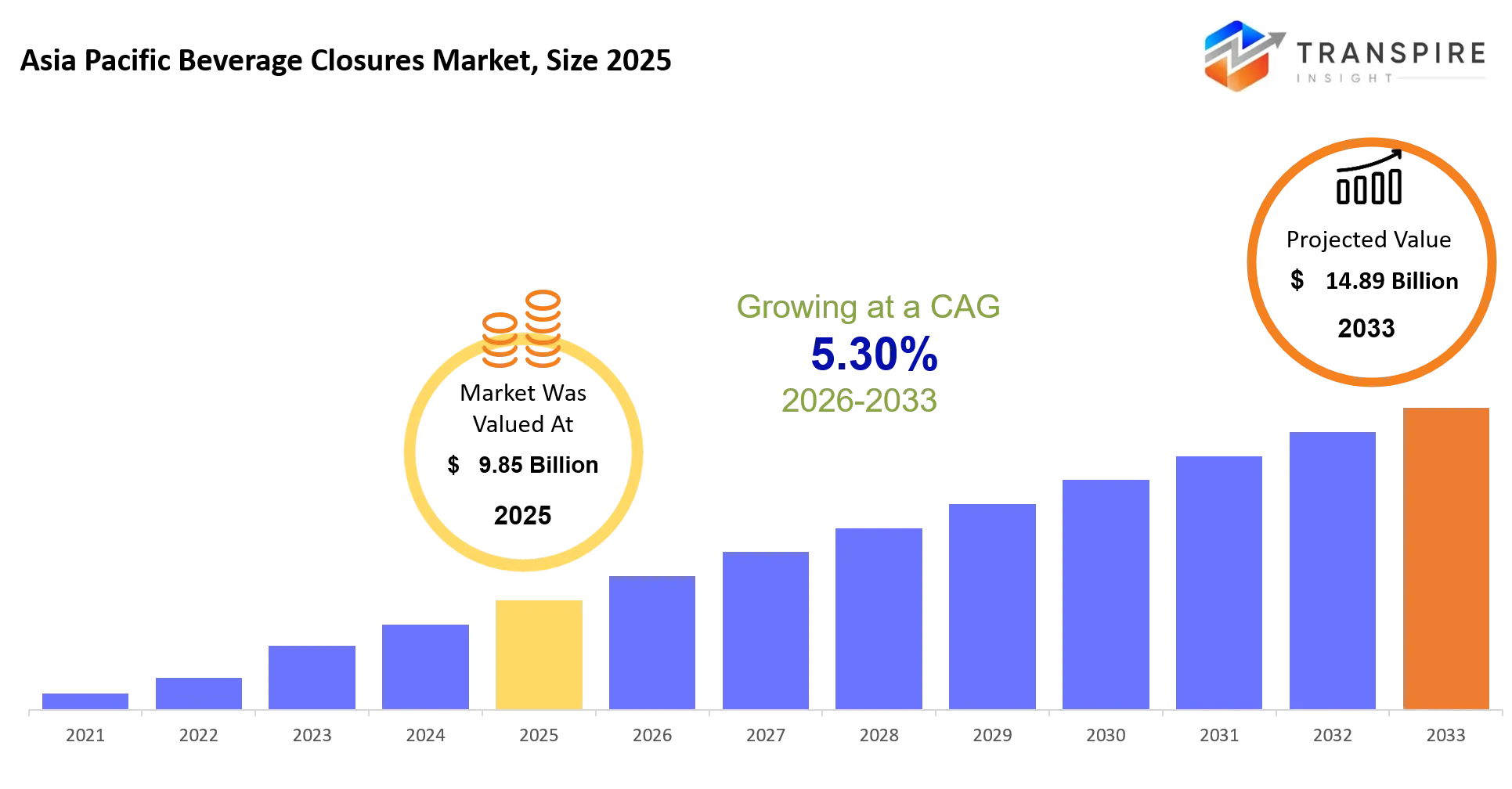
As per Transpire Insight Analysis, the Asia Pacific Beverage Closures Market size is estimated at USD 9.85 Billion in 2025 and is anticipated to reach USD 14.89 Billion by 2033, growing at a CAGR of 5.30% from 2026 to 2033.
As per Transpire Insight Analysis , the Asia Pacific Beverage Closures market size is estimated at USD 9.85 Billion in 2025 , and is expected to climb up to USD 14.89 Billion by 2033 . Beverage closures kinda sound simple, but they do a lot helping keep product freshness intact, preventing contamination, extending shelf life, and supporting safe transport of bottled water, soft drinks, alcoholic beverages, dairy goods, and ready-to-drink liquids.
Over the past five years, things have been shifting toward lighter-weight, recycle-friendly, and tethered closure layouts. This happens as beverage makers deal with tougher packaging rules, plus those corporate sustainability promises that everyone keeps mentioning. When COVID-19 hit, supply chain hiccups showed how much the industry leaned on imported raw inputs. As a result, more regional sourcing emerged, along with manufacturing investments across Asia Pacific.
These adjustments have also spurred innovation in closure materials and production approaches, enabling manufacturers to improve day-to-day operational efficiency while still aligning with evolving packaging expectations. And as beverage output expands, and premium packaging turns out to be more and more valuable commercially, advanced closure systems keep helping with clearer product differentiation, better packaging value, and ongoing revenue growth in the market.
Asia Pacific Beverage Closures Market Size & Forecast:
- Asia Pacific Beverage Closures Market Size 2025: USD 9.85 Billion
- Expected Market Value 2033: USD 14.89 Billion
- Forecast CAGR: 5.30%
- Leading region in 2025:China
- Fastest Growing region:India
- Key Profile: Bericap, AptarGroup, Berry Global, Silgan Holdings, Amcor, Crown Holdings, Guala Closures, Closure Systems International, O.Berk Company, Nippon Closures, ALPLA, Plastipak, Tecnocap, United Caps, Mold-Rite Plastics
Key Market Insights
- The Asia Pacific Beverage Closures Market is seen moving up to reach about USD 14.89 billion by 2033, growing from roughly USD 9.85 billion in 2025, and it follows a pretty steady packaging industry growth path.
- In 2025, China sort of dominates the regional business with an estimated around 38% market share, backed by large scale beverage production and tightly linked, integrated packaging supply chains.
- India is likely to be the fastest-growing regional player during the forecast window, mainly because bottled water demand keeps increasing, plus dairy beverages and carbonated soft drink production are expanding too.
- For product types, plastic closures lead the segment with an estimated share over 45%, whereas dispensing closures are recording the fastest adoption rate, especially for premium beverage applications.
- Plastic stays the main material, mainly due to lower manufacturing costs and that lightweight performance angle, while aluminum closures are slowly gaining share in premium beverage packaging.
- When it comes to applications, bottled water holds the biggest portion at more than 30%, and energy drinks are expected to expand the fastest as functional beverage consumption keeps diversifying.
- Beverage manufacturers remain the main end-user segment, while contract bottling companies keep ramping up investments in automated filling and closure systems.
- Key companies such as Amcor, Berry Global, Silgan Holdings, BERICAP, AptarGroup, and Crown Holdings are still pushing into lightweight closure technologies and recyclable packaging options.
- Overall, manufacturers are strengthening their competitive position through regional production expansion, material optimization, digital quality inspection , and strategic collaborations with beverage producers.
What are the Key Drivers, Restraints, and Opportunities in the Asia Pacific Beverage Closures Market?
The main drive of the Asia Pacific Beverage Closures Market is the fast spread of packaged beverage production, that’s pushed by capital spending on high-speed filling lines plus modern packaging sites. Beverage firms are rolling out lighter PET bottles, upgraded glass packaging, and practical resealable formats that need closure systems with solid performance able to guard product integrity during transport and warehouse storage. Meanwhile, packaging rules that favor recyclable materials and tethered cap styles have nudged closure manufacturers to redesign their products, and in turn this has been adding extra value through novelty and what feels like more premium packaging solutions.
One big drag is the structural reliance on petroleum-based resin and metal inputs, which both tend to swing in cost often and can face supply interruptions. Closure makers frequently sign long-term agreements with beverage producers, so if raw material prices jump quickly it’s hard to pass that shift along. That kind of financial squeeze lowers operating margins, postpones plans for newer production technologies, and slows the uptake of pricier sustainable materials in beverage lines that are still cost-sensitive overall.
A strong opening is the wider use of recycled-content closures, bio-based polymers, and even smart manufacturing methods throughout Asia Pacific. Also, more spending on automated inspection systems, digital quality control, and lighter weight closure designs is improving throughput efficiency while still helping with meeting regulatory expectations.
What Has the Impact of Artificial Intelligence Been on the Asia Pacific Beverage Closures Market?
Artificial intelligence and more advanced digital technologies are kind of reshaping beverage closure manufacturing, because it boosts production accuracy, quality assurance, and day to day operational efficiency, sort of. AI based vision inspection systems, for instance, can spot dimensional drift, surface defects and odd sealing behaviors while the line is moving fast. That means manufacturers can cut down on product waste and still keep closure performance steady from batch to batch. At the same time, smart production platforms look at machine signals in real time, to tune molding temperatures, adjust cycle times, and manage energy consumption… which in practice helps overall equipment effectiveness, while manufacturing costs get squeezed downward.
Then there are machine learning models that enable predictive maintenance by catching wear trends inside injection molding machines, capping units, and automated assembly lines before failures actually show up. This tends to reduce unexpected downtime, prolong equipment lifespan, and make it easier to coordinate production schedules across high volume facilities. Also AI driven demand forecasting helps closure manufacturers sync raw material purchasing and inventory levels with seasonal beverage consumption, which can prevent excess stock, and improve how quickly the supply chain reacts.
Even so AI adoption still feels limited by integration expenses and by the sheer difficulty of connecting older, legacy manufacturing equipment with modern digital platforms. Small and medium sized manufacturers often lack easy access to technical specialists and standardized production datasets, which then lowers the accuracy of predictive models. Because of that, large scale rollouts across the regional packaging industry can move slowly, and it’s not always because of willpower.
Key Market Trends
- Since 2021, manufacturers have been reducing closure weight w/ lightweight designs, which lowers resin consumption while still keeping sealing performance and production efficiency pretty much in place.
- Since 2022, tethered cap adoption has been growing faster, and that has made beverage companies kind of rethink their packaging portfolios to match the newer packaging rules , and also the recycling goals.
- Beverage producers have also been more often using recycled polymers in closure making, supporting a circular packaging path , but without trading off product safety or the actual functionality.
- AI-powered vision inspection systems are now pretty much standard on high-volume production lines, and they help catch defects more accurately, while also reducing manufacturing waste.
- Regional sourcing strategies have widened after pandemic related supply chain hiccups, so there is less reliance on imported raw materials, and delivery reliability ends up improving too.
- Premium beverage brands are moving toward customized dispensing closures and aluminum caps, which boosts differentiation and gives consumers more convenience across those competitive retail channels.
- Automation investments have gone up at manufacturing facilities ,so production cycles run a bit faster, the quality is more consistent, and in some cases predictive maintenance can be enabled for molding equipment.
- Strategic partnerships between beverage companies and packaging manufacturers have also gotten stronger, which is helping speed up the development of closures that work well with high-speed filling and bottling lines.
- Manufacturing investments have been leaning more toward India and Southeast Asia recently, supporting broader beverage production capacity and also cutting down regional distribution lead times
Asia Pacific Beverage Closures Market Segmentation
By Closure Type
Plastic Closures still take the biggest chunk mostly because they’re light weight by design, pretty cost efficient, and they just fit well with high speed filling lines, which makes big beverage runs easier. Metal Closures stay relevant too, especially for premium drinks, where extra strength and tamper evidence really matter. Screw Caps keep showing up on bottled water, juices, dairy beverages, and also alcoholic drinks, since the secure re-sealing part boosts convenience. Crown Caps hold their ground in glass packaged carbonated soft drinks and beer, mainly due to steady sealing results.
Cork Closures keep backing premium wine and specialty beverage packs where the traditional look and feel is kind of the point. Dispensing Closures are getting wider adoption in sports drinks, flavored beverages, and functional drinks, because controlled pouring helps people handle it more comfortably. Others include specialty closures meant for niche packaging styles, child resistant situations, and customized branding needs that have to match specific product goals. Product innovation across each closure type will keep advancing sealing performance, sustainability, and manufacturing efficiency.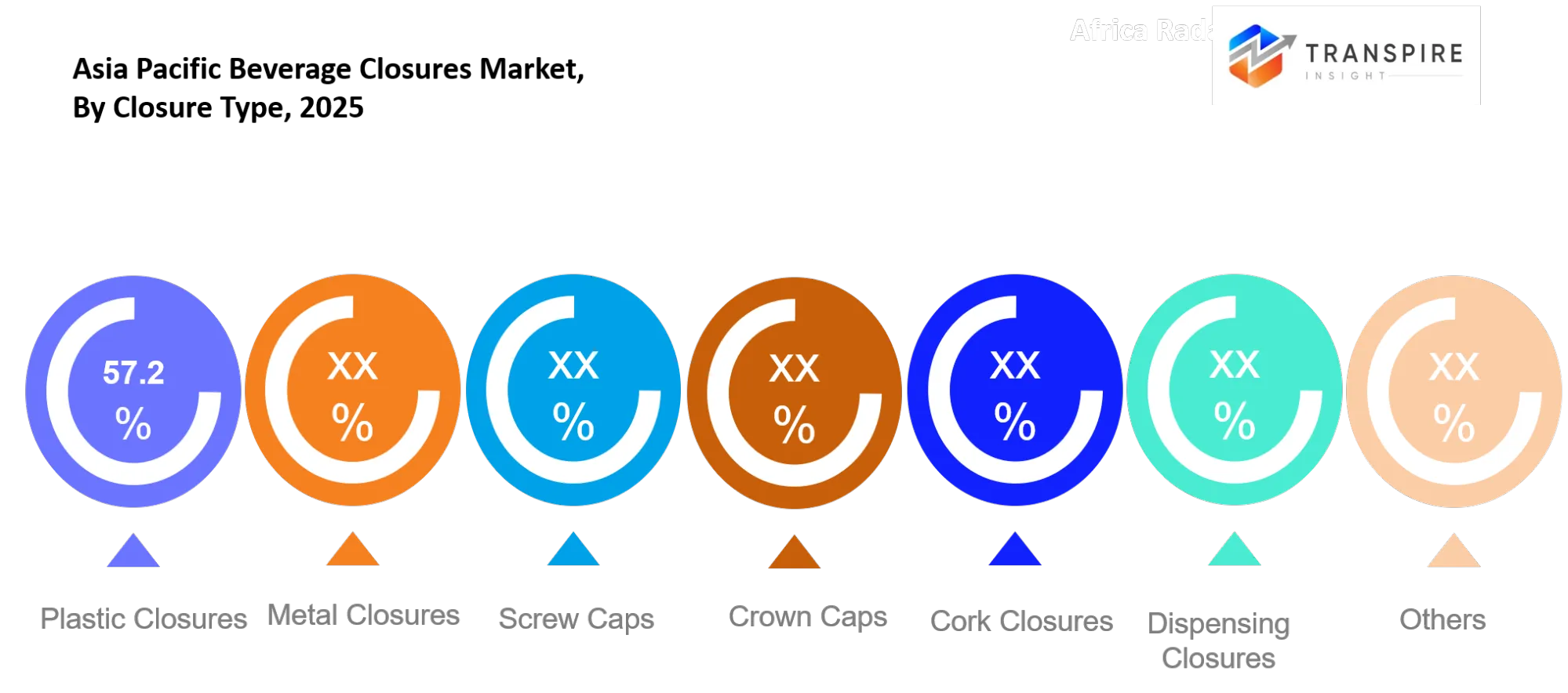
By Material
Plastic Closures still take the biggest chunk mostly because they’re light weight by design, pretty cost efficient, and they just fit well with high speed filling lines, which makes big beverage runs easier. Metal Closures stay relevant too, especially for premium drinks, where extra strength and tamper evidence really matter. Screw Caps keep showing up on bottled water, juices, dairy beverages, and also alcoholic drinks, since the secure re-sealing part boosts convenience. Crown Caps hold their ground in glass packaged carbonated soft drinks and beer, mainly due to steady sealing results.
Cork Closures keep backing premium wine and specialty beverage packs where the traditional look and feel is kind of the point. Dispensing Closures are getting wider adoption in sports drinks, flavored beverages, and functional drinks, because controlled pouring helps people handle it more comfortably. Others include specialty closures meant for niche packaging styles, child resistant situations, and customized branding needs that have to match specific product goals. Product innovation across each closure type will keep nudging sealing performance, sustainability, and manufacturing efficiency forward.
By Beverage Type
Bottled Water ends up taking the largest share, mostly because huge production runs need dependable closure options that are light in weight and still kinda cost-efficient, also they must keep product quality stable while it’s in transportation, and during storage periods. Carbonated Soft Drinks lean heavily on closures with high performance, meaning they have to hold the carbonation in, and at the same time stop any leakage when things get pressurized. Alcoholic Beverages often go for more premium closure designs, in a way they boost how the bottle looks, and also help shield the flavor and freshness for longer storage, even when it’s months. Juices need an effective sealing system, so nutritional value stays intact and shelf life is stretched across retail distribution routes, without awkward surprises.
Dairy Beverages call for closures that deliver strong sealing results, they are basically expected to keep hygiene in check and protect product safety during chilled storage. Energy Drinks keep growing too, with newer convenient packaging formats that match active lifestyles and support consumption while moving, like grab and go. Others consist of ready-to-drink tea, coffee, flavored beverages, plant-based drinks and specialty nutritional beverages, and each of those has its own closure needs tied to the specific package format. Overall product diversification across beverage categories should keep opening doors for innovative closure technologies, and that is where the momentum stays.
By End User
Beverage Manufacturers are kind of the front, leading end-user group, because integrated production setups demand consistent lid or cap quality, fast application, and reliable supply too, so they can run large scale operations without hiccups. Bottling Companies keep a solid level of demand going by supporting many beverage brands at once, mostly via contract filling and packaging services. A lot of modern bottling plants keep putting money into automated capping systems, they boost output, cut down on material loss, and keep packaging uniform across various beverage types.
Food Service Industry keeps demand fairly steady through restaurants, cafés, hotels, entertainment spaces, and institutional catering groups, all of them depending on bottled or packed beverages for daily delivery. Then there are others, like private label beverage producers, regional packaging companies, and specialty beverage businesses that focus on smaller consumer niches. As packaged beverage consumption keeps rising across retail and business channels, it should keep backing long-term demand from every end-user group. Ongoing investment in streamlined packaging operations will help increase production capacity and make the supply chain run more smoothly.
By Distribution Channel
Direct Sales takes the largest share, because big beverage producers like, they prefer long term supply agreements with closure manufacturers, to lock in consistent product quality, stable pricing, and deliveries that don’t get interrupted. Also, direct procurement helps with customized closure designs, the kind that match particular bottle formats, as well as automated filling lines.
Packaging Distributors keep supporting small and mid sized beverage companies, since they give flexible order quantities, a variety of product options, and faster regional availability. Distribution networks have also been pushed outward across developing economies, mainly to raise supply efficiency and cut down on lead times, in a practical way.
Others typically mean wholesalers, regional packaging suppliers, and specialized industrial distributors, those who serve niche beverage producers, with more specific closure needs. Digital procurement platforms and integrated supply chain management systems, keep improving inventory planning, and make order visibility easier across the various distribution channels. Strong collaboration between manufacturers and distribution partners will help product movement run smoothly, while still meeting evolving packaging requirements across the beverage industry.
What are the Key Use Cases Driving the Asia Pacific Beverage Closures Market?
Bottled water still stays as the main application, because a good secure seal protects the product quality during filling, then the transport move, storage stages and finally retail distribution. In high-volume output there’s this need for closures that are light enough but also leak resistant, those closures kind of work with automated bottling lines and keep the packaging performance really stable. That whole mix is what makes bottled water become the biggest driver behind closure demand.
Carbonated soft drinks and dairy beverages look like they are also growing, steadily. With carbonated drinks, the packaging closure has to handle internal pressure retention. Dairy beverages, on the other hand, really rely on dependable sealing to keep freshness, especially while they sit in refrigerated storage. Beverage manufacturers and bottling companies keep putting money into newer closure systems, they aim to boost production efficiency, and keep product integrity in check.
Premium alcoholic beverages and functional drinks are showing up more as emerging areas. Stuff like custom dispensing closures, recyclable cap designs, and smart packaging features are slowly being pushed into specialty beverage categories. Manufacturers seem to care a lot about premium branding, consumer convenience, plus meeting compliance requirements from changing packaging regulations. Over the forecast period these uses are expected to grow, and they should see more commercial adoption.
|
Report Metrics |
Details |
|
Market size value in 2025 |
USD 9.85 Billion |
|
Market size value in 2026 |
USD 10.37 Billion |
|
Revenue forecast in 2033 |
USD 14.89 Billion |
|
Growth rate |
CAGR of 5.30% from 2026 to 2033 |
|
Base year |
2025 |
|
Historical data |
2021 - 2024 |
|
Forecast period |
2026 - 2033 |
|
Report coverage |
Revenue forecast, competitive landscape, growth factors, and trends |
|
Regional scope |
Asia Pacific (India, China, Japan, Australia, South Korea, Rest of Asia Pacific) |
|
Key company profiled |
Bericap, AptarGroup, Berry Global, Silgan Holdings, Amcor, Crown Holdings, Guala Closures, Closure Systems International, O.Berk Company, Nippon Closures, ALPLA, Plastipak, Tecnocap, United Caps, Mold-Rite Plastics |
|
Customization scope |
Free report customization (country, regional & segment scope). Avail customized purchase options to meet your exact research needs. |
|
Report Segmentation |
By Closure Type (Plastic Closures, Metal Closures, Screw Caps, Crown Caps, Cork Closures, Dispensing Closures, Others); By Material (Plastic, Aluminum, Steel, Cork, Composite Materials, Others); By Beverage Type (Bottled Water, Carbonated Soft Drinks, Alcoholic Beverages, Juices, Dairy Beverages, Energy Drinks, Others); By End User (Beverage Manufacturers, Bottling Companies, Food Service Industry, Others); By Distribution Channel (Direct Sales, Packaging Distributors, Others) |
Which Regions are Driving the Asia Pacific Beverage Closures Market Growth?
China is kind of leading the Asia Pacific market, mostly because it has such an extensive base for beverage making, plus an integrated packaging supply chain, and big scale production ability. The government keeps pushing advanced manufacturing, recycling programs are everywhere, and they keep putting money into automated packaging facilities… so the position keeps getting stronger. Also, the logistics web is already well done, with major export ports helping move everything quickly, raw materials , and finished packaging products, across both local areas and international markets. And there’s this mature setup of resin suppliers, closure makers, bottling companies, and beverage producers that keeps the regional leadership going.
Japan sits in the second spot for regional contribution, mainly due to technical know-how and steady investment in high-quality packaging solutions, not just raw output volume. Beverage companies tend to focus on precision manufacturing, premium closure designs, and strict quality rules. These things end up supporting long-term relationships with customers. Economic conditions stay stable and packaging rules are predictable , so modernization of production facilities can continue without too much disruption. With that kind of environment, dependable revenue opportunities show up for domestic producers and also for international packaging suppliers.
India is expected to grow the fastest during the forecast period as beverage output expands across bottled water, dairy drinks, and ready to drink products. More investment in new bottling plants, food processing infrastructure, and automated packaging tech has boosted manufacturing capacity in recent years. Government moves that back domestic manufacturing and industrial progress have also encouraged further investments in packaging production.
Who are the Key Players in the Asia Pacific Beverage Closures Market and How Do They Compete?
Competition across the Asia Pacific beverage closures industry is , in a way, moderately consolidated , but still kind of mixed. You have global packaging companies going head to head with regional manufacturers that do localized production , plus more hands on customer support. Cost efficiency stays important, especially for the high-volume beverage use cases. Still, technology innovation, sustainable materials development, and manufacturing scale have turned into real differentiators. Many companies are also moving production capacity closer to beverage manufacturing hubs. At the same time they’re putting money into lightweight closure designs, digital quality inspection systems, and recyclable packaging solutions, so they can keep stronger long term customer ties.
Amcor seems to lean into material innovation and recyclable packaging technologies, which help beverage producers respond to new regulatory expectations and sustainability needs. Berry Global differentiates with lightweight closure engineering, along with advanced polymer processing, so they can cut down on material consumption while keeping sealing performance steady. BERICAP tends to stress high speed closure systems and tailored product development, especially for beverage manufacturers running automated filling lines, because that makes it easier to plug into large scale production facilities.
AptarGroup competes with precision dispensing technologies and value added closure designs aimed at improving consumer convenience, and also boosting product functionality. Silgan Holdings, meanwhile, strengthens its position by blending wide manufacturing capacity with long term supply partnerships, which helps ensure dependable delivery across multiple beverage categories.
Company List
• Bericap
• AptarGroup
• Berry Global
• Silgan Holdings
• Amcor
• Crown Holdings
• Guala Closures
• Closure Systems International
• O.Berk Company
• Nippon Closures
• ALPLA
• Plastipak
• Tecnocap
• United Caps
• Mold-Rite Plastics
Recent Development News
In April 2026, BERICAP announced the acquisition of Embankment Plastics in Ireland. The acquisition expanded BERICAP's manufacturing footprint and strengthened local production capabilities for beverage, dairy, and food closure solutions, supporting future regional growth. Source:http://www.bericap.com
In March 2026, Amcor launched a customized tethered closure for Vöslauer Mineralwasser. The new closure supports compliance with single-use plastics regulations while improving recyclability, consumer convenience, and sustainable beverage packaging innovation. Source:http://www.amcor.com
In July 2025, BERICAP launched new beverage closure innovations at Drinktec 2025. The company introduced expanded sport cap, dairy, carton packaging, and aluminum closure portfolios designed to improve sustainability, consumer convenience, and product protection across beverage applications. Source:http://www.bericap.com
What Strategic Insights Define the Future of the Asia Pacific Beverage Closures Market?
The market is slowly moving toward sort of intelligent, lightweight, and fully recyclable closure systems as beverage producers fold sustainability aims into high-speed manufacturing and these premium packaging tactics. At the same time, regulatory obligations around recyclable packaging, plus the steady spending on automation and more advanced materials, will end up steering how products are made over the next five to seven years.
There’s also a quieter risk that doesn’t get much attention, which is the ongoing swing in polymer and metal raw material supplies, this can squeeze manufacturer margins a bit , and push back commercialization of newer closure concepts even if overall beverage volumes are still healthy.
On the other hand, one emerging chance is the growing use of bio-based resins and chemically recycled plastics for beverage closures, especially since regional recycling infrastructure is getting better. Market players should beef up their regional production networks , keep investing in recyclable material technologies, and work closely with beverage producers while designing the package. If companies start early with digital manufacturing and sustainable closure innovation, they’ll usually end up with a stronger competitive position as packaging rules tighten across Asia Pacific.
Asia Pacific Beverage Closures Market Report Segmentation
By Closure Type
• Plastic Closures
• Metal Closures
• Screw Caps
• Crown Caps
• Cork Closures
• Dispensing Closures
• Others
By Material
• Plastic
• Aluminum
• Steel
• Cork
• Composite Materials
• Others
By Beverage Type
• Bottled Water
• Carbonated Soft Drinks
• Alcoholic Beverages
• Juices
• Dairy Beverages
• Energy Drinks
• Others
By End User
• Beverage Manufacturers
• Bottling Companies
• Food Service Industry
• Others
By Distribution Channel
• Direct Sales
• Packaging Distributors
• Others
Frequently Asked Questions
Find quick answers to common questions.
The Expected Asia Pacific Beverage Closures Market size for the Market will be USD 14.89 Billion in 2033.
Key segments for the Asia Pacific Beverage Closures Market are By Closure Type (Plastic Closures, Metal Closures, Screw Caps, Crown Caps, Cork Closures, Dispensing Closures, Others); By Material (Plastic, Aluminum, Steel, Cork, Composite Materials, Others); By Beverage Type (Bottled Water, Carbonated Soft Drinks, Alcoholic Beverages, Juices, Dairy Beverages, Energy Drinks, Others); By End User (Beverage Manufacturers, Bottling Companies, Food Service Industry, Others); By Distribution Channel (Direct Sales, Packaging Distributors, Others).
Major Asia Pacific Beverage Closures Market players are Bericap, AptarGroup, Berry Global, Silgan Holdings, Amcor, Crown Holdings, Guala Closures, Closure Systems International, O.Berk Company, Nippon Closures, ALPLA, Plastipak, Tecnocap, United Caps, Mold-Rite Plastics.
The Current Asia Pacific Beverage Closures Market size is USD 9.85 Billion in 2025.
The Asia Pacific Beverage Closures Market CAGR is 5.30% from 2026 to 2033.
• Bericap
• AptarGroup
• Berry Global
• Silgan Holdings
• Amcor
• Crown Holdings
• Guala Closures
• Closure Systems International
• O.Berk Company
• Nippon Closures
• ALPLA
• Plastipak
• Tecnocap
• United Caps
• Mold-Rite Plastics
About the Authors

Chetan Dhatrak
I’m Chetan Dhatrak, a Senior Research Analyst at Transpire Insight, specializing in the Consumer Goods, Foods and Beverages industry. I focus on analyzing market trends, consumer behavior, competitive landscapes, and industry developments to deliver accurate, data-driven insights. My research at Transpire Insight is built on credible sources and in-depth analysis, helping businesses and readers better understand market dynamics, emerging opportunities, and evolving consumer preferences. I’m committed to creating reliable, well-researched content that supports informed decision-making and reflects the latest developments in the consumer goods and food & beverage sectors.

Chakradhar Khansole
Chakradhar serves as the Research Director at Transpire Insight, bringing over 8 years of experience in technology, innovation, and strategic market intelligence. He specializes in transforming complex market data into actionable business insights that enable organizations to make informed, growth-oriented decisions. Recognized for his strategic vision and analytical expertise, Chakradhar leads high-impact research initiatives, delivering comprehensive market assessments, competitive intelligence, and forward-looking industry analysis.
Recently Published Reports
-
Apr 2026
Baby Infant Formula Market
Baby Infant Formula Market Size, Share & Analysis Report By ype (Infant Milk, Follow On Milk, Specialty Baby Milk, Growing-Up Milk), By Ingredient (Carbohydrate, Fat, Protein, Minerals, Vitamins, and Others), By Product Form (Powder, Liquid, and Ready-to-feed), By Distribution Channels (Supermarket/Hypermarket, Specialty Store, Pharmacies, Online Retail, and Others), and Geography (North America, Europe, Asia-Pacific, Middle East and Africa, South and Central America), 2021 - 2031
-
Apr 2026
Edible Insects for Animal Feed Market
Edible Insects for Animal Feed Market Size, Share & Analysis Report By Type (Insect Powder, Insect Meal, Insect Bar, Insect Paste, Insect Oil, and Others), By Insect Type (Beetles, Cricket, Caterpillar, Hymenoptera, Orthoptera, Tree Bugs, and Others), By Application (Livestock, Pet Food, and Aquaculture), By Livestock Type (Poultry, Swine, and Others), and Geography (North America, Europe, Asia-Pacific, Middle East and Africa, South and Central America), 2021 - 2031
-
Apr 2026
Food Industry Disinfection and Bacterial Control Market
Food Industry Disinfection and Bacterial Control Market Size, Share & Analysis Report By Type (Chemical Disinfectants, Physical Disinfectants, and Biocides and Antimicrobials), By Application (Food Processing Equipment Surface Disinfection, Food Preparation Areas Surface Disinfection, Storage Areas Surface Disinfection, Anti-microbial Coatings Food Preservation, and Preservative Solutions Food Preservation), By End User (Meat and Poultry Processing, Dairy Processing, Seafood Processing, Bakery and Confectionery, Restaurants and Commercial Kitchens, and Food Service Providers), By Sales Channel (Online, Offline), and Geography (North America, Europe, Asia-Pacific, Middle East and Africa, South and Central America), 2021 - 2031
-
May 2026
Freeze Dried Food Market
Freeze Dried Food Market Size, Share & Analysis Report By Product Type (Fruits, Vegetables, Freeze-Dried Dairy Products, Freeze-Dried Meat and Seafood, Freeze-Dried Pet Food, and Prepared Meal), By Nature (Organic, and Conventional), By Form (Powdered, Granules, and Diced), By End Use (Breakfast Cereals, Dairy Products, Bakery & Confectionery, Nutritional Bars & Supplements, Powdered Beverages, Snacks, and Retail (Household)), and Geography (North America, Europe, Asia-Pacific, Middle East and Africa, South and Central America), 2021 - 2031