

Enterprise Manufacturing Intelligence Market Summary:
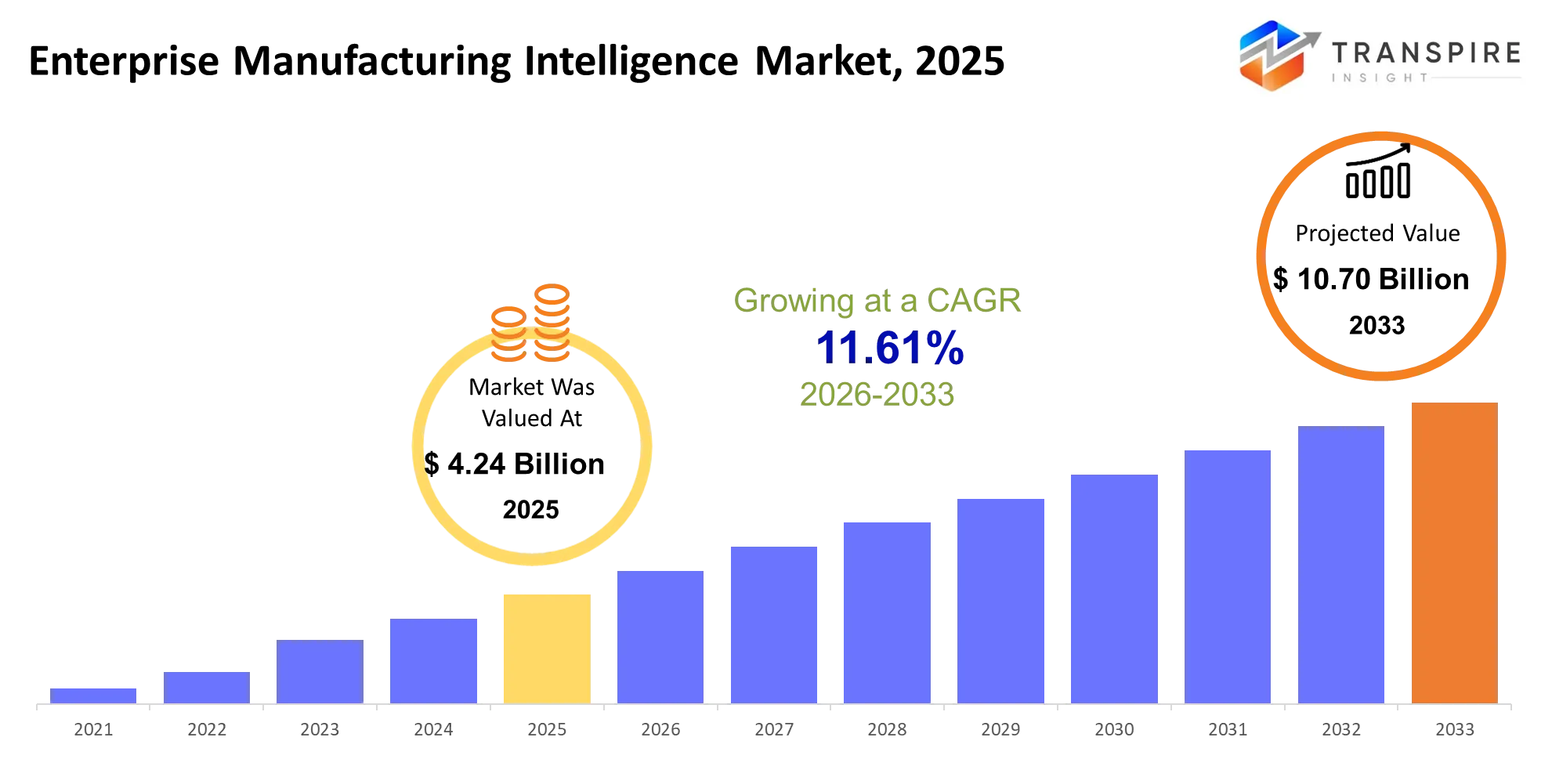
As per Transpire Insight, the Enterprise Manufacturing Intelligence Market size is estimated at USD 4.24 billion in 2025 and is anticipated to reach USD 10.70 billion by 2033, growing at a CAGR of 11.61% from 2026 to 2033.
The Enterprise Manufacturing Intelligence Market is becoming more important as manufacturers try to link production data, business systems and daily activities through an information system. These tools help companies watch how well their factories are doing, find where production is not working well, make products better and make decisions faster. In the past three to five years, the market has moved from old ways of reporting at the plant level to cloud-based systems, real-time data analysis and using AI to help make decisions. A big change has been the growing use of IoT with business software, which lets manufacturers get information from many different places. The growth of factories and money being spent on Industry 4.0 technology has made this change happen even faster. The quick rise of automated manufacturing plants has made it more important to have a view of all production. As a result, manufacturers are putting money into intelligence systems to cut down on delays, use resources better and make better plans for production.
Enterprise Manufacturing Intelligence Market Size & Forecast:
- Market Size 2025: USD 4.24 Billion
- Expected Market Value (2033): USD 10.70 Billion
- Forecast CAGR (2026–2033): 11.61%
- Leading Region in 2025: North America
- Fastest Growing Region: Asia Pacific
- Key Company Profiles: Siemens, Rockwell Automation, SAP, Honeywell, GE Digital, Schneider Electric, Dassault Systèmes, AVEVA, Emerson, ABB, IBM, Oracle, Microsoft, PTC, Critical Manufacturing
Key Market Insights:
Market is moving towards the use of integrated manufacturing software. Platforms & Software
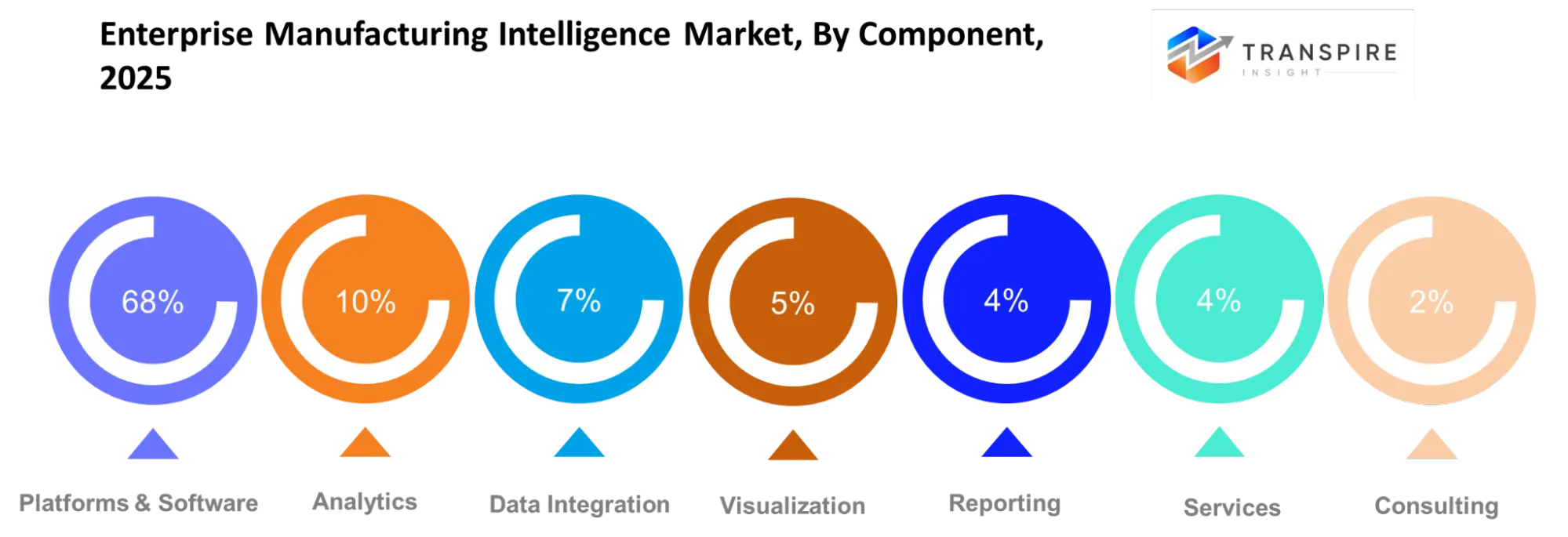
- Platforms & Software constitute 68.12% of the components, since manufacturers are favoring integration of production monitoring, reporting, and management into single systems.
- Analytics constitutes 10.0% of the component segment, as Siemens continues innovating on industrial analytics and AI-driven production intelligence.
- The component share of Data Integration is 7.0%. There is a requirement to connect manufacturing execution systems, enterprise resource planning systems, and manufacturing equipment.
- Visualization accounts for 5.0% and more and more manufacturers are using interactive dashboards for observing production processes and detecting operational bottlenecks.
- Reporting makes up 4.0% of the component segment, because manufacturing companies are adopting automated performance reports and operational information integration.
- Services take up 3.5% of the market and include needs for implementation, integration, maintenance, and customization of manufacturing solutions.
What are the Key Drivers, Restraints, and Opportunities in the Enterprise Manufacturing Intelligence Market?
Drivers:
The growing adoption of intelligent manufacturing solutions is one of the main factors driving the growth of the market. Companies have been using IoT-enabled devices and automation tools and software in order to gain more detailed insights about their manufacturing processes. Given the growing complexity of production processes, disjointed systems for reporting become inefficient. That is why manufacturers are adopting intelligent manufacturing solutions, enabling them to monitor their equipment performance, identify inefficiencies in the manufacturing process, and optimise
Restraints:
The high cost of adoption and integration difficulties are restraints for the market development. Many manufacturing plants have out-of-date equipment and proprietary databases and software. Their integration is costly and difficult and also requires some technical know-how and adjustments.
Opportunities:
Cloud-native intelligence systems and industrial AI offer huge opportunities to technology companies. Manufacturing firms are seeking more and more agile systems that would allow them to integrate information from several locations of production without the need to invest heavily in infrastructure on site. Investments in smart factories in the Asia Pacific region present huge opportunities to software vendors, especially in countries such as India, China, Japan, and South Korea.
|
Driver |
Relative Impact on Growth (%) |
Geographic Relevance |
Impact Timeline |
Demand Strength |
Growth Mechanism (5–10 words) |
Key Beneficiaries (5–10 words) |
Major Constraint (5–10 words) |
|
Increasing Adoption of Industry 4.0 and Smart Manufacturing |
28% |
North America, Europe, Asia Pacific |
Long-term |
High |
Integrates factory data for improved operational visibility. |
Manufacturers, industrial software vendors, automation providers. |
High implementation costs and legacy infrastructure limitations. |
|
Rising Industrial IoT Integration and Real-Time Production Monitoring |
24% |
Asia Pacific, North America, Europe |
Medium-term |
High |
Connects production equipment for continuous operational monitoring. |
Equipment manufacturers, IIoT providers, manufacturing enterprises. |
Connectivity gaps and industrial data integration challenges. |
|
Growing Adoption of Artificial Intelligence and Predictive Analytics |
20% |
North America, Europe, Asia Pacific |
Medium-term |
High |
Enables predictive insights and data-driven production decisions. |
AI vendors, analytics providers, industrial manufacturers. |
Poor data quality and shortage of skilled professionals. |
|
Increasing Need for Production Efficiency and Quality Optimization |
16% |
Asia Pacific, North America, Europe |
Short-term |
High |
Identifies production bottlenecks and reduces operational inefficiencies. |
Manufacturing companies, quality management providers, plant operators. |
Integration complexity and resistance to operational changes. |
|
Rising Focus on Energy Efficiency, Sustainability and Regulatory Compliance |
12% |
Europe, North America, Asia Pacific |
Long-term |
Medium |
Tracks energy consumption and supports sustainability reporting. |
Industrial manufacturers, sustainability software vendors, energy managers. |
High monitoring costs and evolving regulatory requirements. |
|
Total |
100% |
What Has the Impact of Artificial Intelligence Been on the Enterprise Manufacturing Intelligence Market?
AI technology is improving the capabilities of enterprise manufacturing intelligence solutions by enabling manufacturers to transform huge amounts of data into production insights. With the help of AI-powered analytics, it is possible to analyse the information collected from sensors, machinery, production lines, and enterprise systems in order to find hidden patterns that would be hard to detect through regular reports. It will be possible to automate performance monitoring, production optimisation, and resource planning. Predictive maintenance is one of the most useful implementations of AI in the industry. Machine learning algorithms analyse information about the operating conditions of the equipment, temperature fluctuations, vibrations, and previous experience in order to make predictions about failures and prevent them from affecting the production processes. Another useful implementation of AI is quality management. it will be possible to detect production defects and anomalies. Furthermore, intelligent analytics will help to plan the inventories and production schedules and coordinate the supply chains. Siemens and AVEVA extend their industrial AI capabilities in software ecosystems. It is quite hard to implement AI, as it needs operational data, compatible infrastructure, cybersecurity, and investments.
Instance:
In October 2026, TCS introduced its Industrial Intelligence Foundry, an AI-based solution that assists manufacturers in increasing the efficiency of production, streamlining processes, and enabling quick data-driven decisions.
Key Market Trends:
This trend involves a move towards connected, cloud-enabled, and artificial intelligence-enabled environments compared to isolated plant-level information systems.
- The move towards integrated intelligence platforms instead of traditional reporting platforms to gain an overview of production process performance within several production facilities at once.
- Cloud architecture is recognised for its flexibility in software and system implementation, enabling remote monitoring, centralised management of data, and scalable system architecture.
- Industrial Internet of Things gains importance as manufacturing enterprises start to gather equipment-level data and connect their operational technology and enterprise applications.
- Predictive analytics becomes a basis for the change in approach towards maintenance of production equipment to avoid failures.
- Digital twins become widely applied not only for products but also for production planning and simulation purposes.
- Manufacturing software vendors start implementing AI assistants and intelligent automation into their products.
Enterprise Manufacturing Intelligence Market Segmentation
By Components:
Platform & Software account for 68.12% of the components segment owing to its usage in integrating manufacturing processes, manufacturing process monitoring, and data management in enterprises. The components segment has 10.0% of Analytics, which is used in making data-oriented decisions and performance evaluation. 7.0% is represented by Data Integration, 5.0% by Visualisation and Reporting, and 4.0% by each. 3.5% of the segment belongs to the Services component, while 2.38% belongs to the Consulting component. Increasing penetration of AI-powered software and integrated manufacturing platforms will make this segment stronger.
By Deployment:
The deployment segment has On-Premises, Cloud-Based, Hybrid, Private Cloud, Public Cloud, Edge-Based, and SaaS deployments. Although on-premises solutions continue to be important for manufacturing firms that need more control over their infrastructure and data management, the trend towards cloud-native solutions is rising with a projected CAGR of 27.68%. This is attributed to scalability, remote usability, and fewer infrastructure requirements.
By Application:
The areas of application are Analytics & Analysis, Workflow & KPI Management, Production Monitoring, Quality Management, Supply Chain Analytics, Predictive Maintenance, and Performance Management. Analytics, production monitoring, and quality management can assist manufacturers in monitoring efficiency, detecting bottlenecks, controlling production, and preventing any defects. Workflow & KPI Management are aimed at ensuring the smooth workflow between departments. Particularly crucial nowadays is predictive maintenance, which relies on data from the equipment in order to prevent failures and downtime, as well as supply chain analytics & performance management.
By Industry:
This market benefits the Automotive, Pharmaceuticals & Biotechnology, Electronics, Food & Beverage, Chemicals, Aerospace & Defence, and Industrial Manufacturing Industries. Automotive and electronics manufacturers utilise intelligence platforms for production line monitoring, production equipment monitoring, and quality monitoring. Pharmaceuticals industry needs trust in process monitoring, and traceability of production records; food and beverage manufacturers demand manufacturing consistency and operational excellence; Chemical and aerospace manufacturers require monitoring of manufacturing process equipment, process control, and traceability of manufacturing records. The adoption of manufacturing intelligence solutions is enabled by the growing adoption of automation and the increase in digital transformation in all the end markets.
By Enterprise Size:
The enterprise size categories are Large Enterprises, Medium Enterprises, Small Enterprises, SMEs, MNCs, Government Plants, and Contract Manufacturers. Large enterprises and MNCs will be prime customers as their supply chain will be interrelated and complex and hence needs the complete view. Medium manufacturers are leaning towards modular software to increase efficiency with less capital expenditure. Small enterprises and SMEs are looking at cost-effective cloud computing, and government plants and contract manufacturers require a reliable system for production monitoring and reporting.
By Technology:
AI, Machine Learning, IoT, Digital Twins, Edge Computing, Big Data Analytics, Industrial Cloud. The manufacturing intelligence platform that will employ the above categories of technology will make manufacturing more connected, perceptive and efficient. AI/ML uses data for predictive maintenance, production optimisation and automated analysis of generated data. IoT provides production awareness and insight by linking industrial equipment and sensors. Digital twins aid virtual simulation of manufacturing operations. Edge computing empowers real-time processing of data from production environments. Big Data Analytics provides understanding through analysis of data sets. An industrial cloud solution affords flexible data storage and management infrastructure.
What are the Key Use Cases Driving the Enterprise Manufacturing Intelligence Market?
The use case that we have is centralised monitoring of production through platforms and software. Through this, the company can measure the performance of their equipment, production efficiency, and manufacturing KPIs. This helps them identify problems in their production process and coordinate activities across several plants. Another application is predictive maintenance and quality control. Companies in the automotive, electronics, and industrial manufacturing industries use their equipment data and analysis to detect failures in the system, control the quality of the products, and reduce disruptions in their production process. There are also new applications for the technology. These include AI-based production planning, digital twins, automation of supply chain analysis, and operational intelligence at the edge of operations.
|
Report Metrics |
Details |
|
Market size value in 2025 |
USD 4.24 Billion |
|
Market size value in 2026 |
USD 4.73 Billion |
|
Revenue forecast in 2033 |
USD 10.70 Billion |
|
Growth rate |
CAGR of 11.61% from 2026 to 2033 |
|
Base year |
2025 |
|
Historical data |
2021 - 2024 |
|
Forecast period |
2026 - 2033 |
|
Report coverage |
Revenue forecast, competitive landscape, growth factors, and trends |
|
Regional scope |
United States; Canada; Mexico; United Kingdom; Germany; France; Italy; Spain; Denmark; Sweden; Norway; China; Japan; India; Australia; South Korea; Thailand; Brazil; Argentina; South Africa; Saudi Arabia; United Arab Emirates |
|
Key company profiled |
Siemens, Rockwell Automation, SAP, Honeywell, GE Digital, Schneider Electric, Dassault Systèmes, AVEVA, Emerson, ABB, IBM, Oracle, Microsoft, PTC, Critical Manufacturing |
|
Customization scope |
Free report customization (country, regional & segment scope). Avail customized purchase options to meet your exact research needs. |
|
Report Segmentation |
Component (Platforms & Software, Analytics, Data Integration, Visualization, Reporting, Services, Consulting); Deployment (On-Premises, Cloud-Based, Hybrid, Private Cloud, Public Cloud, Edge-Based, SaaS); Application (Analytics & Analysis, Workflow & KPI Management, Production Monitoring, Quality Management, Supply Chain Analytics, Predictive Maintenance, Performance Management); Industry (Automotive, Pharmaceuticals & Biotechnology, Electronics, Food & Beverage, Chemicals, Aerospace & Defense, Industrial Manufacturing); Enterprise Size (Large Enterprises, Medium Enterprises, Small Enterprises, SMEs, Multinational Corporations, Government Plants, Contract Manufacturers); Technology (AI, Machine Learning, IoT, Digital Twins, Edge Computing, Big Data Analytics, Industrial Cloud) |
Which Regions are Driving the Enterprise Manufacturing Intelligence Market Growth?
North America:
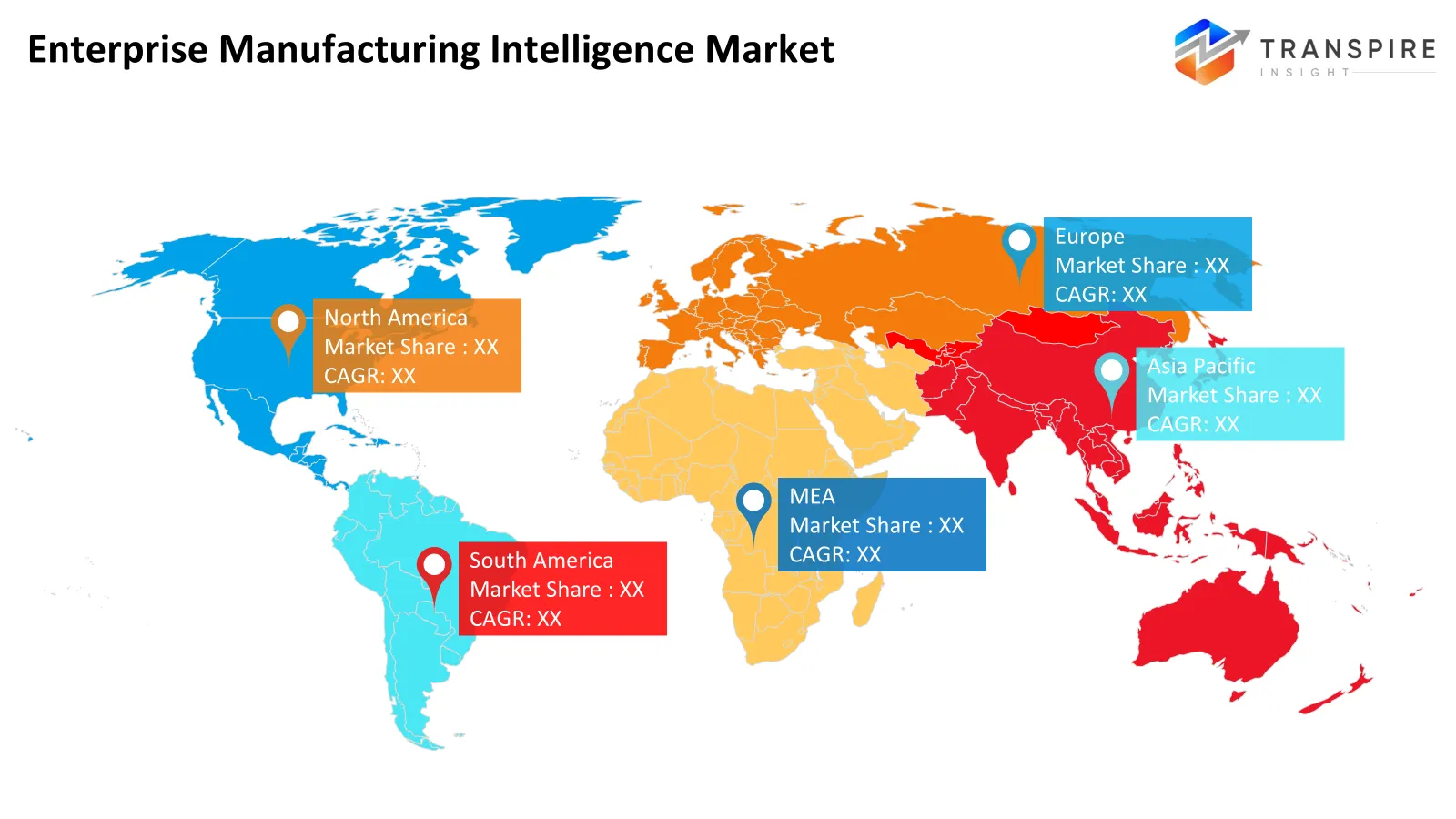
North America constitutes 37.71% of its well-established industrial software ecosystem and adoption of advanced manufacturing technologies. Investments in factory automation, industrial IoT infrastructure, and enterprise digital transformation are contributing towards the growth of the region. In addition, the presence of technology vendors and manufacturing software providers is facilitating the deployment of intelligence platforms. Investments in data centres, aerospace, automotive manufacturing, and industrial automation are driving the demand for operational intelligence.
In January 2026, PepsiCo, Siemens and NVIDIA unveiled their partnership to create AI-powered digital twins for PepsiCo’s manufacturing facilities and warehouses. This is aimed at enhancing production planning, factory operations, and manufacturing performance through simulation and real-time operational intelligence.
Europe:
Europe accounts for 29.0% due to the developed automotive, pharmaceutical, chemical, and industrial manufacturing industries on the continent. The investments made by Europe in areas such as industrial automation, energy efficiency, and digital factories are fuelling the manufacturing ecosystem in the continent. Manufacturers in the region have started utilising connected manufacturing processes for improved visibility, quality, and resource utilisation. Sustainable business objectives and industrial transformation programs have increased the demand for manufacturing intelligence solutions in the region.
In February 2026, PhysicsX and Deutsche Telekom deployed their AI engineering platform in Germany’s Industrial AI Cloud. This is an AI platform supporting industrial simulation, engineering processes, and manufacturing decisions informed by data.
Asia Pacific:
Asia Pacific accounts for 25.0% of the market share and is the fastest-growing regional market segment, expected to grow at a CAGR of 26.41%. Fast-paced industrialisation, electronics production, and smart manufacturing infrastructure investments are driving the growth of the regional market. Many countries in the region, including China, India, Japan, and South Korea, are investing in digital manufacturing solutions by leveraging automation and industrial technologies. Expansion in the number of manufacturing facilities and cloud-based software interests offers good growth prospects for intelligence platform vendors.
In March 2026, Foxconn and SAP entered into a partnership to fast-track AI-based manufacturing, smart factory operations, and supply chain management.
https://ningxia.foxconn.com.cn/en-us/press-center/events/csr-events/1981
Who are the Key Players in the Enterprise Manufacturing Intelligence Market, and how do they compete?
The competation in the Enterprise Manufacturing Intelligence Market involves industrial automation firms, enterprise software firms, and manufacturing technology companies. The major players include Siemens AG, Rockwell Automation, ABB Ltd., Honeywell International, Emerson Electric, AVEVA, Schneider Electric, SAP SE, Dassault Systèmes, and AspenTech.Siemens and Rockwell Automation compete based on the integration of industrial automation, manufacturing management, and analytics to improve their manufacturing software offerings. ABB and Honeywell compete based on their industrial automation experience and operational technology integration. AVEVA and Schneider Electric compete by leveraging connected industrial platforms, data integration, and intelligence in the cloud. SAP competes by connecting manufacturing intelligence with enterprise resource planning and supply chains, whereas Dassault Systèmes competes by means of digital manufacturing and simulation.
Enterprise Manufacturing Intelligence Market Companies
- Siemens
- Rockwell Automation
- SAP
- Honeywell
- GE Digital
- Schneider Electric
- Dassault Systèmes
- AVEVA
- Emerson
- ABB
- IBM
- Oracle
- Microsoft
- PTC
- Critical Manufacturing
|
Company |
Est. Revenue Share Range |
Key Offerings |
Strategic Positioning |
Geographic Strength |
Technology Focus |
|
Siemens AG |
5–8% |
Opcenter Intelligence, Opcenter Execution, Opcenter Intelligence Cloud |
Integrated manufacturing intelligence leadership |
Europe, North America, Asia Pacific |
AI analytics, cloud, IoT, digital twins |
|
Rockwell Automation |
4–7% |
FactoryTalk Analytics, FactoryTalk Metrics, DataMosaix |
Automation-led analytics differentiation |
North America, Europe, Asia Pacific |
Industrial AI, edge analytics, predictive maintenance |
|
Schneider Electric |
4–7% |
AVEVA MES, System Platform, Unified Operations Center |
Enterprise-wide industrial software ecosystem |
Europe, North America, Asia Pacific |
Industrial AI, cloud, operational data integration |
|
Honeywell International |
3–6% |
Honeywell Forge, Manufacturing Excellence, Process Analytics |
Process-industry intelligence specialization |
North America, Middle East, Asia Pacific |
AI analytics, asset intelligence, industrial IoT |
|
SAP SE |
3–5% |
SAP Digital Manufacturing, SAP Analytics Cloud, Manufacturing Insights |
ERP-integrated manufacturing intelligence |
Europe, North America, Asia Pacific |
Cloud analytics, enterprise integration, AI |
|
ABB Ltd. |
3–5% |
ABB Ability MOM, Production Intelligence, Process Analytics |
Automation-driven operational optimization |
Europe, Asia Pacific, North America |
Industrial IoT, process analytics, asset performance |
|
Emerson Electric |
2–4% |
Plantweb Optics, DeltaV, AspenTech solutions |
Process optimization and software integration |
North America, Europe, Asia Pacific |
Predictive analytics, digital twins, industrial AI |
|
Dassault Systèmes |
2–4% |
DELMIA Apriso, DELMIAWorks, 3DEXPERIENCE |
Virtual twin-based manufacturing intelligence |
Europe, North America, Asia Pacific |
Digital twins, simulation, manufacturing analytics |
|
Aspen Technology |
1–3% |
Aspen InfoPlus.21, Aspen Mtell, Aspen Unified |
Specialized process intelligence and optimization |
North America, Europe, Middle East |
Predictive analytics, industrial AI, process optimization |
|
Yokogawa Electric |
1–3% |
OpreX Intelligent Manufacturing Hub, Exaquantum, OpreX Production Management |
Process-industry intelligence specialization |
Asia Pacific, Middle East, Europe |
Plant analytics, process optimization, AI |
Recent Development News
- In November 2025, Rockwell Automation made an announcement about the inclusion of NVIDIA Nemotron Nano in the FactoryTalk Design Studio workflow so that industrial environments can leverage generative AI capabilities. This innovation enables more efficient automation engineering, workflow efficiency, and the implementation of AI in factory-floor and edge computing environments. https://www.rockwellautomation.com/en-in/company/news/press-releases/rockwell-automation-to-advance-industrial-intelligence-through-e.html
- In March 2026, Siemens added to its industrial AI environment through innovative technology and through collaboration with Alibaba so as to enable cloud-based industrial simulation software. The innovations help in AI-enabled manufacturing and industrial automation. https://press.siemens.com/global/en/pressrelease/siemens-boosts-industrial-ai-operating-system-unveils-new-technologies-and-partnership
What Strategic Insights Define the Future of the Enterprise Manufacturing Intelligence Market?
The future of the Enterprise Manufacturing Intelligence Market will be largely defined by the ability of software vendors to connect enterprise applications, machinery, and analytics within an integrated operating environment. Cloud-based solutions, artificial intelligence, and predictive maintenance are forecast to be some of the main technological focuses for the coming period as manufacturers embrace connected production facilities. Yet there is one problem which will not be as apparent but will have a significant impact – the challenge of connecting modern intelligence platforms with existing manufacturing technologies. Inconsistencies in data, cybersecurity issues, and a lack of skilled IT specialists might complicate the adoption process in existing industrial plants. On the other hand, growing smart factory installations in Asia Pacific present great prospects for software providers with cost-effective solutions.
Key Segmentations are:
Component
- Platforms & Software
- Analytics
- Data Integration
- Visualization
- Reporting
- Services
- Consulting
Deployment
- On-Premises
- Cloud-Based
- Hybrid
- Private Cloud
- Public Cloud
- Edge-Based
- SaaS
Application
- Analytics & Analysis
- Workflow & KPI Management
- Production Monitoring
- Quality Management
- Supply Chain Analytics
- Predictive Maintenance
- Performance Management
Industry
- Automotive
- Pharmaceuticals & Biotechnology
- Electronics
- Food & Beverage
- Chemicals
- Aerospace & Defense
- Industrial Manufacturing
Enterprise Size
- Large Enterprises
- Medium Enterprises
- Small Enterprises
- SMEs
- Multinational Corporations
- Government Plants
- Contract Manufacturers
Technology
- AI
- Machine Learning
- IoT
- Digital Twins
- Edge Computing
- Big Data Analytics
- Industrial Cloud
By Regional Analysis
North America
- US
- Canada
- Mexico
Europe
- Germany
- UK
- France
- Italy
- Spain
- Russia
- Rest of Europe
Asia Pacific
- China
- Japan
- India
- South Korea
- Australia
- Rest of Asia Pacific
South America
- Brazil
- Argentina
- Rest of South America
Middle East & Africa
- UAE
- Saudi Arabia
- Qatar
- South Africa
- Rest of the Middle East & Africa
Frequently Asked Questions
Find quick answers to common questions.
The enterprise manufacturing intelligence market size was valued at USD 4.24 Billion in 2025 and is poised to reach USD 10.70 Billion by 2033, expanding at a 11.61% CAGR.
Key segments for the enterprise manufacturing intelligence market are Component (Platforms & Software, Analytics, Data Integration, Visualization, Reporting, Services, Consulting); Deployment (On-Premises, Cloud-Based, Hybrid, Private Cloud, Public Cloud, Edge-Based, SaaS); Application (Analytics & Analysis, Workflow & KPI Management, Production Monitoring, Quality Management, Supply Chain Analytics, Predictive Maintenance, Performance Management); Industry (Automotive, Pharmaceuticals & Biotechnology, Electronics, Food & Beverage, Chemicals, Aerospace & Defense, Industrial Manufacturing); Enterprise Size (Large Enterprises, Medium Enterprises, Small Enterprises, SMEs, Multinational Corporations, Government Plants, Contract Manufacturers); Technology (AI, Machine Learning, IoT, Digital Twins, Edge Computing, Big Data Analytics, Industrial Cloud).
Growth is primarily driven by increasing adoption of Industry 4.0 technologies, rising demand for real-time production monitoring, growing integration of AI and IoT, the need to improve operational efficiency, increasing focus on predictive maintenance, and investments in smart factory automation and data-driven manufacturing processes.
The market is led by major manufacturers including Siemens, Rockwell Automation, SAP, Honeywell, GE Digital, Schneider Electric, Dassault Systèmes, AVEVA, Emerson, ABB, IBM, Oracle, Microsoft, PTC, Critical Manufacturing.
North America has a market share of 37.71% in the enterprise manufacturing intelligence market, due to its early adoption of sophisticated manufacturing technologies, significant investments in Industry 4.0, and high use of AI and IoT technologies, as well as the presence of major technology vendors. Increasing demand for smart manufacturing, real-time production monitoring, and data-driven decision-making further bolsters the market dominance of the region.
Opportunities in the enterprise manufacturing intelligence market consist of the increased use of AI-driven manufacturing analytics, rising investments in the construction of smart factories, increasing need for predictive maintenance, implementation of IoT and cloud computing platforms, and expanding digital twin technologies. All these factors present new opportunities for software vendors and technology firms to deliver advanced manufacturing intelligence solutions.
- Siemens
- Rockwell Automation
- SAP
- Honeywell
- GE Digital
- Schneider Electric
- Dassault Systèmes
- AVEVA
- Emerson
- ABB
- IBM
- Oracle
- Microsoft
- PTC
- Critical Manufacturing
About the Authors

Avinash Kumar
I’m Avinash Kumar, a Senior Research Analyst at Transpire Insight, with expertise in the Electronics and Semiconductor and Energy & Power industry. My work focuses on analyzing emerging technologies, market trends, industry developments, and innovation across these sectors. I specialize in transforming complex technical and market insights into clear, research-backed content that helps professionals, businesses, and decision-makers stay informed. Through continuous industry research and data-driven analysis, I strive to deliver accurate, reliable, and practical perspectives on the latest advancements shaping the semiconductor and energy landscape.

Chakradhar Khansole
Chakradhar serves as the Research Director at Transpire Insight, bringing over 8 years of experience in technology, innovation, and strategic market intelligence. He specializes in transforming complex market data into actionable business insights that enable organizations to make informed, growth-oriented decisions. Recognized for his strategic vision and analytical expertise, Chakradhar leads high-impact research initiatives, delivering comprehensive market assessments, competitive intelligence, and forward-looking industry analysis.
Recently Published Reports
-
Apr 2026
Fiber Optic Faceplates Market
Fiber Optic Faceplates Market Size, Share & Analysis Report By Type (< 300 mm2, 300-350 mm2, and > 350 mm2, By Application (Night Vision, Holographic Imaging, Medical, and Others), and Geography (North America, Europe, Asia-Pacific, Middle East and Africa, South and Central America), 2021 - 2031
-
Apr 2026
High Temperature Superconductors Market
High Temperature Superconductors Market Size, Share & Analysis Report By Type (1G HTS, and 2G HTS), By Application (Power Cable, Fault Current Limiter, and Transformer), and Geography (North America, Europe, Asia-Pacific, Middle East and Africa, South and Central America), 2021 - 2031
-
Apr 2026
Industrial Plugs and Socket Market
Industrial Plugs and Socket Market Size, Share & Analysis Report By Type (Industrial Plugs, Industrial Sockets), By Current (Up to 32 A, 32 to 125 A, Above 125 A), By Protection (Dustproof and Splash Proof, Waterproof, Explosion Proof), By End User (Heavy Industries, Oil and Gas, Chemicals and Pharmaceuticals, Power Generation, Others), and Geography (North America, Europe, Asia-Pacific, Middle East and Africa, South and Central America), 2021 - 2031
-
Apr 2026
InGaAs Avalanche Photodiodes Market
InGaAs Avalanche Photodiodes Market Size, Share & Analysis Report By Type (1100 - 1700 nm, and 1000 - 1600 nm), By Application (Missile Warning System, Muzzle Flash Detection, Wafer Defect Inspection, Laser Rangefinders, and Others), and Geography (North America, Europe, Asia-Pacific, Middle East and Africa, South and Central America), 2021 - 2031