

Enterprise Biometrics Market Summary:
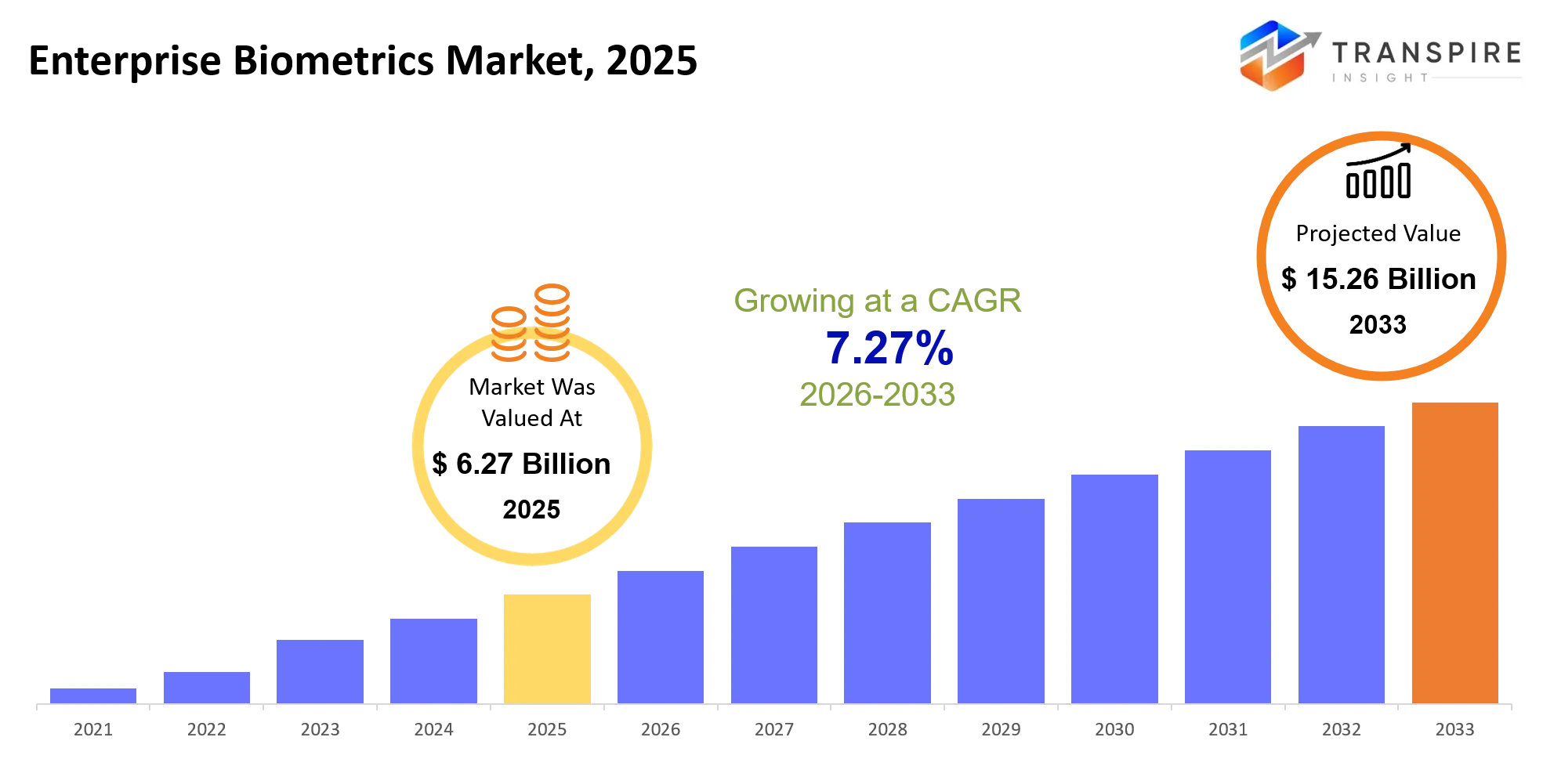
As per Transpire Insight Analysis, the Enterprise Biometrics Market size is estimated at USD 6.98 billion in 2025 and is anticipated to reach USD 15.26 billion by 2033, growing at a CAGR of 11.82% from 2026 to 2033.
The Enterprise Biometrics Market supports companies in checking the identities of employees, customers, and visitors using physical or behavioural traits. Companies use these systems for entering buildings, tracking staff attendance, doing work and getting into digital tools. In the past three to five years, biometric security has gone past just fingerprint readers to include facial recognition, no-touch checks and ways to log in without passwords. The move to work from home and office using cloud services and having connected business systems has made it more important to have identity checks that work for both online situations.for this is the rising effort to stop people from getting in without permission and to avoid identity theft as companies do work online. These worries are making businesses mix biometrics with ways to check identity and with security checks that depend on the level of risk. Because of this, more companies are using these systems because they can make identity checks stronger while using passwords, access cards and manual ways to track who is there.
Enterprise Biometrics Market Size & Forecast:
- Market Size 2025: USD 6.27 Billion
- Expected Market Value (2033): USD 15.26 Billion
- Forecast CAGR (2026–2033): 7.27%
- Leading Region in 2025: XXXX
- Fastest Growing Region: XXXX
- Key Company Profiles:
Key Market Insights:
The market is moving from independent fingerprint hardware to connected identity systems, which would be helpful in providing security along with digital authentication.
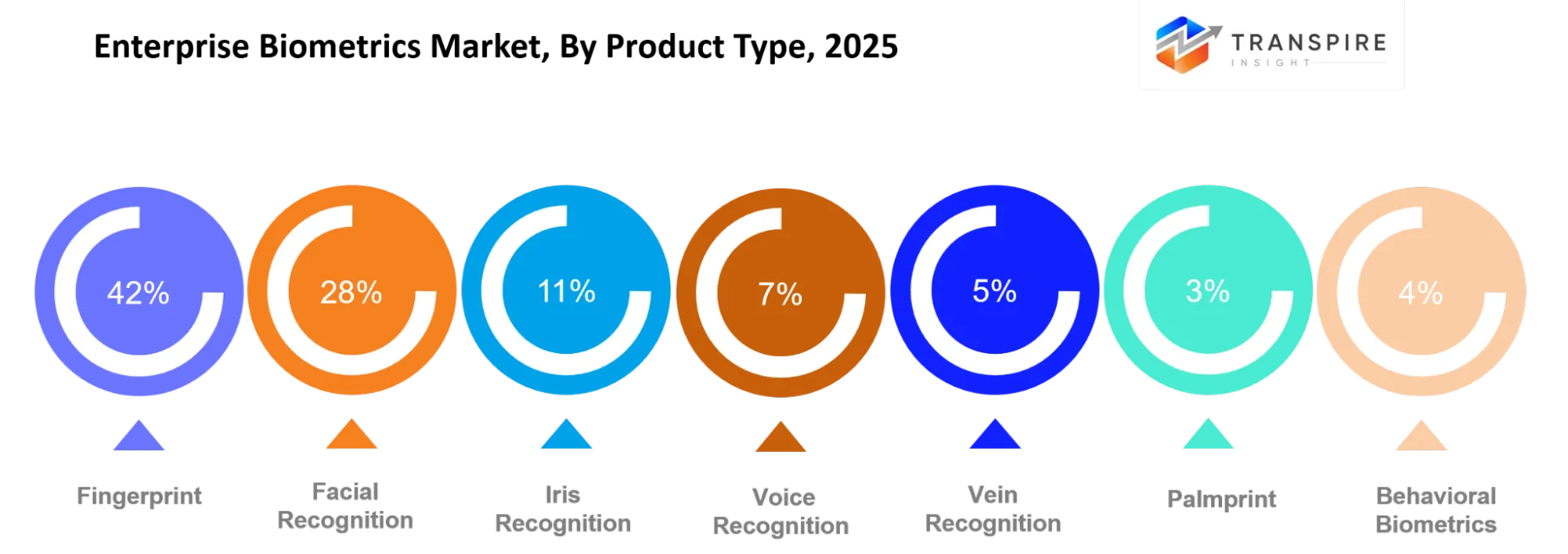
- Fingerprint recognition constitutes 42% of the biometric technology segment as a result of its application in employee attendance, entry into workstations, and identification.
- Iris recognition takes 11% of the segment, providing a choice for companies that seek extra identity verification for the purpose of securing sensitive facilities.
- Voice recognition makes up 7% of the segment, providing an opportunity to use voice-based authentication services as well as remote identification processes.
- Vein recognition constitutes 5% of the segment and gives a choice to those companies who want to use physically secure biometric features.
- Behavioural biometrics accounts for 2% of the segment, enabling identity verification using patterns such as typing and mouse movements.
- Multimodal biometrics holds 2% of the segment, enabling the verification process using two or more biometrics.
What are the Key Drivers, Restraints, and Opportunities in the Enterprise Biometrics Market?
Drivers
The growth of the market is due to the use of identity management in offices, cloud-based solutions, finance, and remote working scenarios. Password hacking, credential sharing, and unauthorized access to facilities have rendered the traditional mode of authentication unreliable on its own. It is thus prompting the enterprises to use fingerprint readers, facial recognition devices, and multi-factor authentication solutions. The use of such technologies can help in improving operational efficiency by making the need for manual attendance unnecessary and making passwords management easier.
Restraints
High initial cost is another issue as the organizations have to buy the sensors, license software, control access hardware, and integrate systems. Privacy issues, data protection legislation, matching errors, and the possibility of biometrics getting exposed can hamper their use. Once compromised, it is not easy to replace biometric information like passwords, which makes storage and data protection extremely important.
Opportunities
There is an opportunity with passwordless authentication, cloud-based identity management, and multimodal technologies. The vendors can create subscription-based platforms to link the biometric devices to workforce management and security enterprise software. Asia-Pacific offers great potential for the vendors to target the growing needs of digital infrastructure and identity verification. Collaboration with system integrators and device manufacturers in the region can make implementation easier and increase the chances of success.
What Has the Impact of artificial intelligence on the Enterprise Biometrics Market?
Artificial intelligence is revolutionising enterprise biometric systems to acquire, analyse, and interpret biometric data. Artificial intelligence technologies can perform facial recognition to identify individuals based on facial landmarks. The models will analyse and compare biometric characteristics to find a match with previously collected data from profiles stored to enable automated employee access and visitor verification. AI can be used for presentation vein recognition, attack detection, where an image or recording is utilised to masquerade as an individual, by detecting such attacks. In addition, intelligent methods of matching can also be implemented to assess fingerprints and multimodal biometric inputs. But the adoption of artificial intelligence is not going to resolve all the security problems. Factors such as the quality of images, lighting conditions, sensors, and training data of the recognition algorithms can affect the performance of the systems. Privacy threats, biases, false matches, and costs are some of the challenges still associated with the use of biometric solutions. Enterprise organisations will require routine testing, proper handling of data, human supervision, and processes for failed authentication.
In February 2026, Imprivata launched its AI-driven behavioural analysis and biometric authentication in its Enterprise Access Management suite. This will help to enable passwordless access and improve security for managing access to shared devices by organisations, showing the use of AI in enterprise biometric authentication.
Key Market Trends:
The market is shifting towards integrated identity security as opposed to using a single authentication method. There has been increased emphasis on convenience, privacy, compatibility, and anti-spoofing while making the choice of biometric systems.
- Organisations are considering the use of facial, iris, palm, and multi-modal biometrics to address different security requirements.
- The relevance of facial recognition is increasing in high-traffic entryways and visitor management due to the non-contact authentication that increases efficiency.
- Biometric technology is now being deployed together with identity, access, and workforce management applications.
- It is important for the authentication process to allow users to authenticate themselves with corporate systems from their office networks, remote locations, and even from their mobile devices.
- The use of intelligent image processing and liveness detection technologies is being considered for better verification processes, though it is still accurate depending on how it is implemented and where.
- From one-factor to multi-factor authentication. Enterprises are combining biometric data with device identification and security key access for critical tasks.
Enterprise Biometrics Market Segmentation
By Biometric Technology
Fingerprint recognition dominates with 42% market share, due to its wide application in areas such as employee attendance, door access, and workstation access. Facial recognition accounts for 28% and is expected to grow at a CAGR of 16%, due to the demand for contactless authentication and automated entry control. Iris recognition accounts for 11%, voice recognition 7%, vein recognition 5%, and palmprint 3%. Behavioural biometrics and multimodal biometrics each account for 2%. Fingerprint systems will continue to be applicable for enterprise access, while facial and multimodal biometric systems have more potential in higher throughput and higher security environments.
By Authentication
The market includes single-factor, two-factor, multi-factor, passwordless, continuous, risk-based, adaptive, and step-up authentication. While single-factor may suffice for minimal access needs, two-factor and multi-factor could provide more security in terms of sensitive accounts and facility access needs. Passwordless authentication would provide an opportunity to reduce dependency on traditional passwords, especially when coupled with biometrics and credentials. Continuous and adaptive authentication can allow users the opportunity for ongoing risk assessment based on changes in user behaviour and conditions of access. The future use of biometrics would depend on its integration into existing identity management systems and its costs, among others.
By Contact Type
Contact biometric verification technologies such as the fingerprint scanner are still helpful where there is already the existence of hardware infrastructure. On the other hand, contactless and touchless technologies, including facial recognition, could allow people to move through entry points more rapidly. Biometric technologies include remote, mobile, wearables, sensor-based, and hybrid systems, among others. Growth potential in the future would rely on reliability, acceptance by users, compatibility of the devices used for biometrics as well as protecting biometric information
By Application
Applications that include securing the entrances and accesses to buildings as well as time attendance, identity authentication, workforce authentication, logical access, transaction authentication and visitor management. In biometric attendance system, an employer may rely on it to reduce manual record keeping and in biometric authentication the IT department may use it to secure the firm’s applications and information. It is likely that banks, retail shops and other firms will apply the use of biometrics in order to enhance their identification and transaction authentication systems. With an increasing integration of physical and digital security systems, it is possible that such platforms would help organizations to manage access rights and identity information better.
By End User
Banking, financial services, and insurance (BFSI) can leverage biometrics for enhanced customer verification and sensitive transactions protection. Government bodies need to use biometrics for identity authentication in controlled facilities and government services. Healthcare organisations can leverage biometrics to control access to systems and protected areas. Retail companies can leverage biometrics for employee access and certain payment applications. Biometrics can be used by IT and telecom companies to protect digital infrastructure, while manufacturers can protect restricted production areas. Education and, transportation and logistics sectors provide opportunities for campus access, workforce verification, and controlled entry management.
By Deployment
On-site solutions offer companies more direct control over their infrastructure and data management, whereas cloud-based deployment options can help with centralisation of administrative functions in multiple locations. The hybrid model enables businesses to maintain certain critical activities on-site and use cloud services for management and reporting purposes. Cloud-based services may require less infrastructure, as opposed to private cloud, public cloud, edge computing, and managed services. The choice of future deployment will be based on various factors such as data residency, connectivity, integration, scalability, and cost of ownership.
What are the Key Use Cases Driving the Enterprise Biometrics Market?
Use cases for fingerprint recognition technology in the Enterprise Biometrics Market, especially for employee attendance, accessing workstations, and entering restricted office premises. Businesses use fingerprint scanning technology to make identity verification easy, reduce the hassle of manual attendance tracking, and access business premises. Its widespread use in enterprise security systems ensures sustained adoption. Facial recognition technology is evolving from physical building access control and visitor management systems to workforce authentication. Contactless verification makes it easier for organisations to manage access at their high-traffic business places by linking identity verification with existing access control systems. . Service providers such as hospitals, governments, manufacturing, and IT firms can use these solutions to protect their critical systems as well as restricted environments. Multi-modal biometric technology will provide the scope of combining different types of recognition technologies like fingerprints and facial recognition in one.
|
Report Metrics |
Details |
|
Market size value in 2025 |
USD 42.27 Billion |
|
Market size value in 2026 |
USD 46.08 Billion |
|
Revenue forecast in 2033 |
USD 84.35 Billion |
|
Growth rate |
CAGR of 9.02% from 2026 to 2033 |
|
Base year |
2025 |
|
Historical data |
2021 - 2024 |
|
Forecast period |
2026 - 2033 |
|
Report coverage |
Revenue forecast, competitive landscape, growth factors, and trends |
|
Regional scope |
United States; Canada; Mexico; United Kingdom; Germany; France; Italy; Spain; Denmark; Sweden; Norway; China; Japan; India; Australia; South Korea; Thailand; Brazil; Argentina; South Africa; Saudi Arabia; United Arab Emirates |
|
Key company profiled |
HID Global; Thales Group; IDEMIA; NEC Corporation; Aware Inc.; M2SYS Technology; Fulcrum Biometrics; Veridium; Innovatrics; Suprema; BIO-key International; Daon; Fingerprint Cards; Cognitec Systems; Iris ID |
|
Customization scope |
Free report customization (country, regional & segment scope). Avail customized purchase options to meet your exact research needs. |
|
Report Segmentation |
Biometric Technology (Fingerprint, Facial Recognition, Iris Recognition, Voice Recognition, Vein Recognition, Palmprint, Behavioral Biometrics, Multimodal Biometrics); Authentication (Single-Factor, Two-Factor, Multi-Factor, Passwordless, Continuous Authentication, Risk-Based, Adaptive, Step-Up Authentication); Contact Type (Contact-Based, Contactless, Touchless, Remote, Mobile, Wearable, Sensor-Based, Hybrid); Application (Door Security, Physical Building Access, Time & Attendance, Identity Verification, Workforce Authentication, Logical Access, Transaction Authentication, Visitor Management); End User (BFSI, Government, Healthcare, Retail, IT & Telecom, Manufacturing, Education, Transportation & Logistics); Deployment (On-Premises, Cloud, Hybrid, SaaS, Private Cloud, Public Cloud, Edge, Managed Services) |
Which Regions are Driving the Enterprise Biometrics Market Growth?
North America
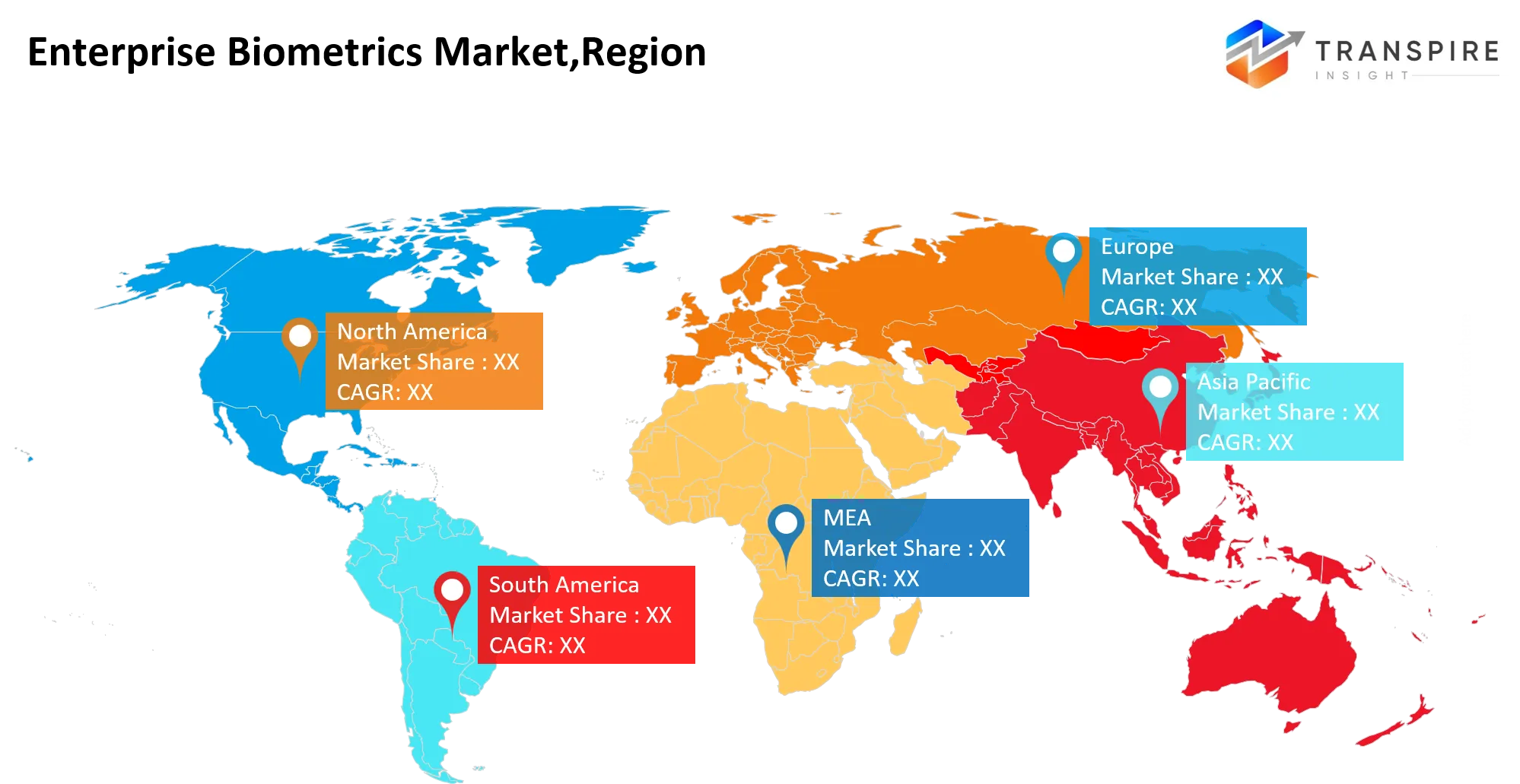
North America holds the lead position in the Enterprise Biometrics Market with a 39% market share as per the given data due to investments in enterprise cybersecurity and established access control systems. Enterprises from the financial sector, technology industry, healthcare organisations, and government organisations create demand for secure employee authentication and identity verification. North America enjoys an advantage of having well-established information technology systems that help integrate biometric devices with existing identity management systems and security systems. Investment in passwordless access, fraud detection, and other security solutions will benefit the market.
In March 2025, Invixium displayed its biometric access control systems at ISC West, which included facial recognition and fingerprint scanning systems. Such technologies enable employee authentication and secure access to workplaces and signify the need for enterprise security solutions in North America.
Europe
Europe constitutes 25% of the market. Demands arise due to enterprise security, digital transformation initiatives, and concerns about personal data protection in enterprises. Enterprises from the financial services, manufacturing sector, healthcare organisations, and public administration seek reliable identity control solutions for their employees and authorised visitors. Well-established technological infrastructure helps integrate biometric solutions with physical access control systems and digital authentication solutions. Privacy considerations and transparent data handling may impact purchase decisions and implementations.
In May 2025, the European Commission introduced the Shared Biometric Matching Service aimed at fingerprint recognition and facial recognition within EU information systems. It reveals ongoing efforts made in Europe towards biometric identification systems and secure identity verification technologies.
Asia-Pacific
The Asia-Pacific region accounts for 27% of the market and is tagged as the fastest-growing region, expected to have a CAGR of 18%. With the advent of digital solutions, industrial investments, modernisation of enterprises, and adoption of connected identity solutions, there is scope for biometric vendors. The growth opportunities include workforce management, financial authentication, and access control solutions in both developing and mature markets. Hardware solutions that are affordable, software applications and strategic partnerships are essential for vendors in this region.
In June 2026,NEXT Biometrics received an extra order from one of their OEM customers in India for their Basalt FAP20 fingerprint sensors. Such sensors are designed to be used in banking and finance identity verification applications.
Who are the Key Players in the Enterprise Biometrics Market and how do they compete?
Competition in the Enterprise Biometrics Market is based on recognition accuracy, security capabilities, integration abilities, deployment options, and overall ownership costs. The competitors compete by means of customised biometric hardware, enterprise identity platforms, and end-to-end physical or digital access solutions. The ability to address different client needs is more important than having one recognition technology. The main focus of HID is secure identity and access control solutions, which are distinguished by integration with enterprise credentials and physical security ecosystems. Expansion efforts of HID are based on the integration of identity technologies with wider access management systems. Thales provides digital identity, authentication, and cybersecurity solutions, which are positioned for enterprises that need identity assurance across connected services.
Enterprise Biometrics Market companies
- HID Global
- Thales Group
- IDEMIA
- NEC Corporation
- Aware Inc.
- M2SYS Technology
- Fulcrum Biometrics
- Veridium
- Innovatrics
- Suprema
- BIO-key International
- Daon
- Fingerprint Cards
- Cognitec Systems
- Iris ID
Recent Development News
In March 2026, Precise Biometrics and Fingerprint Cards announced a collaboration to merge their companies by integrating their biometric hardware, software, and identity solutions. This merger is meant to help them expand their product lines, increase commercial presence, and enhance their market positions in the enterprise access and digital identity segments.
In August 2025, NEXT Biometrics reported its first big production order for its FAP 30 Granite fingerprint sensor from an existing Indian original equipment manufacturer. The order for NOK 3.2 million is meant for readers used in government identity programs, including those related to law enforcement.
What Strategic Insights Define the Future of the Enterprise Biometrics Market?
The future of the Enterprise Biometrics Market will be contingent on how well the providers are able to incorporate identity security, user convenience, and privacy protection. Fingerprint recognition technology is still very relevant, but facial recognition, password-less authentication, and biometric platforms will allow providers to extend their application base for enterprise customers. The lesser-known risk factor is the extended exposure to biometric data. In contrast to passwords, biometric data such as fingerprints and facial features cannot be easily changed. Enterprises will need to consider how the data will be stored, encrypted, accessed, and retained before implementing the solutions. in Asia Pacific. The provided data shows that the region has the best growth potential of all. Providers will be able to capitalise on this by developing local partnerships and providing flexibility through cloud and on-premises solutions as well as integration with existing security solutions. The key point for the providers would be to offer security benefits without unnecessary privacy concerns.
Biometric Technology
- Fingerprint
- Facial Recognition
- Iris Recognition
- Voice Recognition
- Vein Recognition
- Palmprint
- Behavioral Biometrics
- Multimodal Biometrics
Authentication
- Single-Factor
- Two-Factor
- Multi-Factor
- Passwordless
- Continuous Authentication
- Risk-Based
- Adaptive
- Step-Up Authentication
Contact Type
- Contact-Based
- Contactless
- Touchless
- Remote
- Mobile
- Wearable
- Sensor-Based
- Hybrid
Application
- Door Security
- Physical Building Access
- Time & Attendance
- Identity Verification
- Workforce Authentication
- Logical Access
- Transaction Authentication
- Visitor Management
End User
- BFSI
- Government
- Healthcare
- Retail
- IT & Telecom
- Manufacturing
- Education
- Transportation & Logistics
Deployment
- On-Premises
- Cloud
- Hybrid
- SaaS
- Private Cloud
- Public Cloud
- Edge
- Managed Services
Frequently Asked Questions
Find quick answers to common questions.
The enterprise biometrics market size was valued at USD 42.27 billion in 2025 and is poised to reach USD 84.35 billion by 2033, expanding at a 9.02% CAGR.
Key segments for the enterprise biometrics market are Biometric Technology (Fingerprint, Facial Recognition, Iris Recognition, Voice Recognition, Vein Recognition, Palmprint, Behavioral Biometrics, Multimodal Biometrics); Authentication (Single-Factor, Two-Factor, Multi-Factor, Passwordless, Continuous Authentication, Risk-Based, Adaptive, Step-Up Authentication); Contact Type (Contact-Based, Contactless, Touchless, Remote, Mobile, Wearable, Sensor-Based, Hybrid); Application (Door Security, Physical Building Access, Time & Attendance, Identity Verification, Workforce Authentication, Logical Access, Transaction Authentication, Visitor Management); End User (BFSI, Government, Healthcare, Retail, IT & Telecom, Manufacturing, Education, Transportation & Logistics); Deployment (On-Premises, Cloud, Hybrid, SaaS, Private Cloud, Public Cloud, Edge, Managed Services)
Growth is primarily driven by increasing usage of passwordless authentication, more stringent data protection laws, and increasing use of biometrics for employee access and attendance control
The market is led by major manufacturers including HID Global; Thales Group; IDEMIA; NEC Corporation; Aware Inc.; M2SYS Technology; Fulcrum Biometrics; Veridium; Innovatrics; Suprema; BIO-key International; Daon; Fingerprint Cards; Cognitec Systems; Iris ID
North America accounts for a 39.00% share of the world enterprise biometric market due to sophisticated security infrastructure, increasing usage of biometric authentication technology, stringent data security policies, and increased demand for secure access control solutions.
Opportunities within the worldwide enterprise biometrics market comprise increased need for password-less authentication, more implementation of artificial intelligence-based biometrics technology, growth of cloud-based identity verification processes, and increased use of contactless biometrics within banks, health care, government offices, and corporate offices.
- HID Global
- Thales Group
- IDEMIA
- NEC Corporation
- Aware Inc.
- M2SYS Technology
- Fulcrum Biometrics
- Veridium
- Innovatrics
- Suprema
- BIO-key International
- Daon
- Fingerprint Cards
- Cognitec Systems
- Iris ID
About the Authors

Mayur Shinde
I am Mayur Shinde, a Senior Research Analyst at Transpire Insight, specializing in the Automotive & Transportation and Information & Communication Technology (ICT) Industry. My work focuses on analyzing emerging market trends, technological advancements, competitive landscapes, and industry developments to deliver accurate, data-driven insights. I am passionate about transforming complex market information into clear, actionable content that helps businesses, professionals, and decision-makers stay informed and make confident strategic decisions.

Chakradhar Khansole
Chakradhar serves as the Research Director at Transpire Insight, bringing over 8 years of experience in technology, innovation, and strategic market intelligence. He specializes in transforming complex market data into actionable business insights that enable organizations to make informed, growth-oriented decisions. Recognized for his strategic vision and analytical expertise, Chakradhar leads high-impact research initiatives, delivering comprehensive market assessments, competitive intelligence, and forward-looking industry analysis.
Recently Published Reports
-
Apr 2026
3D Optical Profiler Market
3D Optical Profiler Market Size, Share & Analysis Report By Type (Desktop 3D Optical Profiler, and Portable 3D Optical Profiler), By Technology (Confocal Technology, and White Light Interference), By End-Use Industry (Manufacturing, Research Institutions, Automotive, Aerospace and Defense, Medical Devices, and Other), and Geography (North America, Europe, Asia-Pacific, Middle East and Africa, South and Central America), 2021 - 2031
-
Apr 2026
Depth Sensor Market
Depth Sensor Market Size, Share & Analysis Report By Type (Infrared Depth Sensors, Time-of-Flight (ToF) Sensors, Stereo Vision Sensors, Structured Light Sensors, Ultrasonic Depth Sensors), By Application (Automotive, Robotics, Gaming, Consumer Electronics, Industrial Automation, Healthcare, Security & Surveillance, Others), By End Users (Automotive Manufacturers, Consumer Electronics Companies, Healthcare Providers, Industrial Companies, Security Agencies, Gaming Companies, Robotics Companies, Others), and Geography (North America, Europe, Asia-Pacific, Middle East and Africa, South and Central America), 2021 – 2031
-
Apr 2026
Digital Manufacturing Market
Digital Manufacturing Market Size, Share & Analysis Report By Component (Hardware, Software, and Services), By Technology (Robotics, 3D Printing, Internet of Things (IoT), and Others), By Application (Automotive and Transportation, Aerospace and Defense, Consumer Electronics, Industrial Machinery, and Others), By Process Type (Computer-Based Designing, Computer-Based Simulation, Computer 3D Visualization, Analytics, and Others), and Geography (North America, Europe, Asia-Pacific, Middle East and Africa, South and Central America), 2021 – 2031
-
Apr 2026
Digital Visa Services Market
Digital Visa Services Market Size, Share & Analysis Report By Type (Individual Travelers, Group Travelers), By Application (Tourism, Business Travel, Others), and Geography (North America, Europe, Asia-Pacific, Middle East and Africa, South and Central America), 2021 – 2031