

Emergency Management Services Market Summery:
According to Transpire Insights, a detailed research report on the market reflects that the Incident Management application segment dominates the Emergency Management Services Market, accounting for approximately 68% of the total market share worldwide. IBM Corporation leads the market with approximately around USD 62 billion in annual revenue and an estimated 18-22% market share in emergency management and public safety technology solutions, making it the leading contributor to market development, innovation, advanced emergency management platforms, expanding digital response capabilities, AI-driven disaster preparedness solutions, and overall market growth dynamics.
Market Snapshot
- Market Value (2025): USD 45.9 Billion.
- Expected Market Value (2026): USD 48.7 Billion.
- Estimated Market Value (2033): USD 73.3 Billion.
- Forecast CAGR (2026-2033): 6.02%.
- Leading Region in 2025: Asia-Pacific.
- Second-largest Region: Europe.
- Fastest Growing Region: North America.
Introduction
Emergency Management Services (EMS) encompass a broad range of planning, preparedness, response, recovery, and mitigation solutions designed to help governments, enterprises, healthcare organizations, critical infrastructure operators, and communities effectively manage natural disasters, public health emergencies, cyber incidents, industrial accidents, and other crises. These services integrate advanced technologies such as Artificial Intelligence (AI), Geographic Information Systems (GIS), cloud computing, Internet of Things (IoT), predictive analytics, satellite communication, and real-time monitoring platforms to improve situational awareness, accelerate emergency response, optimize resource allocation, and strengthen disaster resilience. The Emergency Management Services Market is driven by the increasing frequency of natural disasters, rising cybersecurity threats, growing investments in smart cities, stricter government regulations, and increasing adoption of digital emergency response solutions worldwide.
For Instance:-
- North America, Market Outlook: North America is expected to remain one of the largest markets in the Emergency Management Services Market, supported by significant investments in disaster preparedness, public safety modernization, homeland security programs, and advanced emergency communication infrastructure, with the regional market projected to exceed USD 11.8 billion during the forecast period.
- Europe, Digital Resilience & Emergency Preparedness: European governments and emergency response agencies are investing heavily in AI-enabled emergency management platforms, integrated command-and-control centers, digital crisis communication systems, early warning technologies, and cross-border disaster response initiatives to enhance public safety, regulatory compliance, and operational resilience.

Market Highlights: -
- Asia Pacific is expected to grow at a rapid CAGR in the Emergency Management Services Market, holding approximately 38% of the market share during the forecast period.
- North America remains one of the leading regional markets, accounting for approximately 34% of the Emergency Management Services Market due to strong government funding, advanced emergency infrastructure, and widespread technology adoption.
- Europe is anticipated to hold approximately 22% of the Emergency Management Services Market over the forecast period, supported by increasing investments in disaster preparedness and climate resilience initiatives.
- By Solution Type, the Incident Management Solutions segment dominated the market, accounting for approximately 44% market share in 2025 and is projected to expand at a significant CAGR during the forecast period.
- By Application, the Government & Public Safety segment dominated the market, holding approximately 42% market share in 2025 and is expected to witness substantial growth throughout the forecast period.
- By End User, the Government Agencies & Municipal Authorities segment dominated the market, accounting for approximately 46% market share in 2025 and is projected to grow steadily over the forecast period.
- Government Disaster Risk Reduction Programs: Governments worldwide continue to increase investments in emergency preparedness, disaster risk reduction, climate adaptation strategies, emergency communication networks, resilient infrastructure, and digital public safety platforms, creating significant opportunities for Emergency Management Services providers.
How is Technology Driving Growth in the Emergency Management Services Market?
The Emergency Management Services Market is witnessing significant growth due to rapid technological advancements in emergency response and disaster management. Artificial Intelligence (AI), Machine Learning (ML), Geographic Information Systems (GIS), Internet of Things (IoT), cloud computing, predictive analytics, satellite imagery, drone surveillance, and digital communication platforms are transforming how emergency situations are monitored, analyzed, and managed. These technologies enable real-time situational awareness, faster incident detection, predictive risk assessment, efficient resource deployment, and coordinated emergency response across multiple agencies. Furthermore, cloud-based emergency management platforms improve collaboration among government organizations, healthcare providers, law enforcement agencies, and disaster response teams while enhancing operational efficiency and decision-making during critical incidents. The increasing deployment of smart city infrastructure and digital public safety ecosystems further accelerates market growth.
Market Drivers
Increasing Disaster Risks, Digital Transformation & Government Investments.The primary driver of the Emergency Management Services Market is the increasing occurrence of natural disasters, climate-related emergencies, pandemics, industrial accidents, cyber threats, and critical infrastructure disruptions. Governments across developed and developing economies are investing significantly in emergency preparedness, resilient infrastructure, AI-powered command centers, public warning systems, and integrated disaster management platforms. Additionally, the growing adoption of cloud computing, IoT-enabled monitoring systems, advanced communication technologies, and predictive analytics enables emergency agencies to improve operational efficiency, reduce response times, and strengthen disaster resilience. Increasing public-private partnerships and smart city initiatives further support market expansion ly.
For Instance:- The United States Federal Emergency Management Agency (FEMA) continues to invest billions of dollars annually in disaster preparedness, hazard mitigation, emergency response modernization, community resilience programs, and digital emergency management technologies to strengthen national disaster readiness.
Restrain
One of the major constraints affecting the Emergency Management Services Market is the high implementation and maintenance cost associated with advanced emergency management platforms, integrated communication infrastructure, AI-based analytics, and cybersecurity solutions. Additionally, interoperability challenges between legacy systems.
Analysis of Prices and Consumer Behaviour
Government & Public Safety applications dominate the Emergency Management Services Market, contributing approximately 69% of total market revenue due to increasing investments in disaster preparedness, emergency communication systems, public safety modernization, and critical infrastructure protection. AI-enabled emergency management platforms and integrated command-and-control solutions typically command 18-25% higher pricing than conventional emergency management systems due to their advanced predictive analytics, automation capabilities, and real-time decision support. Government agencies, emergency response organizations, and critical infrastructure operators account for nearly 64% of total market demand, driven by increasing regulatory compliance requirements and disaster resilience initiatives. Approximately 71% of organizations prioritize cloud-based emergency management solutions, AI-driven situational awareness, cybersecurity integration, and real-time incident response capabilities when selecting service providers. The growing focus on digital transformation, climate resilience, and smart public safety infrastructure continues to drive long-term growth in the Emergency Management Services Market.
Top Companies in the Emergency Management Services Market
- Motorola Solutions
- Hexagon AB
- Esri
- Everbridge
- Honeywell,
- BM
- NEC Corporation
- Lockheed Martin
- Siemens
- Atos
- BlackBerry
- Rave Mobile Safety
- AlertMedia
- Rockwell Collins
- Oracle
Market Segmentation
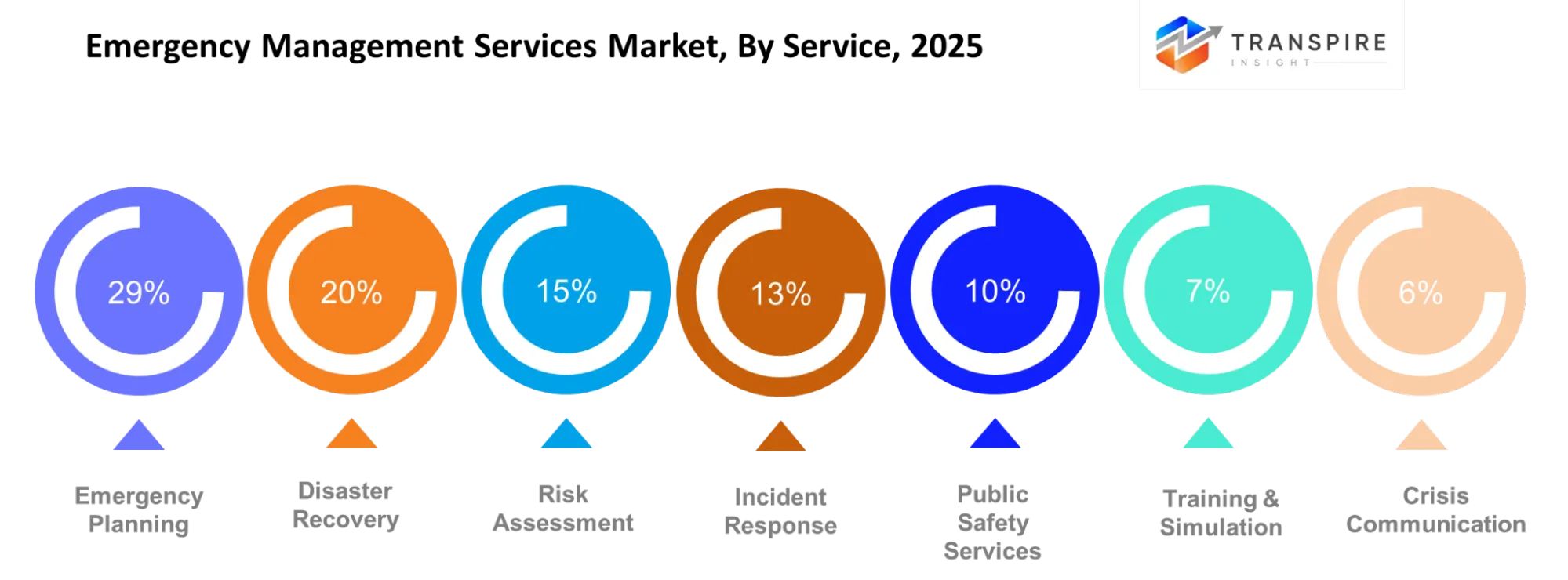
The Emergency Management Services Market share is divided into five categories: Product Type, Application, End User, Packaging Type, and Distribution Channel.
The Incident Management Solutions segment dominated the market, accounting for approximately 44% in 2025, and is expected to rise at a significant CAGR during the forecast period.
The Emergency Management Services Market is segmented by solution type into Incident Management Solutions, Emergency Communication Systems, Disaster Recovery Services, Business Continuity Management, Crisis Management Solutions, Emergency Notification Systems, Risk Assessment & Planning Solutions, and Others. Among these, the Incident Management Solutions segment dominated the market, accounting for approximately 44% in 2025, and is expected to expand at a significant CAGR during the forecast period. The dominance of this segment is attributed to the growing need for real-time incident tracking, coordinated emergency response, efficient resource allocation, and rapid decision-making during disasters, cyber incidents, industrial accidents, and public safety emergencies. Increasing adoption of AI-powered incident management platforms, cloud-based coordination systems, and integrated command-and-control technologies continues to strengthen the segment's market position
The Government & Public Safety segment held the greatest share of approximately 42% in 2025 and is expected to increase at a substantial CAGR over the forecast period.
The Emergency Management Services Market is segmented by application into Government & Public Safety, Healthcare & Hospitals, Critical Infrastructure, Transportation & Logistics, Energy & Utilities, Manufacturing & Industrial Facilities, Commercial Enterprises, and Others. Among these, the Government & Public Safety segment accounted for approximately 42% of the market in 2025 and is expected to register substantial growth during the forecast period. The segment's leadership is driven by increasing government investments in disaster preparedness, homeland security, emergency communication networks, public warning systems, and national resilience programs. Growing frequency of natural disasters, climate-related emergencies, and cybersecurity incidents is further encouraging governments to modernize emergency response infrastructure through advanced digital technologies.
The Government Agencies & Municipal Authorities segment held the greatest share of approximately 46% in 2025 and is expected to increase at a high CAGR over the forecast period.
The Emergency Management Services Market is segmented by end user into Government Agencies & Municipal Authorities, Healthcare Organizations, Emergency Response Agencies, Defense & Homeland Security, Critical Infrastructure Operators, Commercial Enterprises, Educational Institutions, and Others. Among these, the Government Agencies & Municipal Authorities segment held the largest market share of approximately 46% in 2025 and is projected to grow at a considerable CAGR throughout the forecast period. The segment's growth is driven by increasing public investments in emergency preparedness, disaster mitigation strategies, resilient infrastructure, digital emergency operations centers, and integrated emergency communication platforms. Continuous modernization of public safety systems and regulatory mandates further support long-term market expansion.
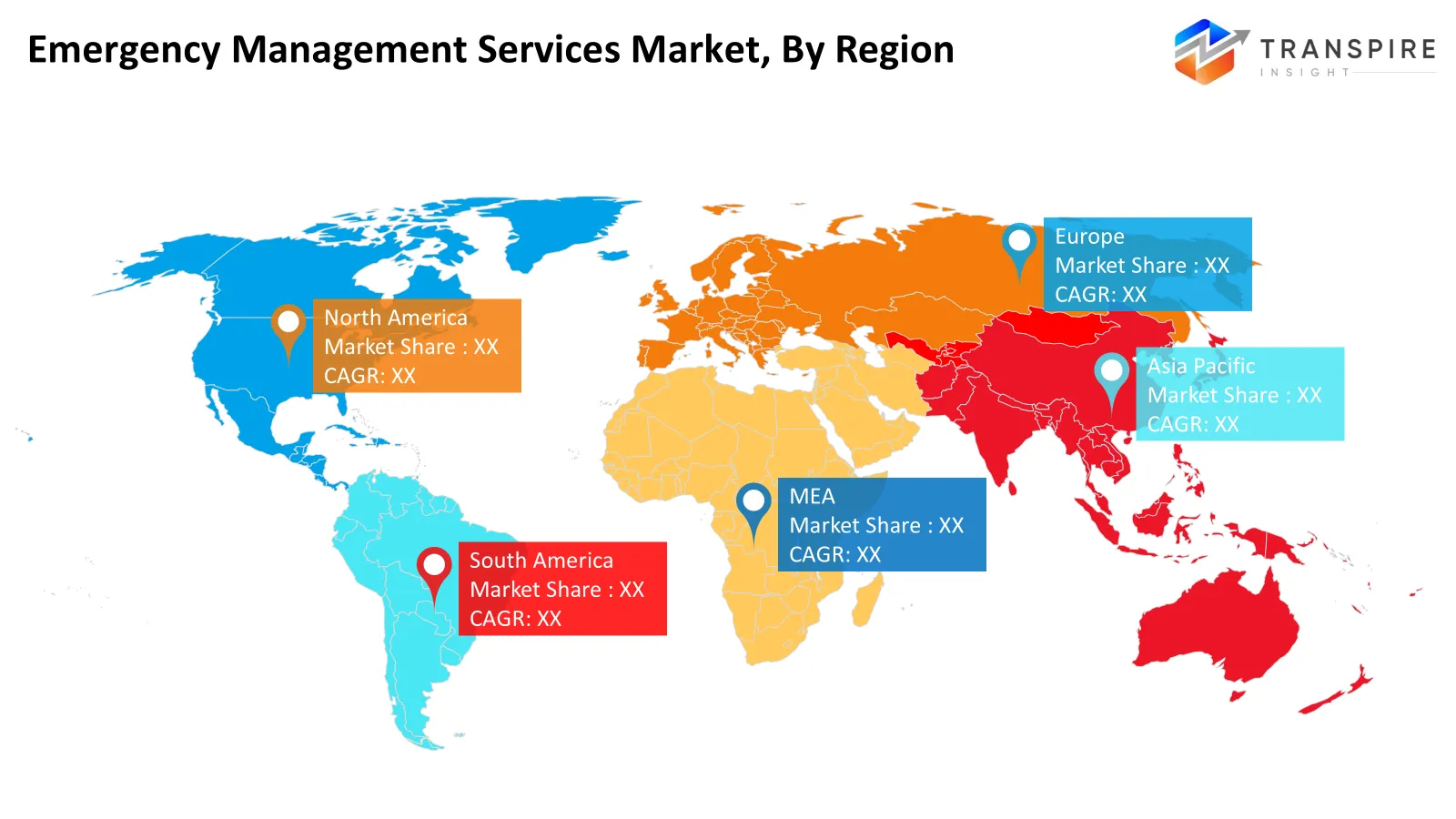
Regional Segment Analysis of the Emergency Management Services Market
- North America (U.S., Canada, Mexico)
- Europe (Germany, France, U.K., Italy, Spain, Rest of Europe)
- Asia-Pacific (China, Japan, India, Rest of APAC)
- South America (Brazil, Argentina, Rest of South America)
- Middle East & Africa (UAE, Saudi Arabia, South Africa, Rest of MEA)
Asia Pacific is expected to grow at a rapid CAGR in the Emergency Management Services Market by holding approximately 38% of the share during the forecast period.
Asia Pacific is anticipated to register the fastest growth owing to increasing urbanization, rapid digital transformation, expanding smart city initiatives, and rising government investments in disaster preparedness and emergency response infrastructure. Countries including China, India, Japan, South Korea, and Australia are significantly strengthening emergency communication systems, disaster monitoring technologies, AI-powered command centers, and climate resilience programs. Increasing occurrences of floods, earthquakes, typhoons, and industrial emergencies continue to accelerate investments in advanced emergency management solutions across the region.
North America is expected to dominate the Emergency Management Services Market by holding approximately 34% of the market share during the forecast period.
North America remains the leading regional market due to its advanced emergency response infrastructure, strong government funding, widespread adoption of AI-enabled emergency management platforms, and mature public safety ecosystem. The United States and Canada continue to invest heavily in homeland security, disaster mitigation, emergency communication modernization, cybersecurity resilience, and integrated command-and-control systems. The region's strong technology ecosystem and presence of major emergency management solution providers further support sustained market leadership.
Europe is anticipated to hold approximately 22% share of the Emergency Management Services Market over the forecast period.
Europe continues to demonstrate strong market growth owing to increasing investments in climate adaptation, cross-border disaster management, digital public safety initiatives, and critical infrastructure protection. Government agencies across Germany, France, the United Kingdom, Italy, and Nordic countries are implementing AI-enabled emergency response platforms, advanced early warning systems, and integrated crisis management technologies. Stringent regulatory frameworks, increasing focus on disaster resilience, and growing investments in smart public infrastructure continue to strengthen regional market expansion.
Strategies for Market Growth in Non-Leading Regions
Emerging economies can accelerate market growth by strengthening national disaster preparedness frameworks, expanding digital emergency communication infrastructure, and investing in AI-enabled emergency management platforms. Governments should encourage public-private partnerships to modernize emergency response capabilities while supporting cloud-based emergency operations centers and integrated disaster management systems. Increasing investments in early warning technologies, resilient critical infrastructure, satellite monitoring, GIS-based disaster mapping, and emergency workforce training can significantly improve disaster response efficiency. Furthermore, supportive regulatory frameworks, international collaboration, and digital transformation initiatives will enhance long-term market development across Latin America, Africa, and developing Asian economies.
Future Market Trends for the Emergency Management Services Market
Artificial Intelligence and Predictive Emergency Response : Artificial Intelligence, machine learning, and predictive analytics are increasingly being integrated into emergency management platforms to improve disaster forecasting, automate incident detection, optimize resource allocation, and enable faster decision-making during emergencies.
Cloud-Based Emergency Operations Centers: Organizations are rapidly migrating toward cloud-based emergency management platforms that provide real-time collaboration, scalable deployment, centralized incident management, and seamless communication among multiple emergency response agencies.
Smart Cities and IoT-Enabled Public Safety : The rapid expansion of smart city initiatives is driving demand for IoT-enabled sensors, intelligent surveillance systems, connected emergency communication networks, drone monitoring, and real-time situational awareness technologies to strengthen urban resilience and public safety.
Recent Developments
- In June 2026: Several government agencies across North America expanded investments in AI-powered emergency management platforms and integrated emergency communication systems to strengthen disaster preparedness, improve real-time incident coordination, and enhance national resilience against climate-related disasters and cybersecurity threats.
- In November 2025 - Digital Emergency Infrastructure Expansion: Multiple public safety organizations accelerated the deployment of cloud-based emergency operations centers, GIS-enabled disaster management platforms, and advanced emergency notification systems to improve interagency collaboration, operational efficiency, and emergency response capabilities while supporting the growing demand for digital public safety solutions ly.
Market Segment
This study forecasts revenue at , regional, and country levels from 2020 to 2033. Transpire Insights has segmented the Emergency Management Services Market based on the below-mentioned segments:
Emergency Management Services Market
- Disaster Recovery
- Emergency Planning
- Risk Assessment
- Incident Response
- Public Safety Services
- Training & Simulation
- Crisis Communication
- Others.
Emergency Management Services Market, By Deployment
- On-premise
- Cloud-based
- Hybrid
- Mobile-based
- Edge Deployment
- Private Cloud
- Public Cloud
- Others
Emergency Management Services Market, Application
- Natural Disasters
- Industrial Accidents
- Healthcare Emergencies
- Cybersecurity Incidents
- Fire & Rescue
- Military Operations
- Public Events
- Others
Emergency Management Services Market, By End User
- Government Agencies
- Healthcare Organizations
- Enterprises
- Utilities
- Defence
- Educational Institutions
- Transportation,
- Others
Emergency Management Services Market, By Component
- Software
- Hardware
- Services
- Sensors
- Communication Equipment
- Analytics Platforms
- Command Centers
- Others
Emergency Management Services Market, By Regional Analysis
North America
- US
- Canada
- Mexico
Europe
- Germany
- UK
- France
- Italy
- Spain
- Russia
- Rest of Europe
Asia Pacific
- China
- Japan
- India
- South Korea
- Australia
- Rest of Asia Pacific
South America
- Brazil
- Argentina
- Rest of South America
Middle East & Africa
- UAE
- Saudi Arabia
- Qatar
- South Africa
- Rest of the Middle East & Africa
Frequently Asked Questions
Find quick answers to common questions.
Increasing frequency of natural disasters, growing cybersecurity threats, rising government investments in disaster preparedness, smart city initiatives, and rapid adoption of AI, cloud computing, IoT, and real-time emergency response technologies are driving the growth of the Emergency Management Services Market.
North America dominates the Emergency Management Services Market due to its advanced emergency response infrastructure, substantial government funding, widespread adoption of digital public safety technologies, and strong focus on disaster resilience and homeland security.
Emergency Management Services enhance disaster preparedness, improve real-time situational awareness, enable faster incident response, optimize resource allocation, strengthen business continuity, and support regulatory compliance across government, healthcare, critical infrastructure, and commercial sectors.
The Government & Public Safety segment leads the market, driven by increasing investments in disaster management, emergency communication systems, crisis response modernization, and national public safety programs worldwide.
Major companies include IBM Corporation, Motorola Solutions, Hexagon AB, Everbridge, Honeywell International Inc., Siemens AG, Esri, NEC Corporation, Atos SE, and BlackBerry Limited.
- Motorola Solutions
- Hexagon AB
- Esri
- Everbridge
- Honeywell,
- BM
- NEC Corporation
- Lockheed Martin
- Siemens
- Atos
- BlackBerry
- Rave Mobile Safety
- AlertMedia
- Rockwell Collins
- Oracle
About the Authors

Mayur Shinde
I am Mayur Shinde, a Senior Research Analyst at Transpire Insight, specializing in the Automotive & Transportation and Information & Communication Technology (ICT) Industry. My work focuses on analyzing emerging market trends, technological advancements, competitive landscapes, and industry developments to deliver accurate, data-driven insights. I am passionate about transforming complex market information into clear, actionable content that helps businesses, professionals, and decision-makers stay informed and make confident strategic decisions.

Chakradhar Khansole
Chakradhar serves as the Research Director at Transpire Insight, bringing over 8 years of experience in technology, innovation, and strategic market intelligence. He specializes in transforming complex market data into actionable business insights that enable organizations to make informed, growth-oriented decisions. Recognized for his strategic vision and analytical expertise, Chakradhar leads high-impact research initiatives, delivering comprehensive market assessments, competitive intelligence, and forward-looking industry analysis.
Recently Published Reports
-
Apr 2026
3D Optical Profiler Market
3D Optical Profiler Market Size, Share & Analysis Report By Type (Desktop 3D Optical Profiler, and Portable 3D Optical Profiler), By Technology (Confocal Technology, and White Light Interference), By End-Use Industry (Manufacturing, Research Institutions, Automotive, Aerospace and Defense, Medical Devices, and Other), and Geography (North America, Europe, Asia-Pacific, Middle East and Africa, South and Central America), 2021 - 2031
-
Apr 2026
Depth Sensor Market
Depth Sensor Market Size, Share & Analysis Report By Type (Infrared Depth Sensors, Time-of-Flight (ToF) Sensors, Stereo Vision Sensors, Structured Light Sensors, Ultrasonic Depth Sensors), By Application (Automotive, Robotics, Gaming, Consumer Electronics, Industrial Automation, Healthcare, Security & Surveillance, Others), By End Users (Automotive Manufacturers, Consumer Electronics Companies, Healthcare Providers, Industrial Companies, Security Agencies, Gaming Companies, Robotics Companies, Others), and Geography (North America, Europe, Asia-Pacific, Middle East and Africa, South and Central America), 2021 – 2031
-
Apr 2026
Digital Manufacturing Market
Digital Manufacturing Market Size, Share & Analysis Report By Component (Hardware, Software, and Services), By Technology (Robotics, 3D Printing, Internet of Things (IoT), and Others), By Application (Automotive and Transportation, Aerospace and Defense, Consumer Electronics, Industrial Machinery, and Others), By Process Type (Computer-Based Designing, Computer-Based Simulation, Computer 3D Visualization, Analytics, and Others), and Geography (North America, Europe, Asia-Pacific, Middle East and Africa, South and Central America), 2021 – 2031
-
Apr 2026
Digital Visa Services Market
Digital Visa Services Market Size, Share & Analysis Report By Type (Individual Travelers, Group Travelers), By Application (Tourism, Business Travel, Others), and Geography (North America, Europe, Asia-Pacific, Middle East and Africa, South and Central America), 2021 – 2031