
Electronic Skin Patches Market Summary:
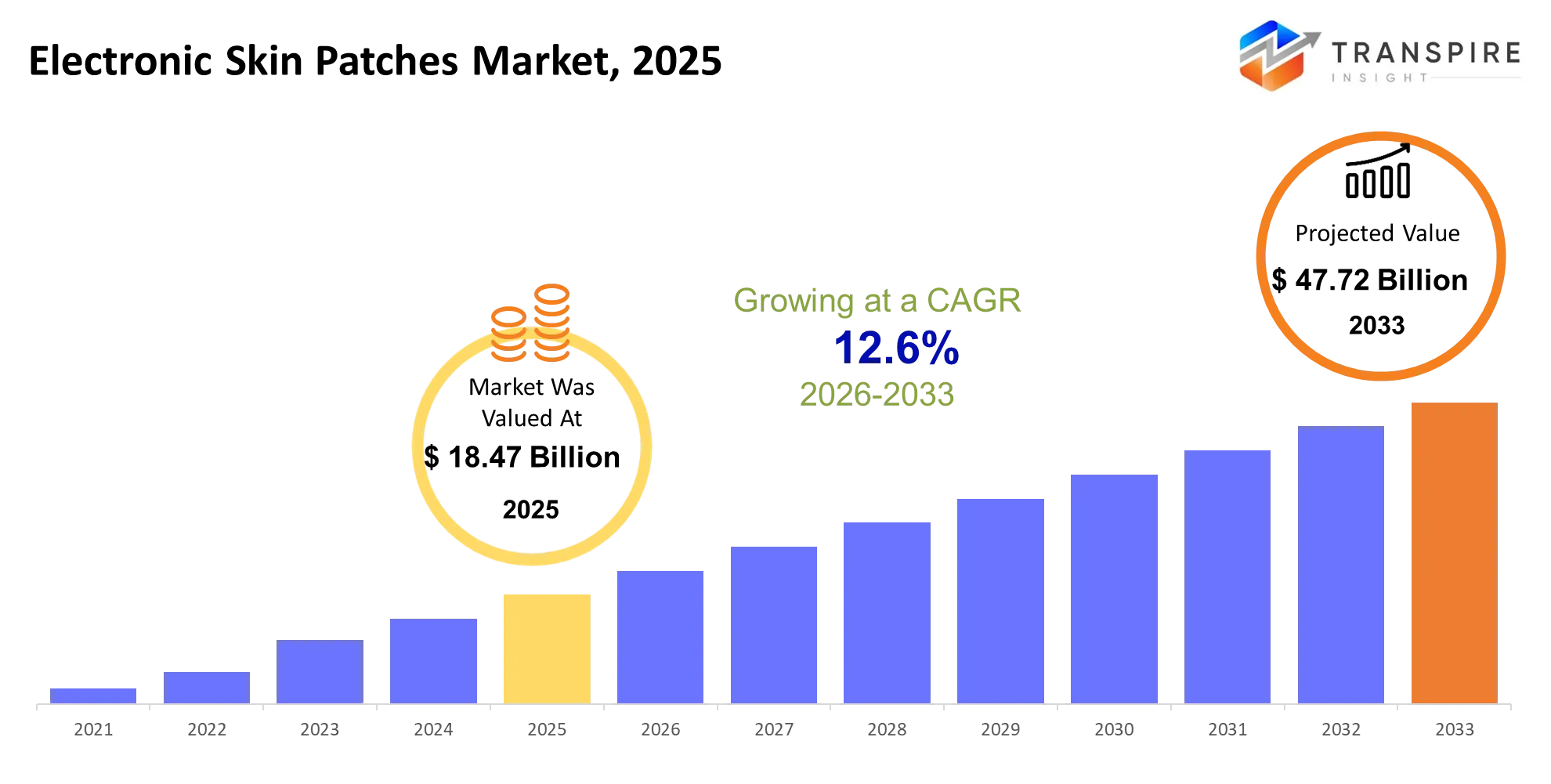
As per Transpire Insight, the Electronic Skin Patches Market size is estimated at USD 18.47 billion in 2025 and is anticipated to reach USD 47.72 billion by 2033, growing at a CAGR of 12.6% from 2026 to 2033.
The electronic skin patches market is changing the way healthcare professionals and individuals watch over health conditions in situations. These patches can measure glucose levels, heart activity, temperature and other body signs, letting users gather health information without needing to go to places often. In the past three to five years, technology has improved in a way that makes it possible for wearable devices to be worn as well as monitor continuously. In addition, these devices do not require individuals to go to any clinic or hospital. All this has been made possible due to the move from checkups to continuous monitoring. This also involves the healthcare industry, which enables doctors to monitor patients remotely. There has been gradual development in healthcare and home monitoring systems through improvements in the medical field. One such technology is glucose monitoring or CGM. Through this, people are able to know their glucose levels as a result of their activities.
Electronic Skin Patches Market Size & Forecast:
- Market Size 2025: USD 18.47 Billion
- Expected Market Value (2033): USD 47.72 Billion
- Forecast CAGR (2026–2033): 12.6%
- Leading Region in 2025: North America
- Fastest Growing Region: Asia Pacific
- Key Company Profiles: Epicore Biosystems, MC10, Quad Industries, Vivalink, Sensoria Health, iRhythm Technologies, Abbott, Dexcom, Medtronic, Nemaura Medical, BioIntelliSense, Xenoma, IMEC, Flexible Electronics, VitalConnect
Key Market Insights:
The market is shifting from traditional health monitoring to advanced patches that will help in continuous monitoring and more personalised treatment. The glucose monitoring segment dominates the market at present, whereas sweat-based biosensors provide room for innovative applications.
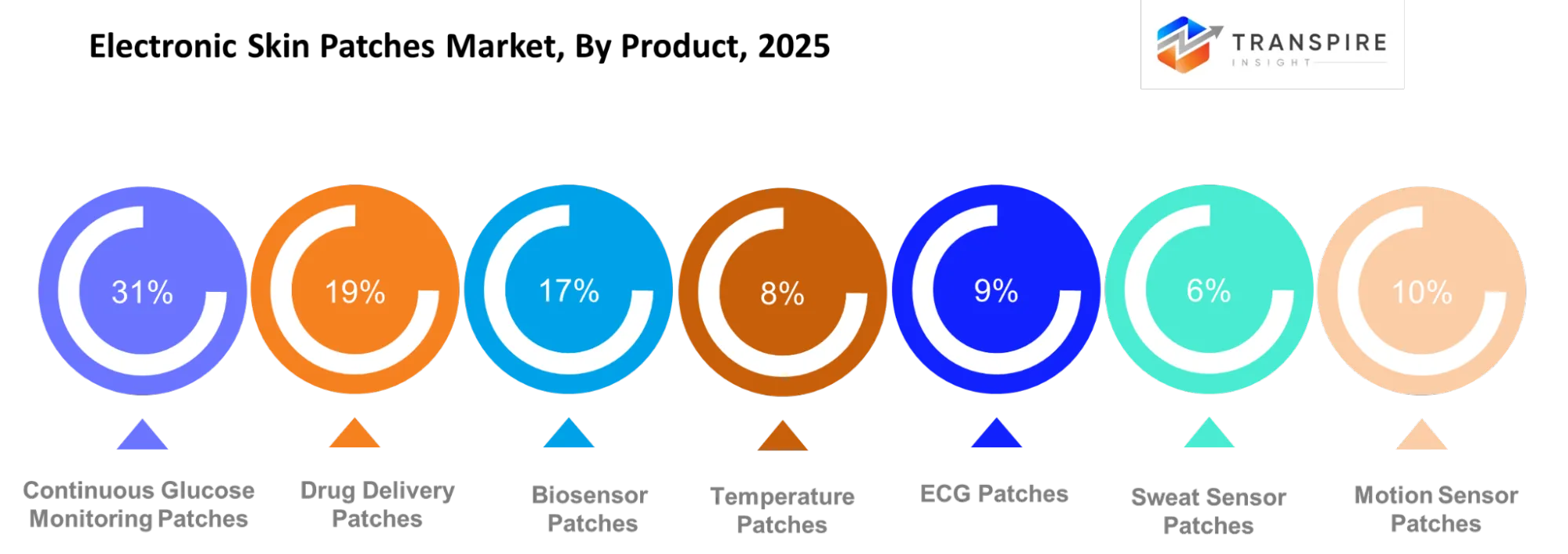
- Continuous glucose monitoring, accounting for 31.4% due to improved sensor capability and longer wearing periods provided by companies like Dexcom.
- Sweat and biosensing patches hold an 18.4% CAGR due to new advancements in non-invasive biochemical monitoring and increased demand for monitoring of vital parameters other than just heart rate.
- Drug delivery patches constitute 19% of the whole market due to the efforts of producers in creating wearable medication dispensers.
- Biosensor patches are also in high demand and hold 17% of the market due to the importance of biological sensing technology in connected health.
- ECG patches account for 9% of the market, with the development of wearables aimed at collecting heart data by Philips.
- Temperature patches make up 8%, used in patient monitoring due to advanced sensor capabilities.
- Sweat sensor patches hold 6% of the market, with research in flexible sensors and microfluidic technology opening doors to biochemistry and hydration analysis.
What are the Key Drivers, Restraints, and Opportunities in the Electronic Skin Patches Market?
Drivers:
This growing demand for monitoring chronic conditions is prompting both health professionals and individuals to consider the use of e-skin patches. Diabetic patients will find these patches very useful, since measuring glucose levels at various points in time during the day can provide useful information on how diet, physical activities, and medications impact one’s glucose levels. Advancements in wireless communication technology, sensor technology, and design have also made such devices more comfortable for wearers. With healthcare moving to monitoring systems, companies can boost their sales.
Restraints:
High development costs, sensor calibration, skin irritation, and inconsistent readings under some conditions might inhibit usage. Medical-grade sensors have to be put through testing and clinical validation before their release to the market, adding to the development time and costs. The variation in reimbursement of medical expenses and health data privacy can act as barriers to adoption in case of constrained healthcare budgets and technology systems.
Opportunities:
Multisensor patches that integrate glucose monitoring, temperature, sweat chemistry, among others, could generate new opportunities in preventive care, sports science, and home healthcare. Technologies in flexible electronics and microfluidics could assist manufacturers in developing small devices that capture different data from one wearable sensor. Asia Pacific is an area where there is room for expansion as healthcare digitisation grows and demand for chronic disease management rises.
What Has the Impact of artificial intelligence on the Electronic Skin Patches Market?
AI is revolutionising the utility of electronic skin patches by turning continuous sensor readings into meaningful information for the user and healthcare providers. In cardiac monitoring, the AI-powered software could analyse the ECG readings, detect abnormal patterns and mark the parts that need further clinical attention. According to Philips, its ePatch technology uses medical-grade AI to help with extended cardiac monitoring and report preparation.Glucose monitoring can be improved with the help of connected applications that would combine sensor readings with meal, physical activities, and medication data. Users could discover the patterns in their behavior and how it affects glucose levels. Predictive analytics might help detect potential issues earlier, but the accuracy of predictions would depend on the quality of data and clinical application.Still, AI integration creates some problems. The noise of sensor readings, individual differences between patients, lack of training data, cybersecurity threats, and high cost of clinical validation can impact the results negatively. AI-driven insights have to be properly interpreted and cannot substitute professional medical opinion. Manufacturers that provide reliable sensors and validated analytics would have an advantage.
Instance:
In September 2026, the South Korean company HoneyNaps created the next-generation PSG solution through its innovative wireless PSG device that utilizes AI-powered sleep analysis alongside skin sensor patches. This device cuts down the requirement of over 24 traditional wired sensors to four patches. Such an approach can enable better testing for sleep disorders along with increased comfort, and has applications in both hospitals as well as home-based monitoring.
Key Market Trends:
The market trends are moving from being simple gadgets to becoming integrated smart patches. The competitive landscape within this industry depends greatly on such features as usability, data accuracy, software integration, as well as interoperability.
- The industry is working to increase comfort levels by optimising patch thickness, flexibility, and adhesive technology.
- Extended measurement durations: Developers pay more attention to solving problems related to frequent sensor replacements and disturbances.
- The use of Bluetooth and other communication methods makes wearable sensor data available to the user via applications and clinical platforms.
- Engineers work towards creating integrated electrical, chemical, thermal, and mechanical measurements in one device.
- Assisted analysis software: More and more importance is being given to software for detection of meaningful patterns in physiological data.
- Remote monitoring: Clinicians switch to remote care models and monitor patients beyond conventional clinical facilities.
- Connected apps help connect the sensor readings to personal habits and symptoms of the user.
Electronic Skin Patches Market Segmentation
By product:
Continuous Glucose Monitoring Patches lead the market s, accounting for 31.4% of the market, followed by Drug Delivery Patches at 19%, Biosensor Patches at 17%, ECG Patches at 9%, Temperature Patches at 8%, Sweat Sensor Patches at 6%, Motion Sensor Patches at 5%, and Others at 4.6%. The glucose monitoring segment gets a boost from the requirement for diabetes management and the need for access to live readings. The drug delivery and biosensor segments have distinct purposes, ranging from treatment to physiological testing. The sweat and biosensor patches are considered to be the fastest-growing segments, with an 18.4% CAGR.
By sensor types:
The market features Chemical, Biosensor, Temperature, Pressure, Strain, Electrochemical, Optical, and Other Sensors. Provided information does not feature separate figures per sensor type. Both chemical and electrochemical sensors could contribute to biochemical measurements, while temperature sensors help track changes in body temperature. Pressure and strain sensors can measure mechanical changes linked to physical activity and motion. Optical sensors can provide yet another way of physiological measurements that depends on device design. Future growth will be determined by such factors as accuracy of measurement, material compatibility, and integration capabilities without making sensors uncomfortable or too expensive.
By application:
The market includes Diabetes Monitoring, Cardiovascular Monitoring, Drug Delivery, Sports and Fitness, Wound Monitoring, Patient Monitoring, Wellness, and Other Applications. Established continuous glucose monitoring technology makes diabetes monitoring easy and effective. For cardiovascular monitoring there is a need to develop wearable sensors for heart-related data collecting within long periods of time. Wound monitoring and general patient monitoring applications can allow performing follow-up outside hospitals. For sports and fitness, it would be useful to apply wearable measurements for activity, effort and recovery measurements. Development of connected monitoring systems could enable manufacturers to address medical and wellness needs.
By technology:
The market is divided into Flexible Electronics, Printed Electronics, Wearable Sensors, Organic Electronics, Nanomaterials, Microfluidics, Wireless Electronics, and Other Technologies. Flexible electronics would make it easier for patches to match the contours, while printed electronics might be helpful in enabling the production of lightweight conductive patterns. Microfluidics could come in handy in case of biosensors, which can be used to detect even small amounts of biological fluids. For instance, sweat detection and analysis sensors could use microfluidics. The use of nanomaterials might increase the sensitivity or conductivity of specific sensor designs.
By end user:
the market comprises Hospitals, Clinics, Home Healthcare, Sports and Fitness Organisations, Research Institutions, Pharmaceutical Companies, Consumers, and Others. The hospitals and clinics could use patches in various monitoring and diagnostic scenarios. Home healthcare service providers could gain an advantage of being able to control patients remotely by receiving their readings. Research institutions would be able to perform testing of new sensors and find out more about physiological functions. Pharmaceutical companies might benefit from using sensors within clinical research studies. Also, sports organisations and consumers could use patches for activity analysis.
By connectivity:
There are Bluetooth, NFC, Wi-Fi, Cellular, RFID, Near-Field, Wired, and Others. Bluetooth technology links up the patches with cell phones and other receivers located around. On the other hand, Wi-Fi and cellular technologies can help with data transfer through a connected system. NFC and RFID can come in handy for various needs of identification, communication and data transfer. Wired connectivity also remains an essential feature in particular devices. The right technology for connectivity will depend on factors such as power consumption, data transfer range and size, security, among others. In future products, data transfer and integration will be considered.
By material:
The market has Polymer, Silicone, Graphene, Gold, Silver, Conductive Ink, Nanomaterials, and Other Materials. Polymers and silicone can be used for making flexible structures and skin contact materials, while conductive ink and metals can be used for making electrical connections and sensors. Graphene and other nanomaterials can be used for their electrical and sensing properties. The material selection will decide on how comfortable, flexible, signal quality, durable, and expensive a device will be. With the advent of more advanced wearable systems in the market, materials that offer both skin compatibility and sensor performance can become handy.
What are the Key Use Cases Driving the Electronic Skin Patches Market?
The use cases in which electronic skin patches are useful include diabetes monitoring as the use of such patches enables diabetics to monitor any changes in glucose levels during activities such as eating, exercising, sleeping, and others. Such measurements can help to control diabetes as long as they are combined with proper medical advice. Other use cases include cardiovascular monitoring where the measurement of heart activity takes place with the aid of the use of wearable ECG patches for a long period of time. In hospitals and clinics, such patches can be used to gather information as patients carry out their daily routines. Such patches can also be used in home health care companies for selective remote monitoring. Some of the new applications include biochemical monitoring using sweat, wound monitoring, sports recovery monitoring, and multisensor patient monitoring.
|
Report Metrics |
Details |
|
Market size value in 2025 |
USD 18.47 Billion |
|
Market size value in 2026 |
USD 20.80 Billion |
|
Revenue forecast in 2033 |
USD 47.72 Billion |
|
Growth rate |
CAGR of 12.6% from 2026 to 2033 |
|
Base year |
2025 |
|
Historical data |
2021 - 2024 |
|
Forecast period |
2026 - 2033 |
|
Report coverage |
Revenue forecast, competitive landscape, growth factors, and trends |
|
Regional scope |
United States; Canada; Mexico; United Kingdom; Germany; France; Italy; Spain; Denmark; Sweden; Norway; China; Japan; India; Australia; South Korea; Thailand; Brazil; Argentina; South Africa; Saudi Arabia; United Arab Emirates |
|
Key company profiled |
Epicore Biosystems, MC10, Quad Industries, Vivalink, Sensoria Health, iRhythm Technologies, Abbott, Dexcom, Medtronic, Nemaura Medical, BioIntelliSense, Xenoma, IMEC, Flexible Electronics, VitalConnect |
|
Customization scope |
Free report customization (country, regional & segment scope). Avail customized purchase options to meet your exact research needs. |
|
Report Segmentation |
By Product (Continuous Glucose Monitoring Patches, Drug Delivery Patches, Biosensor Patches, Temperature Patches, ECG Patches, Sweat Sensor Patches, Motion Sensor Patches, Others); By Sensor Type (Chemical, Biosensor, Temperature, Pressure, Strain, Electrochemical, Optical, Others); By Application (Diabetes Monitoring, Cardiovascular Monitoring, Drug Delivery, Sports & Fitness, Wound Monitoring, Patient Monitoring, Wellness, Others); By Technology (Flexible Electronics, Printed Electronics, Wearable Sensors, Organic Electronics, Nanomaterials, Microfluidics, Wireless Electronics, Others); By End User (Hospitals, Clinics, Home Healthcare, Sports & Fitness, Research Institutions, Pharmaceutical Companies, Consumers, Others); By Connectivity (Bluetooth, NFC, Wi-Fi, Cellular, RFID, Near-field, Wired, Others); By Material (Polymer, Silicone, Graphene, Gold, Silver, Conductive Ink, Nanomaterials, Others) |
Which Regions are Driving the Electronic Skin Patches Market Growth?
North America:
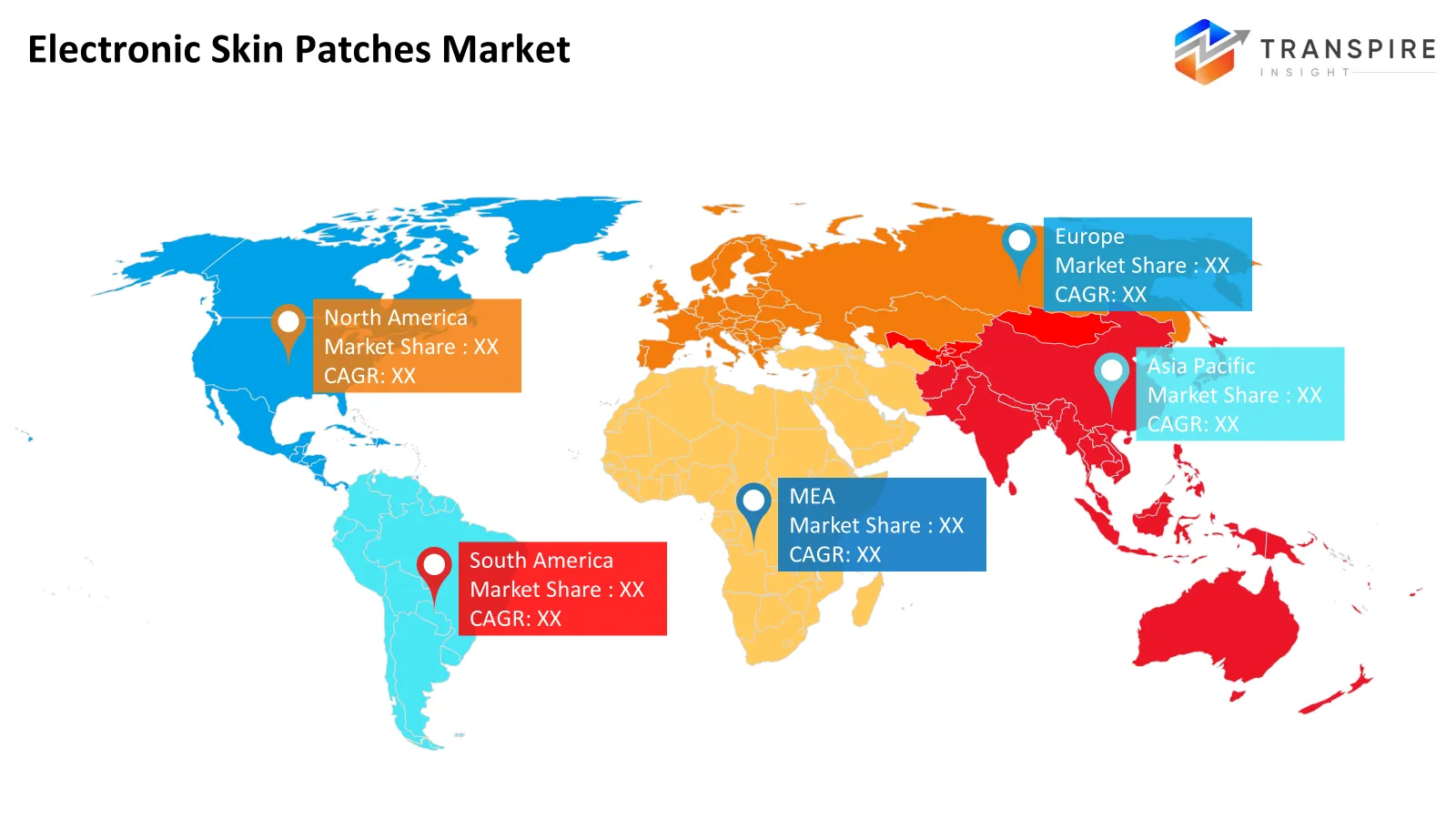
The North American region is dominant in the supplied regional segmentation with a market share of 39.6%. The dominance of the North American region is driven by the presence of robust healthcare facilities, advanced development of medical devices, and the use of connected monitoring systems. Management of chronic diseases and remote patient monitoring create valuable business prospects for the producers of wearable sensors.
In April 2026, US-based Sibel Health secured a deal from the Advanced Research Projects Agency for Health (ARPA-H) for designing and developing a wearable sensor for the continuous measurement of oedema. The biosensor patch is expected to detect fluid retention in the legs remotely in the non-clinical setting and will expand the scope of medical sensors mounted on skin.
Europe:
The Europe region constitutes 28% of the total market, becoming the second largest in the supplied data. Growth prospects of the region are tied to the presence of developed healthcare systems, medical research, and the interest in monitoring patients in non-conventional hospitals. Cooperation between healthcare organisations, research institutions, and medical device companies can facilitate product testing and clinical applications. Data privacy laws and medical device laws affect the design of connected patches.
In May 2026, Denmark-based IMP Scandinavia, medtech startup formed by former DTU graduates, received EU Medical Device Regulation (MDR) Class IIb approval for its intelligent monitoring patient patch. The development will help with the commercial launch and scaling up operations across Europe, with increasing opportunities for connected wearables in the field of clinical monitoring and patient safety
Asia Pacific:
The Asia Pacific region accounts for 24% of the market supply and is considered the fastest-growing region, with an 18.1% CAGR. Improvements in healthcare accessibility, growing focus on chronic disease management, and investment in digital health solutions have created scope for the growth of wearable monitoring devices. There is potential in the diverse manufacturing sector of the region for the development of sensors and electronics at varying costs. Affordability and availability of distribution channels would be key factors in their adoption.
In June 2026, Researchers at Australia's University of New South Wales (UNSW) invented AusculPatch, a 3.2 grams patch that detects vibrations produced by the heart, lungs, and blood vessels through an ultra-lightweight wearable sensor. The wearable device is expected to monitor cardiac and respiratory activity continuously outside the clinical setting in patients at home.
https://www.unsw.edu.au/newsroom/news/2026/06/Wearable-sensor-improve-heart-health-monitoring
Who are the Key Players in the Electronic Skin Patches Market, and how do they compete?
The competition in the international market for electronic skin patches includes competitors such as medical device manufacturers, wearable biosensor firms, and health technology companies. Competitors compete based on sensor accuracy, comfort level, monitoring period, software capabilities, clinical validation, and healthcare provider network. This is influenced by the current trend of provision of integrated services which involve wearable devices and analytics. Abbott and Dexcom are competitors when it comes to glucose monitoring using sensors, applications, and devices in helping manage the disease. The launch of the Dexcom G7 15 Day shows the importance of prolonged wear time and fewer sensor changes. VitalConnect which was acquired by iRhythm, is a company that has developed wearable biosensor technology in cardiac and multiparameter monitoring. Generally, firms in the industry can improve their competitive position by improving clinical validation, distribution network, and integration of their products to the healthcare system than competing on device prices.
Electronic Skin Patches Market companies
- Epicore Biosystems
- MC10
- Quad Industries
- Vivalink
- Sensoria Health
- iRhythm Technologies
- Abbott
- Dexcom
- Medtronic
- Nemaura Medical
- BioIntelliSense
- Xenoma
- IMEC
- Flexible Electronics
- VitalConnect
Recent Development News
- In October 2026, iRhythm Technologies successfully acquired VitalConnect. This acquisition diversified iRhythm’s offering in wearable cardiac monitoring and multiparameter monitoring services for inpatients, telemedicine, and hospital-to-home settings. This partnership is expected to increase access for customers and contribute to future growth of the business. https://investors.irhythmtech.com/news/news-details/2026/iRhythm-Completes-Acquisition-of-VitalConnect-Expanding-Its-Cardiac-Monitoring-Platform-Across-Ambulatory-Inpatient-and-Hospital-to-Home-Care/default.aspx
- In November 2025, Dexcom announced the U.S. release of the G7 15 Day continuous glucose monitoring system. The device was designed to deliver glucose measurements in real time for up to 15.5 days, thus reducing the need for sensor replacements among eligible adult patients. This demonstrates how longer wear times can enhance product differentiation in glucose monitoring systems. https://investors.dexcom.com/news/news-details/2025/Dexcom-G7-15-Day-Continuous-Glucose-Monitoring-System-to-Launch-on-Dec--1-in-the-United-States/default.aspx
What Strategic Insights Define the Future of the Electronic Skin Patches Market?
The future of the electronic skin patch industry would be determined by its capacity to generate information from the continuously measured physiological parameters. The glucose measurement and heart monitoring technologies have become well-established commercial applications in that regard. Besides, sweat analysis, multi-sensing patches and remote patient monitoring are among other promising directions to consider in the future. The manufacturers should pay attention not only to the added features but also to the precision of sensors, comfort materials, wear time and connection with clinical software.An underestimated risk in this industry involves a mismatch between the generation of a lot of sensory data and the delivery of clinically proven results due to poor signal quality, inconsistency, data protection issues and high costs for validation. One of the trends of interest for that industry is an approach that integrates the data from several sensing techniques and uses clinically approved AI.
By Product
- Continuous Glucose Monitoring Patches
- Drug Delivery Patches
- Biosensor Patches
- Temperature Patches
- ECG Patches
- Sweat Sensor Patches
- Motion Sensor Patches
- Others
By Sensor Type
- Chemical
- Biosensor
- Temperature
- Pressure
- Strain
- Electrochemical
- Optical
- Others
By Application
- Diabetes Monitoring
- Cardiovascular Monitoring
- Drug Delivery
- Sports & Fitness
- Wound Monitoring
- Patient Monitoring
- Wellness
- Others
By Technology
- Flexible Electronics
- Printed Electronics
- Wearable Sensors
- Organic Electronics
- Nanomaterials
- Microfluidics
- Wireless Electronics
- Others
By End User
- Hospitals
- Clinics
- Home Healthcare
- Sports & Fitness
- Research Institutions
- Pharmaceutical Companies
- Consumers
- Others
By Connectivity
- Bluetooth
- NFC
- Wi-Fi
- Cellular
- RFID
- Near-field
- Wired
- Others
By Material
- Polymer
- Silicone
- Graphene
- Gold
- Silver
- Conductive Ink
- Nanomaterials
- Others
By Regional Analysis
North America
- US
- Canada
- Mexico
Europe
- Germany
- UK
- France
- Italy
- Spain
- Russia
- Rest of Europe
Asia Pacific
- China
- Japan
- India
- South Korea
- Australia
- Rest of Asia Pacific
South America
- Brazil
- Argentina
- Rest of South America
Middle East & Africa
- UAE
- Saudi Arabia
- Qatar
- South Africa
- Rest of the Middle East & Africa
Frequently Asked Questions
Find quick answers to common questions.
The electronic skin patches market size was valued at USD 18.47 billion in 2025 and is poised to reach USD 47.72 billion by 2033, expanding at a 12.6% CAGR.
Key segments for the electronic skin patches market are By Product (Continuous Glucose Monitoring Patches, Drug Delivery Patches, Biosensor Patches, Temperature Patches, ECG Patches, Sweat Sensor Patches, Motion Sensor Patches, Others); By Sensor Type (Chemical, Biosensor, Temperature, Pressure, Strain, Electrochemical, Optical, Others); By Application (Diabetes Monitoring, Cardiovascular Monitoring, Drug Delivery, Sports & Fitness, Wound Monitoring, Patient Monitoring, Wellness, Others); By Technology (Flexible Electronics, Printed Electronics, Wearable Sensors, Organic Electronics, Nanomaterials, Microfluidics, Wireless Electronics, Others); By End User (Hospitals, Clinics, Home Healthcare, Sports & Fitness, Research Institutions, Pharmaceutical Companies, Consumers, Others); By Connectivity (Bluetooth, NFC, Wi-Fi, Cellular, RFID, Near-field, Wired, Others); By Material (Polymer, Silicone, Graphene, Gold, Silver, Conductive Ink, Nanomaterials, Others).
Growth is primarily driven by an increase in the use of wearable medical devices, advances in flexible sensors, and the rise in adoption of remote patient monitoring solutions.
The market is led by major manufacturers including Epicore Biosystems, MC10, Quad Industries, Vivalink, Sensoria Health, iRhythm Technologies, Abbott, Dexcom, Medtronic, Nemaura Medical, BioIntelliSense, Xenoma, IMEC, Flexible Electronics, and VitalConnect.
The North America region accounts for 39.6% of the electronic skin patch market owing to the advanced health care infrastructure, increasing demand for remote patient monitoring, rising use of wearables in healthcare, robust research and development activities, and the presence of key technology and health care players.
Business opportunities due to increasing demand for remote patient monitoring, increasing use of wearable devices, the increasing trend of personalised healthcare, incorporation of artificial intelligence in sensors, and increased usage of flexible electronic patches in sports and fitness industries.
- Epicore Biosystems
- MC10
- Quad Industries
- Vivalink
- Sensoria Health
- iRhythm Technologies
- Abbott
- Dexcom
- Medtronic
- Nemaura Medical
- BioIntelliSense
- Xenoma
- IMEC
- Flexible Electronics
- VitalConnect
About the Authors

Avinash Kumar
I’m Avinash Kumar, a Senior Research Analyst at Transpire Insight, with expertise in the Electronics and Semiconductor and Energy & Power industry. My work focuses on analyzing emerging technologies, market trends, industry developments, and innovation across these sectors. I specialize in transforming complex technical and market insights into clear, research-backed content that helps professionals, businesses, and decision-makers stay informed. Through continuous industry research and data-driven analysis, I strive to deliver accurate, reliable, and practical perspectives on the latest advancements shaping the semiconductor and energy landscape.

Chakradhar Khansole
Chakradhar serves as the Research Director at Transpire Insight, bringing over 8 years of experience in technology, innovation, and strategic market intelligence. He specializes in transforming complex market data into actionable business insights that enable organizations to make informed, growth-oriented decisions. Recognized for his strategic vision and analytical expertise, Chakradhar leads high-impact research initiatives, delivering comprehensive market assessments, competitive intelligence, and forward-looking industry analysis.
Recently Published Reports
-
Apr 2026
Fiber Optic Faceplates Market
Fiber Optic Faceplates Market Size, Share & Analysis Report By Type (< 300 mm2, 300-350 mm2, and > 350 mm2, By Application (Night Vision, Holographic Imaging, Medical, and Others), and Geography (North America, Europe, Asia-Pacific, Middle East and Africa, South and Central America), 2021 - 2031
-
Apr 2026
High Temperature Superconductors Market
High Temperature Superconductors Market Size, Share & Analysis Report By Type (1G HTS, and 2G HTS), By Application (Power Cable, Fault Current Limiter, and Transformer), and Geography (North America, Europe, Asia-Pacific, Middle East and Africa, South and Central America), 2021 - 2031
-
Apr 2026
Industrial Plugs and Socket Market
Industrial Plugs and Socket Market Size, Share & Analysis Report By Type (Industrial Plugs, Industrial Sockets), By Current (Up to 32 A, 32 to 125 A, Above 125 A), By Protection (Dustproof and Splash Proof, Waterproof, Explosion Proof), By End User (Heavy Industries, Oil and Gas, Chemicals and Pharmaceuticals, Power Generation, Others), and Geography (North America, Europe, Asia-Pacific, Middle East and Africa, South and Central America), 2021 - 2031
-
Apr 2026
InGaAs Avalanche Photodiodes Market
InGaAs Avalanche Photodiodes Market Size, Share & Analysis Report By Type (1100 - 1700 nm, and 1000 - 1600 nm), By Application (Missile Warning System, Muzzle Flash Detection, Wafer Defect Inspection, Laser Rangefinders, and Others), and Geography (North America, Europe, Asia-Pacific, Middle East and Africa, South and Central America), 2021 - 2031