
Dispositivos de Ultrasonido Market Summary:
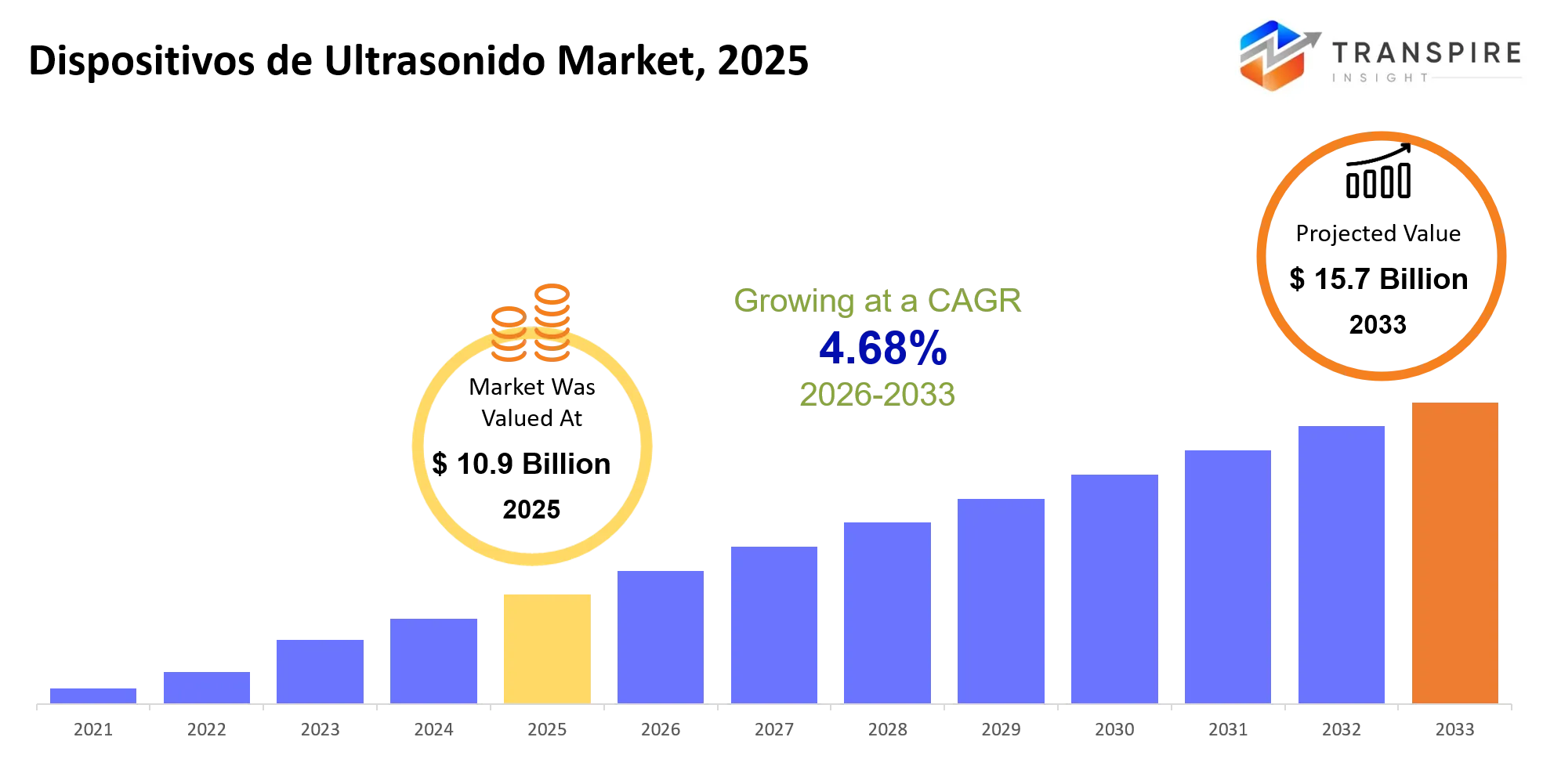
As per Transpire Insight Analysis, the Dispositivos de Ultrasonido Market size is estimated at USD 10.9 billion in 2025 and is anticipated to reach USD 15.7 billion by 2033, growing at a CAGR of 4.68% from 2026 to 2033.
The Dispositivos de Ultrasonido Market supports hospitals, diagnostic centres, and specialist clinics to look inside the body, monitor pregnancies, check heart conditions and guide surgical procedures. In the three to five years the industry has shifted away from old cart-based machines. Now there is a focus on portable systems, AI-assisted imaging, and software tools that support clinical workflows. This change helps healthcare workers do exams near patients, making things faster and more consistent. It also reduces the time needed for measurements. A big change is the addition of automated image analysis to ultrasound devices. This lets doctors finish exams quicker and with fewer errors. Point-of-care imaging is becoming more important as emergency departments, intensive care units, and smaller clinics need assessments at the patient’s bedside. There is pressure on medical staff, growing demand for better services and a need to bring diagnostics beyond big imaging centres. All of these factors are pushing hospitals to upgrade their equipment. This opens opportunities for manufacturers who offer flexible systems, software tailored to specific uses and options that fit different budgets.
Dispositivos de Ultrasonido Market Size & Forecast:
- Market Size 2025: USD 10.9 Billion
- Expected Market Value (2033): USD 15.7 Billion
- Forecast CAGR (2026–2033): 4.68%
- Leading Region in 2025: North America
- Fastest Growing Region: Asia Pacific
- Key Company Profiles: GE HealthCare, Philips, Siemens Healthineers, Canon Medical Systems, Fujifilm, Samsung Medison, Mindray, Esaote, Konica Minolta, Hologic, Shenzhen SonoScape, Butterfly Network, Clarius Mobile Health, CHISON Medical, Hitachi
Key Market Insights:
The market is shifting towards diagnostic imaging, and manufacturers are creating specific devices that solve workflow issues and increase access to ultrasound scans.
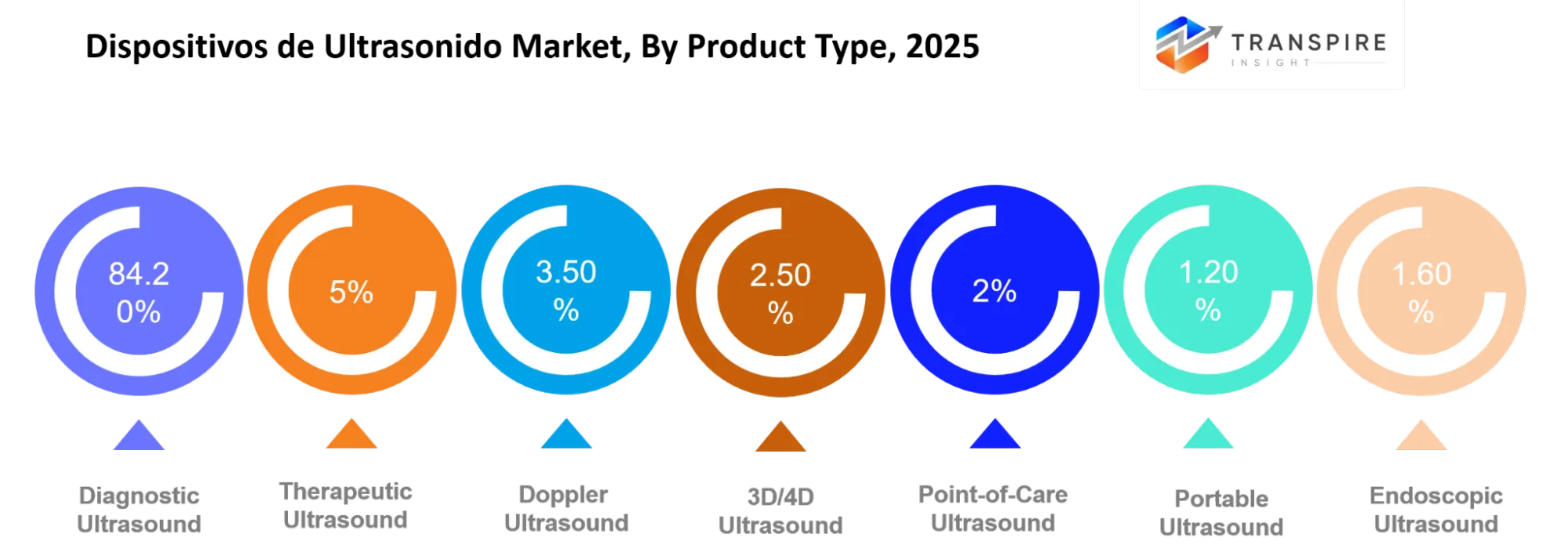
- Diagnostic ultrasound constitutes 84.20% of the supplied segmentation with respect to product type, underlining the significance of imaging services for routine diagnostics in various specialities.
- Therapeutic ultrasound constitutes 5.00% of the supplied product-type segmentation, indicating the importance of ultrasound-based therapy alongside diagnostic services.
- Doppler ultrasound comprises 3.50%, as imaging of blood flow and the vascular system plays an integral part in cardiac diagnostic imaging services.
- Portable ultrasound constitutes 1.20% of the supplied segmentation, while the release of portable systems such as GE HealthCare's LOGIQ e line in August 2026 testifies to this trend.
- Endoscopic ultrasound makes up 1.00% of the supplied product-type segmentation, which provides for diagnostic imaging services performed during medical procedures.
What are the Key Drivers, Restraints, and Opportunities in the Dispositivos de Ultrasonido Market?
Driver
Growth of the market is advancements in faster and non-invasive diagnosis and flexible clinical workflows are making the way to help in the adoption of ultrasound systems. As hospitals provide imaging at the bedside in ED, ICU, and cardiovascular evaluation departments, they are using fewer efforts in transporting patients to an imaging department for certain scans. In this way, opportunities exist for the equipment manufacturers to sell portable systems, specialised probes, software upgrades, and application-based solutions. Measurement tools based on AI can speed up the adoption process through assisting doctors in carrying out repetitive tasks.
Restraint
The high cost of acquisition still limits smaller hospitals, free-standing independent diagnostic centres, and high-technology activities working with small budgets. More sophisticated equipment might also involve costs for training of personnel, maintenance contracts, special software and software upgrades. Such acquisitions can be delayed by the question of replacement in cases where limitations of reimbursement or volumes make more sophisticated equipment unprofitable and where additional training is required because of an operator's lack of proficiency.
Opportunities
Growing the reach of point-of-care ultrasound andAI-enabled imaging represents an opportunity to expand into unserved facilities and to create more diverse clinical uses. Innovations that focus on small systems, remote assistance, and simple controls might help manufacturers expand into emerging healthcare markets such as Asia Pacific. Industry players that provide dependable imaging, low ownership costs, and training and maintenance may capture underserved needs as equipment revenues.
|
Driver |
Relative Impact on Growth (%) |
Geographic Relevance |
Impact Timeline |
Demand Strength |
Growth Mechanism |
Key Beneficiaries |
Major Constraint |
|
Rising prevalence of chronic diseases and increasing diagnostic imaging demand |
28% |
North America, Europe, Asia-Pacific |
Short-term |
High |
Expands cardiac, abdominal, vascular, and cancer-related diagnostic examinations |
Ultrasound manufacturers, hospitals, diagnostic imaging centres, patients |
Limited reimbursement and constrained healthcare budgets |
|
Technological advancements in high-resolution imaging and AI-enabled ultrasound |
24% |
North America, Europe, Asia-Pacific |
Medium-term |
High |
Improves image quality, diagnostic consistency, workflow efficiency, and clinical decision-making |
Medical imaging OEMs, AI developers, radiologists, sonographers |
Regulatory validation and clinical integration challenges |
|
Growing adoption of portable, handheld, and point-of-care ultrasound devices |
19% |
North America, Asia-Pacific, Europe |
Short-term |
High |
Enables bedside imaging, emergency assessment, rural screening, and faster diagnosis |
Handheld device manufacturers, emergency departments, primary-care providers |
Limited operator training and device affordability |
|
Expansion of healthcare infrastructure and diagnostic access |
16% |
Asia-Pacific, Latin America, Middle East and Africa |
Medium-term |
High |
Increases equipment procurement through hospital expansion and diagnostic service development |
Equipment suppliers, hospitals, distributors, public healthcare providers |
High capital costs and uneven infrastructure |
|
Rising demand for preventive, maternal, and minimally invasive diagnostic care |
13% |
Asia-Pacific, North America, Europe |
Long-term |
Medium |
Supports prenatal screening, routine monitoring, and ultrasound-guided procedures |
Obstetric clinics, specialty hospitals, ultrasound manufacturers, patients |
Unequal screening access and reimbursement limitations |
|
Total |
100% |
— |
— |
— |
— |
— |
— |
What Has the Impact of Artificial Intelligence Been on the Dispositivos de Ultrasonido Market?
AI is transforming the workflow of ultrasound through its ability to facilitate image acquisition, measurements, and analysis with minimal manual effort. AI can help in identifying anatomy, performing measurements, assessing the fetus, and certain abdominal scans. These features are especially useful in a hospital environment where imaging staff has to deal with a large number of patients without affecting the quality of their examinations. In cardiovascular imaging, for example, AI-enabled measurements can save on repetitive manual labour and standardise some selected assessments.AI is also being used in the optimisation of operations through examination presets, image quality improvement, automated reporting inputs, and software guiding users on how to perform particular scanning procedures. The predictive abilities are being developed through analysis of imaging patterns and risk assessment, though these tools need to be validated for the appropriate clinical use. Therefore, AI should be perceived as a tool for decision-making and not a substitute for trained personnel. The key challenge is associated with the costs and complexity of the integration of AI solutions into the current hospital infrastructure. The performance may differ from one patient population, equipment type, or clinical setting to another.
Instance
In February 2026,GE HealthCare launched a partnership with Diagnoly for the integration of an AI-assisted fetal screening technology into its Voluson ultrasound system, leading to greater standardisation of prenatal examinations and advanced imaging features. Such advancements have prompted healthcare organisations to adopt intelligent ultrasound systems for greater efficiency.
Key Market Trends:
The evolution of ultrasound technology is moving away from advancements in hardware to connected, application-specific technology.
- Manual measurements and scanning tasks are now supplemented with AI-enabled technology, thus allowing clinicians to focus on more difficult diagnostic activities.
- Traditional cart-mounted units are still highly valued, but at the same time, laptop-size and handheld models are becoming available as imaging is expanded to ERs, OPDs, and point-of-care.
- Specialised applications for cardiovascular, women's health, breast imaging, and image-guided procedures drive manufacturers to create dedicated product solutions.
- Application suites, workflows, and system connectivity become the elements that increase the value of the equipment purchased.
- Scanning comfort and usability become the priorities as the health sector tries to cope with repetitive stress injuries and enhance scan efficiency.
- Connected systems can assist in diagnosing certain issues with remote support services to decrease unnecessary site visits.
Dispositivos de Ultrasonido Market Segmentation
By Product Type
Diagnostic Ultrasound occupies the top position with 84.20% market share, while Therapeutic ultrasound holds 5.00%, Doppler Ultrasound 3.50%, and 3D/4D Ultrasound 2.50%. Point of Care Ultrasound holds 2.00%, while Portable Ultrasound accounts for 1.20%, Endoscopic Ultrasound 1.00%, and Contrast Enhanced Ultrasound 0.60%. The Point of Care Ultrasound is the fastest-growing segment with an estimated CAGR of 7.30%. The future growth opportunities for this market segment are due to Bedside Imaging and quick decision-making, while Diagnostic Ultrasound is expected to be the backbone of routine imaging needs.
By Portability
Trolley- and cart-based systems remain a possible solution for hospitals and departments that need all imaging, including larger, stationary systems; portable and hand-held units also can be used outside the imaging department; small, laptop- and pocket-based units, on the other hand, provide more flexibility in an emergency and outpatient department, or at remote locations. However, stationary systems can be considered a good solution when hospitals like and appreciate the image quality and the opportunity to use them for more sophisticated imaging procedures and scans. Future systems should move toward having everything with mobility, speed, and image quality, plus battery operation, robustness, and application.
By Application
Radiology and general imaging and diagnostic equipment is likely to be used to cover general diagnostic requirements; obstetrics and gynaecology imaging equipment will enable ultrasound to be used to examine the foetus antenatally and gynaecological investigations; cardiology imaging equipment will enable ultrasound to be used to examine the cardiac anatomy and functions in medicine; urology and musculoskeletal imaging equipment will be used to cover more specialised clinical needs. In medicine, emergency medicine employs bedside 'point-of-care' investigations; while in oncology ultrasound is employed in some diagnostic and image-guided procedures. Application-specific software and probe are likely to be an important consideration when selecting equipment; workflow automation is likely to be another consideration.
By Technology
Many examinations continue to be based on 2D imaging. In addition to 3D/4D imaging for more detailed visualisation of anatomy, Doppler and colour Doppler to provide information about blood flow, elastography to visualise stiffness of tissue, and contrast-enhanced ultrasound to perform some examinations with contrast agents are currently available. Additional functions, such as AI-assisted automatic measurement and guidance tools, contribute to the market. The development of new products will probably be based on combining different complementary imaging techniques, with easier operation and more standardised examination procedures.
By End User
requires portable and powerful ultrasound equipment for use in emergencies to inpatients and outpatients, from the general practitioner to speciality physicians, for procedural guidance. Diagnostic imaging facilities stress rapid image processing, high-quality imaging and low noise/artefacts, while special clinics have their own requirements based on their speciality focus. Research institutes require a flexible imaging platform for research and clinical trial purposes, respectively, while home health care is an under-serviced area in remote monitoring and assisted diagnostic models, where the emphasis would depend on clinical relevance and professional expertise.
By Device Class
Systems classified as premium have been designed to address the sophisticated needs of imaging procedures and complex procedures; mid-range systems represent a balance between performance, features, and affordability. Basic level systems are suited to providers with a stricter budget or less demanding imaging needs. Point-of-care systems concentrate on rapid mobilisation. Specialised systems have been built around certain applications. Portable and Handheld systems concentrate on portability and point-of-care at sites other than the imaging facilities. Suppliers that are able to match performance, service, and total cost of ownership to their customers' needs may address a wider pool of patients.
What are the Key Use Cases Driving the Dispositivos de Ultrasonido Market?
The use case for ultrasonography is diagnostic ultrasonography. This includes all routine examinations in the departments of radiology, general imaging, and specialities. The example highlights the value of non-invasive imaging for everyday clinical examinations, such as the examination of abdominal organs and soft tissues.Other uses of ultrasonography include obstetrical ultrasonography, cardiovascular ultrasonography, and musculoskeletal ultrasonography. Blood flow examination is performed using Doppler ultrasonography, while 3D/4D systems help to visualise images better. Ultrasound examination of emergency patients and critically ill patients in emergency rooms and intensive care units is another use case. Innovative uses include artificial intelligence ultrasonography scanning, guided procedures, and selected remote patient care procedures. Mobile ultrasonography equipment may be used in facilities that are not part of major medical centres, while special ultrasound equipment is used for procedural and specific diagnostic ultrasonography.
|
Report Metrics |
Details |
|
Market size value in 2025 |
USD 10.9 Billion |
|
Market size value in 2026 |
USD 11.4 Billion |
|
Revenue forecast in 2033 |
USD 15.7 Billion |
|
Growth rate |
CAGR of 4.68% from 2026 to 2033 |
|
Base year |
2025 |
|
Historical data |
2021 - 2024 |
|
Forecast period |
2026 - 2033 |
|
Report coverage |
Revenue forecast, competitive landscape, growth factors, and trends |
|
Regional scope |
United States; Canada; Mexico; United Kingdom; Germany; France; Italy; Spain; Denmark; Sweden; Norway; China; Japan; India; Australia; South Korea; Thailand; Brazil; Argentina; South Africa; Saudi Arabia; United Arab Emirates |
|
Key company profiled |
GE HealthCare, Philips, Siemens Healthineers, Canon Medical Systems, Fujifilm, Samsung Medison, Mindray, Esaote, Konica Minolta, Hologic, Shenzhen SonoScape, Butterfly Network, Clarius Mobile Health, CHISON Medical, Hitachi |
|
Customization scope |
Free report customization (country, regional & segment scope). Avail customized purchase options to meet your exact research needs. |
|
Report Segmentation |
Product Type (Diagnostic Ultrasound, Therapeutic Ultrasound, Doppler Ultrasound, 3D/4D Ultrasound, Point-of-Care Ultrasound, Portable Ultrasound, Endoscopic Ultrasound, Contrast-Enhanced Ultrasound); Portability (Cart/Trolley-Based, Portable, Handheld, Compact, Laptop-Based, Pocket-Sized, Stationary); Application (Radiology, Obstetrics & Gynecology, Cardiology, General Imaging, Urology, Musculoskeletal, Emergency Medicine, Oncology); Technology (2D, 3D, 4D, Doppler, Color Doppler, Elastography, Contrast-Enhanced, AI-Assisted); End User (Hospitals, Diagnostic Centers, Specialty Clinics, Ambulatory Centers, Maternity Centers, Research Institutes, Home Healthcare); Device Class (Premium Systems, Mid-Range Systems, Entry-Level Systems, Point-of-Care Systems, Specialty Systems, Portable Systems, Handheld Systems) |
Which Regions are Driving the Dispositivos de Ultrasonido Market Growth?
North America
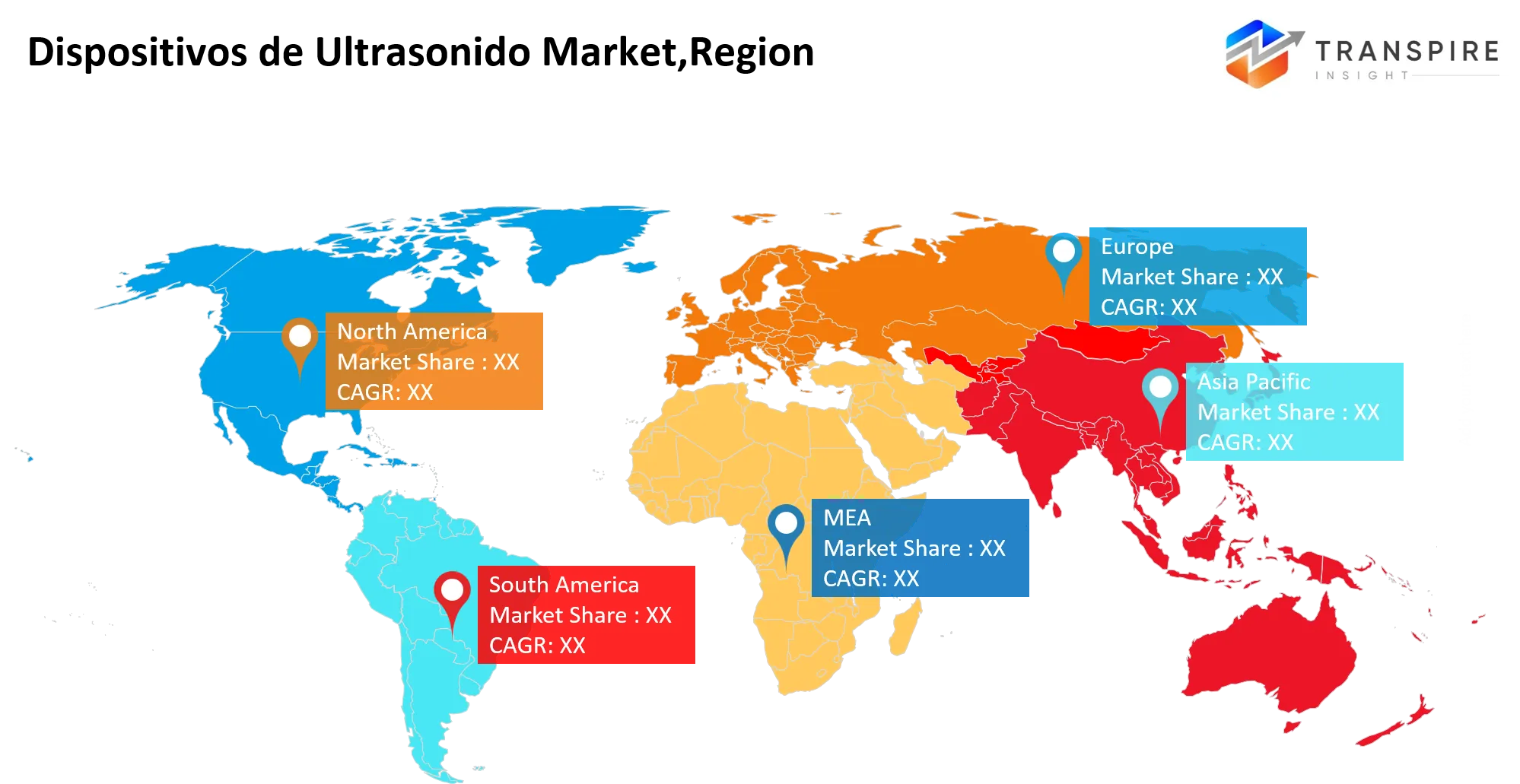
North America constitutes 29.80% of the regional market share. This dominance is attributed to the presence of excellent healthcare facilities, efficient hospitals, and imaging devices. Investments in technologies, health care professionals, and reimbursement systems are key factors that have helped drive the demand for advanced ultrasound devices. There is also an increased demand for artificial intelligence-imaging, cardiovascular testing, and diagnostic equipment.
In February 2026, GE Healthcare expanded its partnership with BARDA with a contract of USD 35 million to develop AI-based ultrasound systems for trauma and preparedness applications.
Europe
Europe accounts for 27.00%. There are numerous hospitals in Europe, and there is high-quality diagnosis and an emphasis on quality of care, which ensures continuous usage of the equipment. Performance of the equipment, cost of lifecycle, regulatory compliance, and the implementation of systems solutions within the hospital workflow will influence the choice of the equipment. There is the possibility that solutions from companies providing quality equipment, energy-efficient technologies, speciality applications, and services can grow in the market.
In July 2026, Philips released its Alturion ultrasound system featuring AI-driven processes to make imaging and work processes more efficient for hospitals in Europe.
Asia Pacific
Asia Pacific constitutes 26.00% of the fastest-growing region with a CAGR of 6.20%. The development of the healthcare infrastructure, along with the rise in demand for diagnostics and a large population, would probably help with investment in imaging machines. The portability of the systems and low pricing of the products might make the systems suitable even for small hospitals and outpatient centres. The use of low-cost technology, clinical education, and locally applied systems could be a good marketing approach.
In April 2026, Mindray demonstrated AI-enabled ultrasound uses at CMEF 2026 in Shanghai, showing the potential of intelligent imaging and digital healthcare solutions in Asia Pacific.
https://www.mindray.com/cn/media-center/news/mindray-qiyuan-ai-cmef-2026
Who are the Key Players in the Dispositivos de Ultrasonido Market, and how do they compete?
The competition in the Dispositivos de Ultrasonido industry depends on imaging quality, clinical application scope, level of automated operation, portability, service support, and cost of ownership. Competing products can be differentiated based on whether they target high-end hospitals' imaging suites, niche imaging applications, or low-cost machines for small health facilities. Product news indicates a focus on AI-enabled workflow management and applications' capability sets as the current trend of investments. Competitive position of GE HealthCare is based on a broad imaging product line-up and highly specialised cardiovascular and women's health systems. The launches of the company's Vivid Pioneer and LOGIQ e series products emphasise its focus on cardiac imaging and compact general-imaging solutions.Philips is characterised by a specialisation in cardiovascular imaging, its AI-related features, and workflow tools. The company launched its Transcend Plus series, which included imaging capabilities and AI enhancements to the existing cardiovascular ultrasound platform series. Canon Medical Systems, Fujifilm, Mindray, and Esaote are other significant competitors in the industry, specialising in various imaging applications, equipment price ranges, and healthcare institutions. Their competitive positions need to be defined by the current product portfolio, geographic availability, service, and validated sales results.
Dispositivos de Ultrasonido Market companies
- GE HealthCare
- Philips
- Siemens Healthineers
- Canon Medical Systems
- Fujifilm
- Samsung Medison
- Mindray
- Esaote
- Konica Minolta
- Hologic
- Shenzhen SonoScape
- Butterfly Network
- Clarius Mobile Health
- CHISON Medical
- Hitachi
|
Company |
Est. Revenue Share Range |
Key Offerings |
Strategic Positioning |
Geographic Strength |
Technology Focus |
|
GE HealthCare |
Estimated 25–28% |
LOGIQ, Vivid, Voluson, Venue ultrasound systems |
leadership through broad clinical specialization |
North America, Europe, Asia Pacific |
AI-assisted imaging, advanced transducers, automated workflows |
|
Philips |
Estimated 16–19% |
EPIQ, Affiniti, Compact 5000, Lumify |
Premium imaging with integrated clinical workflows |
North America, Europe, Asia Pacific |
AI-enabled imaging, 3D/4D imaging, connected ultrasound |
|
Siemens Healthineers |
Estimated 14–17% |
ACUSON Sequoia, Redwood, Juniper, SC2000 PRIME |
Premium performance and hospital integration |
Europe, North America, Asia Pacific |
BioAcoustic imaging, real-time 3D, intelligent workflow tools |
|
Mindray |
Estimated 8–11% |
Resona, DC, M9, TE series ultrasound systems |
Cost-competitive innovation across clinical segments |
Asia Pacific, Europe, Latin America |
AI-assisted diagnosis, high-resolution imaging, portable systems |
|
Samsung Medison |
Estimated 7–10% |
HERA, V-series, HS-series ultrasound systems |
Differentiation in women's health and fetal imaging |
Asia Pacific, Europe, North America |
Fetal imaging AI, 3D/4D imaging, automated measurements |
|
Canon Medical Systems |
Estimated 5–8% |
Aplio, Aplio i-series, Xario, Viamo systems |
Advanced imaging and specialist clinical applications |
Asia Pacific, North America, Europe |
Advanced beamforming, elastography, quantitative imaging |
|
Fujifilm Healthcare / Sonosite |
Estimated 3–5% |
ARIETTA, Sonosite PX, LX, ST systems |
Portable imaging and point-of-care specialization |
North America, Asia Pacific, Europe |
Rugged handheld and portable imaging, workflow optimization |
|
Esaote |
Estimated 2–4% |
MyLab X90, MyLab ultrasound systems, portable scanners |
Niche specialization in musculoskeletal and clinical imaging |
Europe, Asia Pacific, Latin America |
Musculoskeletal imaging, elastography, compact architectures |
|
Hologic |
Estimated 1–3% |
Aplio-series breast imaging systems, breast ultrasound solutions |
Breast imaging specialization and diagnostic differentiation |
North America, Europe |
Automated breast ultrasound, lesion characterization, 3D imaging |
|
Butterfly Network |
Estimated 0.5–2% |
Butterfly iQ+, Butterfly iQ3, Compass software |
Handheld accessibility and software-led expansion |
North America, Europe, selected Asia Pacific markets |
Ultrasound-on-chip, handheld scanning, AI-enabled software |
Recent Development News
In July 2026, the Alturion ultrasound system from Philips was introduced. An ultrasound platform with an artificial intelligence (AI) workflow for high-throughput clinical environments was introduced by Philips. This development marks the industry's emphasis on making exams efficient and enabling consistent decision-making in clinical practice.
In November 2025, the R20 ultrasound system from Samsung Medison was introduced. Samsung Medison introduced the next-generation general imaging platform with AI automation, enhanced imaging, and ergonomic design.
What Strategic Insights Define the Future of the Dispositivos de Ultrasonido Market?
In the future, the success of the Dispositivos de Ultrasonido Market will depend on the ability of manufacturers to combine diagnostic capabilities with portability, smart software and affordability. While diagnostic ultrasound applications will continue to be significant, there are also some opportunities to differentiate through point-of-care systems and procedural imaging. Point-of-care ultrasound highlights the significance of watching demand for devices capable of performing clinical assessments outside imaging departments.One hidden risk is that manufacturers will put considerable efforts into making their products smarter without gaining enough popularity among clinicians. High integration costs, training, regulation, and inconsistent performance in clinical environments may negatively impact returns on investment.There is an emerging opportunity in Asia Pacific due to the expansion of the healthcare infrastructure and the need for accessible diagnostic solutions. Providers should focus on developing products addressing specific clinical needs and not just introducing advanced technologiesA good approach here would be creating scalable product portfolios, building robust distribution and maintenance networks in local markets, and providing training together with the equipment.
Product Type
- Diagnostic Ultrasound
- Therapeutic Ultrasound
- Doppler Ultrasound
- 3D/4D Ultrasound
- Point-of-Care Ultrasound
- Portable Ultrasound
- Endoscopic Ultrasound
- Contrast-Enhanced Ultrasound
Portability
- Cart/Trolley-Based
- Portable
- Handheld
- Compact
- Laptop-Based
- Pocket-Sized
- Stationary
Application
- Radiology
- Obstetrics & Gynecology
- Cardiology
- General Imaging
- Urology
- Musculoskeletal
- Emergency Medicine
- Oncology
Technology
- 2D
- 3D
- 4D
- Doppler
- Color Doppler
- Elastography
- Contrast-Enhanced
- AI-Assisted
End User
- Hospitals
- Diagnostic Centers
- Specialty Clinics
- Ambulatory Centers
- Maternity Centers
- Research Institutes
- Home Healthcare
Device Class
- Premium Systems
- Mid-Range Systems
- Entry-Level Systems
- Point-of-Care Systems
- Specialty Systems
- Portable Systems
- Handheld Systems
Frequently Asked Questions
Find quick answers to common questions.
The dispositivos de ultrasonido market size was valued at USD 10.9 billion in 2025 and is poised to reach USD 15.7 billion by 2033, expanding at a 4.68% CAGR
Key segments for the dispositivos de ultrasonido market are Product Type (Diagnostic Ultrasound, Therapeutic Ultrasound, Doppler Ultrasound, 3D/4D Ultrasound, Point-of-Care Ultrasound, Portable Ultrasound, Endoscopic Ultrasound, Contrast-Enhanced Ultrasound); Portability (Cart/Trolley-Based, Portable, Handheld, Compact, Laptop-Based, Pocket-Sized, Stationary); Application (Radiology, Obstetrics & Gynecology, Cardiology, General Imaging, Urology, Musculoskeletal, Emergency Medicine, Oncology); Technology (2D, 3D, 4D, Doppler, Color Doppler, Elastography, Contrast-Enhanced, AI-Assisted); End User (Hospitals, Diagnostic Centers, Specialty Clinics, Ambulatory Centers, Maternity Centers, Research Institutes, Home Healthcare); Device Class (Premium Systems, Mid-Range Systems, Entry-Level Systems, Point-of-Care Systems, Specialty Systems, Portable Systems, Handheld System
Growth is primarily driven by increasing demand for non-invasive diagnostic imaging, technological advancements in 3D/4D and AI-enabled ultrasound systems, growing adoption of portable devices, and expanding applications in cardiology, radiology, and maternal healthcare.
The market is led by major manufacturers including GE HealthCare, Philips, Siemens Healthineers, Canon Medical Systems, Fujifilm, Samsung Medison, Mindray, Esaote, Konica Minolta, Hologic, Shenzhen SonoScape, Butterfly Network, Clarius Mobile Health, CHISON Medical, Hitachi
North America has a market share of 29.80% in the market for dispositivos de ultrasonido. North America is well supported by advanced healthcare infrastructure, widespread use of sophisticated diagnostic imaging systems, increased demand for disease detection, significant healthcare spending, and top-notch medical device manufacturing companies.
The business potential in the dispositivos de ultrasonido market can be seen in the development of AI-assisted imaging systems, the increasing need for handheld or portable ultrasound equipment, the growing application of point-of-care diagnostics, and increased use of advanced imaging technologies in developing countries.
- GE HealthCare
- Philips
- Siemens Healthineers
- Canon Medical Systems
- Fujifilm
- Samsung Medison
- Mindray
- Esaote
- Konica Minolta
- Hologic
- Shenzhen SonoScape
- Butterfly Network
- Clarius Mobile Health
- CHISON Medical
- Hitachi
About the Authors

Pankaj Ghogare Patil
I am Pankaj Ghogare Patil, a Senior Research Analyst at Transpire Insight, specializing in the Pharmaceutical, Chemicals & Materials, Healthcare IT, and Biotechnology industry. My expertise lies in conducting comprehensive market research, analyzing industry trends, evaluating competitive landscapes, and translating complex data into actionable insights. At Transpire Insight, I closely follow emerging technologies, regulatory developments, and market innovations to create accurate, well-researched, and informative content that helps businesses and professionals make informed decisions. I am committed to producing credible, evidence-based articles that reflect industry best practices while making technical topics accessible and valuable for a broad audience.

Chakradhar Khansole
Chakradhar serves as the Research Director at Transpire Insight, bringing over 8 years of experience in technology, innovation, and strategic market intelligence. He specializes in transforming complex market data into actionable business insights that enable organizations to make informed, growth-oriented decisions. Recognized for his strategic vision and analytical expertise, Chakradhar leads high-impact research initiatives, delivering comprehensive market assessments, competitive intelligence, and forward-looking industry analysis.
Recently Published Reports
-
Apr 2026
AI in Diabetic Retinopathy Market
AI in Diabetic Retinopathy Market Size, Share & Analysis Report By Type (Screening AI Systems, Diagnostic AI Systems, and Predictive AI Models), By Application Segment (Hospitals, Ophthalmology Clinics, Diagnostic Centers, and Research and Development), and Geography (North America, Europe, Asia-Pacific, Middle East and Africa, South and Central America), 2021 - 2031
-
Apr 2026
Psychometric Tests Market
Psychometric Tests Market Size, Share & Analysis Report By Type (Personality Tests, Ability/Aptitude Tests, Skill/Knowledge Tests, and Others), By Application (Talent Acquisition and Talent Management), and Geography (North America, Europe, Asia-Pacific, Middle East and Africa, South and Central America), 2021 – 2031
-
Apr 2026
Rare Biological Sample Collection Market
Rare Biological Sample Collection Market Size, Share & Analysis Report By Type (Isolation Kits & Reagent, Blood Collection Tubes, and Others), By Application (Oncology, Transcriptomics, Pharmacogenomics, and Others), and Geography (North America, Europe, Asia-Pacific, Middle East and Africa, South and Central America), 2021 – 2031
-
Jul 2026
Diabetic Retinopathy Market
Diabetic Retinopathy Market Size, Share & Analysis Report By Type (Proliferative Diabetic Retinopathy, and Diabetic Macular Edema (DME)), By Treatment Type (Anti VEGF Drug, Steroid Implants, Laser Surgeries, and Vitrectomy), and Geography (North America, Europe, Asia-Pacific, Middle East and Africa, South and Central America), 2021 – 2031
Our Clients