
Germany Compact Air Compression Systems Market Summary
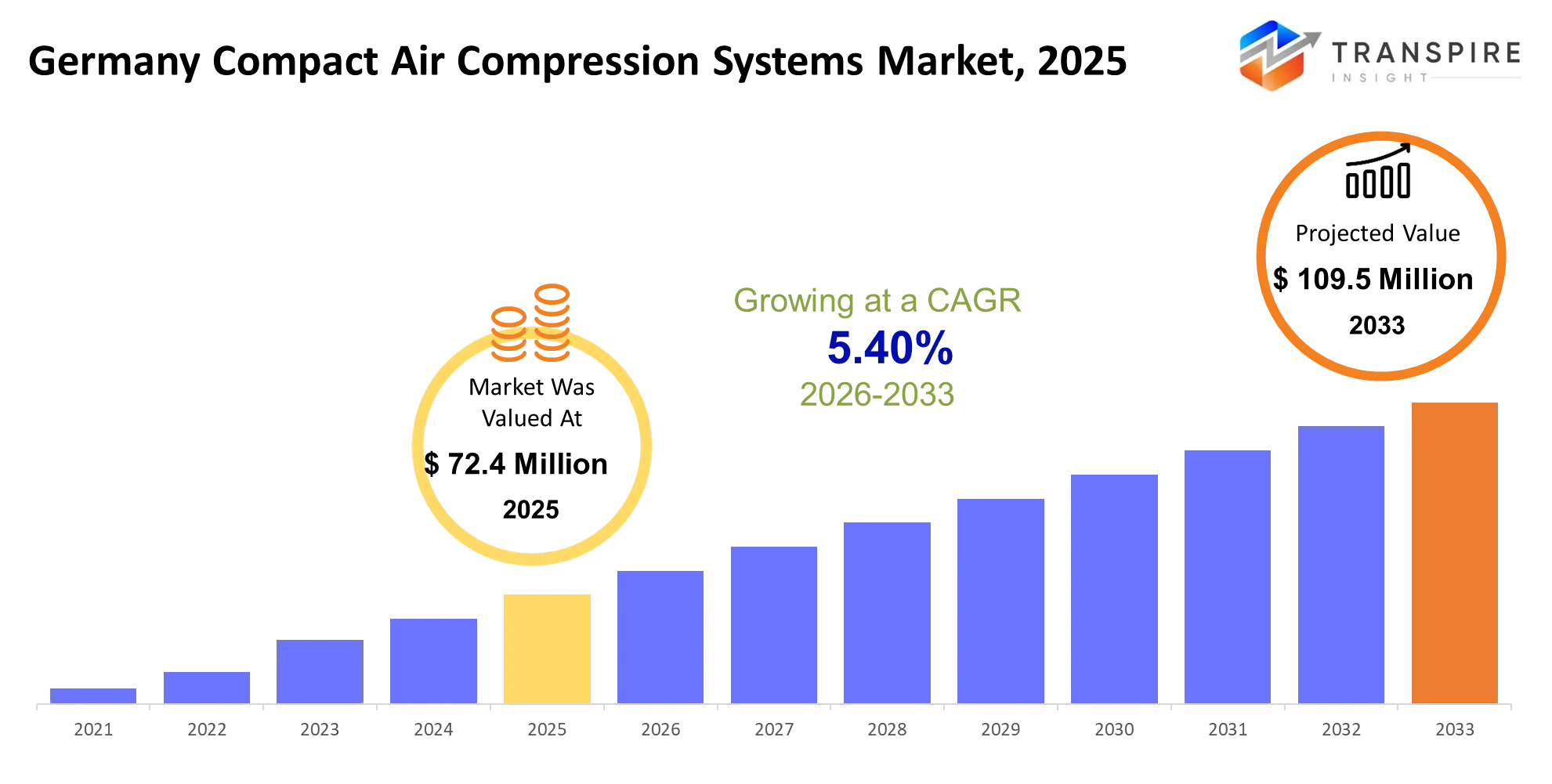
As per Transpire Insight Analysis The Germany Compact Air Compression Systems Market size is estimated at USD 72.4 Million in 2025 and is anticipated to reach USD 109.5 Million by 2033, growing at a CAGR of 5.40% from 2026 to 2033.
The Germany Compact Air Compression Systems Market basically provides dependable compressed air for factory automation, pneumatic tools , packaging, assembly, medical equipment, and other workflows where a steady air supply matters. These compact arrangements let manufacturers place the compression capacity nearer to production lines, while still keeping energy use, upkeep demands, and the usable footprint under control. In the last three to five years, the whole space has leaned away from conventional fixed speed gear toward variable-speed units, digital monitoring, and energy-smart solutions. EU Ecodesign rules for electric motors and variable-speed drives, kind of pushed that move forward too, mainly by tightening efficiency standards for motor driven equipment.
The energy price shock after Russia’s invasion of Ukraine also made investment choices quicker, because compressed air electricity use turned into a clearer day-to-day operating cost. Many manufacturers now look at compressors as complete energy systems, not only as isolated machines, so they use centralized control, remote observation, leak detection, and even heat recovery to trim lifecycle expenses. Atlas Copco states that air leaks can reach up to 20% of a system’s total energy consumption, which makes system tuning pretty appealing financially. As a result, the market is growing via replacement of older inefficient installations, upgrades of production sites, and wider adoption of connected compact compressors, where the efficiency and uptime improvements are easier to measure and sell internally.
Germany Compact Air Compression Systems Market Size & Forecast:
- Germany Compact Air Compression Systems Market Size 2025: USD 72.4 Million
- Expected Market Value 2033: USD 109.5 Million
- Forecast CAGR: 5.40%
- Leading region in 2025: North Rhine-Westphalia
- Fastest Growing region: Bavaria
- Key Profile: Atlas Copco, Kaeser Kompressoren, Ingersoll Rand, Gardner Denver, ELGi Equipments, BOGE Kompressoren, Sullair, Hitachi Industrial Equipment Systems, FS-Curtis, Quincy Compressor, Chicago Pneumatic, Doosan Portable Power, CompAir, Bauer Kompressoren, Kobelco Compressors
Key Market Insights
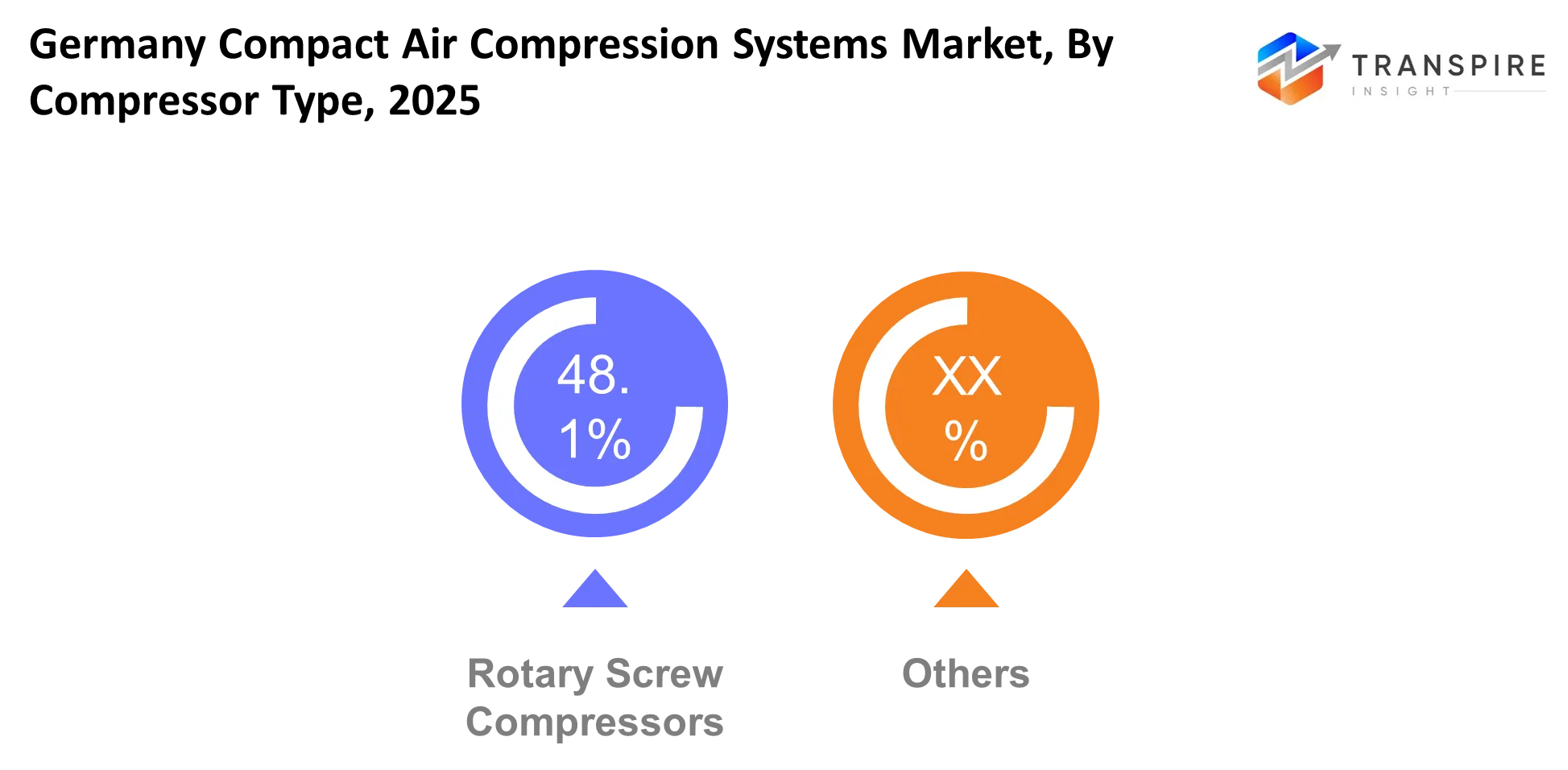
- Rotary screw compressors kinda lead the market with an estimated 50–55% share, mainly because they run in continuous duty, stay pretty compact, and fit well into automated manufacturing applications too
- Reciprocating compressors come in second place, often for workshops, small factories, service facilities, and for operations that only need intermittent compressed-air delivery
- Variable-speed compact compressors are the fastest growing segment through 2033, since many users try to match output with shifting production loads in a more “responsive” way
- Manufacturing makes up roughly 45–50% of the application share, pushed by pneumatic automation, assembly lines, machining, packaging, and various material-handling flows
- Electronics, battery production, and precision manufacturing are also showing up more, and they want stable clean, and tightly controlled compressed-air supply, not just “good enough”
- Industrial manufacturing on the whole is already more than 50% of end user demand, because compressed air supports multiple production processes across German plants
- Food processing, pharmaceuticals, electronics, and battery manufacturing are expanding faster now, partly due to stricter air quality expectations and automated production settings that don’t tolerate swings
- Atlas Copco and Kaeser Kompressoren are building stronger competitive positions via SMARTLINK, intelligent controls, remote monitoring, predictive maintenance, and energy optimization
- Ingersoll Rand, BOGE Kompressoren, and CompAir are competing through more efficient equipment, setups tailored to specific uses, digital monitoring, and lifecycle service offers
- Overall the advantage is moving toward full compressed-air systems, with energy efficiency, heat recovery, connected controls, predictive maintenance, and service agreements bundled together
What are the Key Drivers, Restraints, and Opportunities in The Germany Compact Air Compression Systems Market?
Energy efficiency has turned into a pretty strong commercial driver, because electricity makes up a major share of the compressor lifecycle spend. With EU Regulation 2019/1781, Ecodesign efficiency rules were put in place for electric motors and variable-speed drives, and there were requirements that kicked in during 2021 and then 2023 for different motor classes. Because of that, German makers have a stronger financial and compliance nudge to swap out older, less efficient gear with variable-speed setups and digitally managed systems. The immediate money side effect mostly shows up through replacement sales, system upgrades, controllers monitoring software and energy-management services ,not just the compressor hardware on its own.
Even so, high switching costs are still a real structural block. When you replace a compressor, you often have to adjust dryers, receivers, pipework, the controls, electrical infrastructure, and even the production schedule. On top, there are qualification demands, especially when compressed air directly influences product quality. All of this stretches replacement timelines, and it can push investment further out, even if a newer compressor looks better on operating cost.
Connected compressed-air systems look like the most obvious next-step chance. Atlas Copco’s SMARTLINK and Kaeser’s SIGMA AIR MANAGER show, kind of plainly, how real-time operating information can enable remote monitoring, demand-driven control, energy management, plus predictive maintenance. As German plants expand Industry 4.0 infrastructure, more compact compressors that connect with existing plant monitoring can capture extra value via optimization software, service agreements, and maintenance that’s tied to performance.
What Has the Impact of Artificial Intelligence Been on The Germany Compact Air Compression Systems Market?
Artificial intelligence plus advanced analytics are, in practice, pushing compact compressed-air systems away from just producing air toward setups that keep adjusting operating conditions, more or less all the time. In Germany, digital compressor platforms already pull in sensor information on pressure, temperature, operating hours, energy use, and maintenance status, so manufacturers can spot odd behavior early, before it turns into actual equipment failure. Atlas Copco’s SMARTLINK offers remote monitoring, operating alerts, energy assessment, and service related details, while Kaeser’s SIGMA AIR MANAGER 4.0 leans on demand forecasting and networked control to line up compressors dryers, and filters in a coordinated way.
Research on machine-learning and predictive control is taking the same idea further by estimating demand and choosing operating conditions that cut down unnecessary compression, even when demand wiggles around. A 2025 German research study for industrial compressed-air systems reported about 4% energy savings with a reinforcement-learning controller, compared with a factory installed industrial controller, under tested conditions. Together, these techniques can lift uptime, lower avoidable energy consumption, and enable condition-based maintenance instead of sticking to fixed service cycles that do not really match reality.
The biggest block though is integration. Older compressors, plant controls, sensor sets, and software ecosystems often speak different “languages,” and AI models that behave reliably need enough high-quality operating data. So retrofitting intelligent control tends to cost more than simply adding monitoring on new equipment, even if the long-term upside is there.
Key Market Trends
- Since 2021, the higher motor efficiency standards have kinda sped up the replacement of older compressor gear, with IE3, IE4, and also variable speed setups getting more attention over time.
- Since 2022, when energy prices started bouncing around a lot, buyers have tended to favor the lifecycle operating costs, rather than only looking at compressor purchase price, or that single initial cost.
- Digital monitoring isn’t really stuck in compressor rooms anymore, connected systems are increasingly watching pressure, flow, humidity, energy use, and even maintenance health status , in a more continuous way.
- Variable speed tech has also gained importance as factories try to match compressor output to the changing production loads, instead of keeping higher pressure just for “safety”.
- Manufacturers are combining compressors with centralized controller systems, plus dryers, filters and monitoring software, so the whole compressed-air station can be optimized rather than handling pieces separately.
- Predictive maintenance has moved away from purely periodic servicing, and toward sensor driven intervention, which lets operators spot abnormal conditions before a critical failure actually happens.
- Heat recovery is becoming a more convincing retrofit choice, since plants can reuse the thermal energy produced by compressors for space heating, hot water, or certain industrial processes.
- Industry 4.0 adoption is pushing compressor suppliers toward SCADA connectivity, remote diagnostics, real time dashboards, and automated energy management functions.
- In Bavaria, industrial production went up 0.6% in 2025, while machinery output rose 2.9% and automotive production increased 2.7% , which is helping regional equipment demand stay stronger.
- AI based control is now moving from the lab and research stage into industrial deployment, with recent German studies showing around 4% energy savings tied to compressed-air control.
Germany Compact Air Compression Systems Market Segmentation
By Compressor Type:
Rotary Screw Compressors help with continuous production because of steady airflow and an efficient way of running, so they’re often used in manufacturing, automotive, chemicals and other industrial facilities as well. Reciprocating Compressors are more like the go-to option for workshops, maintenance operations, plus smaller production units that only need intermittent airflow. Scroll Compressors give quiet and clean operation, which makes them fit for healthcare, electronics, and precision tasks. Centrifugal Compressors are typically for bigger facilities that ask for high volume airflow, they basically carry the load at scale. Oil-Free Compressors are built for situations where clean air matters most, especially healthcare, pharmaceuticals, food processing, and electronics. Oil-Lubricated Compressors on the other hand offer cost-effective running across general industrial activities, and that’s why they show up everywhere.
Portable Compressors support construction, maintenance, and mobile industrial work where compressed air has to move from one place to the next. Mini Compressors fit compact equipment and smaller pneumatic jobs, mainly when space is tight and the system footprint is small. Variable Speed Compressors tune the output based on changing production loads, which helps with energy management and reduces unnecessary electricity use. There are also other types, like specialized compressor setups, created for certain pressure, flow, installation, or operating needs across different industrial facilities.
By Power Rating:
Under 5 kW setups can run small pneumatic tools, like the kind you find in workshops, labs or compact equipment, but they dont take much compressed air. When you’re in the 5–15 kW range, these systems tend to fit smaller production places , maintenance groups and light industrial tasks. From 15–30 kW, you get more headroom for medium manufacturing, automated machinery, and general workshop use. The 30–75 kW segment is typically for continuous industrial work, production lines, packaging gear , and even automotive operations. Then 75–150 kW systems cover bigger production needs, where steady airflow matters for several machines at once and more automated sequences.
If you go beyond 150 kW, you’re looking at high-volume industrial installations that need a serious compressed-air delivery. In general, Low Capacity systems are still a good match for smaller sites and specialized devices , and Medium Capacity systems handle the wider industrial load with multiple pneumatic applications. High Capacity systems are built for tougher production conditions, including long, interconnected compressed-air networks. Other options also exist, including power arrangements tuned for special equipment demands, different operating pressures, facility footprint, and production timings.
By Application:
Manufacturing is a big use case, because compressed air, helps keep pneumatic tools running, and it also supports automated machinery, assembly equipment, material handling, plus packaging processes too. In automotive facilities compressed air is used for painting, assembly, fastening, cleaning, and a lot of production-line automation. In Food & Beverage operations they need controlled air quality for packaging, processing, and bottling equipment, kind of consistently. Healthcare facilities rely on clean compressed air for medical devices and certain clinical applications ,that have tighter requirements. Construction operations lean on portable compression equipment for drilling, fastening, surface preparation, and other site related activities, regardless of conditions.
Electronics manufacturing benefits from clean and stable airflow for precision production, and for how the equipment operates day to day. Chemicals facilities want compressed air to power instrumentation, control systems, pneumatic valves, and process equipment. Energy & Utilities operations depend on compression systems for control equipment, maintenance routines, and general plant operations. Mining applications lean on sturdy systems for drilling, ventilation related equipment, and pneumatic tools, because downtime is costly. Then there are others like laboratories, workshops, packaging operations, and specialized industrial processes with separate pressure needs and air-quality requirements.
By End User:
Industrial Manufacturing stay a big end-user group, kinda because compressed air helps with multiple production activities inside factories. In Automotive Industry sites, they use compressed air in assembly, painting, tooling and those automated production systems. Hospitals depend on steady clean-air setups for medical equipment, and for selected treatment use-cases too. Pharmaceutical Companies, they tend to put emphasis on controlled air quality, especially during manufacturing, packaging, and process equipment operation. Construction Companies rely on portable units for site-based pneumatic tools and machinery. Food Processing Companies need dependable compressed air during processing, packaging, and day to day production operations.
Electronics Manufacturers, they look for stable and clean compressed air for precision production environments. Energy Companies use compression equipment for plant controls, maintenance tasks, and broader industrial processes. SMEs show up as a notable customer group because compact systems work in smaller facilities, even when installation space is limited, and production still needs to be controlled. Other customers cover laboratories, workshops, research facilities, service providers, and specialized industrial users who want dependable compressed-air equipment under particular operating conditions.
By Distribution Channel:
Direct Sales still matter, for big industrial buyers who need some tech assessment, proper system sizing, installation support and then after-sales service too. Industrial Distributors tend to fit the smaller factories, workshops, and maintenance departments better, because they give fairly quick access to equipment and offer technical assistance as well.
OEM Supply basically links compressor manufacturers with machinery builders, and those builders then fold the compression system into their own production equipment. Online B2B channels do the product discovery thing, quotation requests, and also procurement for standardized equipment—pretty straightforward even if people browse a lot.
Equipment Dealers often bring the local availability angle, plus installation help, maintenance services and replacement units when needed. Rental Providers cater to construction and temporary industrial projects , where short-term compressed-air capacity is required, without a big permanent investment in fixed assets.
Government Procurement supports public facilities and institutional buyers through formal buying procedures. Export Sales connect German suppliers with international customers who look for specialized compression equipment and engineering support. Importers give access to international compressor brands, including specialized configurations, and they do it within domestic industrial markets.Others include service companies, engineering contractors, system integrators, and specialized procurement partners, basically the rest of the ecosystem.
What are the Key Use Cases Driving The Germany Compact Air Compression Systems Market?
Manufacturing is still the most common thing people do, and compressed air helps out with pneumatic tools, automated assembly, machining, packaging, plus material handling setups. In industrial plants airflow cant be “just ok” because if production stops, it can ripple into several linked processes, and then operating costs climb too. That is why rotary screw units and variable speed solutions tend to stay a good fit for nonstop factory routines.
On the other hand automotive production and electronics manufacturing are showing more growth, mainly because they can use automated assembly, precision tooling, painting, cleaning, and tightly controlled environments. Pharmaceutical plants and food processing sites also end up needing clean compressed air, especially for packaging and some process machinery, which pushes interest toward oil free systems and air treatment equipment.
More new uses are starting to pop up, like battery manufacturing and higher end electronics production, where air quality needs to be managed and pressure support has to stay dependable for precision steps. At the same time digital factory upgrades will open additional doors for connected compressors, ones that can include energy tracking, early fault detection, and automated plant controls too.
|
Report Metrics |
Details |
|
Market size value in 2025 |
USD 72.4 Million |
|
Market size value in 2026 |
USD 76 Million |
|
Revenue forecast in 2033 |
USD 109.5 Million |
|
Growth rate |
CAGR of 5.40% from 2026 to 2033 |
|
Base year |
2025 |
|
Historical data |
2021 - 2024 |
|
Forecast period |
2026 - 2033 |
|
Report coverage |
Revenue forecast, competitive landscape, growth factors, and trends |
|
Regional scope |
Germany |
|
Key company profiled |
Atlas Copco, Kaeser Kompressoren, Ingersoll Rand, Gardner Denver, ELGi Equipments, BOGE Kompressoren, Sullair, Hitachi Industrial Equipment Systems, FS-Curtis, Quincy Compressor, Chicago Pneumatic, Doosan Portable Power, CompAir, Bauer Kompressoren, Kobelco Compressors |
|
Customization scope |
Free report customization (country, regional & segment scope). Avail customized purchase options to meet your exact research needs. |
|
Report Segmentation |
By Compressor Type (Rotary Screw Compressors, Reciprocating Compressors, Scroll Compressors, Centrifugal Compressors, Oil-Free Compressors, Oil-Lubricated Compressors, Portable Compressors, Mini Compressors, Variable Speed Compressors, Others); By Power Rating (Below 5 kW, 5–15 kW, 15–30 kW, 30–75 kW, 75–150 kW, Above 150 kW, Low Capacity, Medium Capacity, High Capacity, Others); By Application (Manufacturing, Automotive, Food & Beverage, Healthcare, Construction, Electronics, Chemicals, Energy & Utilities, Mining, Others); By End User (Industrial Manufacturing, Automotive Industry, Hospitals, Pharmaceutical Companies, Construction Companies, Food Processing Companies, Electronics Manufacturers, Energy Companies, SMEs, Others); By Distribution Channel (Direct Sales, Industrial Distributors, OEM Supply, Online B2B, Equipment Dealers, Rental Providers, Government Procurement, Export Sales, Importers, Others) |
Which Regions are Driving The Germany Compact Air Compression Systems Market Growth?
North Rhine-Westphalia is expected to stay kind of the most important regional market, backed by Germany’s biggest clump of industrial making, chemicals, machinery, metalworking, and automotive activity, which is… well it matters. The area draws power from dense industrial clusters around the Rhine-Ruhr zone, and this helps form a wide installed base for pneumatic production equipment, plus those usual replacement cycles that keep showing up. Also there’s a real mix of engineering contractors, industrial distributors, maintenance providers and equipment manufacturers, all of which makes the local service network stronger. So demand should remain tightly related to plant modernization, compressed-air system upgrades, and energy-efficiency funding, not just buying brand-new equipment on its own.
Bavaria is also a strong second market, but the demand pattern there looks different, mostly shaped by automotive manufacturing, mechanical engineering, electronics, and precision production. Industrial output gives a fairly broad customer span, while the region’s concentration of technology-heavy manufacturers supports needs for variable-speed, oil-free, and digitally monitored compression equipment, basically more “smart” performance. Bavaria’s industrial production rose 0.6% in 2025, and machinery plus automotive output went up by 2.9% and 2.7% respectively, so there is a helpful base for equipment spending. In short, the blend of advanced manufacturing plus steady capex means Bavaria contributes reliably, not just as a smaller reflection of North Rhine-Westphalia.
Baden-Württemberg is set up as one of the quicker-growing regional markets out through 2033, and that growth is supported by its automotive supplier ecosystem, machinery makers, electronics firms, and high-precision engineering businesses.
Who are the Key Players in The Germany Compact Air Compression Systems Market and How Do They Compete?
The competitive landscape looks kind of consolidated on the premium side, even if lots of regional distributors, engineering firms and specialized manufacturers still create competition, especially in smaller installations. Price keeps mattering for the basic compact units, but energy use, how fast service responds, system integration , and lifecycle costs are taking more of the lead in purchasing decisions. Atlas Copco and Kaeser go head to head with end to end compressed-air solutions, while German brands like BOGE tend to lean toward engineering , efficiency, and local service. And the recent consolidation kind of underlines that distribution reach is not just a detail. Atlas Copco for example acquired the German compressed air provider Dr. Weigel Anlagenbau, in January 2025, to sharpen customer support and expand its regional service footprint.
Atlas Copco differentiates using connected monitoring, energy optimization, and a pretty wide equipment portfolio, and the Dr. Weigel move also helps its regional installation and service strength. Kaeser stresses efficient rotary screw technology, plus system level engineering, with its CSD/CSDX lineup running IE4 and IE5 drives, airends built for optimized Sigma Profile, and better cooling efficiency. BOGE targets both the premium buyers and the more price sensitive segment, with the new E Series offering compressors from 4 to 30 kW, positioning the German-made equipment around value, and simplified day to day operation. Meanwhile Ingersoll Rand and CompAir keep competitive pressure up via broad industrial ranges, application specific configurations, and strong aftermarket support, so in the end service capability and total cost of ownership become the real differentiators.
Company List
- Atlas Copco
- Kaeser Kompressoren
- Ingersoll Rand
- Gardner Denver
- ELGi Equipments
- BOGE Kompressoren
- Sullair
- Hitachi Industrial Equipment Systems
- FS-Curtis
- Quincy Compressor
- Chicago Pneumatic
- Doosan Portable Power
- CompAir
- Bauer Kompressoren
- Kobelco Compressors
Recent Development News
- "In January 2025, Atlas Copco acquired Dr. Weigel Anlagenbau GmbH. The German compressed-air provider adds compressor sales, installation, cooling-system expertise, and 45 employees to Atlas Copco's service division, strengthening regional customer coverage in Germany.https://www.atlascopcogroup.com/en/media/press-releases/2025/20250129-Dr--Weigel-Anlagenbau (Atlas Copco Group)."
- "In May 2025, Kaeser Kompressoren introduced efficiency improvements across the CSD/CSDX rotary screw compressor range. The updated range uses IE4 fixed-speed or IE5 speed-controlled drives, optimized Sigma Profile airends, and improved fan technology to reduce energy consumption and maintenance requirements.https://www.ligna.de/en/press/apm/csd-csdx-more-efficient-than-ever-before/44702463 (LIGNA)."
- "In October 2025, Kaeser launched the M50E SFC electric compressor with frequency control. The 5 m³ model adjusts pressure between 6 and 11 bar, reduces starting-current requirements, and targets applications requiring flexible, lower-emission compressed-air supply.https://www.internationalrentalnews.com/news/kaeser-launches-new-version-of-5m3-electric-compressor/8087113.article (International Rental News)."
What Strategic Insights Define the Future of The Germany Compact Air Compression Systems Market?
The market is kind of structurally shifting toward compact, linked, and energy-optimized compression systems, instead of just simple equipment replacement. The real push, you know, is to lower industrial energy bills while still keeping dependable pneumatic production. That means variable speed drives, remote observation, heat recovery and demand-based control are getting more and more into the top of the purchasing checklist.
There is also a less obvious hazard , cybersecurity exposure, as compressors become connected to the factory networks. In 2025, research was published that pointed out vulnerabilities in a commercial smart air compressor, and it basically showed that digital linkage can add operational risk, alongside the efficiency improvements.
An up-and-coming opening sits in AI based control. Recent studies describe something like 4% energy savings versus an installed industrial controller, but only under the tested conditions. So market players should really focus on interoperable compressor platforms with solid cybersecurity, predictive analytics, and energy performance benefits that can actually be measured, rather than competing primarily on raw purchase price.
Germany Compact Air Compression Systems Market Report Segmentation
By Compressor Type
- Rotary Screw Compressors
- Reciprocating Compressors
- Scroll Compressors
- Centrifugal Compressors
- Oil-Free Compressors
- Oil-Lubricated Compressors
- Portable Compressors
- Mini Compressors
- Variable Speed Compressors
- Others
By Power Rating
- Below 5 kW
- 5–15 kW
- 15–30 kW
- 30–75 kW
- 75–150 kW
- Above 150 kW
- Low Capacity
- Medium Capacity
- High Capacity
- Others
By Application
- Manufacturing
- Automotive
- Food & Beverage
- Healthcare
- Construction
- Electronics
- Chemicals
- Energy & Utilities
- Mining
- Others
By End User
- Industrial Manufacturing
- Automotive Industry
- Hospitals
- Pharmaceutical Companies
- Construction Companies
- Food Processing Companies
- Electronics Manufacturers
- Energy Companies
- SMEs
- Others
By Distribution Channel
- Direct Sales
- Industrial Distributors
- OEM Supply
- Online B2B
- Equipment Dealers
- Rental Providers
- Government Procurement
- Export Sales
- Importers
- Others
Frequently Asked Questions
Find quick answers to common questions.
The expected Germany Compact Air Compression Systems Market size for the market will be USD 109.5 Million in 2033.
Key segments for The Germany Compact Air Compression Systems Market are By Compressor Type (Rotary Screw Compressors, Reciprocating Compressors, Scroll Compressors, Centrifugal Compressors, Oil-Free Compressors, Oil-Lubricated Compressors, Portable Compressors, Mini Compressors, Variable Speed Compressors, Others); By Power Rating (Below 5 kW, 5–15 kW, 15–30 kW, 30–75 kW, 75–150 kW, Above 150 kW, Low Capacity, Medium Capacity, High Capacity, Others); By Application (Manufacturing, Automotive, Food & Beverage, Healthcare, Construction, Electronics, Chemicals, Energy & Utilities, Mining, Others); By End User (Industrial Manufacturing, Automotive Industry, Hospitals, Pharmaceutical Companies, Construction Companies, Food Processing Companies, Electronics Manufacturers, Energy Companies, SMEs, Others); By Distribution Channel (Direct Sales, Industrial Distributors, OEM Supply, Online B2B, Equipment Dealers, Rental Providers, Government Procurement, Export Sales, Importers, Others).
Major Germany Compact Air Compression Systems Market players are Atlas Copco, Kaeser Kompressoren, Ingersoll Rand, Gardner Denver, ELGi Equipments, BOGE Kompressoren, Sullair, Hitachi Industrial Equipment Systems, FS-Curtis, Quincy Compressor, Chicago Pneumatic, Doosan Portable Power, CompAir, Bauer Kompressoren, Kobelco Compressors.
The Germany Compact Air Compression Systems Market size is USD 72.4 Million in 2025.
The Germany Compact Air Compression Systems Market CAGR is 5.40% from 2026 to 2033.
- Atlas Copco
- Kaeser Kompressoren
- Ingersoll Rand
- Gardner Denver
- ELGi Equipments
- BOGE Kompressoren
- Sullair
- Hitachi Industrial Equipment Systems
- FS-Curtis
- Quincy Compressor
- Chicago Pneumatic
- Doosan Portable Power
- CompAir
- Bauer Kompressoren
- Kobelco Compressors
About the Authors

Avinash Kumar
I’m Avinash Kumar, a Senior Research Analyst at Transpire Insight, with expertise in the Electronics and Semiconductor and Energy & Power industry. My work focuses on analyzing emerging technologies, market trends, industry developments, and innovation across these sectors. I specialize in transforming complex technical and market insights into clear, research-backed content that helps professionals, businesses, and decision-makers stay informed. Through continuous industry research and data-driven analysis, I strive to deliver accurate, reliable, and practical perspectives on the latest advancements shaping the semiconductor and energy landscape.

Chakradhar Khansole
Chakradhar serves as the Research Director at Transpire Insight, bringing over 8 years of experience in technology, innovation, and strategic market intelligence. He specializes in transforming complex market data into actionable business insights that enable organizations to make informed, growth-oriented decisions. Recognized for his strategic vision and analytical expertise, Chakradhar leads high-impact research initiatives, delivering comprehensive market assessments, competitive intelligence, and forward-looking industry analysis.
Recently Published Reports
-
Apr 2026
Active Power Filter Market
Active Power Filter Market Size, Share & Analysis Report By Type (Shunt Active Power Filters, Series Active Power Filter, Hybrid Active Power Filter), By Application (Harmonics Mitigation, Reactive Power Compensation, Voltage Regulation, Power Factor Correction), By Phase (Single Phase, Three Phase), By End-User Industry (Manufacturing, Healthcare, Commercial, Automotive, Oil and Gas, Others), and Geography (North America, Europe, Asia-Pacific, Middle East and Africa, South and Central America), 2021 - 2031
-
Apr 2026
Electrical Transformer Market
Electrical Transformer Market Size, Share & Analysis Report By Core (Closed, Shell, and Berry), By Insulation (Gas, Oil, Solid, Air, and Other), By Phase (Single, and Three), By Rating (100 MVA to 500 MVA, 501 MVA to 800 MVA, and 801 MVA to 1200 MVA), and Geography (North America, Europe, Asia-Pacific, Middle East and Africa, South and Central America), 2021 – 2031
-
Apr 2026
Hydraulic Piston Pumps Market
Hydraulic Piston Pumps Market Size, Share & Analysis Report By Type (Axial Piston Pumps, Radial Piston Pumps), By Operating Pressure (Low Pressure, Medium Pressure, High Pressure), By Application (Construction, Mining, Agriculture, Automotive, Oil & Gas, Industrial Machinery, Others), By End-User (OEMs, Aftermarket), and Geography (North America, Europe, Asia-Pacific, Middle East and Africa, South and Central America), 2021 – 2031
-
Apr 2026
Laboratory Gas Generators Market
Laboratory Gas Generators Market Size, Share & Analysis Report By Product (Nitrogen Gas Generator, Hydrogen Gas Generator, Zero Air Gas Generator, Purge Gas Generator, TOC Gas Generators, Others), By Application (Gas Chromatography, Liquid Chromatography-mass Spectrometry (LC-MS), Gas Analyzers, Others), By End-user (Life Science, Chemical & Petrochemical, Food & Beverage, Others), and Geography (North America, Europe, Asia-Pacific, Middle East and Africa, South and Central America), 2021 – 2031