

Digital Communication System Market Summery:
According to Transpire Insights, a detailed research report on the market reflects that the telecommunications application segment dominates the Digital Communication System Market, accounting for approximately 42% of the total market share worldwide. Cisco Systems, Inc. leads the market with approximately USD 56.0 billion in annual revenue and an estimated 11–14% market share, making it one of the leading contributors to market development through continuous innovation in digital communication technologies, advanced networking infrastructure, cloud-based communication platforms, 5G and next-generation connectivity solutions, expanding deployment capabilities, and strategic investments in AI-driven networking, cybersecurity, and software-defined communication systems.
Market Snapshot
- Market Value (2025): USD 164.2 Billion.
- Expected Market Value (2026): USD 172.9 Billion.
- Estimated Market Value (2033): USD 236.8 Billion.
- Forecast CAGR (2026–2033): 8.70%.
- Leading Region in 2025: Asia-Pacific.
- Second-largest Region: Europe.
- Fastest Growing Region: North America.
Introduction
Digital Communication Systems are advanced technologies and network infrastructures that enable the reliable transmission, processing, and exchange of digital data, voice, video, and multimedia content across wired and wireless communication networks. These systems include communication hardware, networking equipment, optical transmission systems, routers, switches, wireless communication devices, satellite communication technologies, communication software, and network management solutions. Digital communication systems play a vital role in telecommunications, information technology, defense, healthcare, industrial automation, transportation, banking, media & entertainment, and smart city infrastructure. The Digital Communication System Market is driven by rapid digital transformation, widespread deployment of 5G networks, increasing internet penetration, cloud computing adoption, AI-enabled networking, IoT expansion, satellite communications, and growing demand for secure, high-speed, and low-latency communication infrastructure.
- For Instance:- Asia Pacific, Market Outlook: Asia Pacific is expected to remain the largest regional market for Digital Communication Systems, supported by rapid 5G deployment, expanding telecommunications infrastructure, increasing smartphone penetration, smart city initiatives, and significant investments in fiber-optic networks across China, Japan, South Korea, India, and Southeast Asia. The regional market is projected to surpass USD 290 billion during the forecast period, driven by growing digital connectivity and next-generation communication technologies.
- Europe, Sustainability & Innovation: Digital communication solution providers across Europe are investing in AI-powered network management, energy-efficient telecommunications infrastructure, Open RAN technologies, cloud-native communication platforms, software-defined networking (SDN), and secure digital communication systems to improve network performance, reduce energy consumption, strengthen cybersecurity, and comply with evolving digital regulations.

Market Highlights:-
- Asia Pacific is expected to grow at a rapid CAGR in the Digital Communication System Market, holding approximately 43% of the market share during the forecast period.
- North America is anticipated to be the fastest-growing region, accounting for approximately 28% of the market due to increasing investments in 5G infrastructure, AI-powered networking, cloud computing, satellite communications, and enterprise digital transformation.
- Europe is projected to hold approximately 21% share of the Digital Communication System Market over the forecast period.
- By Component Type, the Networking Equipment segment dominated the market, accounting for approximately 38% share in 2025 and is projected to expand at a substantial CAGR during the forecast period.
- By Application, the Telecommunications segment dominated the market and accounted for approximately 42% share in 2025 and is expected to maintain strong growth throughout the forecast period.
- By End User, the Telecommunication Service Providers segment dominated the market with approximately 40% share in 2025 and is projected to witness significant growth during the forecast period.
- Government Digital Infrastructure Initiatives: Governments worldwide are investing heavily in broadband expansion, nationwide fiber-optic networks, 5G rollout, digital connectivity programs, satellite communication infrastructure, and cybersecurity initiatives to accelerate digital transformation and strengthen national communication capabilities.
How is Technology Driving Growth in the Digital Communication System Market?
The Digital Communication System Market is witnessing remarkable growth due to continuous advancements in 5G technology, artificial intelligence (AI), cloud computing, edge computing, software-defined networking (SDN), network function virtualization (NFV), satellite communications, and fiber-optic technologies. Service providers are increasingly deploying AI-powered network optimization, intelligent traffic management, predictive maintenance, and automated network orchestration to improve communication reliability, bandwidth utilization, and operational efficiency. Furthermore, innovations in low-earth orbit (LEO) satellite communications, Open RAN architecture, advanced optical transmission systems, IoT connectivity, and secure communication protocols are enabling faster, more scalable, and highly secure digital communication networks. Continuous investments in smart infrastructure and next-generation communication technologies continue to drive market expansion.
Market Drivers
Growing Demand for 5G, Cloud Computing & Enterprise Digital Transformation.The Digital Communication System Market is primarily driven by increasing deployment of 5G networks, rising cloud adoption, expansion of IoT ecosystems, enterprise digital transformation, remote work infrastructure, smart cities, connected healthcare, and industrial automation. Growing demand for high-speed internet, low-latency communication, secure enterprise networking, AI-driven communication platforms, and data-intensive applications is accelerating investments in advanced digital communication infrastructure. Additionally, increasing adoption of fiber-optic broadband, edge computing, unified communications, and satellite connectivity is supporting sustained market growth.
- For Instance:- India, the Digital India Programme, BharatNet Project, and nationwide 5G deployment initiatives are significantly strengthening broadband connectivity, expanding rural digital infrastructure, promoting smart cities, and accelerating digital communication technology adoption across public and private sectors.
Restrain
The primary challenge for the Digital Communication System Market is the high capital investment required for next-generation communication infrastructure deployment, along with cybersecurity threats, spectrum allocation challenges, regulatory complexities, interoperability issues, and increasing operational costs. Additionally.
Analysis of Prices and Consumer Behaviour
Telecommunications applications dominate the Digital Communication System Market, contributing approximately 42% of total revenue due to increasing investments in 5G infrastructure, broadband expansion, fiber-optic deployment, cloud networking, and mobile communication services. Advanced digital communication systems designed for telecommunications operators, defense, enterprise networking, and mission-critical applications are typically priced 30–40% higher than conventional communication solutions because of their superior performance, scalability, cybersecurity capabilities, and AI-enabled network intelligence. Telecommunications account for nearly 42% of total market demand, followed by enterprise networking, industrial automation, and government communication applications. Approximately 72% of demand is generated by telecommunication service providers, cloud infrastructure companies, and large enterprises. Customer preferences indicate that nearly 76% of buyers prioritize high-speed connectivity, network reliability, cybersecurity, low latency, scalability, and seamless cloud integration, while growing investments in 5G, AI-powered communication platforms, satellite broadband, edge computing, and digital transformation initiatives continue to drive long-term expansion of the Digital Communication System Market.
Top Companies in the Digital Communication System Market
- Cisco Systems
- Huawei
- Nokia
- Ericsson
- ZTE
- Motorola Solutions
- NEC Corporation
- Fujitsu
- Juniper Networks
- Qualcomm
- Samsung Electronics
- CommScope
- Ribbon Communications
- Ciena
- IBM
Market Segmentation
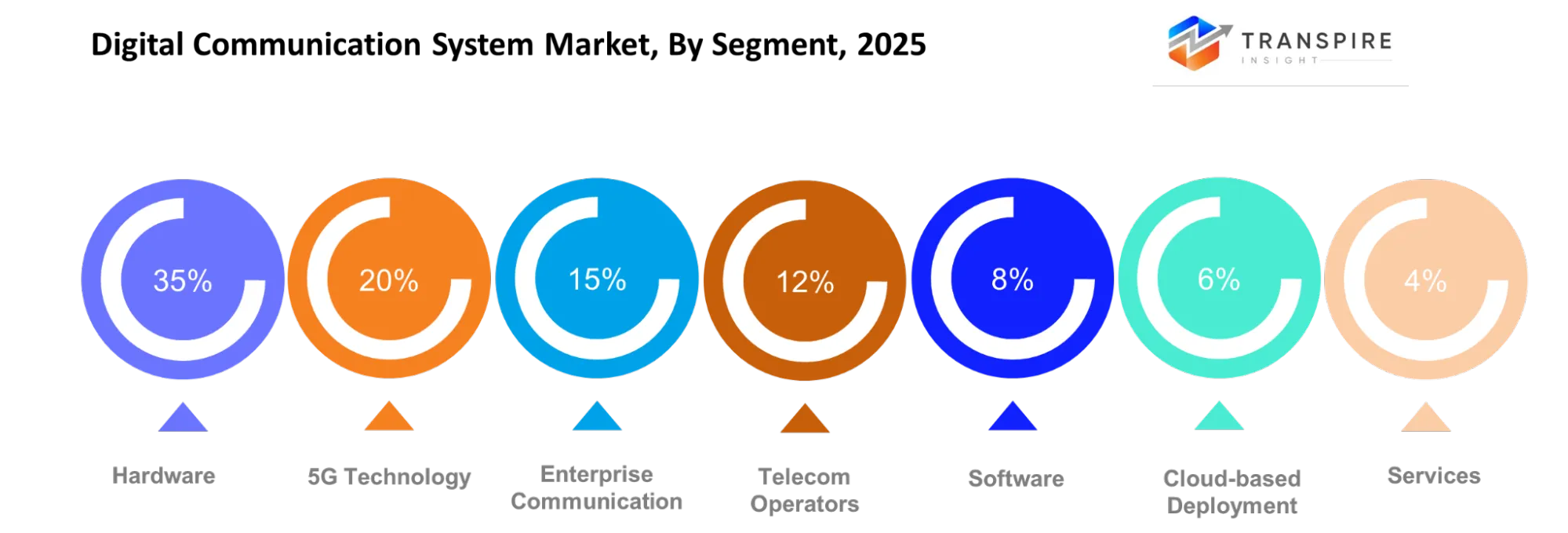
The Digital Communication System Market share is divided into five categories: Product Type, Application, End User, Packaging Type, and Distribution Channel.
The Networking Equipment segment dominated the market, accounting for approximately 38% in 2025, and is expected to grow at a significant CAGR during the forecast period.
The Digital Communication System Market is segmented by component type into Networking Equipment, Communication Hardware, Transmission Equipment, Wireless Communication Systems, Optical Communication Systems, Communication Software, Network Security Solutions, and Others. Among these, the Networking Equipment segment dominated the market, accounting for approximately 38% in 2025 and is expected to expand at a significant CAGR during the forecast period. The segment's leadership is attributed to the increasing deployment of routers, switches, gateways, access points, and network controllers across 5G infrastructure, enterprise networking, cloud data centers, and broadband communication networks. Rising demand for high-speed connectivity, network scalability, and AI-driven network management continues to strengthen the segment's growth.
The Telecommunications segment held the largest share of approximately 42% in 2025 and is expected to grow at a substantial CAGR over the forecast period.
The Digital Communication System Market is segmented by application into Telecommunications, Enterprise Networking, Government & Defense, Healthcare, Industrial Automation, Media & Entertainment, Transportation & Logistics, and Others. Among these, the Telecommunications segment accounted for approximately 42% of the market in 2025 and is projected to witness substantial CAGR growth during the forecast period. The increasing deployment of 5G networks, fiber-optic broadband, cloud communications, satellite connectivity, and next-generation mobile infrastructure continues to generate significant demand for advanced digital communication systems. Continuous investments in network modernization, expanding internet penetration, and increasing data traffic are further accelerating segment growth.
The Telecommunication Service Providers segment held the largest share of approximately 40% in 2025 and is expected to grow at a high CAGR over the forecast period.
The Digital Communication System Market is segmented by end user into Telecommunication Service Providers, Enterprises, Government & Defense Organizations, Healthcare Providers, Manufacturing Companies, Transportation & Logistics Companies, Educational Institutions, and Others. Among these, the Telecommunication Service Providers segment held approximately 40% market share in 2025 and is expected to register a considerable CAGR throughout the forecast period. The segment's dominance is supported by increasing investments in nationwide broadband expansion, 5G deployment, fiber-optic infrastructure, cloud communication services, network virtualization, and AI-enabled communication platforms to meet the growing demand for reliable, secure, and high-speed digital connectivity.
Regional Segment Analysis of the Digital Communication System Market
- North America (U.S., Canada, Mexico)
- Europe (Germany, France, U.K., Italy, Spain, Rest of Europe)
- Asia-Pacific (China, Japan, India, South Korea, Australia, Rest of APAC)
- South America (Brazil, Argentina, Rest of South America)
- Middle East & Africa (UAE, Saudi Arabia, South Africa, Rest of MEA)
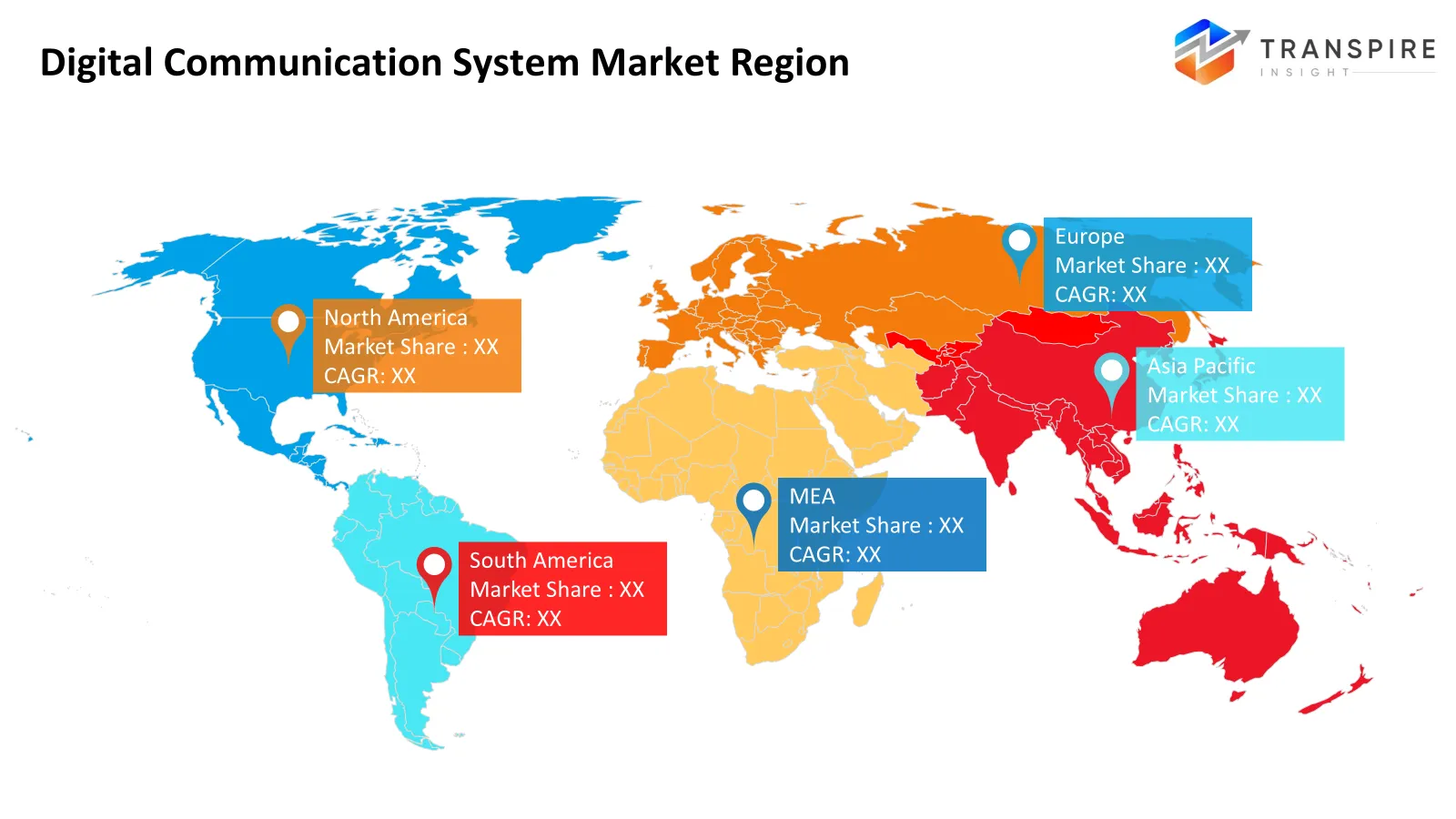
Asia Pacific is expected to grow at a rapid CAGR in the Digital Communication System Market by holding approximately 43% of the market share during the forecast period.
Asia Pacific dominates the Digital Communication System Market due to rapid expansion of telecommunications infrastructure, widespread 5G deployment, increasing smartphone adoption, strong electronics manufacturing capabilities, and government-backed digital transformation initiatives. China, Japan, South Korea, and India continue investing heavily in fiber-optic broadband, cloud infrastructure, AI-powered networking, satellite communication technologies, and smart city development. Growing internet penetration and increasing demand for high-speed digital connectivity continue to strengthen the region's leadership in the market.
North America is the fastest-growing region in the Digital Communication System Market, holding approximately 28% market share.
North America is witnessing robust market growth due to substantial investments in 5G infrastructure, cloud computing, artificial intelligence, edge computing, cybersecurity, and satellite communication systems. The presence of leading telecommunications companies, technology providers, and cloud service providers, combined with strong government initiatives supporting broadband expansion and digital infrastructure modernization, continues to drive regional market growth. Increasing enterprise digital transformation and growing adoption of unified communication platforms further accelerate demand.
Europe is anticipated to hold approximately 21% share of the Digital Communication System Market over the forecast period.
Europe maintains a strong position in the Digital Communication System Market due to its advanced telecommunications infrastructure, increasing adoption of Open RAN technologies, strong cybersecurity regulations, and continuous investments in fiber-optic networks and smart connectivity solutions. Germany, France, the United Kingdom, Italy, and Spain continue expanding digital infrastructure while supporting sustainable and secure communication technologies. Growing investments in Industry 4.0, smart transportation, and digital public services further contribute to regional market expansion.
Strategies for Market Growth in Non-Leading Regions
Emerging economies can accelerate market growth by expanding broadband infrastructure, increasing investments in fiber-optic networks, promoting domestic telecommunications equipment manufacturing, and strengthening digital connectivity through public-private partnerships. Governments should encourage spectrum allocation reforms, 5G rollout, cloud infrastructure development, and cybersecurity investments while supporting local innovation ecosystems. Strategic collaborations between telecommunication operators, technology providers, cloud service companies, and network equipment manufacturers can accelerate technology transfer and improve digital accessibility. Investments in workforce development, AI-enabled network management, and rural broadband expansion will further strengthen long-term market competitiveness.
Future Market Trends for the Digital Communication System Market
1. Expansion of 5G and Next-Generation Wireless Networks
Telecommunication companies are accelerating investments in standalone 5G networks, Open RAN architecture, private wireless networks, and next-generation mobile communication technologies to deliver faster connectivity, lower latency, and enhanced network performance.
2. AI-Powered Network Automation and Cloud-Native Communications
Growing adoption of artificial intelligence, machine learning, software-defined networking (SDN), network function virtualization (NFV), and cloud-native communication platforms is enabling intelligent network optimization, predictive maintenance, automated traffic management, and improved operational efficiency.
3. Satellite Broadband and Secure Digital Connectivity
Increasing deployment of Low Earth Orbit (LEO) satellite constellations, advanced optical communication technologies, quantum-safe encryption, and cybersecurity solutions is transforming digital communication infrastructure by expanding connectivity to remote regions while enhancing network resilience and data security.
Recent Developments
- In March 2026 – Cisco Systems, Inc.: Expanded its AI-powered networking portfolio by introducing advanced cloud-managed networking solutions and intelligent communication platforms designed to enhance enterprise connectivity, network automation, cybersecurity, and 5G infrastructure deployment.
- In October 2025 – Nokia Corporation: Announced the expansion of its next-generation optical networking and 5G communication solutions through strategic investments in fiber-optic technologies, cloud-native core networks, and Open RAN infrastructure to strengthen digital communication capabilities and support growing broadband demand.
Market Segment
This study forecasts revenue at global, regional, and country levels from 2020 to 2033. Transpire Insights has segmented the Digital Communication System Market based on the below-mentioned segments:
Digital Communication System Market, Component
- Hardware
- Software
- Services
- Network Equipment
- Communication Modules
- Security Solutions
- Cloud Platforms
- Others
Digital Communication System Market, By Technology
- 5G
- LTE
- Wi-Fi
- Satellite Communication
- Optical Communication
- Microwave Communication
- IoT Communication
- Others
Digital Communication System Market, By Application
- Enterprise Communication
- Defence & Military
- Public Safety
- Industrial Communication
- Healthcare
- Transportation
- Smart Cities
- Others
Digital Communication System Market, By Deployment
- On-premise
- Cloud-based
- Hybrid
- Private Networks
- Public Networks
- Edge Deployment
- Virtualized Networks
- Others
Digital Communication System Market, By End User
- Telecom Operators
- Government
- Enterprises
- Manufacturing
- Healthcare
- Energy & Utilities
- BFSI
- Others
Digital Communication System Market, By Regional Analysis
North America
- United States
- Canada
- Mexico
Europe
- Germany
- United Kingdom
- France
- Spain
- Italy
- Rest of Europe
Asia Pacific
- Japan
- China
- Australia & New Zealand
- South Korea
- India
- Rest of Asia Pacific
South America
- Brazil
- Argentina
- Rest of South America
Middle East & Africa
- Saudi Arabia
- United Arab Emirates
- South Africa
- Rest of the Middle East & Africa
Frequently Asked Questions
Find quick answers to common questions.
Rising deployment of 5G networks, increasing internet penetration, growing adoption of cloud computing, AI-powered networking, IoT devices, edge computing, fiber-optic communication, and rapid digital transformation across industries are driving the growth of the Digital Communication System Market.
Asia Pacific dominates the market due to rapid expansion of telecommunications infrastructure, widespread 5G deployment, increasing smartphone penetration, strong investments in fiber-optic networks, and government initiatives supporting digital connectivity and smart city development.
Digital Communication Systems enable high-speed, secure, and reliable transmission of voice, video, and data while supporting real-time connectivity, cloud communications, remote collaboration, IoT integration, network automation, and mission-critical communication across telecommunications, healthcare, manufacturing, transportation, defense, and enterprise sectors.
The Telecommunications segment leads the market, driven by increasing investments in 5G infrastructure, broadband expansion, fiber-optic networks, mobile communication services, and growing demand for high-speed digital connectivity worldwide.
Major companies include Cisco Systems, Inc., Nokia Corporation, Ericsson, Huawei Technologies Co., Ltd., Juniper Networks, Ciena Corporation, ZTE Corporation, NEC Corporation, CommScope Holding Company, Inc., and Fujitsu Limited.
- Cisco Systems
- Huawei
- Nokia
- Ericsson
- ZTE
- Motorola Solutions
- NEC Corporation
- Fujitsu
- Juniper Networks
- Qualcomm
- Samsung Electronics
- CommScope
- Ribbon Communications
- Ciena
- IBM
About the Authors

Mayur Shinde
I am Mayur Shinde, a Senior Research Analyst at Transpire Insight, specializing in the Automotive & Transportation and Information & Communication Technology (ICT) Industry. My work focuses on analyzing emerging market trends, technological advancements, competitive landscapes, and industry developments to deliver accurate, data-driven insights. I am passionate about transforming complex market information into clear, actionable content that helps businesses, professionals, and decision-makers stay informed and make confident strategic decisions.

Chakradhar Khansole
Chakradhar serves as the Research Director at Transpire Insight, bringing over 8 years of experience in technology, innovation, and strategic market intelligence. He specializes in transforming complex market data into actionable business insights that enable organizations to make informed, growth-oriented decisions. Recognized for his strategic vision and analytical expertise, Chakradhar leads high-impact research initiatives, delivering comprehensive market assessments, competitive intelligence, and forward-looking industry analysis.
Recently Published Reports
-
Apr 2026
3D Optical Profiler Market
3D Optical Profiler Market Size, Share & Analysis Report By Type (Desktop 3D Optical Profiler, and Portable 3D Optical Profiler), By Technology (Confocal Technology, and White Light Interference), By End-Use Industry (Manufacturing, Research Institutions, Automotive, Aerospace and Defense, Medical Devices, and Other), and Geography (North America, Europe, Asia-Pacific, Middle East and Africa, South and Central America), 2021 - 2031
-
Apr 2026
Depth Sensor Market
Depth Sensor Market Size, Share & Analysis Report By Type (Infrared Depth Sensors, Time-of-Flight (ToF) Sensors, Stereo Vision Sensors, Structured Light Sensors, Ultrasonic Depth Sensors), By Application (Automotive, Robotics, Gaming, Consumer Electronics, Industrial Automation, Healthcare, Security & Surveillance, Others), By End Users (Automotive Manufacturers, Consumer Electronics Companies, Healthcare Providers, Industrial Companies, Security Agencies, Gaming Companies, Robotics Companies, Others), and Geography (North America, Europe, Asia-Pacific, Middle East and Africa, South and Central America), 2021 – 2031
-
Apr 2026
Digital Manufacturing Market
Digital Manufacturing Market Size, Share & Analysis Report By Component (Hardware, Software, and Services), By Technology (Robotics, 3D Printing, Internet of Things (IoT), and Others), By Application (Automotive and Transportation, Aerospace and Defense, Consumer Electronics, Industrial Machinery, and Others), By Process Type (Computer-Based Designing, Computer-Based Simulation, Computer 3D Visualization, Analytics, and Others), and Geography (North America, Europe, Asia-Pacific, Middle East and Africa, South and Central America), 2021 – 2031
-
Apr 2026
Digital Visa Services Market
Digital Visa Services Market Size, Share & Analysis Report By Type (Individual Travelers, Group Travelers), By Application (Tourism, Business Travel, Others), and Geography (North America, Europe, Asia-Pacific, Middle East and Africa, South and Central America), 2021 – 2031