
Data Center Immersion Cooling Market Summary:
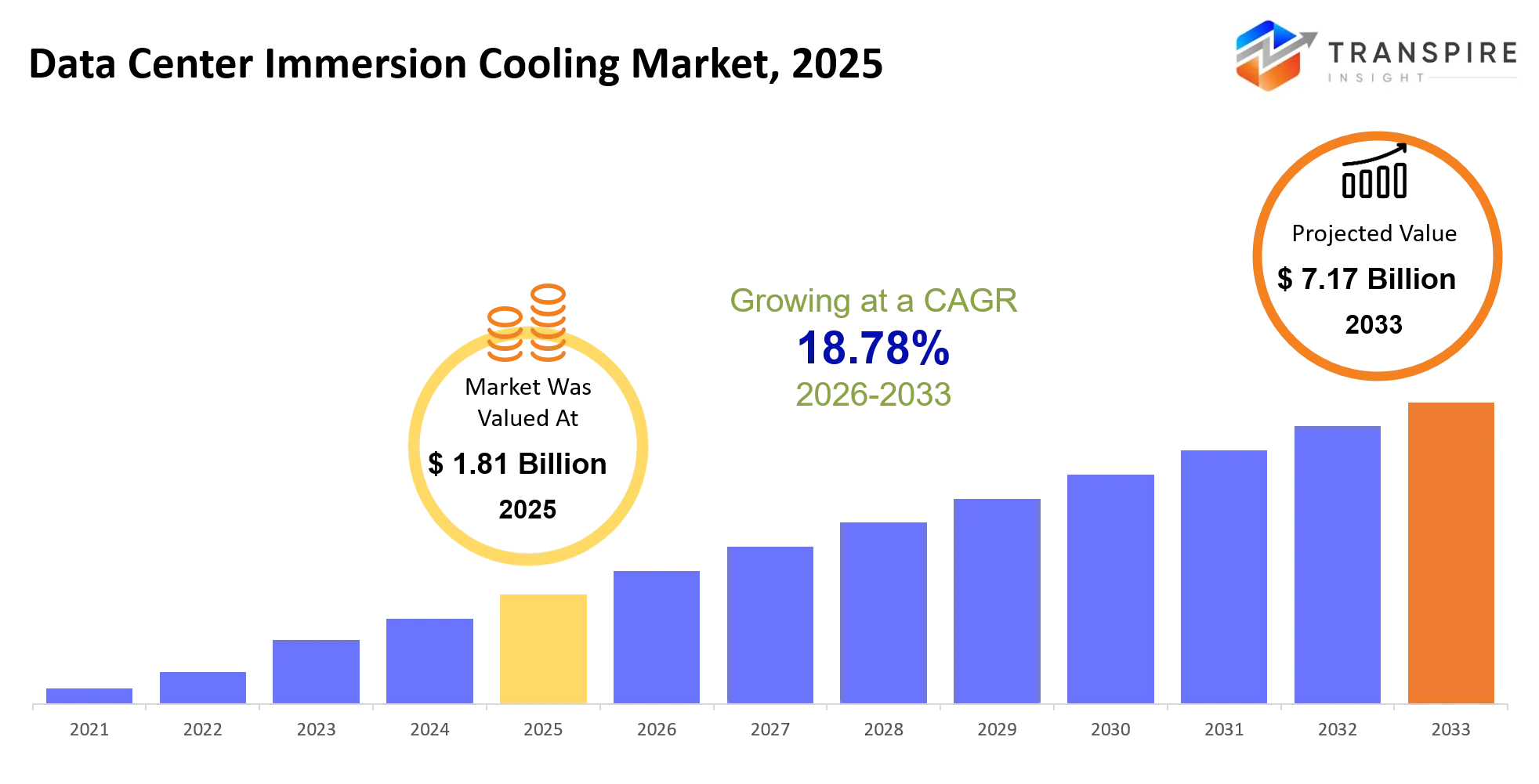
As per Transpire Insight Analysis, the Data Centre Immersion Cooling Market size is estimated at USD 1.81 billion in 2025 and is anticipated to reach USD 7.17 billion by 2033, growing at a CAGR of 18.78% from 2026 to 2033.
The data center immersion cooling market is changing as people who run big computer systems are looking for better ways to deal with the heat those systems make. The technology puts servers into liquids that don’t conduct electricity. This supports take the heat from the computers more easily than old air cooling systems in the right situations. In the past three to five years, the growth of cloud computing, artificial intelligence (AI) and powerful computers has made it more important to have cooling systems that can handle more servers in the same space. A big change is happening. People are starting to use cooling instead of old air cooling for tough tasks. New money is being put into this area. Equipment that passes tests and working together between cooling experts, the people who make the liquids and tech companies are helping with problems about whether things work together and how to put them in place. As AI systems get bigger, immersion cooling is getting attention because it can help with keeping things cool, using less energy for cooling and making data centres work better.
Data Center Immersion Cooling Market Size & Forecast:
- Market Size 2025: USD 1.81 Billion
- Expected Market Value (2033): USD 7.17 Billion
- Forecast CAGR (2026–2033): 18.78%
- Leading Region in 2025: North America
- Fastest Growing Region: Asia-Pacific
- Key Company Profiles: Fujitsu Limited; Bitfury Group; Vertiv Holdings; Submer Technologies; Green Revolution Cooling; LiquidStack; Asperitas; Midas Green Technologies; LiquidCool Solutions; Iceotope Technologies; DCX; Schneider Electric; Intel Corporation; CoolIT Systems; DUG Technology
Key Market Insights:
The market is moving towards solutions that will be able to handle high-density computing along with enhanced thermal management. At present, single-phase solutions have the maximum market share, whereas two-phase cooling and AI infrastructure are generating new opportunities for technology vendors.
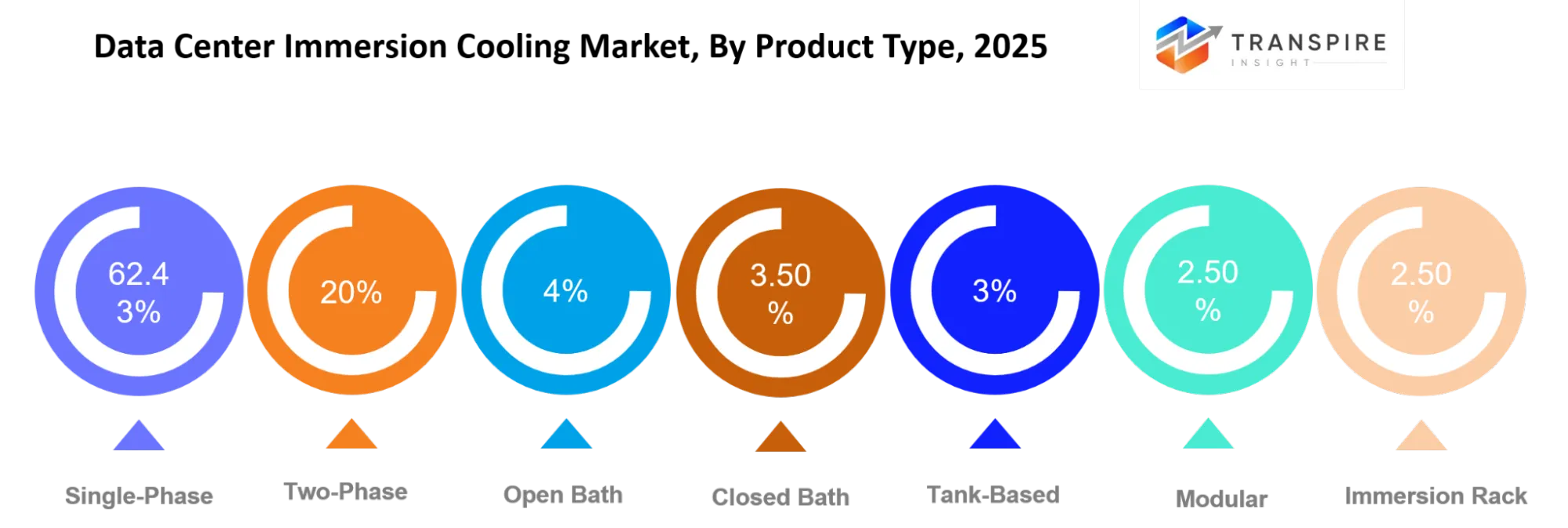
- Single-phase immersion cooling holds 62.43% market share due to the proven performance in immersion-based thermal management.
- Two-Phase Immersion Cooling will witness growth at a rate of 19.42% CAGR and is witnessing interest in technologies of heat transfer.
- Open bath systems constitute 4.00% of the market and are an alternate system design option for facilities seeking immersion-based server cooling.
- Closed Bath Systems are expected to occupy 3.50% of the market and are another type of system design for cooling environment management.
- Tank systems make up 3.00%, while system configurations are being developed by manufacturers for equipment suited for different data centres.
- Modular immersion cooling systems are 2.50% in terms of market share, which provides opportunities for infrastructure setup.
- Immersion racks account for 2.00% of the market and provide an option for an alternate system design for high-density computer equipment.
What are the Key Drivers, Restraints, and Opportunities in the data centre immersion cooling market?
Drivers
Increased usage of artificial intelligence training, cloud computing, and high-performance computing increases the level of heat that is created within data center servers. It becomes harder for traditional air cooling methods to handle high-powered systems due to the heat. Immersion cooling tackles this issue by using dielectric fluids to move the heat around. It becomes easier for system operators to deal with the thermal load while saving up on cooling power.
Restraints
High initial capital costs continue to be a significant obstacle. The operators might have to invest in special tanks, suitable servers, a fluid management system, a heat exchanger, and a maintenance process. Conversion costs could be an issue for existing facilities where air cooling is used. This could lead to delays in purchasing the cooling technology, especially for small companies with limited budget constraints.
Opportunities
The development of AI-enabled data centres provides opportunities for designing immersion cooling technology into facilities from scratch. The providers could grow by using modular systems, improved dielectric fluids, and cooperating with server manufacturers and infrastructure builders. Asia-Pacific provides further growth opportunities with growing investments in digital infrastructure and supercomputers. The companies with proven experience in operation, life cycle costs, and maintenance would be well-placed to implement their pilot projects into commercial use.
What Has the Impact of artificial intelligence on the Data Centre Immersion Cooling Market?
The use of artificial intelligence on the international immersion cooling of data centres industry lies in the rise in thermal management needs of the current generation of computer infrastructures. The usage of strong processors and accelerators that require a lot of heat to function efficiently creates a need for proper thermal management of AI training and inference loads. Immersion cooling makes it possible for compatible computers to cool off through the direct transmission of heat into dielectric fluid.AI can also make the process of cooling more efficient as well. AI monitoring software can analyse temperature levels, fluid condition, equipment performance, and workload on the server to identify abnormal patterns. AI-powered predictive maintenance models can assist operators in identifying possible equipment failures and thus prevent them from causing any unplanned downtime. Thus, AI can assist operators in balancing computing load, energy consumption, and thermal stability. AI monitoring requires precise sensor data, integration with the existing data centre management infrastructure, and proper controls. Installation cost, cybersecurity issues, and imprecise predictions are factors that may limit the effectiveness of AI-powered monitoring.
Instance
In February 2026, Infosys increased its cooperation with ExxonMobil for developing immersion cooling systems for AI and high-performance computing facilities. This shows that growing demands in AI processing create a need for more effective cooling methods in data centres.
https://www.infosys.com/newsroom/press-releases/2026/collaborates-advance-immersion-cooling.html
Key Market Trends:
Market trends are moving away from specialised systems towards integrated cooling solutions that are based on today’s server architecture. Product development is being driven by compatibility, flexibility of deployment, energy management, and the demands of running AI-ready data centres.
- Shift toward liquid cooling. Operators are exploring cooling options other than air cooling as power density of servers goes up, specifically data centres that serve AI and HPC purposes.
- Certification programs and joint tests contribute to defining clearer expectations on server, fluid, and cooling system compatibility.
- Vendors are designing two-phase liquids and equipment capable of transferring heat by evaporating and condensing it, though not all are commercially viable depending on the application area.
- Cooperation between vendors of cooling equipment, fluid producers, engineering and technology firms allows
- Immersion cooling systems in compact sizes offer more opportunities for communication rooms and smaller-scale computing centres.
Data Center Immersion Cooling MarketSegmentation
By System type
Single-phase immersion cooling systems hold the leading share of 62.43% of the market according to the available data. The two-phase cooling system is the fastest-growing category and is projected to achieve a CAGR of 19.42%. The other system types according to the available distribution are two phase system that have share of 20.00%, open bath with share of 4.00%, closed bath accounts of 3.50%, tank system with 3.00% of the share, modular system holds of 2.50%, immersion rack having share of 2.00%, and customized system with 2.57% of the total market.
By cooling fluid
the market includes mineral oil, synthetic hydrocarbon, fluorocarbon, engineered fluid, bio-based fluid, dielectric fluid, ester-based fluid, and other fluids. The choice of fluid depends on thermal capabilities, electrical insulating properties, material compatibility, fluid stability, maintenance needs, and environmental considerations. Users also should consider how a certain fluid works with selected servers and cooling equipment. Further development of product testing and cooperation between fluid suppliers and hardware suppliers could contribute to the reduction of deployment uncertainty. The report does not specify individual market shares of these fluid types.
By application
the market operates in cloud and hyperscale computing, AI and machine learning, high-performance computing, cryptocurrency computing, edge computing, enterprise IT, research computing, and telecommunications. AI and high-performance computing are significant segments of interest as they require intense processing and, therefore, generate a considerable thermal load. Cloud providers require cooling systems capable of supporting large-scale computing infrastructure and varying workloads. Cryptocurrency computing is another area of application, especially for high-density processing. Enterprise, research, and telecom facilities have different needs depending on the computing scale and maintenance resources.
By data center tiers
There is a market for Tier 1, Tier 2, Tier 3, and Tier 4 data centers, along with modular, edge, hyperscale, and colocation data centers. Cooling requirements are dependent upon redundancy, availability, infrastructure, and the criticality of the workload. Those data centers which require high availability should look into whether there is any requirement of compatibility between immersion cooling and power supply, maintenance, and backup. Modular and edge data centers may be attracted to smaller equipment and faster deployment time.
By data center size
The market consists of hyperscale facilities, large enterprises, medium enterprises, small enterprises, micro data centers, edge facilities, colocation facilities, and speciality facilities. Large-scale facilities may have sufficient capabilities and workloads to test immersion cooling, while small facilities may be interested in more compact solutions. Enterprises' purchase decisions are based on financial means, server density, current infrastructure, and future computing capacity. Immersion cooling is suitable for specialised facilities based on their equipment and operational needs. The provided document does not state market shares for each of these categories separately.
By customer
The market involves hyperscalers and cloud companies, enterprises, colocation facilities, telecoms, government bodies, research facilities, banks, and cryptocurrency businesses. The hyperscalers might look at immersion cooling for their dense computing installations, whereas colocation facilities need to take into account that they have to accommodate different customer systems. Telecoms and edge infrastructure suppliers might focus on small-size units and remote control. Government entities, research institutes, and banks could pay special attention to reliability, security, and a controllable environment. Cryptocurrency firms can be interested in using immersion cooling for intense computing tasks.
What are the Key Use Cases Driving the Data Centre Immersion Cooling Market?
The use case for the technology is the cooling of high-density servers through single-phase immersion systems, which constitute the majority of system types in the supplied market data. Such a technology will be applicable in situations where it is necessary to cool high demands on heat from computing workloads while at the same time maintaining equipment stability. Potential new use cases include hyperscale cloud computing infrastructure, AI and Machine learning, high-performance computing, and cryptocurrency mining. In such scenarios, there will be a high demand for cooling on servers, and hence advanced cooling technologies should be considered. Other use cases include enterprise IT, research computing, and telecommunications. Potential emerging use cases are edge facilities, modular data centres, and specialised AI facilities.
|
Report Metrics |
Details |
|
Market size value in 2025 |
USD 1.81 Billion |
|
Market size value in 2026 |
USD 2.15 Billion |
|
Revenue forecast in 2033 |
USD 7.17 Billion |
|
Growth rate |
CAGR of 18.78% from 2026 to 2033 |
|
Base year |
2025 |
|
Historical data |
2021 - 2024 |
|
Forecast period |
2026 - 2033 |
|
Report coverage |
Revenue forecast, competitive landscape, growth factors, and trends |
|
Regional scope |
United States; Canada; Mexico; United Kingdom; Germany; France; Italy; Spain; Denmark; Sweden; Norway; China; Japan; India; Australia; South Korea; Thailand; Brazil; Argentina; South Africa; Saudi Arabia; United Arab Emirates |
|
Key company profiled |
Fujitsu Limited; Bitfury Group; Vertiv Holdings; Submer Technologies; Green Revolution Cooling; LiquidStack; Asperitas; Midas Green Technologies; LiquidCool Solutions; Iceotope Technologies; DCX; Schneider Electric; Intel Corporation; CoolIT Systems; DUG Technology |
|
Customization scope |
Free report customization (country, regional & segment scope). Avail customized purchase options to meet your exact research needs. |
|
Report Segmentation |
System Type (Single-Phase, Two-Phase, Open Bath, Closed Bath, Tank-Based, Modular, Immersion Rack, Custom Systems); Cooling Fluid (Mineral Oil, Synthetic Hydrocarbon, Fluorocarbon, Engineered Fluid, Bio-Based Fluid, Dielectric Fluid, Ester-Based Fluid, Other Fluids); Application (Cloud/Hyperscale, AI/ML, High-Performance Computing, Cryptocurrency, Edge Computing, Enterprise IT, Research Computing, Telecom); Data Center Tier (Tier 1, Tier 2, Tier 3, Tier 4, Modular Data Center, Edge Data Center, Hyperscale, Colocation); Data Center Size (Hyperscale, Large Enterprise, Medium Enterprise, Small Enterprise, Micro Data Center, Edge Site, Colocation, Specialized Facility); Customer Type (Hyperscalers/Cloud Providers, Enterprises, Colocation Providers, Telecom Operators, Government, Research Institutions, Financial Institutions, Cryptocurrency Operators) |
Which Regions are Driving the Data Center Immersion Cooling MarketGrowth?
North America
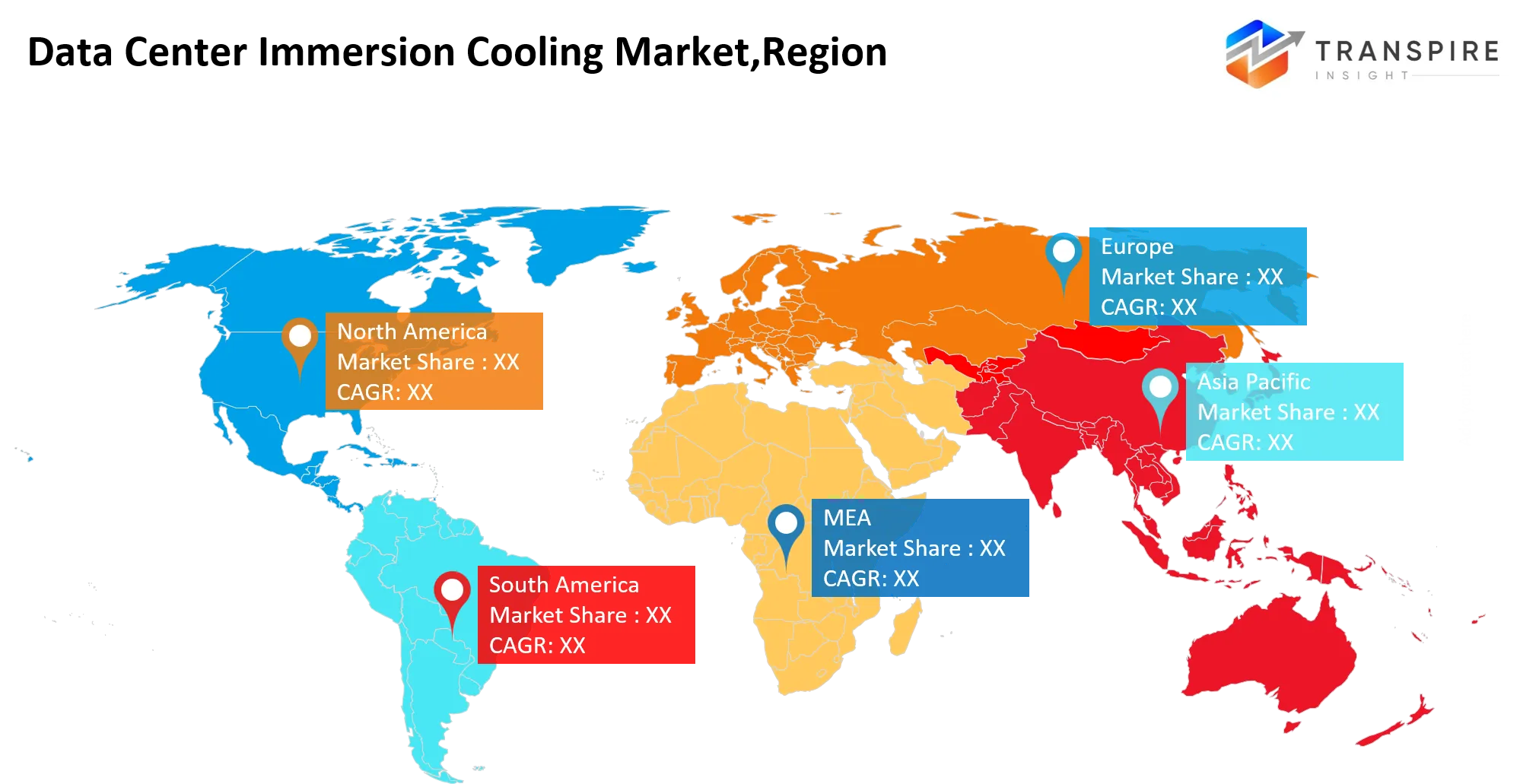
The North American region holds the largest share of 40.32% in the market for immersion cooling technology because of the existing infrastructure of data centres, along with investments in the field of cloud computing and AI. The region enjoys the presence of hyperscalers, technology providers, and manufacturers of cooling systems. There is increasing demand for high-performance computing, which is driving operators towards exploring thermal management solutions. Continuous investments in the development of AI infrastructure and upgrading of data centers are set to promote the adoption of immersion cooling.
In July 2025, Dataprana introduced the 30 MW immersion-cooled data center project in La Marque, Texas. The use of modular immersion-cooled containers will make the facility suitable for high-density computing. Thus, the project illustrates the commercial implementation of immersion cooling in North America and the region's interest in data center infrastructure that is dedicated to specialized and high-performance computing.
Europe
Europe accounts for 24.00% of the market due to the presence of well-built data centres along with great concern about energy efficiency. Unlike North America, the region's growth is being impacted by the drive to increase efficiency and reduce the environmental footprint left by data center processes. The existence of digital infrastructure and demand for cloud services is contributing to a solid base for the development of cooling technologies. The collaboration between technology vendors and data centres is allowing immersion cooling technology to become a viable choice at some facilities.
In January 2025, Stellium Data Centres, SUBMER, and Circle B collaborated on the proof-of-concept deployment involving immersion cooling technology provided by SUBMER for Stellium's data center in Newcastle, UK. The project was aligned with the principles of the Open Compute Project and illustrated the practical application of immersion cooling in the operational environment of the data center. The collaboration supports Europe's initiatives to optimize the performance of its data centers.
Asia-Pacific
Asia-Pacific constitute a 29.00% market share and is the fastest-growing region with an expected CAGR of 19.94%. Growing applications of cloud services, AI computing technologies, and development of data centres are driving the demand for highly efficient cooling systems. Development of digital infrastructure in different regional markets is paving the way for immersion cooling technology to be offered by vendors. Future growth depends on the development of HPC, equipment compatibility, and installation services.
In February 2026, Valeo and 2CRSi partnered to introduce the outdoor autonomous immersion-cooled edge data center for Indian telecom operators. The collaboration unites Valeo's expertise in thermal management with 2CRSi's high-performance servers, thus addressing the need for the expansion of AI and 5G infrastructure in India.
Who are the Key Players in the Data Centre Immersion Cooling Marketand how do they compete?
Competition in the international immersion cooling market for data centres includes specialists in cooling systems, producers of dielectric fluids, providers of servers, and firms engaged in the development of integrated data center infrastructure. Companies distinguish themselves through system design, compatibility with fluids, technical support, scalability, and cooperation helping customers to switch from testing to commercial implementation. Submer deals with liquid cooling and other aspects of data center infrastructure, including design and construction expertise. The company's involvement in additional services helps customers in finding integrated solutions for high-performance computing. Green Revolution Cooling (GRC) is dealing with single-phase immersion cooling and expanding its activities through investments, cooperation, and products for various deployment environments. Cooperation with Samsung C&T and investments by Samsung Ventures help GRC to expand commercially. LiquidStack is competing with scalable liquid cooling equipment and modular data center infrastructure. Development of its products is needed to increase cooling capacity because of increasing computing power demands. Shell deals with cooling fluids and their validation, while cooperation with Intel provides trust to selected immersion cooling solutions.
Data Center Immersion Cooling Market companies
- Fujitsu Limited
- Bitfury Group
- Vertiv Holdings
- Submer Technologies
- Green Revolution Cooling
- LiquidStack
- Asperitas
- Midas Green Technologies
- LiquidCool Solutions
- Iceotope Technologies
- DCX
- Schneider Electric
- Intel Corporation
- CoolIT Systems
- DUG Technology
Recent Development News
In February 2026, Infosys partnered with ExxonMobil to develop and roll out immersion fluids for their data centers for AI and HPC Infrastructure. This partnership involves the use of expertise in cooling fluids together with Infosys Topaz and Cobalt solutions for developing energy-efficient digital infrastructure.
https://www.infosys.com/newsroom/press-releases/2026/collaborates-advance-immersion-cooling.html
In October 2025, the three companies entered into a memorandum of understanding for developing and scaling immersion cooling technology for AI data centers. The activities involved by the three companies include joint marketing, proof of concept and integration of the solution involving the three companies.
https://lgcorp.com/media/release/29509
What Strategic Insights Define the Future of the Data Center Immersion Cooling Market?
The immersion cooling technology for data centres worldwide is shifting toward solutions offering increased thermal capacity coupled with reliability and sustainability. AI infrastructure will continue to be one of the drivers of demand; however, commercialisation will depend on something more than just the ability to cool effectively. One of the hidden risks associated with this technology is integration into air-cooled infrastructures and issues related to the cost and complexity of doing so. Compatibility of fluids, maintenance processes, equipment warranties, and after-sales services could be equally important for successful adoption. One of the possible sources of growth could be newly built AI-centric data centres in Asia-Pacific, which might integrate advanced cooling systems in the process of construction. Modular systems and monitoring capabilities will allow vendors to address the requirements of edge computing and special-purpose data centres.Participants of the market need to pay attention to the proven effectiveness of technologies, comparisons of the total cost of ownership, fluid and hardware compatibility, and partnership with service providers.
System Type
- Single-Phase
- Two-Phase
- Open Bath
- Closed Bath
- Tank-Based
- Modular
- Immersion Rack
- Custom Systems
Cooling Fluid
- Mineral Oil
- Synthetic Hydrocarbon
- Fluorocarbon
- Engineered Fluid
- Bio-Based Fluid
- Dielectric Fluid
- Ester-Based Fluid
- Other Fluids
Application
- Cloud/Hyperscale
- AI/ML
- High-Performance Computing
- Cryptocurrency
- Edge Computing
- Enterprise IT
- Research Computing
- Telecom
Data Center Tier
- Tier 1
- Tier 2
- Tier 3
- Tier 4
- Modular Data Center
- Edge Data Center
- Hyperscale
- Colocation
Data Center Size
- Hyperscale
- Large Enterprise
- Medium Enterprise
- Small Enterprise
- Micro Data Center
- Edge Site
- Colocation
- Specialized Facility
Customer Type
- Hyperscalers/Cloud Providers
- Enterprises
- Colocation Providers
- Telecom Operators
- Government
- Research Institutions
- Financial Institutions
- Cryptocurrency Operators
Frequently Asked Questions
Find quick answers to common questions.
The data center immersion cooling market size was valued at USD 1.81 billion in 2025 and is poised to reach USD 7.17 billion by 2033, expanding at an 18.78% CAGR.
Key segments for the data center immersion cooling market are System Type (Single-Phase, Two-Phase, Open Bath, Closed Bath, Tank-Based, Modular, Immersion Rack, Custom Systems); Cooling Fluid (Mineral Oil, Synthetic Hydrocarbon, Fluorocarbon, Engineered Fluid, Bio-Based Fluid, Dielectric Fluid, Ester-Based Fluid, Other Fluids); Application (Cloud/Hyperscale, AI/ML, High-Performance Computing, Cryptocurrency, Edge Computing, Enterprise IT, Research Computing, Telecom); Data Center Tier (Tier 1, Tier 2, Tier 3, Tier 4, Modular Data Center, Edge Data Center, Hyperscale, Colocation); Data Center Size (Hyperscale, Large Enterprise, Medium Enterprise, Small Enterprise, Micro Data Center, Edge Site, Colocation, Specialized Facility); Customer Type (Hyperscalers/Cloud Providers, Enterprises, Colocation Providers, Telecom Operators, Government, Research Institutions, Financial Institutions, Cryptocurrency Operators)
Growth is primarily driven by increased power consumption in data centers, the requirement of effective thermal management, and the need to lower cooling costs and greenhouse gas emissions.
The market is led by major manufacturers including Fujitsu Limited; Bitfury Group; Vertiv Holdings; Submer Technologies; Green Revolution Cooling; LiquidStack; Asperitas; Midas Green Technologies; LiquidCool Solutions; Iceotope Technologies; DCX; Schneider Electric; Intel Corporation; CoolIT Systems; DUG Technology
North America has a market share of 40.32%, driven by huge investments in data centres, AI and HPC workloads, significant presence of technology giants, and increasing adoption of energy-efficient cooling technologies
Opportunities in the market include the rising requirement for data centers that are ready for AI and the development of HPC infrastructure, as well as increased use of energy-efficient cooling solutions.
- Fujitsu Limited
- Bitfury Group
- Vertiv Holdings
- Submer Technologies
- Green Revolution Cooling
- LiquidStack
- Asperitas
- Midas Green Technologies
- LiquidCool Solutions
- Iceotope Technologies
- DCX
- Schneider Electric
- Intel Corporation
- CoolIT Systems
- DUG Technology
About the Authors

Avinash Kumar
I’m Avinash Kumar, a Senior Research Analyst at Transpire Insight, with expertise in the Electronics and Semiconductor and Energy & Power industry. My work focuses on analyzing emerging technologies, market trends, industry developments, and innovation across these sectors. I specialize in transforming complex technical and market insights into clear, research-backed content that helps professionals, businesses, and decision-makers stay informed. Through continuous industry research and data-driven analysis, I strive to deliver accurate, reliable, and practical perspectives on the latest advancements shaping the semiconductor and energy landscape.

Chakradhar Khansole
Chakradhar serves as the Research Director at Transpire Insight, bringing over 8 years of experience in technology, innovation, and strategic market intelligence. He specializes in transforming complex market data into actionable business insights that enable organizations to make informed, growth-oriented decisions. Recognized for his strategic vision and analytical expertise, Chakradhar leads high-impact research initiatives, delivering comprehensive market assessments, competitive intelligence, and forward-looking industry analysis.
Recently Published Reports
-
Apr 2026
Active Power Filter Market
Active Power Filter Market Size, Share & Analysis Report By Type (Shunt Active Power Filters, Series Active Power Filter, Hybrid Active Power Filter), By Application (Harmonics Mitigation, Reactive Power Compensation, Voltage Regulation, Power Factor Correction), By Phase (Single Phase, Three Phase), By End-User Industry (Manufacturing, Healthcare, Commercial, Automotive, Oil and Gas, Others), and Geography (North America, Europe, Asia-Pacific, Middle East and Africa, South and Central America), 2021 - 2031
-
Apr 2026
Electrical Transformer Market
Electrical Transformer Market Size, Share & Analysis Report By Core (Closed, Shell, and Berry), By Insulation (Gas, Oil, Solid, Air, and Other), By Phase (Single, and Three), By Rating (100 MVA to 500 MVA, 501 MVA to 800 MVA, and 801 MVA to 1200 MVA), and Geography (North America, Europe, Asia-Pacific, Middle East and Africa, South and Central America), 2021 – 2031
-
Apr 2026
Hydraulic Piston Pumps Market
Hydraulic Piston Pumps Market Size, Share & Analysis Report By Type (Axial Piston Pumps, Radial Piston Pumps), By Operating Pressure (Low Pressure, Medium Pressure, High Pressure), By Application (Construction, Mining, Agriculture, Automotive, Oil & Gas, Industrial Machinery, Others), By End-User (OEMs, Aftermarket), and Geography (North America, Europe, Asia-Pacific, Middle East and Africa, South and Central America), 2021 – 2031
-
Apr 2026
Laboratory Gas Generators Market
Laboratory Gas Generators Market Size, Share & Analysis Report By Product (Nitrogen Gas Generator, Hydrogen Gas Generator, Zero Air Gas Generator, Purge Gas Generator, TOC Gas Generators, Others), By Application (Gas Chromatography, Liquid Chromatography-mass Spectrometry (LC-MS), Gas Analyzers, Others), By End-user (Life Science, Chemical & Petrochemical, Food & Beverage, Others), and Geography (North America, Europe, Asia-Pacific, Middle East and Africa, South and Central America), 2021 – 2031