

Cutting Board Market Summery:
According to Transpire Insights, a detailed research report on the market reflects that the residential food preparation application segment dominates the Cutting Board Market, accounting for approximately 59% of the total share worldwide. John Boos & Co. leads the market with approximately (around USD 0.16 billion) in annual revenue and an estimated 6–9% market influence/share, making it a leading contributor to market development, innovation, manufacturing expansion, and industry growth.
Market Snapshot Cutting Board Market
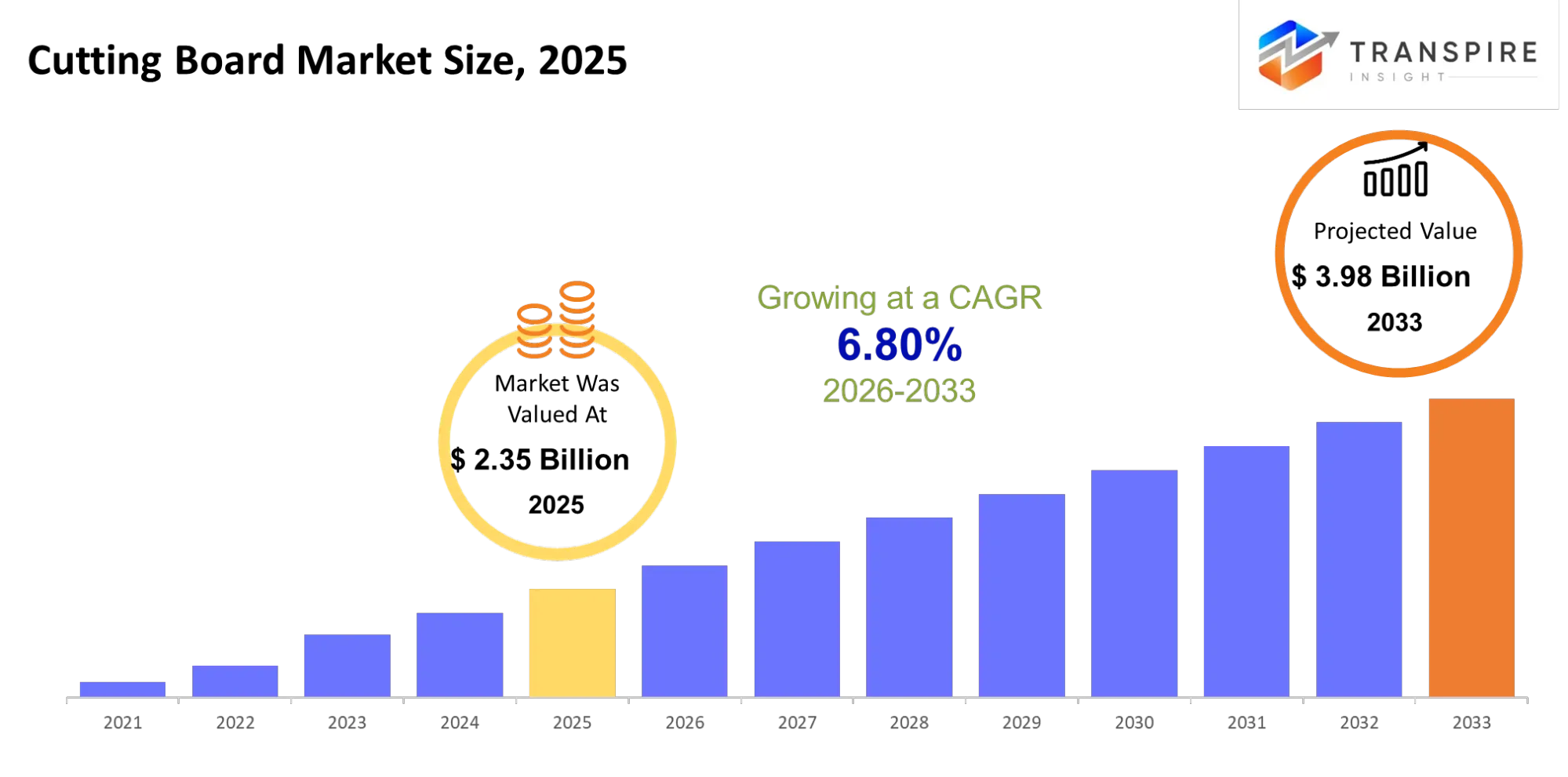
- Market Value (2025): USD 2.35 Billion.
- Expected Market Value (2026): USD2.51 Billion.
- Estimated Market Value (2033): USD 3.98 Billion.
- Forecast CAGR (2026–2033): 6.80%
- Leading Region in 2025: Asia Pacific
- Second-largest Region: Europe
- Fastest Growing Region: North America
Introduction
The Cutting Board Market comprises essential food preparation products designed to provide safe, hygienic, durable, and convenient surfaces for cutting, chopping, slicing, and preparing a wide range of food ingredients. Wooden cutting boards, plastic cutting boards, bamboo cutting boards, glass cutting boards, composite cutting boards, silicone cutting boards, and other specialized cutting board products are examples of Cutting Board offerings that address the growing requirements of households, professional chefs, restaurants, hotels, catering businesses, foodservice operators, and commercial kitchens.
- Advanced cutting board materials, antimicrobial surfaces, food-grade plastics, sustainably sourced wood, engineered bamboo, composite materials, non-slip technologies, ergonomic designs, dishwasher-safe materials, heat-resistant surfaces, and precision manufacturing technologies are examples of industry innovations that improve hygiene, durability, functionality, safety, ease of cleaning, and overall product performance. Cutting Board innovation improves food preparation efficiency, surface stability, knife compatibility, resistance to moisture and staining, product longevity, and user experience through the integration of high-quality materials, antimicrobial technologies, reinforced construction, non-slip bases, ergonomic handles, and sustainable manufacturing processes. Improved food safety, enhanced durability, reduced cross-contamination risks, greater ease of maintenance, improved kitchen efficiency, and sustainable product development across diverse applications are all made possible by technological and material innovation. Food safety standards, hygiene regulations, food-contact material requirements, consumer product safety standards, sustainability criteria, manufacturing quality standards, and industry-specific compliance requirements are all adhered to.
- The demand for advanced Cutting Board solutions is being driven by a number of factors, including increasing household food preparation activities, growing demand for hygienic kitchen products, rising awareness of food safety and cross-contamination prevention, increasing adoption of premium kitchenware, expanding foodservice and hospitality industries, growing demand for durable and sustainable kitchen products, rising consumer preference for eco-friendly materials, increasing popularity of home cooking, growing demand for professional-grade kitchen accessories, expanding online retail and e-commerce distribution, increasing adoption of multifunctional kitchen products, and ongoing developments in antimicrobial cutting surfaces, sustainable wood and bamboo materials, high-performance composite boards, non-slip technologies, ergonomic designs, dishwasher-safe materials, stain-resistant surfaces, and next-generation food preparation products.
Market Highlights:
- Asia Pacific is expected to grow at a rapid CAGR in the Cutting Board Market, holding nearly 42% of the market share during the forecast period, supported by increasing urbanization, rising household food preparation activities, expanding foodservice and hospitality industries, growing consumer awareness of kitchen hygiene, and increasing demand for durable and sustainable kitchenware products.
- North America is anticipated to be one of the fastest-growing regions in the Cutting Board Market during the forecast period, holding around 31% share, driven by increasing home cooking activities, rising demand for premium kitchen accessories, growing awareness of food safety and cross-contamination prevention, expanding restaurant and foodservice industries, and increasing adoption of innovative and multifunctional cutting board products.
- Europe is anticipated to hold approximately 24% share of the Cutting Board Market over the predicted timeframe, supported by stringent food safety and hygiene standards, increasing consumer preference for sustainable kitchen products, growing adoption of eco-friendly materials, rising demand for premium kitchenware, and expanding professional foodservice and hospitality sectors.
- By Material, the Wood segment dominated the market and holds nearly 47.3% share in 2025 and is projected to grow at a substantial CAGR during the forecast period, owing to its durability, natural appearance, knife-friendly surface, versatility, and strong consumer preference for traditional and premium wooden cutting boards across household and professional kitchen applications.
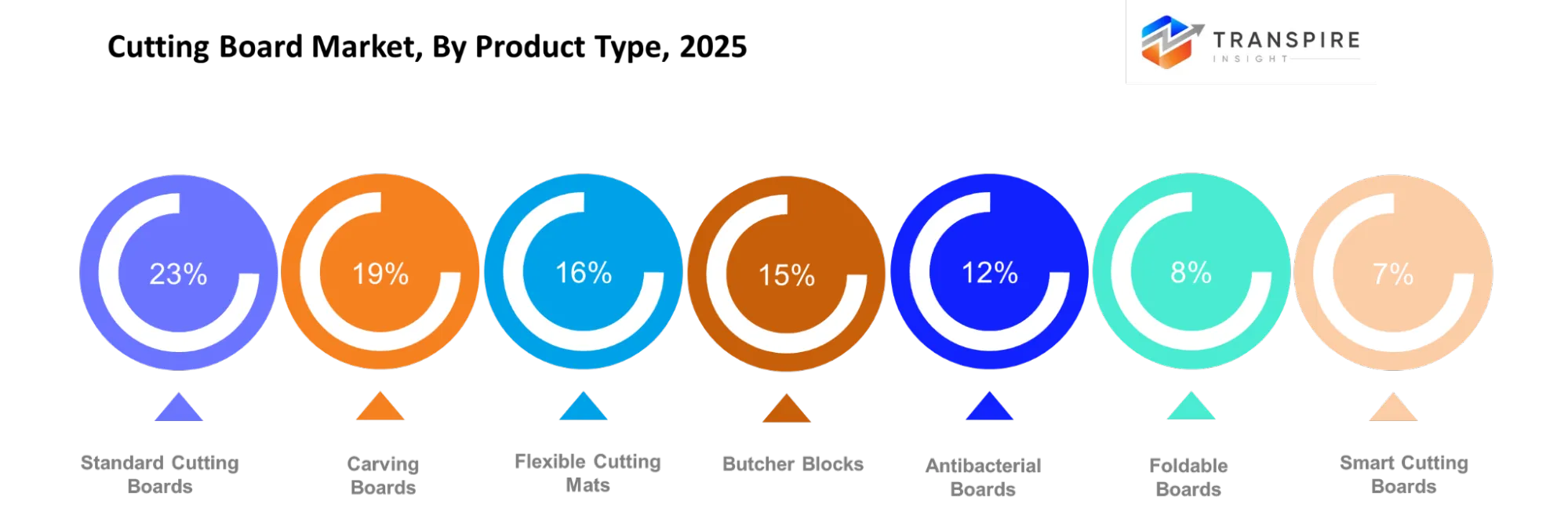
- By Product Type, the Standard Cutting Boards segment dominated the market and holds almost 48.6% share in 2025 and is projected to grow at a substantial CAGR during the forecast period, supported by their broad application in everyday food preparation, affordability, availability across multiple sizes and materials, ease of use, and widespread adoption among households and commercial kitchens.
- By End User, the Households segment dominated the market and holds approximately 36.8% share in 2025 and is projected to grow at a substantial CAGR during the forecast period, driven by rising home cooking activities, increasing consumer awareness of kitchen hygiene, growing demand for convenient food preparation products, and expanding consumer preference for durable, multifunctional, and aesthetically appealing kitchenware.
- By Distribution Channel, the Supermarkets & Hypermarkets segment dominated the market and holds roughly 41.4% share in 2025 and is projected to grow at a substantial CAGR during the forecast period, supported by widespread product availability, competitive pricing, increasing consumer footfall, greater product variety, promotional activities, and growing demand for convenient access to kitchen and household products.
- By Application, the Food Preparation segment dominated the market and holds around 44.1% share in 2025 and is projected to grow at a substantial CAGR during the forecast period, driven by increasing household cooking activities, growing demand for hygienic food preparation surfaces, rising adoption of multifunctional cutting boards, and expanding usage across residential, commercial, and professional kitchens.
- Growing Adoption of Hygienic, Sustainable, Durable, and Multifunctional Cutting Board Products: Households, restaurants, hotels, catering services, food processing companies, culinary schools, commercial kitchens, professional chefs, outdoor cooking users, and other industry stakeholders across Asia Pacific, North America, and Europe are increasing investments in wooden cutting boards, bamboo cutting boards, plastic cutting boards, composite boards, antibacterial boards, flexible cutting mats, butcher blocks, foldable boards, smart cutting boards, and other advanced food preparation surfaces to improve kitchen hygiene, food preparation efficiency, durability, safety, and convenience.
How is the Cutting Board Market Growing Due to Technology?
The Cutting Board Market is growing as a result of ongoing developments in cutting board materials, antimicrobial technologies, sustainable manufacturing, non-slip surfaces, ergonomic designs, smart kitchen technologies, food-grade materials, and advanced composite manufacturing processes. Improved hygiene, enhanced durability, greater food preparation efficiency, reduced cross-contamination risks, easy maintenance, and improved user convenience are provided by contemporary solutions such as wooden cutting boards, bamboo cutting boards, plastic cutting boards, composite cutting boards, antibacterial boards, flexible cutting mats, butcher blocks, foldable cutting boards, smart cutting boards, and other advanced food preparation surfaces. Innovations in antimicrobial surface treatments, moisture-resistant materials, sustainable wood and bamboo, high-performance composites, non-slip technologies, ergonomic handles, dishwasher-safe construction, stain-resistant surfaces, temperature-resistant materials, integrated weighing systems, digital connectivity, and smart kitchen features allow households, restaurants, hotels, catering services, food processing facilities, culinary schools, commercial kitchens, professional chefs, and other food preparation users to develop cutting board solutions that are more hygienic, durable, reliable, convenient, sustainable, and performance-focused while meeting stringent food safety standards, food-contact material regulations, hygiene requirements, consumer product safety standards, sustainability criteria, manufacturing quality standards, and industry-specific compliance requirements. In addition to improving food safety, cutting efficiency, product durability, kitchen organization, ease of cleaning, sustainability, and operational efficiency across the Cutting Board Market, these technological advancements are promoting broader adoption among households, foodservice establishments, hospitality businesses, food processing companies, culinary institutions, professional kitchens, retailers, kitchenware manufacturers, and other emerging food preparation applications.
|
Report Metrics |
Details |
|
Market size value in 2025 |
USD 2.35 Billion |
|
Market size value in 2026 |
USD 2.51 Billion |
|
Revenue forecast in 2033 |
USD 3.98 Billion |
|
Growth rate |
CAGR of 6.80% from 2026 to 2033 |
|
Base year |
2025 |
|
Historical data |
2021 - 2024 |
|
Forecast period |
2026 - 2033 |
|
Report coverage |
Revenue forecast, competitive landscape, growth factors, and trends |
|
Regional scope |
United States; Canada; Mexico; United Kingdom; Germany; France; Italy; Spain; Denmark; Sweden; Norway; China; Japan; India; Australia; South Korea; Thailand; Brazil; Argentina; South Africa; Saudi Arabia; United Arab Emirates |
|
Key company profiled |
John Boos & Co., OXO, Joseph Joseph, Epicurean, IKEA, Cuisinart, Farberware, Winco, San Jamar, Dexas, Totally Bamboo, TeakHaus, Royal Craft Wood, Gorilla Grip, Zulay Kitchen |
|
Customization scope |
Free report customization (country, regional & segment scope). Avail customized purchase options to meet your exact research needs. |
|
Report Segmentation |
By Material (Wood, Bamboo, Plastic, Glass, Composite, Stainless Steel, Silicone, Others); By Product Type (Standard Cutting Boards, Carving Boards, Flexible Cutting Mats, Butcher Blocks, Antibacterial Boards, Foldable Boards, Smart Cutting Boards, Others); By End User (Households, Restaurants, Hotels, Catering Services, Food Processing Industry, Culinary Schools, Others); By Distribution Channel (Supermarkets & Hypermarkets, Specialty Stores, Online Retail, Department Stores, Wholesale Clubs, Direct Sales, Others); By Application (Food Preparation, Meat Processing, Vegetable Cutting, Bakery Use, Commercial Kitchens, Outdoor Cooking, Others) |
Market Drivers
The Cutting Board Market is being driven by the growing adoption of hygienic kitchen products, increasing household food preparation activities, rising awareness of food safety and cross-contamination prevention, expanding foodservice and hospitality industries, demand for sustainable kitchenware, premiumization of culinary products, and increasing preference for durable and multifunctional cutting surfaces, along with the expanding use of cutting board solutions across households, restaurants, hotels, catering services, food processing facilities, culinary schools, commercial kitchens, and outdoor cooking applications. The increasing demand for wooden cutting boards, bamboo cutting boards, plastic cutting boards, glass cutting boards, composite cutting boards, stainless steel cutting boards, silicone cutting boards, and other advanced food preparation surfaces, along with the growing adoption of antibacterial technologies, non-slip bases, ergonomic designs, moisture-resistant materials, stain-resistant surfaces, dishwasher-safe construction, sustainable materials, and multifunctional product configurations, is driving demand for solutions that improve food hygiene, reduce cross-contamination risks, enhance durability, increase preparation efficiency, simplify cleaning, and provide convenient food preparation across diverse applications. These advancements are encouraging kitchenware manufacturers, foodservice businesses, retailers, hospitality providers, food processing companies, culinary institutions, and end users to invest in next-generation cutting board products, sustainable materials, antimicrobial surfaces, innovative designs, and expanded multifunctional capabilities. Companies in the worldwide Cutting Board Market are expanding their material capabilities, improving product durability and hygiene performance, increasing investments in cutting board innovation, strengthening user-focused product development, and creating new growth opportunities.
• For example, leading kitchenware manufacturers and food preparation product companies continue to advance cutting board innovation by developing high-quality wooden boards, sustainable bamboo products, antimicrobial plastic boards, high-performance composite surfaces, flexible cutting mats, butcher blocks, foldable boards, non-slip cutting surfaces, and smart cutting boards that improve food hygiene, enhance preparation efficiency, reduce cross-contamination risks, simplify cleaning, increase product durability, support sustainable consumption, and expand applications across households, restaurants, hotels, catering services, food processing facilities, culinary schools, commercial kitchens, outdoor cooking, and other emerging food preparation applications in the Cutting Board Market.
Restrain
The primary challenges facing the Cutting Board Market are fluctuating raw material costs, concerns regarding hygiene and cross-contamination, product wear and replacement requirements, environmental concerns associated with certain plastic materials, manufacturing complexity for advanced products, limited consumer awareness regarding material-specific maintenance, and competition from alternative food preparation surfaces and multifunctional kitchen products. The use of premium wood, engineered bamboo, high-performance composites, antimicrobial materials, stainless steel, silicone, smart technologies, and specialized manufacturing processes can significantly increase product manufacturing and retail costs.
Analysis of Prices and Consumer Behaviour
The Cutting Board Market is experiencing increasing demand for affordable, hygienic, durable, sustainable, and high-performance food preparation surfaces as households, restaurants, hotels, catering businesses, food processing facilities, culinary schools, professional kitchens, and other end users increasingly prioritize food safety, convenience, durability, ease of cleaning, sustainability, product quality, and long-term value. Pricing is influenced by factors such as material type, product size, thickness, construction quality, manufacturing process, antibacterial features, design, brand positioning, durability, sustainability credentials, smart functionality, distribution channel, geographic location, application requirements, and maintenance needs. Technology providers, businesses, and consumers are increasingly evaluating cutting board products based on overall lifecycle value, material quality, hygiene performance, durability, ease of maintenance, sustainability, functionality, design, and long-term usability rather than initial purchase price alone. Consumer purchasing behaviour is also shifting toward solutions offering antimicrobial protection, sustainable materials, non-slip performance, lightweight construction, easy cleaning, stain resistance, dishwasher compatibility, multifunctional designs, and compatibility with modern kitchen environments, while manufacturers are increasingly adopting advanced composite materials, engineered bamboo, food-grade plastics, antimicrobial technologies, ergonomic designs, non-slip technologies, and smart kitchen features to strengthen customer satisfaction and expand market reach. As households, commercial kitchens, foodservice operators, hospitality businesses, food processing organizations, culinary institutions, and professional chefs increasingly demand affordable, reliable, hygienic, sustainable, and innovative cutting board solutions, companies are focusing on competitive pricing strategies, product diversification, advanced materials, sustainable manufacturing, customized commercial products, improved hygiene performance, enhanced durability, and innovative food preparation applications to address evolving customer requirements and strengthen their position in the Cutting Board Market.
Who are the Key Players in the Cutting Board Market and how do they compete?
In the market for Cutting Board solutions, the competitiveness of companies depends on firms that provide high-quality kitchenware, food preparation products, hygienic cutting surfaces, sustainable materials, and innovative kitchen accessories. They compete, not just on prices, but on material quality, product durability, hygiene performance, surface design, cutting efficiency, antimicrobial properties, sustainability, ease of cleaning, ergonomic functionality, product variety, and integration with modern kitchen requirements. Thus, a strategy of competition leads to continuous product innovation and helps households, restaurants, hotels, catering services, food processing facilities, culinary schools, commercial kitchens, professional chefs, and other end users improve food safety, preparation efficiency, convenience, durability, sustainability, and long-term kitchen management.
Leading kitchenware and food preparation product providers are enhancing their presence in the market through the development and introduction of advanced cutting board and kitchen surface solutions. Companies are able to distinguish themselves from competitors by offering premium wooden cutting boards, bamboo cutting boards, high-quality plastic boards, composite cutting surfaces, antibacterial boards, flexible cutting mats, butcher blocks, foldable boards, stainless steel boards, silicone cutting boards, and smart cutting board technologies. Other market participants are strengthening their position through the implementation of antimicrobial surface technologies, sustainable material sourcing, non-slip designs, ergonomic construction, moisture-resistant materials, stain-resistant surfaces, dishwasher-safe products, multifunctional configurations, and smart kitchen capabilities, enabling households, foodservice businesses, hospitality establishments, food processing organizations, and professional kitchens to improve food hygiene, reduce cross-contamination risks, optimize preparation efficiency, enhance durability, simplify maintenance, and adopt more sustainable food preparation solutions.
Top Companies in the Cutting Board Market
- John Boos & Co.
- OXO
- Joseph Joseph
- Epicurean
- IKEA
- Cuisinart
- Farberware
- Winco
- San Jamar
- Dexas
- Totally Bamboo
- TeakHaus
- Royal Craft Wood
- Gorilla Grip
- Zulay Kitchen
Market Segmentation
The Cutting Board Market share is divided into five categories:Material,Product Type,End User, Distribution,Application.
The Wood dominated the market, accounting for nearly 47.3% in 2025, and is expected to rise at a significant CAGR during the forecast period.
The Cutting Board Market is segmented. By Material Wood, Bamboo, Plastic, Glass, Composite, Stainless Steel, Silicone, Others. Among these,the Wood dominated the market, accounting for nearly 47.3% in 2025 and expected to increase at a significant CAGR during the forecast period.due to its durability, knife-friendly surface, natural appearance, strong hygiene properties, versatility, and widespread consumer preference across households and professional kitchens.
The Standard Cutting Boards segment held the greatest share of approximately 49.1% in 2025 and is expected to increase at a substantial CAGR over the forecast period.
The Cutting Board Market is segmented By Product Type Standard Cutting Boards, Carving Boards, Flexible Cutting Mats, Butcher Blocks, Antibacterial Boards, Foldable Boards, Smart Cutting Boards, Others. Among these, the Standard Cutting Boards segment held the greatest share of approximately 49.1% in 2025 and is expected to increase at a substantial CAGR over the forecast period.due to its durability, knife-friendly surface, natural appearance, strong hygiene properties, versatility, and widespread consumer preference across households and professional kitchens.
The Households segmentheld the greatest share of approximately 45.4%in 2025 and is expected to increase at a high CAGR over the forecast period.
The Cutting Board Marketis segmented.By End User Households, Restaurants, Hotels, Catering Services, Food Processing Industry, Culinary Schools, Others.Among these the Households segment held the greatest share of approximately 44.9% in 2025 and is expected to increase at a considerable CAGR over the projected period. due to increasing home cooking, frequent food preparation, growing hygiene awareness, affordable product availability, and rising demand for convenient, durable, and multifunctional kitchenware.
Regional Segment Analysis of the Cutting Board Market
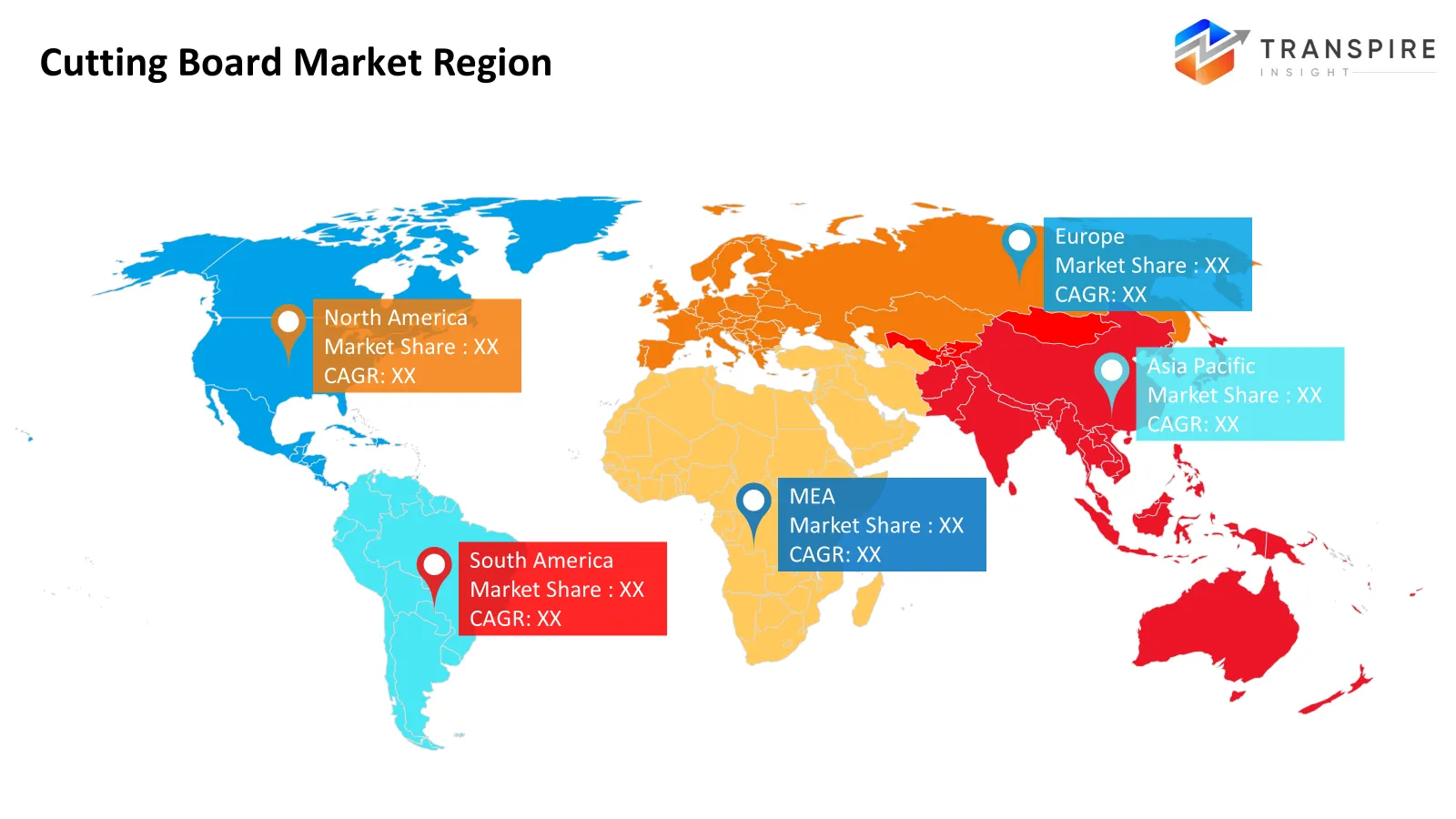
- North America (U.S., Canada, Mexico)
- Europe (Germany, France, U.K., Italy, Spain, Rest of Europe)
- Asia-Pacific (China, Japan, India, Rest of APAC)
- South America (Brazil and the Rest of South America)
- The Middle East and Africa (UAE, South Africa, Rest of MEA)
Asia Pacific is expected to grow at a rapid CAGR in the Cutting Board Market by holding nearly 42% of the share during the forecast period.
Over the forecast period, the Cutting Board Market is anticipated to expand rapidly in Asia Pacific. The region accounts for nearly 42% of the market and is expected to maintain its leading position due to increasing household food preparation activities, expanding foodservice and hospitality industries, rising consumer awareness of kitchen hygiene, growing demand for durable kitchenware, and increasing adoption of sustainable cutting board products across countries such as China, India, Japan, South Korea, Singapore, and Australia. Market demand is driven by increasing urbanization, growing disposable income, changing consumer lifestyles, rising home cooking trends, expanding restaurant and catering infrastructure, and increasing demand for hygienic and sustainable food preparation products. The expansion of residential households, commercial kitchens, restaurants, hotels, catering services, food processing facilities, culinary schools, and outdoor cooking applications, combined with increasing investments in innovative kitchenware, antimicrobial surfaces, sustainable materials, non-slip technologies, and multifunctional cutting board designs, is further strengthening regional market growth. The rising adoption of wooden cutting boards, bamboo cutting boards, plastic cutting boards, composite boards, antibacterial boards, flexible cutting mats, and other advanced food preparation surfaces, expanding organized retail and e-commerce distribution, improved access to premium kitchenware, and growing demand for hygienic and durable food preparation solutions further support the growth of the Cutting Board Market in Asia Pacific.
Europe is anticipated to hold approximately 24% share of the Cutting Board Market over the predicted timeframe.
Over the course of the projected period, Europe is expected to hold approximately 24% market share of the Cutting Board Market. The region's growth is primarily driven by increasing adoption of sustainable kitchenware, growing demand for hygienic food preparation products, rising consumer awareness of food safety, expanding premium kitchenware consumption, sustainability initiatives, and increasing demand for durable and environmentally responsible cutting board solutions across households, restaurants, commercial kitchens, food processing facilities, hospitality establishments, catering services, culinary schools, and institutional applications. Germany, France, the UK, Italy, and Spain are among the countries demonstrating strong demand for wooden cutting boards, bamboo cutting boards, composite boards, antibacterial boards, flexible cutting mats, butcher blocks, and advanced food preparation surfaces. Manufacturers and end users are increasingly focusing on material quality, hygiene performance, product durability, sustainable materials, ease of cleaning, non-slip functionality, ergonomic design, and regulatory compliance. Partnerships involving kitchenware manufacturers, foodservice companies, retailers, hospitality providers, food processing organizations, culinary institutions, government agencies, and e-commerce platforms are accelerating the development, distribution, and adoption of advanced Cutting Board solutions to improve food safety, preparation efficiency, sustainability, convenience, and promote long-term market growth throughout Europe.
North America is anticipated to hold approximately 31% share of the Cutting Board Market over the predicted timeframe.
North America is anticipated to hold around 31% of the worldwide market for Cutting Board solutions throughout the forecast period. A well-established kitchenware industry, advanced retail infrastructure, strong foodservice sector, expanding restaurant and hospitality industry, and growing demand for hygienic, premium, and multifunctional kitchen products are expected to contribute to the region's sustained growth. Growing investments by kitchenware manufacturers, retailers, restaurants, hotels, catering businesses, food processing organizations, culinary institutions, and technology companies, increased demand for wooden cutting boards, bamboo products, composite boards, antibacterial surfaces, butcher blocks, flexible cutting mats, and smart cutting board technologies, and continuous advancements in sustainable materials, antimicrobial technologies, non-slip surfaces, ergonomic designs, and multifunctional kitchen solutions are contributing to market expansion. Additionally, efforts to improve food safety, reduce cross-contamination risks, enhance product durability, expand sustainable kitchenware adoption, strengthen consumer convenience, meet evolving food preparation requirements, and introduce customized household, commercial, and professional cutting board solutions are driving innovation, product diversification, technology adoption, and commercialization in the North American Cutting Board Market.
Strategies for Market Growth in Non-Leading Regions
By developing scalable, cost-effective, hygienic, durable, reliable, and sustainable kitchenware infrastructure utilizing wooden cutting boards, bamboo cutting boards, plastic boards, glass boards, composite materials, stainless steel, silicone products, antibacterial technologies, flexible cutting mats, butcher blocks, and multifunctional cutting board solutions, non-leading regions can promote growth in the Cutting Board Market. Through the development of local kitchenware manufacturing ecosystems, optimized retail infrastructure, and value-added cutting board production, distribution, and food preparation capabilities, regions can strengthen local consumer goods and foodservice sectors and improve access to high-quality kitchenware products. Commercialization and market penetration will be accelerated through strategic partnerships with cutting board manufacturers, kitchenware companies, supermarkets and hypermarkets, specialty stores, restaurants, hotels, catering services, food processing organizations, culinary institutions, wholesale clubs, and e-commerce platforms. To increase food safety, product durability, preparation efficiency, hygiene, sustainability, consumer convenience, and product value, investments in sustainable wood and bamboo materials, advanced composites, antimicrobial surfaces, non-slip technologies, ergonomic designs, dishwasher-safe construction, stain-resistant materials, flexible cutting technologies, and smart kitchen capabilities are required. Government support for food safety programs, sustainable manufacturing initiatives, consumer product standards, workforce training, technology research and development, environmentally responsible material utilization, and foodservice infrastructure development can increase technology adoption, attract private investment, strengthen local kitchenware capabilities, and accelerate the long-term growth of the Cutting Board Market in emerging economies.
Recent Development
- In February, 2026, leading cutting board manufacturers, kitchenware technology providers, food preparation product companies, and consumer goods companies announced advancements in sustainable cutting board materials, antimicrobial surfaces, high-performance composite materials, non-slip technologies, ergonomic designs, and multifunctional food preparation technologies with improved hygiene, enhanced durability, greater preparation efficiency, and optimized product functionality. The innovation supports next-generation cutting board applications, improves food safety and surface performance, promotes convenient maintenance, and enhances sustainability, kitchen efficiency, smart functionality, and scalability across residential, commercial, foodservice, hospitality, and institutional applications.
- In May, 2026: Leading Cutting Board companies expanded their product development and deployment capabilities with advanced wooden cutting boards, bamboo cutting boards, plastic boards, composite cutting surfaces, antibacterial boards, flexible cutting mats, butcher blocks, foldable cutting boards, stainless steel boards, silicone cutting boards, and smart cutting board technologies for households, restaurants, hotels, catering services, food processing facilities, culinary schools, commercial kitchens, and outdoor cooking applications. The development supports advanced cutting board performance, improves food hygiene, enhances preparation efficiency and durability, optimizes cleaning and maintenance, reduces cross-contamination risks, supports sustainable kitchenware consumption, and strengthens reliable, scalable, sustainable, and technology-driven Cutting Board Market capabilities.
Future Market Trends for the Cutting Board Market:
- Growing Adoption of Hygienic Cutting Boards, Sustainable Materials, and Advanced Food Preparation Technologies: As households, restaurants, commercial kitchens, food processing organizations, hospitality providers, catering services, culinary institutions, professional chefs, and foodservice operators place greater priority on food safety, hygiene, sustainability, durability, convenience, and preparation efficiency, consumers and organizations are expanding their adoption of advanced Cutting Board technologies, including wooden cutting boards, bamboo cutting boards, plastic cutting boards, glass cutting boards, composite cutting boards, antibacterial boards, flexible cutting mats, butcher blocks, foldable cutting boards, and smart cutting board solutions.
- Growing Need for Sustainable, Durable, and Value-Added Cutting Board Solutions: To meet increasing demand for hygienic food preparation, sustainable kitchenware, reduced cross-contamination risks, easy cleaning, long product life, and reliable kitchen performance, kitchenware manufacturers are progressively developing advanced Cutting Board products, sustainable wood and bamboo materials, high-performance composites, antimicrobial surfaces, non-slip technologies, ergonomic designs, dishwasher-safe construction, stain-resistant materials, and value-added multifunctional food preparation applications. Rising consumer and commercial interest in eco-friendly kitchenware, premium food preparation products, food safety, convenient kitchen solutions, and innovative kitchen technologies is expected to support continued product innovation across the Cutting Board Market.
- Increasing Investment in Cutting Board Manufacturing, Sustainable Kitchenware, and Intelligent Food Preparation: In order to improve product durability, hygiene performance, food preparation efficiency, sustainability, consumer convenience, food safety, and support next-generation kitchen ecosystems, organizations are investing in advanced cutting board materials, antimicrobial technologies, sustainable manufacturing processes, high-performance composite surfaces, non-slip systems, ergonomic designs, smart kitchen platforms, multifunctional product configurations, and innovative Cutting Board solutions.
Market Segment
This study forecasts revenue at , regional, and country levels from 2020 to 2033. Transpire Insights has segmented the Cutting Board Market based on the below-mentioned segments.
Cutting Board Market, By Material
- Wood
• Bamboo
• Plastic
• Glass
• Composite
• Stainless Steel
• Silicone
• Others
Cutting Board Market, By Product Type
- Standard Cutting Boards
• Carving Boards
• Flexible Cutting Mats
• Butcher Blocks
• Antibacterial Boards
• Foldable Boards
• Smart Cutting Boards
• Others
Cutting Board Market, By End User
- Households
• Restaurants
• Hotels
• Catering Services
• Food Processing Industry
• Culinary Schools
• Others
Cutting Board Market, By Distribution Channel
- Supermarkets & Hypermarkets
• Specialty Stores
• Online Retail
• Department Stores
• Wholesale Clubs
• Direct Sales
• Others
Cutting Board Market, By Application
- Food Preparation
• Meat Processing
• Vegetable Cutting
• Bakery Use
• Commercial Kitchens
• Outdoor Cooking
• Others
Cutting Board Market, By Regional Analysis
North America
- United States
- Canada
- Mexico
Europe
- Germany
- United Kingdom
- France
- Spain
- Italy
- Rest of Europe
Asia Pacific
- Japan
- China
- Australia & New Zealand
- South Korea
- India
- Rest of Asia Pacific
South America
- Brazil
- Argentina
- Rest of South America
Middle East & Africa
- Saudi Arabia
- United Arab Emirates
- South Africa
- Rest of the Middle East & Africa
Frequently Asked Questions
Find quick answers to common questions.
The Cutting Board Market is driven by increasing home cooking, rising food safety awareness, growing demand for hygienic kitchen products, expanding foodservice industries, and increasing preference for durable, sustainable, and multifunctional cutting boards.
Wood dominates the Cutting Board Market, accounting for nearly 47.3% share in 2025. Its durability, knife-friendly surface, natural appearance, versatility, and strong consumer preference make wooden cutting boards highly popular.
Households represent the leading end-user segment due to increasing home cooking, frequent food preparation, growing hygiene awareness, affordable product availability, and rising demand for convenient, durable, and multifunctional kitchenware.
Technology is transforming the market through antimicrobial surfaces, sustainable materials, non-slip technologies, ergonomic designs, high-performance composites, dishwasher-safe construction, integrated weighing systems, digital connectivity, and smart kitchen features that improve hygiene, durability, convenience, and food preparation efficiency.
Asia Pacific is the leading region in the Cutting Board Market, holding nearly 42% share during the forecast period. Growth is supported by urbanization, rising household food preparation, expanding foodservice industries, increasing hygiene awareness, and demand for sustainable kitchenware.
- John Boos & Co.
- OXO
- Joseph Joseph
- Epicurean
- IKEA
- Cuisinart
- Farberware
- Winco
- San Jamar
- Dexas
- Totally Bamboo
- TeakHaus
- Royal Craft Wood
- Gorilla Grip
- Zulay Kitchen
About the Authors

Chetan Dhatrak
I’m Chetan Dhatrak, a Senior Research Analyst at Transpire Insight, specializing in the Consumer Goods, Foods and Beverages industry. I focus on analyzing market trends, consumer behavior, competitive landscapes, and industry developments to deliver accurate, data-driven insights. My research at Transpire Insight is built on credible sources and in-depth analysis, helping businesses and readers better understand market dynamics, emerging opportunities, and evolving consumer preferences. I’m committed to creating reliable, well-researched content that supports informed decision-making and reflects the latest developments in the consumer goods and food & beverage sectors.

Chakradhar Khansole
Chakradhar serves as the Research Director at Transpire Insight, bringing over 8 years of experience in technology, innovation, and strategic market intelligence. He specializes in transforming complex market data into actionable business insights that enable organizations to make informed, growth-oriented decisions. Recognized for his strategic vision and analytical expertise, Chakradhar leads high-impact research initiatives, delivering comprehensive market assessments, competitive intelligence, and forward-looking industry analysis.
Recently Published Reports
-
Apr 2026
Bottled Water Market
Bottled Water Market Size, Share & Analysis Report By Product Type (Still Bottled Water, Carbonated Bottled Water, Functional Bottled Water, and Others), By Packaging (PET, Cans, and Others), By Sales Channel (Supermarkets/Hypermarkets, Convenience Stores/Drug Stores, Grocery Stores/Club Stores, Foodservice, and Others) and Geography (North America, Europe, Asia-Pacific, Middle East and Africa, South and Central America), 2021 - 2032
-
Apr 2026
Color Cosmetic Packaging Market
Color Cosmetic Packaging Market Size, Share & Analysis Report By Application (Mascara Packaging, Liquid Packaging, and Liquid Face), By Type (Tubes & Bottles, Pens & Markers, Compacts & Containers, and Droppers & Pumps), and Geography (North America, Europe, Asia-Pacific, Middle East and Africa, South and Central America), 2021 - 2031
-
Apr 2026
External Microphone For Camera Market
External Microphone For Camera Market Size, Share & Analysis Report By Type (Shotgun Microphone, Lavalier Microphone, and Others), By Application (Digital Camera, Professional Video Camera, and Others), and Geography (North America, Europe, Asia-Pacific, Middle East and Africa, South and Central America), 2021 - 2031
-
Apr 2026
Foot Orthotic Insoles Market
Foot Orthotic Insoles Market Size, Share & Analysis Report By Type (Pre-fabricated, and Custom-made), By Material (Thermoplastic, Composite Carbon Fiber, and Others), By Distribution Channel (Drug Stores, Hospitals & Clinics, and Others), and Geography (North America, Europe, Asia-Pacific, Middle East and Africa, South and Central America), 2021 - 2031