
Asia Pacific Small Kitchen Appliances Market Summary
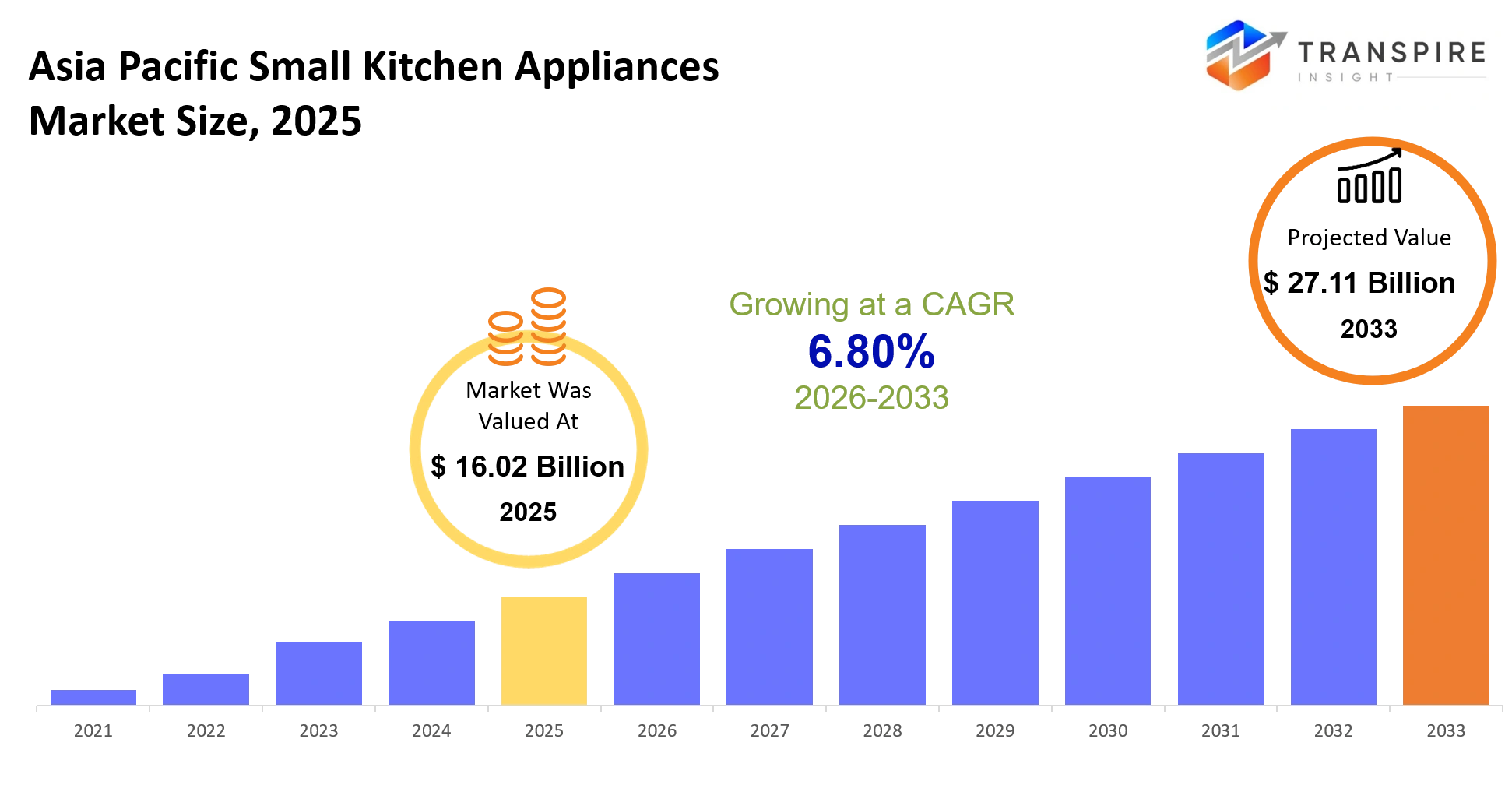
As per Transpire Insight Analysis the Asia Pacific Small Kitchen Appliances Market size is estimated at USD 16.02 Billion in 2025 and is anticipated to reach USD 27.11 Billion by 2033, growing at a CAGR of 6.80% from 2026 to 2033.
The Asia Pacific Small Kitchen Appliances Market kinda supports everyday cooking by trimming down cooking time, boosting ease of use and helping people get steadier meal results , whether it’s at home or in commercial kitchens. Things like mixer grinders, air fryers, coffee makers, rice cookers , and electric kettles have turned into a kind of must-have, since shoppers are looking for faster , more practical solutions that match modern routines. Over the last five years, the space has moved away from the older, single-purpose gadgets toward connected, energy saving and multifunctional models, where several cooking functions are basically packed into one device. During COVID-19, supply chain problems made online appliance buying speed up , and it also pushed makers to diversify sourcing while at the same time tightening up regional production ties. This shift has widened what’s available in the market and made delivery less fragile across Asia Pacific. And as disposable incomes rise , city living grows , and smart home adoption keeps spreading, manufacturers are rolling out more premium and digitally enabled appliances. That ends up lifting overall product value, increasing replacement needs, and keeping revenue moving upward across the region.
Asia Pacific Small Kitchen Appliances Market Size & Forecast:
- Asia Pacific Small Kitchen Appliances Market Size 2025: USD 16.02 Billion
- Expected Market Value 2033: USD 27.11 Billion
- Forecast CAGR: 6.80%
- Leading region in 2025:China
- Fastest Growing region:India
- Key Profile: Philips, Panasonic, LG Electronics, Samsung Electronics, Whirlpool, Midea, Haier, Breville, Bajaj Electricals, Havells, TTK Prestige, Morphy Richards, Xiaomi, Sharp, Toshiba
Key Market Insights
- The Asia Pacific Small Kitchen Appliances Market hit USD 16.02 billion in 2025, and it is expected to reach USD 27.11 billion by 2033, showing a pretty steady long-term industry expansion trend, not too shaky or anything.
- China still pretty much runs the regional business with an estimated around 42% market share in 2025, backed by strong domestic manufacturing ability and a huge appliance production ecosystem that keeps feeding itself.
- India is showing the quickest momentum all the way through 2033, pushed by more city households forming, a rising stream of middle income shoppers and also better retail penetration, like more stores and better distribution.
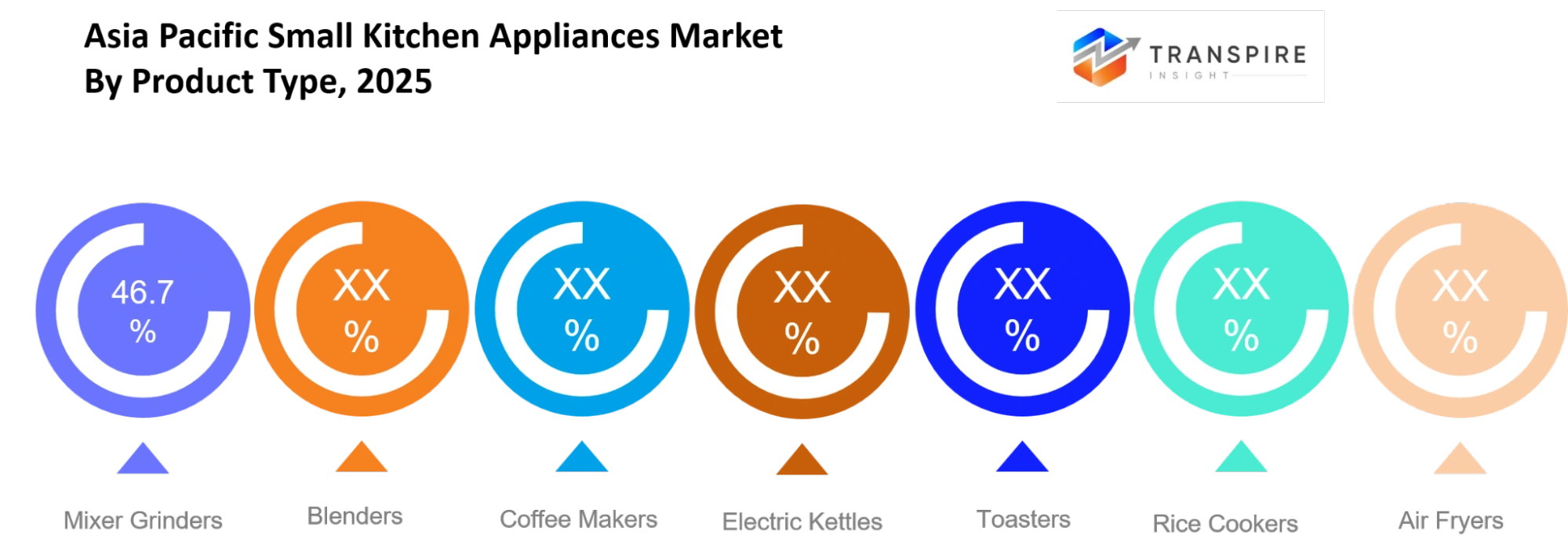
- Within the product mix , mixer grinders are leading the category with an estimated over 24% share, while air fryers are growing the fastest, since these “healthier cooking” approaches are getting more common approval.
- Online retail is basically about nearly 34% of appliance sales, and it’s powered by e-commerce platforms along with digital payment adoption, plus direct-to-consumer brand tactics that sometimes feel more human , not just transactional .
- Residential buyers push over 70% of the local income, while commercial kitchens and cafés keep stretching their budgets for compact , fast-working appliances, especially in places where speed actually matters.
- Companies like Panasonic, Philips, Midea Group, Xiaomi, Samsung Electronics, and LG Electronics still improve their competitive standing through product innovation, AI enabled functions, and ongoing expansion of local manufacturing sites.
- Manufacturers are also rolling out more multifunctional appliances, they combine air frying , steaming, baking, and grilling into one unit , so the buyer view of value looks higher and it quietly nudges replacement cycles to come faster .
- Energy efficient appliances remain on the rise too, particularly models with inverter technologies and smart power management, because governments are tightening appliance efficiency regulations across Asia Pacific .
What are the Key Drivers, Restraints, and Opportunities in the Asia Pacific Small Kitchen Appliances Market?
The main force that’s driving market expansion is this fast move toward compact, all-in-one appliances that kinda fit with changing urban routines and those smaller living spaces . As more people are in dual-income households, and since digital shopping has become very normal , consumers have been more willing to swap older standalone units for products that basically bundle several cooking functions. In response, manufacturers have rolled out connected air fryers, programmable rice cookers, and smart coffee machines, which lifts average selling prices and it also grows the premium portion of revenue.
Still, the biggest restraint has to be the constant volatility in raw material costs and electronic components. Steel, copper, semiconductors, and plastics keep swinging in price, and companies can’t always swallow those changes , not without pushing retail prices too. So this structural issue reduces pricing flexibility, squeezes operating margins , and it can even make shoppers postpone buying when markets are price-sensitive, especially in developing economies where affordability is still a key deciding factor.
Meanwhile, there’s a clear opportunity in how smart home ecosystems are spreading across emerging Asia Pacific countries. Artificial intelligence, Internet of Things connectivity, and voice-enabled kitchen devices keep drawing premium customers who want integrated home automation. India and Southeast Asia look especially promising because internet penetration is rising, smart appliance adoption is gaining momentum, and organized retail channels are becoming more established. All of that encourages larger manufacturers to set up nearby production bases and then launch localized product lineups.
What Has the Impact of Artificial Intelligence Been on the Asia Pacific Small Kitchen Appliances Market?
Artificial intelligence and more advanced digital tech are basically reshaping small kitchen appliances in a way where cooking becomes more automated, more personalized, and somehow also more energy efficient. Now AI-powered cooking helpers can recognize ingredients, suggest recipes, tweak cooking temperatures, and fine tune preparation time without you having to do manual programming. And the connected devices, they share data through mobile apps, so people can watch how things are going from far away, plus they get maintenance reminders, and even software updates, which is kind of neat I guess.
Then machine learning models are helping with predictive maintenance too. They look at motor behavior, heating efficiency, and everyday usage patterns, and from that they try to spot trouble before it turns into an actual breakdown. These predictive tricks can cut down on repair expenses, boost product dependability, and also stretch the appliance life span. Manufacturers, they also examine consumer usage insights to push product design forward, tighten up energy consumption, and release software updates that improve cooking performance over time. Smart sensors add to it as well by increasing heating accuracy, so electricity gets used less but food quality stays steadier.
Still, AI adoption has limits in real life. Higher cost components, like faster processors, connectivity modules, and cloud based software, push manufacturing expenses up, so wide adoption gets harder in price sensitive markets. On top of that, data privacy worries, uneven internet access in certain areas, and compatibility problems across different smart home ecosystems are slowing broader rollout of fully AI-enabled kitchen appliances across multiple Asia Pacific economies.
Key Market Trends
- Smart kitchen appliances with Wi‑Fi and app connectivity have been growing pretty a lot since 2021, and brands like Xiaomi, LG Electronics, and Samsung are rolling out AI enabled cooking features, kind of like smoother automation.
- China is still the manufacturing heartland for more than 40% of appliance production in the region, yet India and Vietnam keep pulling in fresh manufacturing investments too.
- Online retail is now taking up about 34% of appliance sales in 2025. This is getting helped along by flash sales, direct to consumer platforms, and also digital financing choices that make checkout less painful.
- In the meantime, air fryer shipments have kept up annual double digit growth across several Asia Pacific countries since 2022, because people are adopting healthier cooking habits and then replacing older units more often.
- Manufacturers have also been moving away from single function products toward multifunction appliances that do steaming, baking, grilling, and frying, basically for household convenience and stronger product value.
- Plus, energy efficiency standards across major regional economies pushed companies to redo motors, heating elements, and insulation systems, so electricity consumption drops.
- Premium appliance lines that cost above the usual models are still expanding, especially as urban consumers want smart displays, voice control and automated cooking programs.
- Panasonic, Philips, Midea Group, Havells, and Bajaj Electricals continue expanding their regional manufacturing too, which also strengthens distribution partnerships and helps them bring out localized product portfolios.
- And since the pandemic, supply chain diversification has gone faster, with manufacturers widening sourcing networks across Southeast Asia, so they depend less on one production base, rather than only “one place, one plan” kind of thing.
Asia Pacific Small Kitchen Appliances Market Segmentation
By Product Type
Mixer grinders still end up with the biggest slice, largely because daily food prep across lots of Asia Pacific homes really relies on grinding blending and mixing, you know, all those core functions. Blenders keep strong usage in city kitchens too, mainly as people drink more smoothies juices and protein beverages, so that helps adoption. Coffee makers continue to push forward in metropolitan zones, driven by the café culture vibe, plus more households trying premium home coffee preparation. Electric kettles also manage to hold steady sales, since quickly heating water is a lifesaver for tea coffee, and even instant meals.
Rice cookers stay basically crucial across many East and Southeast Asian countries, where rice is a staple and it is not really optional. Air fryers show the fastest growth though, because “healthier cooking” methods are slowly becoming more normal in everyday routines. Toasters keep a consistent level of demand, especially for fast breakfast routines, while other types like food processors sandwich makers and egg boilers widen the whole appliance lineup, kind of branching out. And then there’s continued innovation, so manufacturers keep rolling out multifunctional products, packing several cooking capabilities into one compact appliance, which sounds simple but it really sells.
By Distribution Channel
Supermarkets and hypermarkets are still key sales channels, because customers can sort of handle and see the real product, compare appliance features, right before buying. Specialty stores and electronics retailers keep pulling in shoppers who want product know-how, help with installation, and the usual after service. Department stores stay around in urban shopping centers in a pretty steady way, while brand stores push customer engagement via exclusive product launches, plus promotional campaigns that feel more curated.
Online retail keeps showing up as one of the fastest-growing channels, mainly because pricing is competitive, the selection feels wider, home delivery is convenient, and digital payment options are everywhere. Direct sales also remain useful especially for premium appliance categories, with more personalized demonstrations, and also corporate sales programs that are targeted. Then there are other routes , like regional distributors and independent retailers, they help improve product availability in smaller cities and semi-urban areas across Asia Pacific.
By Application
Food prep still seems to be the main application, households and commercial kitchens, both depend on appliances for chopping, grinding, mixing, and getting ingredients ready before cooking. Beverage prep keeps moving forward too, mostly because people drink more coffee, tea, juices and nutritional drinks that are made with coffee makers, blenders, and electric kettles. Grinding in particular keeps its strong position because preparing fresh spices is still pretty common in many regional cuisines.
Cooking applications are also getting stronger, think rice cookers, air fryers, and multifunctional cooking devices that make it easier to handle a meal from start to finish. Baking and heating features further encourage appliance usage in homes, cafés, and food service places. Multi purpose cooking appliances are still drawing attention from consumers who want space saving solutions, basically one device that can do several cooking tasks. Other applications then focus on specialized food handling needs, so the range stays wide.
By End User
Residential consumers still represent the biggest share, since daily meal preparation keeps pushing frequent appliance buys and replacement rhythms. Meanwhile, Hotels and restaurants keep putting money into tougher kitchen equipment, it boosts operational efficiency, and it also helps keep the food quality steady. Cafés are also moving toward premium coffee machines , blenders, and various food preparation tools, mostly to handle expanding beverage menus while matching customer expectations.
On the other hand, catering services are increasingly relying on portable but high capacity appliances, so they can be more nimble during big events. Commercial kitchens continue to invest in energy efficient products, which lower running costs and raise productivity. Institutions, office pantries and other commercial spaces add reliable demand too, because workplace dining, educational facilities and healthcare establishments keep modernizing their kitchen setups.
By Price Range
Economy products still manage to serve price-sensitive consumers who want dependable kitchen appliances for day-to-day use and not much else. The mid range section makes up a big chunk of sales, because it somehow balances cost with extra conveniences like digital controls, and even better energy efficiency… which people notice. Premium appliances keep stretching outward too, with more advanced functionality, sturdier materials, and smart connectivity features that feel a little future-proof.
Smart appliances pull in tech-minded buyers who like controlling everything through a mobile application, running automated cooking programs, and syncing with connected home ecosystems. Energy-efficient appliances keep getting broader acceptance too, since lower electricity consumption helps households save over time, even if the upfront cost is a bit higher, sometimes. Compact appliances stay desirable in apartments, and tighter kitchens where space is everything, while luxury appliances lean into premium styling, advanced automation, and higher cooking performance overall. Other specialized items still cater to niche tastes and also to specific commercial requirements.
What are the Key Use Cases Driving the Asia Pacific Small Kitchen Appliances Market?
Everyday household food preparation is still the biggest driver, with mixer grinders rice cookers electric kettles, and all-in-one cooking appliances helping people make meals more or less every day. People who cook at home a lot, plus busy city routines, keep pushing customers toward smaller machines that cut down prep time while also making cooking more consistent.
Meanwhile hotels, restaurants cafes and commercial kitchens are leaning more into higher performance coffee makers, blenders, air fryers and food processors, basically so they can run faster, and keep food quality steady. Office pantries and institutional kitchens too are starting to add more appliances, to handle employee dining plus those bigger batch meal schedules.
New things on the horizon sound like AI-enabled smart kitchens, connected cooking ecosystems, and energy management solutions that try to tune appliance performance in real time. Compact multifunctional appliances meant for small apartments, and also the nicer smart home setups, are expected to open up more growth chances through most of the forecast period.
|
Report Metrics |
Details |
|
Market size value in 2025 |
USD 16.02 Billion |
|
Market size value in 2026 |
USD 17.11 Billion |
|
Revenue forecast in 2033 |
USD 27.11 Billion |
|
Growth rate |
CAGR of 6.80% from 2026 to 2033 |
|
Base year |
2025 |
|
Historical data |
2021 - 2024 |
|
Forecast period |
2026 - 2033 |
|
Report coverage |
Revenue forecast, competitive landscape, growth factors, and trends |
|
Regional scope |
United States; Canada; Mexico; United Kingdom; Germany; France; Italy; Spain; Denmark; Sweden; Norway; China; Japan; India; Australia; South Korea; Thailand; Brazil; Argentina; South Africa; Saudi Arabia; United Arab Emirates |
|
Key company profiled |
Philips, Panasonic, LG Electronics, Samsung Electronics, Whirlpool, Midea, Haier, Breville, Bajaj Electricals, Havells, TTK Prestige, Morphy Richards, Xiaomi, Sharp, Toshiba |
|
Customization scope |
Free report customization (country, regional & segment scope). Avail customized purchase options to meet your exact research needs. |
|
Report Segmentation |
By Product Type (Mixer Grinders, Blenders, Coffee Makers, Electric Kettles, Toasters, Rice Cookers, Air Fryers, Others); By Distribution Channel (Supermarkets & Hypermarkets, Specialty Stores, Online Retail, Department Stores, Brand Stores, Electronics Retailers, Direct Sales, Others); By Application (Food Preparation, Beverage Preparation, Cooking, Baking, Heating, Grinding, Multi-Purpose Cooking, Others); By End User (Residential Consumers, Hotels & Restaurants, Cafés, Catering Services, Commercial Kitchens, Institutions, Office Pantries, Others); By Price Range (Economy, Mid-Range, Premium, Smart Appliances, Energy-Efficient Appliances, Compact Appliances, Luxury Appliances, Others) |
Which Regions are Driving the Asia Pacific Small Kitchen Appliances Market Growth?
China, kind of leads the regional market because it pairs a huge consumer base with one of the world’s most solid home appliance manufacturing ecosystem. You can see it in how the industrial clusters are well developed, plus there are broad supplier networks, and logistics infrastructure that’s really advanced. Because of that, manufacturers can turn out appliances at prices that stay competitive, while still hitting high output volumes ,not just once but steadily. On top of it, government backing for smart manufacturing, energy-efficient products, and digital transformation has, in practice, pushed domestic production capabilities even further . China keeps widening that edge through continuous spending on research, automation, and export infrastructure so its leadership holds up, and it also keeps serving both local demand and international markets.
Japan comes in as the second-largest regional contributor ,but its growth looks a bit different from China. It leans more toward technology leadership rather than raw manufacturing scale. Consumer purchasing power stays relatively steady, and product quality standards are strict in a controlled way. That combination plus consistent replacement demand builds a dependable revenue foundation for higher-end kitchen appliances. Companies tend to emphasize durability, compact product layout, and strong energy efficiency, mainly to match what aging households want, and also what space-limited urban users prefer. This premium innovation approach supports long-term revenue, even if population growth is comparatively slower.
India is projected to be the fastest-growing during the forecast window, since rapid urbanization, a rising layer of middle-income households, and digital commerce are all reshaping how people buy appliances. Production-linked incentive programs, along with more domestic manufacturing capacity, and increased investment in organized retail, have improved product availability across major metros as well as Tier II cities.
Who are the Key Players in the Asia Pacific Small Kitchen Appliances Market and How Do They Compete?
Competition is still pretty moderately fragmented, so you have multinational brands over here, and then a bunch of strong regional manufacturers over there. The main things that people actually compete on stay the usual ones: product innovation, pricing strategy , smart technology integration, manufacturing scale, and distribution reach, nothing too surprising. Even the established players keep defending their market share with continuous product upgrades, but regional brands kinda push value-oriented alternatives too, and that tends to attract cost-conscious consumers who want less expensive but still “good enough” options.
Philips, for example, differentiates its portfolio by leaning into intelligent cooking technologies, multifunctional appliances, and overall premium user experiences. It keeps expanding its smart kitchen lineup, including products like the OneChef all-in-one cooking appliance, aimed at people who want compact appliances but with multiple cooking functions. Panasonic competes by putting forward durability, precision engineering, and energy-efficient technologies , and it also keeps a solid presence across Japan and Southeast Asia by using localized product development. LG Electronics instead leans on AI-enabled smart home integration, so its kitchen appliances can connect smoothly with the wider connected home ecosystem, which adds extra customer value rather than acting like a standalone product.
Midea leans hard on large-scale manufacturing, competitive pricing, and quick product commercialization, which helps it push deeper into markets across emerging Asia Pacific economies. Xiaomi differentiates through IoT-enabled appliances that fit into its connected smart home platform, and it still keeps pricing competitive for younger digital consumers.
Company List
• Philips
• Panasonic
• LG Electronics
• Samsung Electronics
• Whirlpool
• Midea
• Haier
• Breville
• Bajaj Electricals
• Havells
• TTK Prestige
• Morphy Richards
• Xiaomi
• Sharp
• Toshiba
Recent Development News
In March 2026, Philips (Versuni) launched the Philips OneChef all-in-one smart cooking appliance in India. The product combines 33 cooking functions in one appliance, strengthening the company's premium smart kitchen portfolio and expanding its presence in India's connected appliance segment.https://www.domesticappliances.philips.co.in
In March 2026, Versuni expanded its Chennai manufacturing facility and significantly increased production capacity at its Ahmedabad plant. The investment supports greater localization of Philips-branded kitchen appliances, reduces import dependence, and increases regional manufacturing capacity.https://timesofindia.indiatimes.com
In May 2025, Midea entered a global partnership with the Asian Football Confederation (AFC). The strategic partnership strengthens Midea's brand visibility across Asia and supports long-term expansion of its smart home and kitchen appliance business throughout the region.https://www.midea.com
What Strategic Insights Define the Future of the Asia Pacific Small Kitchen Appliances Market?
The market seems to be moving toward more intelligent, connected, and multifunctional appliances that mix automation, energy efficiency, and digital integration in compact designs, or at least that’s what the data feels like right now. This kind of shift is not only about growing volumes. It’s more about expanding smart home ecosystems, more localized manufacturing investment, and ongoing software driven product upgrades that keep showing up, over time.
There is one less obvious risk though, the growing reliance on semiconductor parts and electronic control modules. If that dependence keeps increasing, manufacturers could get hit by supply disruptions and cost swings later on, even if consumer demand stays relatively steady. It’s kind of a trade-off that can be missed too easily.
On the opportunity side, AI enabled cooking assistants look promising, especially when they’re designed around regional cuisines. In India and parts of Southeast Asia, localized software and connected services are still underpenetrated, at least compared with more mature regions. So companies that blend regional production with software based differentiation, decent after sales support, and partnerships across digital ecosystems might end up capturing more premium market share.
For investors, the angle should be to focus on manufacturers that can balance competitive pricing with genuinely smart features. Value added functionality should become a stronger edge in the next five to seven years, not just a nice extra.
Asia Pacific Small Kitchen Appliances Market Report Segmentation
By Product Type
• Mixer Grinders
• Blenders
• Coffee Makers
• Electric Kettles
• Toasters
• Rice Cookers
• Air Fryers
• Others
By Distribution Channel
• Supermarkets & Hypermarkets
• Specialty Stores
• Online Retail
• Department Stores
• Brand Stores
• Electronics Retailers
• Direct Sales
• Others
By Application
• Food Preparation
• Beverage Preparation
• Cooking
• Baking
• Heating
• Grinding
• Multi-Purpose Cooking
• Others
By End User
• Residential Consumers
• Hotels & Restaurants
• Cafés
• Catering Services
• Commercial Kitchens
• Institutions
• Office Pantries
• Others
By Price Range
• Economy
• Mid-Range
• Premium
• Smart Appliances
• Energy-Efficient Appliances
• Compact Appliances
• Luxury Appliances
• Others
Frequently Asked Questions
Find quick answers to common questions.
The expected Asia Pacific Small Kitchen Appliances Market size for the market will be USD 27.11 Billion in 2033.
Key segments for the Asia Pacific Small Kitchen Appliances Market are By Product Type (Mixer Grinders, Blenders, Coffee Makers, Electric Kettles, Toasters, Rice Cookers, Air Fryers, Others); By Distribution Channel (Supermarkets & Hypermarkets, Specialty Stores, Online Retail, Department Stores, Brand Stores, Electronics Retailers, Direct Sales, Others); By Application (Food Preparation, Beverage Preparation, Cooking, Baking, Heating, Grinding, Multi-Purpose Cooking, Others); By End User (Residential Consumers, Hotels & Restaurants, Cafés, Catering Services, Commercial Kitchens, Institutions, Office Pantries, Others); By Price Range (Economy, Mid-Range, Premium, Smart Appliances, Energy-Efficient Appliances, Compact Appliances, Luxury Appliances, Others).
Major Asia Pacific Small Kitchen Appliances Market players are Philips, Panasonic, LG Electronics, Samsung Electronics, Whirlpool, Midea, Haier, Breville, Bajaj Electricals, Havells, TTK Prestige, Morphy Richards, Xiaomi, Sharp, Toshiba.
The Asia Pacific Small Kitchen Appliances Market size is USD 16.02 Billion in 2025.
The Asia Pacific Small Kitchen Appliances Market CAGR is 6.80% from 2026 to 2033.
• Philips
• Panasonic
• LG Electronics
• Samsung Electronics
• Whirlpool
• Midea
• Haier
• Breville
• Bajaj Electricals
• Havells
• TTK Prestige
• Morphy Richards
• Xiaomi
• Sharp
• Toshiba
About the Authors

Chetan Dhatrak
I’m Chetan Dhatrak, a Senior Research Analyst at Transpire Insight, specializing in the Consumer Goods, Foods and Beverages industry. I focus on analyzing market trends, consumer behavior, competitive landscapes, and industry developments to deliver accurate, data-driven insights. My research at Transpire Insight is built on credible sources and in-depth analysis, helping businesses and readers better understand market dynamics, emerging opportunities, and evolving consumer preferences. I’m committed to creating reliable, well-researched content that supports informed decision-making and reflects the latest developments in the consumer goods and food & beverage sectors.

Chakradhar Khansole
Chakradhar serves as the Research Director at Transpire Insight, bringing over 8 years of experience in technology, innovation, and strategic market intelligence. He specializes in transforming complex market data into actionable business insights that enable organizations to make informed, growth-oriented decisions. Recognized for his strategic vision and analytical expertise, Chakradhar leads high-impact research initiatives, delivering comprehensive market assessments, competitive intelligence, and forward-looking industry analysis.
Recently Published Reports
-
Apr 2026
Bottled Water Market
Bottled Water Market Size, Share & Analysis Report By Product Type (Still Bottled Water, Carbonated Bottled Water, Functional Bottled Water, and Others), By Packaging (PET, Cans, and Others), By Sales Channel (Supermarkets/Hypermarkets, Convenience Stores/Drug Stores, Grocery Stores/Club Stores, Foodservice, and Others) and Geography (North America, Europe, Asia-Pacific, Middle East and Africa, South and Central America), 2021 - 2032
-
Apr 2026
Color Cosmetic Packaging Market
Color Cosmetic Packaging Market Size, Share & Analysis Report By Application (Mascara Packaging, Liquid Packaging, and Liquid Face), By Type (Tubes & Bottles, Pens & Markers, Compacts & Containers, and Droppers & Pumps), and Geography (North America, Europe, Asia-Pacific, Middle East and Africa, South and Central America), 2021 - 2031
-
Apr 2026
External Microphone For Camera Market
External Microphone For Camera Market Size, Share & Analysis Report By Type (Shotgun Microphone, Lavalier Microphone, and Others), By Application (Digital Camera, Professional Video Camera, and Others), and Geography (North America, Europe, Asia-Pacific, Middle East and Africa, South and Central America), 2021 - 2031
-
Apr 2026
Foot Orthotic Insoles Market
Foot Orthotic Insoles Market Size, Share & Analysis Report By Type (Pre-fabricated, and Custom-made), By Material (Thermoplastic, Composite Carbon Fiber, and Others), By Distribution Channel (Drug Stores, Hospitals & Clinics, and Others), and Geography (North America, Europe, Asia-Pacific, Middle East and Africa, South and Central America), 2021 - 2031