
Cosmetics and Beauty Products Market Summary:
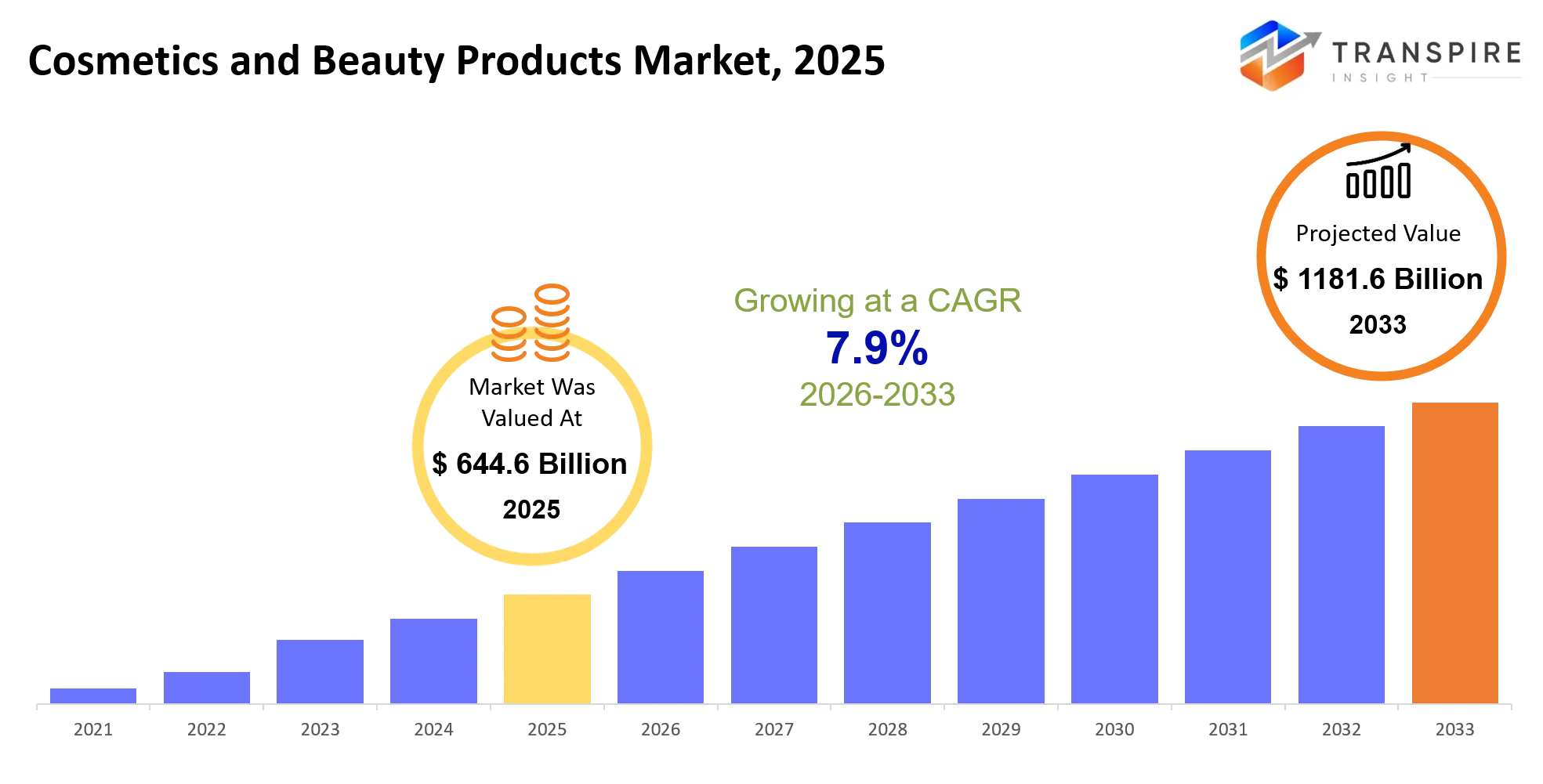
As per Transpire Insight Analysis, the Cosmetics and Beauty Products Market size is estimated at USD 644.6 billion in 2025 and is anticipated to reach USD 1181.6 billion by 2033, growing at a CAGR of 7.9% from 2026 to 2033.
The Cosmetics and Beauty Products Market around the world is changing. People are now paying attention to how their skin feels and looks. They want to know exactly what is in the products they use. They also care about taking care of themselves and finding products that work best for them. Skincare is still a part of this market. More and more people are using cleansers, moisturisers, serums and sunscreen every day. In the past three to five years, buying beauty products online has become much more common. People are getting help from suggestions and products that are made based on science. A big change is that more people are shopping online first. They use things like tryouts, social media shopping and websites that sell directly to customers. These changes push companies to make products connect with customers online and reach more people. Companies that offer products make it easy to buy and share real information about ingredients are doing better. They are able to keep customers coming back and make money over time.
Cosmetics and Beauty Products Market Size & Forecast:
- Market Size 2025: USD 644.6 Billion
- Expected Market Value (2033): USD 1181.6 Billion
- Forecast CAGR (2026–2033): 7.9%
- Leading Region in 2025: Asia Pacific
- Fastest Growing Region: Middle East & Africa
- Key Company Profiles: L'Oréal, Unilever, Estée Lauder, Procter & Gamble, Shiseido, Beiersdorf, Coty, Kao Corporation, Amorepacific, Chanel, LVMH, Natura &Co, Revlon, Puig, Mary Kay
Key Market Insights:
The market is moving towards spending on skin care, digitised buying and a desire for products where the value is easily explained.
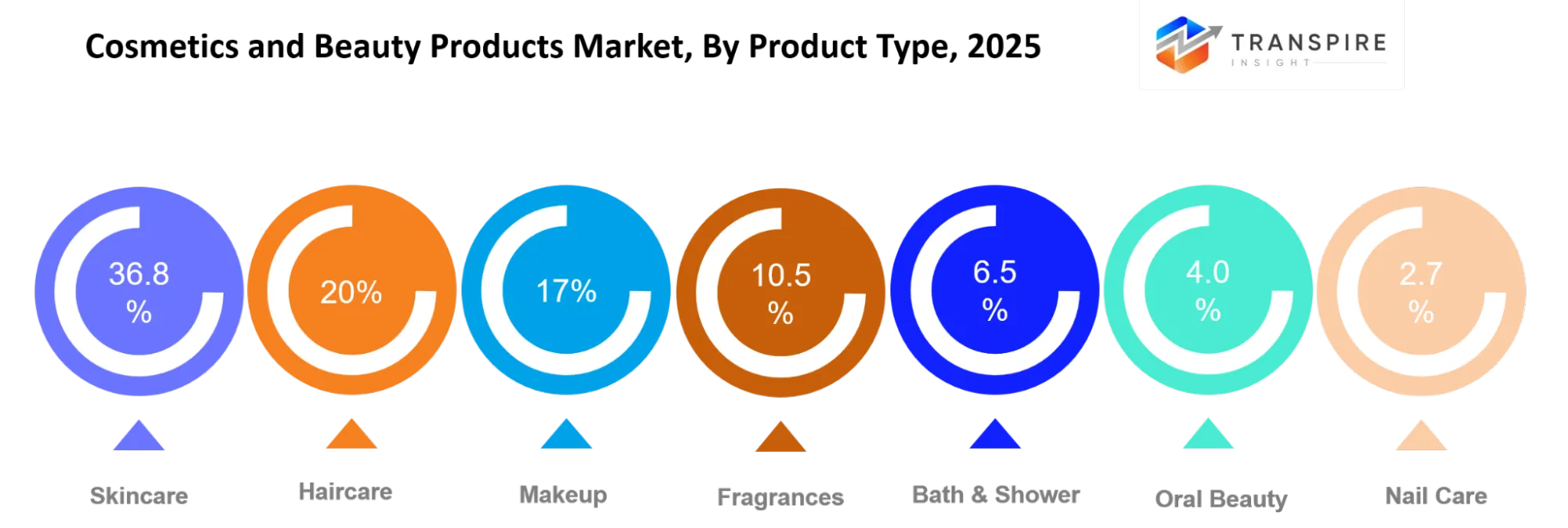
- The skincare category represents 36.8% of the market, thus being the most substantial product category.
- haircare accounts for 20.0% of the market thanks to the demand for scalp treatment, hair treatment, and products for special hair textures
- Make-up accounts for 17.0% of the market; however, virtual try-on and tutorials in social media influence how consumers choose the shades and finish.
- Fragrance contributes 10.5% of the market value. Positioning as a premium product, the ability to express oneself through fragrance choice,
- Bath & Shower represents 6.5% of the market. Sensory experience, skin-friendly formulations, convenient packaging and combinations of cleansing and moisturising products are what brands compete on.
- Nail care represents 2.7% of the market. Home nail kits and new technologies in the application of nail cosmetics help brands innovate in the category.
What are the Key Drivers, Restraints, and Opportunities in the Cosmetics and Beauty Products Market?
Drivers
Increasing use of skincare and personal grooming products is changing from a one-time purchase to a routine. Consumers’ growing knowledge about sun protection, hydration of the skin, hair, and age-related problems is helping drive the sales of these products in several price segments. Increased use of online platforms for beauty shopping and demos on social media are helping consumers to compare products before making the final decision.
Restraints
Fluctuating ingredient prices and the cost involved in developing new products can affect margins. Developing premium products involves costs in terms of testing, packaging, marketing, and regulatory approvals. New players may find it difficult to gain retail visibility and compete against the established players who have good distribution channels. Consumer scepticism regarding misleading claims, irritation, and the efficacy of the product can hamper their trust.
Opportunities
Products based on natural and organic ingredients can serve as a area for growth. Companies may use their formulas to demonstrate the sources of their ingredients and the proof of the efficacy of their products. In addition, AI and skin analysis can help make more accurate suggestions about products and attract consumers with the help of the reliable data. Finally, emerging markets provide an opportunity for products with local relevance, specific regional ingredient preferences and affordable premium products.
|
Driver |
Relative Impact on Growth (%) |
Geographic Relevance |
Impact Timeline |
Demand Strength |
Growth Mechanism |
Key Beneficiaries |
Major Constraint |
|
Rising demand for skincare, anti-aging, and personal care products |
28% |
Asia Pacific, North America, Europe |
Short-term (≤2 years) |
High |
Growing beauty awareness increases product purchases and usage frequency. |
Skincare brands, ingredient suppliers, retailers, consumers |
Price sensitivity limits premium product adoption. |
|
Expansion of e-commerce, social commerce, and beauty influencer marketing |
23% |
Asia Pacific, North America, Europe |
Short-term (≤2 years) |
High |
Digital platforms expand product reach and simplify purchasing. |
Online retailers, beauty brands, influencers, digital platforms |
Intense competition increases customer acquisition costs. |
|
Growing preference for premium, personalized, and science-backed beauty products |
19% |
North America, Europe, Asia Pacific |
Medium-term (2–4 years) |
High |
Personalized formulations encourage premium spending and brand loyalty. |
Premium brands, dermatology-led brands, formulation technology providers |
High prices restrict adoption among budget-conscious consumers. |
|
Advancements in AI-driven beauty technology and product innovation |
16% |
North America, Asia Pacific, Europe |
Medium-term (2–4 years) |
High |
AI skin analysis improves product recommendations and personalization. |
Beauty technology vendors, manufacturers, digital retailers |
Data privacy concerns and implementation costs hinder adoption. |
|
Increasing demand for sustainable, clean-label, and environmentally responsible cosmetics |
14% |
Europe, North America, Asia Pacific |
Long-term (≥4 years) |
Medium |
Sustainable formulations attract environmentally conscious consumers. |
Sustainable ingredient suppliers, eco-packaging firms, beauty brands |
Higher production costs and greenwashing concerns limit adoption. |
|
Total |
100% |
— |
— |
— |
— |
— |
— |
What Has the Impact of Artificial Intelligence Been on the Cosmetics and Beauty Products Market?
AI is transforming the process of product development, customer research, and even making recommendations for beauty products.virtual makeup applications allow customers to see how different lipstick colours, foundations, and other beauty products would look like on them. A cosmetics company may use skin sensing technologies powered by AI to evaluate how the customer's skin looks and make recommendations for their treatment, however, these recommendations of AI are not medical diagnosis. In terms of product development, machine learning may help researchers in screening ingredients, evaluating formulation options and finding interesting combinations before any laboratory tests. Predictive analytics is able to predict demand based on sales data, seasonal trends, search behaviour, and customer reviews. Machine learning may help in planning inventories and preventing oversupply, as well as helping marketing departments in targeting the right consumers.AI helps in increasing operational efficiency through automation of customer service, product classification and online reviews analysis. However, implementing this technology is not always easy. Expensive technology, fragmented customer data, privacy considerations and potential inaccuracies caused by different skin types and lighting conditions may limit the effectiveness of the system. These companies should combine artificial intelligence results with human testing and monitoring to provide.
Instance
In January 2026, Shiseido launched a mist-based sun care product using an AI-enabled VOYAGER formulation platform. It uses extensive formulation data to suggest possible ingredient combinations for researchers in order to formulate new sun-care products that include fragrance and colour. The development illustrates how the advancement in AI is enhancing innovation in cosmetics products.
https://corp.shiseido.com/en/news/detail.html?n=00000000004127
Key Market Trends
The worldwide market of beauty and cosmetic products is changing the trend from mass-oriented beauty routines toward individualised skincare, ingredient transparency, and digital product discovery process.
- From general beauty routines to a personal approach, more and more customers are using digital skin assessments and product recommendations.
- Consumers pay more attention to the list of ingredients. It is easier for companies to provide information about formulation and ingredient sourcing.
- The way customers discover beauty products becomes different, with the development of virtual try-ons, video tutorials, and influencer reviews.
- Beauty routine tends to become more targeted with such concerns like hydration, UV protection, even tone. This is how brands respond to it.
- There is an increased interest in botanical ingredients and their sources, as well as increased pressure on environmental and ingredient claims.
- Using AI, brands can analyse customer preferences and suggest appropriate products. Virtual makeup try-on and digital assistants are becoming popular.
Cosmetics and Beauty Products MarketSegmentation
By Product Type
Skincare Products constitute the largest market with 36.8% market share, thanks to increasing demand for moisturiser, serum, and sun protection products. Haircare constitutes 20.0%, followed by Makeup at 17.0% and Fragrances at 10.5%. Bath and shower products contribute 6.5%, Oral Beauty 4.0%, Nail care 2.7%, and Men's Grooming 2.5% of the market. Growth drivers include routine personal care, formulation, and shifting consumer preferences.
By Category
The market is made up of premium products, mass market products, professional products, natural and organic products, luxury products, dermatological products, clean beauty products, and others. The natural and organic products are expected to witness a CAGR of 8.7% owing to high demand for ingredients and information about the formula that is plant-based. Premium and luxury products attract the consumer by way of formulations and brand image.
By Distribution Channel
Distribution channels include speciality stores, supermarkets, department stores, pharmacies, convenience stores, beauty salons and e-commerce. A key feature is the one-on-one advice provided by speciality stores and beauty salons, and the ability of pharmacists to sell skincare products. E-commerce has expanded access by using product reviews, digital advertising and the ability to deliver products directly to one's home.
By Consumer Group
The market is for women, men, children, teenagers, pensioners, unisex, professional users, and others. Women drive the demand for cosmetics in the following sectors – skin care, makeup, and hair care; and men's grooming is entering the domain of facial skin care and hair styling. There are further opportunities in age-specific compositions and in professional beauty products.
By Form
Cosmetic and Beauty Products. You'll find cosmetics and beauty products in forms such as creams, lotions, gels, serums, powders, sprays, oils, etc. Lotions and creams are most common in a daily-use range of products, and serums are common in a range of products that focus on specific skin problems such as anti-ageing.
By Ingredient Type
Ingredients can be artificial, natural, organic, herbal, botanical, vegan, mineral-based, and bio-based. Ingredients like natural or botanical arise due to the growing interest of consumers to buy such products made from plants. On the other hand, artificial ingredients provide uniformity and flexibility in the creation of a formula for a product.
What are the Key Use Cases Driving the Cosmetics and Beauty Products Market?
Day-to-day skincare is a use case within the cosmetics and beauty products industry, including cleaning, moisturising, sun protection, and targeted treatment products. A 36.8% share within this segment illustrates the value of such products that can be easily integrated into consumers' personal routines of use. Usage cases among others involve haircare, makeup that covers both skin conditioning and hair styling, fragrance, bath, and showering products that include both cleaning and skin conditioning agents. Professionally oriented customers purchase specialised hair and skincare items for their business in a salon environment. Some other use cases include AI-powered product suggestions, virtually trying on makeup before purchase, creating personalised beauty routines and ingredient-based products. Those use cases combine the power of the technology and product discovery experience of customers in e-commerce, specialty store, pharmacy, and professional environment of cosmetic industry.
|
Report Metrics |
Details |
|
Market size value in 2025 |
USD 644.6 Billion |
|
Market size value in 2026 |
USD 693.9 Billion |
|
Revenue forecast in 2033 |
USD 1181.6 Billion |
|
Growth rate |
CAGR of 7.9% from 2026 to 2033 |
|
Base year |
2025 |
|
Historical data |
2021 - 2024 |
|
Forecast period |
2026 - 2033 |
|
Report coverage |
Revenue forecast, competitive landscape, growth factors, and trends |
|
Regional scope |
United States; Canada; Mexico; United Kingdom; Germany; France; Italy; Spain; Denmark; Sweden; Norway; China; Japan; India; Australia; South Korea; Thailand; Brazil; Argentina; South Africa; Saudi Arabia; United Arab Emirates |
|
Key company profiled |
L'Oréal, Unilever, Estée Lauder, Procter & Gamble, Shiseido, Beiersdorf, Coty, Kao Corporation, Amorepacific, Chanel, LVMH, Natura &Co, Revlon, Puig, Mary Kay |
|
Customization scope |
Free report customization (country, regional & segment scope). Avail customized purchase options to meet your exact research needs. |
|
Report Segmentation |
Product Type (Skincare, Haircare, Makeup, Fragrances, Bath & Shower, Oral Beauty, Nail Care, Men's Grooming)Category (Premium, Mass, Professional, Natural & Organic, Luxury, Dermatological, Clean Beauty, Others)Distribution Channel (Specialty Stores, Supermarkets, Department Stores, Pharmacies, Convenience Stores, Beauty Salons, E-commerce, Others)Consumer Group (Women, Men, Children, Teenagers, Seniors, Unisex, Professional Users, Others)Form (Creams, Lotions, Gels, Serums, Powders, Sprays, Oils, Others)Ingredient Type (Synthetic, Natural, Organic, Herbal, Botanical, Vegan, Mineral-Based, Bio-Based) |
Which Regions are Driving the Cosmetics and Beauty Products Market Growth?
North America
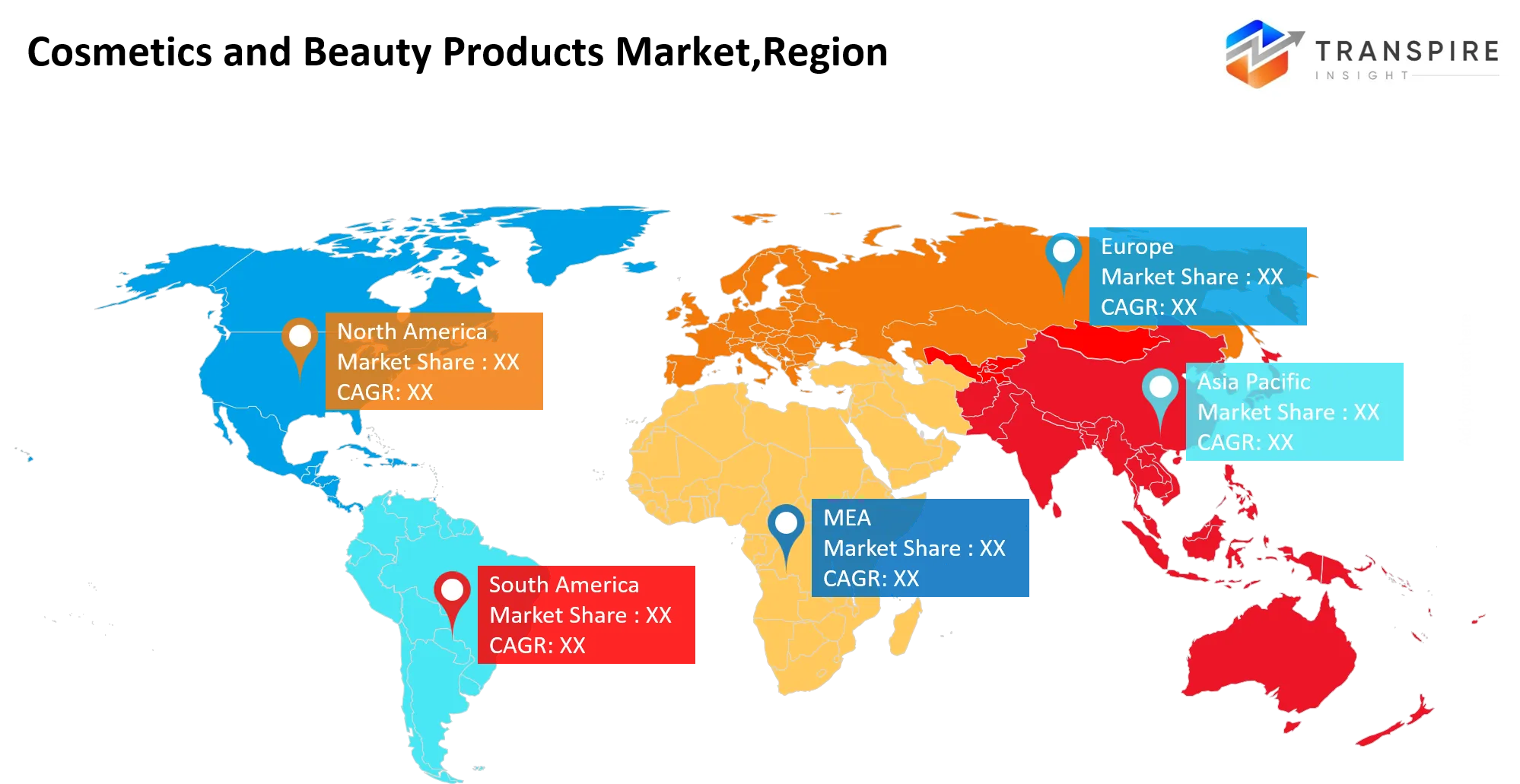
North America accounts for 24.8% of the market share in the cosmetics and beauty products business due to the presence of established brands, developed sales channels, and specialty stores as well as online sales options. High-quality skin care, hair care products, dermatological items, and personal care products are available to consumers. Digital marketing expertise and efficient distribution networks help companies introduce new products and focus on specific consumer segments. Value creation at various price points becomes an important factor of competition.
In May 2025, the L’Oréal Groupe celebrates its 50th milestone anniversary of its make-up production facility based in North Little Rock, Arkansas, that makes mascara and liquid make-up products. This clearly shows the significance of having manufacturing facilities and distribution channels within the continent.
https://www.loreal.com/en/usa/articles/group/north-little-rock-50-years
Europe
Europe holds 26.1% of the market share since there are companies that make cosmetics, fragrances, specialty stores, and the development process. Europe is strong in formulation science, luxury branding, and fragrances. Regulations on cosmetics’ safety, ingredients restricted, labeling, and claims have a big part in product development and introduction to the market. The stability of the product comes from established consumer markets and international brand reputation, whereas sustainability and the need for formulation drive the packaging and communication of the product.
In May 2025, The Estée Lauder Companies revealed an initiative for sustainability at the Oevel, Belgium, campus. It shows how sustainable manufacturing and innovative ingredients and product distribution is becoming crucial for beauty companies in Europe.
Asia-Pacific
Asia-Pacific leads in the market with 39.2% of market share due to a large number of population, variety of beauty routines, increase in e-commerce, and demand for affordable and premium beauty products. Companies that have a presence in regional as well as international markets make use of customised formulations, m-commerce, social commerce, and customised products for various skin tones, weather, and type of hair in order to provide their products. The increase in e-commerce opens up avenues for existing and new players in the market.
In April 2025, Sephora expanded its unique partnership with Haus Labs by Lady Gaga in Southeast Asia, Oceania and Hong Kong. 125 new products became available through Sephora’s retail network within the Asia-Pacific region.
Who are the Key Players in the Cosmetics and Beauty Products Market and how do they compete?
The competition for the cosmetics and beauty industry happens on different levels, such as mass personal care, premium skincare, luxury perfumes, professional products and online-only brands. The basis of competition is product performance, brand recognition, price, distribution channels and innovations. Large companies depend on their research centres and retail network across the globe, whereas small companies depend on unique ingredients, consumer needs and online marketing channels. Discovery of the products through online and social media platforms has increased competition due to the fact that the new brands have managed to get their products discovered online without necessarily having physical retail stores. L'Oréal functions in the mass, dermatological, professional and luxury segments in the beauty industry. It competes using scientific research, product development, digital beauty solutions and international distribution. Collaboration with Innovist and Kering Beauté until 2026 will help the company expand through locally-relevant personal care products and luxury perfume assets. Unilever depends on accessible personal care products, existing brands, premium hair and skin care innovations and social marketing
Cosmetics and Beauty Products Marketcompanies
- L'Oréal
- Unilever
- Estée Lauder
- Procter & Gamble
- Shiseido
- Beiersdorf
- Coty
- Kao Corporation
- Amorepacific
- Chanel
- LVMH
- Natura &Co
- Revlon
- Puig
- Mary Kay
|
Company |
Est. Revenue Share Range |
Key Offerings |
Strategic Positioning |
Geographic Strength |
Technology Focus |
|
L'Oréal Groupe |
Estimated 8–12% |
L'Oréal Paris, Maybelline, Lancôme, La Roche-Posay |
Broad portfolio leadership across mass, luxury, and dermocosmetics |
Europe, North America, Asia Pacific |
AI-powered personalization and advanced formulation science |
|
Unilever PLC |
Estimated 4–7% |
Dove, Vaseline, TRESemmé, Sunsilk |
Mass-market scale with strong everyday beauty brands |
Asia Pacific, Europe, Latin America |
Sustainable formulations and data-driven product development |
|
Procter & Gamble Company |
Estimated 2–4% |
Head & Shoulders, Pantene, Olay, SK-II |
High-volume brands supported by consumer research |
North America, Asia Pacific, Europe |
Hair and skin science with advanced formulation technologies |
|
The Estée Lauder Companies Inc. |
Estimated 2–4% |
Estée Lauder, Clinique, M·A·C, La Mer |
Prestige beauty leadership with premium brand differentiation |
North America, Asia Pacific, Europe |
Skin biology research and advanced ingredient science |
|
LVMH Moët Hennessy Louis Vuitton SE |
Estimated 1–3% |
Dior Beauty, Guerlain, Givenchy Beauty, Benefit Cosmetics |
Luxury positioning driven by exclusivity and brand heritage |
Europe, North America, Asia Pacific |
Luxury formulation innovation and premium fragrance development |
|
Chanel Limited |
Estimated 1–3% |
Chanel fragrances, makeup, skincare, N°1 de Chanel |
Ultra-premium positioning with controlled brand distribution |
Europe, North America, Asia Pacific |
Advanced skincare research and fragrance composition |
|
Beiersdorf AG |
Estimated 1–2% |
NIVEA, Eucerin, La Prairie, Labello |
Skin-science expertise across mass and premium segments |
Europe, Asia Pacific, Latin America |
Dermatological research and skin-barrier science |
|
Shiseido Company, Limited |
Estimated 1–2% |
Shiseido, Clé de Peau Beauté, NARS, ANESSA |
Premium skincare leadership with Japanese beauty expertise |
Asia Pacific, North America, Europe |
Skin research, UV protection, and precision skincare |
|
Coty Inc. |
Estimated 1–2% |
CoverGirl, Rimmel, Max Factor, Kylie Cosmetics |
Dual presence in mass cosmetics and prestige fragrance |
Europe, North America, Asia Pacific |
Fragrance formulation and digitally enabled beauty experiences |
|
Puig Brands, S.A. |
Estimated 0.5–1.5% |
Charlotte Tilbury, Rabanne fragrances, Carolina Herrera fragrances, Jean Paul Gaultier fragrances |
Prestige fragrance growth with selective luxury makeup |
Europe, North America, Asia Pacific |
Fragrance development and digital brand engagement |
Recent Development News
In March 2025, The Estée Lauder Companies teamed up with India’s Startup India initiative to expand its BEAUTY&YOU India initiative and help beauty startups grow, including those founded by women. This initiative creates new opportunities for innovative product ideas, innovations, and local beauty brands.
https://www.elcompanies.com/en-gb/news-and-media/newsroom/press-releases/2025/03-12-2025
In June 2026, L'Oréal announced an agreement to buy a majority stake in Innovist, an Indian personal care brand that includes such brands as Bare Anatomy and Chemist at Play. This acquisition will help the company establish itself in the digital-first beauty market in India and add locally created science-based skincare and haircare brands to its portfolio.
What Strategic Insights Define the Future of the Cosmetics and Beauty Products Market?
The future of the international market of cosmetic and beauty products will depend on how well firms are able to balance the performance, personalisation, and accessibility of the products. The emphasis on regular-use products is stressed by share of natural and organic products, which speaks of the possibilities in ingredient-based product formulation. Nevertheless, brands should not think that being natural will be sufficient to ensure consumer trust and success on the market. One of the problems lies in the discrepancy between marketing and demonstrable product benefits. An emerging threat is the growing competition from digital-native companies that have the ability to respond promptly to consumers' preferences and target certain niches. Product discovery using artificial intelligence and localisation of products provide good opportunities to achieve better engagement and serve underserved customers.
Product Type
- Skincare
- Haircare
- Makeup
- Fragrances
- Bath & Shower
- Oral Beauty
- Nail Care
- Men's Grooming
Category
- Premium
- Mass
- Professional
- Natural & Organic
- Luxury
- Dermatological
- Clean Beauty
- Others
Distribution Channel
- Specialty Stores
- Supermarkets
- Department Stores
- Pharmacies
- Convenience Stores
- Beauty Salons
- E-commerce
- Others
Consumer Group
- Women
- Men
- Children
- Teenagers
- Seniors
- Unisex
- Professional Users
- Others
Form
- Creams
- Lotions
- Gels
- Serums
- Powders
- Sprays
- Oils
- Others
Ingredient Type
- Synthetic
- Natural
- Organic
- Herbal
- Botanical
- Vegan
- Mineral-Based
- Bio-Based
Frequently Asked Questions
Find quick answers to common questions.
The cosmetics and beauty products market size was valued at USD 644.6 Billion in 2025 and is poised to reach USD 1181.6 Billion by 2033, expanding at a 7.9% CAGR.
Key segments for the cosmetics and beauty products market are Product Type (Skincare, Haircare, Makeup, Fragrances, Bath & Shower, Oral Beauty, Nail Care, Men's Grooming)Category (Premium, Mass, Professional, Natural & Organic, Luxury, Dermatological, Clean Beauty, Others)Distribution Channel (Specialty Stores, Supermarkets, Department Stores, Pharmacies, Convenience Stores, Beauty Salons, E-commerce, Others)Consumer Group (Women, Men, Children, Teenagers, Seniors, Unisex, Professional Users, Others)Form (Creams, Lotions, Gels, Serums, Powders, Sprays, Oils, Others)Ingredient Type (Synthetic, Natural, Organic, Herbal, Botanical, Vegan, Mineral-Based, Bio-Based)
Growth is primarily driven by increasing consumer awareness of skincare and personal grooming, rising disposable incomes, growing demand for natural and organic products, and the influence of social media and beauty influencers. The expansion of e-commerce platforms, increasing adoption of premium beauty products, and growing interest in personalized skincare solutions are further supporting market growth.
The market is led by major manufacturers including L'Oréal, Unilever, Estée Lauder, Procter & Gamble, Shiseido, Beiersdorf, Coty, Kao Corporation, Amorepacific, Chanel, LVMH, Natura &Co, Revlon, Puig, Mary Kay
The Asia Pacific region accounts for 39.2% of the worldwide market for cosmetics and beauty products due to increasing disposable income, demand for skin care and personal care products, and high consumer interest in beauty trends. The region is favoured by the presence of a large consumer population, an expanding e-commerce platform, and the increasing power of social media and beauty influencers. The increasing demand for K-beauty and J-beauty products adds to its market strength.
The commercial opportunities in the market for cosmetics and beauty products include the increasing demand for natural and organic beauty products, customized skin care solutions, and luxury cosmetics. The increasing adoption of e-commerce and direct-to-consumer channels provides commercial opportunities for the companies. The increasing demand for men’s grooming products, skin analysis through artificial intelligence, sustainable packaging, and beauty products according to skin types also provides commercial opportunities to the market players.
- L'Oréal
- Unilever
- Estée Lauder
- Procter & Gamble
- Shiseido
- Beiersdorf
- Coty
- Kao Corporation
- Amorepacific
- Chanel
- LVMH
- Natura &Co
- Revlon
- Puig
- Mary Kay
About the Authors

Chetan Dhatrak
I’m Chetan Dhatrak, a Senior Research Analyst at Transpire Insight, specializing in the Consumer Goods, Foods and Beverages industry. I focus on analyzing market trends, consumer behavior, competitive landscapes, and industry developments to deliver accurate, data-driven insights. My research at Transpire Insight is built on credible sources and in-depth analysis, helping businesses and readers better understand market dynamics, emerging opportunities, and evolving consumer preferences. I’m committed to creating reliable, well-researched content that supports informed decision-making and reflects the latest developments in the consumer goods and food & beverage sectors.

Chakradhar Khansole
Chakradhar serves as the Research Director at Transpire Insight, bringing over 8 years of experience in technology, innovation, and strategic market intelligence. He specializes in transforming complex market data into actionable business insights that enable organizations to make informed, growth-oriented decisions. Recognized for his strategic vision and analytical expertise, Chakradhar leads high-impact research initiatives, delivering comprehensive market assessments, competitive intelligence, and forward-looking industry analysis.
Recently Published Reports
-
Apr 2026
Bottled Water Market
Bottled Water Market Size, Share & Analysis Report By Product Type (Still Bottled Water, Carbonated Bottled Water, Functional Bottled Water, and Others), By Packaging (PET, Cans, and Others), By Sales Channel (Supermarkets/Hypermarkets, Convenience Stores/Drug Stores, Grocery Stores/Club Stores, Foodservice, and Others) and Geography (North America, Europe, Asia-Pacific, Middle East and Africa, South and Central America), 2021 - 2032
-
Apr 2026
Color Cosmetic Packaging Market
Color Cosmetic Packaging Market Size, Share & Analysis Report By Application (Mascara Packaging, Liquid Packaging, and Liquid Face), By Type (Tubes & Bottles, Pens & Markers, Compacts & Containers, and Droppers & Pumps), and Geography (North America, Europe, Asia-Pacific, Middle East and Africa, South and Central America), 2021 - 2031
-
Apr 2026
External Microphone For Camera Market
External Microphone For Camera Market Size, Share & Analysis Report By Type (Shotgun Microphone, Lavalier Microphone, and Others), By Application (Digital Camera, Professional Video Camera, and Others), and Geography (North America, Europe, Asia-Pacific, Middle East and Africa, South and Central America), 2021 - 2031
-
Apr 2026
Foot Orthotic Insoles Market
Foot Orthotic Insoles Market Size, Share & Analysis Report By Type (Pre-fabricated, and Custom-made), By Material (Thermoplastic, Composite Carbon Fiber, and Others), By Distribution Channel (Drug Stores, Hospitals & Clinics, and Others), and Geography (North America, Europe, Asia-Pacific, Middle East and Africa, South and Central America), 2021 - 2031