
Cosmetic OEM/ODM Market Summary:
According to Transpire Insights, a detailed research report on the market reflects that the skincare and personal care products application segment dominates the Cosmetic OEM/ODM Market, accounting for approximately 48% of the total market share worldwide. Intercos Group leads the market with approximately USD 1.3 billion in annual revenue and an estimated 8-10% market share, making it the leading contributor to market development, innovation, advanced cosmetic formulation and manufacturing technologies, expanding OEM/ODM production capabilities, sustainable product development, customized beauty solutions, and overall industry growth dynamics.
Market Snapshot
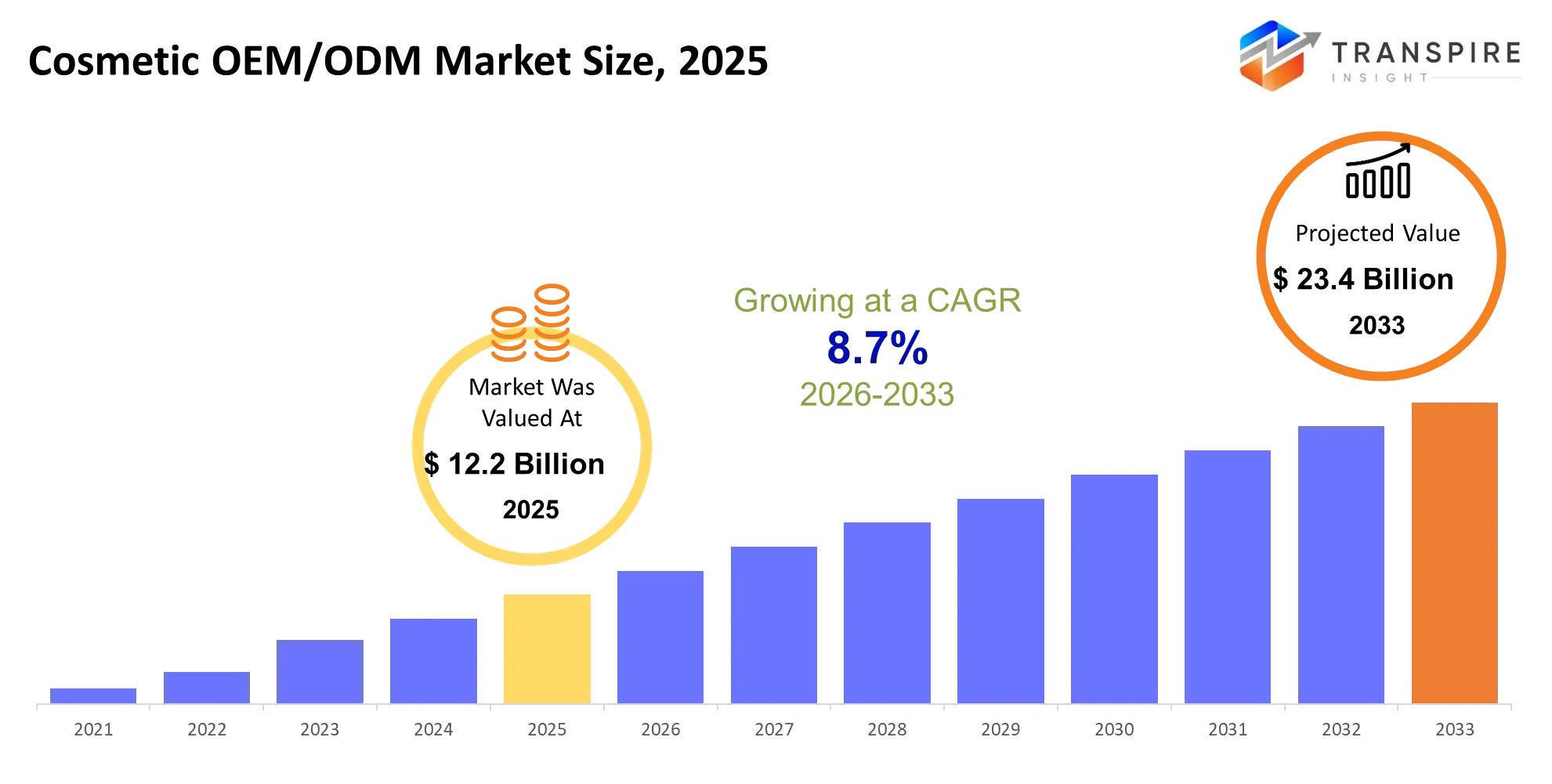
- Market Value (2025): USD 12.2 Billion.
- Expected Market Value (2026): USD 13.1 Billion.
- Estimated Market Value (2033): USD 23.4 Billion.
- Forecast CAGR (2026-2033): 8.7%.
- Leading Region in 2025: Asia Pacific
- Second-largest Region: North America
- Fastest Growing Region: Europe
Introduction
The Cosmetic OEM/ODM Market is composed of specialized contract manufacturing and product development offerings that allow beauty and personal care brands to outsource cosmetics production in an efficient manner. Original Equipment Manufacturers (OEMs) make products to the customer’s recipe and specification. Original Design Manufacturers (ODMs) are full-service, providing research, formulation, product development, regulatory compliance, packaging and mass production. The market enables brands to speed up product launches, improve operational efficiency and reduce the capital investment in manufacturing infrastructure. Furthermore, increasing demand for private label cosmetics, clean beauty products, customized formulations and sustainable packaging is further augmenting the market growth. Continuous innovation in cosmetic science, the constant development of new ingredients, and adaptable manufacturing processes are also making OEM and ODM suppliers the strategic partners of beauty brands looking for quality, scalability, regulatory compliance, and quicker time-to-market in the multiple consumer markets they target.
For instance:-
- OEM/ODM providers are making strong investments in advanced cosmetic formulations, AI-enabled product development and premium private-label manufacturing to support innovation, regulatory compliance and rapid commercialization for leading beauty brands.
- With its strict cosmetic regulations, sustainability-driven manufacturing and expertise in premium formulation, Europe is the place to go for certified OEM/ODM partners serving luxury, clean beauty and science-backed cosmetic brands.
Key Market Highlights: -
- Asia Pacific is expected to grow at a rapid CAGR in the Cosmetic OEM/ODM Market by holding around 40% of the share during the forecast period.
- North America is anticipated to hold roughly 33.8% share of the Cosmetic OEM/ODM Market over the predicted timeframe.
- Europe is anticipated to hold nearly 25% share of the Cosmetic OEM/ODM Market over the predicted timeframe.
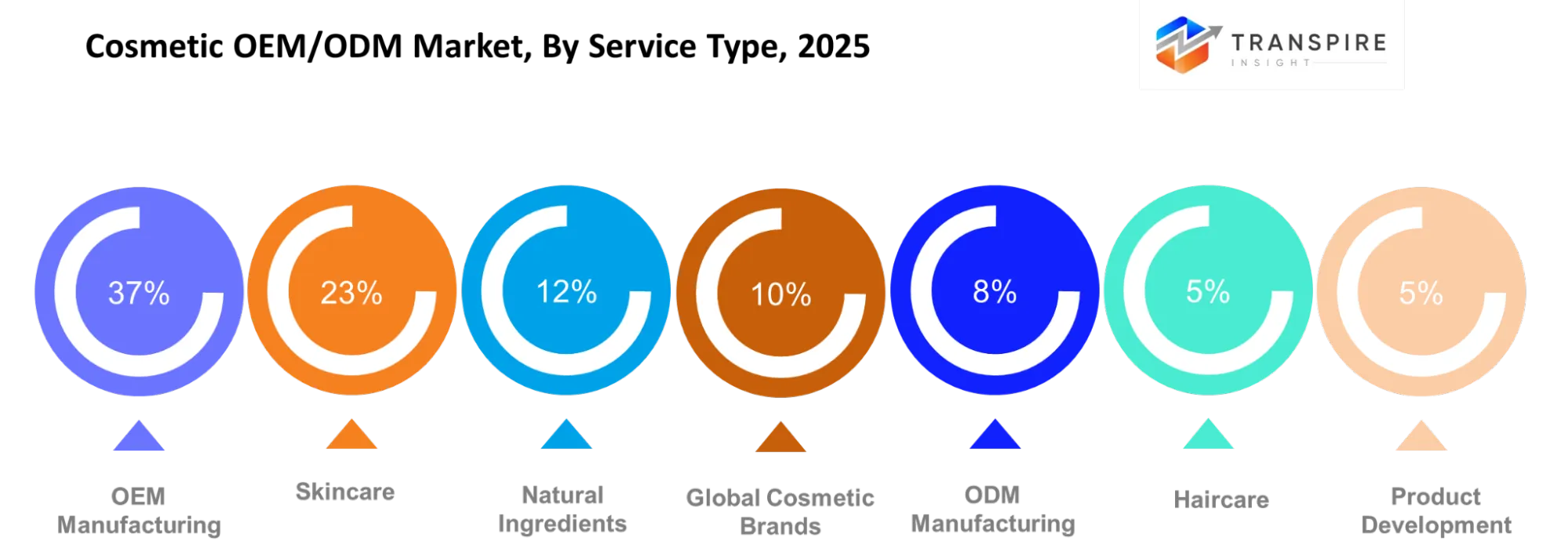
- By Service Type, the oem manufacturing dominated the market and holds nearly 55% share in 2025 and is projected to grow at a substantial CAGR during the forecast period.
- By Product Type, the Skincare dominated the market and holds close to 40% share in 2025 and is projected to grow at a substantial CAGR during the forecast period.
- By Ingredient Type, the Natural ingredients dominated the market and holds about 65% share in 2025 and is projected to grow at a substantial CAGR during the forecast period.
- In the Cosmetic OEM/ODM Market, government initiatives such as manufacturing incentives, export promotion programs, MSME support, and strict cosmetic safety regulations are improving production capabilities, regulatory compliance, product quality, and competitiveness.
How is Technology Driving Growth in the Cosmetic OEM/ODM Market?
Technology is fueling growth for the Cosmetic OEM/ODM Market through product innovation, manufacturing efficiency and speed to market. Artificial intelligence enables data-driven development of formulations, personalized cosmetic solutions and accelerated product testing. Biotechnology and advanced delivery systems for ingredients improve product performance and safety. Smart manufacturing with automation and digital quality control improves production efficiency and ensures consistent quality standards. Additionally, virtual collaboration platforms enhance communication between brands and manufacturers. Sustainable processing technologies and eco-friendly production practices allow brands to meet regulations and minimize the environmental footprint, while satisfying the growing demand for clean and sustainable beauty products.
Market Drivers
The Cosmetic OEM/ODM Market is fueled by increasing investments in advanced manufacturing facilities, research and development and innovative cosmetic formulations. The brands are partnering with OEM/ODM manufacturers for cost-effective and scalable production due to the rising demand for private-label cosmetics, clean beauty products, and sustainable packaging. Independent and Direct to Consumer (D2C) beauty brands are increasingly outsourcing to reduce capital investment and cut down product development cycles. Continuous innovation in artificial intelligence, biotechnology, automation and smart manufacturing are improving formulation precision, production efficiency and quality control. Strong manufacturing ecosystems across Asia and Europe also enable innovation, regulatory compliance, expansion and long-term market growth.
For Instance: The Asia Pacific region dominates the cosmetic OEM/ODM manufacturing market due to its huge production capacity, ongoing R&D investments, K-beauty innovations, affordable manufacturing and a high demand from both international and emerging beauty brands.
Restrain
The Cosmetic OEM/ODM Market is challenged by complex international cosmetic regulations, changing ingredient restrictions and tough product safety requirements that increase the costs of compliance. Proprietary formulations raise IP concerns for brand owners using third party production and this remains a key risk. Moreover, price fluctuations in raw materials, disruptions in the supply chain, and the costs of logistics impact the efficiency and profitability of manufacturing. Third, how to ensure product quality consistency at large scale production is critical to protect brand reputation and regulatory compliance.
Analysis of Prices and Consumer Behaviour
OEM manufacturing services hold the lion’s share of the cosmetic OEM/ODM services market, with a share of approximately 58% of the total market. This is mainly driven by the huge demand for affordable and scalable manufacturing solutions by the beauty, skincare, personal care, and private-label cosmetic brands. Premium OEM/ODM services including advanced formulation development, regulatory compliance, sustainable ingredients, and customized packaging, are estimated to cost 30-40% more than regular manufacturing services, primarily due to the increased R&D investment, quality assurance and value-added product development. Skin and Personal Care manufacturing makes up about 52% of all manufacturing contracts, supported by consistent consumer demand and ongoing product innovation.OEM/ODM services for the skincare & personal care industry account for nearly 48% of the world’s demand. The purchasing behavior shows that around 60% of beauty brands consider product quality, formulation innovation, regulatory compliance and manufacturing reliability as the key factors to choose OEM/ODM partners. Moreover, nearly 35% of brands are opting for long-term manufacturing agreements and strategic partnerships to cut down manufacturing costs, ensure supply chain stability, speed up product launches, and provide consistent product quality in the markets
Top Companies in the Cosmetic OEM/ODM Market
- Intercos Group
- COSMAX
- Kolmar Korea
- Nihon Kolmar
- Mana Products
- Toyo Beauty
- Fareva
- Chromavis
- Ancorotti Cosmetics
- BioTruly
- Cosmecca Korea
- HCT Group
- KDC/One
- Nox Bellow Cosmetics
- Ridgepole
Cosmetic OEM/ODM Market Segmentation
The Cosmetic OEM/ODM Market share is divided into five categories: By Service Type, By Product Type, By Ingredient Type, By Distribution Channel, By End User.
The OEM Manufacturing dominated the market, accounting for nearly 55% in 2025 and is expected to rise at a significant CAGR during the forecast period.
The Cosmetic OEM/ODM Market is segmented by service type into oem manufacturing, odm manufacturing, private label manufacturing, custom formulation, packaging services, contract filling, product development, others. Among these, the OEM Manufacturing dominated the market, accounting for nearly 55% in 2025 and expected to increase at a significant CAGR during the forecast period. OEM manufacturing was predominant owing to growing demand for cost-efficient and scalable production, faster commercialization, regulatory compliance, customized formulations, and established manufacturing expertise.
The Skincare dominated the market, accounting for close to 40% in 2025, and is expected to rise at a significant CAGR during the forecast period
The Cosmetic OEM/ODM Market is segmented by product type into skincare, haircare, colour cosmetics, fragrances, personal care, oral care, men's grooming, others. Among these, the Skincare dominated the market, accounting for close to 40% in 2025 and expected to increase at a significant CAGR during the forecast period. Skincare was the leading category, with consumer demand increasing for premium formulations, anti-ageing products, clean beauty innovations and constant new product launches.
The Natural ingredients dominated the market, accounting for about 65% in 2025 and is expected to rise at a significant CAGR during the forecast period.
The Cosmetic OEM/ODM Market is by ingredient type into natural ingredients, organic ingredients, synthetic ingredients, vegan ingredients, herbal ingredients, bio-based ingredients, active ingredients, others. Among these, the Natural ingredients dominated the market, accounting for about 65% in 2025 and expected to increase at a significant CAGR during the forecast period. Natural ingredients ruled the roost driven by rising consumer inclination towards clean beauty, sustainable formulations, skin-friendly products, regulatory compliance and premium cosmetic innovations.
Regional Segment Analysis of the Cosmetic OEM/ODM Market
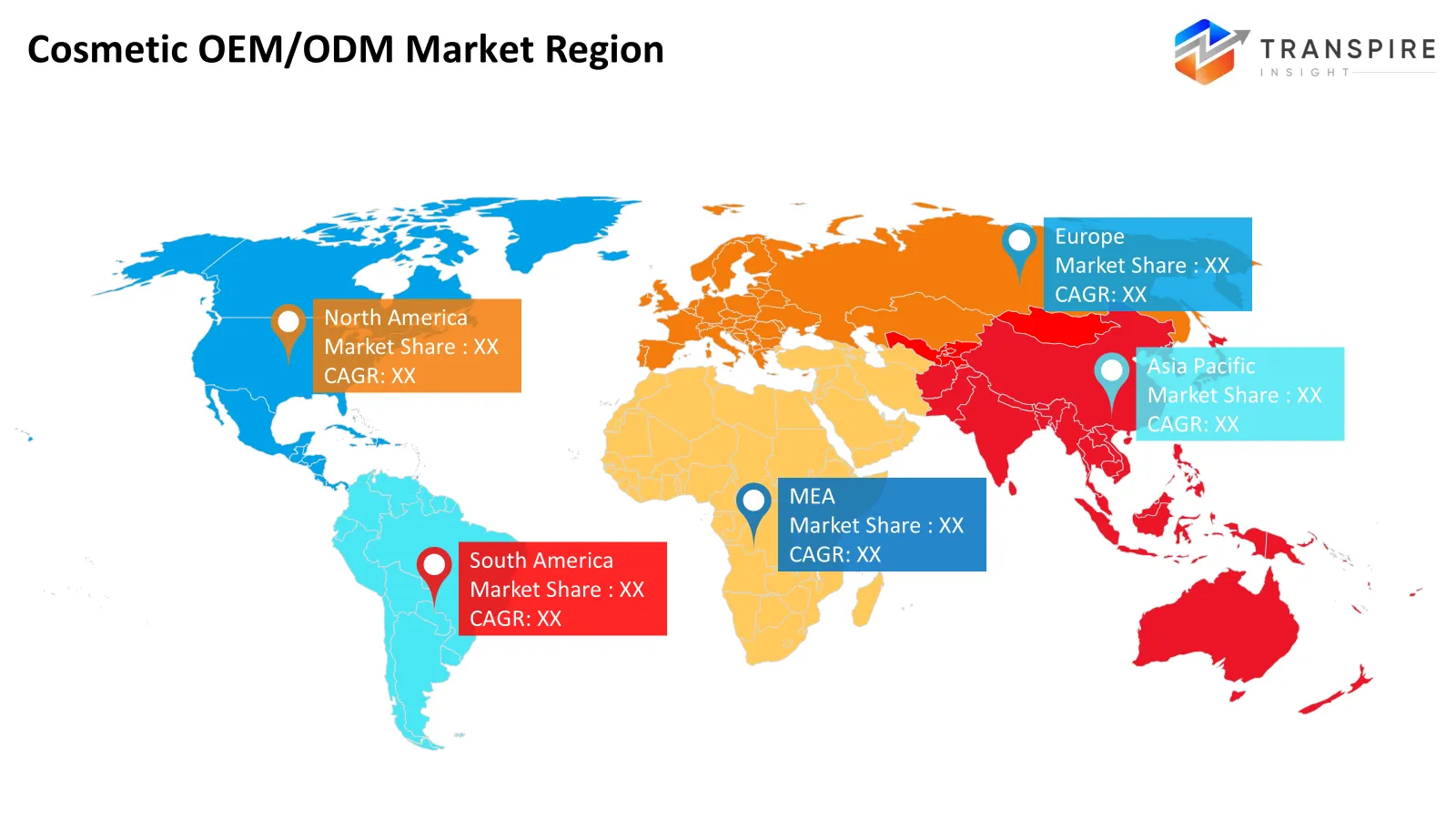
- Europe (Germany, France, U.K., Italy, Spain, Rest of Europe)
- North America (U.S., Canada, Mexico)
- Asia-Pacific (China, Japan, India, Rest of APAC)
- South America (Brazil and the Rest of South America)
- The Middle East and Africa (UAE, South Africa, Rest of MEA)
Asia Pacific is expected to grow at a rapid CAGR in the Cosmetic OEM/ODM Market, holding around 40% of the share during the forecast period.
The Asia Pacific is expected to witness the fastest growth in the Cosmetic OEM/ODM Market due to the presence of well-established manufacturing infrastructure, cost-effective manufacturing base and continued investments in research and development.The region is benefiting from strong cosmetic manufacturing hubs in South Korea, China and Japan, rising demand for private label beauty products, expanding K-beauty and J-beauty trends, increasing outsourcing by brands and rising adoption of innovative, sustainable and customized cosmetic formulations.
North America is the fastest-growing region in the Cosmetic OEM/ODM Market during the period, holding roughly 33.8% share.
North America is the fastest growing region in the Cosmetic OEM/ODM Market, due to the rising demand for premium skincare, clean beauty products and private label cosmetics. The region is well catered with strong investment in R&D, state-of-the-art formulation technologies and AI-driven product innovation. The factors that continue to drive regional market growth are increasing outsourcing by established beauty brands and emerging direct-to-consumer companies, stringent quality standards, sustainable manufacturing practices, and high consumer spending on personal care products.
Europe is the fastest-growing region in the Cosmetic OEM/ODM Market during the period, holding nearly 25% share.
Europe is the fastest growing region in the Cosmetic OEM/ODM Market, driven by its strong expertise in premium cosmetic formulations, sustainable manufacturing and strict regulatory compliance. The growing research & development, the increasing demand for clean beauty and luxury personal care products, and the presence of globally recognized OEM/ODM manufactures are supporting the growth of the region. Since the pandemic, Europe’s competitive position and long-term market growth have been further supported by increasing investments in innovative ingredients, eco-friendly packaging and high-quality private-label cosmetics.
Strategies for Market Growth in Non-Leading Regions:
The development of non-leading regions through cost-effective, scalable and technologically advanced cosmetic OEM/ODM manufacturing capabilities would increase the competitiveness of small and medium sized manufacturers. The setting up of regional formulation laboratories, contract manufacturing facilities and packaging units can bring down import dependence, shorten production lead times and lower manufacturing costs. Developing strategic partnerships with beauty brands, personal care companies, ingredient suppliers, packaging suppliers and retail distributors can support the expansion of commercial opportunities and increase market penetration. Training programs in cosmetic formulation, Good Manufacturing Practices (GMP), regulatory compliance, quality assurance and sustainable manufacturing will enhance the capabilities of the workforce, thus improving production standards and operational efficiency. Flexible financing models, long-term manufacturing agreements, private-label partnerships and contract production services will also make it more accessible for emerging brands and help develop businesses. Investment will be further spurred, access to markets improved, innovation spurred, and sustainable growth across the developing world fostered through partnerships with government manufacturing programs, export promotion agencies, industry associations, and digital commerce platforms.
Future Market Trends for the Cosmetic OEM/ODM Market: -
- Clean Beauty and Sustainable Manufacturing: The rising demand for clean-label cosmetics, plant-based ingredients, biodegradable packaging, and environmentally responsible manufacturing practices will prompt OEM/ODM providers to expand their sustainable production capabilities worldwide.
- Advanced Technologies and Smart Formulation: Artificial intelligence, biotechnology, digital formulation platforms and advanced ingredient research will drive product innovation, customized cosmetic development, manufacturing efficiency and regulatory compliance in markets.
- Growth of Private-Label and Indie Beauty Brands: Outsourcing, flexible manufacturing solutions, faster product commercialization and long-term strategic OEM/ODM partnerships will be driven globally by increasing demand from private-label, direct-to-consumer and emerging beauty brands.
Recent Development
- In January 2026: Leading cosmetic OEM/ODM manufacturers expanded their AI-enabled formulation platforms for faster product customization, more accurate formulations and accelerated product development for beauty brands.
- In March 2026: Major OEM/ODM companies are driving innovation in anti-aging and functional cosmetics and science-backed beauty product development through skin microbiome and biotech-based skin care product formulations.
Market Segment
This study forecasts revenue at global, regional and country levels from 2020 to 2033. Transpire Insights has segmented the Cosmetic OEM/ODM Market based on the below-mentioned segments:
Cosmetic OEM/ODM Market, By Service Type
- OEM Manufacturing
- ODM Manufacturing
- Private Label Manufacturing
- Custom Formulation
- Packaging Services
- Contract Filling
- Product Development
- Others
Cosmetic OEM/ODM Market, By Product Type
- Skincare
- Haircare
- Colour Cosmetics
- Fragrances
- Personal Care
- Oral Care
- Men's Grooming
- Others
Cosmetic OEM/ODM Market, By Ingredient Type
- Natural Ingredients
- Organic Ingredients
- Synthetic Ingredients
- Vegan Ingredients
- Herbal Ingredients
- Bio-based Ingredients
- Active Ingredients
- Others
Cosmetic OEM/ODM Market, By Distribution Channel
- Direct Sales
- Brand Owners
- E-commerce Brands
- Retail Chains
- Beauty Salons
- Distributors
- Export Channels
- Others
Cosmetic OEM/ODM Market, By End User
- Cosmetic Brands
- Startups
- D2C Brands
- Pharmacies
- Beauty Clinics
- Spa Chains
- Retailers
- Others
Cosmetic OEM/ODM Market, By Regional Analysis
North America
- US
- Canada
- Mexico
Europe
- Germany
- UK
- France
- Italy
- Spain
- Russia
- Rest of Europe
Asia Pacific
- China
- Japan
- India
- South Korea
- Australia
- Rest of Asia Pacific
South America
- Brazil
- Argentina
- Rest of South America
Middle East & Africa
- UAE
- Saudi Arabia
- Qatar
- South Africa
- Rest of the Middle East & Africa
Frequently Asked Questions
Find quick answers to common questions.
Rising demand for private-label cosmetics, clean beauty products, customized formulations, sustainable manufacturing, and outsourcing by beauty brands drives market growth.
OEM/ODM services reduce manufacturing costs, accelerate product launches, provide formulation expertise, ensure regulatory compliance, and enable scalable production capabilities.
Asia Pacific dominates through advanced manufacturing infrastructure, cost-efficient production, strong cosmetic exports, continuous innovation, and expanding K-beauty and J-beauty industries.
OEM manufacturing leads the market due to cost-effective production, customized formulations, regulatory expertise, faster commercialization, and large-scale manufacturing capabilities.
Future opportunities include AI-powered formulation, biotechnology, sustainable packaging, personalized cosmetics, private-label expansion, and digital manufacturing technologies for brands.
- Intercos Group
- COSMAX
- Kolmar Korea
- Nihon Kolmar
- Mana Products
- Toyo Beauty
- Fareva
- Chromavis
- Ancorotti Cosmetics
- BioTruly
- Cosmecca Korea
- HCT Group
- KDC/One
- Nox Bellow Cosmetics
- Ridgepole
About the Authors

Chetan Dhatrak
I’m Chetan Dhatrak, a Senior Research Analyst at Transpire Insight, specializing in the Consumer Goods, Foods and Beverages industry. I focus on analyzing market trends, consumer behavior, competitive landscapes, and industry developments to deliver accurate, data-driven insights. My research at Transpire Insight is built on credible sources and in-depth analysis, helping businesses and readers better understand market dynamics, emerging opportunities, and evolving consumer preferences. I’m committed to creating reliable, well-researched content that supports informed decision-making and reflects the latest developments in the consumer goods and food & beverage sectors.

Chakradhar Khansole
Chakradhar serves as the Research Director at Transpire Insight, bringing over 8 years of experience in technology, innovation, and strategic market intelligence. He specializes in transforming complex market data into actionable business insights that enable organizations to make informed, growth-oriented decisions. Recognized for his strategic vision and analytical expertise, Chakradhar leads high-impact research initiatives, delivering comprehensive market assessments, competitive intelligence, and forward-looking industry analysis.
Recently Published Reports
-
Apr 2026
Bottled Water Market
Bottled Water Market Size, Share & Analysis Report By Product Type (Still Bottled Water, Carbonated Bottled Water, Functional Bottled Water, and Others), By Packaging (PET, Cans, and Others), By Sales Channel (Supermarkets/Hypermarkets, Convenience Stores/Drug Stores, Grocery Stores/Club Stores, Foodservice, and Others) and Geography (North America, Europe, Asia-Pacific, Middle East and Africa, South and Central America), 2021 - 2032
-
Apr 2026
Color Cosmetic Packaging Market
Color Cosmetic Packaging Market Size, Share & Analysis Report By Application (Mascara Packaging, Liquid Packaging, and Liquid Face), By Type (Tubes & Bottles, Pens & Markers, Compacts & Containers, and Droppers & Pumps), and Geography (North America, Europe, Asia-Pacific, Middle East and Africa, South and Central America), 2021 - 2031
-
Apr 2026
External Microphone For Camera Market
External Microphone For Camera Market Size, Share & Analysis Report By Type (Shotgun Microphone, Lavalier Microphone, and Others), By Application (Digital Camera, Professional Video Camera, and Others), and Geography (North America, Europe, Asia-Pacific, Middle East and Africa, South and Central America), 2021 - 2031
-
Apr 2026
Foot Orthotic Insoles Market
Foot Orthotic Insoles Market Size, Share & Analysis Report By Type (Pre-fabricated, and Custom-made), By Material (Thermoplastic, Composite Carbon Fiber, and Others), By Distribution Channel (Drug Stores, Hospitals & Clinics, and Others), and Geography (North America, Europe, Asia-Pacific, Middle East and Africa, South and Central America), 2021 - 2031