

Asia Pacific Enclomiphene Market Summary
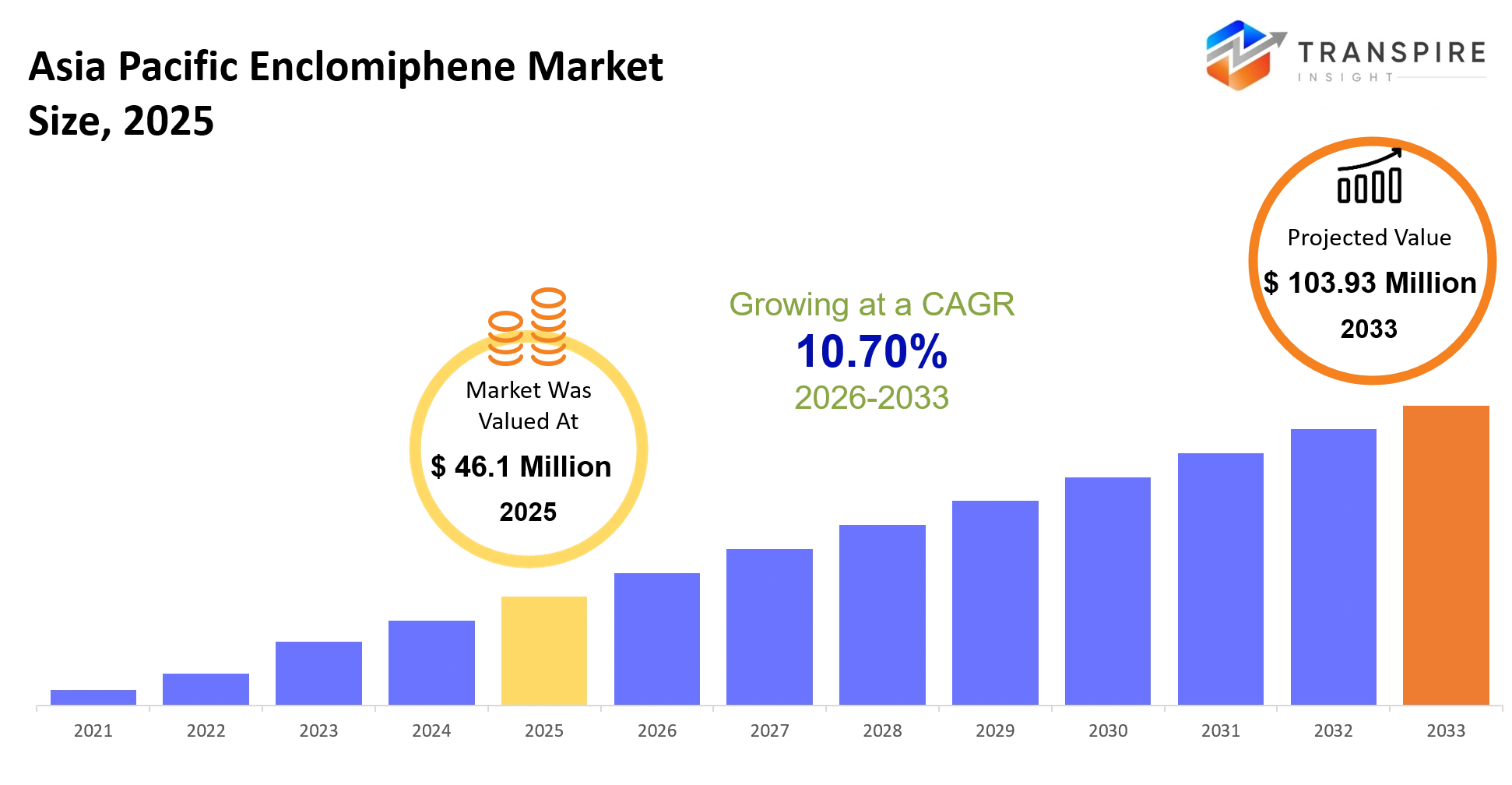
As per Transpire Insight Analysis the Asia Pacific Enclomiphene Market size is estimated at USD 46.1 Million in 2025 and is anticipated to reach USD 103.93 Million by 2033, growing at a CAGR of 10.70% from 2026 to 2033.
The Asia Pacific Enclomiphene Market kinda helps fertility clinics , endocrinologists ,and men’s health specialists too, by offering a treatment choice that aims to restore natural testosterone production while also keeping fertility intact. It addresses a real-world problem for men with secondary hypogonadism who want to dodge conventional testosterone replacement therapy, or at least delay it. Over the last three to five years, things in the market have moved toward fertility-preserving hormonal approaches, because many physicians now prefer methods that help stimulate internal hormone production rather than relying on long term hormone replacement. That shift picked up steam after health systems resumed regular reproductive and endocrine care once pandemic disruptions eased , so there’s now a bigger queue of patients needing diagnosis and treatment. Also, as male fertility assessments get more baked into routine reproductive healthcare, doctors are now noticing eligible patients earlier, and then suggesting more targeted therapies. This little shift is pushing prescription volume growth, which in turn pushes regional distribution partnerships around, and it also opens up stronger commercial opportunities for pharmaceutical companies across Asia Pacific.
Asia Pacific Enclomiphene Market Size & Forecast:
- Asia Pacific Enclomiphene Market Size 2025: USD 46.1 Million
- Expected Market Value 2033: USD 103.93 Million
- Forecast CAGR: 10.70%
- Leading region in 2025: East Asia
- Fastest Growing region: South Asia
- Key Profile: Repros Therapeutics, Veru Inc., Marius Pharmaceuticals, Empower Pharmacy, Ferring Pharmaceuticals, Sun Pharmaceutical, Cipla, Dr. Reddy's Laboratories, Lupin, Zydus Lifesciences, Torrent Pharmaceuticals, Viatris, Pfizer, Teva Pharmaceutical Industries, Sanofi
Key Market Insights
- East Asia kind of dominated the Asia Pacific Enclomiphene Market, with about 43% market share in 2025, and that’s backed up by advanced specialty clinics plus more robust pharmaceutical distribution networks.
- South Asia is expected to grow the quickest during 2025–2033, mainly because fertility services are expanding and there is more private healthcare investment, going in bit-by-bit but steady.
- In the product split, prescription enclomiphene tablets led with roughly 72% share in 2025, which also shows physician preference for easy oral dosing, not a surprise really.
- For distribution, hospital pharmacy remained the second-largest segment. This is happening because specialist endocrinology and fertility consultations keep widening across major metropolitan healthcare systems, even if adoption varies by location.
- Online pharmacy channels are forecast to see the fastest growth through 2033, supported by regulated digital prescription platforms and the ongoing rise of teleconsultation services.
- When it comes to use cases, male secondary hypogonadism treatment took the lead with around 61% market share in 2025, largely due to earlier diagnosis and more structured hormone management protocols.
- Male infertility management should become the fastest-growing application through 2033, as fertility preservation starts gaining bigger clinical importance over time.
- Looking at end users, specialty fertility clinics accounted for nearly 48% of revenue in 2025, benefiting from integrated reproductive as well as endocrine treatment pathways.
- Meanwhile specialized men's health centers are projected as the fastest-growing end user group, as dedicated hormonal health programs expand across many major Asia Pacific cities, steadily and in parallel.
What are the Key Drivers, Restraints, and Opportunities in the Asia Pacific Enclomiphene Market?
The main growth engine is basically the shift toward fertility-keeping hormonal therapy for men who have secondary hypogonadism . Newer clinical practice trends , plus the fact that reproductive medicine services keep getting broader , have pushed many physicians to prefer regimens that actually nudge the body’s own testosterone production rather than leaning on long- term replacement therapy. In practice, this kind of change can give patients more treatment flexibility when they’re thinking about future parenthood. With more referrals coming in from fertility specialists, prescription volumes tend to rise, pharmaceutical distribution gets stronger, and revenue prospects open up across hospital setups and specialty clinic networks.
The biggest restraint is still limited regulatory buy-in and uneven reimbursement , across the Asia Pacific health systems. In a lot of places, clinicians still depend on imported specialty therapies, or they face restricted prescribing routes. Regulatory evaluations tend to demand a lot of clinical evidence, and those reviews can’t be wrapped up fast. As a result, timelines for market entry can stretch by multiple years in certain jurisdictions , which slows commercial launch timing and dampens possible revenue. From the Transpire Insight review of regional procurement notices and launch schedules, supply chain concentration appears to be the primary delivery execution risk. Also, relying on just a small group of manufacturers adds more procurement uncertainty than people might expect, and that’s not trivial.
The best opportunity seems to come from blending digital men’s health platforms with fertility- centered endocrine care, and it kinda makes sense when you zoom in a bit. With telemedicine, electronic prescribing, and AI- assisted patient monitoring, treatment continuity can get a boost, and at the same time specialist access can stretch beyond just the biggest cities. In South Asia, the conditions look especially favorable because private fertility infrastructure keeps expanding at a fast pace. So, pharmaceutical companies that set up regional manufacturing partnerships, along with physician education programs, will likely be the ones that are positioned better for the next phase of market growth.
What Has the Impact of Artificial Intelligence Been on the Asia Pacific Enclomiphene Market?
Artificial intelligence and digital technologies are, um, getting better at improving operational efficiency across the Asia Pacific enclomiphene industry, mostly by helping with clinical decision-making, prescription management, and patient follow-up. Hospitals and special fertility centers in particular increasingly use AI-enabled electronic medical record systems, to automate hormone monitoring timetables, spot abnormal lab findings, and enhance treatment compliance, which sounds simple but it really adds up. Machine learning models also help clinicians forecast prescription demand, refine pharmaceutical stock levels, and lessen medicine shortages across regional distribution routes.
On the clinical side, predictive analytics can sort of help providers interpret hormone response trends, so the treatment plan can be adjusted before any real measurable clinical decline starts to show up. Overall these kinds of tools usually lower the number of unnecessary follow up visits, they can also reinforce therapy adherence, and they help with more efficient use of specialist capacity, honestly it makes the workflow smoother.Digital consultation platforms are also expanding access to endocrine support in underserved places, while cutting down the time until treatment starts. Meanwhile pharmaceutical companies are tapping advanced analytics too, to improve production scheduling and anticipate regional procurement needs.
Still, it’s not all smooth sailing. Widespread AI adoption is held back by scattered healthcare data, limited between-system interoperability among hospitals and the pretty high cost of folding advanced clinical software into existing infrastructure, almost like bolting new parts onto old machinery. On top of that, differences in data quality across countries can reduce predictive accuracy, so physician oversight stays essential, especially for treatment decisions that involve fertility, hormonal therapies and related nuance.
Key Market Trends
- Fertility preserving hormone therapy sort of got more routine acceptance from physicians between 2022 and 2025, and it started swapping out the usual testosterone replacement more often for patients who actually qualify, bit by bit, not all at once.
- After 2021 digital consultations grew a lot, which made it easier for endocrinologists to run hormone therapy even when patients are far away, like geographically separated populations and all that.
- During 2024 and 2025 regional pharmaceutical licensing deals moved faster, and that helped make commercial access better for these specialized men’s health therapies, yes.
- Specialty fertility clinics also put money into integrated endocrine services, so multidisciplinary care models became more common across the big Asia Pacific healthcare markets.
- Online pharmacy participation increased after stricter digital prescription rules rolled in, and somehow this improved patient access while still staying in line with regulatory compliance requirements.
- Clinical research has been leaning more into longer term fertility outcomes next to testosterone restoration, and that trend is already nudging future product placement and physician prescribing behavior, in practice.
- Meanwhile South Asia pulled in higher private healthcare investment between 2023 and 2025, supporting the growth of reproductive medicine infrastructure as well as more specialist capacity.
- Pharmaceutical firms expanded partnerships with regional distributors too, mainly to strengthen localized supply chains and cut down on delivery delays that happen because of imports.
- AI supported clinical workflow tools showed up inside leading healthcare systems, improving hormone monitoring prescription management, and patient follow up efficiency across specialty settings.
Asia Pacific Enclomiphene Market Segmentation
By Formulation :
Tablets keep a really notable place, mostly due to the simple administration, fairly stable shelf life, and dosing that tends to be exact. Medical professionals often choose tablet formulations for long term treatment paths, because dose consistency supports smoother treatment management, in a way that feels more predictable. On top of that, strong production capacity and broad commercial availability also end up boosting tablet demand across different healthcare facilities, not just one.
Capsules, meanwhile, are another practical option. They make swallowing easy for many people and also help manufacturers shape various release patterns, tailored to the needs of a particular therapy. Meanwhile oral solutions can fit patients who have trouble with solid dosage forms, and they let clinicians fine tune the dose when that kind of flexibility becomes necessary. Healthcare providers may also consider liquid formulations in certain clinical circumstances where careful dosing matters more than usual.
By Indication :
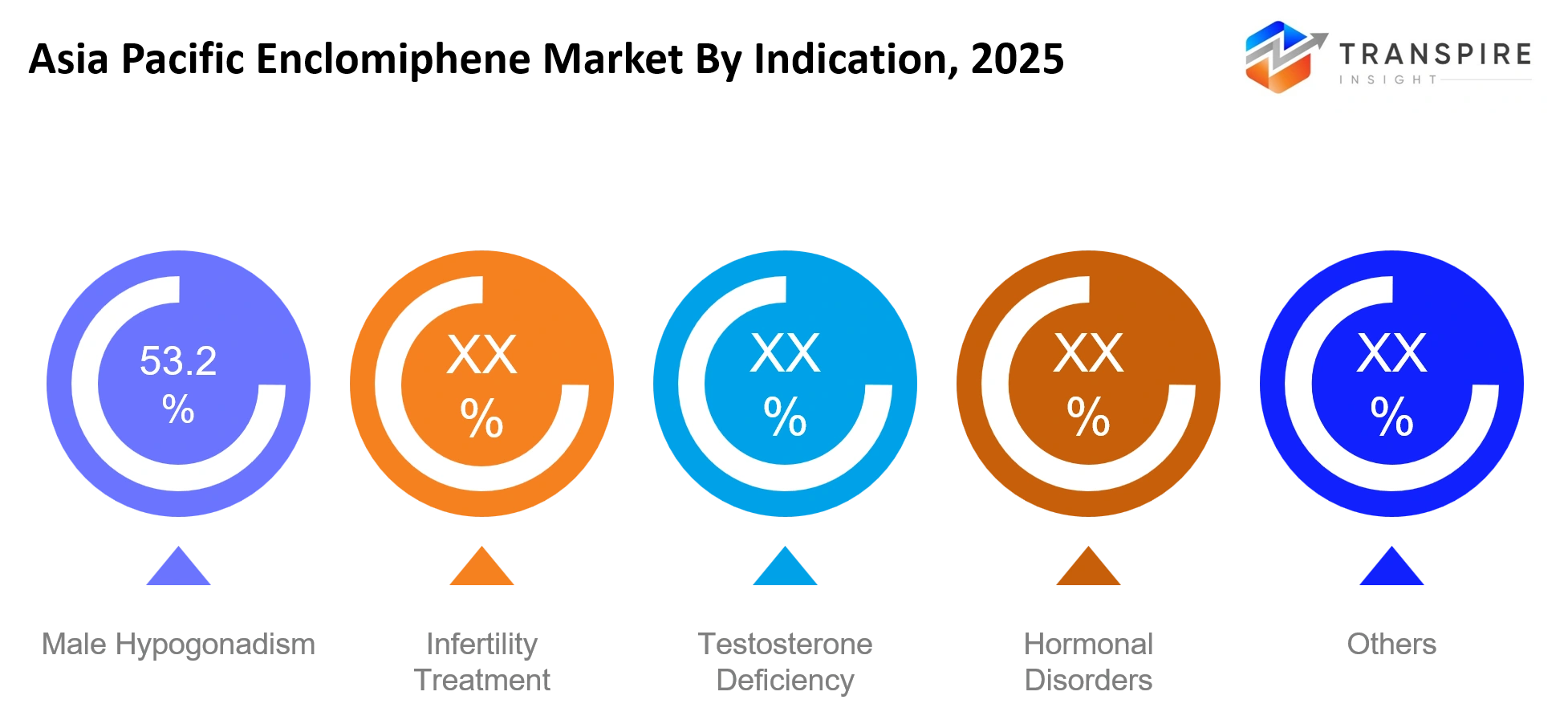
Male hypogonadism is kind of a major therapeutic use case, because the treatment mostly aims to bring hormonal stability back , while also trying to backstop natural testosterone formation. People have been giving more clinical notice to hormonal health lately, so diagnosis happens sooner and the medical response is more timely . In the same way infertility care is still an important lane, since reproductive well being gets more focus from clinicians and families too. And as fertility screening programs keep widening , there is more request for therapies that help reproductive ability, without adding extra complications.
Testosterone deficiency keeps showing consistent clinical demand, partly due to shifting lifestyles, older populations, and better public awareness around hormone related conditions. Endocrine imbalances also create more chances for treatment, because maintaining the right hormonal rhythm supports overall functioning and long term wellness. Some other reasons for care are still being reviewed, through continuing medical research that tries to open up additional therapeutic directions. With a broader clinical view moving forward, expansion into carefully studied treatment areas should become more realistic.
By Distribution Channel :
Hospital pharmacies take up a meaningful chunk, mainly since hospital-based specialists often start treatment after some detailed clinical evaluation, so yeah it matters. When physicians and the pharmacy departments coordinate well, it helps with safe dispensing and also with continuous patient monitoring, it keeps things steady. Retail pharmacies still have a key part too , especially for improving medicine availability when follow-up prescriptions happen after a specialist consultation, kind of like a bridge. And then wider pharmacy networks push patient access across both city and semi urban areas.
Online pharmacies keep getting more acceptance because digital ordering, home delivery, and competitive pricing make the whole purchase routine more convenient . Specialty pharmacies tend to concentrate on products that really need professional guidance, patient education, and ongoing treatment support, you know for continuity. Other distribution paths also contribute through local healthcare systems and specialized supply networks, which cater to different communities in different ways. Overall, expanding across multiple distribution channels boosts product accessibility, while also supporting the shift in healthcare preferences.
By End User :
Hospitals still end up being the main end users , because multidisciplinary medical teams kind of manage diagnosis, treatment planning and also patient monitoring in their structured clinical environments. With advanced diagnostic equipment, plus specialist availability, the treatment quality goes up, and it also helps with better medical decisions. Fertility clinics are another big end user category too, since reproductive health services keep expanding across a lot of countries. More fertility consultations have, in practice, increased the need for well targeted hormonal treatment options.
Specialty clinics then give more concentrated endocrine and reproductive support, by relying on experienced healthcare professionals and more customized treatment approaches . Homecare has also become more important, simply because convenient treatment management improves patient comfort and reduces those unnecessary trips back to hospitals. Other healthcare facilities continue to support local populations through outpatient care and community based medical services. Overall, a well balanced healthcare network helps widen access to treatment across different patient groups.
By Dosage Strength :
The 12.5 mg dosage strength sort of fits patients who need slow start of treatment, or really careful hormone management, but only when it’s under medical supervision. Lower strengths allow physicians to gauge the treatment response first, before they make further dosage changes , in other words step by step. The 25 mg dosage is still widely used , because a balanced therapeutic effectiveness tends to support routine clinical practice across a variety of patient groups. Over time, consistent prescribing habits have made this dosage level more accepted inside healthcare facilities.
Then there’s the 50 mg dosage , which is for patients who, after clinical assessment, need a stronger therapeutic level and then require ongoing monitoring. These customized dosage options give flexibility for individualized treatment strategies, based on specific medical needs , and also on physician guidance. Other dosage strengths keep showing up for more specialized clinical cases, where the usual strengths may not fully cover the actual treatment requirements. With broader dosage availability, treatment becomes more adaptable while still supporting personalized patient care.
What are the Key Use Cases Driving the Asia Pacific Enclomiphene Market?
Specialists in endocrinology and reproductive medicine seem to be creating the biggest pull via treatment programs that focus on male hormonal health, honestly it’s quite noticeable. Fertility clinics and hospitals still act as the main purchasers, since structured diagnosis and laboratory monitoring plus physician guided therapy help keep clinical results steady. People are paying more attention to reproductive wellness, and evidence based treatment protocols are also helping the buying momentum across organized healthcare facilities.
At the same time demand is pushing further into men’s health centers that offer preventive hormone assessment and a long term wellness approach for working age adults. Specialty clinics are adopting these services more often too, partly because personalized endocrine care is becoming standard in more places. Meanwhile licensed online pharmacy networks support refill access in regions where digital healthcare rules allow prescription based dispensing.
New opportunities are forming around telemedicine services, where patients connect with certified specialists for remote consultations and follow ups, all within regulated healthcare frameworks. Clinical research organizations are even looking at wider therapeutic pathways through controlled studies, trying to refine treatment strategies. These emerging uses are still somewhat limited right now, but they do show measurable potential as regulatory standards and clinical evidence keep moving forward.
|
Report Metrics |
Details |
|
Market size value in 2025 |
USD 46.1 Million |
|
Market size value in 2026 |
USD 51.03 Million |
|
Revenue forecast in 2033 |
USD 103.93 Million |
|
Growth rate |
CAGR of 10.70% from 2026 to 2033 |
|
Base year |
2025 |
|
Historical data |
2021 - 2024 |
|
Forecast period |
2026 - 2033 |
|
Report coverage |
Revenue forecast, competitive landscape, growth factors, and trends |
|
Regional scope |
Asia Pacific (India, China, Japan, Australia, South Korea, Rest of Asia Pacific) |
|
Key company profiled |
Repros Therapeutics, Veru Inc., Marius Pharmaceuticals, Empower Pharmacy, Ferring Pharmaceuticals, Sun Pharmaceutical, Cipla, Dr. Reddy's Laboratories, Lupin, Zydus Lifesciences, Torrent Pharmaceuticals, Viatris, Pfizer, Teva Pharmaceutical Industries, Sanofi . |
|
Customization scope |
Free report customization (country, regional & segment scope). Avail customized purchase options to meet your exact research needs. |
|
Report Segmentation |
By Formulation (Tablets, Capsules, Oral Solutions, Others); By Indication (Male Hypogonadism, Infertility Treatment, Testosterone Deficiency, Hormonal Disorders, Others); By Distribution Channel (Hospital Pharmacies, Retail Pharmacies, Online Pharmacies, Specialty Pharmacies, Others); By End User (Hospitals, Fertility Clinics, Specialty Clinics, Homecare, Others); By Dosage Strength (12.5 mg, 25 mg, 50 mg, Customized Dosage, Others) |
Which Regions are Driving the Asia Pacific Enclomiphene Market Growth?
The East Asia region makes up about 46% of total demand in the Asia Pacific Enclomiphene Market, because advanced healthcare systems and more solid pharmaceutical manufacturing power make it easier for the product to be available in wider places. There are also clear regulatory routes, well known clinical protocols, and broader access to specialist services which push consistent treatment uptake across many big economies. Add in strong medicine production networks, contract manufacturing houses, plus ongoing investment into reproductive healthcare, and you get regional supply chains and overall commercial momentum that really stay active. With continuous healthcare spending, more clinical studies, and ongoing product availability, this area should keep its lead across most of the forecast period.
For Southeast Asia, the contribution is more steady, basically through gradual healthcare growth that is backed by better insurance coverage and fairly consistent pharmaceutical rules. Delivery does look a bit different there, since private hospitals, fertility centers, and a rising retail pharmacy presence are doing a lot of the work for patient access. Economic steadiness and continued spending on healthcare infrastructure support dependable buying trends, even if the national systems don’t fully match. Stable regulatory supervision, plus improving access to healthcare, create solid long term revenue chances across the region.
South Asia is set to see the quickest pace of growth after the recent expansion of healthcare infrastructure, plus stronger awareness around reproductive health , and wider access to specialist medical services. More money is being pushed into hospital networks, as well as fertility treatment facilities, which has boosted diagnosis and treatment availability across many big urban centers. At the same time, regulatory improvements for pharmaceutical manufacturing and medicine distribution are opening up more commercial chances for suppliers. From 2026 through 2033 growth should then generate quite compelling opportunities, for manufacturers and distributors, and also for investors that want to step into high-demand healthcare markets with better clinical capacity.
Who are the Key Players in the Asia Pacific Enclomiphene Market and How Do They Compete?
Competition across the Asia Pacific Enclomiphene market is still kinda moderately fragmented, so the way companies play the game isn’t only about price, it’s more about product quality , regulatory compliance, how well they can manufacture, and how far their distribution actually goes. Big name manufacturers keep trying to lock in their position by doing portfolio expansion and getting regulatory approvals faster, meanwhile the more specialized pharmaceutical players usually lean into reproductive health offerings that are meaningfully differentiated and also use regional partnerships to grow their commercial footprint. Even with all that, formulation development innovation, supply chain dependability, and physician engagement are still major competitive levers that show up across the whole industry.
Evolve Biolabs leans into reproductive health therapies and it tries to stand out through specialized product development, mainly by targeting hormone-related treatment needs. Macleods Pharmaceuticals, on the other hand, rides on large-scale manufacturing capability and broad pharmaceutical distribution channels , so they can expand efficiently across several Asia Pacific countries. Zuventus Healthcare pushes its presence through physician engagement programs plus an expanding specialty portfolio, which supports endocrine and fertility care at the same time. Sun Pharmaceutical Industries relies heavily on deep regulatory know-how, diversified product development, and a wide commercial infrastructure to reinforce its regional reach.
In the longer run, strategic licensing arrangements, moving into additional healthcare markets, and ongoing investment in specialty pharmaceutical products are likely to stay as the core approaches, for maintaining long-term competitive advantage, and not just getting there once.
Company List
- Repros Therapeutics
- Veru Inc.
- Marius Pharmaceuticals
- Empower Pharmacy
- Ferring Pharmaceuticals
- Sun Pharmaceutical
- Cipla
- Dr. Reddy's Laboratories
- Lupin
- Zydus Lifesciences
- Torrent Pharmaceuticals
- Viatris
- Pfizer
- Teva Pharmaceutical Industries
- Sanofi
Recent Development News
In May 2026, Nova IVF Fertility announced plans to expand its fertility centre network following the Craft Fertility acquisition. The expansion initiative aimed to establish 10 new centres across Kerala over the next three to five years, improving regional access to reproductive healthcare services relevant to fertility treatment pathways. Sourcehttps://www.novaivffertility.com/
In September 2025, Hims & Hers Health launched personalized testosterone treatments featuring compounded enclomiphene through its digital platform. The launch expanded access to fertility-preserving testosterone therapy in the U.S., but it is not an Asia Pacific market development. Sourcehttps://investors.hims.com/
What Strategic Insights Define the Future of the Asia Pacific Enclomiphene Market?
The Asia Pacific Enclomiphene Market seems to be slowly shifting toward a more personalized model for male fertility and hormonal well being in the next 5–7 years, pushed by stronger clinical attention on keeping fertility intact while also tackling testosterone deficiency. There’s a kind of quiet risk though , because regulatory rules across Asia Pacific are fragmented, and the approval routes are different everywhere. That difference plus tighter scrutiny around fertility related hormonal therapies could end up delaying commercialization, even when demand signals look solid.
At the same time, there’s an emerging opening in digital fertility platforms and telehealth style treatment approaches. This could really matter in places like India, Japan, and Australia, since remote consultations can make access easier to specialized therapies that might otherwise feel out of reach. Market participants should, in practice, focus on region specific regulatory tactics, team up for clinical evidence in a credible way, and connect enclomiphene into broader fertility care ecosystems. Basically , don’t market the therapy as just a standalone product, because the integration angle feels more sustainable.
Asia Pacific Enclomiphene Market Report Segmentation
By Formulation
- Tablets
- Capsules
- Oral Solutions
By Indication
- Male Hypogonadism
- Infertility Treatment
- Testosterone Deficiency
- Hormonal Disorders
By Distribution Channel
- Hospital Pharmacies
- Retail Pharmacies
- Online Pharmacies
- Specialty Pharmacies
By End User
- Hospitals
- Fertility Clinics
- Specialty Clinics
- Homecare
By Dosage Strength
- 12.5 mg
- 25 mg
- 50 mg
- Customized Dosage
Frequently Asked Questions
Find quick answers to common questions.
The expected Asia Pacific Enclomiphene Market size for the market will be USD 103.93 Million in 2033.
Key segments for the Asia Pacific Enclomiphene Market are By Formulation (Tablets, Capsules, Oral Solutions, Others); By Indication (Male Hypogonadism, Infertility Treatment, Testosterone Deficiency, Hormonal Disorders, Others); By Distribution Channel (Hospital Pharmacies, Retail Pharmacies, Online Pharmacies, Specialty Pharmacies, Others); By End User (Hospitals, Fertility Clinics, Specialty Clinics, Homecare, Others); By Dosage Strength (12.5 mg, 25 mg, 50 mg, Customized Dosage, Others) .
Major Asia Pacific Enclomiphene Market players are Repros Therapeutics, Veru Inc., Marius Pharmaceuticals, Empower Pharmacy, Ferring Pharmaceuticals, Sun Pharmaceutical, Cipla, Dr. Reddy's Laboratories, Lupin, Zydus Lifesciences, Torrent Pharmaceuticals, Viatris, Pfizer, Teva Pharmaceutical Industries, Sanofi .
The Asia Pacific Enclomiphene Market size is USD 46.1 Million in 2025.
The Asia Pacific Enclomiphene Market CAGR is 10.70% from 2026 to 2033.
- Repros Therapeutics
- Veru Inc.
- Marius Pharmaceuticals
- Empower Pharmacy
- Ferring Pharmaceuticals
- Sun Pharmaceutical
- Cipla
- Dr. Reddy's Laboratories
- Lupin
- Zydus Lifesciences
- Torrent Pharmaceuticals
- Viatris
- Pfizer
- Teva Pharmaceutical Industries
- Sanofi
About the Authors

Pankaj Ghogare Patil
I am Pankaj Ghogare Patil, a Senior Research Analyst at Transpire Insight, specializing in the Pharmaceutical, Chemicals & Materials, Healthcare IT, and Biotechnology industry. My expertise lies in conducting comprehensive market research, analyzing industry trends, evaluating competitive landscapes, and translating complex data into actionable insights. At Transpire Insight, I closely follow emerging technologies, regulatory developments, and market innovations to create accurate, well-researched, and informative content that helps businesses and professionals make informed decisions. I am committed to producing credible, evidence-based articles that reflect industry best practices while making technical topics accessible and valuable for a broad audience.

Chakradhar Khansole
Chakradhar serves as the Research Director at Transpire Insight, bringing over 8 years of experience in technology, innovation, and strategic market intelligence. He specializes in transforming complex market data into actionable business insights that enable organizations to make informed, growth-oriented decisions. Recognized for his strategic vision and analytical expertise, Chakradhar leads high-impact research initiatives, delivering comprehensive market assessments, competitive intelligence, and forward-looking industry analysis.
Recently Published Reports
-
Apr 2026
AI in Diabetic Retinopathy Market
AI in Diabetic Retinopathy Market Size, Share & Analysis Report By Type (Screening AI Systems, Diagnostic AI Systems, and Predictive AI Models), By Application Segment (Hospitals, Ophthalmology Clinics, Diagnostic Centers, and Research and Development), and Geography (North America, Europe, Asia-Pacific, Middle East and Africa, South and Central America), 2021 - 2031
-
Apr 2026
Psychometric Tests Market
Psychometric Tests Market Size, Share & Analysis Report By Type (Personality Tests, Ability/Aptitude Tests, Skill/Knowledge Tests, and Others), By Application (Talent Acquisition and Talent Management), and Geography (North America, Europe, Asia-Pacific, Middle East and Africa, South and Central America), 2021 – 2031
-
Apr 2026
Rare Biological Sample Collection Market
Rare Biological Sample Collection Market Size, Share & Analysis Report By Type (Isolation Kits & Reagent, Blood Collection Tubes, and Others), By Application (Oncology, Transcriptomics, Pharmacogenomics, and Others), and Geography (North America, Europe, Asia-Pacific, Middle East and Africa, South and Central America), 2021 – 2031
-
Jul 2026
Diabetic Retinopathy Market
Diabetic Retinopathy Market Size, Share & Analysis Report By Type (Proliferative Diabetic Retinopathy, and Diabetic Macular Edema (DME)), By Treatment Type (Anti VEGF Drug, Steroid Implants, Laser Surgeries, and Vitrectomy), and Geography (North America, Europe, Asia-Pacific, Middle East and Africa, South and Central America), 2021 – 2031
Our Clients







