

Synthetic Abrasives Market Summary:
As per the Transpire Insight Analysis, the Synthetic Abrasives Market size is estimated at USD 458.3 billion in 2025 and is anticipated to reach USD 639.6 billion by 2033, growing at a CAGR of 4.25% from 2026 to 2033.
The worldwide synthetic abrasives market supplies engineered materials for precision cutting, grinding, polishing and surface finishing for metalworking, EVs, the electronics industry, aerospace, construction and general industrial manufacturing. Over the past 3–5 years, the industry has transitioned from heavy volume usage of generic abrasives to specification-driven demand for engineered abrasives, as a result of CNC automation, increased machining accuracy and more stringent workplace dust-control regulations. A major structural change is the ascending use of precision-engineered superabrasives, which extend tool life, enhance dimensional accuracy and increase process repeatability. A significant practical trigger has been the explosive growth in electric vehicle manufacturing and semiconductor production, where better surface quality impacts part integrity and enhances process yields. As factory automation has increased, so have finishing standards, resulting in the rapid replacement of conventional abrasives and natural abrasives by high-performance synthetics, which boost productivity, reduce materials costs, and lower total manufacturing costs.
Synthetic Abrasives Market Size & Forecast:
- Global Market Size 2025: USD 458.3 Billion
- Expected Market Value (2033): USD 639.6 Billion
- Forecast CAGR (2026–2033): 4.25%
- Leading Region in 2025: Asia Pacific (45%)
- Fastest Growing Region: North America (24% & CAGR 17.6%)
- Key Company Profiles: Saint-Gobain Abrasives, 3M, Norton Abrasives, Tyrolit, Mirka, Bosch, Fujimi Incorporated, Asahi Diamond Industrial, Henan Huanghe Whirlwind, Carborundum Universal, Sak Abrasives, Krebs & Riedel, Deerfos, Klingspor, SuperAbrasives Inc.

Key Synthetic Abrasives Market Insights:
Synthetic abrasives are becoming more than just high-volume consumables, and buyers are now selecting grain consistency, cut-rate stability and compliance, not the lowest unit price. The true drivers of the market are automation, stricter surface finish requirements, and EV, electronics, and aerospace manufacturing.
- Aluminium oxide holds the lead with 37% and continues to be the most popular option due to its cost-performance balance.
- Silicon carbide has a higher percentage of 23%; it is used where harder substrates and heat-sensitive finishing are required for sharper cutting.
- Plants are pursuing longer wheel life in high removal applications, which in turn promotes ceramic abrasives at 15%.
- CBN at 10% is gaining deeper involvement in hard alloy machining, backed by top-of-the-line OEM tool upgrades.
- Synthetic diamond at 10% is gaining ground in ultra-fine polishing, owing to precision-electronics workflows.
- Zirconia alumina is niche at 3%, but is being aggressively removed from stock in heavy fabrication.
- Others at 2% relate to customization demand, rather than commodity volume, particularly speciality blends.
- Asia Pacific accounts for 45% of the market, reflecting the region's manufacturing density, which is driving supplier investment and capacity growth.
- Advanced production and automation-driven purchasing/re-shoring are bolstering North America's 24% share.
What are the Key Drivers, Restraints, and Opportunities in the Synthetic Abrasives Market?
Driver:
The main growth driver is the move to precision manufacturing in the electric vehicles, aerospace, and electronics industries. The move to finer tolerances and surface finishes in CNC and robotic applications has led manufacturers to move towards engineered synthetic abrasives to work for them. This increases market revenues by replacing cheaper traditional abrasives with premium synthetic abrasives that will last longer, delivering more precision, less downtime, and reducing costs.
Restraint:
Volatility in raw materials of alumina and silicon carbide, dust, noise, VOCs compliance pressure, and capex costs all persist as growth inhibitors. The fundamental problem is that a large fraction of the feedstocks are still bundled into just a handful of supply chains; hence costs and availability are still vulnerable when end-demand is high.
Opportunity:
The next unlock is smart, connected abrasive machining with high-quality superabrasives in globalized manufacturing clusters. In APAC, semiconductor, aerospace and EV clusters are escalating use of automated finishing cells with IOT monitoring and anomaly detection, resulting in lower rework costs, less tool-change downtime and value justification for synthetic diamonds and CBN upgrades. This is relevant because the economics of consumables-to-process dependability are changing. Suppliers that group abrasives with data-driven monitoring, condition-based maintenance and application expertise will win higher-margin business and greater integration into customer processes.
What Has the Impact of Artificial Intelligence Been on the Synthetic Abrasives Market?
Artificial intelligence is revolutionising the synthetic abrasives market with changes to the decision-making process on purchase, from cost per product to measurable machining efficiency and process control. Intelligent vision systems, machine learning algorithms, and smart sensors monitor grinding parameters and automatically locate wheel wear, vibration, temperature spikes, and surface profile deviations in real time. This allows automatic adjustment of feed rates, grinding pressures, spindle speeds, and cooling flows for a stable surface finish, while reducing abrasive and raw material consumption.
Manufacturers employ predictive analytics to predict wheel life, proactively schedule maintenance, and proactively determine deviations from quality standards before production issues occur, reducing unplanned equipment downtime and improving overall equipment efficiency. Digital twins allow the simulation of grinding process parameters, helping process engineers optimize abrasive type and grit size without production interruption. These innovations are critical in demanding sectors including aerospace, semiconductors, and precision engineering where micron-level accuracy is required. Nevertheless, general AI adoption is limited by integration issues, as many ageing grinding operations have disconnected equipment generating inconsistent data streams, necessitating investment in sensors, unified data frameworks, upskilling personnel, and capital. As a result, small to medium enterprises are slower to implement.
In May 2026, GrindingHub showcased new self-optimising sensor and AI integrations. This event highlighted live adaptive control implementations that reduce wheel wear and improve high-precision manufacturing outputs.
Key Synthetic Abrasives Market Trends:
Synthetic abrasives are changing from industrial consumables to digitally engineered precision-engineering solutions for automated, sustainable and high-value manufacturing ecosystems. The emphasis on innovation is shifting away from production volume towards productivity, material efficiency and application-specific performance.
- Conventional grains are being replaced by engineered superabrasives for longer life and precision machining.
- Machining consistency is enhanced with AI-powered grinding analytics, which enable predictive wear monitoring and automated process optimization.
- As the use of robotic finishing cells grows, application-specific abrasives are needed that have uniform cutting performance and low vibration.
- The growth of the semiconductor industry is driving the development of ultra-fine polishing materials for advanced wafer manufacturing.
- In the aerospace sector, the demand for ceramic and CBN abrasives is increasing because they can be used to cut heat-resistant superalloys efficiently.
- Sustainability measures are being promoted to use recyclable abrasive products and low-emission bonding technologies in industrial facilities.
- Digital procurement platforms are reducing procurement cycles and driving demand for customized industrial abrasive solutions.
- Manufacturers are investing in hybrid abrasive technologies that increase productivity in electric vehicle, renewable energy, and precision engineering applications.
Synthetic Abrasives Market Segmentation
By Product Type:
Alumina Oxide Abrasives lead the market with a 37% share, driven by a balance of durability, cutting speed, and cost for general-purpose grinding/cutting/polishing applications. Silicon Carbide Abrasives capture 23% share attributed to higher hardness for brittle materials and non-ferrous metals processing, 15% from high wear resistance of Ceramic Abrasives due to automation in manufacturing, 10% from effective hardening of boron nitride with Cubic Abrasives, 10% from cutting edge high durability of Synthetic Diamond Abrasives in semiconductor and aerospace segments. 3% share goes to Zirconia Alumina Abrasives and 2% to other specialized industrial applications.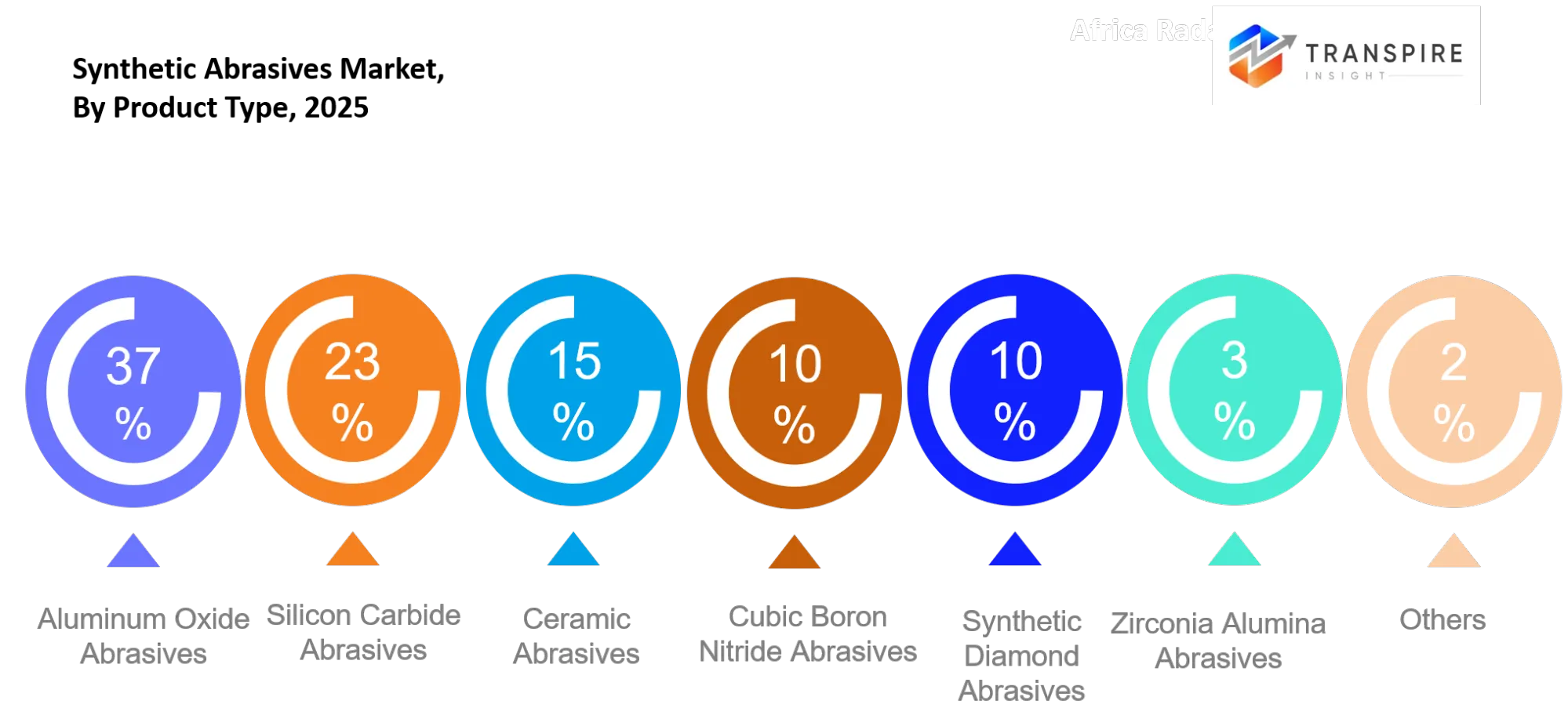
By Application:
Metal fabrication continues to dominate as it involves more incessant machining processes. They demand sustained abrasive performance and less downtime. There is rising demand for non-traditional abrasives in automobiles for electric drivetrain parts, electronics, construction, aerospace, medical devices, precision machining, etc. To support diversified long-term consumption by offering higher precision levels.
By End User:
Companies involved in manufacturing continue to lead the market for the greatest end use of synthetic abrasives, due to ongoing manufacturing needs and investments in automation. The trend is in the use of high-tech finishing systems by automotive OEMs, electronics manufacturers, construction firms, aerospace fabricators, medical device producers, and various other industrial users to achieve higher levels of precision in machining and production efficiencies.
By Form:
Industrial machining of bonded abrasives remains the most popular form, due to its robustness and high durability in abrasive machining operations, while coated abrasives are the most common abrasive for controlled finishing purposes. The market for loose abrasives, superabrasives, powders and other specialized types is steadily increasing, aided by the growing requirements from semiconductor manufacturing, precision and fine surface-finishing applications.
By Distribution Channel:
For large industrial accounts, direct sales allowing for special prices and technology access through long-term supply and in-house service contracts have replaced more traditional methods. Industrial distributors secure access to products in localized markets, while OEM suppliers are now offering integrated abrasive solutions and production equipment. Optimized purchasing processes through online B2B platforms, export, and other trading channels are increasing market range and worldwide accessibility.
What are the Key Use Cases Driving the Synthetic Abrasives Market?
The predominant application continues to be metal fabrication and automotive paint finishing, where aluminium oxide and silicon carbide are used for grinding, deburring and surface prep on a large scale.
With this as a platform, electronics polishing, aerospace finishing and precision machining are emerging as tighter Ra targets now dictate quality, yield and rework implications.
New requirements are emerging for medical devices, battery components and additive manufacturing post-processing. Here, synthetic diamond and CBN are sought for hard materials and ultra-fine finishing. The trend is therefore in the upward direction up the value chain, with higher specification synthetic grades displacing general-purpose media for surface integrity-driven applications.
|
Report Metrics |
Details |
|
Market size value in 2025 |
USD 458.3 Billion |
|
Market size value in 2026 |
USD 477.8 Billion |
|
Revenue forecast in 2033 |
USD 639.6 Billion |
|
Growth rate |
CAGR of 4.25% from 2026 to 2033 |
|
Base year |
2025 |
|
Historical data |
2021 - 2024 |
|
Forecast period |
2026 - 2033 |
|
Report coverage |
Revenue forecast, competitive landscape, growth factors, and trends |
|
Regional scope |
United States; Canada; Mexico; United Kingdom; Germany; France; Italy; Spain; Denmark; Sweden; Norway; China; Japan; India; Australia; South Korea; Thailand; Brazil; Argentina; South Africa; Saudi Arabia; United Arab Emirates |
|
Key companies profiled |
Saint-Gobain Abrasives, 3M, Norton Abrasives, Tyrolit, Mirka, Bosch, Fujimi Incorporated, Asahi Diamond Industrial, Henan Huanghe Whirlwind, Carborundum Universal, Sak Abrasives, Krebs & Riedel, Deerfos, Klingspor, SuperAbrasives Inc. |
|
Customization scope |
Free report customization (country, regional & segment scope). Avail customized purchase options to meet your exact research needs. |
|
Report Segmentation |
By Product Type (Aluminum Oxide Abrasives, Silicon Carbide Abrasives, Cubic Boron Nitride Abrasives, Synthetic Diamond Abrasives, Zirconia Alumina Abrasives, Ceramic Abrasives, Coated Abrasives, Others); By Application (Metal Fabrication, Automotive, Electronics, Construction, Aerospace, Medical Devices, Precision Machining, Others); By End User (Manufacturing, Automotive OEMs, Electronics Industry, Construction Companies, Aerospace Industry, Medical Equipment Manufacturers, Others); By Form (Bonded Abrasives, Coated Abrasives, Loose Abrasives, Superabrasives, Abrasive Powders, Others); By Distribution Channel (Direct Sales, Industrial Distributors, OEM Suppliers, Online B2B Platforms, Exporters, Others) |
Which Regions are Driving the Synthetic Abrasives Market Growth?
Asia Pacific has a 45% share and is ahead as it combines the largest manufacturing base with robust demand from the metalworking, automotive, electronics and construction supply chains. Policy support for domestic industrial production, strong export infrastructure and large investment in plant means the region is ahead; China and India lead demand while extensive integrated supplier ecosystems allow shorter conversion cycles and high abrasive consumption. This position is kept alive by the region being able to quickly absorb demand for both standard and premium synthetic grades.
Europe has a 24% share of the market, yet with a different growth logic, depending more on quality-intensive manufacturing rather than volume expansion. Europe enjoys stable aerospace, automotive, and precision engineering demand, as well as stringent efficiency and environmental regulations. The compliance requirements exert pressure for the use of lower dust, longer-lifespan abrasives. Relative to Asia Pacific, Europe is smaller in scale, but more predictable in product mix and pricing discipline.
In March 2026, AV&R announced a collaboration with Saint-Gobain Abrasives to combine high-performance abrasive technology with robotic automation. This partnership addresses complex European manufacturing constraints by raising process precision and repeatability.
North America is the most dynamic market, growing at a 17.6% CAGR with a 24% share, driven by a resurgence in reshoring, automation, and innovative machining processes. New investment in automotive, aerospace and semiconductor value chains is boosting demand for high-precision finishing solutions. The opportunity in the region is most attractive where robotics, digital inspection and high-end superabrasives meet. That puts North America squarely in the upgrade, not volume, camp. In April 2026, Precision Finishing acquired Royson LLC. This strategic acquisition expanded turnkey mechanical and chemical engineering capabilities to enhance process accuracy and system integrations for high-end industrial finishing customers.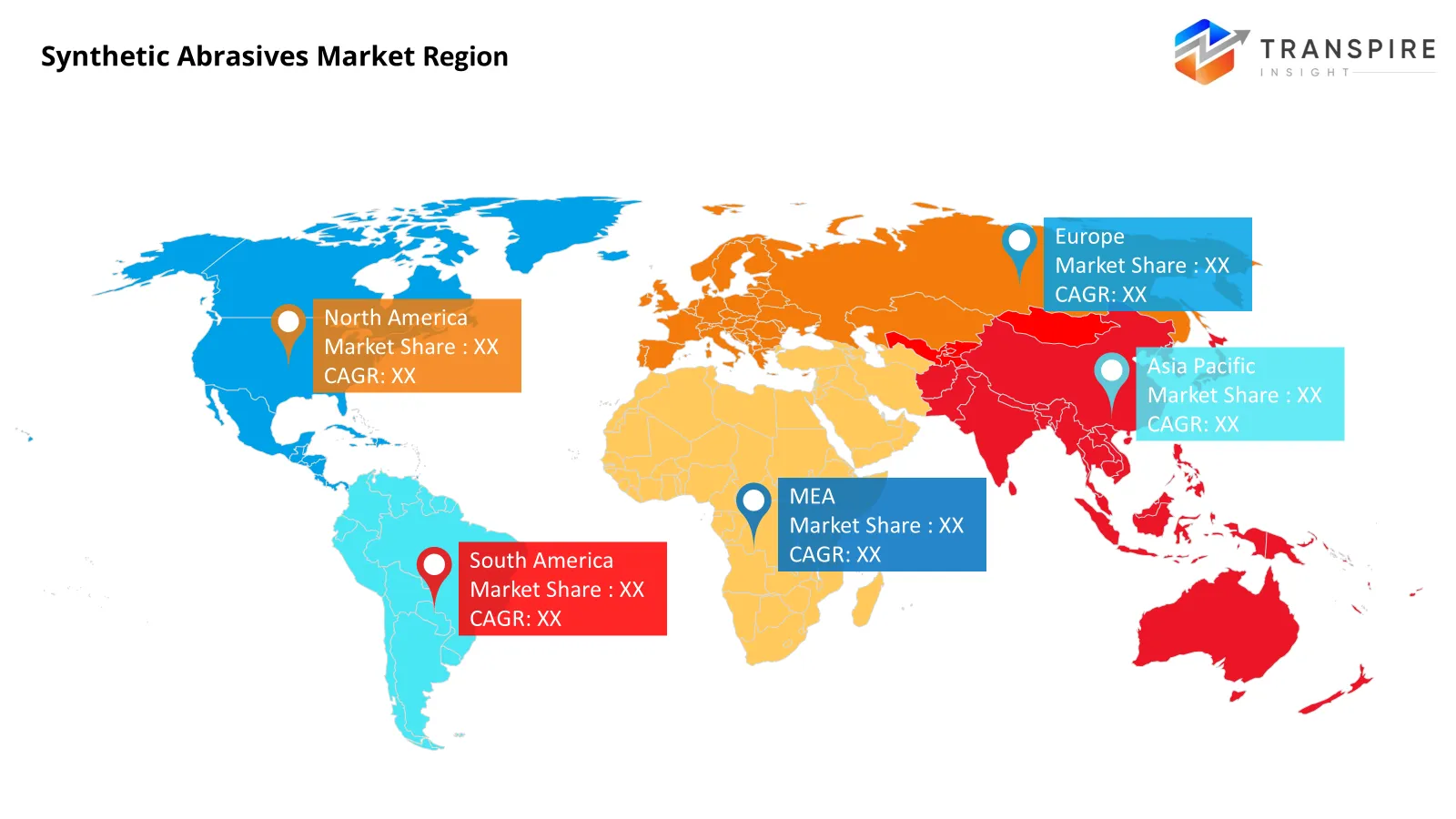
Who are the Key Players in the Synthetic Abrasives Market and how do they Compete?
Competition is divided between scale oriented multi-nationals, like Saint-Gobain, 3M, Bosch and Tyrolit, which offer service expertise, multiple abrasive types and international channels to win large industrial customers, and precision-focused specialists like Fujimi, Asahi Diamond Industrial and Superabrasives, where ultra-precision and application expertise is more relevant. The divide is widening as buyers seek performance, not abrasives.
Saint-Gobain and 3M distinguish themselves on innovation-focused product portfolios and system sales, providing abrasive media as part of a process solution that reduces scrap and enhances throughput. Norton, Mirka, and Klingspor focus on consistency and channel penetration, enabling them to capture continuing business from metalworking and finishing customers. Bosch and CUMI focus on maintaining brand trust as they expand along OEM corridors. Deerfos and Sak Abrasives emphasize value leadership in regional markets and export discipline. Tyrolit, Krebs & Riedel and Henan Huanghe Whirlwind defend margins by improving application-specific grade offerings. Fujimi, Asahi Diamond Industrial and SuperAbrasives differentiate themselves in superabrasives where technical validation is the true barrier to entry.
Key Players are:
- Saint-Gobain Abrasives
- 3M
- Norton Abrasives
- Tyrolit
- Mirka
- Bosch
- Fujimi Incorporated
- Asahi Diamond Industrial
- Henan Huanghe Whirlwind
- Carborundum Universal
- Sak Abrasives
- Krebs & Riedel
- Deerfos
- Klingspor
- SuperAbrasives Inc.
Recent Development News
- In May 2026, Weiler Abrasives introduced its high-performance Fortis Mill roll grinding wheels engineered specifically for hot and cold steel mill manufacturing operations. This product launch delivers maximum material removal rates and specialized grain retention to optimize industrial roll quality and processing throughput.
- In February 2026, Mirka Ltd completed the technical buyout acquisition of Hermes Technical. This strategic transaction integrates advanced engineered synthetic bonded products and manufacturing lines into the company's existing portfolio, expanding its market share in industrial precision grinding.
What Strategic Insights Define the Future of the Synthetic Abrasives Market?
Markets are shifting from commodity grinding media to engineered, application-specific abrasive packages that facilitate automation, tighter tolerances, and sustainability goals. This transition is being further substantiated by EV, aerospace, and electronics manufacturing, where downtime and finish uniformity are now more compromising plant economics than price. Compaction of margins due to volatility of raw materials and private-label substitution of standard AI2O3 and SIC products. The greatest opportunity exists in superabrasives, AI-guided robotic finishing, and battery-related precision machining, with customers willing to pay for added uptime, lowered scrap, and a consistent surface quality. From a strategic perspective, abrasives should not be sold as individual consumables but bundled together with process data, wear analysis, and application consultation. This will make them less substitutable and enable them to apportion their fair share of value in the emerging automated manufacturing ordering paradigm.
Key Segmentations are:
By Product Type
- Aluminum Oxide Abrasives
- Silicon Carbide Abrasives
- Cubic Boron Nitride Abrasives
- Synthetic Diamond Abrasives
- Zirconia Alumina Abrasives
- Ceramic Abrasives
- Coated Abrasives
- Others
By Application
- Metal Fabrication
- Automotive
- Electronics
- Construction
- Aerospace
- Medical Devices
- Precision Machining
- Others
By End User
- Manufacturing
- Automotive OEMs
- Electronics Industry
- Construction Companies
- Aerospace Industry
- Medical Equipment Manufacturers
- Others
By Form
- Bonded Abrasives
- Coated Abrasives
- Loose Abrasives
- Superabrasives
- Abrasive Powders
- Others
By Distribution Channel
- Direct Sales
- Industrial Distributors
- OEM Suppliers
- Online B2B Platforms
- Exporters
- Others
Regional Outlook
North America
- US
- Canada
- Mexico
- US
- Canada
Europe
- Germany
- UK
- France
- Italy
- Spain
- Rest of Europe
Asia Pacific
- China
- Japan
- India
- South Korea
- Australia
- Rest of Asia Pacific
South America
- Brazil
- Argentina
- Rest of South America
Middle East & Africa
- UAE
- Saudi Arabia
- Qatar
- South Africa
- Rest of the Middle East & Africa
Frequently Asked Questions
Find quick answers to common questions.
The Synthetic Abrasives Market size was valued at USD 458.3 billion in 2025 and is poised to reach USD 639.6 billion by 2033, expanding at a 4.25% CAGR.
Key segments for the Synthetic Abrasives Market are By Product Type (Aluminum Oxide Abrasives, Silicon Carbide Abrasives, Cubic Boron Nitride Abrasives, Synthetic Diamond Abrasives, Zirconia Alumina Abrasives, Ceramic Abrasives, Coated Abrasives, Others); By Application (Metal Fabrication, Automotive, Electronics, Construction, Aerospace, Medical Devices, Precision Machining, Others); By End User (Manufacturing, Automotive OEMs, Electronics Industry, Construction Companies, Aerospace Industry, Medical Equipment Manufacturers, Others); By Form (Bonded Abrasives, Coated Abrasives, Loose Abrasives, Superabrasives, Abrasive Powders, Others); By Distribution Channel (Direct Sales, Industrial Distributors, OEM Suppliers, Online B2B Platforms, Exporters, Others).
Growth is primarily driven by rising demand from automotive, metal fabrication, electronics, aerospace, and precision manufacturing, along with higher adoption of high-performance, durable, and automated grinding and finishing solutions.
The Synthetic Abrasives Market is led by major manufacturers including Saint-Gobain Abrasives, 3M, Norton Abrasives, Tyrolit, Mirka, Bosch, Fujimi Incorporated, Asahi Diamond Industrial, Henan Huanghe Whirlwind, Carborundum Universal, Sak Abrasives, Krebs & Riedel, Deerfos, Klingspor, SuperAbrasives Inc.
Asia Pacific influences market dynamics through its strongest share of about 45%, supported by large-scale industrial output, strong automotive and metalworking demand, and higher adoption of advanced abrasive technologies.
Commercial opportunities include growing demand for eco-friendly abrasives, expansion in EV and aerospace manufacturing, rising use in precision machining, and strong potential in emerging Asia-Pacific industrial markets.
- Saint-Gobain Abrasives
- 3M
- Norton Abrasives
- Tyrolit
- Mirka
- Bosch
- Fujimi Incorporated
- Asahi Diamond Industrial
- Henan Huanghe Whirlwind
- Carborundum Universal
- Sak Abrasives
- Krebs & Riedel
- Deerfos
- Klingspor
- SuperAbrasives Inc.
About the Authors

Pankaj Ghogare Patil
I am Pankaj Ghogare Patil, a Senior Research Analyst at Transpire Insight, specializing in the Pharmaceutical, Chemicals & Materials, Healthcare IT, and Biotechnology industry. My expertise lies in conducting comprehensive market research, analyzing industry trends, evaluating competitive landscapes, and translating complex data into actionable insights. At Transpire Insight, I closely follow emerging technologies, regulatory developments, and market innovations to create accurate, well-researched, and informative content that helps businesses and professionals make informed decisions. I am committed to producing credible, evidence-based articles that reflect industry best practices while making technical topics accessible and valuable for a broad audience.

Chakradhar Khansole
Chakradhar serves as the Research Director at Transpire Insight, bringing over 8 years of experience in technology, innovation, and strategic market intelligence. He specializes in transforming complex market data into actionable business insights that enable organizations to make informed, growth-oriented decisions. Recognized for his strategic vision and analytical expertise, Chakradhar leads high-impact research initiatives, delivering comprehensive market assessments, competitive intelligence, and forward-looking industry analysis.
Recently Published Reports
-
May 2026
Healthcare Polymer Packaging Market
Healthcare Polymer Packaging Market Size, Share & Analysis Report By Packaging Type (Syringes, IV Bottles and Pouches, Clamshells, Blisters, Bottles & Jars, Containers, Tubes, IV Parental Packaging, Others), By Type (Regulated, Non-regulated), By Polymer Type (LDPE (Low-Density Polyethylene), HDPE (High-Density Polyethylene), Homo-polymer (Homo), Random Copolymer (Random), Block Copolymer (Block), PET, Polystyrene, Polyvinyl Chloride, Polyamide/EVOH, Others), and Geography (North America, Europe, Asia-Pacific, Middle East and Africa, South and Central America), 2021 - 2031
-
Apr 2026
Hydrophilic Tape (Waterstop) Market
Hydrophilic Tape (Waterstop) Market Size, Share & Analysis Report By Type (Bentonite-Based Hydrophilic Tape, Rubber-Based Hydrophilic Tape), By Application (Residential Buildings, Commercial Buildings, Infrastructure Projects), and Geography (North America, Europe, Asia-Pacific, Middle East and Africa, South and Central America), 2021 - 2031
-
Apr 2026
Metalens Market
Metalens Market Size, Share & Analysis Report By Type (Visible Light Metalens, and Infrared Metalens), By Application (Consumer Electronics, Automotive Electronics, Industrial, Medical, and Others), and Geography (North America, Europe, Asia-Pacific, Middle East and Africa, South and Central America), 2021 - 2031
-
Apr 2026
PBT Resin Market
PBT Resin Market Size, Share & Analysis Report By Type (Reinforced PBT Resin, Unreinforced PBT Resin), By Processing Method (Injection Molding, Extrusion, Blow Molding, Others), By End-User (Automotive, Electrical & Electronics, Consumer Appliances, Industrial Machinery, Medical Devices, Packaging, Others), and Geography (North America, Europe, Asia-Pacific, Middle East and Africa, South and Central America), 2021 - 2031