
Convergent Billing System Market Summary:
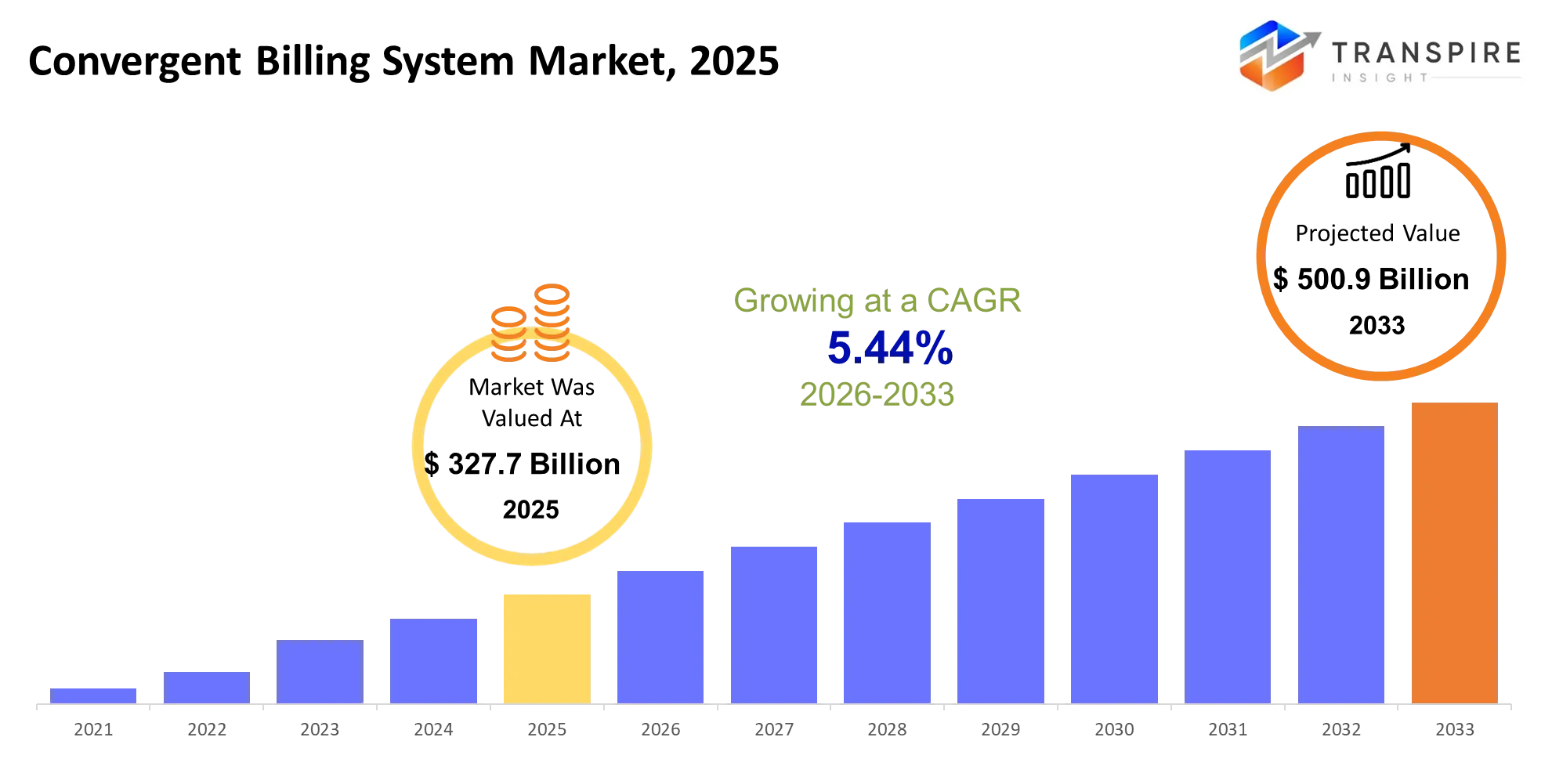
As per the Transpire Insight, The Convergent Billing System Market size is estimated at USD 327.7 billion in 2025 and is anticipated to reach USD 500.9 billion by 2033, growing at a CAGR of 5.44% from 2026 to 2033.
The converged billing systems combine charging, rating, invoicing, payments and revenue controls into a single layer and allow telco and digital operators to price services consistently across all domains: mobile, broadband, content and enterprise. Over the past three to five years, the industry has moved from converging legacy billing systems to cloud-native, real-time monetisation systems that can support 5G, IoT and flexible usage models. The key architectural change is the shift from batch billing to event-driven charging with API-based integration to enable flexible configuration and monetisation of services. Vodafone Idea's plan in 2026 to extend Ericsson's cloud-native charging from prepaid to postpaid and replace legacy offline charging and rating systems highlights this trend. This enables greater adoption as operators can reduce the cost of specialised legacy systems, deploy offers faster, and bring their services to market faster with real-time account visibility. Thus, billing emerges as a revenue-enablement layer rather than a back-office function.
Convergent Billing System Market Size & Forecast:
- Market Size 2025: USD 327.7 Billion
- Expected Market Value 2033: USD 500.9 Billion
- Forecast CAGR (2026-2033): 5.44%
- Leading Region in 2025: Asia Pacific
- Fastest Growing Region: Middle East and Africa
- Key Company Profiles: Amdocs, Ericsson, Oracle, SAP, CSG Systems, Netcracker, Nokia, Huawei, Optiva, Cerillion, Hansen Technologies, Comarch, Tecnotree, MATRIXX Software, ZTE.
Key Convergent Billing System Market Insights:
The market is moving from invoice-based telecom software to an always-on monetisation layer for connectivity, cloud, IoT and partner services. Providers are not just competing for billing accuracy, but for speed of launch, price and settlement for complex offers.
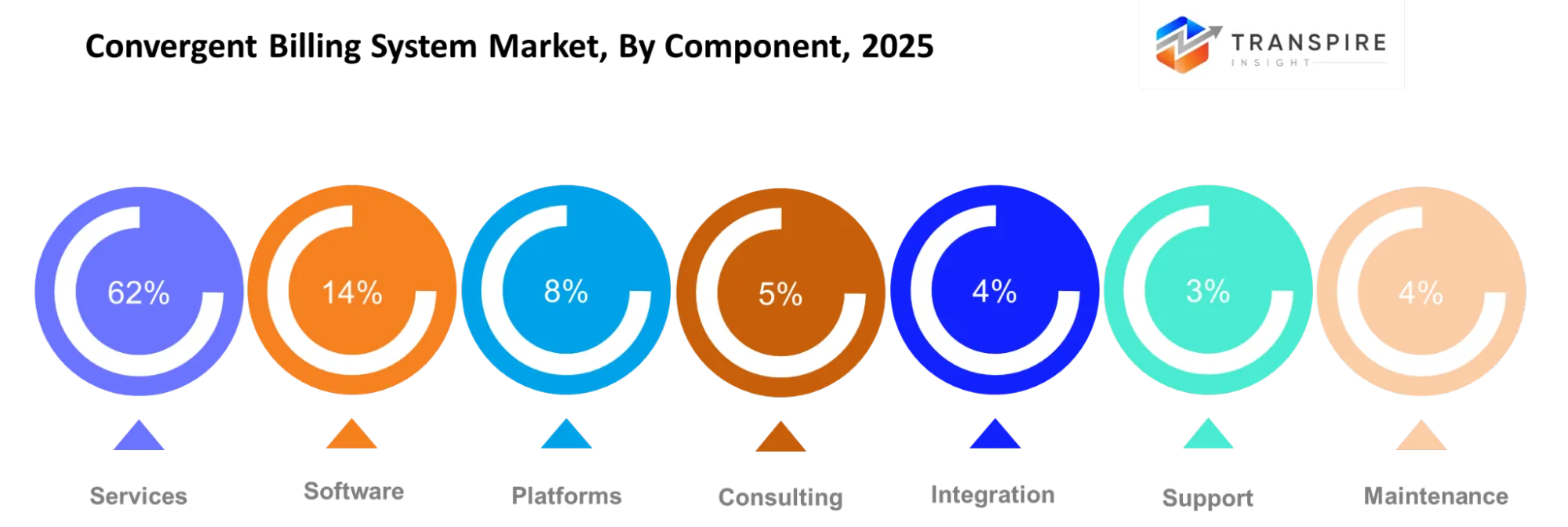
- Services account for a 62.05% share; Amdocs' cloud-native implementation capabilities are growing as operators look to migrate from BSS legacy systems with a low-risk approach.
- Software is 14%, and Oracle expands its high-throughput cloud billing offering for usage-driven 5G, IoT and multi-party commercial models.
- Platforms are at 8%, with Ericsson claiming to be integrating catalogue, order, charging, and care functions to aid in the activation and billing of IoT services.
- After NEC's acquisition of CSG, Netcracker's expanded scale enables greater transformation and SaaS-integrated programs.
- The integration solution captures 4% of the market, and Ericsson's e& Egypt modernization example demonstrates the need for synchronized billing, mediation, and charging solutions.
- AI Billing Agent by Cerillion helps businesses realign their service teams towards conversational inquiry resolution while reducing manual billing investigations, accounting for 3% of the support.
- Maintenance is 2%, and the operators are modernizing increasingly in phases, maintaining the critical tariff logic while limiting disruption risk.
- Other components account for 1.95% and include ecosystem settlement around network capabilities, content, cloud, and enterprise partners, API-led.
- Real-time charging is taking the place of batch processing since the quality-based offers need to be used, balanced, and entitled on the spot.
What are the Key Drivers, Restraints, and Opportunities in the Convergent Billing System Market?
Driver:
Cloud-native modernization is accelerating as operators replace legacy charging stacks with scalable platforms supporting real-time rating, flexible tariffs, and faster product launches. KDDI’s 2026 selection of Oracle Cloud Scale Charging and Billing highlights this shift, addressing infrastructure costs and limitations in legacy billing operations. Modernization reduces operational complexity, enables quicker service deployment, and strengthens monetization across broadband, content, and digital services. As operators expand cloud-based offerings, scalable charging infrastructure becomes increasingly important for managing complex pricing and usage models.
Restraint:
Migration complexity remains a major constraint because billing connects customer data, network charging, mediation, payments, taxation, product catalogs, and downstream finance systems. These dependencies make phased transformation necessary and keep legacy environments in service longer than operators would prefer. Integration risk raises overall project cost and extends implementation cycles.
Opportunity:
AI-native and autonomous-network architectures create a new monetisation layer for differentiated connectivity and usage-based services. Ericsson’s 2026 work highlights charging and billing for autonomous networks, where services can be activated, adapted, and monetised with minimal manual intervention. AI applications for anomaly detection, order-fallout prediction, capacity forecasting, and usage analysis are moving beyond experimentation. Investments in cloud-native APIs, event-driven charging, and AI operations can help operators commercialize personalized offers at scale, enterprise connectivity, IoT services, and outcome-based pricing.
What Has the Impact of Artificial Intelligence Been on the Convergent Billing System Market?
Artificial intelligence evolution is moving from a transaction engine to a more predictive operational layer; artificial intelligence can detect charging anomalies, identify invoice anomalies, predict order fallout, forecast capacity needs, and analyze consumption behaviour in advance of the customer impact. This can include Vodafone Idea's 2026 Ericsson deployment, which is deploying anomaly detection, order-fallout detection and prediction, capacity forecasting, and AI-enabled intelligent consumption analysis with cloud-native convergent charging. Artificial intelligence alleviates manual investigation efforts, provides decision support for more accurate billing, allows for targeted intervention prioritization, and accelerates response times.
AI can also facilitate opportunistic monetization and customer understanding as 5G, IoT, and differentiated connectivity drive increasingly variable usage. As demonstrated by Ericsson and AWS' intelligent invoice-anomaly detection and AI-enabled charging operations using machine-learning and generative artificial intelligence tools, the main drawbacks of this technology are that its performance hinges on clean, pre-integrated data and that the underlying legacy data and billing workflows require modernisation. Legacy interfaces, fragmentation of records, governance constraints, and deployment costs can all undermine accuracy while delaying payoff; intelligence allows for credible monitoring, auditability, and prioritization in a consistent way.
In February 2026, Mistral AI entered a strategic partnership with Ericsson to integrate advanced foundation models and generative AI tooling directly into telecom carrier infrastructure.
Key Convergent Billing System Market Trends:
The market is evolving from back-office invoicing to a real-time monetisation layer. Flexibility of cloud, API interoperability, charging accuracy, and speed of commercialising new digital services are becoming increasingly important parameters.
- The legacy batch-based charging is getting replaced by event-based charging for data, APIs, cloud resources, and IoT usage.
- Operators are looking for elastic capacity when they launch, during peaks, or during mass renewals, and cloud-native deployment has become more popular.
- Prepaid and postpaid stacks come together to provide a single customer view across fixed, mobile and digital services.
- Product catalogues are evolving from fixed tariff tables to bundles, entitlements and offers from partners that are configured and can be variable in discounts.
- 5G standalone is driving billing changes from volume-based to slice-, quality-, and outcome-based.
- Network APIs are bringing developer-facing consumption models that demand tracking, consent management, billing, and settlement.
- Revenue assurance, fraud monitoring, offer selection, and anomaly detection are where AI is being integrated.
- Operators are increasingly offering multi-party settlement packages, including content, cloud, satellite, fintech, and enterprise services.
- Phased modernisation, not full stack replacement, and reduced vendor lock-in, due to Open APIs and modular architecture.
- AI token, GPU, and edge-compute usage is also gaining traction within billing engines alongside traditional connectivity usage.
Convergent Billing System Market Segmentation
By Component:
Services hold the largest component share at 62.05% and are projected to expand at a 10.78% CAGR, reflecting the implementation-intensive nature of billing transformation. Operators require consulting, integration, migration, managed operations, support, and maintenance to modernise legacy charging systems without disrupting revenue collection. Software accounts for 14%, platforms 8%, consulting 5%, integration 4%, support 3%, maintenance 2%, and others 1.95%. Services therefore remain central to modernisation spending, while modular software and platform adoption is gaining importance as operators pursue reusable, API-first monetisation architectures, cloud deployment, real-time charging, and faster configuration of new commercial models.
By Deployment:
Cloud and SaaS models are gaining adoption by reducing infrastructure ownership and enabling elastic processing. Hybrid and private-cloud architectures remain important for operators requiring greater control over sensitive billing workloads. Public cloud and multi-cloud environments improve scalability and geographic flexibility, while governance, interoperability, and data-residency requirements influence implementation choices. This deployment mix is gradually shifting billing infrastructure toward flexible, API-driven environments that support faster service launches and modernization.
By Solution Type:
Charging, billing account management, revenue management, mediation, payment management, product catalogue, and customer relationship management are increasingly integrated into connected workflows. This convergence allows operators to coordinate pricing, usage, customer accounts, payments, and revenue assurance through shared data. Real-time charging and automated mediation are becoming particularly important as service portfolios become more complex. The shift reduces fragmented processing and supports faster configuration of new commercial offerings.
By Operator Type :
Mobile and broadband operators remain central users because they manage high-volume, multi-service customer accounts and increasingly complex pricing structures. Cable and fixed-line operators are modernizing billing to support bundled connectivity and digital services, while satellite providers require flexible charging across geographically distributed customers. MVNOs benefit from configurable platforms that simplify wholesale and retail billing. IoT operators add further complexity through device-level usage, event-based charging, and enterprise account management requirements.
By Enterprise Size:
Large enterprises and telecom groups represent substantial modernisation opportunities because their legacy environments often span multiple products, geographies, and billing systems. These organisations increasingly require centralised revenue controls and scalable charging architectures. SMEs and digital operators generally favour configurable cloud-based solutions that reduce implementation complexity and infrastructure requirements. Subscription businesses also benefit from modular billing platforms, enabling smaller organisations to introduce flexible pricing, automate invoicing, and scale operations without extensive technology investments.
By Application:
Telecom remains the core market as operators manage mobile, broadband, voice, data, and enterprise connectivity through convergent platforms. Media companies increasingly use flexible billing for subscriptions, content packages, and usage-based services. Utilities apply similar capabilities to variable consumption and recurring payments, while BFSI and healthcare require controlled transaction and account management. Retail and IoT applications further expand adoption through digital subscriptions, connected devices, usage tracking, and personalized commercial offerings.
By Billing Model:
Prepaid and postpaid remain established structures, but operators are expanding toward hybrid, subscription, usage-based, pay-as-you-go, and bundled models. This transition reflects more varied service consumption and the growth of digital and connected offerings. Usage-based billing enables charges to align with actual consumption, while bundled models combine multiple services under unified accounts. Consequently, operators increasingly require flexible rating engines, real-time charging, automated invoicing, and stronger revenue controls.
What are the Key Use Cases Driving the Convergent Billing System Market?
The core use case is unified telecom monetization, where mobile, broadband, TV, roaming, and digital content are rated through one customer account. This supports the services-led structure by requiring integration and migration across legacy prepaid and postpaid systems.
Expanding applications include enterprise connectivity, IoT fleet management, media subscriptions, utilities, and financial-service bundles. These require engines combining recurring charges, usage fees, partner commissions, discounts, taxes, and payments within unified workflows.
Emerging use cases include 5G network slicing, programmable APIs, edge computing, satellite-cellular services, and AI workloads. These applications require near-real-time charging because value increasingly depends on performance, location, quality of service, compute consumption, or specific outcomes rather than conventional monthly access alone.
|
Report Metrics |
Details |
|
Market size value in 2025 |
USD 327.7 Billion |
|
Market size value in 2026 |
USD 342.6 Billion |
|
Revenue forecast in 2033 |
USD 500.9 Billion |
|
Growth rate |
CAGR of 5.44% from 2026 to 2033 |
|
Base year |
2025 |
|
Historical data |
2021 - 2024 |
|
Forecast period |
2026 - 2033 |
|
Report coverage |
Revenue forecast, competitive landscape, growth factors, and trends |
|
Regional scope |
United States; Canada; Mexico; United Kingdom; Germany; France; Italy; Spain; Denmark; Sweden; Norway; China; Japan; India; Australia; South Korea; Thailand; Brazil; Argentina; South Africa; Saudi Arabia; United Arab Emirates |
|
Key companies profiled |
Amdocs, Ericsson, Oracle, SAP, CSG Systems, Netcracker, Nokia, Huawei, Optiva, Cerillion, Hansen Technologies, Comarch, Tecnotree, MATRIXX Software, ZTE. |
|
Customization scope |
Free report customization (country, regional & segment scope). Available customised purchase options to meet your exact research needs. |
|
Report Segmentation |
By Component (Services, Software, Platforms, Consulting, Integration, Support, Maintenance, Others); By Deployment (Cloud, On-premise, Hybrid, SaaS, Private Cloud, Public Cloud, Multi-cloud, Others); By Solution Type (Billing Account Management, Customer Relationship Management, Product Catalog, Charging, Revenue Management, Mediation, Payment Management, Others); By Operator Type (Fixed-line, Mobile, Broadband, Cable, Satellite, MVNO, IoT Operators, Others); By Enterprise Size (Large Enterprises, SMEs, Mid-sized, Startups, Government, Telecom Groups, Digital Operators, Others); By Application (Telecom, Media, Utilities, BFSI, Healthcare, Retail, IoT, Others); By Billing Model (Prepaid, Postpaid, Hybrid, Usage-based, Subscription, Pay-as-you-go, Bundled, Others). |
Which Regions are Driving the Convergent Billing System Market Growth?
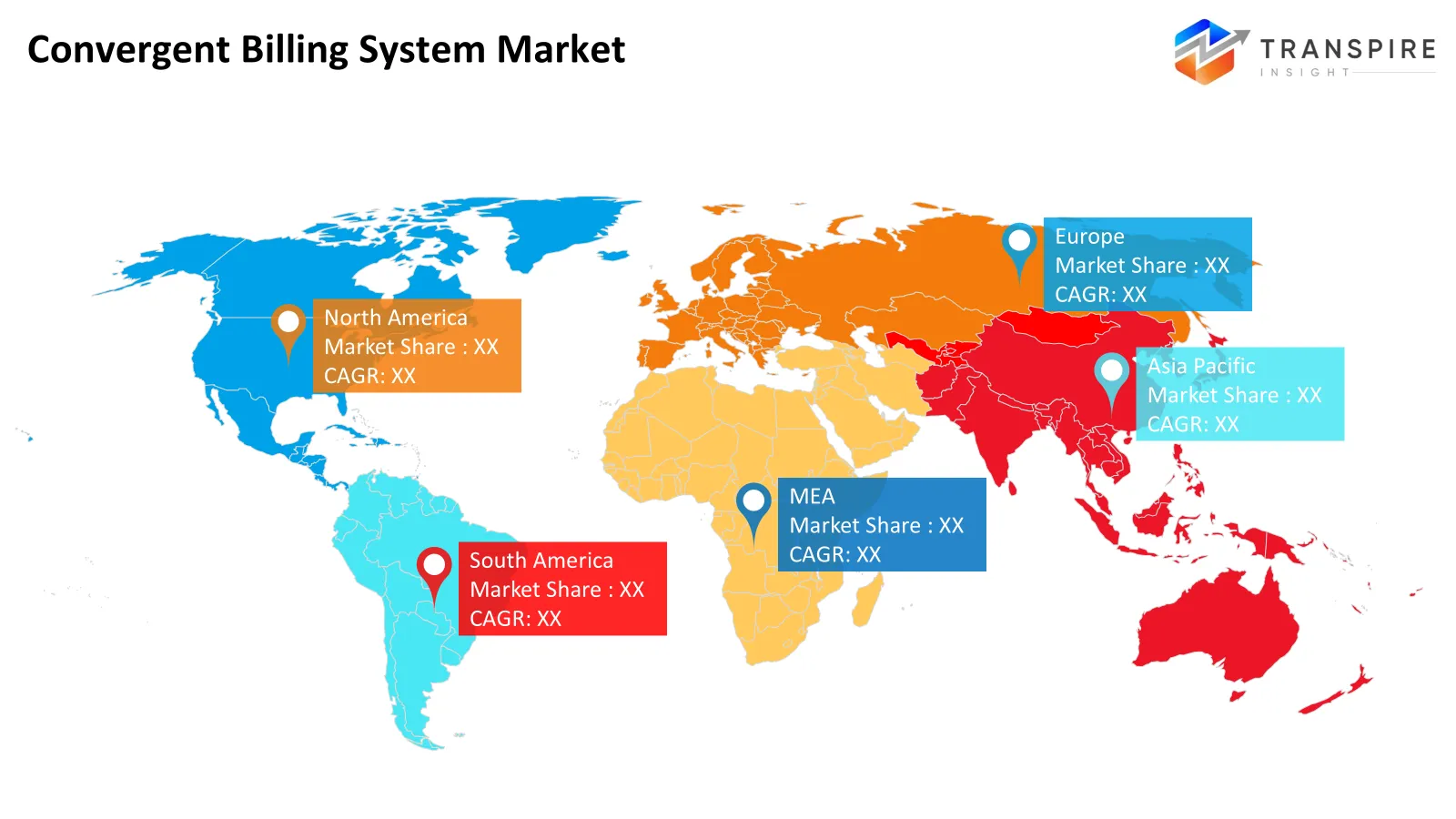
North America accounts for the largest market share at 32.30% due to deep-rooted mobile, cable, cloud, and enterprise-service lines. Leading operators have mature deployed billing estates and are focusing on modernization efforts to enable the adoption of digital bundles, 5G, private networks, and IoT monetization. The mature public-cloud footprint, systems-integrator coverage, and enterprise adoption levels make cloud migration commercially viable. It is further propelled by the requirement for consolidating acquired brands, platforms, and different network types with partner services within highly transparent account and payment-experience platforms.
In September 2026, Netcracker Technology launched a partnership with New York-based fibre and cloud provider FirstLight to implement its AI-Native Operations digital platform.
Europe ranks second with a 24% share, driven less by scale than North America and more by regulatory discipline, multi-country operations, and network modernization. Operators need billing systems that handle cross-border tax, currencies, roaming, consumer transparency, and local data-handling requirements. Its stability comes from established broadband and mobile penetration, long-term vendor relationships, and cautious phased modernization rather than disruptive replacement. Cloud adoption is progressing, but hybrid deployment remains important where sovereignty and resilience requirements are strict.
In February 2026, Amdocs announced a multi-year strategic collaboration with Amazon Web Services to accelerate AI-driven telecom modernization across cloud-native ecosystems.
Asia Pacific accounts for 29% of demand and is the fastest-growing region with a CAGR of 10.19%. Rising demand from Asia-Pacific for prepaid, hybrid, and usage-based pricing is driven by recent 5G rollouts, proliferation of digital-wallet adoption, growth in the number of IoT devices, and the rise of low-cost digital operators. Unlike in most developed Western regions, the opportunity in this region is more than scale; it also lies in greenfield digital services and subscriber markets. Countries including India, Southeast Asia, China, and other leading telecommunications countries can leverage cloud-native billing for the commercialization of enterprise connectivity, API exposure, content bundles, and network-slice-based services. Latin America will represent 8% and the Middle East and Africa 6.70%, offering potential for mobile-first adoption and investments in digital infrastructure.
In September 2026, Mavenir partnered with Indian artificial intelligence cloud provider Neysa to deliver an integrated, sovereign AI infrastructure stack for telecom operators and neocloud providers.
Who are the Key Players in the Convergent Billing System Market, and how do they compete?
The contest focuses on the pace of modernisation and real-time charging performance, cloud portability, as well as the ability to commercialise 5G, APIs, IoT, and multi-party services without replacing all legacy systems at once. Amdocs is promoting Freestyle Billing, modular APIs, and real-time pricing flexibility for large operators doing incremental cloud modernisation. Ericsson's range of offerings leverages Charging Evolved, data platforms, and network native monetization; its T-Mobile program showcases session-aware, quality-based charging for consumer, enterprise, and partner services. Oracle leverages high-throughput Cloud Scale Billing for complex enterprise, network-slicing, and IoT workloads, while SAP leverages enterprise finance and customer-process integration.
New entrants are well represented by CSG and Netcracker, who are building on their combined scale following NEC's $2.9 billion acquisition, integrating CSG's digital BSS assets with Netcracker's orchestration and automation assets. Nokia, Huawei, ZTE, and MATRIXX are focusing on carrier-grade 5G charging and network-adjacent deployments. Optiva, Cerillion, Hansen Technologies, Comarch, and Tecnotree compete via SaaS, composable architecture, regional operator focus, and lower-complexity deployment options; Cerillion's AI Billing Agent is highlighting customer-service automation.
Key Players are:
- Amdocs
- Ericsson
- Oracle
- SAP
- CSG Systems
- Netcracker
- Nokia
- Huawei
- Optiva
- Cerillion
- Hansen Technologies
- Comarch
- Tecnotree
- MATRIXX Software
- ZTE
Recent Development News
- In September 2026, Covalense Digital was selected to modernize billing and CRM for a leading West African telecom operator using a unified BSS stack and converged billing platform. The project will integrate rating, invoicing, taxation, receivables, collections, and customer management across mobile, fibre, and enterprise services. https://covalensedigital.com/resources/press-releases/telecom-bss-modernisation-west-african-operator
- In March 2026, Vodafone Idea expanded its partnership with Ericsson to deploy cloud-native Ericsson Charging for its postpaid business and replace legacy offline charging and rating functions. The convergent system will enable real-time charging across voice, VoLTE, SMS, and data services while supporting faster service launches and greater billing scalability. https://www.ericsson.com/en/press-releases/2/2026/vi-expands-ericsson-tie-up-for-network-charging-in-india
- In February 2026, KDDI selected Oracle to upgrade its core charging and rating infrastructure with Oracle Cloud Scale Charging and Billing on Oracle Cloud Infrastructure. The modernization is designed to reduce infrastructure and operational costs while supporting flexible billing models, faster product releases, and revenue management across broadband, content, and other services. https://www.oracle.com/news/announcement/kddi-selects-oracle-for-telco-billing-transformation-2026-02-13/
What Strategic Insights Define the Future of the Convergent Billing System Market?
The industry is moving towards autonomous monetisation where charging, billing, service orchestration and customer experience decisions are created by dynamic, real-time AI-enabled workflows. The message is moving away from merely getting transactions right to dynamically match price with usage, service quality, customer experience, intent, and enterprise goals. But there is a risk of architectural sprawl with AI agents enabled alongside a disjointed architecture for rating, mediation, catalogues and payments that could lead to inconsistent decisions and even revenue leakage. The opportunity is around differentiated 5G connectivity, IoT, network slicing and enterprise AI services which require dynamic charging and not fixed bundles. Vendors should deliver open APIs, event-driven architecture, cloud portability and strong data governance rather than feature-led point upgrades. Operators should go to market with a high value monetisation journey focus, a common product and customer data foundation, and scale AI initially where it brings a tangible financial benefit through anomaly detection, forecasting, and automated remediation.
Key Segmentations are:
By Component
- Services
- Software
- Platforms
- Consulting
- Integration
- Support
- Maintenance
- Others
By Deployment
- Cloud
- On-premises
- Hybrid
- SaaS
- Private Cloud
- Public Cloud
- Multi-cloud
- Others
By Solution Type
- Billing Account Management
- Customer Relationship Management
- Product Catalogue
- Charging
- Revenue Management
- Mediation
- Payment Management
- Others
By Operator Type
- Fixed-line
- Mobile
- Broadband
- Cable
- Satellite
- MVNO
- IoT Operators
- Others
By Enterprise Size
- Large Enterprises
- SMEs
- Mid-sized
- Startups
- Government
- Telecom Groups
- Digital Operators
- Others
By Application
- Telecom
- Media
- Utilities
- BFSI
- Healthcare
- Retail
- IoT
- Others
By Billing Model
- Prepaid
- Postpaid
- Hybrid
- Usage-based
- Subscription
- Pay-as-you-go
- Bundled
- Others
By Regional Analysis
North America
- US
- Canada
- Mexico
Europe
- Germany
- UK
- France
- Italy
- Spain
- Russia
- Rest of Europe
Asia Pacific
- China
- Japan
- India
- South Korea
- Australia
- Rest of Asia Pacific
South America
- Brazil
- Argentina
- Rest of South America
Middle East & Africa
- UAE
- Saudi Arabia
- Qatar
- South Africa
- Rest of the Middle East & Africa
Frequently Asked Questions
Find quick answers to common questions.
The convergent billing system market size was valued at USD 327 billion in 2025 and is poised to reach USD 500.9 billion by 2033, expanding at a 5.44% CAGR.
Key segments for the convergent billing system market are By Component (Services, Software, Platforms, Consulting, Integration, Support, Maintenance, Others); By Deployment (Cloud, On-premise, Hybrid, SaaS, Private Cloud, Public Cloud, Multi-cloud, Others); By Solution Type (Billing Account Management, Customer Relationship Management, Product Catalog, Charging, Revenue Management, Mediation, Payment Management, Others); By Operator Type (Fixed-line, Mobile, Broadband, Cable, Satellite, MVNO, IoT Operators, Others); By Enterprise Size (Large Enterprises, SMEs, Mid-sized, Startups, Government, Telecom Groups, Digital Operators, Others); By Application (Telecom, Media, Utilities, BFSI, Healthcare, Retail, IoT, Others); By Billing Model (Prepaid, Postpaid, Hybrid, Usage-based, Subscription, Pay-as-you-go, Bundled, Others).
Growth is primarily driven by cloud-native billing modernization, real-time charging, 5G and IoT monetization, AI-enabled revenue management, and the replacement of fragmented legacy systems.
The market is led by major manufacturers, including Amdocs, Ericsson, Oracle, SAP, CSG Systems, Netcracker, Nokia, Huawei, Optiva, Cerillion, Hansen Technologies, Comarch, Tecnotree, MATRIXX Software, ZTE.
North America holds 32.30% of the market, supported by advanced 5G infrastructure, cloud adoption, enterprise connectivity, established telecom operators, and early deployment of AI-enabled billing modernization.
Opportunities include autonomous monetization, AI-driven revenue management, 5G network slicing, IoT usage-based billing, cloud-native migration, and flexible subscription and bundled pricing models.
- Amdocs
- Ericsson
- Oracle
- SAP
- CSG Systems
- Netcracker
- Nokia
- Huawei
- Optiva
- Cerillion
- Hansen Technologies
- Comarch
- Tecnotree
- MATRIXX Software
- ZTE
About the Authors

Mayur Shinde
I am Mayur Shinde, a Senior Research Analyst at Transpire Insight, specializing in the Automotive & Transportation and Information & Communication Technology (ICT) Industry. My work focuses on analyzing emerging market trends, technological advancements, competitive landscapes, and industry developments to deliver accurate, data-driven insights. I am passionate about transforming complex market information into clear, actionable content that helps businesses, professionals, and decision-makers stay informed and make confident strategic decisions.

Chakradhar Khansole
Chakradhar serves as the Research Director at Transpire Insight, bringing over 8 years of experience in technology, innovation, and strategic market intelligence. He specializes in transforming complex market data into actionable business insights that enable organizations to make informed, growth-oriented decisions. Recognized for his strategic vision and analytical expertise, Chakradhar leads high-impact research initiatives, delivering comprehensive market assessments, competitive intelligence, and forward-looking industry analysis.
Recently Published Reports
-
Apr 2026
3D Optical Profiler Market
3D Optical Profiler Market Size, Share & Analysis Report By Type (Desktop 3D Optical Profiler, and Portable 3D Optical Profiler), By Technology (Confocal Technology, and White Light Interference), By End-Use Industry (Manufacturing, Research Institutions, Automotive, Aerospace and Defense, Medical Devices, and Other), and Geography (North America, Europe, Asia-Pacific, Middle East and Africa, South and Central America), 2021 - 2031
-
Apr 2026
Depth Sensor Market
Depth Sensor Market Size, Share & Analysis Report By Type (Infrared Depth Sensors, Time-of-Flight (ToF) Sensors, Stereo Vision Sensors, Structured Light Sensors, Ultrasonic Depth Sensors), By Application (Automotive, Robotics, Gaming, Consumer Electronics, Industrial Automation, Healthcare, Security & Surveillance, Others), By End Users (Automotive Manufacturers, Consumer Electronics Companies, Healthcare Providers, Industrial Companies, Security Agencies, Gaming Companies, Robotics Companies, Others), and Geography (North America, Europe, Asia-Pacific, Middle East and Africa, South and Central America), 2021 – 2031
-
Apr 2026
Digital Manufacturing Market
Digital Manufacturing Market Size, Share & Analysis Report By Component (Hardware, Software, and Services), By Technology (Robotics, 3D Printing, Internet of Things (IoT), and Others), By Application (Automotive and Transportation, Aerospace and Defense, Consumer Electronics, Industrial Machinery, and Others), By Process Type (Computer-Based Designing, Computer-Based Simulation, Computer 3D Visualization, Analytics, and Others), and Geography (North America, Europe, Asia-Pacific, Middle East and Africa, South and Central America), 2021 – 2031
-
Apr 2026
Digital Visa Services Market
Digital Visa Services Market Size, Share & Analysis Report By Type (Individual Travelers, Group Travelers), By Application (Tourism, Business Travel, Others), and Geography (North America, Europe, Asia-Pacific, Middle East and Africa, South and Central America), 2021 – 2031