

Computer-assisted Coding Market Summary:
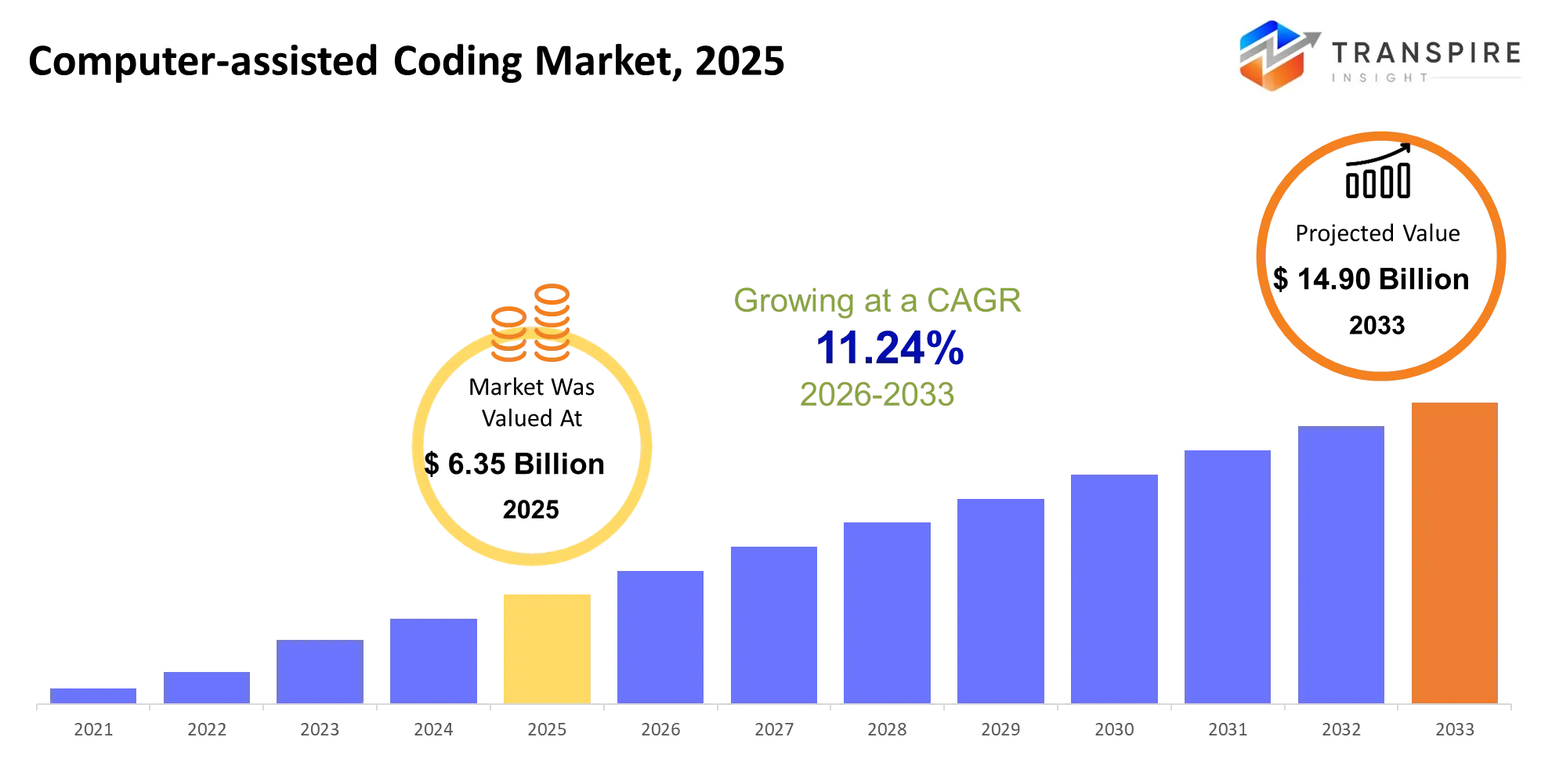
As per Transpire Insight, the Computer-assisted Coding Market size is estimated at USD 6.35 billion in 2025 and is anticipated to reach USD 14.90 billion by 2033, growing at a CAGR of 11.24% from 2026 to 2033.
Computer-assisted coding tools support healthcare providers in turning notes into standard diagnosis and procedure codes. These codes are used for billing, claims, reporting and compliance. Hospitals use these tools to cut down on chart reviews support coding teams and spot missing documentation before claims go out. In the past three to five years, the market has shifted from rule-based code suggestions to AI-powered workflows. These newer systems can understand context across large numbers of patient records. A key change is that coding is now being integrated with health records and revenue cycle platforms. It is no longer seen as a back-office job. Real-world pressures include documentation, staffing shortages, claim denials and the need to make sure billed services match the care that was actually given. As providers look for faster claim processing and consistent coding, software that combines automation with clear review trails is becoming more important. Growth in the market shows a need to improve coding efficiency and financial accuracy. It’s not about going digital—it's, about solving actual operational challenges.
Computer-assisted Coding Market Size & Forecast:
- Market Size 2025: USD 6.35 Billion
- Expected Market Value (2033): USD 14.90 Billion
- Forecast CAGR (2026–2033): 11.24%
- Leading Region in 2025: North America
- Fastest Growing Region: Asia Pacific
- Key Company Profiles: 3M Health Information Systems, Optum, Nuance Communications, Cerner, Epic Systems, Dolbey, AAPC, IMO Health, Oracle Health, M*Modal, Nym Health, Clinithink, CorroHealth, Artificial Intelligence in Medicine, CodaMetrix
Key Market Insights:
The market is shifting toward software usage, automation and artificial intelligence in medical coding will drive the computer-assisted coding market globally as providers enhance coding accuracy and minimise administrative workload.
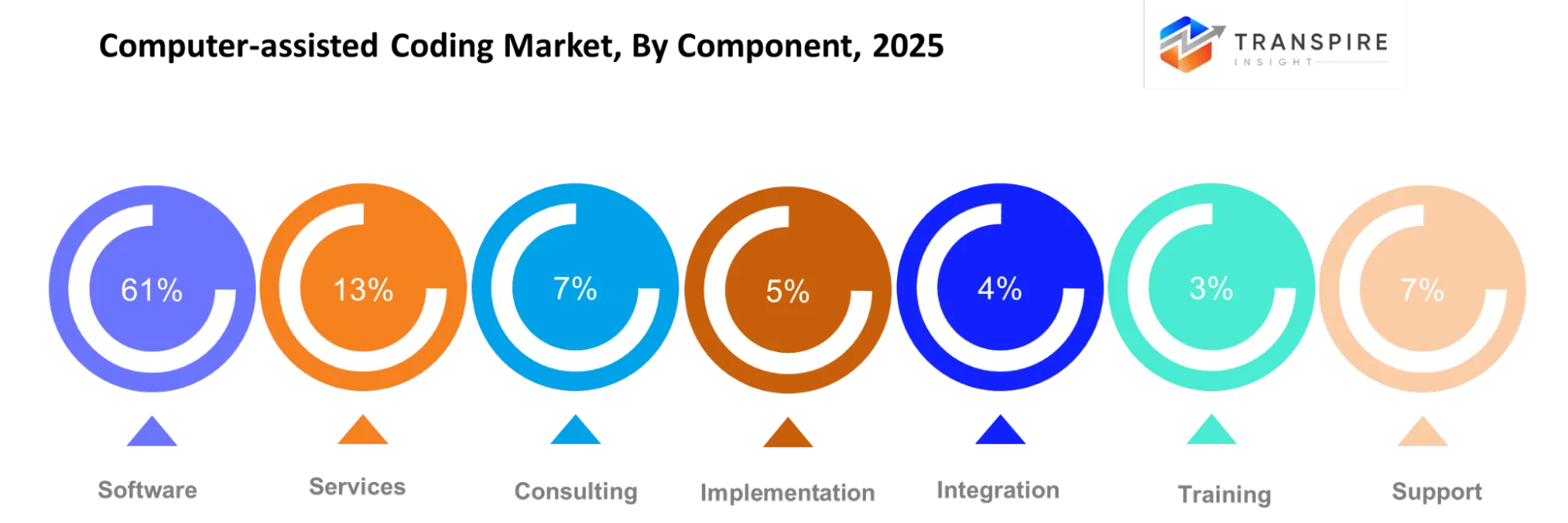
- Software accounts for 61.2% of the market share as companies like 3M Health Information Systems, Optum and Dolbey keep upgrading their automated coding platforms for providers.
- The fastest-growing technology in the market is AI and natural language processing (NLP), with the predicted annual growth rate of 12.8% due to expansion of these services by providers of health IT.
- Services comprise 12.8% of the market share as there is an increasing demand for technical services to streamline and optimise coding procedures in hospitals switching to computer-assisted coding platforms.
- Consulting constitutes 7.0% of the market share because health care organisations are turning to consulting companies to become compliant with the coding process and automate it.
- Implementation is 5.8% of the total computer-assisted coding market because providers spend money on the implementation of computer-assisted coding platforms that are compatible with their EHR and clinical documentation systems.
What are the Key Drivers, Restraints, and Opportunities in the Computer-assisted Coding Market?
Drivers:
Healthcare professionals need to code clinical data that is becoming more complex and comply with deadlines while coping with workforce limitations. Coding software will allow for spending less time on code validation and dealing with difficult issues. This way, hospital can reduce the length of coding lines and file cleaner claims. Examples of recent collaboration between healthcare providers and technology companies, such as the Cleveland Clinic and AKASA partnership , illustrate that hospitals are looking into the possibility of implementing AI into revenue cycle operations rather than testing it out.
Restraints:
It is hard to implement the technology because of existing electronic health record systems, inconsistent medical records, and local coding regulations that increase the costs of the implementation process. Hospitals need to check whether coding suggestions are correct, keep confidential patient information safe, and prove that it is possible to understand why the machine reached particular decisions during coding. It might not save money because of errors and rework caused by wrong code proposals.
Opportunities:
The opportunity is in contextual and speciality-specific coding that ties together documentation, coding, and pre-billing checks. The vendors can concentrate their efforts on the emergency room, outpatient clinics, and high-volume speciality areas where there is potential for process improvement due to repetitive cases. In the Asia Pacific region, alliances with regional health care and IT companies would be useful in developing language processing and coding capabilities in diverse markets. Systems that offer confidence ratings, evidence trails, and human reviews of cases are poised to succeed.
|
Driver |
Relative Impact on Growth (%) |
Geographic Relevance |
Impact Timeline |
Demand Strength |
Growth Mechanism |
Key Beneficiaries |
Major Constraint |
|
Growing Demand for Coding Accuracy and Revenue Cycle Efficiency |
27% |
North America, Europe |
Short-term (≤2 years) |
High |
Reduces coding errors, claim denials, and manual processing time. |
Hospitals, billing firms, coding vendors, healthcare providers. |
Incomplete clinical documentation and complex coding exceptions. |
|
AI and NLP Integration in Automated Medical Coding |
24% |
North America, Asia-Pacific |
Medium-term (2–4 years) |
High |
Extracts clinical concepts and recommends codes from medical records. |
AI software vendors, EHR providers, hospitals, coding service firms. |
Algorithmic errors, limited explainability, and validation requirements. |
|
Increasing Adoption of Electronic Health Records |
19% |
North America, Europe, Asia-Pacific |
Medium-term (2–4 years) |
High |
Connects digital patient records with automated coding workflows. |
EHR vendors, hospitals, clinics, healthcare technology integrators. |
Legacy system incompatibility and costly integration projects. |
|
Evolving Healthcare Coding Standards and Regulatory Requirements |
17% |
North America, Europe |
Short-term (≤2 years) |
High |
Supports updated code sets and standardized reimbursement documentation. |
Healthcare providers, coding platforms, compliance teams, billing companies. |
Frequent updates increase maintenance costs and training needs. |
|
Healthcare Workforce Shortages and Outsourcing of Coding Services |
13% |
North America, Europe, Asia-Pacific |
Long-term (≥4 years) |
Medium |
Automates repetitive tasks and expands outsourced coding capacity. |
Revenue cycle firms, outsourcing providers, hospitals, software vendors. |
Data privacy concerns and continued human review requirements. |
|
Total |
100% |
market |
— |
— |
— |
— |
— |
What Has the Impact of artificial intelligence on the Computer-assisted Coding Market?
Artificial intelligence in computer-assisted coding allows software to understand the clinical context rather than just matching exact words or phrases and applying strict rules. NLP technology allows extraction of diagnoses, procedures, symptoms and other necessary information from doctors' notes, discharge summaries and other clinical documents. Machine learning algorithms allow ranking the probable codes, finding gaps in documentation and sending ambiguous cases to qualified coding specialists. It provides an efficient division of labour where software performs routine tasks, and people are responsible for exceptional cases.AI technologies are also being integrated into clinical documentation improvement and revenue cycle management applications. Predictive capabilities will allow to highlight cases at risk of denials or needing additional proof before submitting claims, thus prioritising case reviews. Potential operational benefits can include faster processing of patient charts, more consistent suggestions of codes and reduced manual search. However, the efficiency of this approach will depend on the quality of documentation, training data, current codes and integration with hospital systems. Costs of implementation, privacy concerns and mistakes in complicated cases are among the major limitations.
Instance:
In April 2026, Corti introduced its Symphony for Medical Coding, an AI-based software model that aims to automatically code medical information. This represents one of AI’s ways of assisting the health care industry through automation and improved precision in medical code assignment.
https://corti.ai/newsroom/corti-ships-symphony-for-medical-coding-accuracy-over-openai-anthropic
Key Market Trends:
The market is shifting from standalone code suggestion tools to integrated solutions that help with documentation, coding, and claim preparation.
- The use of rule-based tools is now being complemented with NLP and machine learning models that understand entire clinical passages rather than single terms.
- Vendors are linking coding with clinical documentation improvement, pre-billing review, and revenue cycle management to avoid handovers among different teams.
- Human-in-the-loop approaches continue to be prevalent as automation handles high-confidence cases and submits ambiguous cases for human review.
- Contextual coding is being considered since codes have to be based on a patient’s full clinical journey rather than a single note.
- Healthcare organisations are now paying more attention to audit trails, code-level evidence, and compliance checks while considering AI-powered products.
- Cloud hosting and platform integration are becoming more relevant as organisations look for flexible deployment and software updates without standalone systems.
Computer-assisted Coding Market Segmentation
By Components:
Software has the largest contribution to the delivered component segment, which accounts for 61.2%. This is due to the criticality of the coding applications software within the clinical operations and billing processes in hospitals. The second component that is the Services segment accounts for 12.8%, with the Consulting component coming next with 7.0%, followed by Implementation at 5.8%, Integration at 4.8%, Support at 3.2%, Training at 3.0%, and Maintenance at 2.2%. Software is the critical component, while services and implementation assist in integrating the software within the current systems of the health care facilities.
By Deployment:
The deployment models range from cloud, on-premises, hybrid, software-as-a-service (SaaS), hosted, private cloud, public cloud, and others. The cloud and SaaS offerings can ease software updates, remote access, and scalability, while on-premises and private cloud models can be suitable for organisations with more data control demands. Hybrid models will enable the connection of new software to existing hospital systems for healthcare providers.
By Coding Type:
Coding systems include ICD, CPT, HCPCS, SNOMED CT, DRG, procedure coding, diagnosis coding, and many more. . The different coding types are required due to varying clinical, reimbursement, and reporting requirements, which means that the process of mapping needs to be done correctly. Coding Assistance systems are required in healthcare organisations (hospitals and providers) that use these types of coding and need to keep on updating their code sets. The systems that give explanations of the suggested codes and missing documentation will help to reduce manual corrections and inconsistencies. The future success of the CAC systems depends on how well they will accommodate various coding types without affecting the clinical processes.
By Technology:
The technology component includes natural language processing (NLP), AI, machine learning, deep learning, rule-based approaches, robotic process automation, speech recognition and others. AI/NLP-based coding is the fastest-growing segment NLP enables computers to interpret free-text clinical notes, with machine learning models ranking the most likely options and identifying when recognised documentation patterns are present. Rule-based models, supporting doctors and coders in standardised validation rules, will also feature, while automation reduces rote work. Ultimately, the market will probably lean towards partial solutions, where AI interprets clinical information, coding rules limit what the AI and humans are presented with, and trained coders review difficult cases.
By End User:
End-user will be hospitals, physician offices, outpatient surgery facilities, clinics, health insurance companies, medical coding companies, government entities, and others. Hospitals might be interested in high-volume coding, audit-ready systems and EHR compatibility, while small practices could be looking for an affordable solution to decrease administrative work without having a huge staff of coders. Coding technology is useful for insurance companies for claims assessment and documentation checks, while medical coding companies can be oriented on the efficiency of their operations.
By Application:
Common applications are clinical documentation, revenue cycle management, claims processing, compliance, auditing, billing, quality reporting and others. Revenue cycle management links code assignment to reimbursement and claims processing concentrates on the submission and verification of the data to the payers. Applications for compliance and auditing enable organisations to look for anomalies and record documentation. Clinical documentation applications can reveal lack of data prior to the completion of coding which saves costly modifications later on. As technology systems in healthcare become more interconnected, more providers will look for solutions which enable the coding information to be used for billing, quality measurement and reporting without re-work.
What are the Key Use Cases Driving theComputer-assisted Coding Market?
The use case is automation of clinical notes in coding and procedures. This supports the leading software use case because providers use applications for coding to manage clinical documentation and suggest coding as well as reducing redundant chart reviews. Coders can then be able to work on difficult cases while validating their suggested codes before filing a claim.Other applications include clinical documentation improvement, claim preparation, compliance testing, auditing, and revenue cycle management. Combining coding with the above functions enables organizations to be aware of lacking information early enough and avoid multiple handoff processes between clinicians and billing staff.Other emerging use cases include using AI technology for professional fee coding within ambulatory visits and workflows depending on medical specialties, priority for denials and documentation risk cases. The above applications can be quite effective if systems can provide supporting evidence for their recommendations and refer difficult cases to reviewers.
|
Report Metrics |
Details |
|
Market size value in 2025 |
USD 6.35 Billion |
|
Market size value in 2026 |
USD 7.07 Billion |
|
Revenue forecast in 2033 |
USD 14.90 Billion |
|
Growth rate |
CAGR of 11.24% from 2026 to 2033 |
|
Base year |
2025 |
|
Historical data |
2021 - 2024 |
|
Forecast period |
2026 - 2033 |
|
Report coverage |
Revenue forecast, competitive landscape, growth factors, and trends |
|
Regional scope |
United States; Canada; Mexico; United Kingdom; Germany; France; Italy; Spain; Denmark; Sweden; Norway; China; Japan; India; Australia; South Korea; Thailand; Brazil; Argentina; South Africa; Saudi Arabia; United Arab Emirates |
|
Key company profiled |
3M Health Information Systems, Optum, Nuance Communications, Cerner, Epic Systems, Dolbey, AAPC, IMO Health, Oracle Health, M*Modal, Nym Health, Clinithink, CorroHealth, Artificial Intelligence in Medicine, CodaMetrix |
|
Customization scope |
Free report customization (country, regional & segment scope). Avail customized purchase options to meet your exact research needs. |
|
Report Segmentation |
Component (Software, Services, Consulting, Implementation, Integration, Training, Support, Maintenance)Deployment (Cloud-Based, On-Premise, Hybrid, SaaS, Hosted, Private Cloud, Public Cloud, Others)Coding Type (ICD, CPT, HCPCS, SNOMED CT, DRG, Procedure Coding, Diagnosis Coding, Others)Technology (NLP, AI, Machine Learning, Deep Learning, Rules-Based Systems, RPA, Speech Recognition, Others)End User (Hospitals, Physician Practices, Ambulatory Surgical Centers, Clinics, Health Insurance Companies, Medical Coding Firms, Government Agencies, Others)Application (Clinical Documentation, Revenue Cycle Management, Claims Processing, Compliance, Auditing, Billing, Quality Reporting, Others) |
Which Regions are Driving the Computer-assisted Coding Market Growth?
North America:
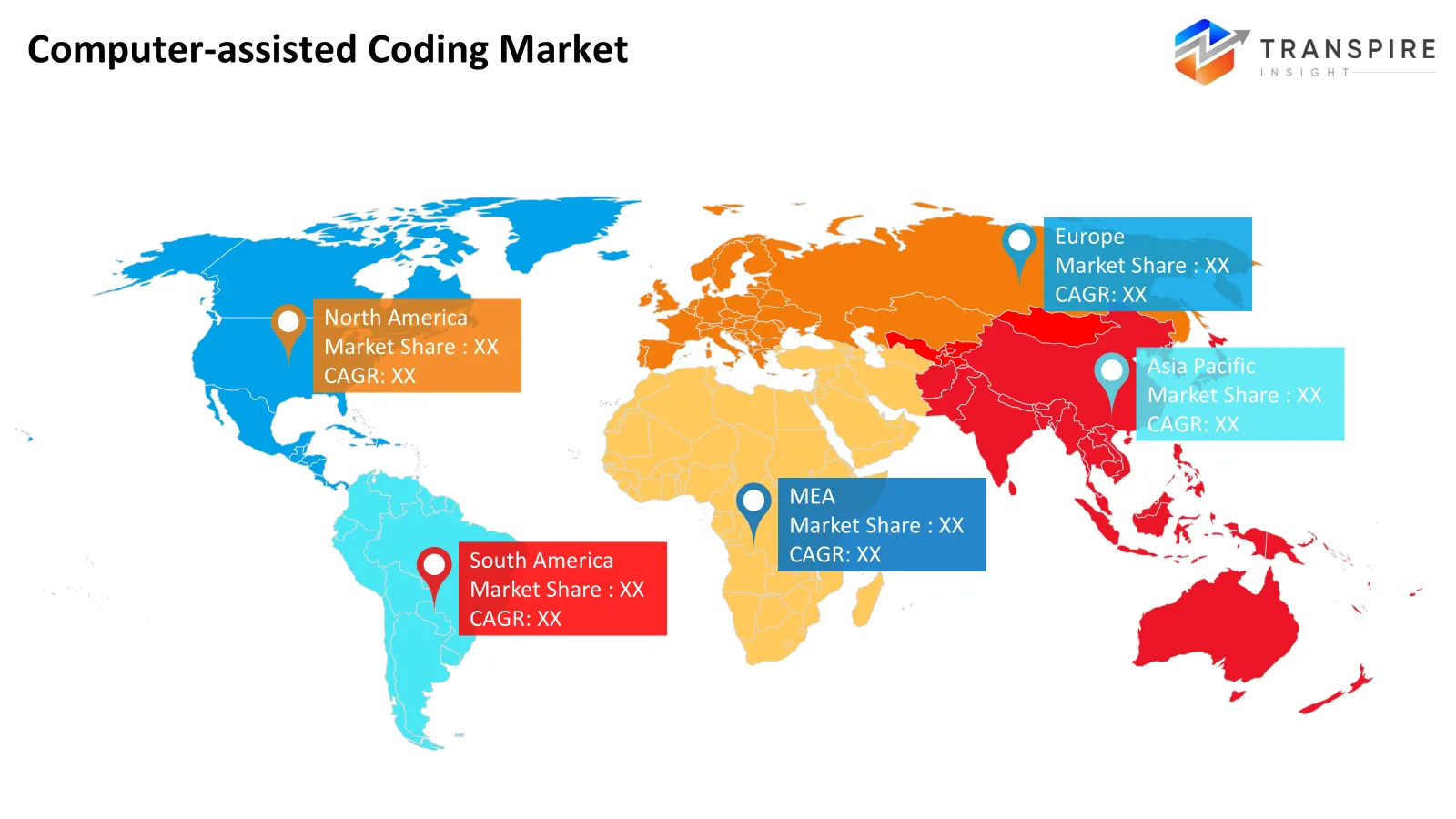
North America holds the largest share, constituting 68.5%, with well-established usage of electronic health records, complex billing processes, and an established market for health tech. Coding automation is highly valuable in a setting where there are demands for correct service documentation and smooth claim processing from providers. Cooperation between vendors and use of AI in revenue cycles will also facilitate adoption of coding automation in the region. The main opportunity in this region is associated with improving accuracy, audibility, and integration in the process, not simply replacing manual steps with digital solutions.
In April 2025, the Cleveland Clinic and Akasa have formed a partnership to implement generative AI solutions that will help with the coding process and increase revenue cycle efficiency
Europe:
The European market holds 17.2% has a solid foundation based on healthcare IT adoption, hospital digitisation, and structured clinical documentation. Different requirements for healthcare tech can be found in Europe due to different health systems, reimbursement schemes, language, and privacy rules. Such factors make the implementation more difficult but generate opportunities for more flexible platform development. Vendors that guarantee data protection, explainable coding, and the ability to integrate with existing hospital infrastructure have good prospects.
In April 2026, Corti unveiled Symphony for Medical Coding, which is an AI model meant to help automate medical coding processes.
Asia Pacific:
Asia Pacific accounts for 9.5% of the regional distribution of the provided supply and is noted to be the region growing at the highest rate with the CAGR of 15.5%. The digitisation of healthcare, the increasing network of providers, and investments in the HIS can generate chances for coding automation. The growth will be driven by the ability of the suppliers to adapt the product according to the local language, coding practices, financials, and IT infrastructure.
In May 2025, iMedX Australia released its HIM Companion Suite to simplify medical coding and health information management through a unified workflow.
Who are the Key Players in the Computer-assisted Coding Market and how do they compete?
The competition comprises health technology incumbents and niche coding automation vendors. The computer-assisted coding benchmark report by KLAS Research features such solutions as Dolbey Fusion CAC, Solventum 3M 360 Encompass, AGS Health, and Optum 360 Enterprise CAC among others. It is evident that customers can benchmark their chosen products according to operational performance and customer service. Products are competing based on integration with electronic health records, coding accuracy, product installation, coverage, and the amount of work done manually as part of the process. Source: KLAS ResearcThrough Solventum 3M 360 Encompass solution, Solventum offers a well-known enterprise coding and documentation workflow specifically for health systems looking for a wide range of functionality. Competitive advantage lies in providing an enterprise coding tool as part of the overall clinical and revenue cycle workflow. On the other hand, Optum offers healthcare IT services and revenue cycle competencies appealing to organisations looking for coding technologies along with other operational competencies. Dolbey Fusion CAC gives a specialised solution to customers considering purchasing a computer-assisted coding product.
Computer-assisted Coding Market Companies
- 3M Health Information Systems
- Optum
- Nuance Communications
- Cerner
- Epic Systems
- Dolbey
- AAPC
- IMO Health
- Oracle Health
- M*Modal
- Nym Health
- Clinithink
- CorroHealth
- Artificial Intelligence in Medicine
- CodaMetrix
|
Company |
Est. Revenue Share Range |
Key Offerings |
Strategic Positioning |
Geographic Strength |
Technology Focus |
|
Solventum |
Estimated 12–18% |
360 Encompass System, computer-assisted coding, reimbursement tools, clinical documentation improvement |
Established enterprise coding leader with broad hospital adoption |
North America, Europe |
Clinical NLP, automated code assignment, coding compliance |
|
Optum |
Estimated 10–16% |
Optum 360 CAC, coding solutions, revenue-cycle management, coding audit support |
Integrated coding and revenue-cycle solutions for large providers |
North America, selected international markets |
AI-assisted coding, coding analytics, workflow automation |
|
Microsoft (Nuance) |
Estimated 7–12% |
Clintegrity 360 CAC, clinical documentation technologies, coding workflow solutions |
Clinical language expertise with enterprise healthcare integration |
North America, Europe |
Clinical NLP, speech recognition, AI-driven documentation analysis |
|
Oracle Health |
Estimated 5–9% |
EHR-integrated coding workflows, clinical documentation, revenue-cycle applications, coding interfaces |
Enterprise healthcare platform integration for complex hospital environments |
North America, Europe, Asia Pacific |
EHR interoperability, clinical data integration, workflow automation |
|
Epic Systems |
Estimated 4–8% |
Coding workflow interfaces, Resolute billing, claim-scrubbing integrations, documentation query workflows |
EHR-centered coding workflows supported by an established provider ecosystem |
North America, selected international markets |
Integrated EHR workflows, coding interfaces, billing automation |
|
Dolbey Systems |
Estimated 2–5% |
Fusion CAC, Fusion Speech, AI Assist, clinical documentation solutions |
Specialist vendor focused on coding productivity and documentation efficiency |
North America |
Speech recognition, NLP, AI-assisted code suggestions |
|
TruCode |
Estimated 2–4% |
TruCode encoder, ICD-10-CM coding tools, ICD-10-PCS support, coding references |
Coding-focused solutions emphasizing encoder functionality and accuracy |
North America, selected international markets |
Coding logic, encoder technology, classification-based lookup |
|
AGS Health |
Estimated 2–5% |
Computer-assisted coding, medical coding services, clinical documentation improvement, revenue-cycle services |
Service-led coding delivery with technology-enabled productivity |
North America, Asia Pacific |
Coding automation, AI-assisted review, revenue-cycle analytics |
|
Artificial Medical Intelligence (AMI) |
Estimated 1–3% |
Computer-assisted coding, clinical documentation analysis, coding workflow support |
Specialized coding technology for healthcare documentation workflows |
North America |
Clinical NLP, automated code suggestions, documentation analysis |
|
CodaMetrix |
Estimated 1–3% |
Autonomous medical coding, specialty-specific coding automation, coding workflow integrations |
AI-first challenger targeting scalable autonomous coding |
North America |
Machine learning, specialty-specific AI, automated code assignment |
Recent Development News
- In April 2026, IKS Health unveiled an AI-powered, audit-ready coding engine that integrates with Epic and combines automated code assignment with human review. According to the company, the process involves confidence scoring, evidence-based rationale, and validation, which shows buyer demand for automation with the ability to meet compliance requirements. https://ikshealth.com/insights/press-releases/iks-health-announces-launch-of-audit-ready-autonomous-coding-capabilities/
- In June 2025, CodaMetrix introduced CMX CARE, a contextual coding automation platform, as well as an emergency department coding module co-developed with provider partners. The development is oriented towards linking patient data throughout their journey and eliminating fragmented coding tasks. https://www.codametrix.com/resources/codametrix-chosen-by-health-systems-representing-180b-in-net-patient-revenue
What Strategic Insights Define the Future of the Computer-assisted Coding Market?
The market is shifting towards coding solutions that will integrate clinical documentation, code assignment, compliance, and claims preparation into one process. Suppliers will have to demonstrate that automation not only helps with speeding up processes but also affects accuracy, denial rate, auditability, staff workloads, and cost of integration. One of the hidden risks is the over-reliance on AI recommendations in case the medical record is incomplete, strange, or ill-structured. In case of errors entering the claims process, there may be additional work for the providers, payment delays, and issues with compliance.The new opportunity is developing speciality-specific and region-specific solutions that fit the specific coding guidelines, languages, and workflows of providers in the rapidly growing Asia Pacific region. Suppliers should focus on transparency of evidence trail, confidence-based escalations, frequent updates of the code set, and human intervention in case of doubts. Providers should start from pilot programs and proceed only in case of success.
Key Segmentations are:
Component
- Software
- Services
- Consulting
- Implementation
- Integration
- Training
- Support
- Maintenance
Deployment
- Cloud-Based
- On-Premise
- Hybrid
- SaaS
- Hosted
- Private Cloud
- Public Cloud
- Others
Coding Type
- ICD
- CPT
- HCPCS
- SNOMED CT
- DRG
- Procedure Coding
- Diagnosis Coding
- Others
Technology
- NLP
- AI
- Machine Learning
- Deep Learning
- Rules-Based Systems
- RPA
- Speech Recognition
- Others
End User
- Hospitals
- Physician Practices
- Ambulatory Surgical Centers
- Clinics
- Health Insurance Companies
- Medical Coding Firms
- Government Agencies
- Others
Application
- Clinical Documentation
- Revenue Cycle Management
- Claims Processing
- Compliance
- Auditing
- Billing
- Quality Reporting
- Others
By Regional Analysis
North America
- US
- Canada
- Mexico
Europe
- Germany
- UK
- France
- Italy
- Spain
- Russia
- Rest of Europe
Asia Pacific
- China
- Japan
- India
- South Korea
- Australia
- Rest of Asia Pacific
South America
- Brazil
- Argentina
- Rest of South America
Middle East & Africa
- UAE
- Saudi Arabia
- Qatar
- South Africa
- Rest of the Middle East & Africa
Frequently Asked Questions
Find quick answers to common questions.
The keyword size was valued at USD 6.35 Billion in 2025 and is poised to reach USD 14.90 Billion by 2033, expanding at a 11.24% CAGR.
Key segments for the computer-assisted coding market are Component (Software, Services, Consulting, Implementation, Integration, Training, Support, Maintenance)Deployment (Cloud-Based, On-Premise, Hybrid, SaaS, Hosted, Private Cloud, Public Cloud, Others)Coding Type (ICD, CPT, HCPCS, SNOMED CT, DRG, Procedure Coding, Diagnosis Coding, Others)Technology (NLP, AI, Machine Learning, Deep Learning, Rules-Based Systems, RPA, Speech Recognition, Others)End User (Hospitals, Physician Practices, Ambulatory Surgical Centers, Clinics, Health Insurance Companies, Medical Coding Firms, Government Agencies, Others)Application (Clinical Documentation, Revenue Cycle Management, Claims Processing, Compliance, Auditing, Billing, Quality Reporting, Others).
Growth is primarily driven by increasing adoption of electronic health records, rising demand for accurate medical coding and billing, growing healthcare data volumes, stricter regulatory compliance requirements, and the integration of artificial intelligence and machine learning to improve coding efficiency and reduce errors.
The market is led by major manufacturers including 3M Health Information Systems, Optum, Nuance Communications, Cerner, Epic Systems, Dolbey, AAPC, IMO Health, Oracle Health, M*Modal, Nym Health, Clinithink, CorroHealth, Artificial Intelligence in Medicine, CodaMetrix.
North America is the most dominant region in the computer-assisted coding market and holds a share of 68.5% owing to sophisticated healthcare IT systems, electronic health record (EHR) adoption, strict medical coding and billing standards, and the rising need for accurate coding, cost-cutting, and healthcare reimbursement.
Opportunities for growth in the computer-assisted coding market around the world include leveraging artificial intelligence and machine learning technologies, increasing demand for cloud-based coding solutions, increased adoption of healthcare IT infrastructure in emerging economies, and strategic collaborations with hospitals and healthcare organizations to improve coding accuracy and minimize billing errors.
- 3M Health Information Systems
- Optum
- Nuance Communications
- Cerner
- Epic Systems
- Dolbey
- AAPC
- IMO Health
- Oracle Health
- M*Modal
- Nym Health
- Clinithink
- CorroHealth
- Artificial Intelligence in Medicine
- CodaMetrix
About the Authors

Pankaj Ghogare Patil
I am Pankaj Ghogare Patil, a Senior Research Analyst at Transpire Insight, specializing in the Pharmaceutical, Chemicals & Materials, Healthcare IT, and Biotechnology industry. My expertise lies in conducting comprehensive market research, analyzing industry trends, evaluating competitive landscapes, and translating complex data into actionable insights. At Transpire Insight, I closely follow emerging technologies, regulatory developments, and market innovations to create accurate, well-researched, and informative content that helps businesses and professionals make informed decisions. I am committed to producing credible, evidence-based articles that reflect industry best practices while making technical topics accessible and valuable for a broad audience.

Chakradhar Khansole
Chakradhar serves as the Research Director at Transpire Insight, bringing over 8 years of experience in technology, innovation, and strategic market intelligence. He specializes in transforming complex market data into actionable business insights that enable organizations to make informed, growth-oriented decisions. Recognized for his strategic vision and analytical expertise, Chakradhar leads high-impact research initiatives, delivering comprehensive market assessments, competitive intelligence, and forward-looking industry analysis.
Recently Published Reports
-
Apr 2026
AI in Diabetic Retinopathy Market
AI in Diabetic Retinopathy Market Size, Share & Analysis Report By Type (Screening AI Systems, Diagnostic AI Systems, and Predictive AI Models), By Application Segment (Hospitals, Ophthalmology Clinics, Diagnostic Centers, and Research and Development), and Geography (North America, Europe, Asia-Pacific, Middle East and Africa, South and Central America), 2021 - 2031
-
Apr 2026
Psychometric Tests Market
Psychometric Tests Market Size, Share & Analysis Report By Type (Personality Tests, Ability/Aptitude Tests, Skill/Knowledge Tests, and Others), By Application (Talent Acquisition and Talent Management), and Geography (North America, Europe, Asia-Pacific, Middle East and Africa, South and Central America), 2021 – 2031
-
Apr 2026
Rare Biological Sample Collection Market
Rare Biological Sample Collection Market Size, Share & Analysis Report By Type (Isolation Kits & Reagent, Blood Collection Tubes, and Others), By Application (Oncology, Transcriptomics, Pharmacogenomics, and Others), and Geography (North America, Europe, Asia-Pacific, Middle East and Africa, South and Central America), 2021 – 2031
-
Jul 2026
Diabetic Retinopathy Market
Diabetic Retinopathy Market Size, Share & Analysis Report By Type (Proliferative Diabetic Retinopathy, and Diabetic Macular Edema (DME)), By Treatment Type (Anti VEGF Drug, Steroid Implants, Laser Surgeries, and Vitrectomy), and Geography (North America, Europe, Asia-Pacific, Middle East and Africa, South and Central America), 2021 – 2031
Our Clients







