
Cloud-Native Application Protection Platform (CNAPP) Market Summary:
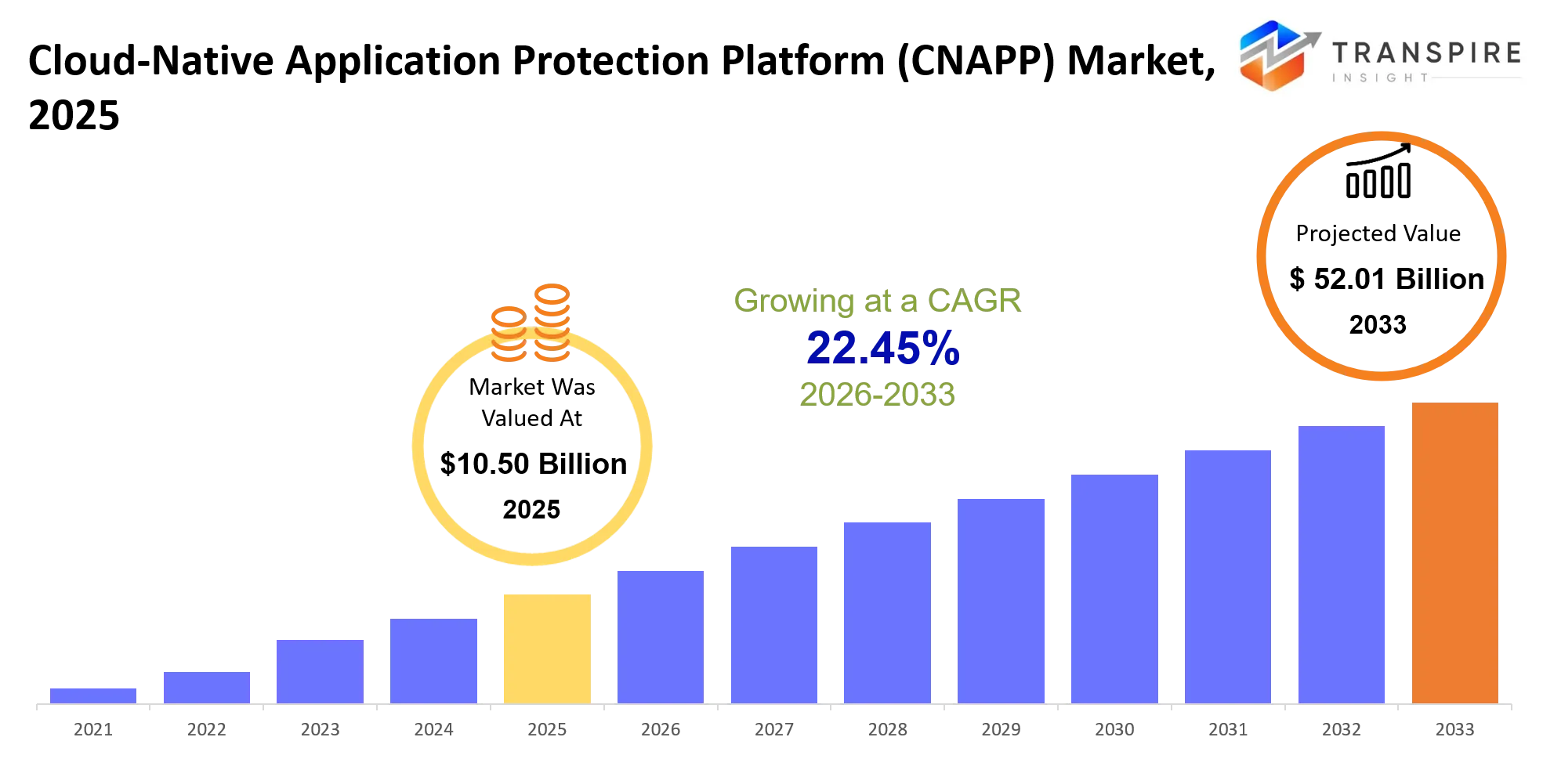
As per Transpire Insight Analysis, the Cloud-Native Application Protection Platform (CNAPP) Market size is estimated at USD 10.50 billion in 2025 and is anticipated to reach USD 52.01 billion by 2033, growing at a CAGR of 22.45% from 2026 to 2033.
The Cloud-Native Application Protection Platform (CNAPP) Market supports businesses in keeping their cloud-based apps, infrastructure, identities, workloads and sensitive data safe. It does this by using tools that work together as one system. Instead of dealing with different tools for checking settings, protecting workloads or managing user permissions, companies can use CNAPP platforms to find weak spots and take action across their entire cloud setup.
In the past three to five years, the market has moved away from separate cloud security tools. Now more and more companies are turning to platforms that link app development with real-time security. This shift makes sense because of the rise in cloud setups, containerised apps and DevSecOps practices. These changes mean security must be checked all the time, not once in a while. A big reason for this change is how complex cloud attacks have become. Hackers often take advantage of too many user permissions or outdated software. These kinds of risks make it harder to stay safe. That’s why organisations are choosing platforms that connect security alerts and help them fix problems in order of importance. As businesses release apps often, having everything in one place helps reduce messy workflows. It also gives visibility into what’s happening in the cloud. This makes it easier to spot threats and respond quickly.
Cloud-Native Application Protection Platform (CNAPP) Market Size & Forecast:
- Market Size 2025: USD 10.50 Billion
- Expected Market Value (2033): USD 52.01 Billion
- Forecast CAGR (2026–2033): 22.45%
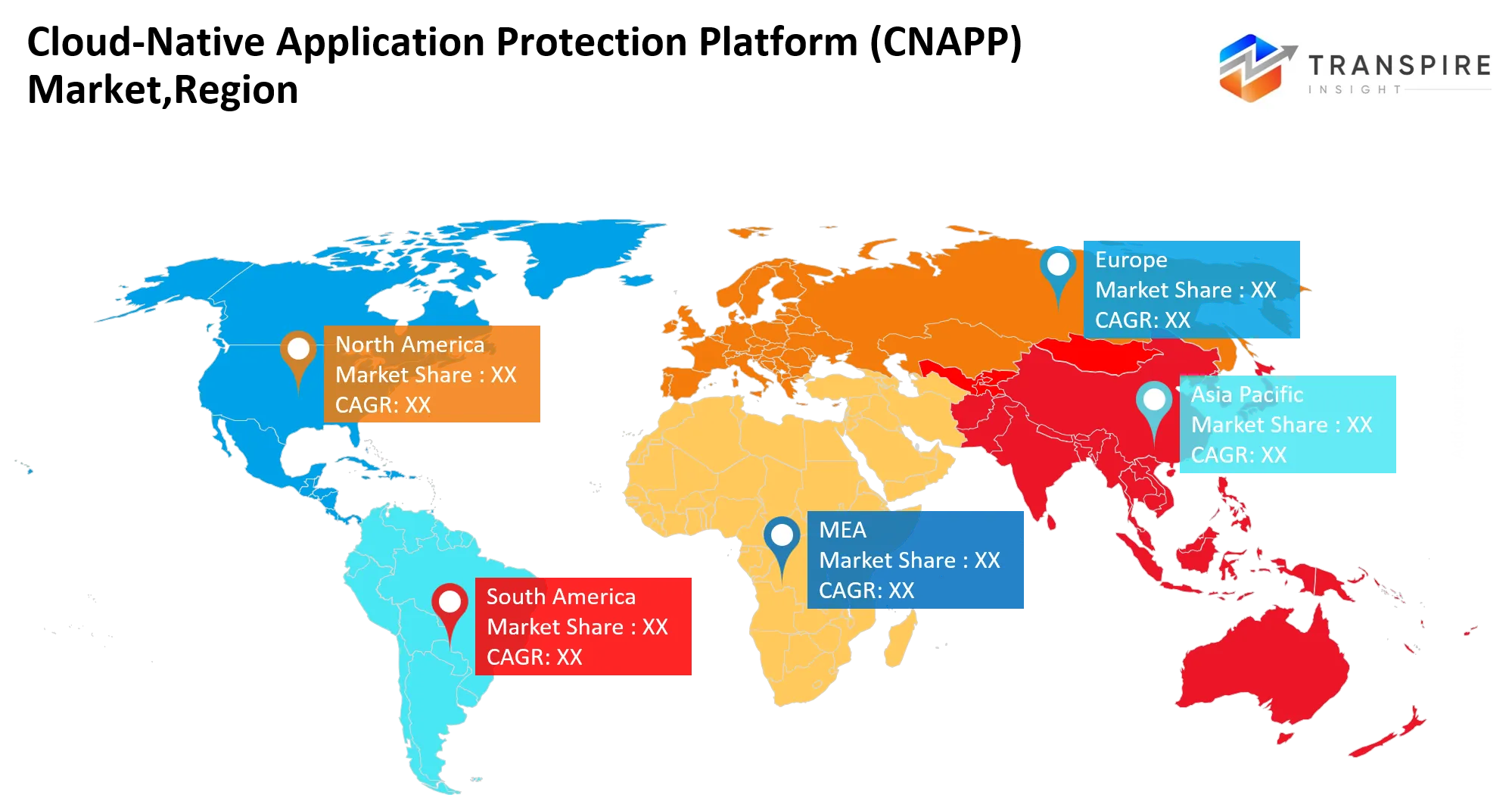
- Leading Region in 2025: North America
- Fastest Growing Region: Asia Pacific
- Key Company Profiles: Palo Alto Networks, Microsoft, CrowdStrike, Wiz, Check Point Software, Fortinet, Cisco, IBM, Orca Security, Aqua Security, Lacework, Tenable, SentinelOne, Trend Micro, Rapid7
Key Market Insights
The CNAPP Market is moving towards a single platform for securing cloud configurations, workloads, applications, and identity management.
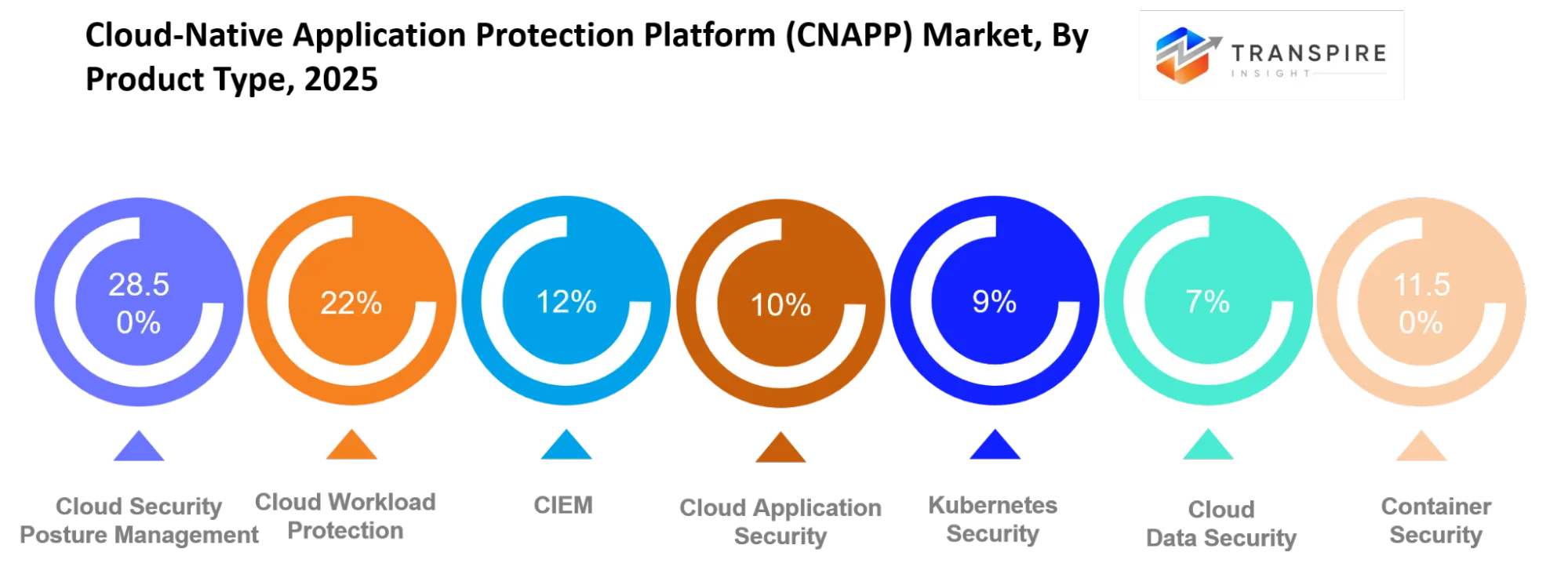
- The Cloud Security Posture Management Market accounts for 28.50% of the market, as the identification of cloud misconfiguration and the enforcement of security policies have become crucial for businesses.
- Cloud Workload Protection holds 22.00% of the market, which relates to the need to secure applications and computing resources in the cloud.
- The share of the Cloud Infrastructure Entitlement Management market takes up 12.00%.
- The Cloud Application Security market share is 10.00%, which corresponds to the necessity to integrate security controls within application development and delivery practices.
- The Kubernetes Security market segment is worth 9.00% of the total market volume, which is related to the increased interest in protecting container orchestration platforms and workloads.
- Cloud Data Security takes 7.00% of the market share, indicating the necessity to identify sensitive data and manage access to it within cloud infrastructure.
- Container Security has 6.00% of the market share, enabling detection and protection throughout the entire container lifecycle.
What are the Key Drivers, Restraints, and Opportunities in the Cloud-Native Application Protection Platform (CNAPP) Market?
Drivers
Separately monitoring vulnerabilities, misconfigurations, identities and workload activity will become harder as hybrid and multi-cloud deployments grow. Combined with the rise in cloud security incidents and the use of containerised applications, there is momentum for consolidating these capabilities in CNAPP platforms. This can lead to better adoption by monitoring in a less siloed way, helping security teams prioritise risk and decreasing the operational effort of alert investigation.
Restraints
Cost and complexity also remain issues, particularly for those with existing legacy technology coupled with cloud workloads. Connecting a CNAPP platform to existing identity management, development workflows, security operations, and compliance workflows may need expert capabilities and more expenditure. Small- and medium-sized businesses might also face obstacles of subscription charges, the time to migrate, and the number of issues that have to be addressed during the initial deployment.
Opportunities
AI workload protection, automated remediation, and multi-cloud security are the next areas of growth. Applying generative AI applications requires organisations to have an understanding of their most sensitive data, access to their models, infrastructure permissions, and application security vulnerabilities. Cloud posture management vendors with ties to runtime security and those offering low-friction developer capabilities will have the most success. A digital transformation and cloud boom in Asia Pacific could further benefit vendors that provide regional support for compliance, 24/7 managed security services, and flexible pricing models.
|
Driver |
Relative Impact on Growth (%) |
Geographic Relevance |
Impact Timeline |
Demand Strength |
Growth Mechanism (5–10 words) |
Key Beneficiaries (5–10 words) |
Major Constraint (5–10 words) |
|
Increasing Cybersecurity Threats and Cloud-Native Attack Surfaces |
27% |
North America, Europe, Asia-Pacific |
Short-term (≤2 years) |
High |
Rising attacks increase demand for unified cloud threat detection. |
CNAPP vendors, cybersecurity firms, enterprise security teams. |
Sophisticated attacks outpace detection capabilities and response readiness. |
|
Growing Multi-Cloud and Hybrid Cloud Adoption |
23% |
North America, Asia-Pacific, Europe |
Medium-term (2–4 years) |
High |
Complex cloud environments require centralized security visibility and control. |
Cloud security vendors, managed service providers, large enterprises. |
Integration challenges across diverse cloud platforms and legacy systems. |
|
Integration of Security into DevSecOps and Software Development |
19% |
North America, Europe, Asia-Pacific |
Medium-term (2–4 years) |
High |
Automated security testing identifies vulnerabilities earlier in development. |
CNAPP providers, DevSecOps platforms, software development teams. |
Developer skill gaps and resistance to workflow changes. |
|
Strengthening Regulatory Compliance and Data Protection Requirements |
17% |
Europe, North America, Asia-Pacific |
Short-term (≤2 years) |
High |
Compliance obligations encourage continuous cloud risk monitoring and reporting. |
Compliance software vendors, cloud providers, regulated enterprises. |
Varying regulations increase implementation costs and complexity. |
|
AI-Driven Cloud Security and Automated Threat Remediation |
14% |
North America, Asia-Pacific, Europe |
Long-term (≥4 years) |
High |
AI improves anomaly detection, prioritization, and remediation speed. |
AI security vendors, CNAPP developers, enterprise security teams. |
False positives, data privacy concerns, and limited AI explainability. |
|
Total |
100% |
market |
— |
— |
— |
— |
— |
What is the Impact of artificial intelligence on the Cloud-Native Application Protection Platform (CNAPP) Market?
The use of artificial intelligence in CNAPPs also changes the way cloud risks are detected, prioritised, and investigated by security professionals. Rather than viewing all alerts as equally relevant, the use of AI makes it possible to assess asset relationships, identity permissions, workload activity, and vulnerability details in order to find risks that could result in a significant incident. This helps security professionals prioritise issues with higher business impact. Another critical innovation introduced by the use of AI in CNAPP solutions is automation. AI-driven CNAPPs can suggest actions that should be taken, help enforce policies, compile security-related reports, and perform investigations of suspicious activities in cloud environments. When incorporated into the development process, automation can help developers fix application configuration and vulnerability issues before deploying their applications.AI recommendations might turn out to be wrong. AI-driven integration with other security tools may take additional effort. Moreover, some advanced functions require extra costs.
Instance
In October 2025, Palo Alto Networks launched Cortex Cloud 2.0, which comes with autonomous AI agents that have been created to improve cloud threat detection, investigation, and response. This move shows how AI is fueling innovation and raising demand for intelligent cloud security solutions.
Key Market Trends
CNAPP solutions have been shifting from separate cloud security services to a risk management approach that spans application development and runtime processes. Competitors will find themselves being driven by automation, context-aware risk assessment, and capabilities related to securing cloud and AI environments.
- Companies used to use several products to deal with posture management, workload defence, and identity security. Nowadays, vendors merge all those features to minimize the number of operational silos.
- Periodic assessment cycles are now making way for continuous monitoring of configuration changes, exposed assets and runtime activity.
- Now there is more focus in cybersecurity on linking vulnerabilities with access rights, exposure, and potential attack vectors rather than treating them separately.
- Security testing is now becoming part of repositories, CI/CD pipelines, and infrastructure-as-code processes, which makes it possible to identify problems early on.
- Now there is an increasing trend to incorporate automatic triage, summaries of investigations and recommendation systems for remediation of issues.
- With the rise of the use of generative AI, there is a need for new types of security features such as model assets, sensitive data, AI application components, and machine identities.
Cloud-Native Application Protection Platform (CNAPP) Market Segmentation
By Security Function
Cloud Security Posture Management (CSPM) had the largest market share of 28.50%, owing to its ability to detect cloud misconfiguration, compliance risk, and exposed assets. Cloud Workload Protection had a share of 22.00% as it was essential to protect cloud workloads from threats and vulnerabilities. Cloud Infrastructure Entitlement Management had a market share of 12.00%, whereas Cloud Application Security had a share of 10.00%. Kubernetes Security, Cloud Data Security, Container Security, and Software Supply Chain Security had market shares of 9.00%, 7.00%, 6.00%, and 5.50%, respectively. These security functions cater to different types of risks, and their combination would help companies devise an effective security strategy. The fastest-growing segment, according to the provided data, is cloud-native workload protection with a CAGR of 18.20%.
By Deployment
Public Cloud caters for those organisations looking for added flexibility without having to house all the underlying hardware themselves. Private Cloud is all about greater control over infrastructure and workloads. Hybrid Cloud lets users run workloads on both private infrastructure and public cloud resources. Multi-Cloud offers flexibility across providers and reduces reliance on a single environment. Edge Cloud caters for workloads closer to users and/or connected devices; Distributed Cloud extends clouds across many geographical locations and is closer to the end user. Sovereign Cloud is for those with jurisdiction, regulatory or data residency requirements. Its future demand depends on the ever-changing levels of flexibility, control, cost and compliance.
By Organisation Size
Big Enterprises are significant customers as they tend to have complex cloud estates, numerous dev teams and significant regulatory controls. SMBs look to subscription-based platforms that do not require a large security staff. Start-up companies appreciate the advantage of embedding security into their development process early rather than fixing things after the fact. Technology vendors want quick-to-build, easy-to-deploy tools that deliver role-based controls, as their releases are frequent. Vendors with flexible pricing models and deployment options can have a broad customer base.
By Application
Application Development and DevSecOps allow your security team to discover vulnerabilities through various stages of software development. Cloud Infrastructure monitors application configurations and secures resources. Container Management secures images and runtime environments. API Security defends interfaces that facilitate communication between applications and services, along with risks associated with point interfaces. When companies are moving toward more automated development and deploying AI-enabled applications, connecting these functions along a shared workflow could be a buying consideration.
By End User
Security for Financial and Regulated Workloads (Banking, Financial Services and Insurance) require full control over the financial information, digital processes and cloud-optimized workloads. The IT and Telecom companies require 24/7 visibility into their cloud applications, network and digital interactions. Government organizations must restrict access and comply with public sector regulations. More and more often, the manufacturing organizations require security for connected factory workflows and industrial applications, while the Media and Entertainment organizations require security for digital content, media content delivery networks, and customer service operations. The Professional Services require reliable assets for protecting their clients' information.
By Service
Managed Security supports organizations in identifying, investigating, and responding to cloud threats without having to build all the necessary skills within their organization. Consulting offers assessment, design, and readiness activities for securing cloud applications and data. Integration connects CNAPP solutions to the existing legacy and cloud infrastructure, identity, and security systems of the organization. Training trains developers and security professionals on how to make the most out of cloud security solutions. Threat Detection, Analysis, and Investigation offer help with incident response activities such as containment and mitigation. As clouds become more advanced, companies without a security footprint in the cloud may seek more managed and integrated services.
What are the Key Use Cases Driving the Cloud-Native Application Protection Platform (CNAPP) Market?
Misconfiguration detection in the cloud is one of the use cases pertaining to the leading segment of CSPM, which forms part of the provided data segmentation. Another important use case pertains to protecting workloads and applications. Companies utilise CNAPP tools to ensure that cloud workloads are monitored, container security is ensured, Kubernetes environments are evaluated, and vulnerability testing is included in DevSecOps processes. The above-mentioned use cases are applicable for IT and Telecom, Financial Services, Healthcare, and Technology companies. New use cases include AI workload security, machine identity governance, software supply chain visibility, and automated incident response. Such use cases help organisations deal with risks related to development with the help of AI technologies, expanding cloud estates, and interconnections in software environments.
|
Report Metrics |
Details |
|
Market size value in 2025 |
USD 10.50 Billion |
|
Market size value in 2026 |
USD 12.60 Billion |
|
Revenue forecast in 2033 |
USD 52.01 Billion |
|
Growth rate |
CAGR of 22.45% from 2026 to 2033 |
|
Base year |
2025 |
|
Historical data |
2021 - 2024 |
|
Forecast period |
2026 - 2033 |
|
Report coverage |
Revenue forecast, competitive landscape, growth factors, and trends |
|
Regional scope |
United States; Canada; Mexico; United Kingdom; Germany; France; Italy; Spain; Denmark; Sweden; Norway; China; Japan; India; Australia; South Korea; Thailand; Brazil; Argentina; South Africa; Saudi Arabia; United Arab Emirates |
|
Key company profiled |
Palo Alto Networks, Microsoft, CrowdStrike, Wiz, Check Point Software, Fortinet, Cisco, IBM, Orca Security, Aqua Security, Lacework, Tenable, SentinelOne, Trend Micro, Rapid7 |
|
Customization scope |
Free report customization (country, regional & segment scope). Avail customized purchase options to meet your exact research needs. |
|
Report Segmentation |
Security Function (Cloud Security Posture Management, Cloud Workload Protection, Cloud Infrastructure Entitlement Management, Cloud Application Security, Kubernetes Security, Cloud Data Security, Container Security, Software Supply Chain Security); Deployment (Public Cloud, Private Cloud, Hybrid Cloud, Multi-Cloud, Edge Cloud, Distributed Cloud, Sovereign Cloud); Organization Size (Large Enterprises, SMEs, Startups, Government, Financial Institutions, Healthcare Organizations, Technology Companies); Application (Application Development, DevSecOps, Cloud Infrastructure, Container Management, API Security, Identity Security, Data Protection); End User (BFSI, IT & Telecom, Healthcare, Retail, Government, Manufacturing, Media & Entertainment, Professional Services); Service (Managed Security, Consulting, Integration, Training, Support, Monitoring, Incident Response) |
Which Regions are Driving the Cloud-Native Application Protection Platform (CNAPP) MarketGrowth?
North America
North America leads in terms of market dominance and accounts for 43.20% of the market share due to its leader status in the provision of cloud infrastructure, high spending on cybersecurity, and the resilience of its enterprise software market. This adoption of cloud visibility and compliance has been spurred mainly by organisations across different verticals like technology, finance, healthcare, and governmental agencies. North America is home to several major cloud service and cybersecurity companies developing integrated security platforms.
In February 2025, Palo Alto Networks announced its new solution known as Cortex Cloud. The cloud security platform is a comprehensive platform that integrates CNAPP capabilities with cloud detection and response technologies, which are currently in high demand by the North American business community.
Europe
Europe constitutes 27.00% of the market share, with factors such as data protection obligations, modernisation of enterprise cloud infrastructure, and growing requirements for controls on sensitive data driving the growth. Companies having presence in multiple EU nations require the deployment of security controls in addition to privacy and industry requirements. The major industries such as financial services, manufacturing, government, and technology possess a broad customer base for cloud security products. There is a higher demand due to the need for controls in hybrid clouds.
In June 2025, Telefónica Tech has entered into a partnership with Wiz aimed at improving cloud security service offerings in Spain. As part of the agreement, Telefónica Tech has added Wiz's CNAPP solution to its portfolio and included services such as detecting, responding to and continuously monitoring of incidents. This development reflects the growing demand for integrated cloud security offerings among European companies that use multicloud architecture.
Asia Pacific
Asia Pacific constitutes 22.00% and is the fastest-growing region. Cloud migration, the increase in digital services and the use of applications in containers are giving rise to new security needs in the region. The financial technology, telecoms, e-commerce and technology players are the major potential adopters and will emerge as the largest potential adopters of cloud security services as they expand digital infrastructure and deal with more sensitive information. Vendors providing scalable implementation, relevant local compliance, and affordable security services can have a further edge.
In April 2025, OpsNow in South Korea launched a new version of its CNAPP platform, integrating OpsNow Security platform with CSPM, CWPP, and CIEM technologies to help customers to detect cloud vulnerabilities, identify excessive permissions, and manage risk responses.
Who are the Key Players in the Cloud-Native Application Protection Platform (CNAPP) Marketand how do they compete?
CNAPP competition revolves around platform integration, risk prioritisation, runtime protection, developer workflows, and the capacity to secure multicloud environments. Product innovation, enterprise integrations, managed services, and pricing for various customer segments are the ways CNAPP vendors compete with each other. At the same time, there is a trend towards closer relations between cloud security and security operations in this space since customers demand more connections and faster response times. Palo Alto Networks provides a solution that combines cloud security with detection and response capabilities via its Cortex Cloud solution based on AI-assisted risk prioritisation and automatic remediation of applications, with the integration of application security into the security operations processes. Microsoft provides solutions that offer cloud security capabilities that integrate into a larger enterprise and cloud security solution of the company. Trend Micro offers its cloud workload protection combined with enterprise security, while Sysdig offers cloud-native workload visibility and runtime protection. Orca Security and Wiz have offerings in cloud risk visibility and prioritisation. Google acquired Wiz to boost its cloud and AI security portfolio.
Cloud-Native Application Protection Platform (CNAPP) Market companies
- Palo Alto Networks
- Microsoft
- CrowdStrike
- Wiz
- Check Point Software
- Fortinet
- Cisco
- IBM
- Orca Security
- Aqua Security
- Lacework
- Tenable
- SentinelOne
- Trend Micro
- Rapid7
A
|
Company |
Est. Revenue Share Range |
Key Offerings |
Strategic Positioning |
Geographic Strength |
Technology Focus |
|
Wiz (Google Cloud) |
Estimated 17–20% |
Wiz Cloud, cloud security posture management, vulnerability prioritization, cloud detection and response |
Agentless visibility with unified cloud risk prioritization |
North America, Europe, Asia Pacific |
Security graphs, agentless scanning, AI-assisted risk analysis |
|
Microsoft |
Estimated 16–19% |
Microsoft Defender for Cloud, Defender CSPM, workload protection, DevOps security integrations |
Enterprise ecosystem integration with bundled security capabilities |
North America, Europe, Asia Pacific |
Cloud posture analytics, threat intelligence, identity-risk correlation |
|
Palo Alto Networks |
Estimated 14–18% |
Prisma Cloud, Cortex Cloud, cloud workload protection, code-to-cloud security |
Broad security platform integration with premium enterprise positioning |
North America, Europe, Asia Pacific |
Code-to-cloud analytics, AI-driven threat detection, runtime protection |
|
CrowdStrike |
Estimated 8–11% |
Falcon Cloud Security, cloud workload protection, cloud security posture management, exposure management |
Unified endpoint and cloud threat detection platform |
North America, Europe, Asia Pacific |
Cloud threat intelligence, behavioral analytics, workload protection |
|
Amazon Web Services (AWS) |
Estimated 5–8% |
Amazon GuardDuty, Amazon Inspector, AWS Security Hub, Amazon Detective |
Native cloud security integrated with AWS infrastructure |
North America, Asia Pacific, Europe |
Cloud-native threat detection, workload scanning, automated security findings |
|
Check Point Software Technologies |
Estimated 3–5% |
CloudGuard CNAPP, CloudGuard Workload Protection, cloud posture management, application security |
Integrated cloud protection for complex enterprise environments |
North America, Europe, Middle East |
Cloud threat prevention, workload segmentation, automated posture management |
|
Orca Security |
Estimated 2–4% |
Orca Cloud Security Platform, cloud security posture management, vulnerability management, identity risk analysis |
Agentless specialist focused on contextualized cloud risk |
North America, Europe, Asia Pacific |
SideScanning technology, attack-path analysis, cloud asset correlation |
|
Trend Micro |
Estimated 2–4% |
Trend Vision One, Cloud One Workload Security, container security, cloud posture management |
Broad hybrid-cloud protection with enterprise security integration |
Asia Pacific, North America, Europe |
Runtime workload defense, virtual patching, cloud threat intelligence |
|
SentinelOne |
Estimated 1–3% |
Singularity Cloud Security, cloud workload protection, cloud posture management, Kubernetes security |
AI-led cloud security integrated with autonomous threat response |
North America, Europe, Asia Pacific |
AI-driven detection, cloud workload analytics, automated threat response |
|
Sysdig |
Estimated 1–3% |
Sysdig Secure, runtime threat detection, Kubernetes security, cloud posture management |
Kubernetes and container security specialization |
North America, Europe, Asia Pacific |
eBPF runtime visibility, container forensics, runtime threat detection |
Recent Development News
In April 2026, Google Cloud made an announcement regarding the launch of cloud and AI security offerings at Next ’26. The company launched additional AI coverage by Wiz and an AI Bill of Materials offering that is capable of helping identify and manage risks related to AI-generated code and shadow AI. This announcement was made due to the increasing demand for security solutions that are not limited to cloud configurations and workloads.
In October 2025, Palo Alto Networks launched Cortex Cloud 2.0, extending its CNAPP features to include autonomous AI agents, a Cloud Command Centre, and improved cloud detection and response. This launch shows the evolution within the industry to merge cloud risk management with automated security operations.
What Strategic Insights Define the Future of the Cloud-Native Application Protection Platform (CNAPP) Market?
The CNAPP market is evolving toward platforms that integrate application development, cloud infrastructure, workload protection, and security operations in one risk management platform. Purely scanning-based solution vendors may feel the heat as customers look for contextual prioritisation, automated remediation, and better protection of AI workloads. One of the silent threats to CNAPP providers is the increasing complexity of machine identities and automation of permissions, which may leave security holes despite traditional configuration compliance. On the other hand, the AI application security and cloud-native workload protection market segments provide vendors with chances to add more valuable features. The Asia Pacific region provides extra growth prospects due to the increase in cloud and digital transformation activities there. CNAPP market players need to focus on proper risk correlation, integration with the existing security products, clear pricing models, and effective remediation processes. Those vendors that will show a tangible decrease in exposure and investigation time will have an advantage.
Security Function
- Cloud Security Posture Management
- Cloud Workload Protection
- Cloud Infrastructure Entitlement Management
- Cloud Application Security
- Kubernetes Security
- Cloud Data Security
- Container Security
- Software Supply Chain Security
Deployment
- Public Cloud
- Private Cloud
- Hybrid Cloud
- Multi-Cloud
- Edge Cloud
- Distributed Cloud
- Sovereign Cloud
Organization Size
- Large Enterprises
- SMEs
- Startups
- Government
- Financial Institutions
- Healthcare Organizations
- Technology Companies
Application
- Application Development
- DevSecOps
- Cloud Infrastructure
- Container Management
- API Security
- Identity Security
- Data Protection
End User
- BFSI
- IT & Telecom
- Healthcare
- Retail
- Government
- Manufacturing
- Media & Entertainment
- Professional Services
Service
- Managed Security
- Consulting
- Integration
- Training
- Support
- Monitoring
- Incident Response
Frequently Asked Questions
Find quick answers to common questions.
The cloud-native application protection platform (CNAPP) market size was valued at USD 10.50 billion in 2025 and is poised to reach USD 52.01 Billion by 2033, expanding at 22.45% CAGR.
Key segments for the cloud-native application protection platform (CNAPP) market are Security Function (Cloud Security Posture Management, Cloud Workload Protection, Cloud Infrastructure Entitlement Management, Cloud Application Security, Kubernetes Security, Cloud Data Security, Container Security, Software Supply Chain Security); Deployment (Public Cloud, Private Cloud, Hybrid Cloud, Multi-Cloud, Edge Cloud, Distributed Cloud, Sovereign Cloud); Organization Size (Large Enterprises, SMEs, Startups, Government, Financial Institutions, Healthcare Organizations, Technology Companies); Application (Application Development, DevSecOps, Cloud Infrastructure, Container Management, API Security, Identity Security, Data Protection); End User (BFSI, IT & Telecom, Healthcare, Retail, Government, Manufacturing, Media & Entertainment, Professional Services); Service (Managed Security, Consulting, Integration, Training, Support, Monitoring, Incident Response)
Growth is primarily driven by increasing cloud adoption, rising cyber threats, growing demand for integrated cloud security solutions, stricter data protection regulations, and the need for real-time threat detection and automated security management.
The market is led by major manufacturers including Palo Alto Networks, Microsoft, CrowdStrike, Wiz, Check Point Software, Fortinet, Cisco, IBM, Orca Security, Aqua Security, Lacework, Tenable, SentinelOne, Trend Micro, Rapid7
The CNAPP market share in North America is 43.20%, owing to a wide cloud adoption, cybersecurity spending, stringent data protection standards, and the availability of leading players in the technology sector. The need to secure workloads and applications in the cloud environment against cyber threats adds to its market superiority.
Commercial opportunities in the worldwide CNAPP space include increased demand for artificial intelligence-based threat detection capabilities, the growth of multi-cloud and hybrid cloud use cases, investment in automation of cloud security processes, and the requirement of unified platforms to protect cloud workloads, applications, and data.
- Palo Alto Networks
- Microsoft
- CrowdStrike
- Wiz
- Check Point Software
- Fortinet
- Cisco
- IBM
- Orca Security
- Aqua Security
- Lacework
- Tenable
- SentinelOne
- Trend Micro
- Rapid7
About the Authors

Mayur Shinde
I am Mayur Shinde, a Senior Research Analyst at Transpire Insight, specializing in the Automotive & Transportation and Information & Communication Technology (ICT) Industry. My work focuses on analyzing emerging market trends, technological advancements, competitive landscapes, and industry developments to deliver accurate, data-driven insights. I am passionate about transforming complex market information into clear, actionable content that helps businesses, professionals, and decision-makers stay informed and make confident strategic decisions.

Chakradhar Khansole
Chakradhar serves as the Research Director at Transpire Insight, bringing over 8 years of experience in technology, innovation, and strategic market intelligence. He specializes in transforming complex market data into actionable business insights that enable organizations to make informed, growth-oriented decisions. Recognized for his strategic vision and analytical expertise, Chakradhar leads high-impact research initiatives, delivering comprehensive market assessments, competitive intelligence, and forward-looking industry analysis.
Recently Published Reports
-
Apr 2026
3D Optical Profiler Market
3D Optical Profiler Market Size, Share & Analysis Report By Type (Desktop 3D Optical Profiler, and Portable 3D Optical Profiler), By Technology (Confocal Technology, and White Light Interference), By End-Use Industry (Manufacturing, Research Institutions, Automotive, Aerospace and Defense, Medical Devices, and Other), and Geography (North America, Europe, Asia-Pacific, Middle East and Africa, South and Central America), 2021 - 2031
-
Apr 2026
Depth Sensor Market
Depth Sensor Market Size, Share & Analysis Report By Type (Infrared Depth Sensors, Time-of-Flight (ToF) Sensors, Stereo Vision Sensors, Structured Light Sensors, Ultrasonic Depth Sensors), By Application (Automotive, Robotics, Gaming, Consumer Electronics, Industrial Automation, Healthcare, Security & Surveillance, Others), By End Users (Automotive Manufacturers, Consumer Electronics Companies, Healthcare Providers, Industrial Companies, Security Agencies, Gaming Companies, Robotics Companies, Others), and Geography (North America, Europe, Asia-Pacific, Middle East and Africa, South and Central America), 2021 – 2031
-
Apr 2026
Digital Manufacturing Market
Digital Manufacturing Market Size, Share & Analysis Report By Component (Hardware, Software, and Services), By Technology (Robotics, 3D Printing, Internet of Things (IoT), and Others), By Application (Automotive and Transportation, Aerospace and Defense, Consumer Electronics, Industrial Machinery, and Others), By Process Type (Computer-Based Designing, Computer-Based Simulation, Computer 3D Visualization, Analytics, and Others), and Geography (North America, Europe, Asia-Pacific, Middle East and Africa, South and Central America), 2021 – 2031
-
Apr 2026
Digital Visa Services Market
Digital Visa Services Market Size, Share & Analysis Report By Type (Individual Travelers, Group Travelers), By Application (Tourism, Business Travel, Others), and Geography (North America, Europe, Asia-Pacific, Middle East and Africa, South and Central America), 2021 – 2031