

 Electronics and Semiconductor
 Aerospace and Defense
 Automotive and Transportation
 Biotechnology
 Chemicals and Materials
 Consumer Goods
 Energy and Power
 Food and Beverages
 Healthcare IT
 Information & Communications
 Manufacturing and Construction
 Packaging
 Pharmaceuticals

Market Summary
The global Cloud Managed Services market size was valued at USD 69.80 billion in 2025 and is projected to reach USD 138.50 billion by 2033, growing at a CAGR of 8.50% from 2026 to 2033. The global cloud managed services market is expanding, as more businesses move to the cloud. IT is getting more complex, and companies need constant monitoring of their IT in cloud and hybrid setups. Rising cyber threats are also pushing businesses to get outside help from managed security services. Small and medium-sized enterprises in new markets are adopting these services to improve their efficiency and scalability, which is further driving growth in the market.
Market Size & Forecast
- 2025 Market Size: USD 69.80 Billion
- 2033 Projected Market Size: USD 138.50 Billion
- CAGR (2026-2033): 8.50%
- North America: Largest Market in 2026
- Asia Pacific: Fastest Growing Market

To learn more about this report,  Download Free Sample Report
Key Market Trends Analysis
- In North America the growth of cloud managed services is really taking off because a lot of companies are already using the cloud. This is also because there are big companies that provide cloud services and there are rules that companies need to follow. So many businesses are letting other companies manage their computer systems and security for them. This helps them save money and make sure everything runs smoothly even when they are using a mix of computer systems. Cloud managed services are helping these businesses to do this.
- In the United States companies really need to update their computer systems so they are using the cloud increasingly. This is because the cloud is a way to store and manage data. Also, there are many cyber-attacks happening so companies are looking for help to protect themselves. Because of this big companies in the United States are relying more on managed infrastructure and managed security services from well-known companies, around the world like managed infrastructure services and managed security services.
- In Asia Pacific things are changing fast with technology. More small businesses are using tools, and the government is helping to make this happen with cloud computing. Because of this the market is growing quickly. Many organizations in Asia Pacific want to use managed infrastructure services that can grow with their business. This will help them expand and fix the problem of not having people with the right IT skills inside their companies. Asia Pacific organizations are looking for these services to support their business expansion and reduce the gaps in IT skills in Asia Pacific.
- Managed infrastructure services are still a popular choice around the world. This is because companies want to outsource things like managing cloud operations, monitoring performance and optimizing workloads. They do this to keep their systems running, manage costs and support their IT environments, which are often spread out and use many different clouds. Managed infrastructure services help companies with these tasks so they can focus on things. Managed infrastructure services are useful for companies that use managed infrastructure services.
- The public cloud is still the popular way to deploy things because it is very flexible and does not cost a lot of money to get started. The public cloud also works well with new applications that are made for the internet. At the time the public cloud and private cloud or hybrid cloud is being used more by industries that have a lot of rules to follow, like banks and hospitals. These industries like the cloud because it lets them control their own data and also use the public cloud when they need to. The public cloud is an option for these industries because it is flexible and can grow with their needs.
- Large enterprises represent the largest organization-size segment, driven by complex IT landscapes and global operations, while SMEs show faster growth rates as managed services enable access to enterprise-grade cloud capabilities without significant capital investment.
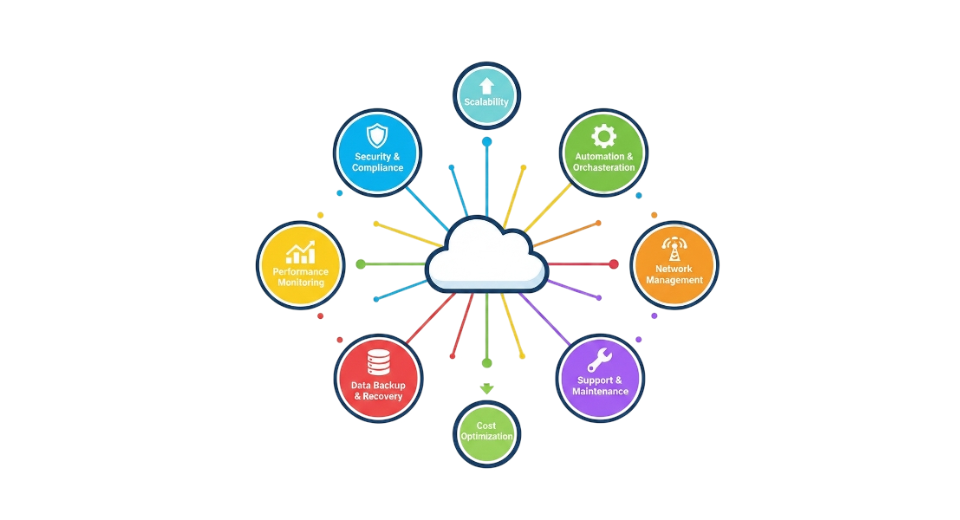
The Global Cloud Managed Services Market is about services that help companies manage their cloud stuff. This means they get help with things like watching over their clouds and making sure they work properly. These services are like having someone take care of computer systems, security and networks for them. This way companies can focus on what they do while still making sure everything runs smoothly and they follow all the rules. The Global Cloud Managed Services Market helps all kinds of small companies in many different fields, like banks, computer companies, hospitals, stores and the government. Cloud managed services are useful because they work with types of clouds. You can use a cloud, a private cloud or a hybrid cloud. This means you can choose the one that's best for your needs and the rules you must follow. Cloud managed services give you the flexibility to do what you need to do.
The market for managed services is really taking off because companies are doing digital transformation projects. More companies are also using hybrid and -cloud strategies, which can be complicated to manage. That is why companies are handing over the management of their cloud operations to people. This helps them save money and work efficiently. They also get to use the expertise of these companies in areas like security and making sure everything runs smoothly. Companies also need help with keeping their systems safe from cyber threats and following all the rules and regulations. They need someone to watch over their systems all the time. That is why they are using managed services increasingly. Managed services are a help to companies because they provide the support that companies need to keep their systems running 24 hours a day 7 days a week. SMEs are emerging as a key growth segment, as managed services enable them to leverage enterprise-grade cloud infrastructure without significant capital expenditure or internal skill constraints.
Regionally, North America leads with a high degree of cloud maturity and hyperscalers’ presence and adoption by large organizations, and Asia Pacific emerges as a fast-growing market with advancements in digitalization and SME adoption of cloud solutions. Europe comes third with a steadily expanding cloud market and supports cloud modernization and governmental initiatives around cloud solutions. The emerging markets of South America and Middle East & Africa are also offering ample opportunities with increasing use of internet and advancements and awareness about managed cloud solutions.
Cloud Managed Services Market Segmentation
By Service Type
- Managed Infrastructure Services
Enterprises are doing something. They are giving the job of managing their infrastructure to companies. This helps the clouds work better and costs money. It also makes sure that everything is always available when it is needed. Big companies have a lot of systems. They use different clouds and this makes things hard to manage. So, they need help with keeping an eye on everything and making sure all the work gets done in the way possible. They also need all their systems to work well together with the main company applications. This is why managed infrastructure services are very important for enterprises and their cloud performance.
- Managed Security Services
Cybersecurity threats are getting worse. Organizations must deal with a lot of rules they need to follow. They also have a digital presence. This is why they need to get help from experts who can handle their security. These experts give them security management. They keep an eye on things all the time to see if there are any threats. They also check for weaknesses. Help fix problems when they happen. This helps reduce the risk of something bad happening and makes sure organizations are doing what they are supposed to do. They do all this for private and hybrid cloud environments. Managed security services like these are very important for cybersecurity. Cybersecurity is a deal and these services help with that.
- Managed Network Services
With more cloud apps and remote work, dependable networking is a must-have. Managed Network Services ensure solid connectivity, communication, and bandwidth. They also cut down on lag, letting businesses with many locations talk to each other without issues.
To learn more about this report, Download Free Sample Report
By Deployment Model
- Public Cloud
Folks go for the public cloud because it doesn't cost much to get started, it's easy to grow, and it works well with new tech. Businesses use it because it's flexible, they only pay for what they use, and they can get to cool tools. It's great for things that aren't super critical and for growing new digital projects
- Private Cloud
A private cloud gives you more control, keeps your data safe, and helps you follow the rules. It's perfect if you have very sensitive info. Groups that need to keep their data in certain places or meet certain rules like using a private cloud to keep a close eye on things while still using virtualization and cloud automation.
- Hybrid Cloud
More people are using hybrid clouds as they try to find the right mix of safety, price, and how well things work. By using both public and private clouds, businesses can put workloads where they make the most sense, grow when they need to, keep important data safe, and still use the cloud to try out new ideas and change how they do things digitally.
By Organization Size
- SMEs (Small & Medium Enterprises)
Small and mid-sized businesses are using cloud managed services increasingly. This gives them access to top-notch infrastructure without spending a ton of money upfront. Managed services offer flexibility, expert help, and make operations smoother. This lets smaller orgnizations move faster with their digital projects and compete well in both local and international markets.
- Large Enterprises
Big companies with complicated IT setups depend on managed services to keep things running smoothly, expand worldwide, and keep a close eye on their systems. Outsourcing cloud tasks cuts down on internal management, makes sure they follow the rules, and supports mixed or multi-cloud plans across different departments and locations.
By End-Use Industry
- BFSI
The BFSI industry needs top-notch security, must follow the rules, and be up and running all the time. Managed services help with secure transactions, keep data safe, and watch things as they happen. This lets banks and insurance companies focus on coming up with new ideas while making sure everything runs smoothly and follows the law.
- IT & Telecom
IT and telecom firms use managed services to keep their networks running well, make their systems better, and help them put out new services fast. Providers use these services to keep an eye on things, stay safe, and grow as needed. This makes sure customers always have a good experience and that things work well, even when there's a lot of competition.
- Healthcare
Healthcare groups need IT systems that are safe, follow the rules, and are always available. Managed services help keep patient info private, make cloud tasks better, and ensure everyone can always get to the important apps. This helps with new digital health plans and following the rules.
- Retail
Retailers are using managed services increasingly to deal with busy and slow seasons, run their online stores, and study customer data. Managed cloud services make sure they have enough computing power when they need it, make apps run better, and keep transactions safe. This makes customers happier and things run more smoothly.
- Government
Government offices are using managed services to update old IT systems, make services better, and be sure they're following strict security and rules. Managed services help with online government, services for citizens, and keeping data safe across different departments and locations.
Regional Insights
The global cloud managed services market differs from region to region because of things like how good the digital tech is, how many companies are using it, and the rules in place. North America is on top, with the United States leading the way because they have great cloud systems, and lots of big cloud companies. Canada and Mexico are right behind, with more and more people getting on board with cloud tech.
Europe is a stable market with lots of rules. Germany, the United Kingdom, and France are the big players because companies there are updating their cloud systems to meet requirements. Spain, Italy, and the rest of Europe are catching up, helped by new digital programs and more small and medium businesses using cloud services.
Asia Pacific is growing the quickest. Japan and China are the main markets because lots of companies are changing their IT and governments are pushing cloud solutions. India, South Korea, Australia, and New Zealand are also growing as more small and medium businesses start using cloud services.
South America is still up-and-coming, with Brazil leading the way thanks to companies moving to the cloud and digital commerce getting bigger. Argentina and the rest of South America are slowly starting to use cloud services more.
The Middle East and Africa are growing steadily. Saudi Arabia and the United Arab Emirates are in the lead, due to their digital transformation plans. South Africa and the rest of the region are getting there, with people knowing more about cloud tech and building the needed systems.
To learn more about this report, Download Free Sample Report
Recent Development News
- September 2023, Accenture expanded its cloud managed services offerings by integrating AI-driven automation and enhanced security solutions to help enterprises optimize hybrid and multi-cloud environments efficiently.
- June 2024, Hewlett Packard Enterprise (HPE) announced updates to its GreenLake cloud and managed services portfolio to support hybrid cloud management, cost optimization, and enterprise workload modernization.
|
Report Metrics |
Details |
|
Market size value in 2025 |
USD 69.80 Billion |
|
Market size value in 2026 |
USD 78.00 Billion |
|
Revenue forecast in 2033 |
USD 138.50 Billion |
|
Growth rate |
CAGR of 8.50% from 2026 to 2033 |
|
Base year |
2025 |
|
Historical data |
2021 – 2024 |
|
Forecast period |
2026 – 2033 |
|
Report coverage |
Revenue forecast, competitive landscape, growth factors, and trends |
|
Regional scope |
North America; Europe; Asia Pacific; Latin America; Middle East & Africa |
|
Country scope |
United States; Canada; Mexico; United Kingdom; Germany; France; Italy; Spain; Denmark; Sweden; Norway; China; Japan; India; Australia; South Korea; Thailand; Brazil; Argentina; South Africa; Saudi Arabia; United Arab Emirates |
|
Key company profiled |
IBM Corporation, Accenture plc, Tata Consultancy Services (TCS), Infosys Limited, Wipro Limited, Capgemini SE, Cognizant Technology Solutions, DXC Technology Company, HCL Technologies Limited, Atos SE, Rackspace Technology, NTT DATA Corporation, Fujitsu Limited, Cisco Systems, Inc., and Hewlett Packard Enterprise (HPE). |
|
Customization scope |
Free report customization (country, regional & segment scope). Avail customized purchase options to meet your exact research needs. |
|
Report Segmentation |
by service type (managed infrastructure, managed security, and managed network services), deployment model (public, private, and hybrid cloud), organization size (SMEs and large enterprises), end-use industry (BFSI, IT & telecom, healthcare, retail, and government) |
Key Cloud Managed Services Company Insights
Accenture is a top global provider of cloud managed services. They use their know-how in consulting and tech to give complete solutions for different cloud setups, including hybrid, multi-cloud, and specific industries. They handle infrastructure, security, networks, and apps, and they add AI and automation to make things run smoother. Because they work closely with big cloud providers like AWS, Microsoft Azure, and Google Cloud, Accenture can offer solutions that are scalable, secure, and meet regulations for businesses of any size. Accenture mixes strategy with managed services, making them a leader in the market. They help with digital changes, cutting costs, and coming up with new ideas in many industries and places.
Key Cloud Managed Services Companies:
- IBM Corporation
- Accenture plc
- Tata Consultancy Services (TCS)
- Infosys Limited
- Wipro Limited
- Capgemini SE
- Cognizant Technology Solutions
- DXC Technology Company
- HCL Technologies Limited
- Atos SE
- Rackspace Technology
- NTT DATA Corporation
- Fujitsu Limited
- Cisco Systems, Inc.
- Hewlett Packard Enterprise (HPE)
Global Cloud Managed Services Market Report Segmentation
By Service Type
- Managed Infrastructure Services
- Managed Security Services
- Managed Network Services
By Deployment Model
- Public Cloud
- Private Cloud
- Hybrid Cloud
By Organization Size
- Small & Medium Enterprises (SMEs)
- Large Enterprises
By End-Use Industry
- BFSI
- IT & Telecom
- Healthcare
- Retail
- Government
Regional Outlook
- North America
- United States
- Canada
- Mexico
- Europe
- Germany
- United Kingdom
- France
- Spain
- Italy
- Rest of Europe
- Asia Pacific
- Japan
- China
- Australia & New Zealand
- South Korea
- India
- Rest of Asia Pacific
- South America
- Brazil
- Argentina
- Rest of South America
- Middle East & Africa
- Saudi Arabia
- United Arab Emirates
- South Africa
- Rest of the Middle East & Africa







 APAC:+91 7666513636


