

Chilled Beam System Market Size & Forecast:
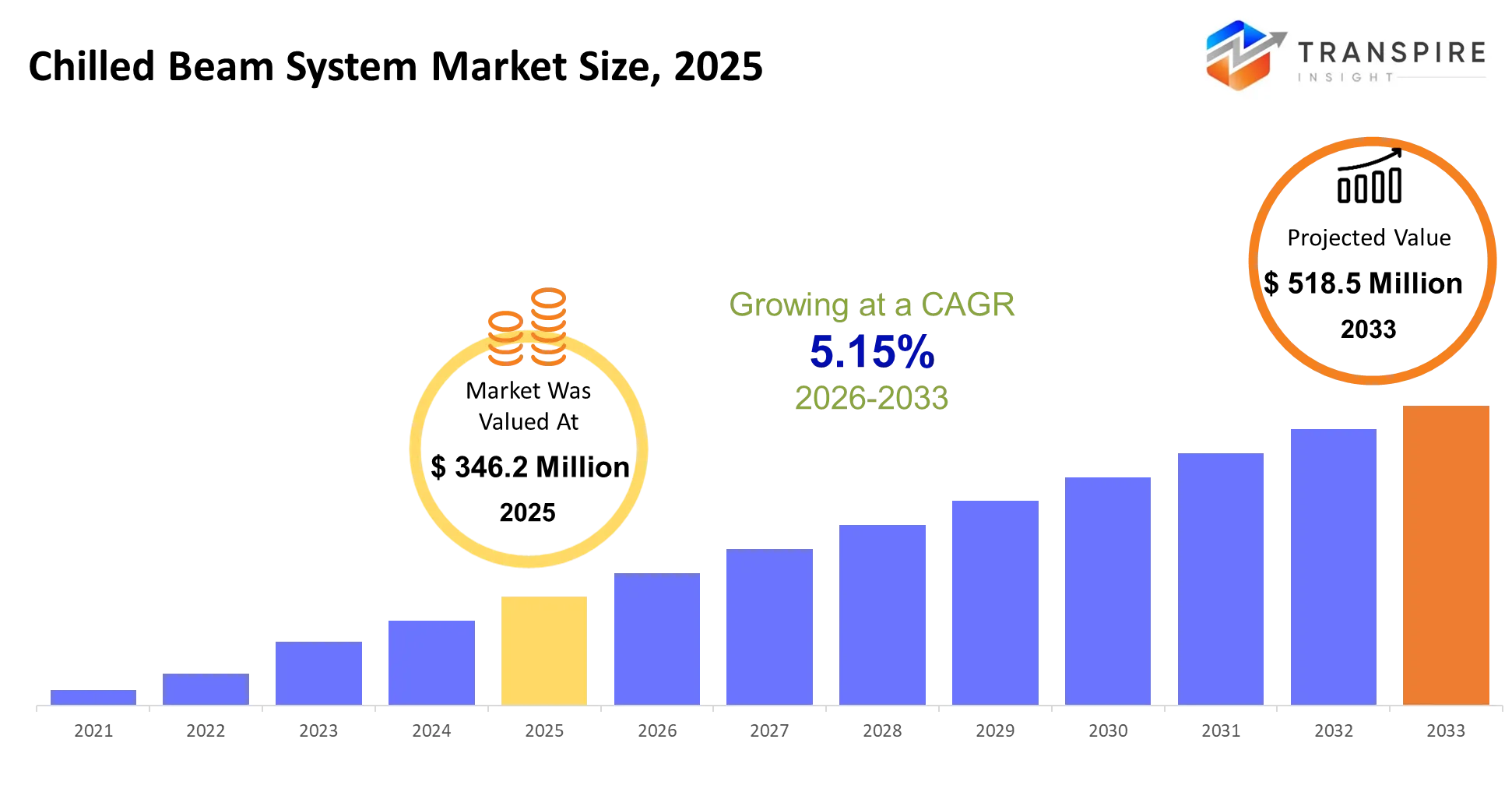
- Chilled Beam System Market Size 2025: USD 346.2 Million
- Chilled Beam System Market Size 2033: USD 518.5 Million
- Chilled Beam System Market CAGR: 5.15%
- Chilled Beam System Market Segments: By Type (Active, Passive, Multi-service, Induction), By Application (Commercial Buildings, Offices, Hospitals, Educational Institutions), By End-User (Construction Companies, HVAC Providers, Building Owners, Facility Managers)
To learn more about this report,  Download Free Sample Report
Chilled Beam System Market Summary:
The global Chilled Beam System market is valued at USD 346.2 million in 2025 and is projected to hit USD 756.1 million by 2033, tracking a steady 5.15% growth rate. From a practical standpoint, chilled beam technology offers a quiet, draft-free method to heat and cool large commercial spaces. It completely bypasses the massive energy drain of standard AC units. Instead of relying on bulky metal ducts and heavy mechanical fans to force air around, these systems simply run hot or cold water through ceiling-mounted copper coils.
Over the past few years, the commercial real estate sector has faced a harsh reality regarding strict net-zero building laws and corporate ESG standards. The real catalyst for this market shift, however, is the extreme volatility of electricity prices. Facility managers no longer judge an HVAC system just by its upfront installation cost; their main focus is slashing the monthly utility bill. Because chilled beams use significantly less power than traditional setups, developers are relying on them to secure coveted green building certifications like LEED and BREEAM. Earning these ratings makes it much easier to attract premium corporate tenants willing to pay higher rent.
There is also a major architectural advantage that drives adoption in dense urban areas. Since water pipes are drastically smaller than standard air ducts, architects can physically lower the ceiling height required on every single floor. When building a skyscraper, saving just one foot per level quickly adds up. It frequently gives developers the vertical space to insert an entirely new, rentable floor without breaking local city height limits, translating directly into millions in extra annual leasing revenue.
Key Market Insights:
- Commercial buildings dominated the market in 2025. Corporate campuses and offices account for over 45% of total revenue.
- Active chilled beams are the clear favorite right now. They handle heavy cooling loads well, making them ideal for packed office floors.
- Passive beams do not have moving parts, meaning they are completely silent. Universities are buying these up specifically for libraries and research labs.
- In Europe, schools are a major buyer. They use government grants to install hydronic cooling because it pays off over years of daily use.
- Multi-service beams are starting to become the premium standard. Manufacturers are building smoke detectors, lights, and speakers right into the cooling units to save ceiling space.
- Hospitals are a massive growth area. Standard air conditioning blows germs around, but chilled beams use natural convection. This keeps the air much cleaner in patient wards.
- Condensation used to be a dealbreaker. Now, smart sensors automatically tweak water temperatures to stop the ceiling from "sweating" on humid days.
- Most sales go to brand new construction projects since it is much easier to plan the plumbing before the building goes up.
What are the Key Drivers, Restraints, and Opportunities in the Chilled Beam System Market?
The primary driver for this market is the strict enforcement of new commercial building codes alongside a massive corporate push for sustainability. International climate agreements and the high financial value of green building ratings, such as LEED and BREEAM, are forcing the construction industry to adapt. Traditional air conditioning units consume a massive amount of mechanical power just to spin their internal fans. Chilled beams, however, use almost no fan power. They rely instead on the natural thermal transfer of water, which noticeably lowers a building's overall carbon footprint. For developers constructing premium office spaces, achieving this low-carbon status is a major financial advantage because it attracts ESG-focused corporate tenants willing to pay higher leasing rates.
A perfect real-world instance of this is the Skanska NowyRynek complex (Building E) in Poland. To meet strict ESG criteria and achieve prestigious LEED Platinum certification, the developers explicitly installed a quiet, energy-efficient chilled beam system for the building's climate control. By designing a highly sustainable, low-emission space, Skanska successfully attracted major international corporate tenants—like Wunderman Thompson Technology—who specifically seek out green offices to meet their own internal corporate climate goals.
The high upfront cost is still a major hurdle. Installing a complex water-piping system in the ceiling requires highly skilled labor, which drives up the initial price tag. This makes it a tough sell for buyers in developing nations who are working with tight construction budgets. Indoor humidity is another huge problem. If the air inside a building gets too damp, water droplets will start condensing and dripping from the cold ceiling pipes. To prevent this, building owners are forced to buy extra dehumidification equipment, adding even more to the total cost.
A classic real-world example of this limitation is seen in commercial kitchens and crowded restaurants. Because these spaces naturally generate massive amounts of moisture and heat, the condensation risk on a chilled beam is extremely high. Unless the building owner invests heavily in localized desiccant driers or separate dehumidifiers to constantly pull moisture out of the air, the ceiling will drip water. This extra equipment cost often makes the technology financially impractical for those specific environments.
The push toward smart buildings is a massive opportunity for this market. Facility managers actively want climate equipment that connects to the Internet of Things (IoT). If manufacturers design chilled beams that talk directly to a central Building Management System (BMS), the system can automatically adjust cooling based on real-time room occupancy.
A practical instance of this is integrating IoT sensors inside corporate conference rooms. Instead of blasting cold air into a room all day, the smart sensors detect the exact moment a meeting ends and the room empties. The BMS instantly signals the chilled beam to cut the water flow, completely eliminating wasted energy for that specific zone.
Another huge opportunity lies in the development of multi-service units. By packing cooling coils, acoustic sound panels, smoke alarms, and LED lighting into one single ceiling fixture, manufacturers can offer a highly attractive, time-saving "all-in-one" package for massive building retrofits.
What Has the Impact of Artificial Intelligence Been on the Chilled Beam System Market?
AI is transforming chilled beams from static ceiling fixtures into a highly responsive, automated climate network. In this market, AI software is primarily used for predictive maintenance and reducing daily energy waste. Instead of relying on a facility manager to manually adjust thermostats, AI platforms use local room sensors to track exactly how many people are in a space, the current room temperature, and the humidity levels. The software then automatically adjusts the water flow to provide the precise amount of cooling needed.
The most significant advantage AI brings to this technology is the complete prevention of condensation. Special machine learning algorithms analyze real-time weather conditions outside and moisture levels inside the building. This allows the system to predict exactly when the metal beams might begin to "sweat." The AI then proactively raises the water temperature just enough to stop it. By solving the condensation issue before a single drop of moisture even appears, AI has effectively eliminated the biggest historical drawback of chilled beam systems.
Key Market Trends:
- Buyers increasingly prioritize architectural integration, seeking systems that look visually appealing when left exposed or that blend seamlessly into modern, open-ceiling office designs.
- Facility managers now demand complete digital transparency, requiring mobile-accessible software dashboards to monitor real-time energy consumption across specific floors or zones.
- The commercial retrofitting segment is rapidly accelerating. Strict new energy ordinances in older cities are forcing property owners to completely replace inefficient fan-coil units with low-energy hydronic cooling solutions.
- Healthcare facilities are fundamentally rethinking indoor airflow. Hospital boards are heavily investing in chilled beams to eliminate drafts and physically stop the circulation of airborne pathogens across sensitive patient wards.
- IoT sensor embedding is becoming standard manufacturing practice. Cooling units are now factory-equipped with the hardware needed to track building foot traffic, monitor air quality, and enhance overall security.
- Luxury hotel chains are actively adopting passive cooling systems to completely eliminate the disruptive noise of traditional window or split AC units, guaranteeing guests an entirely silent room.
- Major corporations are purchasing these systems primarily as a strategic asset to meet the aggressive carbon reduction targets they have promised to their shareholders and investors.
Chilled Beam System Market Segmentation
By Type
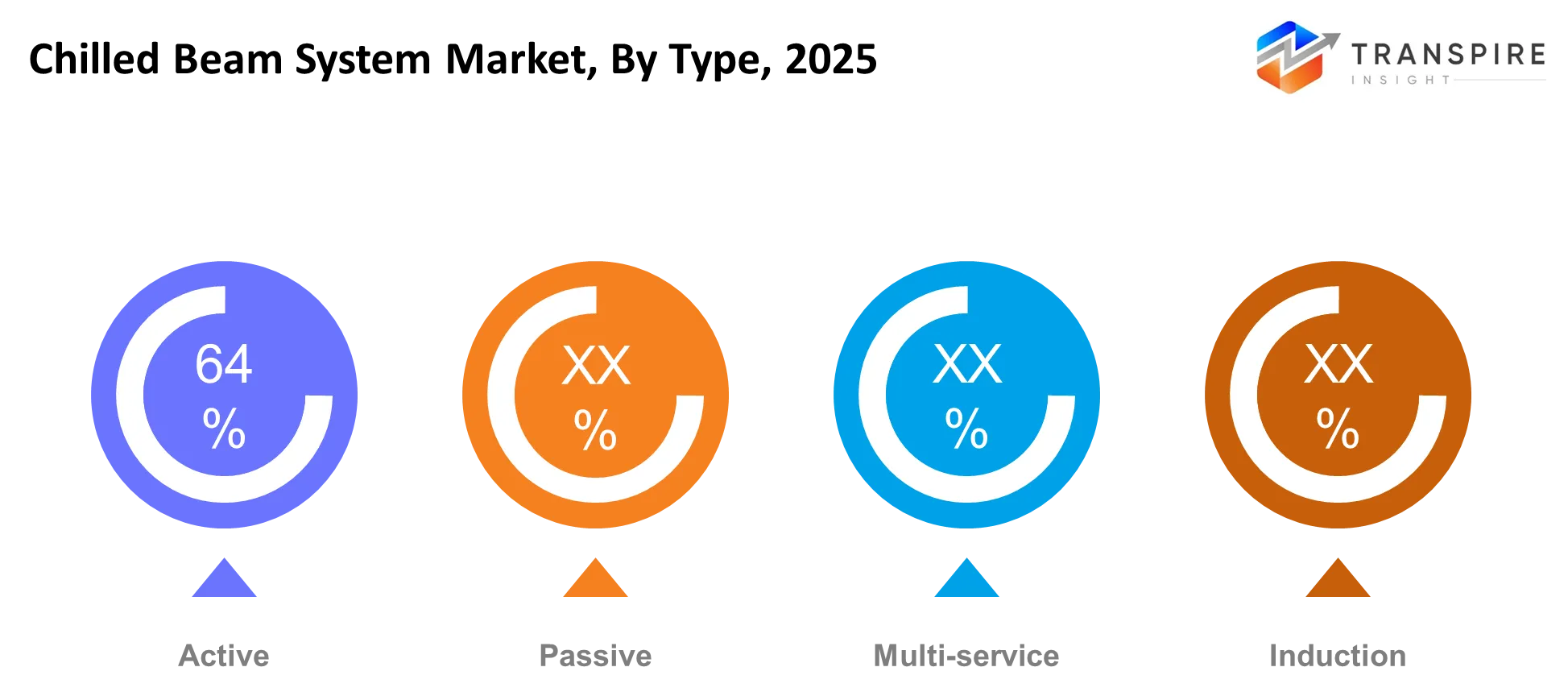
Active chilled beam systems really hold the market with a 64% revenue share, integrating built-in controls - and also optional heating elements - so you get quite comprehensive thermal conditioning. These systems bring about superior comfort control thanks to very responsive temperature regulation and an ability to adjust to varying occupancy patterns all the time. Active systems are best for applications demanding very accurate climate control - like offices with quite changing occupancy levels, hospitals needing very special environmental conditions, and educational facilities using spaces in really different ways all the time. The extra cost for active systems is definitely justified by better comfort delivery and much more effective energy-optimization features that really matter to building operators focusing on their facility's operational performance.
Passive chilled beam systems hold a 23% market share, relying entirely on density-driven convection circulation - without any fan-powered parts. These systems offer significantly lower installation prices and a lot less operating complexity, really appealing to building owners watching their budget and applications with pretty consistent occupancy patterns. Passive systems are seen more often in retrofit projects when you can use the existing chilled water distribution system. Educational institutions and pretty stable office environments really choose passive systems a lot when the upfront savings outweigh the benefits of more precise control.
Multi-service beam systems are growing fast - at a 11. 3% CAGR, integrating chilled beam functionality with lighting fixtures, sound-absorbing materials, and ventilation components all within a single ceiling unit. These systems really simplify ceiling complexity and make ceilings look better visually compared to installing separate components. Commercial office developers are choosing multi-service systems a lot to make the most of their ceiling height and reduce architectural trade-offs. The integration benefits, including a lot simpler installation, one set of controls, and a lot better ceiling appearance, push prices up - allowing vendors to keep this value proposition through their unique products.
By Application
To learn more about this report, Download Free Sample Report
Commercial office buildings represent the biggest application segment at 38% revenue share - driven by tenant comfort requirements and facility managers focusing their efforts on operational efficiency. Contemporary office spaces really include zoning strategies that match chilled beam capabilities - this allows for individual comfort control and energy-cost allocation across quite different space types. The highly competitive commercial real estate market makes us adopt systems that really enhance occupant satisfaction and decrease our operating expenses. Flexible workspace designs incorporating moveable partitions especially benefit from chilled beam modularity and zoning flexibility itself.
Healthcare facilities account for 16% of application revenue - driven by very stringent air quality standards and really precise environmental control requirements in medical settings. Infection prevention protocols and pharmaceutical processes need stable humidity and temperature conditions - which chilled beams deliver quite effectively indeed. Operating rooms, clean rooms, and patient care areas often really specify chilled systems so we can maintain compliance with healthcare facility standards. The mission-critical nature of healthcare environments actually justifies premium technology investments itself.
Educational institutions represent 18% of application revenue - modernizing campus facilities to really meet occupant comfort standards and energy performance objectives. Universities and schools really undertake facility upgrades since our infrastructure is aging and our operational costs are increasing. Educational environments really benefit from chilled beam flexibility allowing for zoning aligned with quite different space types - such as lecture halls, laboratories, dormitories, and administrative offices. Long occupant lifecycles actually justify technology investments that decrease our operating costs and really enhance our facility value itself.
By End-User
Construction companies drive about 46% of end-user revenue by designing new building projects that use chilled beam systems from the very start. General contractors and specialized MEP firms will often specify chilled systems when the architectural and mechanical designs really suit the system's capabilities. Integrated project delivery models are becoming a lot more common - they really position chilled beams as a basic specification requirement instead of a value-engineered alternative option. The construction segment offers the biggest revenue opportunities through lots of high-volume projects and steady technology adoption habits.
HVAC service providers represent around 35% of end-user market revenue through the installation, commissioning, and ongoing maintenance of systems. Specialized trade contractors really develop their expertise in chilled beam setup, installation, and maintenance tasks. These providers develop long-term service relationships with customers and build their technical competence. This sets up a real revenue opportunity extending well beyond the initial installation to include multi-year maintenance contracts and retrofit activities.
Building owners and facility managers account for roughly 19% of revenue through retrofit projects that focus on reducing operational costs and improving performance. Facility managers conduct detailed cost-benefit analyses by comparing the lifecycle expenses of chilled beams to other available technologies. Their decision-making time frames usually cover 15-20 year equipment life cycles. Buildings that are owned by their occupants often put a high priority on making investments in operational efficiency that deliver excellent returns over quite long holding periods.
|
Report Metrics |
Details |
|
Market size value in 2025 |
USD 346.2 Million |
|
Market size value in 2026 |
USD 365.3 Million |
|
Revenue forecast in 2033 |
USD 518.5 Million |
|
Growth rate |
CAGR of 5.15% from 2026 to 2033 |
|
Base year |
2025 |
|
Historical data |
2021 - 2024 |
|
Forecast period |
2026 - 2033 |
|
Report coverage |
Revenue forecast, competitive landscape, growth factors, and trends |
|
Geographic scope |
North America, Europe, Asia-Pacific, Latin America, Middle East & Africa |
|
Key companies profiled |
Halton Group, TROX GmbH, Swegon Group AB, FläktGroup, Johnson Controls, Daikin Industries Ltd., Carrier Global Corporation, Trane Technologies, Lindab Group, Zehnder Group, Systemair AB, Titus HVAC, Krueger-HVAC, Price Industries, WaterFurnace International |
|
Customization scope |
Free report customization (country, regional & segment scope). Avail customized purchase options to meet your exact research needs. |
|
Report Segmentation |
By Type (Active, Passive, Multi-service, Induction), By Application (Commercial Buildings, Offices, Hospitals, Educational Institutions), By End-User (Construction Companies, HVAC Providers, Building Owners, Facility Managers) |
What are the Key Use Cases Driving the Chilled Beam System Market?
The main reason people buy these systems is to cool massive office spaces without spending a fortune on electricity. In giant corporate headquarters and tech hubs, developers use active beams to hit strict energy targets. It allows them to market the building to tech companies and green-focused tenants who care about their carbon footprint.
Hospitals are a rapidly expanding use case. They put chilled beams in recovery rooms and intensive care units. Regular vents blow dust and germs across the room, but chilled beams just let cold air sink naturally. It keeps the room temperature perfectly stable and stops pathogens from circulating, which is exactly what doctors want.
One of the relatively new applications for this concept is being developed in connection with public buildings such as airports or museums. Municipal administrations are using them as part of their efforts to become more sustainable. In addition, luxury hotels are beginning to consider the application of passive beams to offer guests an absolutely silent room.
Which Regions are Driving the Chilled Beam System Market Growth?
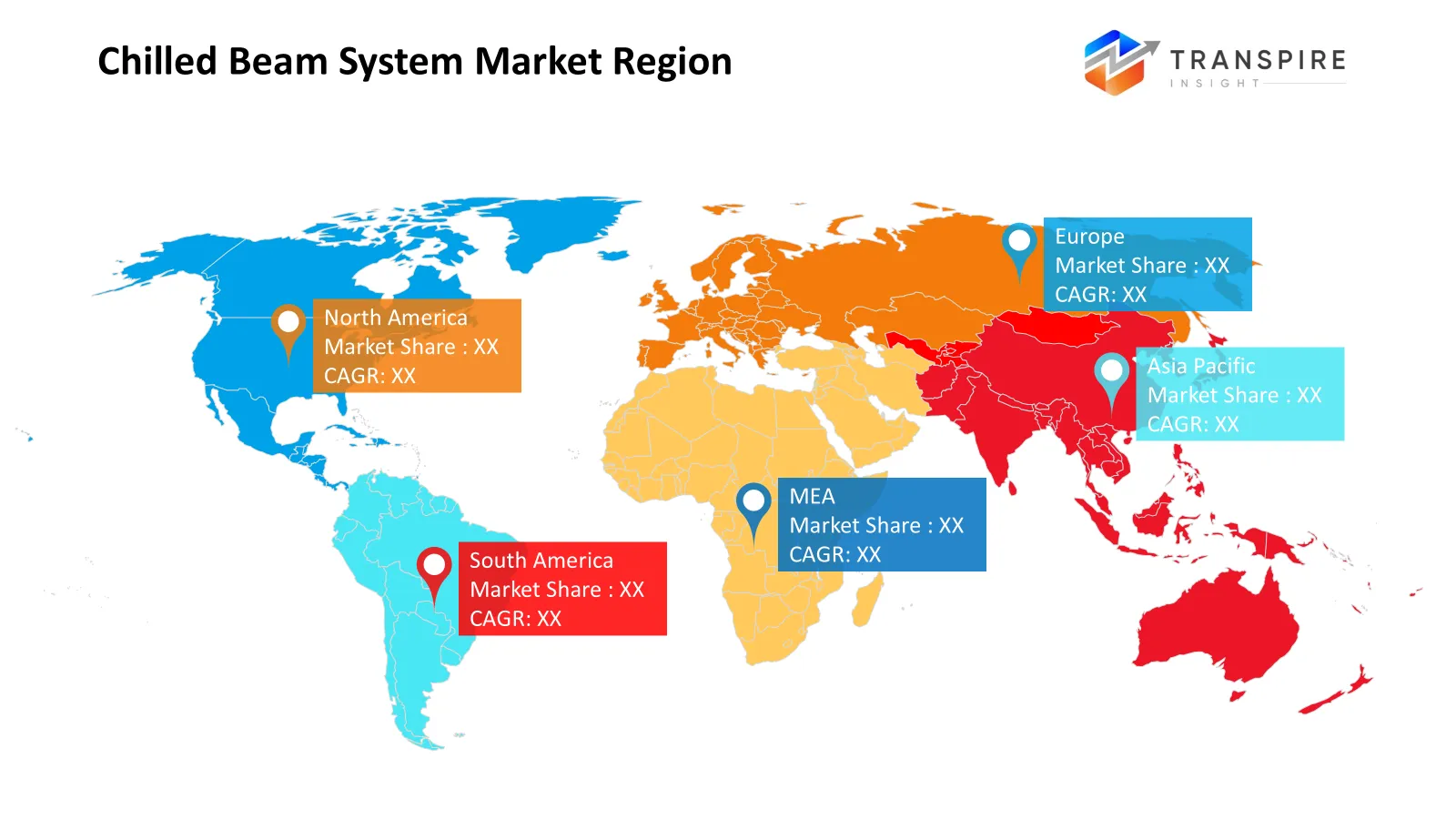
North America holds the biggest chunk of the market right now, sitting at about 28% of the global share. The US is driving this growth. They have a massive commercial real estate sector that is obsessed with getting LEED certifications. Healthcare construction is also booming in the States, and hospital boards are willing to pay top dollar for the energy efficiency these systems provide. A prime instance of this regional development is driven by localized legislation like Local Law 97 in New York City. Because building owners face hefty fines if they violate established carbon limits, they are being forced to retrofit their older skyscrapers with chilled beams just to avoid sanctions.
Europe is an extremely stable market governed heavily by strict environmental laws. Governments here are deeply concerned about carbon footprints and are literally compelling construction companies to discard outdated air-conditioning systems. The primary driver here is the enactment of the European Energy Performance of Buildings Directive (EPBD), which essentially bans the usage of inefficient HVAC equipment during any significant remodeling projects. Furthermore, European governments subsidize the cost of installing these energy-efficient beams in public libraries and schools. A major instance of this regional push is seen in the UK, where massive commercial retrofits—such as the famous 55 Baker Street project in London—have heavily utilized active chilled beams to hit these aggressive, legally mandated energy targets.
The Asia-Pacific area is growing faster than anywhere else. Countries like India and China are building out massive IT parks and commercial centers at breakneck speed. But there is a catch: the climate in these countries gets incredibly humid. Before sales can truly explode, manufacturers have to figure out cheaper ways to handle dehumidification. However, regional growth is heavily sustained by a boom in advanced healthcare and green-certified construction. For instance, in places like Australia and Singapore, modern hospitals and premium corporate offices (such as the 6-star Green Star-rated Workplace 6 building in Sydney) are heavily standardizing hydronic cooling. They are bypassing traditional air conditioning entirely, using chilled beams to guarantee patients and tenants have perfectly clean, draft-free air.
To learn more about this report, Download Free Sample Report
Who are the Key Players in the Chilled Beam System Market and how do they Compete?
The market features a mix of massive global conglomerates and highly specialized European engineering firms. The primary companies operating in this space include Halton Group, TROX GmbH, Swegon Group AB, FläktGroup, Johnson Controls, Carrier Global Corporation, and Trane Technologies. Competition heavily centers around software integration and architectural aesthetics.
Major corporations like Carrier, Trane, and Johnson Controls focus heavily on volume and large-scale distribution. Their main goal is to secure massive installation contracts for entire skyscrapers. To achieve this, they bundle their chilled beams with large basement chillers and central management software. This strategy allows them to offer real estate developers a complete, single-source HVAC package, particularly in the US and Asian markets.
Meanwhile, European manufacturers like Swegon and Halton have a very different objective. Their goal is to dominate the premium architectural market. Instead of competing on raw volume, they focus entirely on visual aesthetics and flawless acoustic design. They specifically target boutique architects building high-end office spaces where dead silence and custom ceiling designs are strict requirements.
Specialist companies are also capturing market share by solving specific technical problems. For example, the Zehnder Group focuses strictly on Induction Beams. While standard chilled beams require extra dehumidifiers to prevent condensation, Zehnder builds drain pans directly into their units. This solves the dripping issue without requiring complex sensors. Similarly, FläktGroup has set a strategic goal to fully digitize its product line. The company connects its physical cooling beams to a proprietary digital platform called CAREconnect. This integration allows facility managers to track HVAC diagnostics remotely, helping FläktGroup secure highly profitable, long-term maintenance contracts.
Chilled Beam System Market Companies
- Halton Group
- TROX GmbH
- Swegon Group AB
- FläktGroup
- Johnson Controls
- Daikin Industries, Ltd.
- Carrier Global Corporation
- Trane Technologies
- Lindab Group
- Zehnder Group
- Systemair AB
- Titus HVAC
- Krueger-HVAC
- Price Industries
- WaterFurnace International
Recent Development News
In February 2026, Swegon Group AB completed the acquisition of a Nordic IoT controls company to enhance building management system integration capabilities within chilled beam product portfolios. The strategic investment strengthens competitive positioning in smart building markets. https://www.swegon.com
In January 2026, TROX GmbH expanded manufacturing capacity in Central Europe to address increasing demand for chilled beam systems in hospital and healthcare facility applications. The capacity expansion supports 12-month lead time reduction for healthcare projects. https://www.troxgroup.com
What Strategic Insights Define the Future of the Chilled Beam System Market?
Looking ahead, the physical hardware is no longer the primary differentiator; the future of this industry revolves entirely around software integration. The ultimate winners will be the manufacturers capable of perfectly syncing their cooling beams with overarching, AI-driven smart building platforms. However, a significant hidden risk continues to threaten global expansion: high ambient humidity. If HVAC companies cannot engineer an affordable, foolproof method to keep indoor air dry and prevent ceiling condensation, they will completely miss out on the lucrative commercial construction boom happening across the Asia-Pacific region.
In contrast, the pending retrofitting boom creates an extremely lucrative and pressing opportunity. With larger cities enacting stringent carbon penalty regulations mandating that old buildings become eco-friendly, building managers will be in desperate need of cooling equipment that meets the requirements. It would be strategically recommended to the HVAC manufacturers to shift their focus and invest in research and development into modular technology and open-source interoperability. Manufacturers should make sure that their chilled beam installations are modular and able to be installed in old buildings with low ceilings.
By Type
- Active
- Passive
- Multi-service
- Induction
By Application
- Commercial Buildings
- Offices
- Hospitals
- Educational Institutions
By End-User
- Construction Companies
- HVAC Providers
- Building Owners
- Facility Managers
Frequently Asked Questions
Find quick answers to common questions.
The Chilled Beam System Market size is expected to reach USD 518.5 Million by 2033.
The key segments are By Type (Active, Passive, Multi-service, Induction), By Application (Commercial Buildings, Offices, Hospitals, Educational Institutions), and By End-User (Construction Companies, HVAC Providers, Building Owners, Facility Managers).
Major players include Halton Group, TROX GmbH, Swegon Group AB, FläktGroup, Johnson Controls, Daikin Industries Ltd., Carrier Global Corporation, Trane Technologies, Lindab Group, Zehnder Group, Systemair AB, Titus HVAC, Krueger-HVAC, Price Industries, and WaterFurnace International.
The Chilled Beam System Market size is USD 346.2 Million in 2025.
The Chilled Beam System Market CAGR is 5.15% from 2026 to 2033.
- Halton Group
- TROX GmbH
- Swegon Group AB
- FläktGroup
- Johnson Controls
- Daikin Industries, Ltd.
- Carrier Global Corporation
- Trane Technologies
- Lindab Group
- Zehnder Group
- Systemair AB
- Titus HVAC
- Krueger-HVAC
- Price Industries
- WaterFurnace International
Recently Published Reports
-
Apr 2026
Fiber Optic Faceplates Market
Fiber Optic Faceplates Market Size, Share & Analysis Report By Type (< 300 mm2, 300-350 mm2, and > 350 mm2, By Application (Night Vision, Holographic Imaging, Medical, and Others), and Geography (North America, Europe, Asia-Pacific, Middle East and Africa, South and Central America), 2021 - 2031
-
Apr 2026
High Temperature Superconductors Market
High Temperature Superconductors Market Size, Share & Analysis Report By Type (1G HTS, and 2G HTS), By Application (Power Cable, Fault Current Limiter, and Transformer), and Geography (North America, Europe, Asia-Pacific, Middle East and Africa, South and Central America), 2021 - 2031
-
Apr 2026
Industrial Plugs and Socket Market
Industrial Plugs and Socket Market Size, Share & Analysis Report By Type (Industrial Plugs, Industrial Sockets), By Current (Up to 32 A, 32 to 125 A, Above 125 A), By Protection (Dustproof and Splash Proof, Waterproof, Explosion Proof), By End User (Heavy Industries, Oil and Gas, Chemicals and Pharmaceuticals, Power Generation, Others), and Geography (North America, Europe, Asia-Pacific, Middle East and Africa, South and Central America), 2021 - 2031
-
Apr 2026
InGaAs Avalanche Photodiodes Market
InGaAs Avalanche Photodiodes Market Size, Share & Analysis Report By Type (1100 - 1700 nm, and 1000 - 1600 nm), By Application (Missile Warning System, Muzzle Flash Detection, Wafer Defect Inspection, Laser Rangefinders, and Others), and Geography (North America, Europe, Asia-Pacific, Middle East and Africa, South and Central America), 2021 - 2031