

Bulk Molding Compounds Market Summary:
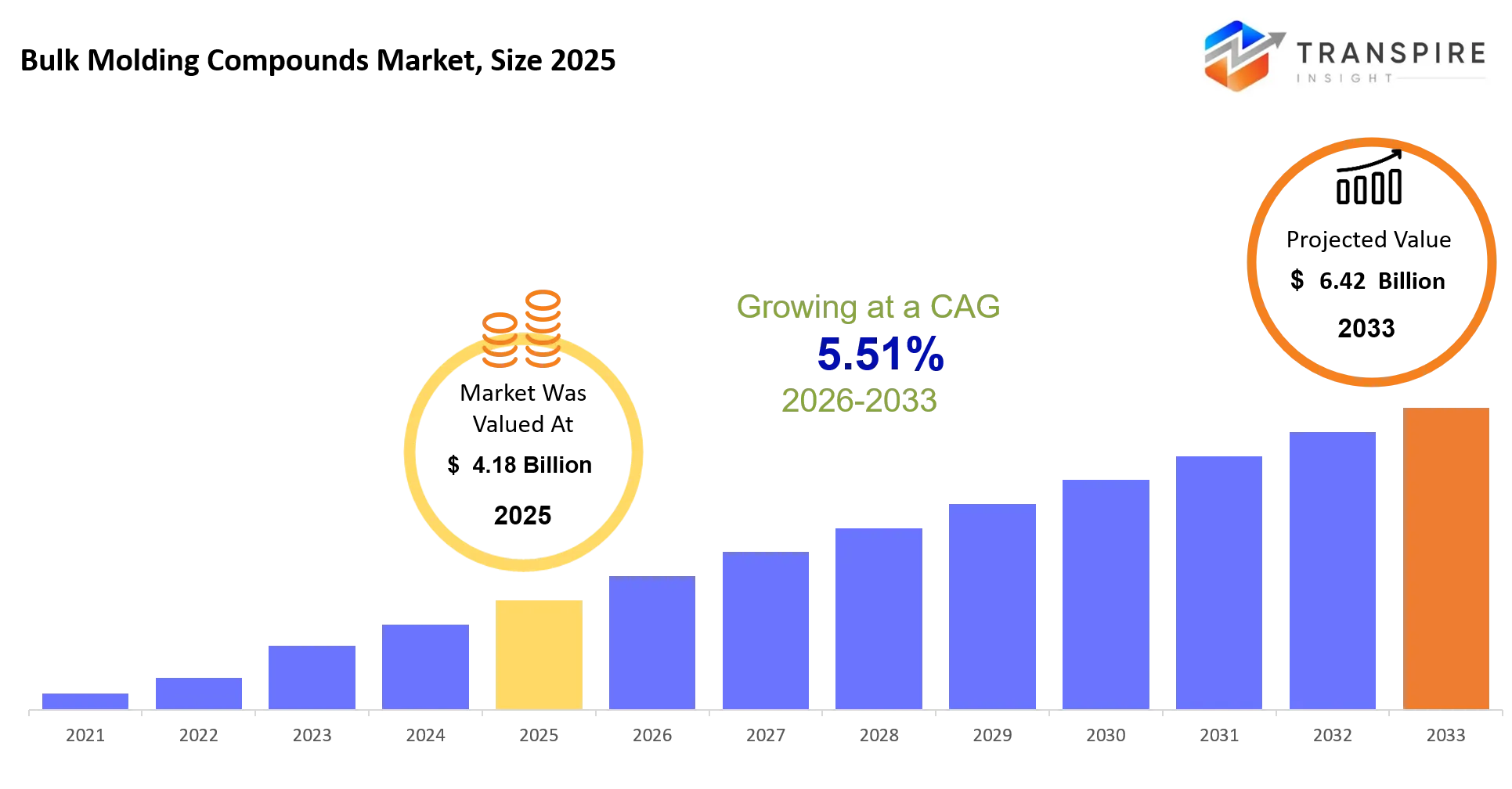
As per Transpire Insight Analysis, the Bulk Molding Compounds Market size is estimated at USD 4.18 billion in 2025 and is anticipated to reach USD 6.42 billion by 2033, growing at a CAGR of 5.51% from 2026 to 2033. The growth will be fueled by higher demand for light and strong metals used in the automobile, electricity, and construction industries and by the increasing manufacture of electric vehicles and renewable energy generation.
The Bulk Molding Compounds market is really important for making things. It gives us materials that're light, strong and can stop electricity. We use these materials to make cars, electronics and buildings. In the past five years, the Bulk Molding Compounds market has changed to make better and more environmentally friendly materials. This is because companies want to make things lighter, use less energy and not hurt the earth.
The Bulk Moulding Compounds market is growing due to the automotive industry. We use Bulk Molding Compounds to make parts for cars like the box that holds the battery and the parts that connect electricity. This is because Bulk Molding Compounds do not change shape easily and can stop fires. People are also spending money on clean energy and smart electricity systems. This means we need Bulk Molding Compounds. The companies that make Bulk Molding Compounds are getting better at making them. They can now make parts quickly and easily. This will help the Bulk Molding Compounds market keep growing.
Bulk Molding Compounds Market Size & Forecast:
- Global Market Size 2025: USD 4.18 Billion
- Expected Market Value (2033): USD 6.42 Billion
- Forecast CAGR (2026–2033): 5.51%
- Leading Region in 2025: Asia Pacific
- Fastest Growing Region: Europe
- Key Company Profiles: IDI Composites International, AOC Resins, Lorenz Kunststofftechnik, Menzolit, Polynt Group, Showa Denko, Continental Structural Plastics, Sumitomo Bakelite, Toray Industries, Mitsubishi Chemical, Ashland, SGL Carbon, Owens Corning, BASF, Solvay
Key Market Insights:
The market is progressing with innovations in lightweight materials, automation in molding operations, and adoption in the electrical and transportation sectors. Efforts related to sustainability along with high-performance composite materials are impacting product development and investments.
- The polyester-type BMC has the highest 47% market share, backed up by advantages such as affordability, outstanding mechanical properties, and application in the production of automotive and electrical parts.
- Bio-based BMC will have the most substantial growth rate at 15.8% CAGR owing to its environmentally responsible nature and sustainability.
- Vinyl ester BMC accounts for 20% of the overall market size thanks to its increasing application in corrosion-resistant industrial and chemical process applications.
- Epoxy BMC is 13% of the market share and gains popularity due to its increasing availability in high-performance grades for the aerospace industry and electrical insulating purposes.
- Phenolic BMC has a 9% market share due to its high fire resistance and usage in the transportation and construction industries.
- Investments in automation of compression molding and manufacturing digitalisation are being made in order to increase the efficiency of production and decrease waste of the material.
- A rapid increase in the number of electric vehicles, renewable energy equipment, and smart electrical infrastructure accelerates the use of modern bulk molding compounds in various industries.
- In addition, manufacturers pay more and more attention to the production of lightweight, recyclable, and environmentally friendly composite products.
What are the Key Drivers, Restraints, and Opportunities in the Bulk Molding Compounds Market?
Drivers
Bulk Molding Compound (BMC) demand in the global market is expected to rise as there is an increase in demand for lightweight, durable, and electrical insulating compounds for use in the automotive sector, electronics, and manufacturing industries. Some of the factors driving the Bulk Molding Compound (BMC) global market include the increased production of electric vehicles, which requires composites in their production. This is attributed to the increase in energy efficiency standards, where metal is being replaced by composites in most applications.
Restraints
The prices of raw materials such as polyester resins, glass fibres, and other speciality materials still pose a problem. Apart from that, there are certain structural constraints related to processing costs, complicated manufacturing, and the requirement of special molding machinery.
Opportunities
There is an opportunity available in the development of bio-based and recyclable Bulk Molding Compound. The companies are investing in green technologies and renewable energy networks, which present an exciting opportunity to grow. For instance, companies are producing low-carbon resin and enhanced fibre-resin formulations in order to comply with regulations and provide better products. The growth in industrialisation of emerging economies of Asia and investment in smart electrical infrastructure would further cement future opportunities for the market.
What Has the Impact of Artificial Intelligence Been on the Bulk Molding Compounds Market?
AI technologies are becoming more widely used to enhance manufacturing and quality control processes in the BMC industry. Manufacturers leverage AI-based analytics to optimise resin formulation, monitor fibre distribution and to ensure that the characteristics of the materials stay consistent during production. The machine learning algorithms analyse real-time production data to detect deviations in the production process, thereby reducing defects and minimising the losses from the use of raw materials. AI technologies also enable predictive maintenance of molding machines by analysing their state and reducing unexpected downtime.
One of the applications of AI is the ability to predict demand and optimise supply chains. With the help of such technologies, companies can better organise production planning and optimise inventory based on past sales statistics and customer demand. AI technologies also enable quicker development of products through virtual tests of the resin formulations. Although these are clear benefits, there are some major difficulties faced by many manufacturers when trying to adopt artificial intelligence, such as the high cost of implementing the technology, the fact that it must be integrated with current manufacturing processes, and having enough skilled workers to handle digital technology.
Instance
In March 2025, AVK Plast collaborated with Deepack for the implementation of an AI-enabled visual inspection system for plastics production. The system uses computer vision to detect surface defects in real-time, enhance traceability, and automate quality control, showing the application of AI in enhancing composite and molding material manufacturing process related to the BMC industry.
https://deepvis.ai/blog/post-3/?utm_source
Key Market Trends:
Bulk Molding Compounds (BMCs) market is undergoing an obvious transformation in response to manufacturers' increasing interest in light products, eco-friendly resins, and automation technologies. The industry representatives are actively considering high-end composite products that would meet the current needs of various industries, such as automotive, electrical, and industrial.
- Traditional metals are gradually being replaced by light BMCs to ensure more energy efficiency and lower product weight.
- Bio-based resins are used increasingly often because of higher sustainability standards and strict environmental regulations.
- Automation and digital monitoring are becoming integral parts of the molding process to improve consistency and minimise production losses.
- Flame-resistant and high-strength BMCs are becoming more popular in relation to the rising number of their applications in electric vehicles, batteries, and other electrical appliances.
- Specialised formulations featuring improved thermal resistance and corrosion protection are created by manufacturers for particular industrial purposes.
- Recycled materials are being used more frequently to decrease carbon emissions.
Bulk Molding Compounds Market Segmentation
By Resin Types
Polyester BMC holds the major share in the global BMC market, accounting for 47% due to its strength, excellent insulating qualities and cost-effective nature, which makes it ideal for automotive, electrical and industrial applications. Vinyl Ester BMC has a 20% share based on its strong corrosion resistance capabilities in chemical and industrial environments. Epoxy BMC holds 13% of the share due to high demand for high-performing electrical and aerospace components, while Phenolic BMC holds 9% as a result of its flame retardant nature. Bio-based BMC holds a current market share of 7% but will be the fastest-growing segment of the market, growing at the fastest 15.8% CAGR as manufacturers continue to use sustainable materials in the production process. Polyurethane BMC and Others each hold 2%.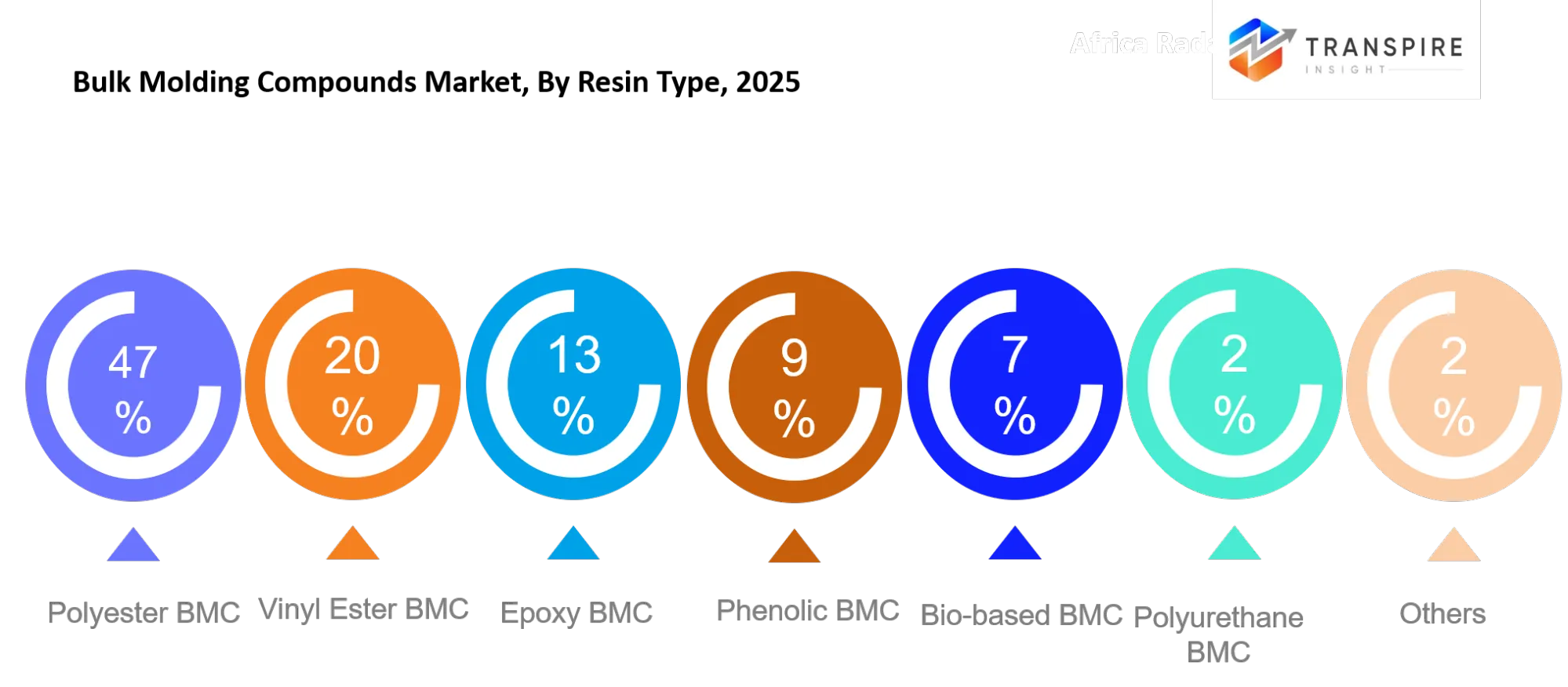
By Applications
Automotive Components holds the largest share in the application segments in the global BMC market owing to manufacturers' increasing use of BMC to make lightweight, structurally sound and safe from electrical shock vehicles. Electrical & Electronics is the second largest segment owing to the increasing demand for insulating materials in switchgear, connectors and electrical enclosures.
By End User
The major end users include Automotive Original Equipment Manufacturers (OEMs) because of increasing demand for composite parts for electric and fuel-efficient automobiles. Electric parts manufacturers are increasingly using BMC materials in their power transmission and electronic equipment, whereas construction businesses use composite materials for making durable constructions. Industrial manufacturers, aerospace companies, consumer goods manufacturers and other end users are progressively adopting such composites as their product quality and manufacturing process improve.
By Reinforcement Material
The most widely used reinforcement material is Glass Fibre because it offers optimum strength and dimensional stability at the right cost. Carbon Fibre is gaining favour among expensive applications where strength-to-weight ratio is important, such as aerospace and luxury vehicles. Other reinforcement materials that have gained the attention of manufacturers include Natural Fibre, Mineral-filled, Hybrid Reinforcement and other reinforcement materials.
By Distribution Channel
The method of Direct Sales will remain dominant because it allows the producers to form long-term connections with their major industrial clients and automakers through personalised technical assistance. Industrial Distributors and OEM Suppliers are essential in providing services to regional manufacturers. Finally, the Online B2B Marketplaces are growing slowly but steadily because of the growing digitalisation of the procurement process among companies around the globe.
What are the Key Use Cases Driving the Bulk Molding Compounds Market?
Bulk Molding Compound (BMC) has wide application in the automotive sector, where Polyester BMC is usually utilised in the manufacturing of lightweight body panels, battery boxes, lamps, and other parts inside an engine bay because of their high mechanical strength, insulating properties, and ability to resist heat. As for usage outside the automobile manufacturing, BMC is widely used in the sphere of electrical and electronic devices and machinery as well as building materials, which can be utilised in the manufacturing of switchgear enclosures, circuit breakers, connectors and anti-corrosion structures with long service life.
The development of bio-based BMC, which represents the most rapidly growing type of BMC, shows the trend to greener composite materials.
|
Report Metrics |
Details |
|
Market size value in 2025 |
USD 4.18 Billion |
|
Market size value in 2026 |
USD 4.41 Billion |
|
Revenue forecast in 2033 |
USD 6.42 Billion |
|
Growth rate |
CAGR of 5.51% from 2026 to 2033 |
|
Base year |
2025 |
|
Historical data |
2021 - 2024 |
|
Forecast period |
2026 - 2033 |
|
Report coverage |
Revenue forecast, competitive landscape, growth factors, and trends |
|
Regional scope |
United States; Canada; Mexico; United Kingdom; Germany; France; Italy; Spain; Denmark; Sweden; Norway; China; Japan; India; Australia; South Korea; Thailand; Brazil; Argentina; South Africa; Saudi Arabia; United Arab Emirates |
|
Key company profiled |
IDI Composites International, AOC Resins, Lorenz Kunststofftechnik, Menzolit, Polynt Group, Showa Denko, Continental Structural Plastics, Sumitomo Bakelite, Toray Industries, Mitsubishi Chemical, Ashland, SGL Carbon, Owens Corning, BASF, Solvay |
|
Customization scope |
Free report customization (country, regional & segment scope). Avail customized purchase options to meet your exact research needs. |
|
Report Segmentation |
By Resin Type (Polyester BMC, Vinyl Ester BMC, Epoxy BMC, Phenolic BMC, Polyurethane BMC, Bio-based BMC, Specialty BMC, Others); By Application (Automotive Components, Electrical & Electronics, Construction, Industrial Equipment, Consumer Goods, Aerospace, Renewable Energy, Others); By End User (Automotive OEMs, Electrical Manufacturers, Construction Companies, Industrial Manufacturers, Aerospace Companies, Consumer Goods Manufacturers, Others); By Reinforcement Material (Glass Fiber, Carbon Fiber, Natural Fiber, Mineral-filled, Hybrid Reinforcement, Others); By Distribution Channel (Direct Sales, Industrial Distributors, OEM Suppliers, Online B2B Platforms, Others) |
Which Regions are Driving the Bulk Molding Compounds MarketGrowth?
North America
The North American region has a market share of 22% in the global market, which is experiencing steady growth due to technology developments and rising demands from the automotive industry, aerospace, and electrical equipment segments. Unlike the Asia-Pacific region, the North American region concentrates on developing high-quality engineering materials and product development, and manufacturing process advancements. Investments in lightweight vehicles and intelligent electrical systems and automation systems are constantly driving market growth.In April 2025, Composites International (IDI, USA) announced the retirement of the company’s Vice President, Jay Merrell, who served for 43 years in the composites business. The succession in leadership is to ensure the further growth of IDI Composites International in manufacturing advanced SMC and BMC for automotive, electrical, and industrial sectors in North America.
Europe
Europe represents 29% of the total market and is expected to witness the highest CAGR of 16.5% during the forecast period. Growth in this region will be mainly due to strict environmental norms, growing popularity of electric vehicles, and investments in sustainable composite materials. Manufacturers in this region are rapidly developing bio-based and recyclable BMC formulations to meet carbon reduction goals and promote circular economy models. With industries increasingly favouring lightweight, energy-efficient, and eco-friendly materials, Europe is expected to present many growth opportunities in the coming years for BMC manufacturers.In February 2025, Menzolit Compounding Solutions represented itself at JEC World 2025, displaying novel and sustainable SMC and BMC technologies used in automotive, electrical, and industrial industries. This trade show displayed the latest innovations in the field of sustainable composites for Europe.
Asia Pacific
The Asia Pacific region dominates the BMC market share with a 43% share due to the presence of an effective automotive manufacturing sector, growth of the electrical and electronics industry, and industrial manufacturing processes. The countries of Asia Pacific, including China, Japan, South Korea, and India, still keep their focus on the manufacture of electric vehicles, renewable energy projects, and industrial infrastructure. In addition, this region enjoys efficient manufacturing processes, a reliable supply chain, and various government incentives to adopt advanced materials.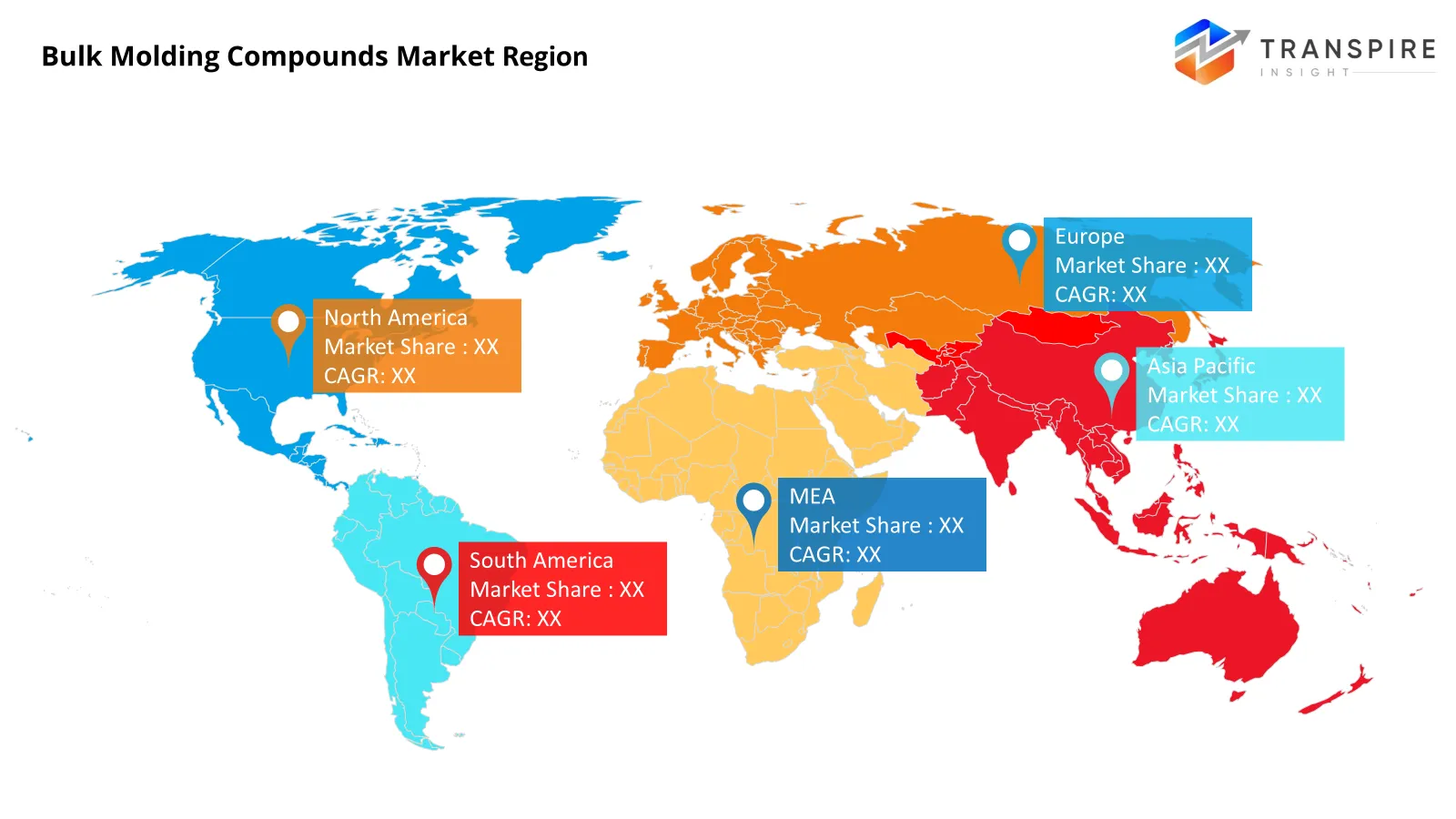
Who are the Key Players in the Bulk Molding Compounds Marketand how do they Compete?
Innovative materials development, customisation of products, efficiency in manufacturing processes, and partnering with end users are some of the main elements that characterise competition in the international BMC industry. Leading companies are working on innovative composite formulations, which help in meeting the increasing demands of the automotive, electrical, industrial, and construction industries with improved mechanical strength, fire resistance, and lightweight characteristics of the products.
The unique selling proposition of IDI Composites International lies in its customisation of thermoset composites for use in the automotive, electrical, and industrial markets. A. Schulman (LyondellBasell) is competing in the global BMC market through its wide range of material offerings, R&D expertise, and manufacturing capability. Lorenz Kunststofftechnik GmbH specialises in the engineering of molding compounds for demanding applications. Showa Denko Materials Co., Ltd. (previously Hitachi Chemical) concentrates on innovative resins and composite materials for electrical and electronics applications.
Bulk Molding Compounds Market companies
- IDI Composites International
- AOC Resins
- Lorenz Kunststofftechnik
- Menzoli
- Polynt Group
- Showa Denko
- Continental Structural Plastics
- Sumitomo Bakelite
- Toray Industries
- Mitsubishi Chemical
- Ashland
- SGL Carbon
- Owens Corning
- BASF
- Solvay
Recent Development News
In April 2025, IDI Composites International made an announcement regarding the retirement of Vice President Jay Merrell after being with the organisation for 43 years. The change in the leadership team is a result of the company's strategic plan for its organisation as well as its continued efforts for thermoset composite development and support for customers.
What Strategic Insights Define the Future of the Bulk Molding Compounds Market?
The future of the BMC market will be determined by growing application of lightweight composite materials, environmentally friendly resin systems, as well as new manufacturing techniques. In view of increasing focus on energy efficiency and durability across various industries, there is a possibility of greater application of BMCs in different fields, such as cars, electricity, renewable energy, and industrial parts. One of the lesser-known threats for the market players will be the volatility of the prices of raw materials and dependence of BMC manufacturing on specific resins and fibres. One of the new opportunities will be the creation of BMCs from natural materials and recyclability, which will allow meeting the demands of the circular economy and environmental regulations. Companies that are ready to invest in innovation of materials and manufacturing will be able to increase their competitive position.
By Resin Type
- Polyester BMC,
- Vinyl Ester BMC
- Epoxy BMC
- Phenolic BMC
- Polyurethane BMC
- Bio-based BMC
- Specialty BMC
By Application
- Automotive Components
- Electrical & Electronics
- Construction
- Industrial Equipment
- Consumer Goods
- Aerospace
- Renewable Energy
By End User
- Automotive OEMs
- Electrical Manufacturers
- Construction Companies
- Industrial Manufacturers
- Aerospace Companies
- Consumer Goods Manufacturers
By Reinforcement Material
- Glass Fiber
- Carbon Fiber
- Natural Fiber
- Mineral-filled
- Hybrid Reinforcement
By Distribution Channel
- Direct Sales
- Industrial Distributors
- OEM Suppliers
- Online B2B Platforms
Regional Outlook
North America
- US
- Canada
- Mexico
Europe
- Germany
- UK
- France
- Italy
- Spain
- Russia
- Rest of Europe
Asia Pacific
- China
- Japan
- India
- South Korea
- Australia
- Rest of Asia Pacific
South America
- Brazil
- Argentina
- Rest of South America
Middle East & Africa
- UAE
- Saudi Arabia
- Qatar
- South Africa
- Rest of the Middle East & Africa
Frequently Asked Questions
Find quick answers to common questions.
The Bulk Molding Compounds Market size was valued at USD 4.18 billion in 2025 and is poised to reach USD 6.42 billion by 2033, expanding at a 5.51% CAGR.
Key segments for the Bulk Molding Compounds Market are By Resin Type (Polyester BMC, Vinyl Ester BMC, Epoxy BMC, Phenolic BMC, Polyurethane BMC, Bio-based BMC, Specialty BMC, Others); By Application (Automotive Components, Electrical & Electronics, Construction, Industrial Equipment, Consumer Goods, Aerospace, Renewable Energy, Others); By End User (Automotive OEMs, Electrical Manufacturers, Construction Companies, Industrial Manufacturers, Aerospace Companies, Consumer Goods Manufacturers, Others); By Reinforcement Material (Glass Fiber, Carbon Fiber, Natural Fiber, Mineral-filled, Hybrid Reinforcement, Others); By Distribution Channel (Direct Sales, Industrial Distributors, OEM Suppliers, Online B2B Platforms, Others).
Growth is primarily driven by growing demand for lightweight and strong materials in the automotive sector, growing applications in the electrical and electronics industries, increasing construction activities, and development in composite material fabrication technology.
The global market is led by major manufacturers including IDI Composites International, AOC Resins, Lorenz Kunststofftechnik, Menzolit, Polynt Group, Showa Denko, Continental Structural Plastics, Sumitomo Bakelite, Toray Industries, Mitsubishi Chemical, Ashland, SGL Carbon, Owens Corning, BASF, Solvay.
The Asia Pacific region accounts for 43% of the global market due to the robust presence of the automotive and electronics industries, growing construction projects, and increased usage of composite materials that are lightweight and robust.
The commercial opportunities that exist are greater use of lightweight composites in electric cars, high demand from the electrical and electronics industries, more applications for renewable energy, and many infrastructure and industrial manufacturing developments in developing countries.
- IDI Composites International
- AOC Resins
- Lorenz Kunststofftechnik
- Menzoli
- Polynt Group
- Showa Denko
- Continental Structural Plastics
- Sumitomo Bakelite
- Toray Industries
- Mitsubishi Chemical
- Ashland
- SGL Carbon
- Owens Corning
- BASF
- Solvay
About the Authors

Pankaj Ghogare Patil
I am Pankaj Ghogare Patil, a Senior Research Analyst at Transpire Insight, specializing in the Pharmaceutical, Chemicals & Materials, Healthcare IT, and Biotechnology industry. My expertise lies in conducting comprehensive market research, analyzing industry trends, evaluating competitive landscapes, and translating complex data into actionable insights. At Transpire Insight, I closely follow emerging technologies, regulatory developments, and market innovations to create accurate, well-researched, and informative content that helps businesses and professionals make informed decisions. I am committed to producing credible, evidence-based articles that reflect industry best practices while making technical topics accessible and valuable for a broad audience.

Chakradhar Khansole
Chakradhar serves as the Research Director at Transpire Insight, bringing over 8 years of experience in technology, innovation, and strategic market intelligence. He specializes in transforming complex market data into actionable business insights that enable organizations to make informed, growth-oriented decisions. Recognized for his strategic vision and analytical expertise, Chakradhar leads high-impact research initiatives, delivering comprehensive market assessments, competitive intelligence, and forward-looking industry analysis.
Recently Published Reports
-
May 2026
Healthcare Polymer Packaging Market
Healthcare Polymer Packaging Market Size, Share & Analysis Report By Packaging Type (Syringes, IV Bottles and Pouches, Clamshells, Blisters, Bottles & Jars, Containers, Tubes, IV Parental Packaging, Others), By Type (Regulated, Non-regulated), By Polymer Type (LDPE (Low-Density Polyethylene), HDPE (High-Density Polyethylene), Homo-polymer (Homo), Random Copolymer (Random), Block Copolymer (Block), PET, Polystyrene, Polyvinyl Chloride, Polyamide/EVOH, Others), and Geography (North America, Europe, Asia-Pacific, Middle East and Africa, South and Central America), 2021 - 2031
-
Apr 2026
Hydrophilic Tape (Waterstop) Market
Hydrophilic Tape (Waterstop) Market Size, Share & Analysis Report By Type (Bentonite-Based Hydrophilic Tape, Rubber-Based Hydrophilic Tape), By Application (Residential Buildings, Commercial Buildings, Infrastructure Projects), and Geography (North America, Europe, Asia-Pacific, Middle East and Africa, South and Central America), 2021 - 2031
-
Apr 2026
Metalens Market
Metalens Market Size, Share & Analysis Report By Type (Visible Light Metalens, and Infrared Metalens), By Application (Consumer Electronics, Automotive Electronics, Industrial, Medical, and Others), and Geography (North America, Europe, Asia-Pacific, Middle East and Africa, South and Central America), 2021 - 2031
-
Apr 2026
PBT Resin Market
PBT Resin Market Size, Share & Analysis Report By Type (Reinforced PBT Resin, Unreinforced PBT Resin), By Processing Method (Injection Molding, Extrusion, Blow Molding, Others), By End-User (Automotive, Electrical & Electronics, Consumer Appliances, Industrial Machinery, Medical Devices, Packaging, Others), and Geography (North America, Europe, Asia-Pacific, Middle East and Africa, South and Central America), 2021 - 2031