
Asia Pacific Water Pump Market Summary
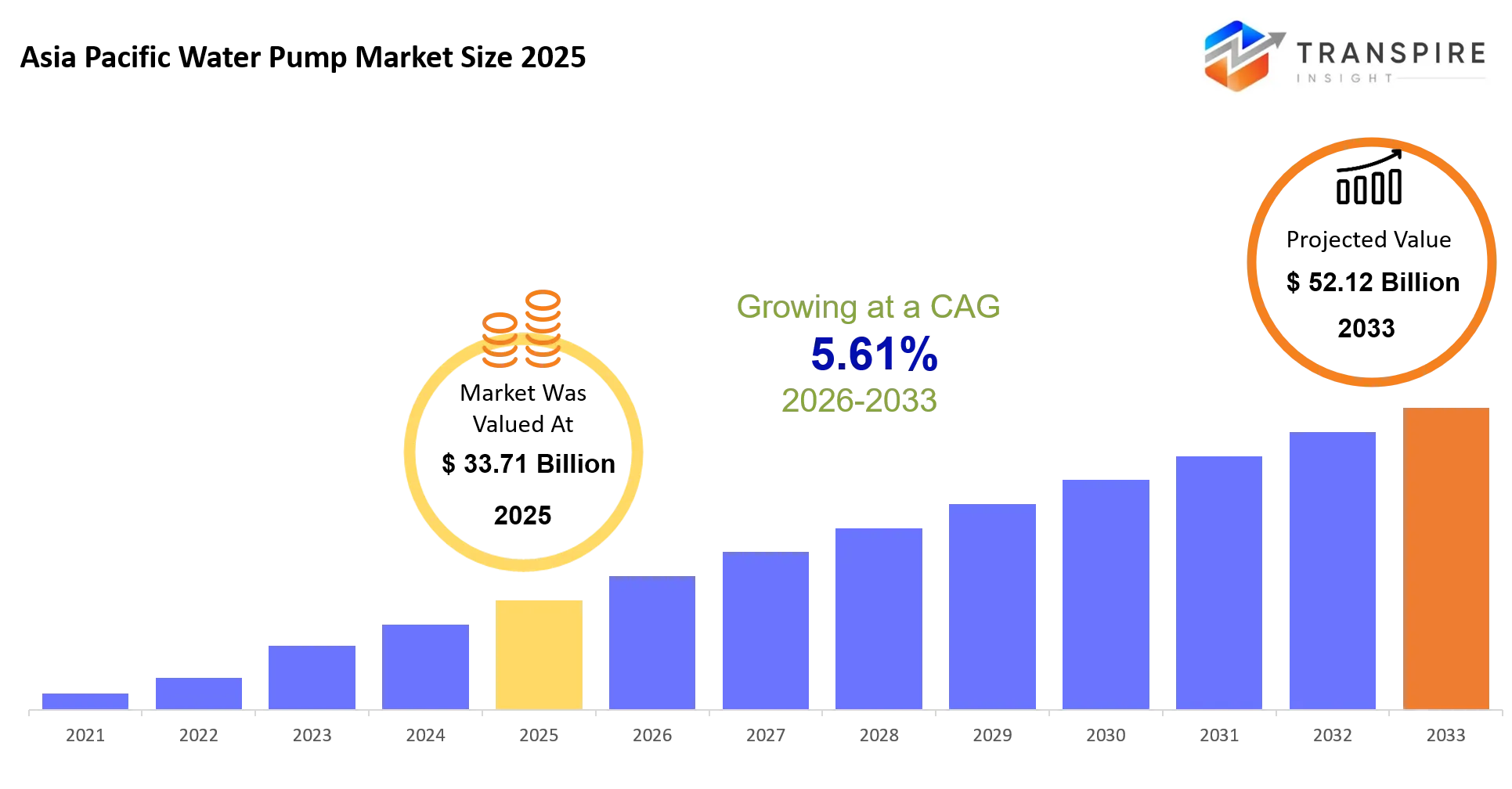
As per Transpire Insight Analysis the Asia Pacific Water Pump Market size is estimated at USD 33.71 Billion in 2025 and is anticipated to reach USD 52.12 Billion by 2033, growing at a CAGR of 5.61% from 2026 to 2033.
The Asia Pacific Water Pump Market has a big part in moving water, kind of efficiently, across agriculture, city and municipal systems, industrial plants, construction sites, and residential buildings. In practice, trustworthy pumping systems help with irrigation, the distribution of drinking water, wastewater handling, flood management, and the more complex industrial processing, so they end up being vital for regional economic development and water resilience , not just “nice to have” equipment.
Over the last five years, the market has been leaning away from traditional pumping systems, more toward energy saving pumps and smart configurations with variable frequency drives, IoT monitoring , and predictive maintenance. This change really picked up speed after the COVID-19 pandemic caused supply chain disruptions, which showed some weaknesses in water infrastructure, and it pushed governments as well as companies to upgrade pumping networks. At the same time , more money has been going into irrigation programs, urban water treatment facilities, and industrial automation, and that has extended or refreshed the replacement cycle for older units. Because utilities and manufacturers are focused on smaller operating expenses and stronger system reliability, advanced pump technologies keep getting picked up more often, helping steady revenue growth across both public projects and private builds.
Asia Pacific Water Pump Market Size & Forecast:
- Asia Pacific Water Pump Market Size 2025: USD 33.71 Billion
- Expected Market Value 2033: USD 52.12 Billion
- Forecast CAGR: 5.61%
- Leading region in 2025:East Asia
- Fastest Growing region:South Asia
- Key Profile: Grundfos, Xylem, KSB, Wilo, Kirloskar Brothers, Ebara Corporation, Flowserve, Sulzer, Pentair, Franklin Electric, CRI Pumps, Tsurumi Manufacturing, Shakti Pumps, CNP Pumps, Gorman-Rupp
Key Market Insights
- In 2025, East Asia kinda dominated the Asia Pacific Water Pump Market, taking almost 42% market share . This was backed by large-scale municipal water infrastructure, and also the industrial manufacturing ability that sits in place there.
- South Asia, though , is predicted to grow the quickest through 2033, largely because irrigation modernization is ramping up, plus urban water supply expansion is getting more momentum and industrial investment keeps increasing.
- When you look at pump types , centrifugal pumps held roughly 46% of the market in 2025, and they keep being the go-to choice. The reasons are pretty straightforward, high efficiency along with reduced servicing needs.
- Submersible pumps are in second place, they captured nearly 24% share, mainly tied to groundwater extraction activities and wastewater management initiatives.
- Solar water pumps are set to show the most rapid growth through 2033. The drivers include rural electrification efforts and government-supported renewable energy programs, which makes adoption easier over time.
- For applications , agriculture irrigation represented about 38% of total demand in 2025. At the same time municipal wastewater treatment keeps expanding across economies that are urbanizing fast.
- On the end-user side, municipal utilities stayed out front with around 34% share, while industrial processing is expected to bring the strongest uptake during the forecast window.
- Companies like Grundfos, Xylem, KSB, Wilo, Kirloskar Brothers, and Ebara Corporation keep reinforcing their market positions, largely via smart pump innovation, digital monitoring, and regional manufacturing expansion.
- Also, manufacturers are increasingly tying things together with IoT-enabled monitoring, variable frequency drives, and predictive maintenance , and that whole approach helps bring energy consumption down by about 20% to 35% in newer pumping setups.
What are the Key Drivers, Restraints, and Opportunities in the Asia Pacific Water Pump Market?
The strongest growth driver seems to be the quick modernization of water infrastructure across Asia Pacific, like it’s really moving fast. Governments keep setting aside big budgets for drinking water distribution, wastewater treatment, irrigation modernization ,and also flood management schemes. At the same time, tighter energy efficiency rules have nudged utilities and manufacturing sites to swap older equipment for high-efficiency pumps, often paired with variable speed drives and digital monitoring. In practice this lowers electricity consumption as well as maintenance expenses ,which makes the replacement spending feel more sensible financially, while at the same time it broadens revenue streams for pump manufacturers and service providers.
Still, high installation and lifecycle costs are probably the most noticeable structural obstacle in the market. Advanced pumping systems usually demand electrical upgrades, automation platforms, specialized engineering, and dedicated maintenance talent. A lot of municipalities , plus smaller industrial plants, are dealing with budget limitations that slow modernization efforts. And the maintenance ecosystem stays fragmented in several emerging economies, so operating uncertainty rises and replacement cycles stretch out. That combination ends up dampening market adoption even though the efficiency gains are pretty obvious.
The best long-term opening appears to be smart water management, but it has to be backed by digital infrastructure. More utilities are rolling out IoT-linked pumps, cloud monitoring platforms, and predictive maintenance software to raise asset utilization. Places like India, China, and Australia are investing strongly in smart city programs and digital water networks where intelligent pumping can tune energy usage, cut down leakage, and strengthen day to day reliability.
What Has the Impact of Artificial Intelligence Been on the Asia Pacific Water Pump Market?
Artificial intelligence plus more advanced digital tools are quietly, but really changing how water pumps run , not just making things “better” in a general way. They improve efficiency, reliability and yes, even asset management across municipal utilities, industrial plants and also irrigation systems. AI enabled monitoring platforms keep watching pressure, vibration, flow rate, temperature and power usage, then they analyze all of that nonstop-ish, so pump performance can be optimized without needing constant hands on supervision. On top of that, automated control systems can shift pump speed in real time using variable frequency drives. This ends up trimming the wasteful energy consumption, while still keeping water delivery steady.
Machine learning is now being used for predictive maintenance; it can spot early signals like bearing wear, seal leakage, cavitation, and motor degradation before a failure actually shows up. With those signals, unplanned downtime drops, the equipment life often lasts longer, and maintenance costs get lower. In parallel, digital twins together with cloud based analytics can let operators simulate operating conditions, refine pumping schedules, and boost the overall network effectiveness. A lot of industrial facilities say they see energy savings in the range of 15% to 30% after AI assisted optimization and intelligent pump control systems go live.
Still, the big problem is that broad AI adoption is held back by integration costs that are sometimes high, plus limited digital infrastructure in many rural setups, and operational data that’s messy or inconsistent from older pumping equipment. Many older facilities simply do not have compatible sensors, or the communication layer needed for smooth data flow, so building accurate machine learning models becomes harder than it should be. But as digital infrastructure improves and retrofit solutions become more affordable, AI driven pump management is expected to turn into a normal capability throughout the Asia Pacific water infrastructure ecosystem
Key Market Trends
- Energy-efficient pumps with variable frequency drives, sort of expanded their installed base by more than 25% from 2020 to 2025, and it also cut lifecycle operating costs in the process, at least that’s how it reads on paper.
- Smart pumps with IoT monitoring moved from “premium only” offers toward standard, mainstream procurement in municipal water utilities, and even in industrial sites too.
- Solar-powered pumping solutions picked up real speed after 2022, mainly because government incentives backed rural irrigation as well as renewable energy rollouts.
- Local manufacturing capacity has grown across India, China, and Southeast Asia, which helps reduce import dependency and makes the supply chain more resilient, even when conditions get messy.
- Utilities, more and more, started using predictive maintenance platforms, allowing operators to curb unexpected equipment failures and fine tune maintenance scheduling.
- Grundfos, Xylem, Wilo, KSB, and Kirloskar Brothers also ramped up investment in digital service platforms and intelligent pump portfolios.
- Procurement strategies increasingly favor lifecycle energy savings rather than only upfront purchase costs, and this is reshaping supplier choices across different infrastructure projects.
- Water reuse plus wastewater recycling projects have been expanding quickly, so demand is building for corrosion-resistant and high-performance pumping systems.
- Industrial customers are often integrating pumps into centralized automation platforms, to boost production efficiency and reduce operational interruptions, or downtime.
- Regional suppliers are extending service networks and aftermarket capabilities too, which strengthens customer retention, and supports more recurring maintenance revenue.
Asia Pacific Water Pump Market Segmentation
By Product Type
Centrifugal Pumps take the largest share, mostly due to continuous water movement, a rather simple design, and overall cost efficiency which matches up well with big irrigation systems, municipal water networks, and industrial operations. Positive Displacement Pumps are more for situations that need accurate flow regulation and pressure that stays stable, in particular during chemical handling and when moving high-viscosity fluids. Submersible Pumps work with strong efficiency in borewells , groundwater extraction, drainage setups , and wastewater handling. Booster Pumps keep water pressure consistent across commercial buildings, residential complexes, and public infrastructure.
Diaphragm Pumps give dependable output in corrosive and abrasive environments, where leak prevention still matters. Reciprocating Pumps fit high pressure industrial processes, plus specialized fluid transfer operations, that ask for precise output. Solar Water Pumps keep expanding over agricultural fields because renewable energy programs reduce reliance on conventional electricity. Others cover specialty pumps, made for niche industrial, construction , and utility uses, aiming at unique operating conditions.
By Power Source
Electric Pumps dominate the market because fairly stable grid connectivity and energy-efficient motor technologies help municipal utilities, manufacturing facilities, and commercial buildings run smoother. Diesel Pumps still matter a lot for remote construction sites, emergency water supply, and areas where dependable electricity just isn’t there. Solar Pumps keep getting more acceptance too, especially for rural irrigation projects and renewable energy initiatives, which can reduce long-term operating costs. Battery-Powered Pumps support portable use cases, temporary installations, and emergency water transfer needs when time and access are tricky.
Hybrid Pumps blend more than one energy source, so operational flexibility improves when power availability shifts across daily operations. Manual Pumps keep serving rural communities and emergency scenarios where mechanical simplicity gives dependable performance. Engine-Driven Pumps are used for flood control, mining operations, and large infrastructure projects that need high mobility. Others include customized power solutions made for specialized industrial and municipal requirements, depending on what the site actually demands.
By Application
Irrigation ends up creating the highest equipment demand, simply because dependable water routing directly helps crop output and those seasonal farming routines. Water Supply also stays as another big application in many urban infrastructure schemes, since you really need trustworthy distribution channels for both residential and commercial customers. Wastewater Treatment facilities lean on advanced pumping systems for sewage transfer, sludge handling, and water reuse routines too. Industrial Processing leans heavily on specialized pumps for fluid management, cooling loops, and the production line process work.
Construction projects still need sturdy pumping hardware for dewatering tasks, foundation activities, and the temporary water management that shows up during the whole execution phase. Oil & Gas sites depend on pumps for process running, moving fluids around the plant, and general site servicing. Residential Use covers household water distribution, pressure boosting, and also groundwater extraction.
Others can include aquaculture, firefighting, and public infrastructure needs where reliable water movement is the main point, even when conditions get complicated.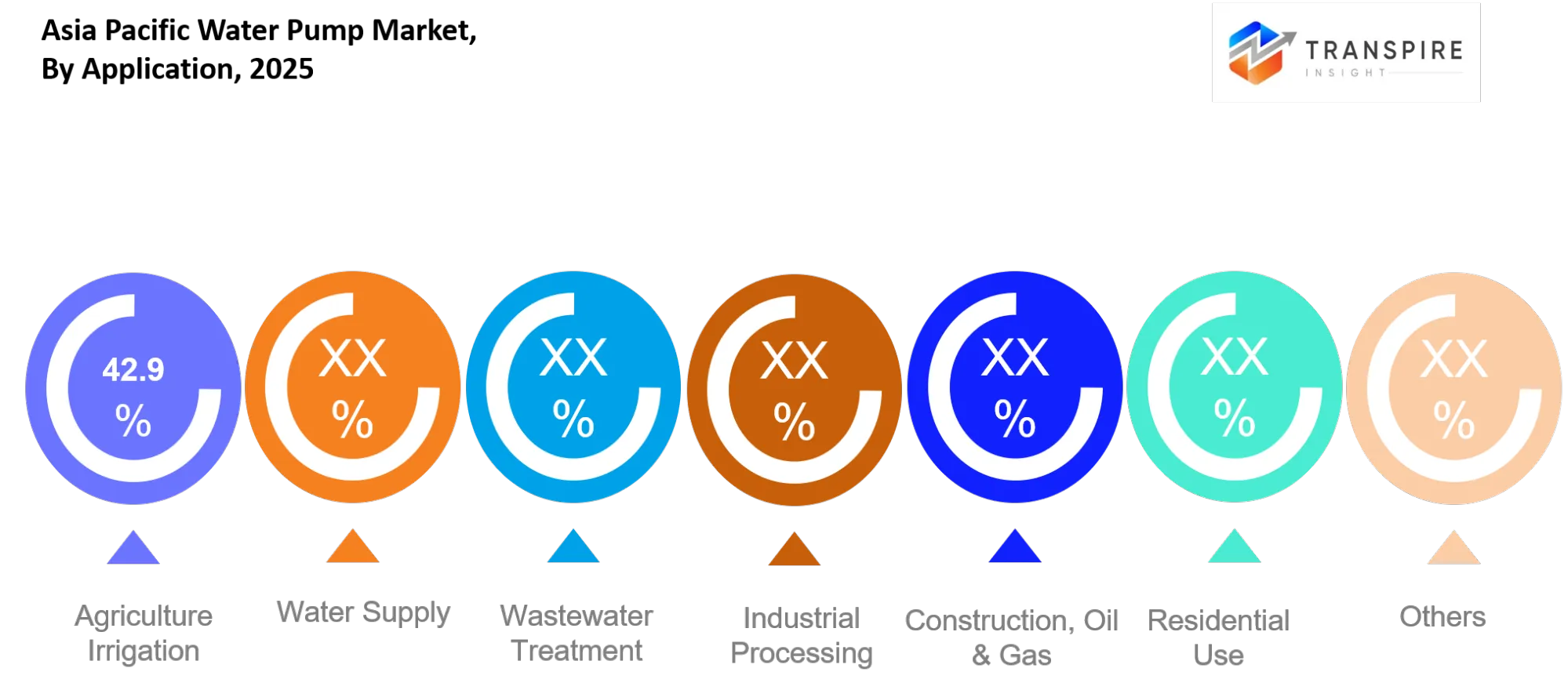
By End User
Agriculture shows up as the biggest end user category, largely because irrigation stays pretty essential for producing food across a few Asia Pacific economies. Municipal Utilities also pour a lot of funding into pumping infrastructure, so drinking water distribution works properly, and wastewater treatment plus flood management systems can keep running. Industrial Manufacturing relies on capable pumping equipment not just for cooling, but also for chemical transfer and the production flow, across multiple industries.
Commercial Buildings, on their side, need pressure control as well as water circulation systems, to keep everyday operations on track and stable. Residential Consumers will buy water pumps for household water supply, borewell extraction, and to improve line pressure when it gets too low. The Mining industry operations in particular depend on heavy duty pumps for dewatering tasks and mineral processing activities.
In the Energy Sector, facilities want dependable fluid movement for cooling systems, and for ongoing plant operations too. Other areas cover healthcare sites, schools and educational institutions, plus public infrastructure projects where specialized water management is really the point.
By Distribution Channel
Direct Sales still remain the go to channel for big industrial customers , and also for government infrastructure projects. You know, the whole technical consultation piece and tailored problem solving helps with purchasing choices, so it feels more reliable.
Dealers help push the regional market reach , mostly by keeping local inventories, offering installation help, and staying on for after-sales support. Industrial Distributors cover a wide range of product categories for manufacturing plants, utilities, and engineering contractors, and they do it with dependable logistics, no drama.
Online Retail keeps expanding too, since digital procurement platforms make it easier to compare items, then place an order , especially for smaller customers who just want speed.
OEM Supply supports equipment manufacturers that bring pumps into the machinery, treatment systems, and industrial equipment before the final installation. Retail Stores pull in residential buyers and small businesses who want readily available products, plus replacement units.
Contractors tend to sway purchasing decisions during construction work, infrastructure upgrades, and municipal development, through project based procurement , like it’s part of the workflow. Others includes specialized procurement partners serving niche industrial sectors, along with customized engineering applications that don’t fit the standard catalog.
What are the Key Use Cases Driving the Asia Pacific Water Pump Market?
Agriculture irrigation still counts as the biggest use case because a steady water delivery, it just helps crop productivity directly, and it also supports year-round cultivation. Big irrigation networks, plus groundwater extraction systems, and canal distribution initiatives, they keep generating long lasting equipment demand across agricultural areas. And yeah, when governments put money into irrigation modernization, that tends to boost both replacement work and brand new installation activity.
Then there’s water supply and wastewater treatment, which keeps growing within municipal utilities as urban populations expand, and as water infrastructure projects get more sophisticated. Industrial manufacturing is doing the same thing too, since factories adopt more equipment for cooling setups, chemical processing, and production workflows that need fluid movement without interruption. Construction keeps adding relevance as well, especially for dewatering and temporary water management while infrastructure is being built.
On top of that, solar-powered irrigation systems are showing up more often as a new direction, with renewable energy investments helping across rural locations. Smart pumping, with digital monitoring and predictive maintenance, is also getting a lot of attention in municipal utilities and industrial facilities, mainly because it improves energy efficiency and it keeps maintenance costs lower over the forecast period.
|
Report Metrics |
Details |
|
Market size value in 2025 |
USD 33.71 Billion |
|
Market size value in 2026 |
USD 35.57 Billion |
|
Revenue forecast in 2033 |
USD 52.12 Billion |
|
Growth rate |
CAGR of 5.61% from 2026 to 2033 |
|
Base year |
2025 |
|
Historical data |
2021 - 2024 |
|
Forecast period |
2026 - 2033 |
|
Report coverage |
Revenue forecast, competitive landscape, growth factors, and trends |
|
Regional scope |
United States; Canada; Mexico; United Kingdom; Germany; France; Italy; Spain; Denmark; Sweden; Norway; China; Japan; India; Australia; South Korea; Thailand; Brazil; Argentina; South Africa; Saudi Arabia; United Arab Emirates |
|
Key company profiled |
Grundfos, Xylem, KSB, Wilo, Kirloskar Brothers, Ebara Corporation, Flowserve, Sulzer, Pentair, Franklin Electric, CRI Pumps, Tsurumi Manufacturing, Shakti Pumps, CNP Pumps, Gorman-Rupp |
|
Customization scope |
Free report customization (country, regional & segment scope). Avail customized purchase options to meet your exact research needs. |
|
Report Segmentation |
By Product Type (Centrifugal Pumps, Positive Displacement Pumps, Submersible Pumps, Booster Pumps, Diaphragm Pumps, Reciprocating Pumps, Solar Water Pumps, Others); By Power Source (Electric Pumps, Diesel Pumps, Solar Pumps, Battery-Powered Pumps, Hybrid Pumps, Manual Pumps, Engine-Driven Pumps, Others); By Application (Agriculture Irrigation, Water Supply, Wastewater Treatment, Industrial Processing, Construction, Oil & Gas, Residential Use, Others); By End User (Agriculture, Municipal Utilities, Industrial Manufacturing, Commercial Buildings, Residential Consumers, Mining Industry, Energy Sector, Others); By Distribution Channel (Direct Sales, Dealers, Industrial Distributors, Online Retail, OEM Supply, Retail Stores, Contractors, Others) |
Which Regions are Driving the Asia Pacific Water Pump Market Growth?
East Asia keeps the biggest regional slice because China, Japan and South Korea have built a lot of industrial backbone, advanced local water networks, and huge manufacturing ecosystems that really depend on dependable pumping equipment. Government spending on wastewater treatment, flood defense and smart water oversight still drives upgrades across public utilities, even when budgets get tight. Also, strong domestic output shortens the delivery chain a bit and keeps product changes moving without too much delay. There are also well known engineering firms, component providers, and research centers working together, so the whole setup stays mature and supports long term leadership in the region.
Southeast Asia brings in fairly steady market revenue, more from steady infrastructure build out than from the massive manufacturing scale seen in East Asia. Places like Indonesia, Thailand, Vietnam and Malaysia keep stretching urban water supply systems, industrial zones, and commercial construction projects that need reliable pumps on a daily basis. With stable economic growth and water related rules being rolled out in a gradual way, utilities and private businesses feel encouraged to modernize old setups. And because the region keeps investing in tourism facilities, manufacturing capacity, and wastewater treatment, the demand feels spread out across different end users.
South Asia is projected to post the quickest growth during the forecast window, mainly because of India ,and it’s backed by Bangladesh and Sri Lanka. Big public programs for rural irrigation, clean drinking water initiatives, smart city efforts ,and renewable energy deployments have raised the need for efficient pumping solutions ,including solar driven options.
Who are the Key Players in the Asia Pacific Water Pump Market and How Do They Compete?
Competition stays pretty moderately fragmented , like you can have global manufacturers going head to head with those strong regional players who really know what the local infrastructure needs are. And yeah, technology matters a lot, so does energy efficiency, digital monitoring, after sales service, and even localized manufacturing, it often outweighs plain price. Meanwhile, international suppliers keep beefing up their premium product portfolio, but regional manufacturers push back with quicker delivery, customized engineering, and those wide dealer networks that seem everywhere.
Grundfos ends up standing out with intelligent pumping systems, variable speed technology, and digital monitoring platforms, all of which help reduce energy usage and also maintenance expenses. They keep growing smart water solutions across industrial and municipal uses. At the same time they expand regional partnerships and offer more locally tailored product lines. Xylem, on the other hand, leans into integrated water infrastructure, basically by combining pumping equipment with digital analytics, plus network monitoring and predictive maintenance software. The idea is that utilities get better operational efficiency, not just better hardware.
KSB highlights high efficiency industrial and municipal pumps, but it’s paired with solid engineering know how and customized project solutions, especially for bigger infrastructure developments. Kirloskar Brothers benefits from a lot of manufacturing capacity and a wide distribution network across South Asia, which supports rapid delivery and localized support for both agriculture and municipal projects. Ebara Corporation competes through specialized wastewater, industrial, and building service pumps, and they keep introducing energy efficient products while also expanding production capabilities, mostly to meet those rising infrastructure investments happening across Asia.
Company List
• Grundfos
• Xylem
• KSB
• Wilo
• Kirloskar Brothers
• Ebara Corporation
• Flowserve
• Sulzer
• Pentair
• Franklin Electric
• CRI Pumps
• Tsurumi Manufacturing
• Shakti Pumps
• CNP Pumps
• Gorman-Rupp
Recent Development News
In April 2025, EBARA Corporation launched the "PURE FRESSURE" wall-mounted direct water supply booster pump. The lightweight design simplifies installation and improves water pressure management for residential and commercial buildings, strengthening the company's building services portfolio.https://www.ebara.com
In June 2025, Grundfos announced a partnership with Rahul Dravid to promote its SCALA2 smart pressure booster system in India. The initiative strengthens brand visibility and supports wider adoption of intelligent residential water solutions in one of the region's largest markets.https://www.grundfos.com
In January 2026, Grundfos joined Infrastructure Masons as a Global Partner to advance water and energy efficiency in digital infrastructure. The collaboration expands opportunities for intelligent pumping technologies in data centers and other digital infrastructure projects.https://www.grundfos.com
What Strategic Insights Define the Future of the Asia Pacific Water Pump Market?
The market is slowly moving toward smart, linked, and energy saving pumping systems, as governments and industrial folks put more weight on cutting running expenses, boosting water security, and upgrading old, tired infrastructure. In practice, digital monitoring and predictive maintenance, plus renewable energy tie ins are going to steer buying decisions over the next five to seven years, not just the equipment price, like it used to be.
There is also one kind of quiet risk , the rising reliance on electronic parts and rare material supply chains, which could leave manufacturers facing production delays, or just higher costs when global trade gets messy, during those disruptions. Yet at the same time, an interesting opportunity is forming: AI enabled smart water networks that connect with solar powered pumping systems, especially across South Asia, where public money for rural water infrastructure keeps growing.
Firms that go in early, with localized manufacturing, plus digital service platforms, and lifecycle upkeep know how, will likely land better chances on long term contracts, and also grow steadier recurring revenue, because projects keep turning more technology driven over time.
Asia Pacific Water Pump Market Report Segmentation
By Product Type
• Centrifugal Pumps
• Positive Displacement Pumps
• Submersible Pumps
• Booster Pumps
• Diaphragm Pumps
• Reciprocating Pumps
• Solar Water Pumps
• Others
By Power Source
• Electric Pumps
• Diesel Pumps
• Solar Pumps
• Battery-Powered Pumps
• Hybrid Pumps
• Manual Pumps
• Engine-Driven Pumps
• Others
By Application
• Agriculture Irrigation
• Water Supply
• Wastewater Treatment
• Industrial Processing
• Construction
• Oil & Gas
• Residential Use
• Others
By End User
• Agriculture
• Municipal Utilities
• Industrial Manufacturing
• Commercial Buildings
• Residential Consumers
• Mining Industry
• Energy Sector
• Others
By Distribution Channel
• Direct Sales
• Dealers
• Industrial Distributors
• Online Retail
• OEM Supply
• Retail Stores
• Contractors
• Others
Frequently Asked Questions
Find quick answers to common questions.
The Expected Asia Pacific Water Pump Market size for the Market will be USD 52.12 Billion in 2033.
Key Segments for the Asia Pacific Water Pump Market are By Product Type (Centrifugal Pumps, Positive Displacement Pumps, Submersible Pumps, Booster Pumps, Diaphragm Pumps, Reciprocating Pumps, Solar Water Pumps, Others); By Power Source (Electric Pumps, Diesel Pumps, Solar Pumps, Battery-Powered Pumps, Hybrid Pumps, Manual Pumps, Engine-Driven Pumps, Others); By Application (Agriculture Irrigation, Water Supply, Wastewater Treatment, Industrial Processing, Construction, Oil & Gas, Residential Use, Others); By End User (Agriculture, Municipal Utilities, Industrial Manufacturing, Commercial Buildings, Residential Consumers, Mining Industry, Energy Sector, Others); By Distribution Channel (Direct Sales, Dealers, Industrial Distributors, Online Retail, OEM Supply, Retail Stores, Contractors, Others).
Major Asia Pacific Water Pump Market Players are Grundfos, Xylem, KSB, Wilo, Kirloskar Brothers, Ebara Corporation, Flowserve, Sulzer, Pentair, Franklin Electric, CRI Pumps, Tsurumi Manufacturing, Shakti Pumps, CNP Pumps, Gorman-Rupp.
The Asia Pacific Water Pump Market size is USD 33.71 Billion in 2025.
The Asia Pacific Water Pump Market CAGR is 5.61% from 2026 to 2033.
• Grundfos
• Xylem
• KSB
• Wilo
• Kirloskar Brothers
• Ebara Corporation
• Flowserve
• Sulzer
• Pentair
• Franklin Electric
• CRI Pumps
• Tsurumi Manufacturing
• Shakti Pumps
• CNP Pumps
• Gorman-Rupp
About the Authors

Kartik bhong
I am Kartik Bhong, a Senior Research Analyst at Transpire Insight, specializing in the Packaging, Manufacturing, and Construction industry. My work focuses on analyzing market trends, emerging technologies, industry regulations, and competitive landscapes to deliver accurate, data-driven insights. I am passionate about transforming complex industry information into clear, practical content that helps businesses, professionals, and decision-makers stay informed and make confident strategic decisions. Through continuous research and a strong commitment to accuracy, I strive to create reliable, well-researched content that reflects the latest developments across these dynamic industries and supports the vision of Transpire Insight in delivering valuable market intelligence.

Chakradhar Khansole
Chakradhar serves as the Research Director at Transpire Insight, bringing over 8 years of experience in technology, innovation, and strategic market intelligence. He specializes in transforming complex market data into actionable business insights that enable organizations to make informed, growth-oriented decisions. Recognized for his strategic vision and analytical expertise, Chakradhar leads high-impact research initiatives, delivering comprehensive market assessments, competitive intelligence, and forward-looking industry analysis.
Recently Published Reports
-
Apr 2026
Handling and Lifting Equipment Market
Handling and Lifting Equipment Market Size, Share & Analysis Report By Product (Cranes and Hoists, Forklifts, Conveyor Systems, Aerial Work Platforms, Others), By Application (E-Commerce, Automotive and Railway, Food and Beverages, Aviation, Others), and Geography (North America, Europe, Asia-Pacific, Middle East and Africa, South and Central America), 2021 - 2031
-
Apr 2026
HVAC Equipment Market
HVAC Equipment Market Size, Share & Analysis Report By Heating Equipment Type (Boilers and Furnaces, Heat Pumps, and Unitary Heaters), By Ventilation Equipment (Air Handling Units, Humidifiers and Dehumidifiers, Air Filters, and Fan Coiling Units), By Air Conditioning Equipment (Unitary Air Conditioners, Room Air Conditioners, Packaged Terminal Air Conditioners, and Chillers), By End User (Commercial, Residential, Industrial, and others), and Geography (North America, Europe, Asia-Pacific, Middle East and Africa, South and Central America), 2021 – 2031
-
Apr 2026
Refrigeration Valves Market
Refrigeration Valves Market Size, Share & Analysis Report By Type (Solenoid Valves, Expansion Valves, Check Valves, Service Valves, Others), By Application (Commercial Refrigeration, Industrial Refrigeration, Transport Refrigeration, Residential Refrigeration, Air Conditioning Systems), By End User (Food and Beverage Industry, Pharmaceutical Industry, HVAC Industry, Chemical Industry, Others), and Geography (North America, Europe, Asia-Pacific, Middle East and Africa, South and Central America), 2021 – 2031
-
Apr 2026
E-Commerce Packaging Materials Market
E-Commerce Packaging Materials Market By Material Type (Corrugated Boxes, Paper & Paperboard, Foam & Cushioning Materials, Plastic Packaging, Flexible Packaging, Protective Packaging, Others), By Product(Primary Packaging, Secondary Packaging, Tertiary Packaging), By Packaging Function (Protective Packaging, Branding & Presentation Packaging, Transit & Logistic Packaging, Sustainable Packaging, Tamper Evidence Packaging), By End-User (Retail & Consumer Goods, Electronic Appliances, Food & Beverages, Healthcare & Pharmaceutical, Fashion & Apparel, Home & Furnishing, Others); By Industry Analysis, Size, Share, Growth, Trends, and Forecasts 2021-2033