
Europe Water Softening Systems Market Size & Forecast:
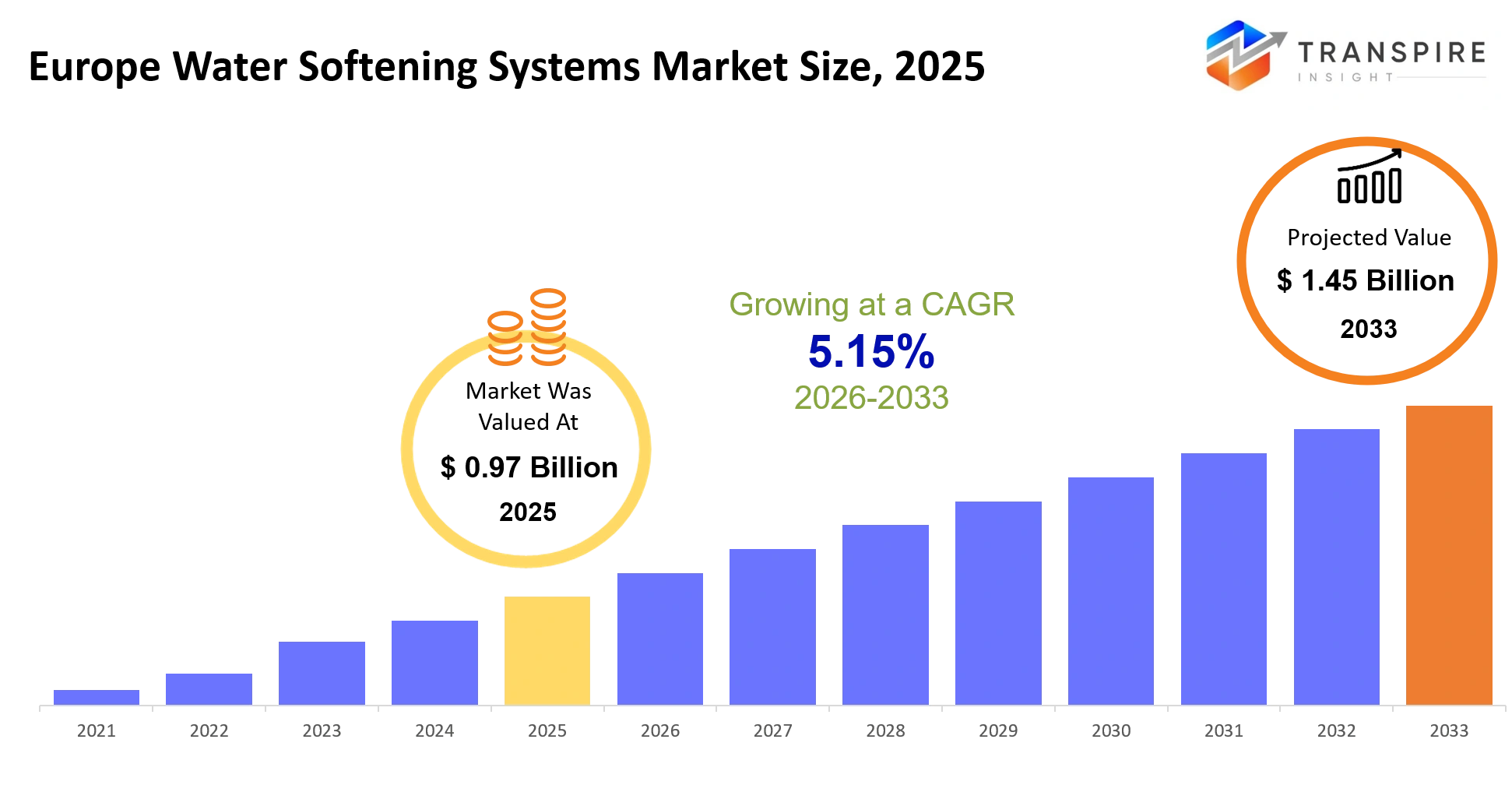
- Europe Water Softening Systems Market Size 2025: USD 0.97 Billion
- Europe Water Softening Systems Market Size 2033: USD 1.45 Billion
- Europe Water Softening Systems Market CAGR: 5.15%
- Europe Water Softening Systems Market Segments: By Type (Salt-Based Systems, Salt-Free Systems, Dual-Tank Systems, Others); By Application (Residential, Commercial, Industrial, Others); By Technology (Ion Exchange, Reverse Osmosis, Magnetic Systems, Others); By Distribution Channel (Direct Sales, Dealers, Online Retail, Others); By End User (Households, Hospitality, Manufacturing, Others); By Capacity (Below 30,000 Grains, 30,000–60,000 Grains, Above 60,000 Grains, Others).
Europe Water Softening Systems Market Summary
The Europe Water Softening Systems Market was valued at USD 0.97 Billion in 2025. It is forecast to reach USD 1.45 Billion by 2033. That is a CAGR of 5.15% over the period.
Europe Water Softening Systems Market helps homes, businesses and factories prevent damage from water. Hard water causes scale buildup in boilers, pipelines, cooling systems and household appliances. Better water quality makes equipment work efficiently. It also lowers maintenance needs reduces energy consumption and makes assets last longer. This makes water softening important for managing facilities and infrastructure.
In the five years the market has changed. People are moving away from salt-based units. They are choosing systems that monitor and optimize water use. These new systems use water and are more efficient. High energy prices and strict environmental rules in Europe encouraged businesses and property owners to upgrade. They replaced equipment with more efficient solutions to save money. This change has helped more people use water softening systems in factories, commercial buildings and homes. It also created opportunities, for manufacturers that offer connected technologies and eco-friendly products. As infrastructure upgrades and equipment replacements continue the European water treatment industry will see growth.
Key Market Insights
- The Europe Water Softening Systems Market is getting bigger because of water treatment technologies, better infrastructure and energy-efficient solutions for homes, businesses and industries.
- Western Europe has the share of the Europe Water Softening Systems Market because it has good infrastructure, strict rules about water quality and a lot of people use advanced water treatment systems.
- The Europe Water Softening Systems Market in Central and Eastern Europe is expected to grow the fastest from 2026 to 2033 because of industries and investments in infrastructure.
- Salt-based water softening systems are used the most because they work well are reliable and are used in different sectors.
- Smart connected water softening systems will grow the fastest by 2033 because people want to be able to control and monitor them from afar.
- The Europe Water Softening Systems Market, for homes makes the money because people want to protect their appliances have better water and are fixing up their homes.
- Manufacturing is the sector that is growing the fastest because companies want to reduce the amount of scaling on their equipment save money on maintenance and use energy.
- Companies are working on products that use the internet to monitor water use less salt are smaller and waste less water.
- To compete companies are working together selling their products in places and providing better service after the sale.
- The Europe Water Softening Systems Market will keep growing because people need to replace equipment want to be sustainable and are using new digital technologies to manage water.
What are the Key Drivers, Restraints, and Opportunities in the Europe Water Softening Systems Market?
Drivers
The main reason people in Europe are using Water Softening Systems is to save money on their bills and make their equipment work better in homes, offices and factories. Because energy is expensive. There are rules to make things more efficient and the water systems are old people who own properties and companies that make these systems are putting in new Water Softening Systems. When you use water it helps to prevent damage to things like boilers and pipes which means people do not have to spend as much money to fix them and they use less energy. This saves people money so they are replacing their systems with new Water Softening Systems all over Europe.
Restraints
One big problem is that it costs a lot of money to put in a Water Softening System, especially for big offices and factories and people also have to pay to keep them working and replace the salt. In buildings people often have to change the plumbing before they can put in a new system, which costs more money and takes longer. The water in Europe is also different in places, which makes it harder to choose the right Water Softening System. These problems make it harder for people to decide to buy a system, especially small businesses and people who do not have a lot of money.
Opportunity
There is a chance for Water Softening Systems that are smart and can connect to the internet so people can monitor them and fix problems before they happen. Big buildings, factories and hotels are starting to use these Water Softening Systems to work more efficiently and prevent unexpected problems. As more buildings in Central Europe become smart and use digital systems to manage themselves companies that make smart Water Softening Systems will have more chances to make money by selling systems that use data to work better until 2033. Water Softening Systems are going to be very important for people, in Europe.
What Has the Impact of Artificial Intelligence Been on the Europe Water Softening Systems Market?
Water softening systems are getting better because of intelligence and advanced digital technologies. These technologies help automate the systems by monitoring them controlling when they need to be regenerated and taking care of the equipment. The smart controllers collect data on how hard the water's how fast it is flowing how much salt is being used and the pressure in the system. This information helps the system decide when it needs to be regenerated of just doing it at a set time.
This way the system does not waste water and salt. It always produces water that is consistently good quality whether it is being used in a home a business or a factory. The systems can also be monitored from away using the internet which means that the people who take care of them can fix problems and make adjustments without having to go to the site.
Computer programs that can learn from experience called machine learning models look at how the systems have been working in the past to predict when parts might start to wear out or fail. This means that the systems can be fixed before they actually break, which reduces the amount of time they are not working makes them last longer and saves money on maintenance. The computer programs also help the people, in charge of the facilities use energy by stopping scale from building up in the equipment, which makes it work better and cost less to run.This makes it easier to take care of the equipment over time. Makes sure it is always working properly even in big installations.A big problem is that it can be very expensive to add intelligence to older water treatment equipment. A lot of the systems do not have the right sensors or ways to communicate digitally which makes it costly to upgrade them and slows down the process of adopting the new technology especially for small businesses and older factories.
Key Market Trends
- Since 2022 companies that make water softeners have started selling water softeners that can be controlled from far away and that can fix themselves. These water softeners can also be checked to see how well they are working at any time.
- The cost of energy in Europe has been changing a lot many businesses are replacing their old water treatment systems with new ones that use less energy and cost less to run.
- The people who make water softeners are now making them so they use salt to clean the water. This is better for the environment. It also helps companies meet their goals for being more sustainable.
- Many factories are now using computers to check on their water treatment equipment and make sure it is working well. This helps the equipment longer and it also helps the factories plan when they need to do maintenance on the equipment.
- The people who own buildings like to use water softeners that're small and do not take up a lot of space. This makes it easier to install them in buildings and in apartments.
- Some companies, like Culligan, BWT, Pentair and EcoWater Systems are making smart water softeners that can be connected to the internet. They are also offering services to help people use these water softeners.
- Since 2023 many companies are selling water softeners. Also offering to install them and fix them if they break. They are also offering to check on the water softeners from away to make sure they are working well.
- Many businesses are now looking at how much a water softener will cost them over its life not just how much it costs to buy at first. They also want to know if the company that sells the water softener will be able to help them if it breaks.
- The companies that make water softeners are spending money to make software that can predict when the water softener might break. This helps the water softener longer and it also helps the businesses that use them.
Europe Water Softening Systems Market Segmentation
By Type
Water softening systems are really important. Salt-Based Systems are the most popular because they work so well and are good for homes, businesses and factories. They stop calcium and magnesium from building up in pipes, boilers and other equipment. This is why people in Europe like to use them. You can buy Salt-Based Systems easily. They are a good replacement for old water treatment equipment.Salt-Free Systems are also getting popular because they need maintenance and use less salt. Dual-Tank Systems are good for businesses and factories that need water all the time. They are very reliable and work well in hotels, hospitals and other places. Then there are systems that are special and used for specific needs and water conditions.
By Application
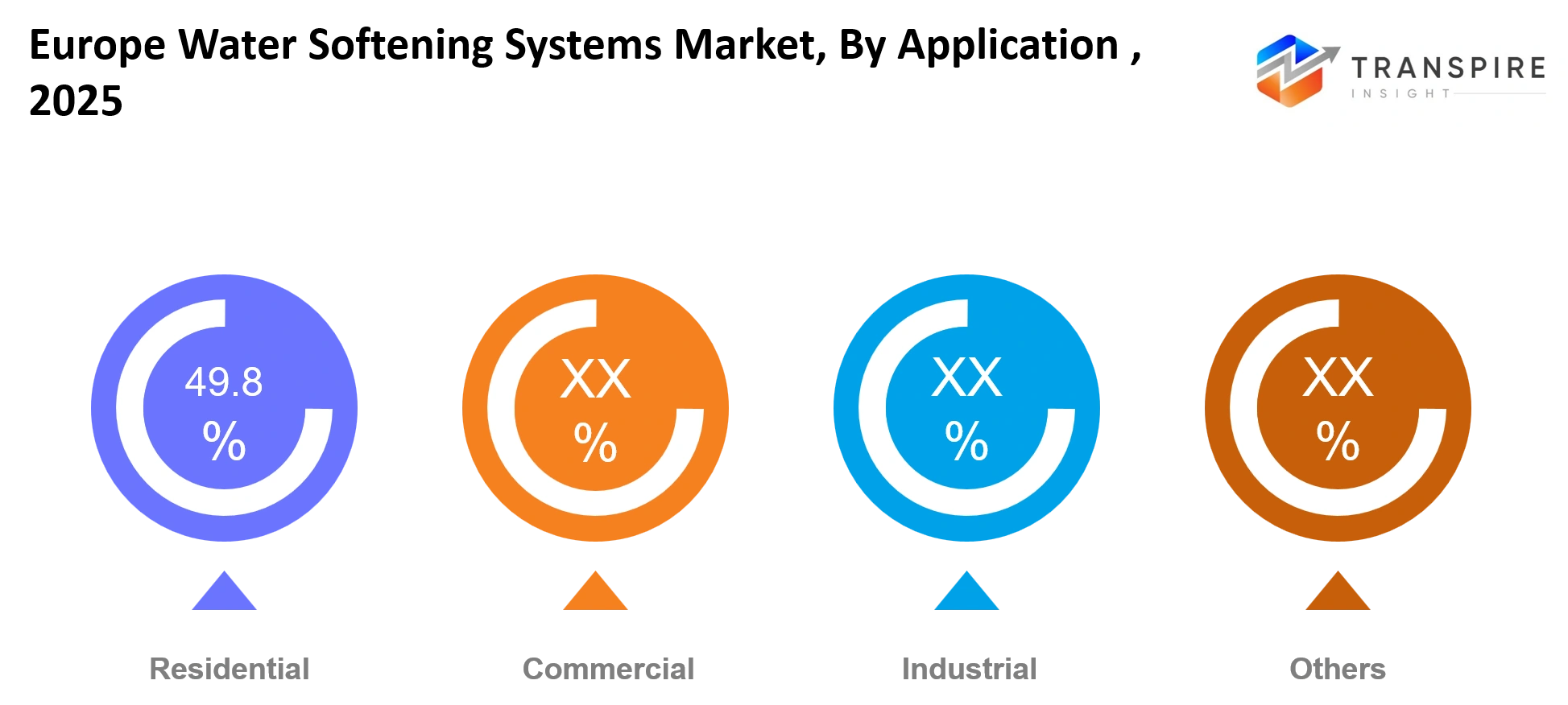
Most people use water softening systems in their homes because hard water can damage appliances and pipes. Water softening systems help appliances work better and last longer. People who are fixing up their homes or building ones like to install these systems. Homeowners like to save money in the run so they buy water softening systems.Businesses like hotels, offices and hospitals also use water softening systems because they need water quality. Factories use them too because soft water helps them work efficiently and reduces damage to equipment. This helps them save money and use energy. There are also places like farms, public buildings and special facilities that use water softening systems.
By Technology
Ion Exchange technology is the popular because it works very well and removes minerals that make water hard. It is reliable. Many people use it in their homes and factories. The companies that make these systems are always trying to make them better so they work more efficiently. This is why people trust and buy these systems.Reverse Osmosis systems are also popular because they make clean water that businesses and factories need. Magnetic Systems are used in some places because they are easy to maintain and help reduce scale buildup. New technologies are being developed to make water softening systems better and more reliable. There are also systems that are special and used for specific needs.
By Distribution Channel
Big businesses and factories often buy water softening systems from the companies that make them. This is because they need systems and help with installation. The companies that make these systems work closely with their customers to make sure they get the system and maintenance plan. This helps customers trust the companies and feel confident when they buy.Dealers sell water softening systems to homes and businesses. Also help with installation and maintenance. You can also buy these systems online which makes it easy to compare and buy them. This is especially helpful for people who are looking for systems for their homes. There are also ways to buy these systems like from wholesalers and special stores.
By End User
Most water softening systems are used in homes because they help appliances work better and make water quality better. Homeowners like to save money in the run so they invest in these systems. Many people are fixing up their homes so they are buying water softening systems. Good water quality is very important for homeowners.Hotels and restaurants need water to protect their equipment and keep their services good. Factories also use water softening systems because they help prevent scale buildup and make equipment longer. This helps factories work better and use money for maintenance. There are also places like hospitals, schools and government buildings that use water softening systems.
By Capacity
Small water softening systems that can handle than 30,000 grains are popular in homes because they are small and affordable. They are easy to install and do not cost much to run. Many people replace their systems with new ones, which helps the market. These small systems are good for homes.Systems that can handle between 30,000 and 60,000 grains are used in homes and businesses that need more water. Systems that can handle, than 60,000 grains are used in factories, hotels and hospitals that need a lot of soft water all the time. These big systems help keep the water quality good and prevent problems. There are also systems that are made for specific needs and water usage.
What are the Key Use Cases Driving the Europe Water Softening Systems Market?
Residential properties are still the use case because softened water helps protect washing machines, dishwashers, water heaters and household plumbing from mineral buildup. This means maintenance costs, better appliance performance and longer equipment life, which keeps driving installation activity in homes.
Commercial use is growing in places like hotels, hospitals, restaurants and office buildings, where good water quality makes operations run smoothly and reduces maintenance needs. Factories also use water to protect their boilers cooling systems and production equipment from damage caused by mineral scale.
New and emerging areas include buildings, with connected water management systems and advanced factories that use automated water treatment monitoring. District heating networks and efficiency commercial developments are also creating new opportunities as digital infrastructure and energy efficiency standards keep improving over time.
|
Report Metrics |
Details |
|
Market size value in 2025 |
USD 0.97 Billion |
|
Market size value in 2026 |
USD 1.02 Billion |
|
Revenue forecast in 2033 |
USD 1.45 Billion |
|
Growth rate |
CAGR of 5.15% from 2026 to 2033 |
|
Base year |
2025 |
|
Historical data |
2021 - 2024 |
|
Forecast period |
2026 - 2033 |
|
Report coverage |
Revenue forecast, competitive landscape, growth factors, and trends |
|
Regional scope |
Europe |
|
Key company profiled |
Culligan, EcoWater Systems, Pentair, A. O. Smith, BWT, Kinetico, Harvey Water Softeners, Whirlpool, Canature, Aquasana, Water2Buy, Atlas Filtri, NuvoH2O, Hague Quality Water, 3M. |
|
Customization scope |
Free report customization (country, regional & segment scope). Avail customized purchase options to meet your exact research needs. |
|
Report Segmentation |
By Type (Salt-Based Systems, Salt-Free Systems, Dual-Tank Systems, Others); By Application (Residential, Commercial, Industrial, Others); By Technology (Ion Exchange, Reverse Osmosis, Magnetic Systems, Others); By Distribution Channel (Direct Sales, Dealers, Online Retail, Others); By End User (Households, Hospitality, Manufacturing, Others); By Capacity (Below 30,000 Grains, 30,000–60,000 Grains, Above 60,000 Grains, Others). |
Which Regions are Driving the Europe Water Softening Systems Market Growth?
Western Europe holds the largest share because Germany, the United Kingdom, France, the Netherlands, and Belgium have mature residential, commercial, and industrial infrastructure with widespread adoption of water treatment technologies. Strict regulations on energy efficiency and building performance encourage investment in systems that reduce scale formation and improve equipment life. High renovation activity and replacement demand also support consistent equipment sales. A strong network of manufacturers, distributors, installers, and service providers reinforces long-term market leadership.
Northern Europe remains a stable contributor because sustainability policies, reliable utility infrastructure, and high construction standards encourage consistent use of advanced water treatment solutions. Unlike Western Europe, the market focuses more on premium, energy-efficient systems with digital monitoring capabilities than on replacement volume. Stable economic conditions support long-term investment across residential and commercial buildings. Continued adoption of smart building technologies strengthens steady market performance.
Central and Eastern Europe is expected to record the fastest growth during 2026–2033 as industrial modernization and infrastructure development accelerate across the region. European funding programs and investment in commercial construction have encouraged installation of efficient water treatment equipment in new facilities. Expansion of manufacturing activities and modernization of public infrastructure continue creating fresh business opportunities. This growth will provide attractive expansion prospects for manufacturers, distributors, and technology providers seeking higher revenue across emerging European markets.
Who are the Key Players in the Europe Water Softening Systems Market and How Do They Compete?
Competition in the Europe Water Softening Systems Market remains moderately fragmented, with global water treatment companies competing alongside regional manufacturers and specialized suppliers. Technology innovation, product efficiency, after-sales service, and distribution reach remain the primary factors shaping competitive positioning. Established companies continue strengthening market share through connected technologies and expanded service networks, while smaller manufacturers compete with customized solutions and competitive pricing for residential and commercial customers.
Culligan focuses on premium residential and commercial water treatment systems supported by extensive installation and maintenance services across Europe. BWT differentiates through energy-efficient technologies, compact system designs, and strong expertise in building water treatment solutions. Both companies continue expanding through product innovation, strategic distribution partnerships, and wider availability of smart connected systems with remote monitoring capabilities.
Pentair emphasizes high-performance water treatment equipment with advanced control technologies designed for residential, commercial, and industrial applications. EcoWater Systems strengthens competitiveness through salt-efficient regeneration technology and connected monitoring features that improve operating efficiency. A. O. Smith continues expanding the European business by broadening water treatment portfolios, strengthening dealer networks, and introducing digitally enabled products that support predictive maintenance and long-term customer service.
Company List
- Culligan
- EcoWater Systems
- Pentair
- A. O. Smith
- BWT
- Kinetico
- Harvey Water Softeners
- Whirlpool
- Canature
- Aquasana
- Water2Buy
- Atlas Filtri
- NuvoH2O
- Hague Quality Water
- 3M
Recent Development News
In March 2025, Pentair launched its EiQ upgrade for Softena, SlimLine, and IQ Soft water softening systems at Aquatech Amsterdam. The new platform introduced smart connectivity, enhanced controller technology, and improved water and salt efficiency, strengthening Pentair's residential water softening portfolio across Europe.
Source: https://www.pentair.eu
In August 2025, Pentair announced the acquisition of Hydra-Stop. The acquisition expands Pentair's water infrastructure portfolio and reinforces its long-term position in the European water treatment sector by broadening its municipal and utility water solutions capabilities.
Source: https://www.pentair.com
In October 2025, BWT expanded its European water treatment business through the acquisition of Eden Springs UK. The transaction strengthens BWT's commercial water treatment and drinking water solutions portfolio while increasing its presence in the UK market, supporting broader adoption of water treatment technologies including water softening systems.
Source: https://www.bwt.com
What Strategic Insights Define the Future of the Europe Water Softening Systems Market?
The Europe water softening systems market is structurally moving toward intelligent, resource-efficient treatment solutions that combine water softening with digital monitoring and predictive maintenance. Over the next five to seven years, growth will be driven by stricter water efficiency standards, aging municipal water infrastructure, and the need to reduce scaling in residential, commercial, and industrial equipment. Manufacturers will increasingly differentiate themselves through smart connectivity, lower salt and water consumption, and integrated treatment systems rather than conventional ion exchange technology alone.
A less visible risk is the growing regulatory scrutiny of brine discharge from salt-based water softeners, which could encourage stricter wastewater management requirements and raise compliance costs in certain European countries. An emerging opportunity lies in hybrid and salt-efficient water treatment systems designed for multi-family housing and commercial buildings seeking to meet sustainability targets without compromising performance. Market participants should invest in digitally connected, low-maintenance platforms and expand partnerships with plumbing, construction, and facility management companies to strengthen market access and long-term customer retention.
Europe Water Softening Systems Market Report Segmentation
By Type
- Salt-Based Systems
- Salt-Free Systems
- Dual-Tank Systems
- Others
By Application
- Residential
- Commercial
- Industrial
- Others
By Technology
- Ion Exchange
- Reverse Osmosis
- Magnetic Systems
- Others
By Distribution Channel
- Direct Sales
- Dealers
- Online Retail
- Others
By End User
- Households
- Hospitality
- Manufacturing
- Others
By Capacity
- Below 30,000 Grains
- 30,000–60,000 Grains
- Above 60,000 Grains
- Others
Frequently Asked Questions
Find quick answers to common questions.
The expected Europe Water Softening Systems Market size for the market will be USD 1.45 Billion in 2033.
Key segments for the Europe Water Softening Systems Market are By Type (Salt-Based Systems, Salt-Free Systems, Dual-Tank Systems, Others); By Application (Residential, Commercial, Industrial, Others); By Technology (Ion Exchange, Reverse Osmosis, Magnetic Systems, Others); By Distribution Channel (Direct Sales, Dealers, Online Retail, Others); By End User (Households, Hospitality, Manufacturing, Others); By Capacity (Below 30,000 Grains, 30,000–60,000 Grains, Above 60,000 Grains, Others).
Major Europe Water Softening Systems Market players are Culligan, EcoWater Systems, Pentair, A. O. Smith, BWT, Kinetico, Harvey Water Softeners, Whirlpool, Canature, Aquasana, Water2Buy, Atlas Filtri, NuvoH2O, Hague Quality Water, 3M.
The Europe Water Softening Systems Market size is USD 0.97 Billion in 2025.
The Europe Water Softening Systems Market CAGR is 5.15% from 2026 to 2033.
- Culligan
- EcoWater Systems
- Pentair
- A. O. Smith
- BWT
- Kinetico
- Harvey Water Softeners
- Whirlpool
- Canature
- Aquasana
- Water2Buy
- Atlas Filtri
- NuvoH2O
- Hague Quality Water
- 3M
About the Authors

Avinash Kumar
I’m Avinash Kumar, a Senior Research Analyst at Transpire Insight, with expertise in the Electronics and Semiconductor and Energy & Power industry. My work focuses on analyzing emerging technologies, market trends, industry developments, and innovation across these sectors. I specialize in transforming complex technical and market insights into clear, research-backed content that helps professionals, businesses, and decision-makers stay informed. Through continuous industry research and data-driven analysis, I strive to deliver accurate, reliable, and practical perspectives on the latest advancements shaping the semiconductor and energy landscape.

Chakradhar Khansole
Chakradhar serves as the Research Director at Transpire Insight, bringing over 8 years of experience in technology, innovation, and strategic market intelligence. He specializes in transforming complex market data into actionable business insights that enable organizations to make informed, growth-oriented decisions. Recognized for his strategic vision and analytical expertise, Chakradhar leads high-impact research initiatives, delivering comprehensive market assessments, competitive intelligence, and forward-looking industry analysis.
Recently Published Reports
-
Apr 2026
Active Power Filter Market
Active Power Filter Market Size, Share & Analysis Report By Type (Shunt Active Power Filters, Series Active Power Filter, Hybrid Active Power Filter), By Application (Harmonics Mitigation, Reactive Power Compensation, Voltage Regulation, Power Factor Correction), By Phase (Single Phase, Three Phase), By End-User Industry (Manufacturing, Healthcare, Commercial, Automotive, Oil and Gas, Others), and Geography (North America, Europe, Asia-Pacific, Middle East and Africa, South and Central America), 2021 - 2031
-
Apr 2026
Electrical Transformer Market
Electrical Transformer Market Size, Share & Analysis Report By Core (Closed, Shell, and Berry), By Insulation (Gas, Oil, Solid, Air, and Other), By Phase (Single, and Three), By Rating (100 MVA to 500 MVA, 501 MVA to 800 MVA, and 801 MVA to 1200 MVA), and Geography (North America, Europe, Asia-Pacific, Middle East and Africa, South and Central America), 2021 – 2031
-
Apr 2026
Hydraulic Piston Pumps Market
Hydraulic Piston Pumps Market Size, Share & Analysis Report By Type (Axial Piston Pumps, Radial Piston Pumps), By Operating Pressure (Low Pressure, Medium Pressure, High Pressure), By Application (Construction, Mining, Agriculture, Automotive, Oil & Gas, Industrial Machinery, Others), By End-User (OEMs, Aftermarket), and Geography (North America, Europe, Asia-Pacific, Middle East and Africa, South and Central America), 2021 – 2031
-
Apr 2026
Laboratory Gas Generators Market
Laboratory Gas Generators Market Size, Share & Analysis Report By Product (Nitrogen Gas Generator, Hydrogen Gas Generator, Zero Air Gas Generator, Purge Gas Generator, TOC Gas Generators, Others), By Application (Gas Chromatography, Liquid Chromatography-mass Spectrometry (LC-MS), Gas Analyzers, Others), By End-user (Life Science, Chemical & Petrochemical, Food & Beverage, Others), and Geography (North America, Europe, Asia-Pacific, Middle East and Africa, South and Central America), 2021 – 2031