
Middle East and Africa Reverse Osmosis Point-of-use Water Treatment Systems Market Size & Forecast:
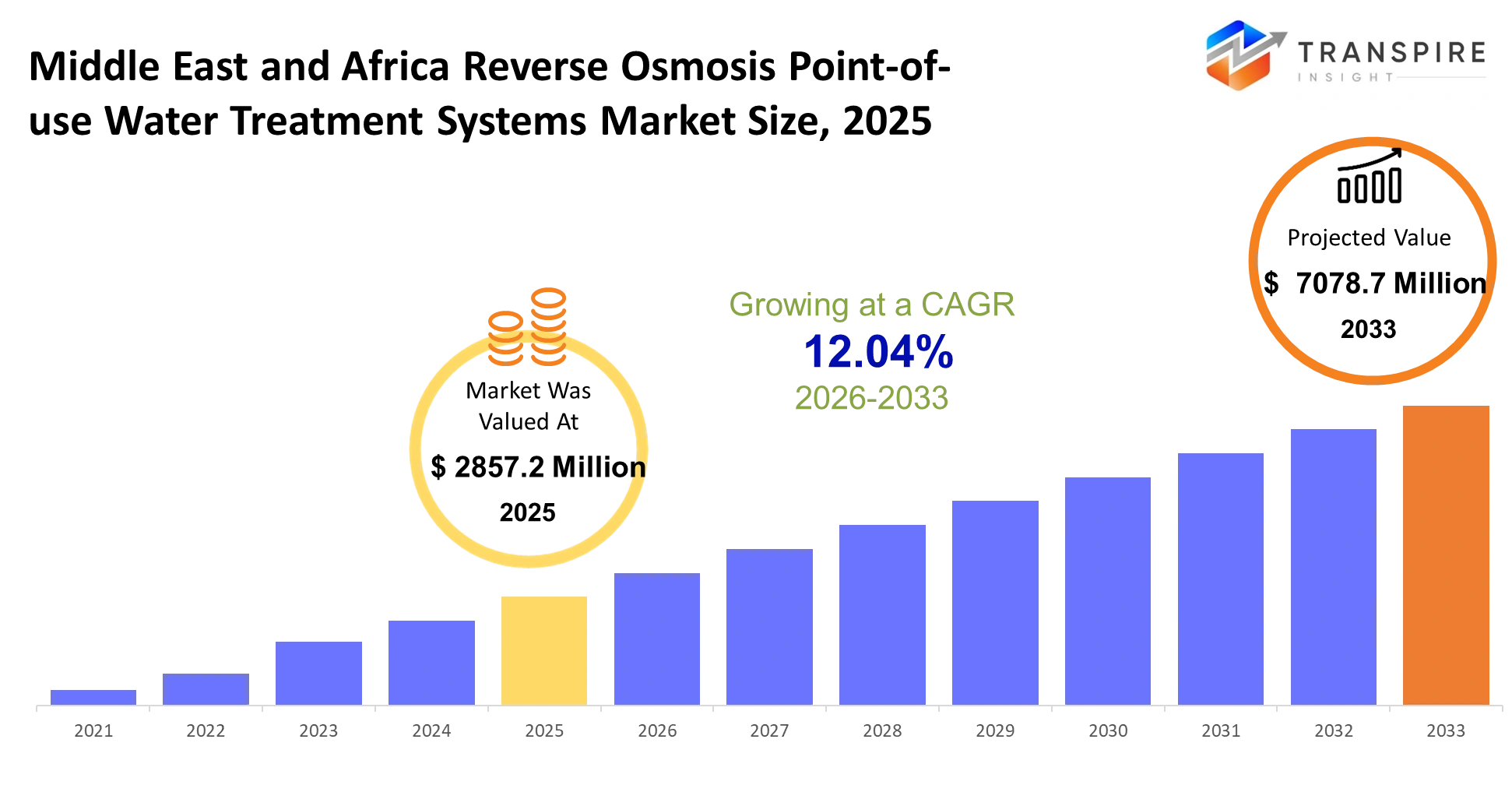
- Middle East and Africa Reverse Osmosis Point-of-use Water Treatment Systems Market Size 2025: USD 2857.2 Million
- Middle East and Africa Reverse Osmosis Point-of-use Water Treatment Systems Market Size 2033: USD 7078.7 Million
- Middle East and Africa Reverse Osmosis Point-of-use Water Treatment Systems Market CAGR: 12.04%
- Middle East and Africa Reverse Osmosis Point-of-use Water Treatment Systems Market Segments: By Type (Under-sink, Countertop, Faucet-mounted, Tankless), By Membrane (TFC, Cellulose, Polyamide), By Filtration (Pre, RO, Post), By Application (Residential, Commercial), By End-User (Households, Offices, Restaurants, Small Commercial Units), By Channel (Online, Retail, Direct)
To learn more about this report,  Download Free Sample Report
Middle East and Africa Reverse Osmosis Point-of-use Water Treatment Systems Market Summary:
The Middle East and Africa Reverse Osmosis Point-of-use Water Treatment Systems Market size is estimated at USD 2857.2 Million in 2025 and is anticipated to reach USD 7078.7 Million by 2033, growing at a CAGR of 12.04% from 2026 to 2033. The Middle East and Africa water purification market for reverse osmosis point-of-use water treatment systems which includes Saudi Arabia and United Arab Emirates and South Africa and the Rest of Middle East and Africa region will move toward development of high-efficiency filtration systems which serve urban residential areas and small business needs. Consumers will increasingly favor compact systems that deliver consistent taste and mineral balance especially in regions facing desalinated or variable-quality supply. Product requirements will change because of better membrane durability and advanced smart monitoring development whereas stricter water safety regulations will determine market acceptance. Cultural preferences and health awareness and infrastructure deficiencies will drive demand in different regional markets.
What Has the Impact of Artificial Intelligence Been on the Middle East and Africa Reverse Osmosis Point-of-use Water Treatment Systems Market?
The incorporation of artificial intelligence in Middle East and Africa reverse osmosis point-of-use water treatment systems market scenarios is revolutionizing this industry by bringing intelligence into decision-making processes. Artificial intelligence applications with in Middle East and Africa reverse osmosis point-of-use water treatment systems market settings will help businesses conduct more thorough market research analysis based on consumption trends, changing water qualities, and consumer preferences. Machine learning techniques will further improve forecasted predictions about market demands and trends, making it easier for manufacturers and suppliers to tailor their strategies according to regional necessities, especially those in urban markets.
Operational processes in the Middle East and Africa reverse osmosis point-of-use water treatment systems market are expected to become more efficient thanks to advanced automation technologies that are based on artificial intelligence. Manufacturing businesses will use AI-powered software solutions to detect performance-related issues of membranes and to improve their filtration systems. The supply chain management process will benefit from predictive analytics because it enables manufacturers to predict demand while reducing transportation costs and improving their distribution planning.
The Middle East and African market for reverse osmosis point-of-use water treatment systems will experience both innovation and personalized solutions through AI technology after achieving operational efficiency. The new smart filtration system will use IoT and AI technologies to create personalized purification solutions which adapt to both local water characteristics and individual user needs. The Middle East and African reverse osmosis point-of-use water treatment systems market will give companies a competitive advantage because businesses using artificial intelligence will develop customer-focused solutions that adapt to market changes.
Key Market Trends & Insights:
- Saudi Arabia controls almost 30% of the Middle East and Africa reverse osmosis point-of-use water treatment systems market in 2025 because of its reliance on desalination.
- UAE maintains substantial market share because its urban households and hospitality industries increasingly adopt premium filtration systems.
- The South African region will experience its most rapid growth until 2030 because people start to recognize safe drinking water solutions that need to be developed.
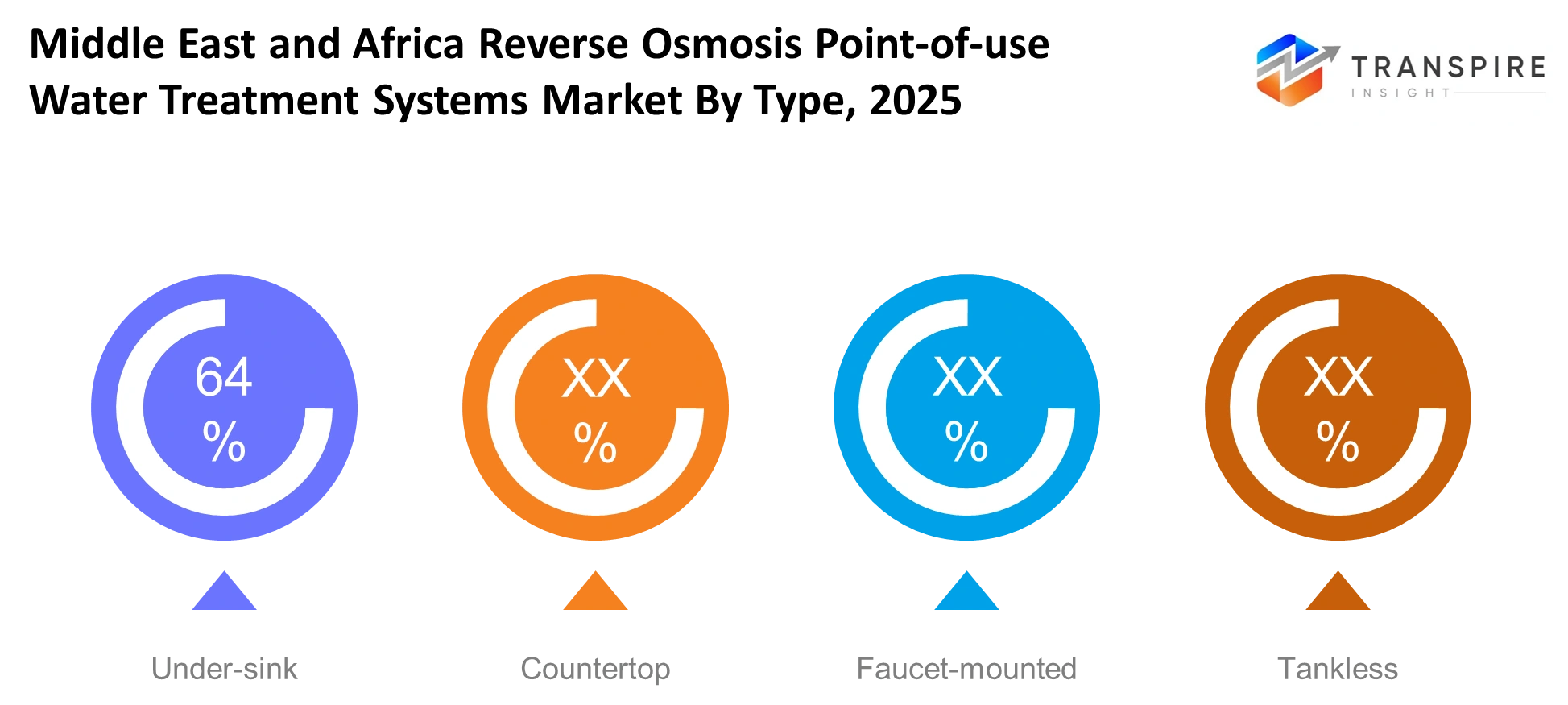
- The market will see 2025 share growth through under-sink RO systems which currently maintain over 45% market share because they provide better filtration and save costs over time.
- The second-largest market share belongs to countertop systems which become popular with urban renters who live in small spaces.
- Smart RO systems will be the fastest-growing segment between 2025–2030 because they use IoT technology and provide real-time monitoring of water quality.
- The residential segment accounts for 65% of the Middle East and Africa reverse osmosis point-of-use water treatment systems market because health-conscious consumers increasingly adopt these systems.
- The fastest-growing segment of the market now includes commercial applications which serve restaurants and clinics because of their need to maintain hygiene standards and deliver reliable water quality.
Middle East and Africa Reverse Osmosis Point-of-use Water Treatment Systems Market Segmentation
By Type
The persistent popularity of under-sink systems comes from their ability to keep plumbing hidden while delivering consistent performance. The systems provide permanent water purification solutions which do not require any visible infrastructure. The ease of installation and portability features which countertop units provide make them ideal for use in rented environments. Users will find faucet-mounted products useful for their immediate requirements because they enable quick installation at an affordable price.
The compact design of tankless systems together with their ability to minimize water waste makes them an attractive solution for customers. New flow technology enables rapid filtration processes which eliminate the need for large storage tanks. Urban users will prefer these systems for modern kitchens and space efficiency. People choose specific products based on how easy they are to use and how flexible their installation methods will be, and according to their water consumption habits.
To learn more about this report, Download Free Sample Report
By Membrane
Thin-film composite membranes will become the leading technology because they achieve high rejection rates and maintain their performance across different water conditions. The membranes will effectively remove dissolved salts and contaminants from water which makes them appropriate for areas with unpredictable water quality. The demand for polyamide membranes will continue because their chemical resistance has improved and their operational lifetime has increased. The consistency of performance will remain the main factor which determines whether people will adopt this technology.
Chlorine-resistant applications will continue to use cellulose-based membranes although their market share will remain limited. The membranes will be suitable for use in locations where municipal water treatment systems provide water. The income levels of different groups will determine which membranes they choose, based on their cost-related decision-making processes. People will decide on membranes based on two factors which include their efficiency and the amount of maintenance required to keep them operational.
By Filtration
The main purification process needs pre-filtration because it helps remove both sediment and bigger particles from the water system. This part of the process will extend membrane operational time while boosting system performance results. The primary method of treatment will use reverse osmosis to achieve complete elimination of dissolved impurities and harmful contaminants. The system will provide dependable water treatment through its high-pressure filtration method which operates successfully across different water sources.
The process of post-filtration will improve taste and odor, which leads to higher user satisfaction after the purification process. The stage will use activated carbon filters because they provide superior water quality. The process will use multiple filtration methods which create a system for progressive water purification. The system will achieve reliable output through proper management of all operational components which also protects the system from breakdowns.
By Application
Residential application will lead to demand because householders become more aware of safe drinking water requirements. Urban families will choose compact systems which operate efficiently for their daily activities. Homeowners will install water systems because they grow increasingly worried about water contamination. People will choose to buy products based on two factors which include how easy they are to maintain and their total cost.
Commercial applications will expand in restaurants, clinics, and small businesses that need reliable water quality throughout their operations. Hygiene standards and customer expectations will support this demand. Businesses will invest in reliable systems to maintain service quality. Commercial usage will grow steadily with rising urban activity.
By End-User
Households will remain the main user group because they need electricity for daily use. The segment will continue to attract customers because people need products for their everyday life and their health needs increase. Offices will implement systems that provide safe drinking water to their workers. The installation process will follow workplace standards that organizations establish for their office areas.
Small-scale business establishments and restaurants will have greater demand due to the requirement of keeping themselves hygienic and efficient in operations. There is a requirement for a company to have clean water for two reasons: cooking and serving customers. It relies on a filtering process regularly to keep up its reliability. End-users will have their own requirements in terms of system capacity and affordability.
By Channel
The online platforms will become more popular because urban areas will experience greater digital technology adoption. The customers will want to assess product features and pricing information and customer reviews before making their buying decisions. The online sales market will experience growth because customers appreciate home delivery services which offer them greater convenience. The e-commerce platforms will increase their product visibility through their ability to show products to more customers.
The retail industry will maintain its strong market presence through its combination of physical stores and dealer networks. The bulk buyers and institutional customers will continue to require direct sales services. The offline purchasing decision process will depend on customers receiving personalized product demonstrations and after-sales support. The customers will choose their preferred distribution channels based on their assessment of trustworthiness and product accessibility and customer service options.
What are the Main Challenges for the Middle East and Africa Reverse Osmosis Point-of-use Water Treatment Systems Market Growth?
Technical issues and inefficiencies arise during the operation of reverse osmosis point-of-use water treatment systems in the Middle East and Africa market due to technical difficulties and inefficiencies. Efficiency of the system is dependent on the nature of input water because different sources produce different outcomes and the need for regular maintenance. Efficiency of the systems used in different areas will be hampered by membrane fouling and changes in pressure and energy use. Disruption of supply chain activities will result from the inability to get vital system components like filters and membranes, leading to high operating costs.
Reverse osmosis point-of-use water treatment systems' growth in the Middle East and Africa market will be slow due to manufacturing and commercialization barriers. Companies involved in large-scale production operations will incur higher production costs because of the high level of accuracy needed during production. Companies will take longer in obtaining approvals from relevant authorities since they have to comply with water safety standards and certifications. Competition by cheaper products will affect price levels, reducing profit margins. Premium systems will have difficulty succeeding in regions that prioritize affordable products.
The adoption process will face major difficulties because developing areas lack proper infrastructure and public awareness of their systems. The system will be unusable because many consumers will not have access to proper water pressure and electricity supply. Users will find it hard to continue using the system because technical knowledge and customer support services are both inadequate. Market restrictions will reduce the adoption of clean water solutions, even as demand for these products grows.
The Middle East and Africa reverse osmosis point-of-use water treatment systems market will face growth challenges due to competing filtration technologies. Budget-conscious users will prefer UV purification and basic filtration systems because they provide more affordable alternatives. The development of new technologies together with changing regulations will create uncertainty for manufacturers who need to make investment decisions for their business.
Regional Insights
The RO POU Water Treatment Systems Market in the Middle East and Africa is expected to grow steadily owing to elements such as scarcity and consumption pattern in urban centers. There will be an increased demand for the product from domestic consumers and small business enterprises because of the rise in consumer consciousness about safe drinking water. Product features will enhance the efficiency of water filtration, and the compactness of the product will enable easy installation in tight spaces in urban centers.
Consumer requirements will compel the companies to develop high-quality products that can meet their demands. The product features like monitoring system will attract consumers due to their efficiency in water management. The market environment will differ according to geographical locations.
The regional demand in Saudi Arabia will increase because the country requires desalinated water for its water supply and needs more water purification systems at its usage points. High-income households will prefer advanced systems with stable output and modern features. The need for residential and commercial space will lead to permanent installation which will occur throughout urban development.
The United Arab Emirates will show strong adoption driven by premium living standards and demand for high-quality drinking water. Smart and compact systems will gain traction in modern apartments. The hospitality industry and the service industry will drive demand because of their need to meet strict hygiene standards and their customers' requirements.
The Middle East and Africa will experience slow growth because of infrastructure shortages and lack of affordable options. Developing cities that lack clean water access will maintain steady demand for water during business operations. The market will favor cost-effective systems but long-term growth will depend on increasing product knowledge and establishing product distribution channels.
Recent Development News
In April 2026, DuPont launched new industrial water treatment technologies aimed at expanding advanced filtration solutions across the Middle East and Africa, strengthening its regional water solutions portfolio.https://simplywall.st/
In February 2026, ACWA Power announced multiple global partnerships during Innovation Days 2026 to accelerate desalination and clean water technologies, supporting sustainable reverse osmosis advancements in the region.https://solarquarter.com/
|
Report Metrics |
Details |
|
Market size value in 2025 |
USD 2857.2 Million |
|
Market size value in 2026 |
USD 3194.4 Million |
|
Revenue forecast in 2033 |
USD 7078.7 Million |
|
Growth rate |
CAGR of 12.04% from 2026 to 2033 |
|
Base year |
2025 |
|
Historical data |
2021 - 2024 |
|
Forecast period |
2026 - 2033 |
|
Report coverage |
Revenue forecast, competitive landscape, growth factors, and trends |
|
Regional scope |
Middle East and Africa (Saudi Arabia, United Arab Emirates, South Africa, Rest of Middle East and Africa) |
|
Key company profiled |
Pentair, A.O. Smith, Culligan, 3M, LG, Panasonic, Kent RO, Pureit, Coway, Eureka Forbes, Whirlpool, Brita, iSpring, Aquasana, Bluewater |
|
Customization scope |
Free report customization (country, regional & segment scope). Avail customized purchase options to meet your exact research needs. |
|
Report Segmentation |
By Type (Under-sink, Countertop, Faucet-mounted, Tankless), By Membrane (TFC, Cellulose, Polyamide), By Filtration (Pre, RO, Post), By Application (Residential, Commercial), By End-User (Households, Offices, Restaurants, Small Commercial Units), By Channel (Online, Retail, Direct) |
How Can New Companies Establish a Strong Foothold in the Middle East and Africa Reverse Osmosis Point-of-use Water Treatment Systems Market?
New companies can establish strong market presence within the Middle East and Africa reverse osmosis point-of-use water treatment systems market by developing solutions which meet local requirements and serve specific market segments. New market entrants should focus on specific water use applications which include compact urban housing and small restaurants and clinics that need continuous water quality maintenance instead of competing through pricing wars. Customers will accept products better when their design matches the specific water conditions of their region because product performance, which customers care about most, remains their main concern.
The Middle East and Africa reverse osmosis point-of-use water treatment systems market will use innovation strategies as its primary method to establish market presence. Startups that develop smart sensors with IoT capability and low-energy filtration solutions will gain a competitive advantage over their rivals. DrinkPrime and Livpure Smart demonstrate how subscription-based purification systems can control maintenance through their app-controlled systems which enhance user experience. New companies can establish ongoing revenue streams through business models which address existing service gaps.
You have data training up to the month of October in the year 2023. The company needs strategic partnerships to achieve faster market entry and market expansion. The company will gain better reach and higher credibility through its partnerships with local distributors and real estate developers and municipal projects. Smart city initiatives and hospitality chains will create large business opportunities for the reverse osmosis point-of-use water treatment systems market in the Middle East and Africa region. The partnerships will assist organizations with their efforts to meet regulatory standards and regional compliance requirements.
The ability of a business to succeed over time depends on its technological edge and its capacity to provide customer support after a sale. Organizations that provide long-lasting membranes together with simple maintenance and effective client assistance will generate trust with their clients more rapidly. Our solution will improve market competitiveness because it addresses the two most common customer challenges which include filter replacement expenses and system operational interruptions.
Key Middle East and Africa Reverse Osmosis Point-of-use Water Treatment Systems Market Company Insights
The Middle East and Africa reverse osmosis point-of-use water treatment systems market will expand steadily as demand for clean, safe drinking water increases. Urban areas will expand and more people will realize health benefits, thus affecting their choice to use products for their homes and small enterprises. The system will be used widely because it has compact design and its filtration system works better in areas with limited space.
People will start to prefer systems that deliver dependable service while needing minimal upkeep work. The manufacturers will create products that last longer and people can install without difficulty to make first-time buyers choose their products. The product demand will be determined by how water quality and infrastructure vary across different regions. The market will move forward based on three factors which include affordable pricing and accessible service and successful technology implementation.
Competition will depend on the company's ability to create new products that provide unique value through their intelligent technology and their environmentally friendly product features. The company will expand its market presence through partnerships with local distributors and service providers. The companies that deliver excellent post-sale service together with affordable maintenance solutions will establish trust with customers which will lead to enduring customer relationships.
Company List
- Pentair
- A.O
- Smith
- Culligan
- 3M
- LG
- Panasonic
- Kent RO
- Pureit
- Coway
- Eureka Forbes
- Whirlpool
- Brita
- iSpring
- Aquasana
- Bluewater
What are the Key Use-Cases Driving the Growth of the Middle East and Africa Reverse Osmosis Point-of-use Water Treatment Systems Market?
The market for reverse osmosis point-of-use water treatment systems in the Middle East and Africa region has been experiencing rapid growth because residential areas require dependable water purification solutions to handle their variable water quality challenges. The demand for compact water treatment systems has been increasing among urban residents because these systems enable users to enhance water taste while removing dissolved salts and ensuring their drinking water remains safe throughout the day. The market expansion benefits from this trend because people in urban and semi-urban areas become more aware of the dangers associated with waterborne diseases.
The Middle East and Africa reverse osmosis point-of-use water treatment systems market receives strong support from healthcare facilities which serve as essential application sites. Clinics and diagnostic centers and small hospitals need purified water to support their medical operations and maintain proper sanitation and provide drinking water to patients. The healthcare industry will use consistent filtration quality to control hygiene standards because many healthcare facilities lack centralized purification systems.
The Middle East and Africa reverse osmosis point-of-use water treatment systems market receives substantial support from commercial establishments which include restaurants and cafés and small food processing units. Businesses need dependable point-of-use systems because clean water serves as a fundamental requirement for food preparation and building customer trust. The expansion of urban hospitality and service industries will drive continuous growth of this demand.
The Middle East and Africa reverse osmosis point-of-use water treatment systems market has been expanded through new office applications and small business use cases. Employers are prioritizing safe drinking water to improve workplace standards, while smart filtration systems with monitoring features will support scalability and long-term efficiency across business environments.
Middle East and Africa Reverse Osmosis Point-of-use Water Treatment Systems Market Report Segmentation
By Type
- Under-sink
- Countertop
- Faucet-mounted
- Tankless
By Membrane
- TFC
- Cellulose
- Polyamide
By Filtration
- Pre
- RO
- Post
By Application
- Residential
- Commercial
By End-User
- Households
- Offices
- Restaurants
- Small Commercial Units
By Channel
- Online
- Retail
- Direct
Frequently Asked Questions
Find quick answers to common questions.
The approximate Middle East and Africa Reverse Osmosis Point-of-use Water Treatment Systems Market size for the market will be USD 7078.7 Million in 2033.
Key segments for the Middle East and Africa Reverse Osmosis Point-of-use Water Treatment Systems Market are By Type (Under-sink, Countertop, Faucet-mounted, Tankless), By Membrane (TFC, Cellulose, Polyamide), By Filtration (Pre, RO, Post), By Application (Residential, Commercial), By End-User (Households, Offices, Restaurants, Small Commercial Units), By Channel (Online, Retail, Direct).
Major Middle East and Africa Reverse Osmosis Point-of-use Water Treatment Systems Market players are Pentair, A.O. Smith, Culligan, 3M, LG, Panasonic, Kent RO, Pureit, Coway, Eureka Forbes, Whirlpool, Brita, iSpring, Aquasana, Bluewater.
The Middle East and Africa Reverse Osmosis Point-of-use Water Treatment Systems Market size is USD 2857.2 Million in 2025.
The Middle East and Africa Reverse Osmosis Point-of-use Water Treatment Systems Market CAGR is 12.04%.
- Pentair
- A.O
- Smith
- Culligan
- 3M
- LG
- Panasonic
- Kent RO
- Pureit
- Coway
- Eureka Forbes
- Whirlpool
- Brita
- iSpring
- Aquasana
- Bluewater
Recently Published Reports
-
Dec 2024
Active Power Filter Market
Active Power Filter Market Size, Share & Analysis Report By Type (Shunt Active Power Filters, Series Active Power Filter, Hybrid Active Power Filter), By Application (Harmonics Mitigation, Reactive Power Compensation, Voltage Regulation, Power Factor Correction), By Phase (Single Phase, Three Phase), By End-User Industry (Manufacturing, Healthcare, Commercial, Automotive, Oil and Gas, Others), and Geography (North America, Europe, Asia-Pacific, Middle East and Africa, South and Central America), 2021 - 2031
-
Jan 2025
Electrical Transformer Market
Electrical Transformer Market Size, Share & Analysis Report By Core (Closed, Shell, and Berry), By Insulation (Gas, Oil, Solid, Air, and Other), By Phase (Single, and Three), By Rating (100 MVA to 500 MVA, 501 MVA to 800 MVA, and 801 MVA to 1200 MVA), and Geography (North America, Europe, Asia-Pacific, Middle East and Africa, South and Central America), 2021 – 2031
-
Jan 2025
Hydraulic Piston Pumps Market
Hydraulic Piston Pumps Market Size, Share & Analysis Report By Type (Axial Piston Pumps, Radial Piston Pumps), By Operating Pressure (Low Pressure, Medium Pressure, High Pressure), By Application (Construction, Mining, Agriculture, Automotive, Oil & Gas, Industrial Machinery, Others), By End-User (OEMs, Aftermarket), and Geography (North America, Europe, Asia-Pacific, Middle East and Africa, South and Central America), 2021 – 2031
-
Jan 2025
Laboratory Gas Generators Market
Laboratory Gas Generators Market Size, Share & Analysis Report By Product (Nitrogen Gas Generator, Hydrogen Gas Generator, Zero Air Gas Generator, Purge Gas Generator, TOC Gas Generators, Others), By Application (Gas Chromatography, Liquid Chromatography-mass Spectrometry (LC-MS), Gas Analyzers, Others), By End-user (Life Science, Chemical & Petrochemical, Food & Beverage, Others), and Geography (North America, Europe, Asia-Pacific, Middle East and Africa, South and Central America), 2021 – 2031