

Asia Pacific Underwater Sonar Market Size & Forecast
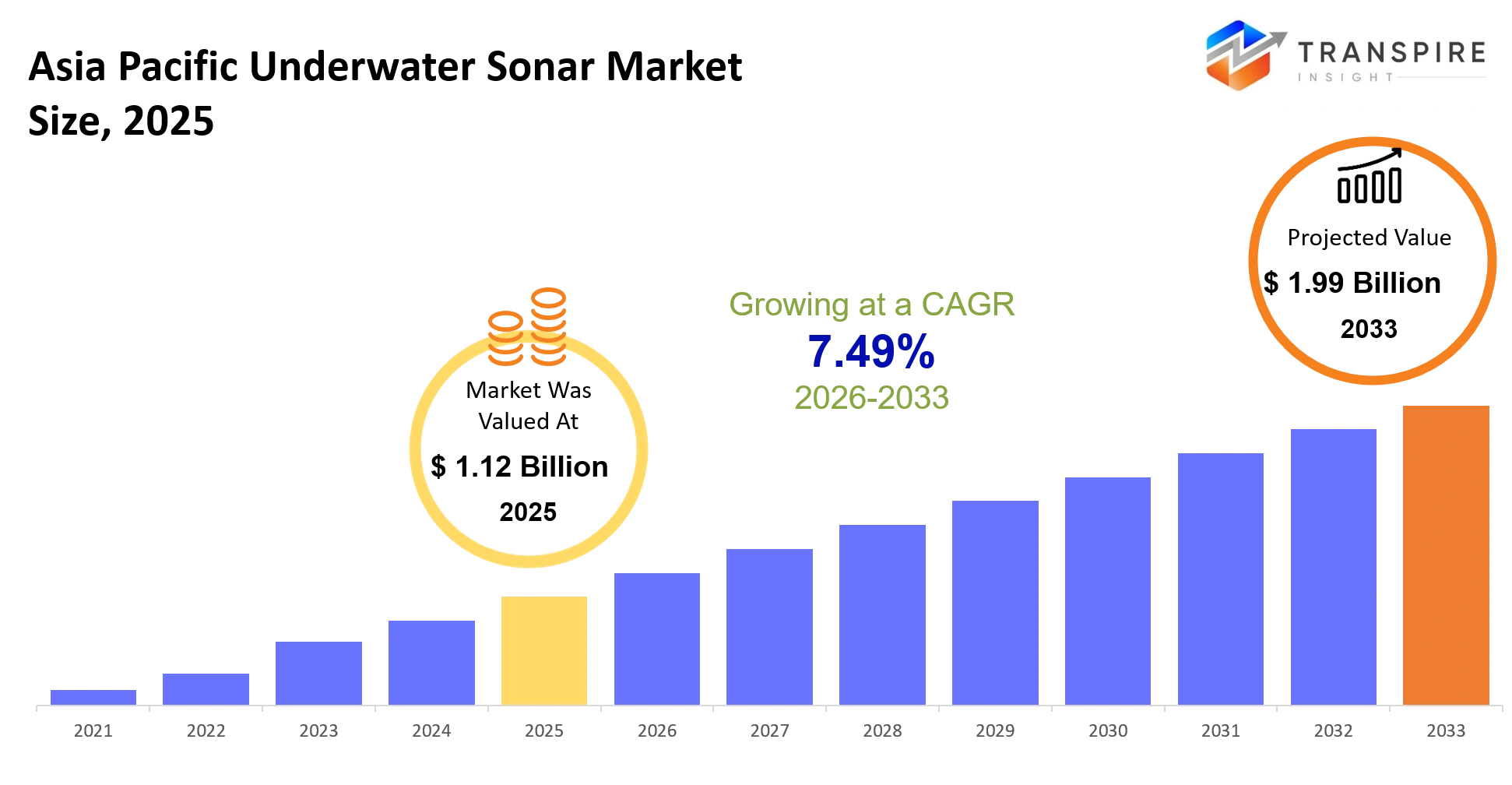
- Asia Pacific Underwater Sonar Market Size 2025: USD 1.12 Billion
- Asia Pacific Underwater Sonar Market Size 2026: USD 1.20 Billion
- Asia Pacific Underwater Sonar Market Size 2033: USD 1.99 Billion
- Asia Pacific Underwater Sonar Market CAGR: 7.49%
- Asia Pacific Underwater Sonar Market Segments: By Sonar Type (Hull-Mounted Sonar, Towed Sonar, Dipping Sonar, Side Scan Sonar, Forward Looking Sonar, Synthetic Aperture Sonar, Multi-Beam Sonar, Others); By Platform (Naval Ships, Submarines, Autonomous Underwater Vehicles, Remotely Operated Vehicles, Surface Vessels, Patrol Boats, Research Vessels, Others); By Application (Naval Defense, Underwater Surveillance, Hydrographic Survey, Oil & Gas Exploration, Fisheries, Search & Rescue, Marine Research, Others); By Technology (Active Sonar, Passive Sonar, Dual-Mode Sonar, Digital Sonar, AI-Enabled Sonar, High-Frequency Sonar, Low-Frequency Sonar, Others); By End User (Defense Forces, Coast Guards, Marine Research Institutes, Offshore Energy Companies, Commercial Shipping, Fisheries, Government Agencies, Others)
Asia Pacific Underwater Sonar Market Summary
The Asia Pacific underwater sonar market is expanding from USD 1.12 Billion in 2025 to USD 1.99 Billion by 2033 at a 7.49% CAGR, propelled by submarine fleet modernization and a fast-growing offshore survey market. AI-enabled classification systems are shifting buyer specifications away from raw detection range toward decision-support software.
A big part of why this is changing, is naval modernization, that structural shift that has been reshaping the market pretty much since 2021. China has kept expanding its submarine fleet, Australia’s AUKUS nuclear submarine pathway , and India’s Project-75I for conventional submarines each drew fresh sonar buying into national defense budgets. At the same time, there’s also this commercial push, more like practical hydrographic mapping for undersea cable routes and offshore wind work.
The real spark that made the buildup happen faster was the South China Sea tension increase from 2021 to 2023. That period pushed Japan, the Philippines, Vietnam, and Australia to speed up their maritime domain awareness funding. Orders for sonar, which used to drift along multi-year procurement schedules, started getting approved within a single defense budget year. And that shortened approval-to-order rhythm is one clear reason for the markets current growth pace, since defense sonar contracts are turning into delivered revenue faster than at any moment in the last ten years.
Key Asia Pacific Underwater Sonar Market Insights
- China still takes the biggest country share in the Asia Pacific underwater sonar market, around 27% in 2025, pushed by continued submarine plus surface fleet growth tied to its naval modernization agenda. There is no shortage of movement, it’s kinda steady.
- India meanwhile looks like the fastest mover, clocking growth a bit beyond 9% CAGR through 2033, supported by Project-75I submarine build work and domestic, locally-made sonar development under the Atmanirbhar Bharat defense manufacturing effort.
- When you break it down by sonar type, Hull-Mounted Sonar ends up leading the segment, it has the biggest installed base across the region’s naval fleets, mainly because it stays the default primary detection setup on almost every commissioned surface combatant and submarine, pretty much as the rule.
- Synthetic Aperture Sonar is more like the speediest gainer. It keeps getting more share as navies swap out older towed arrays for higher resolution seabed imaging systems, especially for mine countermeasure tasks where detail matters.
- On the platform side, Naval Ships and Submarines together generate most of the revenue, and this suggests sonar procurement is concentrated inside state defense budgets rather than coming from commercial shipping fleets.
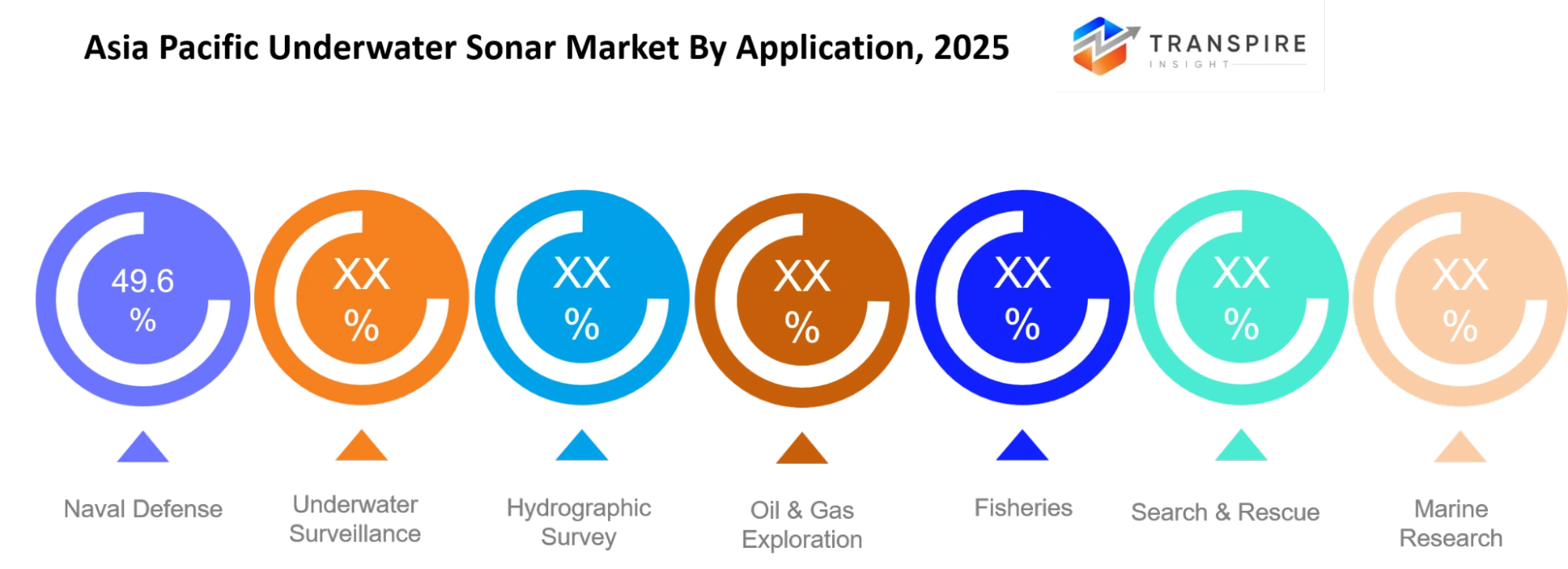
- By application, Naval Defense is the clear top use case, taking 49.6% of the Asia Pacific underwater sonar market revenue in 2025. That’s ahead of hydrographic survey and offshore energy exploration combined, which is interesting because those sound related but still lag.
- For technology, Active Sonar leads by installed units. AI-Enabled Sonar is growing quickest though, because machine learning based target classification helps cut down false positives, especially in cluttered coastal water where the environment can be noisy.
- In terms of end-users, Defense Forces remain the main category. Offshore Energy Companies are also ramping up sonar spending, since regional wind farm and subsea cable projects need detailed seabed survey work, and that work tends to be sonar heavy.
What are the Key Drivers, Restraints, and Opportunities in the Asia Pacific Underwater Sonar Market?
Driver: Submarine fleet expansion across China, India, South Korea and Australia is sort of the main thing, behind todays sonar demand. Like, every new submarine hull ends up needing a bow mounted array, a flank array and more and more a towed array, and just those parts alone can make up a meaningful chunk of the submarines total electronics spend. Australia’s AUKUS submarine push, set out in 2021 and still unfolding through the 2020s, effectively locks the country into nuclear powered submarines, which means sonar suites at a much tougher specification than the diesel electric boats they’re replacing. India’s Project 75I leans on the same idea, and each new hull that’s actually being built, converts straight into a confirmed sonar order not some vague pipeline item, so vendors get a revenue pattern that is unusually steady, even kinda predictable.
Restraint: Export control rules for advanced sonar technology are a real structural obstacle, limiting how fast regional buyers can get their hands on the top performing systems. The United States, a few European governments, and Japan all restrict the movement of low-frequency active sonar and certain signal processing technologies, partly so it wont proliferate toward strategic rivals. This isn’t just some short, temporary licensing hiccup, it is basically a permanent feature of how defense electronics travel across borders, and it nudges buyers like Vietnam, the Philippines, and Indonesia toward mid tier systems, or drags them into long government-to-government approval paths that can stretch procurement by two to four years. That then dampens near term revenue, even when there is budget and intent on paper.
Opportunity: Offshore wind expansion across Taiwan, South Korea, and Japan is starting to open up a commercial sonar opportunity that feels pretty separate from defense procurement. The work isn’t just a matter of placing turbines, it’s the seabed survey, right before turbine foundation placement and also for subsea cable routing. That kind of work wants high resolution side scan and multi beam sonar. For Taiwan alone, the buildout is expected to mean survey coverage across multiple gigawatts of planned capacity through 2030. EdgeTech and NORBIT are already putting survey grade sonar packages toward this buyer group, and as more Asia Pacific governments keep committing to offshore renewable targets, this commercial channel gives vendors a growth path, that can run pretty much on its own, beyond defense budget cycles.
What Has the Impact of Artificial Intelligence Been on the Asia Pacific Underwater Sonar Market?
Artificial intelligence is moving underwater detection systems forward, mostly by doing automated target classification in a quicker more consistent way. In the past, sonar operators mostly depended on trained people to tell whether a submarine contact was actually a submarine, or just a whale pod, a fishing trawler, or plain seafloor debris. That kind of listening and pattern recognition takes years, and it’s more subtle than people expect. Now machine learning classifiers that are trained on huge acoustic signature catalogs basically do that triage on their own. They also raise flags on high-confidence contacts so an operator can double-check, while they drop out a lot of everyday biological activity and environmental noise that would otherwise slow things down. Kongsberg Maritime and Thales Group have both brought classification models into newer processing suites, and some regional navies say they’ve seen real reductions in operator fatigue during long patrols.
Predictive signal processing is the second big use case. AI models trained on ocean temperature, salinity, and current readings can adjust sonar beam patterns in real time, compensating for acoustic distortion as conditions shift. That tends to improve detection range, especially in layered water environments like you often get across the South China Sea and the Strait of Malacca. In practice this bumps up the effective search area per patrol hour, and that matters because in that part of the world, the main limit on surveillance coverage is frequently not the sonar hardware at all, but vessel and aircraft availability, or so it’s reported in many operational discussions.
The most obvious limitation is that training data is scarce for adversary submarine signatures, because the acoustic profiles of newer classes are, essentially, not in historical libraries, so there is no real record. Regional navies try to cover that hole somewhat using simulation-driven synthetic data, but the certainty level for classification when you face something truly unfamiliar is still less strong than it is for the older well-documented submarine classes. And honestly this gap is likely to stay there until encounter data from the real world keeps building up over time.
Key Market Trends
- China’s submarine fleet went from something like 60 hulls to over 70 between 2019 and 2025, and that growth kind of converted straight into recurring sonar refit work plus new-build ordering across the country’s shipyards, not just a one time spike.
- Australia’s AUKUS program also shifted sonar specification standards more regionally in 2023, because allied navies started lining up acoustic data sharing protocols, ahead of the whole nuclear submarine transition, kinda early on.
- Synthetic aperture sonar orders jumped pretty fast after 2022 as regional mine countermeasure fleets moved away from older towed side scan systems and toward higher resolution seabed imaging platforms, better detail, basically.
- India’s own sonar development under Atmanirbhar Bharat reduced import dependency for surface-ship, hull-mounted systems , and since 2023 the domestic content requirements have been rising on new naval contracts too, steadily.
- Taiwan’s offshore wind survey demand kept growing year-over-year through 2024, since turbine foundation mapping and cable route tracing requirements expanded across the Taiwan Strait wind development areas and zones.
- AI-enabled target classification moved from a pilot setup into standard fit on new naval sonar suites, delivered by Kongsberg Maritime and Thales Group after 2023, so it’s not just experiments anymore.
- South Korea sped up work on submarine-launched ballistic missile submarines, and it pulled advanced flank sonar and towed array sonar orders into its shipbuilding pipeline from 2024 onward, basically folding them in sooner.
- Vietnam and the Philippines increased coastal surveillance sonar procurement after more intense South China Sea maritime incidents were noted through 2023 and 2024, so the budgets followed the attention.
- Autonomous underwater vehicle deployments for seabed cable inspections rose across Japan and South Korea, since regional data cable network expansion created extra survey contract volume, and that kept the demand steady.
Asia Pacific Underwater Sonar Market Segmentation
By Sonar Type
Hull-Mounted Sonar seems to take up the biggest chunk in the sonar type segment, mostly because it shows up as standard gear on almost every commissioned surface ship and submarine, throughout the region. After that, Towed Sonar and Dipping Sonar kinda come next, enabling anti-submarine defense work from surface platforms and helicopters, depending on the patrol. Side Scan Sonar plus Multi-Beam Sonar are more for the expanding hydrographic, and offshore survey lane, not so much for the defense fleets. Forward Looking Sonar then fits smaller patrol or research vessels, mainly for navigation, plus dodging obstacles out there. And honestly Synthetic Aperture Sonar is the one that’s growing the quickest—it's gradually swapping older towed systems in mine countermeasure duties, since it can produce clearer seabed imagery while operating at lower speeds. This sort of angle, regional navies have been pushing since 2022, as mine warfare dangers in contested areas got fresh attention again.
By Platform
Naval Ships plus Submarines really make up most of the platform level sonar revenue, which basically shows how procurement gets concentrated inside government defense budgets across China India South Korea and Australia. In the meantime, Autonomous Underwater Vehicles together with Remotely Operated Vehicles are the quickest risers for this platform segment , pushed by offshore wind survey chores and undersea cable inspection contracts in Japan Taiwan, and South Korea. Surface Vessels, and Patrol Boats usually take the lighter sonar fit kinds, more appropriate for coastal surveillance tasks that coast guards run in Vietnam the Philippines, and Indonesia. Meanwhile Research Vessels feel smaller but they stay steady, mostly because marine science institutes are still doing seabed mapping plus fisheries stock assessment in the region’s exclusive economic zones.
By Application
Naval Defense is kinda the main application, holding 49.6% of the Asia Pacific underwater sonar market revenue in 2025, pushed by the submarine and surface fleet modernization programs that are already moving across the region. Underwater Surveillance comes right behind it, basically used for coastal monitoring in those disputed maritime zones. Hydrographic Survey and Oil & Gas Exploration are also gaining, and it’s linked to offshore wind as well as subsea infrastructure projects in Taiwan, South Korea, and Australia. Search & Rescue stays smaller, but it’s still steady revenue, tied to maritime safety mandates. Fisheries and Marine Research mostly round out the segment, backed by regional efforts to track fish stocks and map the seafloor ecosystems, for conservation plus resource planning purposes.
By Technology
Active Sonar still leads the tech segment by installed base, kind of, and it remains the primary detection approach that gets fitted across most regional naval and survey platforms. Passive Sonar is picking up renewed priority again, because submarines are always trying to be quieter, so they can use detection that doesnt really give away their own location. Dual Mode Sonar—mixing both, like Active and Passive together—is getting more often called for on newer submarine builds. Digital Sonar has been taking over from analog processing across almost all new buys since 2020. AI Enabled Sonar is also the fastest growing slice here, since automated classification cuts down operator workload, a lot. High Frequency Sonar fits shallow coastal and harbor defense work, whereas Low Frequency Sonar stays crucial for long range open ocean submarine detection across the Pacific, especially in the deeper operating areas.
By End User
Defense Forces end up being the biggest end user set, pretty much matching the Naval Defense application segment staying ahead in most of the region’s military spending. Coast Guards look like a separate and also increasingly important buyer group, they are buying lighter sonar for surveillance type work, mostly aimed at patrols in territorial waters and such. Marine research institutes plus government agencies keep up a fairly steady demand, driven by scientific obligations and also rule based seabed mapping mandates. Offshore energy companies are putting more money into sonar too, since wind projects and subsea cable work keep expanding around Taiwan, Japan, and South Korea. Commercial shipping operators, and fisheries too, are smaller contributors overall, they use sonar mainly for navigation safety and fish finding, not really for big scale systematic survey tasks.
What are the Key Use Cases Driving the Asia Pacific Underwater Sonar Market?
Submarine and surface fleet anti-submarine work is sort of the main reason sonar demand is still going strong across Asia Pacific. Across China, India, South Korea, and Australia, navies push hull mounted, towed, and dipping sonar—often as a mix, to detect, follow, and identify submerged contacts in waters that are contested. That particular use case usually brings in the most money per unit because the naval sonar systems blend multiple sensor types with classified signal processing software, and it also ties straight into the Naval Defense application segment which keeps the largest share of the total market revenue.
Then there is the offshore infrastructure survey angle, which is expanding a lot as well, but it’s secondary. Wind farm developers plus subsea cable operators in Taiwan, Japan, and South Korea ask for side scan sonar and multi beam sonar surveys to understand seabed conditions before any build. In turn, this connects the need to the Offshore Energy companies end-user space and the bigger, growing AUV and ROV platform segment.
Search and rescue after maritime accidents is smaller, but it stays steady. Patrol vessels tend to use forward looking sonar along with side scan sonar. Fisheries stock monitoring is emerging too, and it’s getting more attention, as regional governments fund sustainable fishing enforcement across exclusive economic zones.
|
Report Metrics |
Details |
|
Market size value in 2025 |
USD 1.12 Billion |
|
Market size value in 2026 |
USD 1.20 Billion |
|
Revenue forecast in 2033 |
USD 1.99 Billion |
|
Growth rate |
CAGR of 7.49% from 2026 to 2033 |
|
Base year |
2025 |
|
Historical data |
2021 - 2024 |
|
Forecast period |
2026 - 2033 |
|
Report coverage |
Revenue forecast, competitive landscape, growth factors, and trends |
|
Regional scope |
China; Japan; India; South Korea; Australia; Taiwan; Vietnam; Indonesia; Philippines; Thailand; Malaysia; Singapore; New Zealand; Rest of Asia Pacific |
|
Key companies profiled |
Kongsberg Maritime, Thales Group, L3Harris Technologies, Raytheon Technologies, Teledyne Marine, Sonardyne International, Ultra Maritime, Saab AB, Furuno Electric, Mitsubishi Electric, Atlas Elektronik, Exail Technologies, Navico Group, EdgeTech, NORBIT |
|
Customization scope |
Free report customization (country, regional & segment scope). Avail customized purchase options to meet your exact research needs. |
|
Report Segmentation |
By Sonar Type (Hull-Mounted Sonar, Towed Sonar, Dipping Sonar, Side Scan Sonar, Forward Looking Sonar, Synthetic Aperture Sonar, Multi-Beam Sonar, Others); By Platform (Naval Ships, Submarines, Autonomous Underwater Vehicles, Remotely Operated Vehicles, Surface Vessels, Patrol Boats, Research Vessels, Others); By Application (Naval Defense, Underwater Surveillance, Hydrographic Survey, Oil & Gas Exploration, Fisheries, Search & Rescue, Marine Research, Others); By Technology (Active Sonar, Passive Sonar, Dual-Mode Sonar, Digital Sonar, AI-Enabled Sonar, High-Frequency Sonar, Low-Frequency Sonar, Others); By End User (Defense Forces, Coast Guards, Marine Research Institutes, Offshore Energy Companies, Commercial Shipping, Fisheries, Government Agencies, Others) |
Which Countries are Driving the Asia Pacific Underwater Sonar Market Growth?
China is leading the Asia Pacific underwater sonar market, roughly 27% share in 2025, and yeah that edge comes from the country’s ongoing submarine build rate plus a bigger and bigger surface combatant fleet. Shipyards around Wuhan and Huludao keep sonar buying moving without pause, plugged into multi decade naval growth blueprints, and their own domestic sonar production base. Even if it is less well documented internationally than what Western sellers are putting out, China’s ecosystem still ends up feeding most hull mounted systems that go onto its fleet, so there’s less need for the overseas vendors that tend to dominate sales in a lot of the rest of the region.
Japan and South Korea kind of sit in the second tier, and together they account for a meaningful chunk of regional revenue. That’s mainly tied to their advanced shipbuilding efforts at home, plus how tightly they work with Western sonar suppliers like Thales Group and Kongsberg Maritime. They also keep an export focused shipbuilding posture, where more and more vessels being sold to other countries come sonar equipped as part of the deal. So there’s this indirect income route too, not only the domestic navy procurement side.
India meanwhile is the fastest moving national market, scaling above a 9% CAGR through 2033. Project-75I submarine programs, indigenous sonar work under Atmanirbhar Bharat, and coastal surveillance budgets that are rising after repeated regional maritime security incidents— all of this is pushing that growth. And as India tries to manufacture sonar components locally, the vendor partnership model is likely to change, shaping how relationships are formed across the rest of the forecast horizon.
Who are the Key Players in the Asia Pacific Underwater Sonar Market and How Do They Compete?
Compete, sure?
The Asia Pacific undersea sonar market feels pretty moderately fragmented, like you’ve got Western defense electronics giants going up against a smaller cluster of specialist sonar firms, plus domestic builders in China and India that are getting more capable every year. A lot of the competition seems to come down to detection range , how fancy the signal processing is, and just how strong the long term government ties are, because sonar procurement tends to go through defense ministry channels rather than something open like commercial tendering.
Kongsberg Maritime and Thales Group basically have the strongest regional presence, built over decades of naval contract relationships across Japan, South Korea, and Australia. They’re also pushing further into the offshore survey sphere via dedicated commercial sonar product lines, so it is not only defense anymore. L3Harris Technologies and Raytheon Technologies compete more on integration , meaning they get selected by fitting sonar into broader combat systems packages , and they often win because they show up inside bigger platform deals rather than selling sonar by itself. Teledyne Marine and Sonardyne International lean into underwater vehicle sonar integration, positioning their offerings for the region’s expanding AUV and ROV survey fleets, even if they never say it that directly.
Meanwhile, Saab AB and Atlas Elektronik keep their focus on submarine sonar specialization, and Furuno Electric along with Mitsubishi Electric chase coast guard and fisheries customers in Southeast Asia with more cost effective systems.
Asia Pacific Underwater Sonar Market Companies
- Kongsberg Maritime
- Thales Group
- L3Harris Technologies
- Raytheon Technologies
- Teledyne Marine
- Sonardyne International
- Ultra Maritime
- Saab AB
- Furuno Electric
- Mitsubishi Electric
- Atlas Elektronik
- Exail Technologies
- Navico Group
- EdgeTech
- NORBIT
Recent Developments
In June 2026, KONGSBERG announced a strategic partnership with DRASS to develop advanced underwater technologies and solutions, strengthening its position in the global underwater defense market.https://www.kongsberg.com/news/news-archive/2026/kongsberg-and-drass-announce-strategic-partnership2/ (Kongsberg)
In September 2025, Thales Group and BAE Systems signed a Memorandum of Understanding to collaborate on the sonar suite for the SSN-AUKUS submarine program, reinforcing their long-term partnership in advanced submarine sonar capabilities.https://www.navalnews.com/event-news/dsei-uk-2025/2025/09/thales-and-bae-systems-ink-mou-for-ssn-aukus-sonar-suite/ (Naval News)
Exail Technologies continues to expand its Synthetic Aperture Sonar (SAMS) portfolio, offering next-generation sonar solutions designed for autonomous underwater vehicles and offshore survey applications.https://www.exail.com/product-range/synthetic-aperture-sonar (Exail)
What Strategic Insights Define the Future of the Asia Pacific Underwater Sonar Market?
Over the next five to seven years, the Asia Pacific underwater sonar market will increasingly split along two distinct demand tracks: defense procurement driven by submarine fleet modernization, and commercial survey demand driven by offshore energy infrastructure. The underlying force behind this split is capital source, since defense budgets and offshore energy investment follow entirely different approval cycles and buyer priorities, and vendors that build separate go-to-market strategies for each track will outperform those treating the market as a single homogenous buyer group.
The hidden risk is export control tightening. As geopolitical tension in the region persists, additional restrictions on advanced sonar technology transfer could slow procurement for smaller Southeast Asian buyers who currently depend on Western suppliers, pushing them toward domestic Chinese alternatives and reshaping regional vendor market share in ways that current growth forecasts do not fully capture.
The clearest emerging opportunity is AUV-based seabed survey services tied to subsea cable and offshore wind expansion. The strategic recommendation for vendors is to build dedicated commercial survey product lines and service partnerships now, ahead of the offshore energy buildout reaching full scale across Taiwan, Japan, and South Korea.
Asia Pacific Underwater Sonar Market Report Segmentation
By Sonar Type
- Hull-Mounted Sonar
- Towed Sonar
- Dipping Sonar
- Side Scan Sonar
- Forward Looking Sonar
- Synthetic Aperture Sonar
- Multi-Beam Sonar
- Others
By Platform
- Naval Ships
- Submarines
- Autonomous Underwater Vehicles (AUVs)
- Remotely Operated Vehicles (ROVs)
- Surface Vessels
- Patrol Boats
- Research Vessels
- Others
By Application
- Naval Defense
- Underwater Surveillance
- Hydrographic Survey
- Oil & Gas Exploration
- Fisheries
- Search & Rescue
- Marine Research
- Others
By Technology
- Active Sonar
- Passive Sonar
- Dual-Mode Sonar
- Digital Sonar
- AI-Enabled Sonar
- High-Frequency Sonar
- Low-Frequency Sonar
- Others
By End User
- Defense Forces
- Coast Guards
- Marine Research Institutes
- Offshore Energy Companies
- Commercial Shipping
- Fisheries
- Government Agencies
- Others
Frequently Asked Questions
Find quick answers to common questions.
The Asia Pacific Underwater Sonar Market size is expected to reach USD 1.99 Billion by 2033.
The key segments are By Sonar Type (Hull-Mounted Sonar, Towed Sonar, Dipping Sonar, Side Scan Sonar, Forward Looking Sonar, Synthetic Aperture Sonar, Multi-Beam Sonar, Others), By Platform (Naval Ships, Submarines, Autonomous Underwater Vehicles, Remotely Operated Vehicles, Surface Vessels, Patrol Boats, Research Vessels, Others), By Application (Naval Defense, Underwater Surveillance, Hydrographic Survey, Oil & Gas Exploration, Fisheries, Search & Rescue, Marine Research, Others), By Technology (Active Sonar, Passive Sonar, Dual-Mode Sonar, Digital Sonar, AI-Enabled Sonar, High-Frequency Sonar, Low-Frequency Sonar, Others), and By End User (Defense Forces, Coast Guards, Marine Research Institutes, Offshore Energy Companies, Commercial Shipping, Fisheries, Government Agencies, Others).
Major players include Kongsberg Maritime, Thales Group, L3Harris Technologies, Raytheon Technologies, Teledyne Marine, Sonardyne International, Ultra Maritime, Saab AB, Furuno Electric, Mitsubishi Electric, Atlas Elektronik, Exail Technologies, Navico Group, EdgeTech, and NORBIT.
The Asia Pacific Underwater Sonar Market size is USD 1.12 Billion in 2025.
The Asia Pacific Underwater Sonar Market CAGR is 7.49% from 2026 to 2033.
- Kongsberg Maritime
- Thales Group
- L3Harris Technologies
- Raytheon Technologies
- Teledyne Marine
- Sonardyne International
- Ultra Maritime
- Saab AB
- Furuno Electric
- Mitsubishi Electric
- Atlas Elektronik
- Exail Technologies
- Navico Group
- EdgeTech
- NORBIT
About the Authors

Tejashri Dhatrak
I am Tejashri Dhatrak, a Senior Research Analyst at Transpire Insight, specializing in the Aerospace and Defence sector. My work focuses on analyzing industry trends, defence technologies, market developments, and emerging innovations that shape the global aerospace and security landscape. At Transpire Insight, I research complex topics, evaluate credible sources, and transform technical insights into accurate, well-structured, and easy-to-understand content for industry professionals and decision-makers. My goal is to provide reliable, research-backed information that helps readers stay informed about defence capabilities, aerospace advancements, strategic developments, and the evolving dynamics of the global defence ecosystem.

Chakradhar Khansole
Chakradhar serves as the Research Director at Transpire Insight, bringing over 8 years of experience in technology, innovation, and strategic market intelligence. He specializes in transforming complex market data into actionable business insights that enable organizations to make informed, growth-oriented decisions. Recognized for his strategic vision and analytical expertise, Chakradhar leads high-impact research initiatives, delivering comprehensive market assessments, competitive intelligence, and forward-looking industry analysis.
Recently Published Reports
-
Apr 2026
Aerospace Fluoropolymers Market
Aerospace Fluoropolymers Market Size, Share & Analysis Report By Type (PTFE, FEP, PFA, ETFE, and Others), By Application (Electrical Insulation, Seals & Gaskets, Coatings, and Others), By End User (Commercial Aviation, Military Aviation, General Aviation, and Others), and Geography (North America, Europe, Asia-Pacific, Middle East and Africa, South and Central America), 2021 - 2031
-
Apr 2026
Airborne SATCOM System Market
Airborne SATCOM System Market Size, Share & Analysis Report By Type (SATCOM Terminals, Transceivers, Airborne Radio, Modems and Routers, SATCOM Radomes, and Other), By Application (Government and Defense and Commercial), and Geography (North America, Europe, Asia-Pacific, Middle East and Africa, South and Central America), 2021 – 2031
-
Apr 2026
Ship Leasing Market
Ship Leasing Market Size, Share & Analysis Report By Vessel Type (Container Ships, Bulk Carriers, Tankers, and Specialized Vessels), By Lease Duration (Short-Term Lease (Less than 1 year), Medium-Term Lease (1-5 years), and Long-Term Lease (More than 5 years)), By Lease Type (Bareboat Charter, Time Charter, Financial Lease, and Others), By End-User Industry (Oil and Gas, Manufacturing and Industrial, Automotive, Agriculture and Food, Retail and Consumer Goods, and Others), and Geography (North America, Europe, Asia-Pacific, Middle East and Africa, South and Central America), 2021 – 2031
-
Apr 2026
Thread Rolling Dies Market
Thread Rolling Dies Market Size, Share & Analysis Report By Type (Flat Thread Rolling Dies, Circular (Cylindrical) Dies, Tangential Thread Rolling Dies, Planetary Thread Rolling Dies, and Other Types), By Material Type (High-Speed Steel (HSS), Carbide, Tool Steel, Alloy Steel, and Other Specialized Alloys), By Distribution Channel (Direct Sales, Distributors and Dealers, and Online Platforms), By Application (Automotive Industry, Aerospace and Defense, Construction and Infrastructure, Industrial Machinery, Electronics and Electrical Components, Medical Devices, and Fastener Production), and Geography (North America, Europe, Asia-Pacific, Middle East and Africa, South and Central America), 2021 – 2031
Our Clients





