Asia Pacific Train Control And Management System Market Size & Forecast:
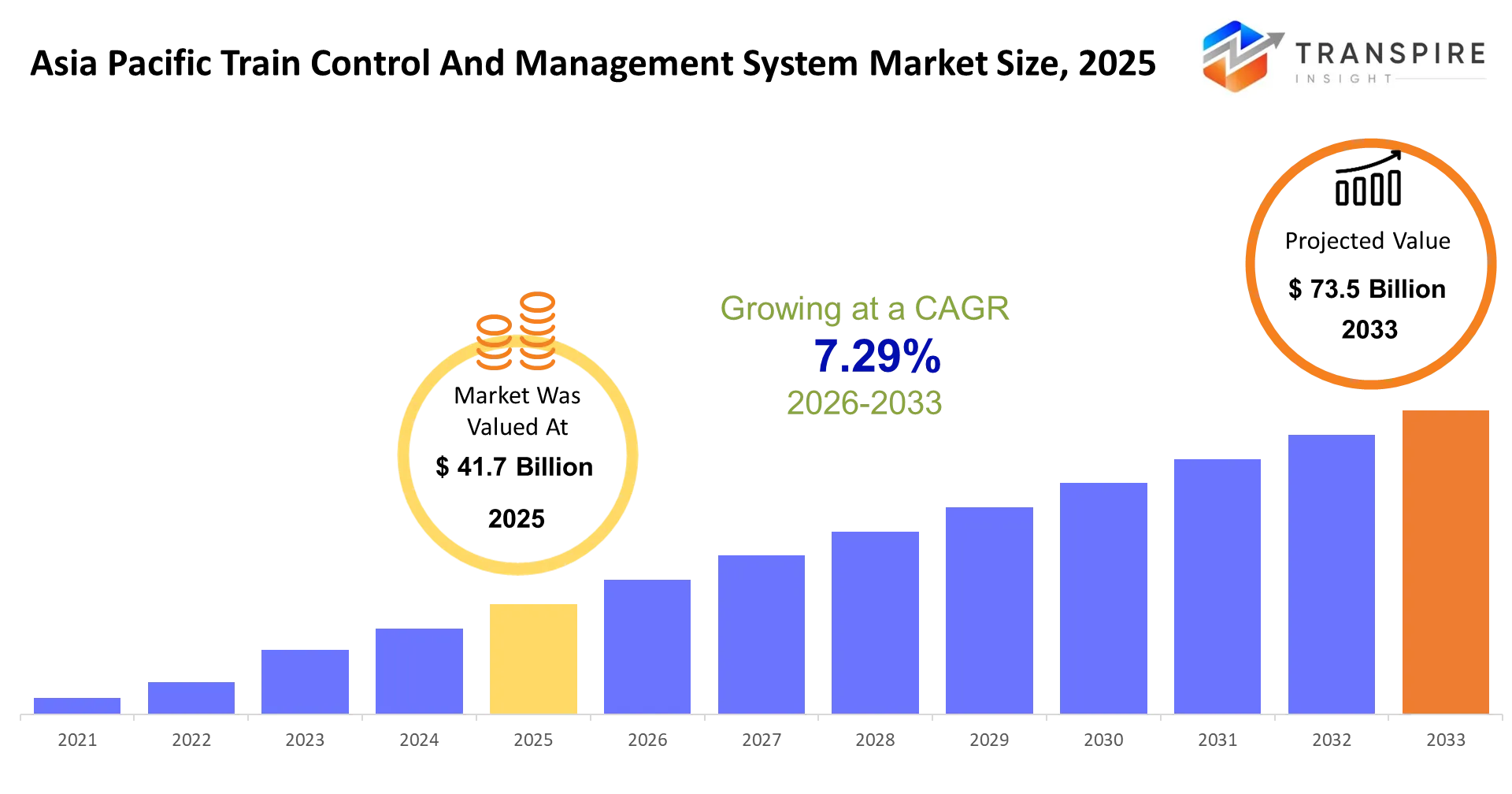
- Asia Pacific Train Control And Management System Market Size 2025: USD 41.7 Billion
- Asia Pacific Train Control And Management System Market Size 2033: USD 73.5 Billion
- Asia Pacific Train Control And Management System Market CAGR: 7.29%
- Asia Pacific Train Control And Management System Market Segments: By Type (Automatic Train Control, Positive Train Control, Communication-based Train Control, Others); By Application (Metro Systems, High-speed Rail, Freight Rail, Urban Transit, Others); By End-User (Rail Operators, Government, Infrastructure Developers, Metro Authorities, Others); By Technology (ETCS, CBTC, PTC Systems, Others)
To learn more about this report,  Download Free Sample Report
Asia Pacific Train Control And Management System Market Summary
The Asia Pacific Train Control And Management System Market was valued at USD 41.7 Billion in 2025. It is forecast to reach USD 73.5 Billion by 2033. That is a CAGR of 7.29% over the period.
The Asia Pacific Train Control and Management System (TCMS) market operates as the digital control system which manages all rail network operations for propulsion and braking and door controls and onboard system diagnostics to maintain safe and efficient train services on both metro and high-speed train systems. The system transitioned during the last five years from relay-based and fragmented controls to modern Ethernet-based digital systems which integrate with communications-based train control and maintenance systems.
The need for safer transit systems with greater capacity after the pandemic together with rapid metro development in India and Southeast Asia has driven this industry transition. The need for better safety measures together with the requirement to maintain service continuity after operational interruptions has created a need to modernize outdated train equipment. Train operators are spending money on centralized control systems which use data analytics to boost operational efficiency while decreasing maintenance costs and operational downtime.
Key Market Insights
- Asia Pacific Train Control And Management System Market Asia Pacific region will hold approximately 45 to 50 percent market share in 2025 because China Japan and India will operate their metro systems.
- Southeast Asia will experience its highest growth period during the years 2025 to 2032 because of investments in urban rail systems and the development of cross-border rail connectivity.
- India demonstrates increasing uptake of Asia Pacific Train Control And Management System Market because its metro rail network extends and its smart city projects progress.
- Onboard TCMS solutions hold the leading share at around 40%, supported by large-scale rolling stock modernization programs.
- The services segment exists as the second most important segment because maintenance contracts and software upgrades for aging rail systems drive their growth.
- Software-based TCMS platforms represent the fastest-growing segment through 2032 due to shifts toward predictive and AI-enabled rail operations.
- The metropolitan transit system and urban transportation network system together operate approximately 55 percent of service capacity because they handle both high-density city travel needs and frequent train service operations.
- The high-speed rail market expansion represents its most rapid growth segment because national rail systems develop modernization efforts while intercity rail links establish new connections.
- The Asia Pacific Train Control And Management System Market will reach its peak in 2025 because government-operated railway systems control more than 60 percent of the market.
- The private rail infrastructure operators show the fastest growth rate because they partner with public entities to expand urban transit systems.
What are the Key Drivers, Restraints, and Opportunities in the Asia Pacific Train Control And Management System Market?
The Asia Pacific Train Control And Management System Market exists because rail systems need modernization and rail systems need digital train operations which use software for control. The Chinese government together with India and Southeast Asian governments has increased its funding for metro systems and high-speed rail projects because urban areas experienced traffic problems and people faced mobility challenges after the pandemic. The adoption of integrated TCMS platforms has risen because these platforms provide instant system checks and combined system management and equipment maintenance forecasting which helps businesses to use their fleets better while reducing their total operational expenses and increasing their sales from both new system installations and system upgrades.
The main obstacle arises from the difficulties involved in implementing systems with existing rolling stock and the various standards used throughout the regional rail network. Existing fleets depend on multiple system generations which need extensive changes before they can use TCMS systems. The process results in extended certification periods together with increased initial design expenses and it creates obstacles to buying products especially for state-owned enterprises that face budget limitations. Strong project pipelines lead to revenue delays because revenues take time to develop.
The adoption of cloud-connected and AI-enabled train control ecosystems, which India uses for Dedicated Freight Corridors and China employs for its next-generation urban rail projects, creates a major business opportunity. The systems enable organizations to monitor their systems from remote locations while they perform asset optimization through predictive maintenance throughout their entire network. Pilot deployments demonstrate operational efficiency improvements, which lead to increased commercial opportunities throughout Asia Pacific Train Control And Management System Market dense urban transit networks.
What Has the Impact of Artificial Intelligence Been on the Asia Pacific Train Control And Management System Market?
Train operations in the Asia Pacific Train Control And Management System Market now operate with data-based continuous optimization instead of their previous process of reactive control. The contemporary TCMS platforms use AI algorithms for train diagnostics and for monitoring onboard subsystems which include braking systems and traction systems and door control systems while the system detects anomalies in real time to decrease the need for manual inspections. The system ensures operational stability throughout metro networks which operate at high frequencies in China and Japan and India because system reliability determines how many passengers can pass through the system.
Machine learning models increasingly help with predictive maintenance through their ability to analyze vibration and temperature and performance data which helps them predict when components will fail before breakdowns happen. Operators in the Asia Pacific Train Control And Management System Market use these insights to achieve unplanned downtime reductions between 15 and 25 percent which results in better fleet availability and maintenance scheduling efficiency. Energy optimization algorithms adjust acceleration and braking patterns which results in reduced traction power consumption throughout urban rail corridors.
The high integration costs together with the fragmented legacy rail infrastructure create obstacles for organizations which attempt to implement AI solutions across their mixed-generation fleet operations. The existence of data silos between signaling systems and rolling stock systems and operations systems decreases both model accuracy and system expansion capabilities. The current digital rail modernization programs implement AI-enabled control systems as essential upgrades for upcoming rail networks in their attempt to extend their digital capabilities.
Key Market Trends
- Legacy relay-based systems have steadily declined since 2020, replaced by Ethernet-based TCMS architectures across new metro and high-speed rail projects.
- China and India expanded digital rail control systems by over 30% since 2021 through their joint efforts which targeted large-scale urban transit infrastructure development.
- Rail operators transitioned from their previous reactive maintenance systems to new predictive maintenance systems after they experienced service disruptions which showed that manual inspections were not effective.
- In 2022, Siemens Mobility and Hitachi Rail expanded their use of modular TCMS platforms, which allow for quicker installation of modern technology onto existing train systems.
- Operators started to adopt software-defined control systems in 2023 because they required a unified approach to managing both signaling data and onboard system information.
- The Southeast Asian rail networks accelerated their acquisition of TCMS solutions after they established cross-border rail corridor agreements and implemented regional connectivity programs that started in 2022.
- The train control systems now require cybersecurity integration because organizations started to protect their digital rail systems which became a growing concern after 2021.
- Public transport authorities increasingly prefer vendor-managed lifecycle contracts which have become their main procurement method since 2020 instead of purchasing hardware through one-time transactions.
- AI-assisted diagnostics now help metro fleets to detect faults faster while decreasing unplanned downtime in major urban rail systems.
Asia Pacific Train Control And Management System Market Segmentation
By Type:
The automatic train control segment will hold a strong position in the Asia Pacific Train Control And Management System Market because rail networks across major economies will continue focusing on safer and more efficient operations. This system helps control train movement automatically, it reduces human error, and it enables better scheduling operations. The growing number of urban passengers who use public transportation will need reliable systems which can monitor their travel activities.
Positive train control will develop at a steady pace because railway companies now prioritize both collision prevention and speed control. The implementation of communication-based train control will become common in metro systems because this technology enables direct communication between trains and control centers which boosts operational efficiency. Different rail systems will use other system types to perform specialized tasks which will enable various railway networks to fulfill their technical and operational requirements.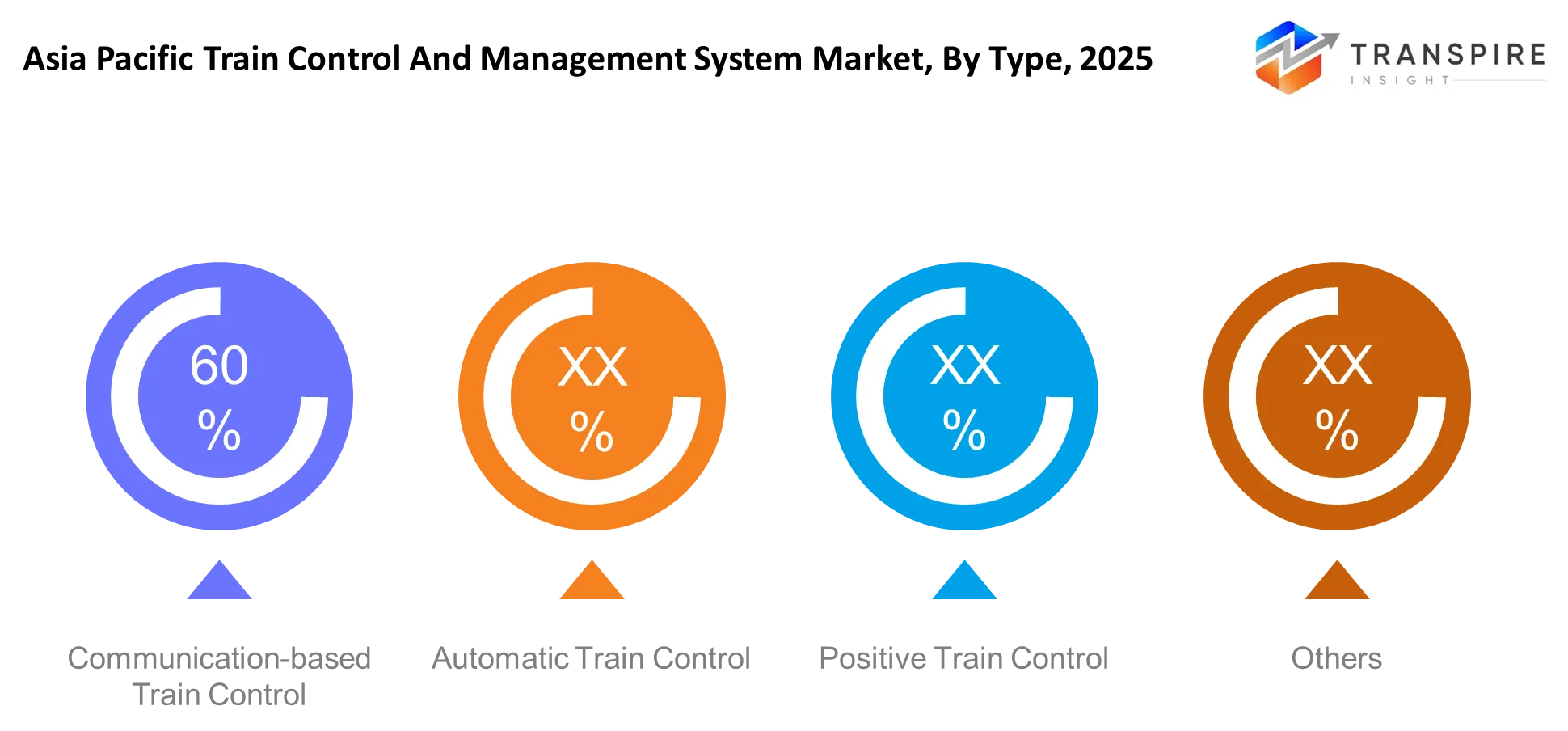
To learn more about this report, Download Free Sample Report
By Application:
The rapid urban growth across Asia Pacific cities will create a major application area for Metro systems. The expansion of public transportation infrastructure will create a need for advanced train management solutions which will enhance both track efficiency and passenger throughput. Transit operations in large metropolitan areas will undergo modernization efforts to achieve faster service times and better commuter experience.
Government investment in regional high-speed rail projects will drive advanced development of high-speed rail systems. The freight rail industry needs effective management systems to achieve better operational efficiency for cargo transportation and train scheduling. The urban transit projects and railway applications will drive market growth because transportation agencies need to enhance their operational monitoring and train network synchronization capabilities.
By End-User:
Rail operators will continue to be the primary end-user group because their operational efficiency and passenger safety requirements drive their railway performance objectives. The advanced management systems deployment will enable operators to track train movements while decreasing service interruptions and sustaining operational standards throughout their growing network of transportation routes.
The government will assume a primary role in infrastructure development and transportation improvement activities. Infrastructure developers will adopt these systems during construction of new rail projects, while metro authorities will focus on smart control solutions to handle dense passenger volumes. The regional rail networks and specialized railway systems will receive usage from other end-user groups.
By Technology:
The rail systems of the Asia Pacific region will adopt ETCS technology because they require standardization and compatible control systems. The implementation of better cross-border rail operations together with more stringent safety measures will enable wider system adoption. The technology will help operators achieve operational consistency while they manage complex railway systems. CBTC systems will experience strong market expansion because of the rising demand for automated metro systems.
The system enables real-time communication which results in better train scheduling and decreased traffic jams in heavily used urban routes. The PTC systems remain vital for safety improvement because they provide automated system operations and monitoring capabilities. Ongoing funding for these technologies will enable both passenger and freight rail systems to achieve modernization goals.
What are the Key Use Cases Driving the Asia Pacific Train Control And Management System Market?
The Asia Pacific Train Control And Management System Market depends mainly on urban metro systems and rapid transit systems as their main market application. Cities such as Shanghai and Tokyo and Delhi need their train systems to operate continuously because they experience high passenger traffic which requires exact control over traction and braking and door systems. The operational requirements of integrated TCMS systems make them necessary for maintaining both safety measures and service continuity.
The application field has grown to include high-speed rail systems and freight automation systems which both government railway operators and public-private infrastructure projects adopt. High-speed rail operations now use advanced TCMS systems to achieve long-distance signaling synchronization, while freight corridors apply this technology to enhance scheduling processes and minimize cross-border logistics delays that occur in India and China.
The latest use cases focus on using AI-powered control systems to enable both autonomous and semi-autonomous train operations. Japanese and South Korean pilot projects currently examine driver-assist automation together with remote diagnostics for unmanned metro systems.
|
Report Metrics |
Details |
|
Market size value in 2025 |
USD 41.7 Billion |
|
Market size value in 2026 |
USD 44.9 Billion |
|
Revenue forecast in 2033 |
USD 73.5 Billion |
|
Growth rate |
CAGR of 7.29% from 2026 to 2033 |
|
Base year |
2025 |
|
Historical data |
2021 - 2024 |
|
Forecast period |
2026 - 2033 |
|
Report coverage |
Revenue forecast, competitive landscape, growth factors, and trends |
|
Regional scope |
Asia Pacific (China, India, Japan, South Korea, Australia, Rest of Asia Pacific) |
|
Key company profiled |
Siemens Mobility, Alstom, Hitachi Rail, Thales, Bombardier, Wabtec, Mitsubishi Electric, Toshiba, ABB, CAF, CRRC, Hyundai Rotem, Ansaldo STS, Talgo, Knorr-Bremse |
|
Customization scope |
Free report customization (country, regional & segment scope). Avail customized purchase options to meet your exact research needs. |
|
Report Segmentation |
By Type (Automatic Train Control, Positive Train Control, Communication-based Train Control, Others); By Application (Metro Systems, High-speed Rail, Freight Rail, Urban Transit, Others); By End-User (Rail Operators, Government, Infrastructure Developers, Metro Authorities, Others); By Technology (ETCS, CBTC, PTC Systems, Others) |
Which Regions are Driving the Asia Pacific Train Control And Management System Market Growth?
The Asia Pacific Train Control And Management System Market does not include any territory that competes with China because China controls the entire market. The government-backed development of infrastructure systems has brought continuous improvements to signaling systems and onboard control systems which work on both new and old rail routes. The regulatory system requires safety measures and standardized processes and digital rail upgrades to be implemented rapidly by train control management systems across the network. The domestic supply chain which contains integrated rail technology manufacturers enables the company to maintain its dominant market position.
Japan represents a more mature and stable market which experiences growth through precision engineering standards and their proven system reliability. Rail operators focus on incremental upgrades to existing metro and high-speed rail systems instead of large-scale network additions. Rail operators make continuous investments in innovative train control systems because strict safety requirements and preventive maintenance practices drive those expenditures. The TCMS modernization process maintains steady demand because it does not experience the major market fluctuations that emerging markets encounter.
The Indian and Southeast Asian regions currently experience their most rapid growth period because multiple metro systems and new urban rail services launched after 2022. The demand for integrated train control systems increased significantly after government initiatives launched smart city programs and dedicated freight corridor development projects. Public-private partnerships are also accelerating procurement of modern signaling and TCMS platforms across multiple cities. The region provides strong expansion opportunities for market newcomers and investors until 2026–2033 because infrastructure development projects will proceed.
Who are the Key Players in the Asia Pacific Train Control And Management System Market and How Do They Compete?
The Asia Pacific Train Control And Management System Market displays a competitive market structure which shows moderate consolidation that exists between global rail technology providers and multiple regional manufacturing companies. The existing companies compete through their ability to provide advanced digital integration solutions which operators need for their interoperability and cybersecurity and lifecycle efficiency requirements. The competition between companies has increased because rail modernization programs in India and Southeast Asia create opportunities for technology-based companies that develop software-defined control systems which work with various types of rolling stock.
Siemens Mobility establishes its technological dominance by developing modular TCMS systems that function perfectly with its CBTC and signaling technologies. The company strengthens its position through long-term metro partnerships in India and China, where it supplies end-to-end digital rail ecosystems rather than standalone systems. The integrated service model enables the company to secure lifecycle contracts while generating income from continuous software upgrades.
Hitachi Rail stands out from its competitors because it possesses specialized knowledge of digital rail infrastructure and predictive maintenance systems, which it applies to high-speed rail operations. The company establishes its market presence through partnerships with Asian rail operators, which focus on fleet modernization efforts that promote energy efficiency and enable remote system monitoring.
Alstom competes through its ability to achieve system interoperability, which it combines with its established presence in metro projects throughout Southeast Asia. The company actively seeks retrofit contracts which allow fleet operators to upgrade their TCMS systems without needing to replace their entire system, thus accelerating the process of system adoption.
Company List
- Siemens Mobility
- Alstom
- Hitachi Rail
- Thales
- Bombardier
- Wabtec
- Mitsubishi Electric
- Toshiba
- ABB
- CAF
- CRRC
- Hyundai Rotem
- Ansaldo STS
- Talgo
- Knorr-Bremse
Recent Development News
In April 2026, Mitsubishi Electric launched a railway energy management proof-of-concept integrating digital analytics with rail control infrastructure. Although deployed initially in Europe, the technology strengthens Mitsubishi Electric’s train control portfolio for future Asia Pacific deployments by advancing integrated TCMS-linked energy optimization capabilities for metro and tram operators.Source https://www.mitsubishielectric.com/
In March 2026, Hitachi Rail launched its Green CBTC Next Gen platform in collaboration with SMRT Trains. The next-generation communications-based train control solution demonstrated measurable energy-efficiency gains while enhancing automated traffic management, reinforcing Asia Pacific’s shift toward digitally optimized urban rail control systems.
Source https://www.hitachirail.com/
What Strategic Insights Define the Future of the Asia Pacific Train Control And Management System Market?
The Asia Pacific Train Control And Management System Market is moving toward software-only systems which will operate through cloud-based rail control systems because of urban growth and the development of autonomous rail systems. The next 5 to 7 years will see digital signaling systems together with AI-powered predictive maintenance and fleet control systems which enable operators to manage intricate rail networks that handle high traffic volumes through reduced operational disruptions and decreased overall expenses.
National rail networks face a concealed danger because they heavily depend on outdated integration systems which hinder the process of establishing standardized TCMS platforms. The system creates a long-lasting danger of system separation because it uses incompatible components which restrict system expansion and create security vulnerabilities especially in international rail initiatives.
The development of edge-based AI control systems presents a major opportunity to establish these technologies in India and Southeast Asia through newly constructed metro systems which currently lack-established legacy systems. The deployment of complete digital systems from the beginning in these environments helps organizations achieve better operational results while decreasing expenses for system updates. Market participants need to focus on creating TCMS architectures which use modular components that can work with both existing systems and new systems because this flexibility will help them win contracts and expand operations to different regions.
Asia Pacific Train Control And Management System Market Report Segmentation
By Type
- Automatic Train Control
- Positive Train Control
- Communication-based Train Control
By Application
- Metro Systems
- High-speed Rail
- Freight Rail
- Urban Transit
By End-User
- Rail Operators
- Government
- Infrastructure Developers
- Metro Authorities
By Technology
- ETCS
- CBTC
- PTC Systems
Frequently Asked Questions
Find quick answers to common questions.
The Asia Pacific Train Control And Management System Market size is USD 73.5 Billion in 2033.
Key Segments for the Asia Pacific Train Control And Management System Market are By Type (Automatic Train Control, Positive Train Control, Communication-based Train Control, Others); By Application (Metro Systems, High-speed Rail, Freight Rail, Urban Transit, Others); By End-User (Rail Operators, Government, Infrastructure Developers, Metro Authorities, Others); By Technology (ETCS, CBTC, PTC Systems, Others).
Major Asia Pacific Train Control And Management System Market Players are Siemens Mobility, Alstom, Hitachi Rail, Thales, Bombardier, Wabtec, Mitsubishi Electric, Toshiba, ABB, CAF, CRRC, Hyundai Rotem, Ansaldo STS, Talgo, Knorr-Bremse.
The Current Asia Pacific Train Control And Management System Market size is USD 41.7 Billion in 2025.
The Asia Pacific Train Control And Management System Market CAGR is 7.29% from 2026 to 2033.
- Siemens Mobility
- Alstom
- Hitachi Rail
- Thales
- Bombardier
- Wabtec
- Mitsubishi Electric
- Toshiba
- ABB
- CAF
- CRRC
- Hyundai Rotem
- Ansaldo STS
- Talgo
- Knorr-Bremse
Recently Published Reports
-
Apr 2026
ATV & UTV Market
ATV & UTV Market Size, Share & Analysis Report By Type (ATV, and UTV), By Variants (Less Than 400 CC, 400 CC To 800 CC, and More Than 800 CC), and Geography (North America, Europe, Asia-Pacific, Middle East and Africa, South and Central America), 2021 - 2031
-
Apr 2026
Automotive Central Gateway Module Market
Automotive Central Gateway Module Market Size, Share & Analysis Report By Type (Ethernet Central Gateway Module, CAN Central Gateway Module, LIN Central Gateway Module, and FlexRay), By Application (Powertrain Control, Body Control, Infotainment System, Advanced Driver Assistance Systems (ADAS), and Others), By End User (Passenger Vehicles, and Commercial Vehicles), and Geography (North America, Europe, Asia-Pacific, Middle East and Africa, South and Central America), 2021 - 2031
-
Apr 2026
Automotive Engine Oil Filter Market
Automotive Engine Oil Filter Market Size, Share & Analysis Report By Filter Type (Fuel Filter, Engine Oil Filter, Hydraulic Oil Filter, and Others), By Filter Media (Cellulose, Synthetic, and Micro), By Sales Channel (OEMs, and Aftermarket), By Vehicle Type (Passenger Cars, Light Commercial Vehicles, Heavy Duty Trucks, Buses and Coaches, and Off-road Vehicles), and Geography (North America, Europe, Asia-Pacific, Middle East and Africa, South and Central America), 2021 - 2031
-
Apr 2026
Automotive Parts Aluminium Die Casting Market
Automotive Parts Aluminium Die Casting Market Size, Share & Analysis Report By Production Process (Pressure Die Casting, Vacuum Die Casting, Squeeze Die Casting, Gravity Die Casting), By Application (Body Parts, Engine Parts, Transmission Parts, Battery And Related Components, Other Application Types), and Geography (North America, Europe, Asia-Pacific, Middle East and Africa, South and Central America), 2021 - 2031
Our Clients