Asia Pacific Telematics Control Unit Market Size & Forecast:
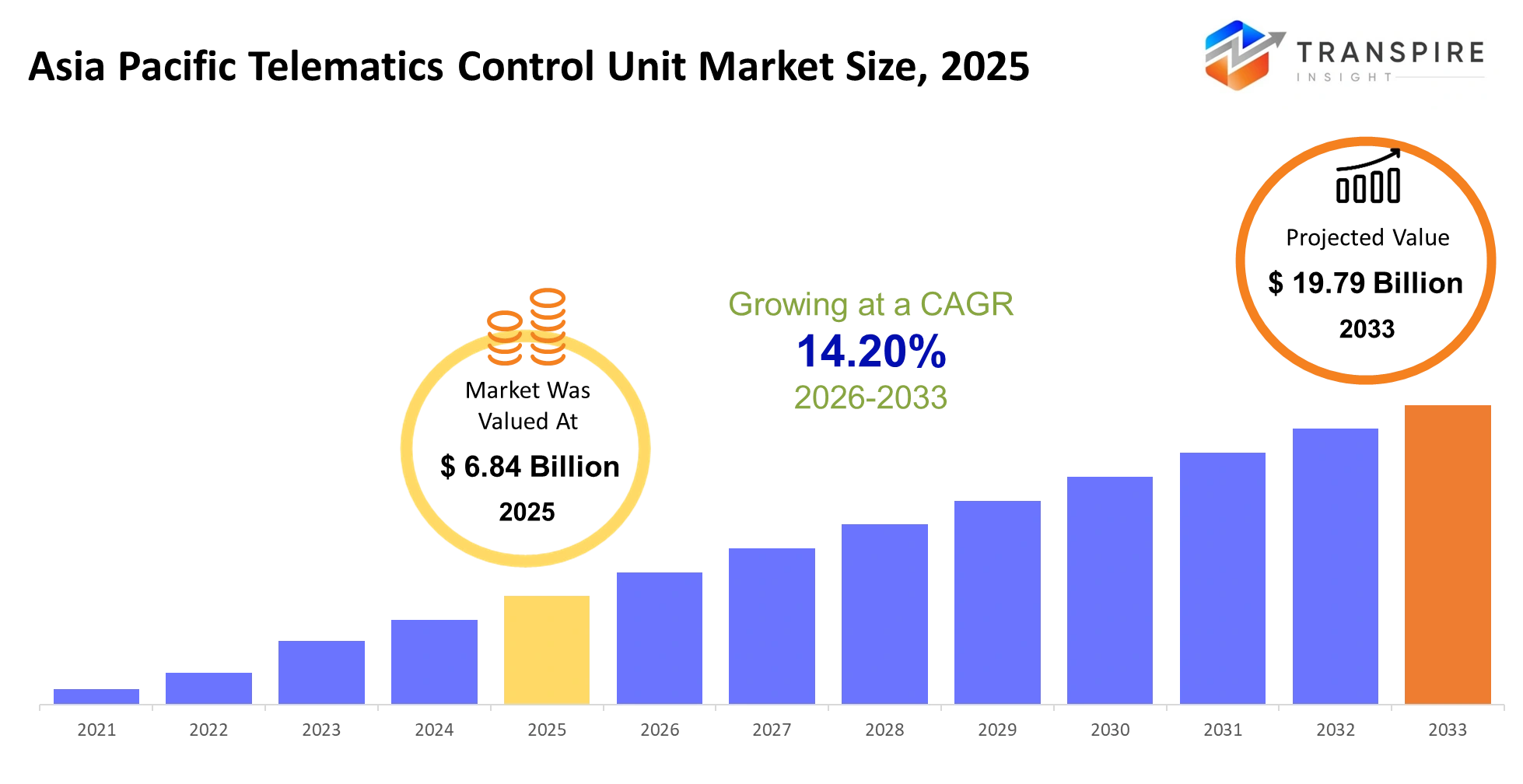
- Asia Pacific Telematics Control Unit Market Size 2025: USD 6.84 Billion
- Asia Pacific Telematics Control Unit Market Size 2033: USD 19.79 Billion
- Asia Pacific Telematics Control Unit Market CAGR: 14.20%
- Asia Pacific Telematics Control Unit Market Segments: By Type (Embedded TCU, Integrated TCU, Standalone TCU, Others); By Application (Vehicle Tracking, Fleet Management, Emergency Assistance, Navigation, Others); By End-User (Automakers, Fleet Operators, Logistics Companies, Insurance Firms, Others); By Connectivity (4G LTE, 5G, Satellite, Others).
To learn more about this report,  Download Free Sample Report
Asia Pacific Telematics Control Unit Market Summary
The Asia Pacific Telematics Control Unit Market was valued at USD 6.84 Billion in 2025. It is forecast to reach USD 19.79 Billion by 2033. That is a CAGR of 14.20% over the period.
Telematics control units function as digital drivers that enable fleet operators and logistics providers and mobility platforms to track vehicle location and engine performance and driving habits and remote vehicle diagnostics. The system provides essential functions which help companies improve their delivery operations while decreasing their equipment downtime and supporting their implementation of usage-based insurance and predictive maintenance solutions for their fleet operations throughout Asia Pacific.
The market has undergone a fundamental transformation during the past three to five years because organizations now prefer software-defined systems which maintain continuous network connectivity through cloud systems and 4G and 5G mobile networks. The automotive industry faced two major challenges because supply chain disruptions resulting from the pandemic and semiconductor shortages forced manufacturers to change their sourcing methods while they focused on developing modular TCU systems. The combination results in faster implementation because both OEMs and fleet operators see connectivity as essential for their operations which improves asset usage and reduces operational expenses in their growing urban mobility and e-commerce delivery systems.
Key Market Insights
- China holds the largest share of the Asia Pacific Telematics Control Unit Market with its 38% share that will reach this level by 2025 because of its extensive electric vehicle and smart transportation systems.
- Japan and South Korea maintain strong adoption, focusing on premium connected cars and advanced driver assistance integration.
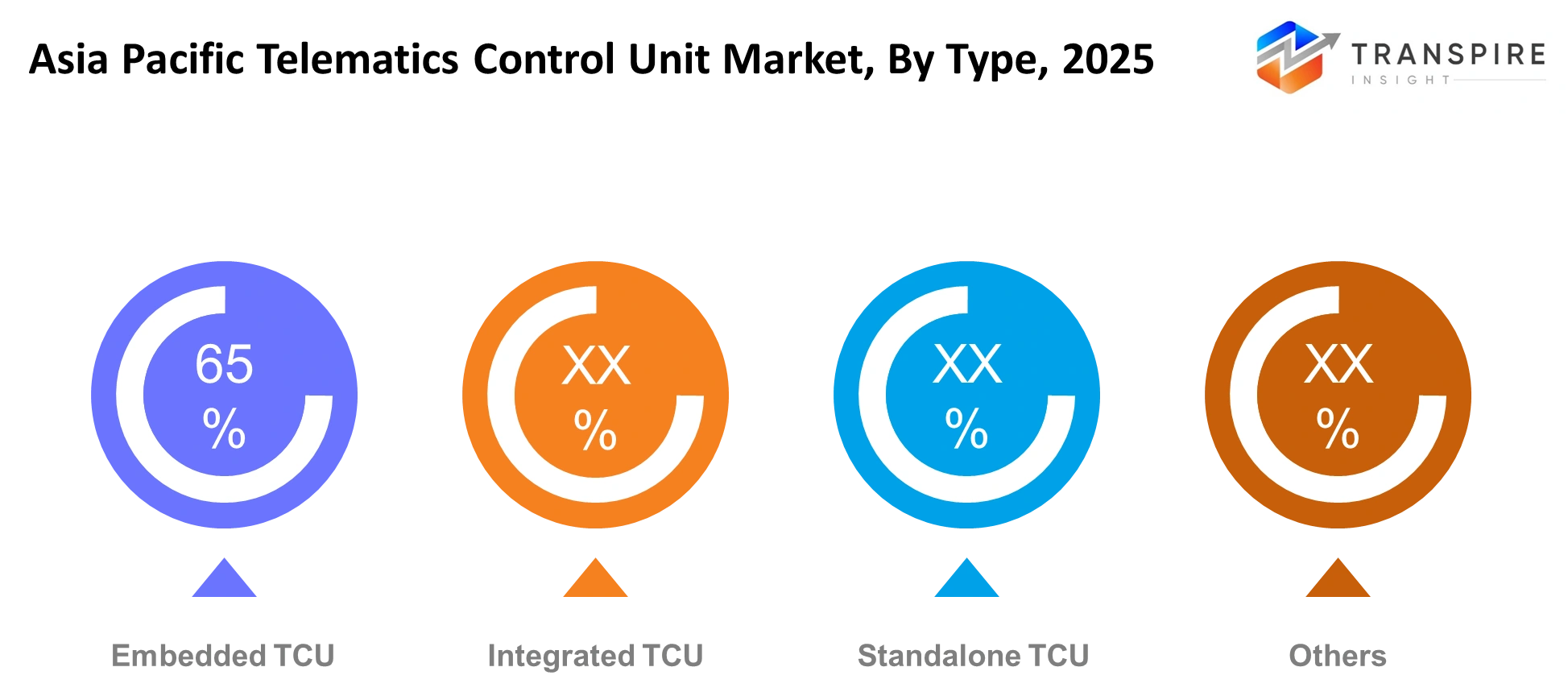
- OEM factory-fit connectivity integration supports embedded telematics control units, which currently dominate the market with approximately 45% share.
- Hybrid TCU systems hold the second-largest share due to flexible connectivity across passenger and commercial vehicles.
- The market for 5G-enabled TCUs will experience its strongest growth until 2030 because these devices deliver ultra-low latency and meet the need for real-time data transmission.
- The Asia Pacific Telematics Control Unit Market sees Fleet management control almost 40 percent of market share because of logistics optimization requirements.
- The fastest-growing application in the market is usage-based insurance which expands through data-driven pricing models and partnerships between insurers.
- Vehicle tracking maintains its status as a highly demanded application which all commercial transport networks use.
- E-commerce and logistics expansion drive commercial vehicle operators to become the main end-user group which adopts new technologies.
- Original equipment manufacturers now provide connected services as standard features which causes the passenger vehicle market to experience rapid expansion.
What are the Key Drivers, Restraints, and Opportunities in the Asia Pacific Telematics Control Unit Market?
The urgent requirement for connected vehicle mandates together with 5G network deployment across China and Japan plus South Korea functions as the main factor driving this development. The agencies together with the original equipment manufacturers (OEMs) established real-time vehicle monitoring systems to achieve three primary goals which included safety protection and emissions control and fleet operational management. The automotive manufacturers see embedded telematics control units as essential parts of their products because they need to create connected vehicles which will become standard equipment in future vehicle models. The company generates additional income through hardware sales while also earning from ongoing software and data service agreements.
The main obstacle arises from the high requirement to obtain semiconductor components and sophisticated electronic parts. The Asia Pacific Telematics Control Unit Market experiences supply chain challenges because TCUs depend on specialized chipsets and secure communication features for their operation. The components exist at risk from worldwide supply changes and extended delivery times. The production constraint results in slower vehicle manufacturing processes together with postponed major fleet upgrades which hinders immediate revenue generation even though demand stays strong.
The most significant opportunity lies in the expansion of electric and software-defined vehicles in Southeast Asia and India. The original equipment manufacturers (OEMs) are increasingly incorporating AI-powered telematics systems into their electric vehicle fleets which they use for ride-hailing services and logistics operations within urban centers like Bengaluru and Jakarta. The system establishes an expandable framework which enables predictive equipment maintenance and energy usage optimization and real-time fleet operations analysis to drive future market development.
What Has the Impact of Artificial Intelligence Been on the Asia Pacific Telematics Control Unit Market?
Artificial intelligence and advanced digital technologies are transforming telematics control unit systems to function as intelligent decision-making systems which replace their previous role as basic data transmitters. AI-based automation continuously tracks engine performance and scrubber operations and fuel consumption and emission standards in both connected fleet systems and marine emission control systems. The system enables real-time operational adjustments which enhance tracking accuracy of regulatory requirements because it decreases manual inspection needs across both vessels and commercial vehicle fleets.
Machine learning models are increasingly applied to predictive maintenance, where telematics data identifies early signs of component degradation in control units, exhaust gas cleaning technology, and powertrain systems. Operators can decrease unplanned downtime by 15 to 25 percent while they achieve better fuel efficiency through optimized routing and load management. AI-based emissions forecasting also supports compliance planning, allowing operators to adjust operations before breaching regulatory limits, particularly in stricter Asian port zones.
The maritime and cross-border logistics sectors face a major obstacle because of their inability to maintain consistent standards for training data which includes both quality and volume. Model accuracy suffers and complete deployment progress slows down because at-sea connectivity problems and incomplete sensor connections exist throughout different fleet systems. The Asia Pacific Telematics Control Unit Market experiences increased system reliability with ongoing investments in edge computing and onboard processing technology which also supports market growth in this region.
Key Market Trends
- China moved from using aftermarket telematics systems to adopting OEM embedded systems, which achieved 40% active connectivity in 2025.
- India implemented fleet digital transformation because of 2022 logistics changes, which resulted in more last-mile delivery companies adopting telematics systems.
- Japan began using 5G telematics systems in 2024, which enabled better vehicle performance tracking and maintenance management for commercial vehicle fleets.
- South Korea developed AI vehicle monitoring systems, while insurance companies started using telematics information to create usage-based insurance pricing systems.
- Continental AG and Bosch dedicated their resources to TCU software development after 2023, which enabled them to generate revenue through data services instead of hardware product sales.
- Southeast Asian fleet companies started using predictive maintenance systems, which helped them decrease unexpected vehicle failures by 20% during their 2025 implementations.
- China implemented stricter emissions monitoring regulations, which resulted in heavy-duty transportation companies adopting advanced telematics systems.
- The rise of electric vehicles since 2023 changed telematics design requirements, which led LG Electronics and DENSO Corporation to develop energy efficiency features.
- The semiconductor supply chain disruptions between 2022 and 2023 required TCUs to be redesigned as modular systems, which resulted in better upgradeability and system functionality through different operational periods.
Asia Pacific Telematics Control Unit Market Segmentation
By Type :
Your knowledge base covers information until the month of October in the year 2023. The TCU segment which exists as an integrated component enables vehicles to use their factory-installed systems for real-time data transmission and vehicle diagnostic purposes. The connected car trend together with original equipment manufacturer integration methods creates strong demand which enhances communication between vehicle systems and external platforms across all passenger and commercial vehicle types.
The integrated TCU solution combines multiple telematics functions into a single module which enables manufacturers to achieve better system performance and reduced operational expenses. The standalone TCU solution enables aftermarket installation together with flexible deployment across various vehicle types which helps telematics systems to expand their presence in new and existing vehicles throughout the Asia Pacific Telematics Control Unit Market.
To learn more about this report, Download Free Sample Report
By Application :
The vehicle tracking application enables users to monitor the location and movement of vehicles at all times which results in enhanced security and operational control together with improved asset tracking capabilities. Commercial transport networks are increasingly implementing fleet management systems which enable their logistics and service-based transportation operations to achieve better scheduling and fuel efficiency and optimized route planning.
Emergency assistance applications enable drivers to achieve better safety results through their ability to detect crashes and send automatic alerts while managing rapid response operations. Navigation applications provide users with improved driving guidance and route optimization capabilities. The additional applications of insurance telematics together with driver behavior analysis and connected mobility services extend their reach across multiple transportation and mobility ecosystems.
By End-User :
Automakers use telematics control units to build connected vehicle systems which provide digital functions while meeting regulatory needs and enabling real-time vehicle tracking. Fleet operators use telematics systems to improve operational monitoring, vehicle utilization, and maintenance scheduling across commercial transportation and mobility service operations.
Logistics companies use telematics control units to track shipments, coordinate deliveries, and enhance route efficiency. Insurance firms adopt usage-based insurance models supported by driving behavior data. Other end users include mobility providers, government transport systems, and aftermarket telematics solution providers expanding connected vehicle adoption.
By Connectivity :
4G LTE connectivity remains widely deployed because established infrastructure provides stable coverage at cost-effective rates. The system delivers reliable telematics performance for various connected vehicles because it has strong data transmission capabilities which power navigation services and vehicle diagnostics and fleet communication functions.
5G connectivity improves ultra-low latency communication which enables vehicle-to-everything applications and real-time data transmission. Satellite connectivity enables operations in remote areas because terrestrial networks are insufficient, providing telematics coverage for extended transportation routes and logistics activities and cross-border mobility systems.
What are the Key Use Cases Driving the Asia Pacific Telematics Control Unit Market?
The Asia Pacific Telematics Control Unit Market has its main use case which drives market growth through fleet management which enables logistics operators and commercial transport companies to use real-time tracking and route optimization together with driver behavior monitoring for fuel cost reduction and delivery efficiency improvements.
The industry uses telematics to create both usage-based insurance products and remote diagnostics systems which apply to commercial vehicle fleets and premium passenger cars. In South Korea and Japan insurance companies now use telematics data to develop better pricing models while OEMs use connected diagnostics to decrease warranty expenses and enhance their aftersales support operations.
The industry now develops AI systems which help electric fleets conduct predictive maintenance and heavy-duty vehicles track their emissions compliance through integrated technology. Urban logistics centers in India and Southeast Asia are adopting these systems because regulatory enforcement and electric vehicle adoption create a need for advanced telematics solutions which maintain continuous operational capability.
|
Report Metrics |
Details |
|
Market size value in 2025 |
USD 6.84 Billion |
|
Market size value in 2026 |
USD 7.81 Billion |
|
Revenue forecast in 2033 |
USD 19.79 Billion |
|
Growth rate |
CAGR of 14.20% from 2026 to 2033 |
|
Base year |
2025 |
|
Historical data |
2021 - 2024 |
|
Forecast period |
2026 - 2033 |
|
Report coverage |
Revenue forecast, competitive landscape, growth factors, and trends |
|
Regional scope |
Asia Pacific (India, China, Japan, Australia,South Korea, Rest of Asia Pacific) |
|
Key company profiled |
Bosch, Continental, Harman, Denso, Visteon, LG Electronics, Panasonic, Qualcomm, Telit, Sierra Wireless, Huawei, ZTE, Ericsson, Nokia, Samsung. |
|
Customization scope |
Free report customization (country, regional & segment scope). Avail customized purchase options to meet your exact research needs. |
|
Report Segmentation |
By Type (Embedded TCU, Integrated TCU, Standalone TCU, Others); By Application (Vehicle Tracking, Fleet Management, Emergency Assistance, Navigation, Others); By End-User (Automakers, Fleet Operators, Logistics Companies, Insurance Firms, Others); By Connectivity (4G LTE, 5G, Satellite, Others). |
Which Regions are Driving the Asia Pacific Telematics Control Unit Market Growth?
China dominates the Asia Pacific Telematics Control Unit Market because it operates extensive automotive manufacturing facilities while its government actively promotes intelligent connected vehicle technology. The implementation of telematics systems has become essential for all vehicle types because strict emissions control and road safety regulations require their use. The 5G network infrastructure provides advanced support for real-time data transfers and enables vehicle-to-cloud connections. The established ecosystem, which includes original equipment manufacturers and semiconductor manufacturers and software developers, allows China to maintain its market leadership in the regional industry.
China demonstrates stronger stability through its advanced automotive engineering capabilities and ongoing dedication to automated mobility development. The country’s gradual but consistent rollout of connected vehicle regulations ensures steady adoption rather than rapid spikes. Japanese automakers design their hybrid and premium vehicles to maintain high precision and reliability through telematics control unit systems. The OEMs and technology providers maintain strong partnerships, which create a coordinated value chain that enables Japan to function as a stable revenue source for the Asia Pacific telematics market.
India has become the fastest-growing region because of its expanding logistics network and various government programs that support vehicle digitization and fleet tracking compliance. The implementation of mandatory telematics for commercial transportation together with the expansion of e-commerce delivery networks has resulted in increased user adoption of the system. Fleet operators can now achieve scalable connectivity through infrastructure enhancements which include extended 4G networks and initial 5G deployment. The growth path of India between 2026 and 2033 will create significant growth opportunities for investors and market newcomers who focus on economical telematics solutions that operate through aftermarket channels and built-in systems.
Who are the Key Players in the Asia Pacific Telematics Control Unit Market and How Do They Compete?
The market for telematics control units in the Asia Pacific region displays moderate market consolidation which established Tier-1 automotive suppliers control while software and connectivity companies start to enter the market. The existing companies maintain their market position through their complete OEM system integration and their certified automotive-grade products and their extended supply agreements. The competitive landscape now depends on software capabilities which include 5G connectivity and cybersecurity protections and AI-driven fleet analytics. Price competition remains active in the aftermarket market but businesses now determine their future market position through technology partnerships and ecosystem development.
Robert Bosch GmbH gains market power through its modular telematics control units which enable AI-based vehicle diagnostics platforms to work directly with OEM production. The company develops predictive maintenance capabilities which help decrease fleet downtime while creating new partnerships with European and Asian automotive manufacturers. Continental AG focuses its business activities on developing telematics systems which operate through software and provide subscription-based connected services to customers. DENSO Corporation uses its established relationships with Japanese OEMs to incorporate telematics technology into hybrid and electric vehicle systems which strengthens its position as a leader in dependable automotive electronic systems.
HARMAN International differentiates itself through its connected cockpit system and its infotainment-based telematics solutions which deliver real-time vehicle data services to drivers. LG Electronics expands its business operations through the delivery of 5G communication hardware and electric vehicle telematics solutions which South Korean automotive manufacturers use to develop their connected electric vehicle fleets. ZF Friedrichshafen AG develops commercial fleet telematics systems which work with advanced driver-assistance technology to enhance its market presence in India and Southeast Asia through direct partnerships with mobility companies.
Company List
- Bosch
- Continental
- Harman
- Denso
- Visteon
- LG Electronics
- Panasonic
- Qualcomm
- Telit
- Sierra Wireless
- Huawei
- ZTE
- Ericsson
- Nokia
- Samsung
Recent Development News
In December 2025, Blue Cloud Softech Solutionsannounced a strategic MoU with ConnectM Technology Solutions. The companies agreed to jointly develop a semiconductor-based EdgeAI system-on-chip designed for automotive cybersecurity, specifically targeting deployment in telematics control units (TCUs) and other connected vehicle systems. This development strengthens secure, AI-enabled TCU architectures for software-defined vehicles across Asia Pacific.
Source: https://scanx.trade/
In January 2026, Visteon Corporation and Mahindra & Mahindraunveiled the next-generation SmartCore™ Pro cockpit domain controller platform for upcoming Mahindra SUV models. The system integrates advanced cockpit electronics, ADAS visualization, and telematics capabilities into a unified domain controller, enhancing in-vehicle connectivity and real-time data processing for the India and broader Asia Pacific automotive market.
Source: https://www.visteon.com/
What Strategic Insights Define the Future of the Asia Pacific Telematics Control Unit Market?
The Asia Pacific Telematics Control Unit Market will undergo a complete transformation toward software-defined mobility systems which will maintain continuous connectivity during the upcoming 5 to 7 years. The combination of 5G networks with vehicle fleets that operate on electric power and new digital compliance standards which major APAC countries enforce drives this shift. The function of telematics control units has progressed from basic hardware tracking systems to complete edge computing systems which enable organizations to make timely operational choices for their logistics systems and passenger transport operations and industrial transportation systems.
The growing dependence on certain major global Tier-1 vendors and chipset manufacturers creates a dangerous threat which organizations must face. The organization becomes exposed to two major risks because it depends on suppliers who control pricing and through which they obtain their necessary components which includes semiconductor products and cybersecurity products.
The emerging opportunity involves establishing artificial intelligence-based telematics systems within electric commercial vehicle fleets throughout Southeast Asia with Indonesia and Vietnam serving as primary markets because they implement government-supported urban mobility initiatives which advance electric vehicle logistics pilots. The space becomes available for advanced energy optimization systems which use predictive technology together with systems which coordinate fleet operations through autonomous capabilities. The construction of software-upgradable telematics architectures which enable fleet operators to meet changing regulatory needs and intelligence specifications should become the main focus for market participants instead of developing static hardware systems.
Asia Pacific Telematics Control Unit Market Report Segmentation
By Type
- Embedded TCU
- Integrated TCU
- Standalone TCU
By Application
- Vehicle Tracking
- Fleet Management
- Emergency Assistance
- Navigation
By End-User
- Automakers
- Fleet Operators
- Logistics Companies
- Insurance Firms
By Connectivity
- 4G LTE
- 5G
- Satellite
Frequently Asked Questions
Find quick answers to common questions.
The Asia Pacific Telematics Control Unit Market size is USD 19.79 Billion in 2033.
Key segments for the Asia Pacific Telematics Control Unit Market are By Type (Embedded TCU, Integrated TCU, Standalone TCU, Others); By Application (Vehicle Tracking, Fleet Management, Emergency Assistance, Navigation, Others); By End-User (Automakers, Fleet Operators, Logistics Companies, Insurance Firms, Others); By Connectivity (4G LTE, 5G, Satellite, Others).
Major Asia Pacific Telematics Control Unit Market players are Bosch, Continental, Harman, Denso, Visteon, LG Electronics, Panasonic, Qualcomm, Telit, Sierra Wireless, Huawei, ZTE, Ericsson, Nokia, Samsung.
The Asia Pacific Telematics Control Unit Market size is USD 6.84 Billion in 2025.
The Asia Pacific Telematics Control Unit Market CAGR is 14.20% from 2026 to 2033.
- Bosch
- Continental
- Harman
- Denso
- Visteon
- LG Electronics
- Panasonic
- Qualcomm
- Telit
- Sierra Wireless
- Huawei
- ZTE
- Ericsson
- Nokia
- Samsung
Recently Published Reports
-
Apr 2026
ATV & UTV Market
ATV & UTV Market Size, Share & Analysis Report By Type (ATV, and UTV), By Variants (Less Than 400 CC, 400 CC To 800 CC, and More Than 800 CC), and Geography (North America, Europe, Asia-Pacific, Middle East and Africa, South and Central America), 2021 - 2031
-
Apr 2026
Automotive Central Gateway Module Market
Automotive Central Gateway Module Market Size, Share & Analysis Report By Type (Ethernet Central Gateway Module, CAN Central Gateway Module, LIN Central Gateway Module, and FlexRay), By Application (Powertrain Control, Body Control, Infotainment System, Advanced Driver Assistance Systems (ADAS), and Others), By End User (Passenger Vehicles, and Commercial Vehicles), and Geography (North America, Europe, Asia-Pacific, Middle East and Africa, South and Central America), 2021 - 2031
-
Apr 2026
Automotive Engine Oil Filter Market
Automotive Engine Oil Filter Market Size, Share & Analysis Report By Filter Type (Fuel Filter, Engine Oil Filter, Hydraulic Oil Filter, and Others), By Filter Media (Cellulose, Synthetic, and Micro), By Sales Channel (OEMs, and Aftermarket), By Vehicle Type (Passenger Cars, Light Commercial Vehicles, Heavy Duty Trucks, Buses and Coaches, and Off-road Vehicles), and Geography (North America, Europe, Asia-Pacific, Middle East and Africa, South and Central America), 2021 - 2031
-
Apr 2026
Automotive Parts Aluminium Die Casting Market
Automotive Parts Aluminium Die Casting Market Size, Share & Analysis Report By Production Process (Pressure Die Casting, Vacuum Die Casting, Squeeze Die Casting, Gravity Die Casting), By Application (Body Parts, Engine Parts, Transmission Parts, Battery And Related Components, Other Application Types), and Geography (North America, Europe, Asia-Pacific, Middle East and Africa, South and Central America), 2021 - 2031
Our Clients