
Asia Pacific Sugar Market Size & Forecast:
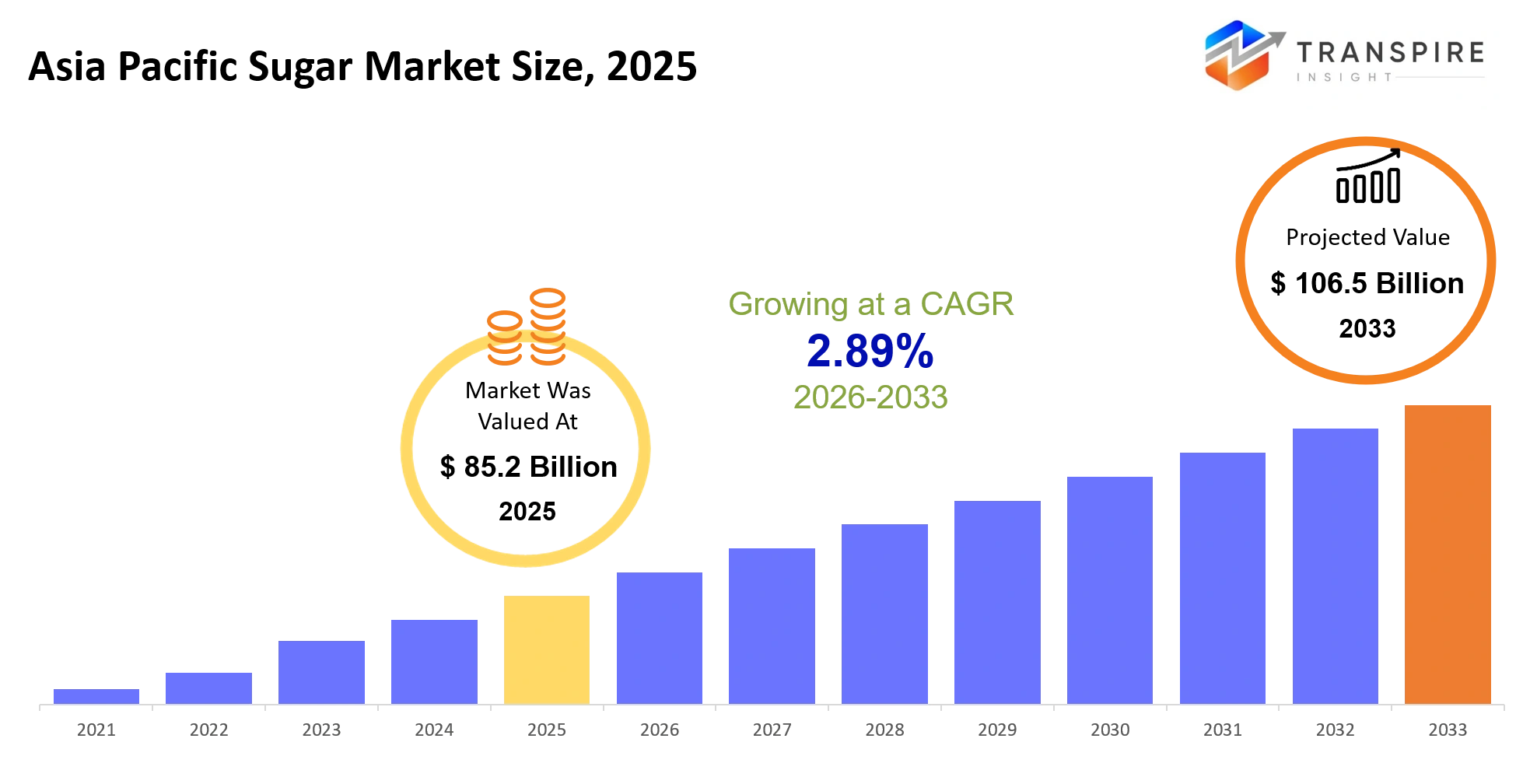
- Asia Pacific Sugar Market Size 2025: USD 85.2 Billion
- Asia Pacific Sugar Market Size 2033: USD 106.5 Billion
- Asia Pacific Sugar Market CAGR: 2.89%
- Asia Pacific Sugar Market Segments: By Type (White Sugar, Brown Sugar, Raw Sugar, Liquid Sugar, Organic Sugar, Specialty Sugar, Others); By Source (Sugarcane, Sugar Beet, Others); By Application (Food & Beverages, Bakery, Confectionery, Pharmaceuticals, Others); By Distribution Channel (Industrial Sales, Retail Sales, Online Retail, Others).
Asia Pacific Sugar Market Summary
The Asia Pacific Sugar Market was valued at USD 85.2 Billion in 2025. It is forecast to reach USD 106.5 Billion by 2033. That is a CAGR of 2.89% over the period.
The enterprise data management market in Asia Pacific is structurally evolving toward independent AI-orchestrated data environments in which governed, integrated, and analytically processing occur simultaneously in a continuous process. This trend is accelerated by the growth in cloud migrations and by increasing cross-border data regulations and the desire within companies to convert disparate operational data into decision-making intelligence in real-time across all industries. Over the next five to seven years, requirements will increasingly shift to an environment of embedded AI governance using data fabric architecture rather than stand-alone storage and integration solutions.
A more obscure trend is vendor consolidation where hyperscale cloud providers may in fact gain control over the majority of enterprise data flows thereby lowering an enterprise's bargaining leverage and increasing its dependence. An opportunity arises with "sovereign AI data platforms" in Southeast Asia, wherein governments are starting to require local intelligence systems within their financial and public sectors.The opportunity and obligation of participants is to focus on cross-cloud capable, compliant architecture that offers flexibility for low-latency, regionally deployable systems.
Key Market Insights
- Nearly 55% combined market share will be contributed by India and Thailand to the Asia Pacific Sugar Market in 2025 backed by the extensive capacity for sugarcane cultivation and export-oriented refining infrastructure.
- Indonesia is expected to emerge as the fastest developing sugar consuming market from 2024 to 2030 led by its booming packaged food & beverage manufacturing.
- Around 60% of the Asia Pacific Sugar Market will continue to be represented by the refined sugar segment driven by the extensive demand by the processed food industry.
- Raw sugar is expected to be the second largest segment followed by industrial refining centers in Thailand & Australia which drive its demand significantly.
- The fastest growing segment will be specialty sugars like low calorie and organic variants owing to an increasingly growing product reformation trend led by health concerns.
- Bakery and confectionery applications are anticipated to exhibit robust growth on account of the changing lifestyle in cities and the rise in income in the regions of Southeast Asia.
- The top end-user segment will be the food processing companies with an estimated 65% consumption share in 2025.
- Retail and household consumption will also continue to grow with the rise in penetration of packaged sugar in urban and semi urban sectors.
- The top players such as Wilmar International, Cargill, Tate & Lyle, Szucker and COFCO are scaling up their refining capacity and engaging in sustainable raw material procurement strategies.
- The companies are building robust competitive positions through supply chain integration, investing in development of bio based sweeteners and strategic expansion in demand prone southeast Asia markets.
What are the Key Drivers, Restraints, and Opportunities in the Asia Pacific Sugar Market?
The growth driver of the Asia Pacific Sugar Market is increasing demand from the food and beverage sector due to expansion and urbanization in these industries leading to increasing demand for sugar as an ingredient. High purchase volume is accounted for by the manufacturers in India, Indonesia and Thailand that is to be contributed by scale of manufacture for packaged food across all the urban areas. This drives an increase in refinery output and long-term contracts supply flow, providing the whole regional sugar value chain stable income.
One of the most considerable restraints is climate variability resulting in fluctuating sugarcane supply owing to uneven and untimely monsoon cycles in important sugarcane producing countries. This structural bottleneck makes production yield unpredictable and inconsistent supply in important producing countries such as India and Thailand which are heavily dependent on monsoon rains for agriculture. Food and beverage processors have to face price volatility, supply shortages, shrink in profitability and delay in long-term capital investment in refineries.
An important opportunity in the market is rise in biomass based ethanol production in Southeast Asia countries particularly Indonesia and Thailand due to governments increasing the ethanol blending ratio to utilize more sugarcane for production. Increase in investment in renewable fuel infrastructure to facilitate sugar producers to diversify sources of revenue and improve earnings stability from the volatility of food products.
What Has the Impact of Artificial Intelligence Been on the Asia Pacific Sugar Market?
AI is slowly changing operational efficiencies throughout the Asia Pacific sugar value chain, optimizing on-farm decisions, refinery automation, and logistics efficiency. Within sugarcane agriculture, AI is assisting farmers with accurate crop status monitoring, soil moisture analysis and irrigation needs through satellite imaging and sensor technology allowing for efficient harvest timing and less waste. Machine learning models within refineries have been implemented to optimize crystallization, boiling and separation operations to maintain stable yields and decrease energy costs.
Predictive modeling is now being used to optimize cane yield, factory throughput, and machinery upkeep in milling equipment. This approach aims to reduce unscheduled downtime due to early wear identification and could result in 10-15% improved uptime within digitally sophisticated operations. Furthermore, AI demand forecasting optimizes warehouse management within the distributive and retail sectors, preventing losses in storage and better distribution management.
Despite these advances, costs and data fragmentation amongst small and medium sugar mills slow adoption due to high implementation costs and poor real-time digital infrastructure in many factories.
Key Market Trends
- Between 2020 and 2025, sugar production was driven by an increase in the higher-efficiency mills, boosting recovery rates in Thailand and India by approximately 8-10% regionally.
- Since 2022, Indonesia imports for sugar has been steadily increasing due to lower domestic production in meeting with increased demand of processed food manufacturing industry.
- By 2025, Beverage Manufacturers' product reformulated for reduced sugar intensity per unit by approximately 12% across major APAC urban markets.
- Since 2023, Wilmar International's expansion of integrated refining business to cater for upstream cane supply and regional price volatility.
- Between 2021 and 2026, India increased ethanol blending mandate, resulting in diversion of about 25% of Sugarcane production to biofuel production.
- Since 2024, the increasing consumer demand of health concern product driven demand for specialty sugar rose sharply among major players to produce low glycemic and organic variants.
- By 2025, Southeast Asia Bakery & Confectionary industry's procurement agreements for sugar was raised due to increased consumption for packaged food driven by urbanization trend.
- Since 2023, Australian and Thailand exporters have adjusted their trade strategy towards long-term agreements for suppliers, in an attempt to minimise exposure of volatile international sugar market trends.
- Between 2022 and 2026, COFCO continued its expansion of refining and distribution in China to ensure domestic supply security under strong consumption pressure.
- Since 2021, consumer retail packaging of sugar has adjusted to smaller unit sizes, due to household consumption behavior adapting to portion controlled purchases.
Asia Pacific Sugar Market Segmentation
By Type:
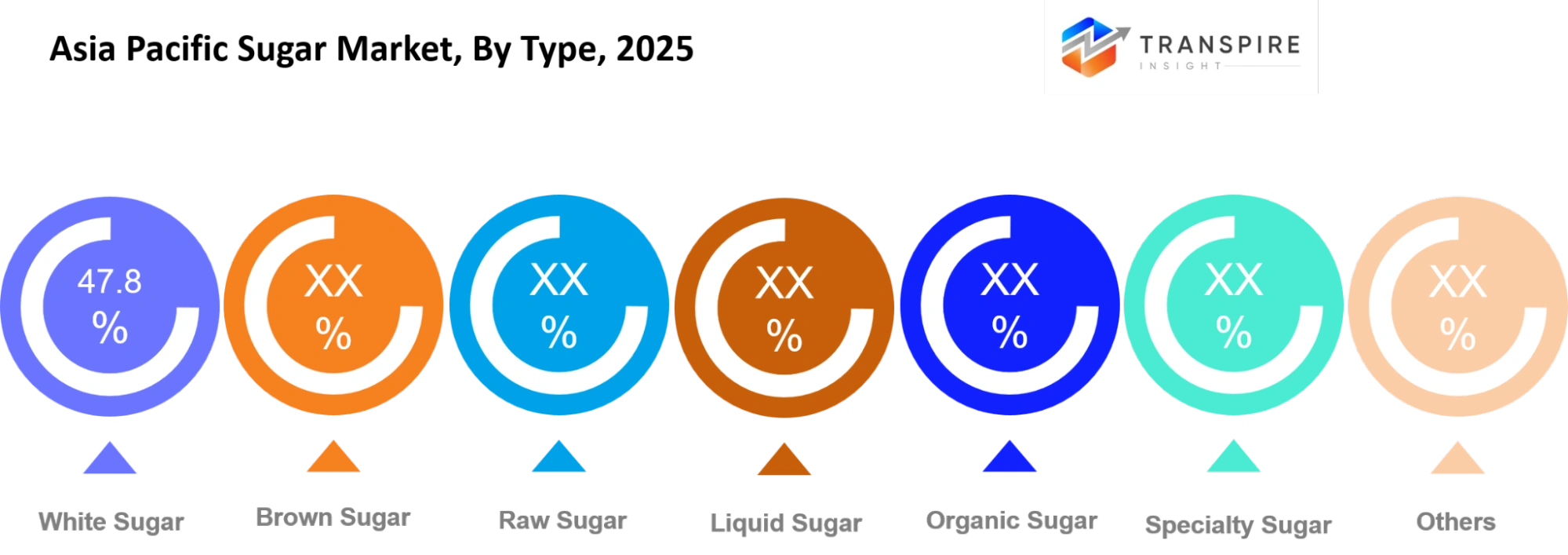
White sugar, brown sugar, raw sugar, liquid sugar, organic sugar, specialty sugar and so on type-structure the Asia Pacific Sugar Market. The white sugar will continue to maintain steady consumption and will still be high due to its reasonable cost and wide usage in processed food and daily consumption. The brown and raw sugar will also continue to be a part of the consumption of both industrial and traditional needs within the food preparation processes.
With changes in consumption habits, there is a growing trend toward the types like specialty sugar and organic sugar in consumer choices. The manufacturers are also increasingly focusing on developing the liquid sugar for beverages and the usage of it in the industrial food processing industries due to the efficient benefit they can obtain from it. The growing consumption toward healthiness are also boosting the solid growth for alternative types of sugar throughout Asia Pacific Sugar Market in all urban markets.
By Source:
Sources: sugarcane, sugar beet and minor sources form the basic supply structure in the Asia Pacific Sugar Market. Sugarcane is dominant among all kinds of sugar sources due to the climate suitability in India, Thailand and South East Asia countries. The sugar beet is also produced in specific locations which use controlled farming techniques, and the range of such types is limited.
In the passage of time, the sugar cane as an important source has increased its supply proportion, as its higher efficiency in production as compared to others, and better availability of farming infrastructure and practices. The sugarcane supply varies with seasonal rainfall among big production countries; hence producers are increasingly trying to enhance yield production.
By Application:
Food and beverages, bakery, confectionery, pharmaceutical and others represent application demand in the Asia Pacific Sugar Market. Food and beverage is still the biggest application as the usage in processed food products and sweet beverages is broad. Bakery and confectionary industries are still having high volume consumption.
The application trend is changing as the sugar content is being revised based on eating habits. The pharmaceutical segment is being grown in the Syrup and medicine form. The industrial food processor is also re-formulating its food products so there will be controlled and optimized sugar usage in the Asia Pacific Sugar Market.
By Distribution Channel:
Industrial sales, retail sales, online retail and others comprise the distribution structure of Asia Pacific Sugar Market. Industrial sales will be highest due to buying in huge volume from food industries and beverage companies. Household consumption will sustain on account of retail sales covering urban and rural areas.
Distribution patterns will change in line with organized retail and online channels gaining popularity. Industrial sales of sugar contracts will increase at a steady growth rate for economies of scale and assured supply chain. Simultaneously, retail packages are likely to shift to small packages based on changing purchasing attitudes in the Asia Pacific Sugar Market.
What are the Key Use Cases Driving the Asia Pacific Sugar Market?
The primary application for the Asia Pacific Sugar Market is packaged food and beverage manufacturing. Sugar has an indispensable role to play in the manufacture of dairy products, beverages, sauces and ready to eat food products by adding to the texture, sweetening, preservative and uniformity of the food product. Bulk food processors constitute a higher demand since they produce in high quantities over a longer term of time.
The production of confectionary and bakery products is a growing application for the sugar market across Southeast Asia and India, on account of rising popularity and consumption of premium packaged snacks and bakery items. High consumption rates of chocolates and other confectionery products on occasions contribute to a greater demand for sugar from food manufacturers. Pharmaceutical companies add sugar in the form of chewable tablets, syrups and pediatric formulations.
Emerging applications include biofuels and specialty nutrition products. Bioethanol production is now in demand from various government fuel-blending programs (especially from India) which has brought into a new application for sugarcane. Health conscious sweetening products or organic sweeteners have long-term growth potential across premium health and wellness products.
|
Report Metrics |
Details |
|
Market size value in 2025 |
USD 85.2 Billion |
|
Market size value in 2026 |
USD 87.7 Billion |
|
Revenue forecast in 2033 |
USD 106.5 Billion |
|
Growth rate |
CAGR of 2.89% from 2026 to 2033 |
|
Base year |
2025 |
|
Historical data |
2021 - 2024 |
|
Forecast period |
2026 - 2033 |
|
Report coverage |
Revenue forecast, competitive landscape, growth factors, and trends |
|
Regional scope |
Asia Pacific (India, China, Japan, Australia, South Korea, Rest of Asia Pacific) |
|
Key company profiled |
Wilmar International, Mitr Phol, Thai Roong Ruang, COFCO, Shree Renuka Sugars, Balrampur Chini, EID Parry, Tongaat Hulett, Nordzucker, Tereos, Südzucker, Cargill, ADM, Yunnan Yingmao, Guangxi Guitang. |
|
Customization scope |
Free report customization (country, regional & segment scope). Avail customized purchase options to meet your exact research needs. |
|
Report Segmentation |
By Type (White Sugar, Brown Sugar, Raw Sugar, Liquid Sugar, Organic Sugar, Specialty Sugar, Others); By Source (Sugarcane, Sugar Beet, Others); By Application (Food & Beverages, Bakery, Confectionery, Pharmaceuticals, Others); By Distribution Channel (Industrial Sales, Retail Sales, Online Retail, Others). |
Which Regions are Driving the Asia Pacific Sugar Market Growth?
India dominates the Asia Pacific Sugar Market thanks to the country's massive sugarcane base, a well-developed milling network and a robust policy framework supporting both the sugar and the ethanol sectors. Factors such as the implementation of a minimum support pricing mechanism and ethanol blending programs are seen to provide stability to producers and foster long-term investments. A diverse ecosystem comprising millions of farmers, various cooperatives, mills and exporting agencies contributes to a cohesive supply chain and helps maintain steady production volumes. This infrastructure will ensure that India will remain a formidable force in both domestic consumption and regional trade over the forecast period.
Thailand takes second place; but its market influence will likely be maintained by its robust export capacity. Contrary to India's sheer volume, Thailand depends on its highly developed export infrastructure, a sound trading system throughout Asia and reliable policy frameworks to manage its production and trade volumes in an organized manner. A predictable supply network with constant regulatory support for its agriculture industry ensures consistent production and export volumes and also a continuous income stream for its farmers, which benefits international trade revenue.
Southeast Asia, particularly Indonesia and Vietnam, exhibits the greatest growth potential. The growth story will be driven by burgeoning food processing activities, an expanding consumer base and a policy-driven push for strengthening the country's domestic agriculture industry. An influx of investment into sugar refining and logistics capabilities will provide new opportunities for sugar farmers, traders and exporters alike in the region between 2026-2033, and create exciting investment opportunities for anyone looking for market entry.
Who are the Key Players in the Asia Pacific Sugar Market and How Do They Compete?
With an oligopoly made up of large, vertically integrated international agribusinesses and smaller regional companies, the Asian Pacific Sugar Market can be described as moderately consolidated. This market segment competition is most intensely focused on the ability to secure necessary raw materials, production efficiency, supply chain management, and geographic coverage. Large corporations utilize vertical integration in order to defend market share, while regional firms achieve a similar goal through strength in local sourcing and specialization. Efficient cost management is extremely important given the sensitivity of profits to fluctuation in the yields of sugarcane and global commodity prices.
Wilmar International utilizes a business model heavily integrated across farming and plantation operations, processing, refining and a worldwide distribution network in order to maintain production efficiencies and ensure a reliable supply chain across the various Asian economies. Cargill concentrates on securing raw materials through the supply chain, leveraging a deep knowledge of industry best practices, and maintaining strong, long-term relations with their target industries such as food and beverage manufacturers. COFCO maintains considerable advantage over the Chinese market and the company continually invests in expanding its refining and distribution capacities in an attempt to further secure the domestic supply chain.
Tate & Lyle stands out from other competitors by providing innovative and specialized solutions in sweetening products to food manufacturers looking for unique formulations. Adzucker makes use of an integrated production system and knowledge of sugar processing, in addition to the capacity to create value-added ingredients, to serve the most specialized applications for the industries it supplies. Companies throughout this region continue to expand through refining, sustainability efforts, alliances, and participation in specialty and value-added segments that allow for larger profit margins than those present in the bulk sugar sector.
Company List
- Wilmar International
- Mitr Phol
- Thai Roong Ruang
- COFCO
- Shree Renuka Sugars
- Balrampur Chini
- EID Parry
- Tongaat Hulett
- Nordzucker
- Tereos
- Südzucker
- Cargill
- ADM
- Yunnan Yingmao
- Guangxi Guitang
Recent Development News
In June 2026, Ingredion announced acquisition of Tate & Lyle for approximately £2.7 billion. The transaction will strengthen specialty sweetener and food ingredient capabilities, creating a larger platform serving food and beverage manufacturers across Asia Pacific and other global markets.
Source: https://www.theguardian.com/
In March 2026, GAIL (India) Limited secured an investment partnership with TruAlt Bioenergy through a ₹130 million investment in Leafiniti Bioenergy. The funding supports expansion of compressed biogas projects linked to sugarcane and bioenergy value chains, strengthening diversification opportunities for sugar producers.
Source: https://energetica-india.net/
What Strategic Insights Define the Future of the Asia Pacific Sugar Market?
Asia Pacific Sugar Market trends toward a diversified value chain where revenue increases are more dependent on processed food ingredients, biofuels and specialty sweetening products, as opposed to bulk sugar sales. This transition will occur as there is increased competition for sugarcane feedstock between food use and energy use, especially as Brazil, China and India implement increased ethanol blending, and as a result, expand cultivation of sugarcane. Over the next 5 to 7 years producers able to manage and diversify this conflicting use stream should be well positioned to manage margin risks and prices.
A secondary risk is the increasing concentration of the market supply in the few areas of climate sensitive production regions of the world. Water scarcity, and water stress and climate events can cause supply shocks that current projections fail to accurately reflect.
A rising opportunity is within Southeast Asia where the market is developing a bio-based chemical industry. Sugar feedstocks may attract industrial demand in these areas. Investment in flexible processing capacity that may swing from food to fuel to industrial use is prudent.
Asia Pacific Sugar Market Report Segmentation
By Type
- White Sugar
- Brown Sugar
- Raw Sugar
- Liquid Sugar
- Organic Sugar
- Specialty Sugar
By Source
- Sugarcane
- Sugar Beet
By Application
- Food & Beverages
- Bakery
- Confectionery
- Pharmaceuticals
By Distribution Channel
- Industrial Sales
- Retail Sales
- Online Retail
Frequently Asked Questions
Find quick answers to common questions.
The Asia Pacific Sugar Market size is USD 106.5 Billion in 2033.
Key segments for the Asia Pacific Sugar Market are By Type (White Sugar, Brown Sugar, Raw Sugar, Liquid Sugar, Organic Sugar, Specialty Sugar, Others); By Source (Sugarcane, Sugar Beet, Others); By Application (Food & Beverages, Bakery, Confectionery, Pharmaceuticals, Others); By Distribution Channel (Industrial Sales, Retail Sales, Online Retail, Others).
Major Asia Pacific Sugar Market players are Wilmar International, Mitr Phol, Thai Roong Ruang, COFCO, Shree Renuka Sugars, Balrampur Chini, EID Parry, Tongaat Hulett, Nordzucker, Tereos, Südzucker, Cargill, ADM, Yunnan Yingmao, Guangxi Guitang.
The Asia Pacific Sugar Market size is USD 85.2 Billion in 2025.
The Asia Pacific Sugar Market CAGR is 2.89% from 2026 to 2033.
- Wilmar International
- Mitr Phol
- Thai Roong Ruang
- COFCO
- Shree Renuka Sugars
- Balrampur Chini
- EID Parry
- Tongaat Hulett
- Nordzucker
- Tereos
- Südzucker
- Cargill
- ADM
- Yunnan Yingmao
- Guangxi Guitang
About the Authors

Chetan Dhatrak
I’m Chetan Dhatrak, a Senior Research Analyst at Transpire Insight, specializing in the Consumer Goods, Foods and Beverages industry. I focus on analyzing market trends, consumer behavior, competitive landscapes, and industry developments to deliver accurate, data-driven insights. My research at Transpire Insight is built on credible sources and in-depth analysis, helping businesses and readers better understand market dynamics, emerging opportunities, and evolving consumer preferences. I’m committed to creating reliable, well-researched content that supports informed decision-making and reflects the latest developments in the consumer goods and food & beverage sectors.

Chakradhar Khansole
Chakradhar serves as the Research Director at Transpire Insight, bringing over 8 years of experience in technology, innovation, and strategic market intelligence. He specializes in transforming complex market data into actionable business insights that enable organizations to make informed, growth-oriented decisions. Recognized for his strategic vision and analytical expertise, Chakradhar leads high-impact research initiatives, delivering comprehensive market assessments, competitive intelligence, and forward-looking industry analysis.
Recently Published Reports
-
Apr 2026
Baby Infant Formula Market
Baby Infant Formula Market Size, Share & Analysis Report By ype (Infant Milk, Follow On Milk, Specialty Baby Milk, Growing-Up Milk), By Ingredient (Carbohydrate, Fat, Protein, Minerals, Vitamins, and Others), By Product Form (Powder, Liquid, and Ready-to-feed), By Distribution Channels (Supermarket/Hypermarket, Specialty Store, Pharmacies, Online Retail, and Others), and Geography (North America, Europe, Asia-Pacific, Middle East and Africa, South and Central America), 2021 - 2031
-
Apr 2026
Edible Insects for Animal Feed Market
Edible Insects for Animal Feed Market Size, Share & Analysis Report By Type (Insect Powder, Insect Meal, Insect Bar, Insect Paste, Insect Oil, and Others), By Insect Type (Beetles, Cricket, Caterpillar, Hymenoptera, Orthoptera, Tree Bugs, and Others), By Application (Livestock, Pet Food, and Aquaculture), By Livestock Type (Poultry, Swine, and Others), and Geography (North America, Europe, Asia-Pacific, Middle East and Africa, South and Central America), 2021 - 2031
-
Apr 2026
Food Industry Disinfection and Bacterial Control Market
Food Industry Disinfection and Bacterial Control Market Size, Share & Analysis Report By Type (Chemical Disinfectants, Physical Disinfectants, and Biocides and Antimicrobials), By Application (Food Processing Equipment Surface Disinfection, Food Preparation Areas Surface Disinfection, Storage Areas Surface Disinfection, Anti-microbial Coatings Food Preservation, and Preservative Solutions Food Preservation), By End User (Meat and Poultry Processing, Dairy Processing, Seafood Processing, Bakery and Confectionery, Restaurants and Commercial Kitchens, and Food Service Providers), By Sales Channel (Online, Offline), and Geography (North America, Europe, Asia-Pacific, Middle East and Africa, South and Central America), 2021 - 2031
-
May 2026
Freeze Dried Food Market
Freeze Dried Food Market Size, Share & Analysis Report By Product Type (Fruits, Vegetables, Freeze-Dried Dairy Products, Freeze-Dried Meat and Seafood, Freeze-Dried Pet Food, and Prepared Meal), By Nature (Organic, and Conventional), By Form (Powdered, Granules, and Diced), By End Use (Breakfast Cereals, Dairy Products, Bakery & Confectionery, Nutritional Bars & Supplements, Powdered Beverages, Snacks, and Retail (Household)), and Geography (North America, Europe, Asia-Pacific, Middle East and Africa, South and Central America), 2021 - 2031