
Asia Pacific Smart Retail Market Summary
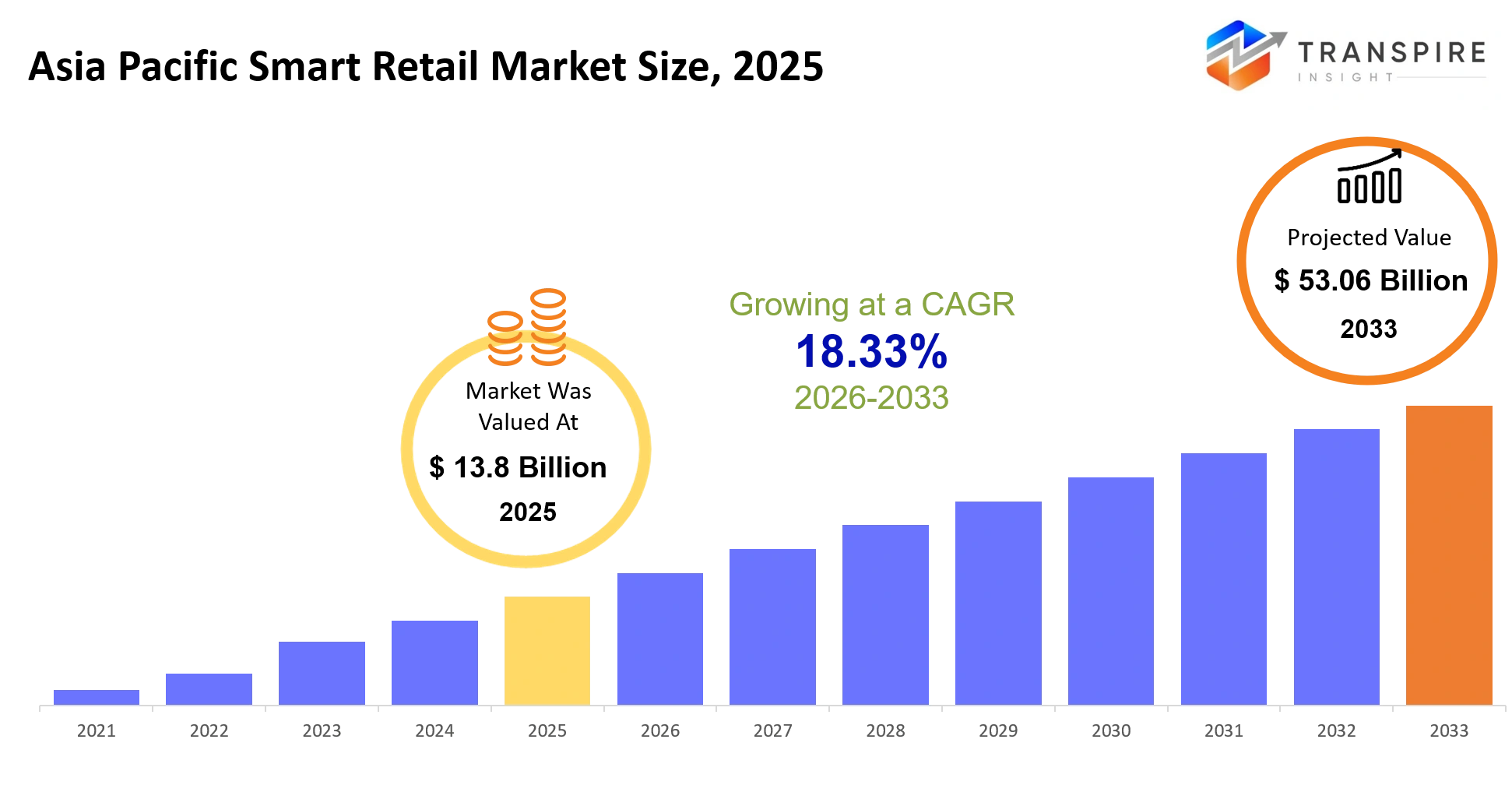
As per Transpire Insight Analysis the Asia Pacific Smart Retail Market size is estimated at USD13.8 Billion in 2025 and is anticipated to reach USD 53.06 Billion by 2033, growing at a CAGR of 18.33% from 2026 to 2033.
The Asia Pacific Smart Retail Market helps retailers kind of improve how stores run by mixing connected technologies with real-time data, so they can keep inventory in check, speed up the checkout process, tailor customer interaction, and cut down on those annoying operational inefficiencies. In practice, smart retail solutions allow companies to react quicker to shifting consumer behavior, and in the same breath improve product availability , pricing correctness, and the whole in-store feel across supermarkets , convenience stores, department stores, and specialty retail formats.
Over the last five years the market moved away from standalone digital tools , and it is now leaning toward a more joined-up AI enabled retail environment, where physical stores are linked with online commerce platforms. The pandemic really pushed this shift along, because it showed the weak spots of labor heavy operations , and it made it clear how much value there is in contactless shopping and automated inventory control. As retailers pour money into cloud platforms, computer vision tools, IoT sensors, and better analytics, day to day operational decisions are getting much more data led. That more general shift is helping profitability, by trimming operating expenses, tightening inventory accuracy, and boosting customer dedication, and all of this is nudging adoption beyond the usual big established retail chains, all the way toward newer regional players too.
Asia Pacific Smart Retail Market Size & Forecast:
- Asia Pacific Smart Retail Market Size 2025: USD 13.8 Billion
- Expected Market Value 2033: USD 53.06 Billion
- Forecast CAGR: 18.33%
- Leading region in 2025: China
- Fastest Growing region: India
- Key Profile: Amazon, Alibaba, Microsoft, IBM, SAP, Oracle, Cisco, Huawei, NCR Voyix, Toshiba Global Commerce Solutions, Zebra Technologies, Honeywell, Intel, Fujitsu, Samsung SDS.
Key Market Insights
- China kind of dominated the market, with about 42% market share in 2025, and it was backed by huge AI retail deployments plus a lot of investment in smart store stuff.
- India, on the other hand, is expected to keep being the fastest-growing regional market in 2025–2033 , mainly because organized retail keeps expanding and digital payment adoption stays strong.
- In the product and service parts, smart payment systems took the lead , with roughly 34% market share in 2025, powered by common contactless and mobile payment integration everywhere.
- Electronic shelf labels ended up in the second spot, as retailers pushed harder on real-time pricing and inventory synchronization across supermarket brands.
- Retail analytics platforms are likely to see the quickest growth through 2033, helped by rising demand for predictive merchandising and customer behavior insight.
- For applications, supermarkets and hypermarkets were the biggest piece, around 39% market share in 2025, largely because automated checkout and inventory optimization technologies kept improving.
- Convenience stores are forecast to become the fastest-growing application during 2025–2033 , supported by smaller autonomous retail formats rolling out across urban areas.
- On ownership, large retail enterprises accounted for nearly 61% market share in 2025, which really shows their higher investment capacity for integrated smart retail infrastructure.
- Meanwhile, small and medium-sized retailers are set to grow the fastest end-user group through 2033, since cloud-based platforms reduce the implementation costs, and well that matters.
What are the Key Drivers, Restraints, and Opportunities in the Asia Pacific Smart Retail Market?
The strongest driver behind market expansion seems to be the rapid uptake of AI enabled retail automation, especially once digital commerce starts moving faster and cloud deployment costs drop, a bit more than expected. Retailers now more often link inventory, pricing, payments, and customer analytics all through one single platform, instead of leaving each piece in separate silos. This technological shift in a practical sense shortens replenishment cycles, reduces on hand gaps, and nudges conversion rates upward .When decisions happen faster it boosts store productivity, and that flows into higher revenue across supermarkets, department stores and convenience retail formats.
The largest restraint is more like the complexity of integrating older retail infrastructure with these newer digital platforms. Big retailers often run several software environments, so they may need costly upgrades before automation can even scale. Smaller retailers get squeezed even more, because the implementation cost stays high compared to operating margins. Based on a Transpire Insight review of regional procurement announcements and launch schedules, supply chain concentration keeps showing up as the main execution risk. Also, limited availability of advanced sensors, and imaging hardware can delay deployments, which then reduces revenue realization and pushes new smart store launches to later dates.
The most promising opportunity seems to sit in AI-driven autonomous retail, which is backed by edge computing and five G connectivity. There s momentum in cashierless formats and in smart shelf monitoring, plus the use of digital twins, and it continues to ramp up across China, India, South Korea, and some parts of Southeast Asia. Retailers are stitching together computer vision with predictive analytics, so they can tailor the promotions to different shoppers and also fine tune how product is placed. Over time, these moves should unlock better operating efficiency, yet they will also create fresh recurring revenue paths via retail software, along with analytics services, and that s the big idea.
What Has the Impact of Artificial Intelligence Been on the Asia Pacific Smart Retail Market?
Artificial intelligence along with digital tools are kind of reshaping how retail works across Asia Pacific, mostly because they link brick and mortar shops with smart automation platforms that feel more “always on”. Instead of humans sitting there watching everything, AI cameras, smart shelves, and computer vision systems keep scanning inventory levels, customer movement and checkout behavior, pretty much non stop. On top of that, lots of retailers lean on automated compliance tools to make sure pricing stays right, shelf availability looks correct, and promotions actually run as planned across different store sites.
Then machine learning kicks in, where models look at buying habits, seasonal swings and even local consumer tastes, so the whole planning process feels smoother and spoilage is reduced sooner, before any shortage really starts. Predictive analytics also helps with demand estimates, replenishment timing, and even workforce scheduling which means quicker operational choices and better product availability. Overall the checkout moves faster, inventory accuracy gets better, operating costs can drop, and customers seem more engaged thanks to personalized recommendations.
All of it is also reinforced by cloud based analytics, since sales, logistics, and customer data get brought into one place through unified operational dashboards. Still, even with all these advantages, broad AI rollout is held back by expensive integration work, patchy older retail systems, and uneven data quality from one regional market to another. Smaller retailers in particular run into connectivity limitations and they often have not much technical know how, so adoption of these advanced intelligent retail platforms moves slowly, even while the tech expenses continue sliding down.
Key Market Trends
- From 2023 to 2025, AI powered cashierless places popped up more, across bigger metro regions, and it did help with faster exits at the counter, plus it generally made day to day operations smoother.
- Retailers started pushing electronic shelf label rollouts even faster in 2024, so pricing could change in real time, and promotions became kind of centralized, for whole store groups.
- After 2023, computer vision showed up in a much stronger way, which boosted inventory accuracy, loss prevention methods, and even traffic insights for organized retail, like a clearer picture of what shoppers actually do.
- In a lot of enterprise setups during 2024–2025, cloud native retail platforms replaced older legacy software, and that made things more scalable, and it helped with multi store administration, too.
- Digital twin tech started feeling more strategic too, letting retailers kind of run through store layouts and merchandising outcomes before anything is actually put in place or launched, like this dry run , without the whole mess.
- Alibaba Cloud kept pushing its AI retail services across Asia Pacific, and it also strengthened predictive demand estimates plus more precise inventory tuning for regional retailers even when local conditions shift around.
- Through 2025, collaborations between tech vendors and supermarket chains grew more frequent, speeding up the smart checkout experience, IoT sensor use, and analytics platforms—more tools, less friction.
- Meanwhile edge computing took more ground in city based retail, lowering processing delays for computer vision tasks, and it improved those near real time customer insights, right when they matter.
- And sustainability efforts encouraged retailers to bring in AI driven energy control systems, which reduced electricity use , while also keeping operational performance on track across smart stores.
Asia Pacific Smart Retail Market Segmentation
By Component :
Hardware kind of holds a major role here, since sensors, cameras, smart shelves, kiosks, and payment terminals are basically the base for connected retail. Software keeps growing too, mainly through retail management platforms that handle inventory control, pricing, customer engagement, and store analytics, you know. And then services stay just as important because consulting, deployment, maintenance, and technical support all help retailers run these advanced digital systems without things falling apart.
In general, IoT platforms connect devices and keep generating ongoing operational data, so retailers can make better decisions across different locations. AI solutions keep pushing forward with demand forecasting, customer insights, and automated store management using data-driven intelligence. Cloud solutions also support scalability, lower infrastructure costs, and allow centralized management for multiple stores, while other supporting technologies cover specialized operational needs that don’t quite fit the “main” bucket.
By Technology :
Artificial intelligence can push technology adoption along by supercharging automation, making forecasting better , tweaking pricing approaches, and basically shaping more individualized shopping moments for customers. At the same time, IoT makes it possible for connected devices to talk in near real time, so retailers can keep an eye on inventory, machinery, and even store conditions with higher precision. Then RFID, well it helps with faster inventory monitoring, and it also strengthens product sightlines across both warehouses and retail locations.
Computer vision strengthens cashier-less shopping, customer behavior analysis, and shelf monitoring by using fast image recognition. Big data analytics turns huge amounts of operational information into usable business insights, for planning and inventory optimization. AR/VR supports interactive shopping experiences and employee training, and other technologies keep showing up to enhance those more specialized retail functions.
By Application :
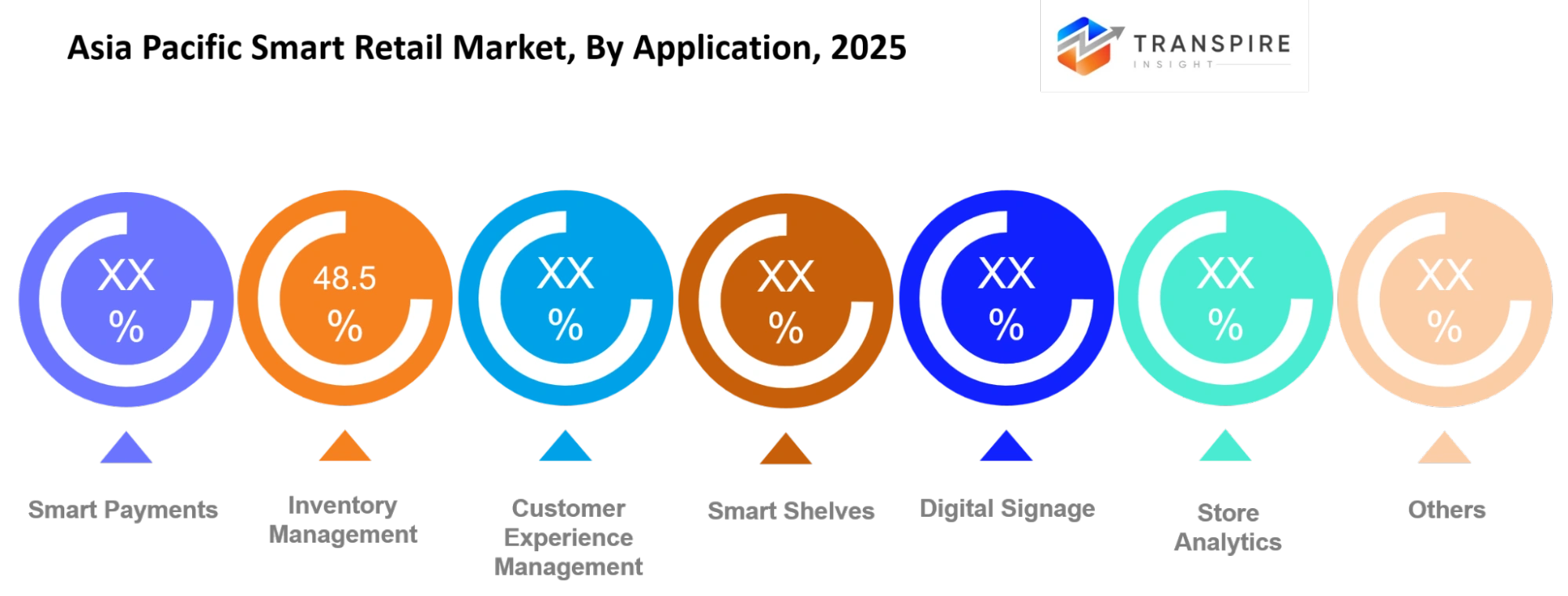
Smart payments kinda take the biggest application share, since retailers keep pushing contactless, mobile, and digital payment choices. Inventory management still matters a lot, because retailers aim for better stock precision and less product shortage using automated tracking systems, or whatever you want to call them. Customer experience management is seeing steady uptake too , especially when it helps with personalized promotions and more meaningful customer engagement.
Smart shelves support improved pricing accuracy and product availability by doing continuous monitoring and then automated updates, which sounds simple but it really changes the workflow. Digital signage boosts promotional flexibility by showing real time ads and product details across the retail space. Store analytics also helps people make better decisions, through customer traffic analysis, and then the other applications tend to cover more operational plus merchandising needs, depending on the store.
By End User :
Supermarkets and hypermarkets end up being the largest end user category because those bigger retail formats invest a lot in automation, digital payments, and intelligent inventory setups. Convenience stores keep rolling out smart retail technologies to raise operational efficiency and shorten checkout times . Specialty stores, meanwhile, use more advanced retail solutions to deliver a more personalized shopping experience and to manage products better.
Department stores are leaning into digital transformation with connected retail platforms and integrated engagement tools. E-commerce retailers blend online and offline technology to improve order fulfillment, inventory visibility, and customer satisfaction. Other retail formats keep adopting digital solutions based on their operational requirements and on broader business expansion strategies.
By Deployment :
Cloud based deployment drives market adoption because it offers flexible infrastructure, reduced go-live costs, and remote accessibility that help large retail networks scale, pretty smoothly. Meanwhile on premise deployment still matters to retailers who need more control over sensitive business data, and want hands on management of their internal systems. A hybrid deployment approach kinda mixes both worlds: it brings cloud adaptability plus local infrastructure so it can balance things like performance, security and day to day operational efficiency.
Hybrid solutions keep getting more accepted, since retailers modernize what they already have without totally throwing away their full infrastructure. Cloud adoption should keep moving forward, especially as multi store operations depend on centralized monitoring, frequent software updates , and real time analytics. Still, other deployment models exist for niche business needs, where standard deployment approaches don’t quite deliver the kind of operational flexibility required for the moment.
What are the Key Use Cases Driving the Asia Pacific Smart Retail Market?
Smart payments still show up as the top use case, largely because big supermarket and hypermarket groups need faster checkout, safer transactions, and this kind of smooth customer journey that people kinda expect now. Retail players choose intelligent payment systems so they can cut down waiting times, boost transaction accuracy, and also handle the rising volumes of digital payments across those hectic store networks.
Inventory management and store analytics keep getting more traction too, especially with convenience stores, specialty retailers, and department stores. Using connected sensors, RFID, and AI-driven analytics lets retail businesses keep stock information more correct, refine restocking decisions, and lower losses caused by inventory mistakes. In other words it supports daily operations that run more efficiently , even when the schedule feels chaotic.
New openings are starting to appear, such as autonomous micro stores and AI-powered digital twins for retail planning. These solutions can help retailers try different store layouts, rework how products are placed, and raise overall operational performance before anything is physically put in place. Plus, the roll out of fifth-generation connectivity together with edge computing should make commercial deployment broader through most of the forecast period.
|
Report Metrics |
Details |
|
Market size value in 2025 |
USD13.8 Billion |
|
Market size value in 2026 |
USD 16.33 Billion |
|
Revenue forecast in 2033 |
USD 53.06 Billion |
|
Growth rate |
CAGR of 18.33% from 2026 to 2033 |
|
Base year |
2025 |
|
Historical data |
2021 - 2024 |
|
Forecast period |
2026 - 2033 |
|
Report coverage |
Revenue forecast, competitive landscape, growth factors, and trends |
|
Regional scope |
Asia Pacific (India, China, Japan, Australia, South Korea, Rest of Asia Pacific) |
|
Key company profiled |
Amazon, Alibaba, Microsoft, IBM, SAP, Oracle, Cisco, Huawei, NCR Voyix, Toshiba Global Commerce Solutions, Zebra Technologies, Honeywell, Intel, Fujitsu, Samsung SDS. |
|
Customization scope |
Free report customization (country, regional & segment scope). Avail customized purchase options to meet your exact research needs. |
|
Report Segmentation |
By Component (Hardware, Software, Services, IoT Platforms, AI Solutions, Cloud Solutions, Others); By Technology (Artificial Intelligence, IoT, RFID, Computer Vision, Big Data Analytics, AR/VR, Others); By Application (Smart Payments, Inventory Management, Customer Experience Management, Smart Shelves, Digital Signage, Store Analytics, Others); By End User (Supermarkets & Hypermarkets, Convenience Stores, Specialty Stores, Department Stores, E-commerce Retailers, Others); By Deployment (Cloud-Based, On-Premise, Hybrid, Others). |
Which Regions are Driving the Asia Pacific Smart Retail Market Growth?
China, in 2025 accounted for roughly 42% of regional revenue and somehow it still ends up being the main market across Asia Pacific. With solid government backing for digital commerce, smart city growth ,and newer payment infrastructure, retail modernization is moving at scale, and pretty fast. There’s also this wide web of cloud providers, AI builders, device makers and structured retail chains that keeps technology getting rolled out, even across smaller urban and suburban zones. Because companies are still funding intelligent retail platforms, smarter logistics networks, and digital foundations, the leadership position is expected to keep holding throughout the whole forecast window.
Japan sits in second place as the regional market, but it’s not the same kind of story. Retail modernization here leans more toward a controlled, quality led path rather than chasing sudden expansion. Regulatory rules stay pretty consistent, digital infrastructure is mature, and consumer spending is fairly steady, which makes it easier to justify long term technology investments. On top of that, automation know-how is strong and department stores, supermarkets, and convenience store networks keep doing upgrades in a steady rhythm, so revenue generation stays dependable. Even with slower population growth, mature supply chains and longer horizon planning continue to preserve demand for advanced retail technologies.
India is expected to see the most rapid growth between 2026 and 2033 , as organized retail keeps expanding, digital payment uptake keeps growing and public digital infrastructure keeps moving forward across major metropolitan areas and also secondary cities. Lately, fresh investment in cloud services along with fifth-generation connectivity, plus smarter logistics, has sped up the rollout of intelligent retail solutions , sort of like more guided and precise shopping systems. More involvement from domestic retailers and technology partners is now opening up new possibilities outside the usual urban marketplaces, not just in city centers. With that momentum, conditions look especially favorable for technology suppliers, software builders , and investors who want longer-term growth across retail settings that are consistently high-growth .
Who are the Key Players in the Asia Pacific Smart Retail Market and How Do They Compete?
Competition remains somewhat fragmented, mainly because large global tech players operate alongside regional digital solution providers and niche retail technology companies that focus on very specific needs. In many cases, the buying choice is driven by technological innovation, cohesive software platforms, AI capabilities, and overall service quality, not just by price. Bigger, established firms keep building out their digital ecosystems, while newer providers come in with narrower, more targeted solutions—for example, cloud retail services, computer vision tools, and intelligent store management—which makes the whole space feel very alive and constantly shifting.
Samsung SDS differentiates itself using integrated digital transformation platforms. These platforms braid together AI, cloud services, and data analytics specifically for enterprise retailers,kind of end-to-end. Panasonic leans more into intelligent checkout systems, in-store automation, and connected hardware to boost operational efficiency in large retail settings. Huawei expands cloud-enabled retail infrastructure by integrating artificial intelligence, connectivity, and edge computing into a unified digital platform, enabling deployments to scale across different retail formats with minimal friction.
NEC Corporation, it seems, is leaning on more advanced computer vision, face recognition, and AI analytics to sharpen its competitive position by feeding customer insights and helping with store operations, yeah. Meanwhile, Alibaba Cloud is also expanding its reach in the region by forming partnerships with retailers seeking cloud-native digital commerce platforms, predictive analytics, and even smarter inventory management. Overall, they keep putting money into software capabilities, doing regional collaborations, and rolling out new technology offerings, and that combination helps them stand out while still supporting long-term expansion across Asia Pacific, more or less.
Company List
- Amazon
- Alibaba
- Microsoft
- IBM
- SAP
- Oracle
- Cisco
- Huawei
- NCR Voyix
- Toshiba Global Commerce Solutions
- Zebra Technologies
- Honeywell
- Intel
- Fujitsu
- Samsung SDS
Recent Development News
In January 2025, Zebra Technologies launched its Mobile Computing AI Suite and Zebra Companion AI platform for retail. The new product suite enables retailers to deploy AI vision applications, intelligent frontline assistants, and workflow automation, supporting smarter inventory management and enhanced in-store customer experiences.
Source: https://www.zebra.com/
In January 2025, Toshiba Global Commerce Solutions launched new AI-powered retail innovations at NRF 2025. The launch introduced modular self-service solutions and the TCx 820 POS platform with AI, computer vision, and machine learning capabilities, strengthening smart retail modernization for retailers across global and Asia Pacific markets.
Source: https://news.toshiba.com/
What Strategic Insights Define the Future of the Asia Pacific Smart Retail Market?
The Asia Pacific Smart Retail Market is moving toward more deeply connected, data-driven retail ecosystems where artificial intelligence, edge computing, computer vision, and unified commerce platforms will start acting like core operational infrastructure, not just a “nice to have” add on. This kind of structural shift is being pushed by labor costs that keep climbing, shoppers wanting friction-less shopping experiences , and digitalization that’s accelerating across organized retail networks.
There’s also a less obvious risk, like fragmented data governance and cybersecurity rules across Asia Pacific, which can quietly bump up compliance spending and make cross-border rollouts for these intelligent retail platforms a lot more complicated.
At the same time, an emerging opportunity looks pretty real: AI-enabled autonomous retail formats expanding into fast urbanizing Southeast Asian markets. That growth can be supported by better digital payment ecosystems and government-backed smart city programs.
For market participants, the path forward will likely involve putting interoperable scalable technology architectures first, and building partnerships with regional software payment, and cloud service providers, so deployment speeds up while they keep enough regulatory flexibility across different countries and markets.
Asia Pacific Smart Retail Market Report Segmentation
By Component
- Hardware
- Software
- Services
- IoT Platforms
- AI Solutions
- Cloud Solutions
By Technology
- Artificial Intelligence
- IoT
- RFID
- Computer Vision
- Big Data Analytics
- AR/VR
By Application
- Smart Payments
- Inventory Management
- Customer Experience Management
- Smart Shelves
- Digital Signage
- Store Analytics
By End User
- Supermarkets & Hypermarkets
- Convenience Stores
- Specialty Stores
- Department Stores
- E-commerce Retailers
By Deployment
- Cloud-Based
- On-Premise
- Hybrid
Frequently Asked Questions
Find quick answers to common questions.
The expected Asia Pacific Smart Retail Market size for the market will be USD 53.06 Billion in 2033.
Key segments for the Asia Pacific Smart Retail Market are By Component (Hardware, Software, Services, IoT Platforms, AI Solutions, Cloud Solutions, Others); By Technology (Artificial Intelligence, IoT, RFID, Computer Vision, Big Data Analytics, AR/VR, Others); By Application (Smart Payments, Inventory Management, Customer Experience Management, Smart Shelves, Digital Signage, Store Analytics, Others); By End User (Supermarkets & Hypermarkets, Convenience Stores, Specialty Stores, Department Stores, E-commerce Retailers, Others); By Deployment (Cloud-Based, On-Premise, Hybrid, Others).
Major Asia Pacific Smart Retail Market players are Amazon, Alibaba, Microsoft, IBM, SAP, Oracle, Cisco, Huawei, NCR Voyix, Toshiba Global Commerce Solutions, Zebra Technologies, Honeywell, Intel, Fujitsu, Samsung SDS.
The Asia Pacific Smart Retail Market size is USD 13.8 Billion in 2025.
The Asia Pacific Smart Retail Market CAGR is 18.33% from 2026 to 2033.
- Amazon
- Alibaba
- Microsoft
- IBM
- SAP
- Oracle
- Cisco
- Huawei
- NCR Voyix
- Toshiba Global Commerce Solutions
- Zebra Technologies
- Honeywell
- Intel
- Fujitsu
- Samsung SDS
About the Authors

Chetan Dhatrak
I’m Chetan Dhatrak, a Senior Research Analyst at Transpire Insight, specializing in the Consumer Goods, Foods and Beverages industry. I focus on analyzing market trends, consumer behavior, competitive landscapes, and industry developments to deliver accurate, data-driven insights. My research at Transpire Insight is built on credible sources and in-depth analysis, helping businesses and readers better understand market dynamics, emerging opportunities, and evolving consumer preferences. I’m committed to creating reliable, well-researched content that supports informed decision-making and reflects the latest developments in the consumer goods and food & beverage sectors.

Chakradhar Khansole
Chakradhar serves as the Research Director at Transpire Insight, bringing over 8 years of experience in technology, innovation, and strategic market intelligence. He specializes in transforming complex market data into actionable business insights that enable organizations to make informed, growth-oriented decisions. Recognized for his strategic vision and analytical expertise, Chakradhar leads high-impact research initiatives, delivering comprehensive market assessments, competitive intelligence, and forward-looking industry analysis.
Recently Published Reports
-
Apr 2026
Bottled Water Market
Bottled Water Market Size, Share & Analysis Report By Product Type (Still Bottled Water, Carbonated Bottled Water, Functional Bottled Water, and Others), By Packaging (PET, Cans, and Others), By Sales Channel (Supermarkets/Hypermarkets, Convenience Stores/Drug Stores, Grocery Stores/Club Stores, Foodservice, and Others) and Geography (North America, Europe, Asia-Pacific, Middle East and Africa, South and Central America), 2021 - 2032
-
Apr 2026
Color Cosmetic Packaging Market
Color Cosmetic Packaging Market Size, Share & Analysis Report By Application (Mascara Packaging, Liquid Packaging, and Liquid Face), By Type (Tubes & Bottles, Pens & Markers, Compacts & Containers, and Droppers & Pumps), and Geography (North America, Europe, Asia-Pacific, Middle East and Africa, South and Central America), 2021 - 2031
-
Apr 2026
External Microphone For Camera Market
External Microphone For Camera Market Size, Share & Analysis Report By Type (Shotgun Microphone, Lavalier Microphone, and Others), By Application (Digital Camera, Professional Video Camera, and Others), and Geography (North America, Europe, Asia-Pacific, Middle East and Africa, South and Central America), 2021 - 2031
-
Apr 2026
Foot Orthotic Insoles Market
Foot Orthotic Insoles Market Size, Share & Analysis Report By Type (Pre-fabricated, and Custom-made), By Material (Thermoplastic, Composite Carbon Fiber, and Others), By Distribution Channel (Drug Stores, Hospitals & Clinics, and Others), and Geography (North America, Europe, Asia-Pacific, Middle East and Africa, South and Central America), 2021 - 2031