
Asia Pacific Real-Time Payments Market Summary
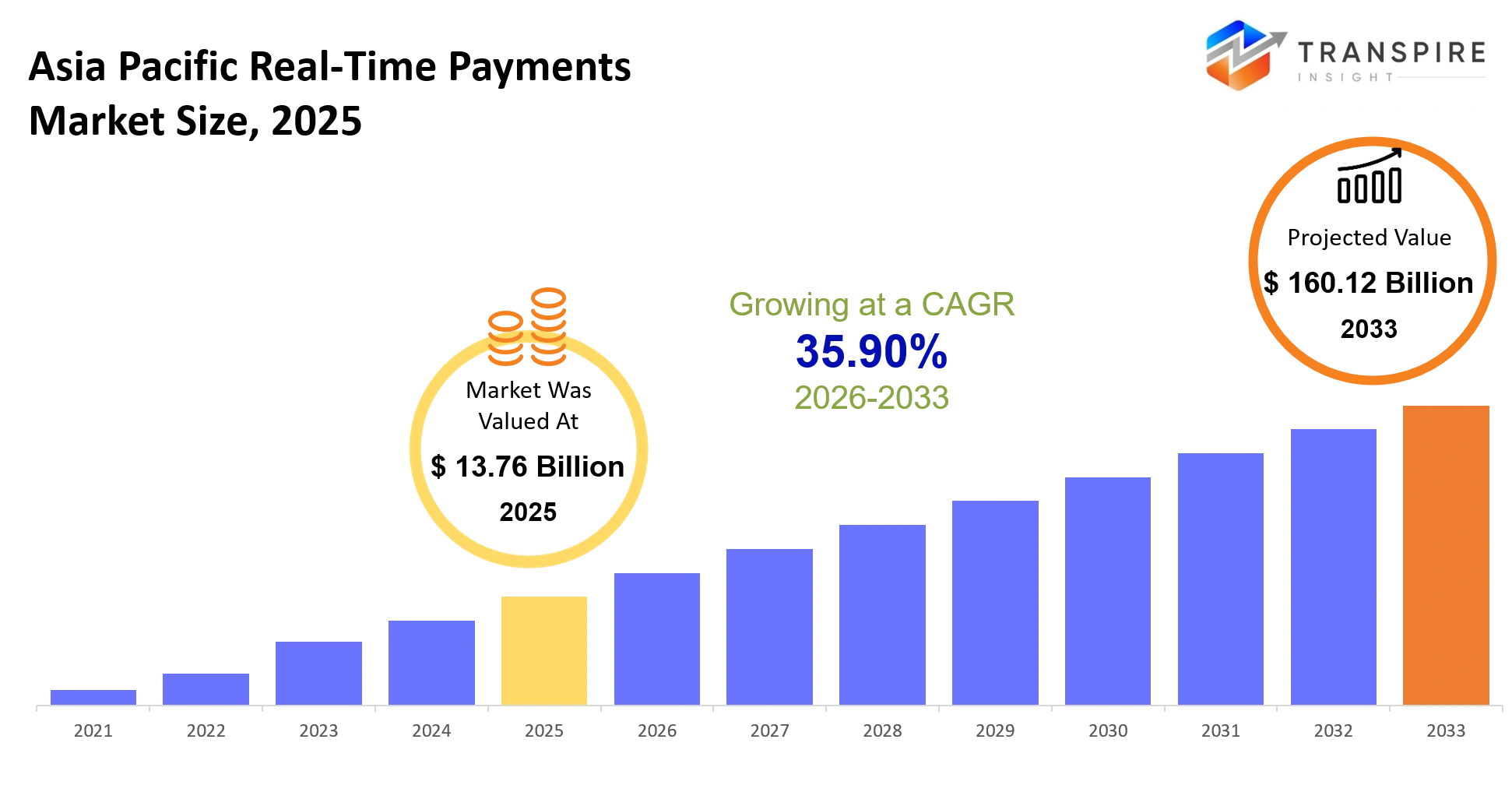
As per Transpire Insight Analysis the Asia Pacific Real-Time Payments Market size is estimated at USD 13.76 Billion in 2025 and is anticipated to reach USD 160.12 Billion by 2033, growing at a CAGR of 35.90% from 2026 to 2033.
According to Transpire Insight Analysis , the Asia Pacific real-time payments market is projected around USD 13.76 Billion in 2025, and it should rise to USD 160.12 Billion by 2033. In real world terms, real-time payment systems enable value to move nearly straight away between individuals, commercial entities, financial institutions, and government bodies, so the transaction can come to rest in seconds, not in hours or days.. And yes, that kind of speed helps cash flow, cuts down settlement lags, and backs digital commerce plus things like bill payments , payroll, and day-to-day merchant transactions across the region’s broader financial network.
Over the last five years, national instant payment infrastructures and open banking initiatives have basically reshaped payment networks. Then the COVID-19 pandemic, kind of pushed the adoption further for contactless and digital payments across Asia Pacific , like faster than before. As a result, banks, fintech companies , and merchants started upgrading their payment rails, extending API connectivity, and tightening up fraud deterrence measures. All of this—quicker settlement, wider digital participation, and payment availability running without interruption— is opening up fresh revenue pathways via value-added financial services and higher overall transaction volumes.
Asia Pacific Real-Time Payments Market Size & Forecast:
- Asia Pacific Real-Time Payments Market Size 2025: USD 13.76 Billion
- Expected Market Value 2033: USD 160.12 Billion
- Forecast CAGR: 35.90%
- Leading region in 2025:
- Fastest Growing region:
- Key Profile:
Key Market Insights
- Asia Pacific Real-Time Payments Market is kinda led by China, holding more than 40% market share in 2025, backed by mature digital payment ecosystems that just keep getting refined.
- India shows the fastest growth across the region through 2033 though, mainly due to UPI expansion, broader merchant acceptance, and government-backed digital payment initiatives that keep rolling out.
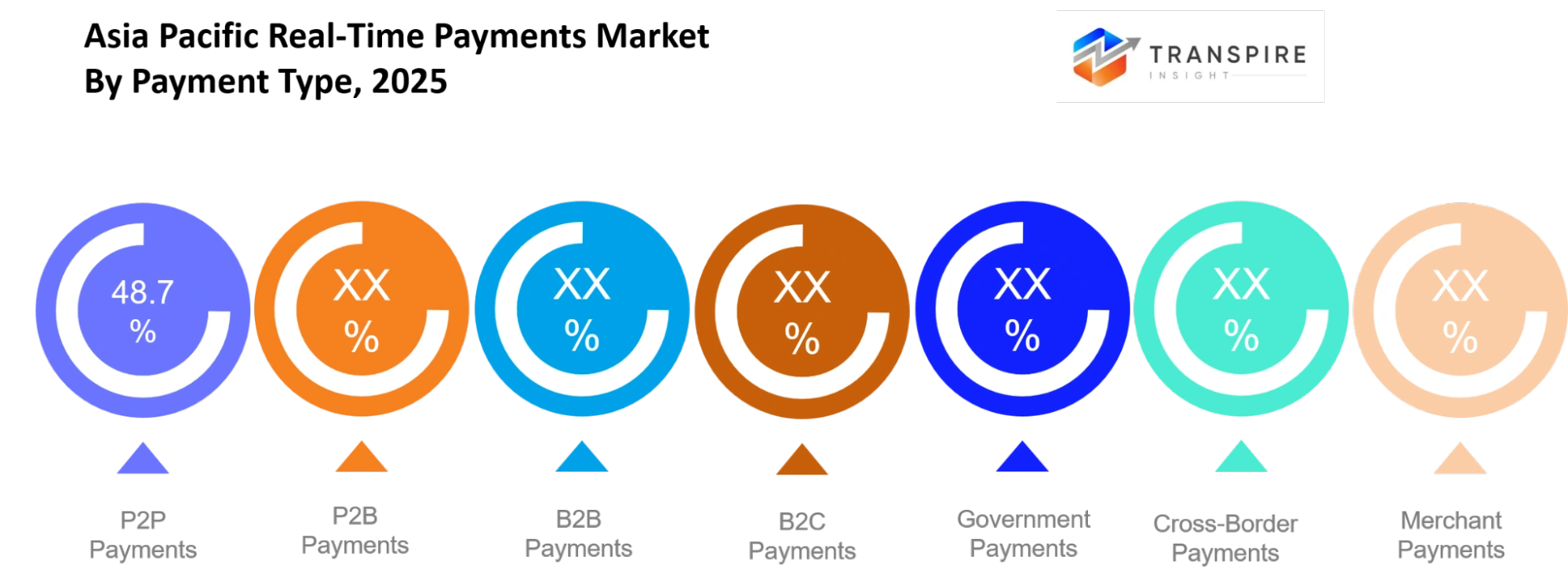
- In terms of payment type, P2P payments feel like they dominate, with roughly 28% market share, mainly powered by mobile banking and instant fund transfers, you know the typical daily-use stuff.
- For components, payment gateways make up about 26% of revenue in 2025, supporting secure, high-speed transaction processing across different industries without too much friction.
- Cloud-based deployment is taking the largest slice too, with over 48% market share, letting financial institutions scale payment infrastructure while also dialing down operational complexity.
- When looking at end users, banks remain the major segment, capturing over 34% revenue share, and they’re putting money into instant settlement capabilities along with fraud management technologies.
- In applications, e-commerce kind of steers the demand curve with roughly 30% share , because retailers really care about a smooth checkout and fast payment confirmation , no delays please .
- Key players like ACI Worldwide, Mastercard, Visa, Fiserv, FIS, and Ant International keep pushing for API innovation, cloud-native payment platforms, and AI enabled fraud detection, basically tightening everything up behind the scenes.
- Strategic partnerships between banks, fintech firms, and payment processors are still growing, bit by bit , to extend cross-border real-time payment connectivity across Southeast Asia , step by step.
- At the same time , advanced analytics, ISO 20022 messaging standards, and AI powered risk management are making transaction security stronger while also boosting processing efficiency across the Asia Pacific Real-Time Payments Market.
What are the Key Drivers, Restraints, and Opportunities in the Asia Pacific Real-Time Payments Market?
The main thing really driving the Asia Pacific Real-Time Payments Market is this steady rush to modernize national payment infrastructure, and it’s getting help from government policy plus central bank initiatives, you know. Things like India’s Unified Payments Interface (UPI), Singapore’s PayNow, Thailand’s PromptPay, and Malaysia’s DuitNow have basically set up nationwide instant payment systems that run around the clock, no pause, no downtime. Because of that, settlement times get cut down , transaction fees tend to drop, and financial institutions can roll out fresh digital banking services more easily. As merchants, consumers, and enterprises keep leaning more on instant money movements, transaction volumes keep climbing too. That usually means more revenue openings for banks, payment processors, and the tech providers behind the scenes.
Still, there’s a restraint that is pretty hard to ignore, and it comes from the fragmented regulatory and technical landscape across Asia Pacific. Payment standards, cybersecurity guidelines, compliance expectations, and interoperability rules don’t match cleanly from one country to the next. So regional integration ends up costing more, and it takes longer than anyone wants. Smaller financial institutions, in particular, feel the squeeze, since modernization can be expensive , and they may not have the technical know how in house. Those structural issues slow down cross-border payment integration and, in turn, can limit the revenue chances in less mature banking markets.
But there’s also a major opportunity here, especially with cross-border real-time payment connectivity. This is being supported by open banking models, digital identity frameworks, and ISO 20022 messaging standards. Regional efforts that link payment networks between places like Singapore, Thailand, Malaysia, and India show how instant international transfers can become quicker and also more affordable. In other words, the groundwork is there, and the expansion path looks clearer, if the systems can keep aligning.
What Has the Impact of Artificial Intelligence Been on the Asia Pacific Real-Time Payments Market?
Artificial intelligence has become a kind of essential technology that supports real-time payment platforms across Asia Pacific, in a way that feels kind of invisible but still crucial. Most financial institutions now rely on AI for transaction monitoring on the fly, spotting suspicious payment behavior and generally improving fraud detection without making customers wait, or at least not in any obvious way. In practice, machine learning models look at transaction history, customer habits, device details, and payment patterns all together within milliseconds. Then payment providers can block fraudulent transactions quickly while still keeping instant settlement. On top of that, AI helps operational stuff too, by automating payment routing, liquidity management, customer verification, and compliance screening.
Predictive analytics, when paired with AI, also assists payment providers with forecasting transaction volumes. It helps optimize network capacity and, quite importantly, anticipate infrastructure bottlenecks before they turn into service disruptions. AI-powered systems can also strengthen anti-money laundering compliance, because they can detect unusual transaction networks that traditional rule based systems might miss. A lot of banks mention measurable drops in false fraud alerts and quicker investigation times after deploying advanced analytics, which tends to improve customer satisfaction ,and reduce operational costs in the background.
Still, AI adoption isn’t all smooth. There are limitations that show up pretty fast, especially integration. Connecting advanced AI platforms with older, legacy banking infrastructure takes real investment, skilled personnel, and transaction data that’s actually high quality. Smaller financial institutions often have trouble justifying those costs. And even when they do, inconsistent data standards across countries can reduce model accuracy in cross border payment environments. Because of that, continued investment in interoperable digital infrastructure, plus standardized payment data , will likely be essential if the region wants to unlock the full value of AI across regional payment networks.
Key Market Trends
- Between 2022 and 2025 , cross-border real-time payment connectivity grew a lot , like really fast in practice, so that those cross-region transfers went from taking days to taking minutes.
- And at the same time, ISO 20022 adoption picked up across Asia Pacific, which means payments could carry more complete information , plus there was smoother interoperability , and banks or payment providers saw better compliance outcomes too.
- On the fraud side , AI-powered detection platforms started looking at transactions within milliseconds.
- This helped multiple financial institutions cut down false positive alerts by something like 20–40% which is a big swing, honestly, even when transaction volumes are high.
- Also, cloud-native payment infrastructure became more common. By 2025, more than 45% of new payment modernization efforts were built on cloud-based architectures, not just on on-prem setups.
- Meanwhile, open banking partnerships kept rising after 2021, so banks and fintech companies could roll out embedded payment services using secure API hookups, without the usual headache.
- QR-code instant payments got a strong push too. Merchant acceptance expanded quickly across retail, hospitality, and transportation , especially around India, Thailand, Singapore, and Indonesia.
- Major vendors like Visa, Mastercard, ACI Worldwide, FIS, and Fiserv then leaned into regional partnerships, aiming to make instant payment processing better, fraud management tighter, and cross-border settlement easier.
- And for customer-facing security , digital identity verification and biometric authentication turned into standard features on many payment platforms.
- This improved transaction security while also making onboarding less painful. At the policy level , central banks across Asia Pacific increased spending on national instant payment infrastructure , which also encouraged interoperability between domestic schemes and commercial banking networks.
- Finally, payment providers changed how they compete. Instead of focusing only on transaction processing , they moved toward value-added services, like AI based analytics, real-time liquidity management, and embedded financial offerings that sit inside broader customer journeys.
Asia Pacific Real-Time Payments Market Segmentation
By Payment Type
P2P Payments take the biggest share, mostly because mobile banking apps and digital wallets have made quick money transfers something people do daily, and yeah it kind of feels normal now. Merchant Payments keep expanding, since more retailers lean into QR code payments and contactless checkout, to make the experience smoother for customers. B2B Payments are picking up speed too, as companies swap batch settlements for immediate transfers, so cash flow stays healthier. B2C Payments also matter, they support insurance claims, refunds, rewards, and other customer-facing transactions, where instant settlement is really the point.
Government Payments help a lot as well, enabling swift delivery of subsidies, pensions, tax refunds, and welfare benefits via digital payment networks. Cross-Border Payments are also turning into a big growth lane, especially as payment connectivity improves between Asia Pacific economies, which cuts transaction costs and shortens settlement delays. P2B Payments cover things like utility bills, education fees, and various service payments, often straight from banking applications. The Others group includes smaller, specialized payment services that handle particular financial interactions across multiple industries , kind of like a mixed cabinet.
By Component
Payment Gateway solutions pull in the top revenue, mostly because secure transaction routing is still absolutely essential for banks, merchants, and payment service providers, even when things change. Payment Processing Software handles authorization, clearing, and settlement functions , and it keeps going smoothly under high transaction volumes with low latency, like no unnecessary delays. APIs also matter more and more now, since they link banking platforms, fintech applications, and merchant ecosystems using standardized digital interfaces, which makes integrations feel a bit calmer. Then Fraud Detection Solutions help keep transactions safer, using behavioral analytics, machine learning, and real time risk assessment that reacts fast.
Settlement Systems help ensure money transfers move quickly between participating financial institutions, while still holding regulatory compliance and day to day operational reliability. Analytics Platforms deliver transaction intelligence, customer insights, and operational monitoring, so overall payment performance tends to improve over time. Security Solutions protect the payment infrastructure through encryption, authentication, tokenization, and other cybersecurity technologies, basically the usual layers. The Others segment, kinda covers the supporting software and infrastructure that boosts payment network performance, and helps keep service availability steadier, too.
By Deployment
Cloud based deployment kinda leads the market, because financial institutions want flexible infrastructure that can back up steady transaction growth and also rapid service rollouts. In practice, SaaS platforms help a lot with payment software implementation, plus they lower upkeep expenses for banks and payment providers at the same time. Hybrid deployment is still pretty common especially inside big financial organizations, since they can juggle legacy systems along with newer cloud services. Meanwhile On premise deployment keeps going strong in institutions that really want full operational control, and compliance with their internal security policies too.
Private cloud setups fit well when the operations are heavily regulated ,so stronger governance matters and security controls need to be customized. Public cloud adoption continues to grow, largely because providers keep getting better on reliability, compliance certifications, and having data centers available across different regions. Multi cloud strategies are also being used more, since they can boost resilience, tune workload placement, and reduce dependency on one single technology vendor. And the Others category covers oddball deployment models, basically for unique operational needs and regulatory constraints that show up across different financial markets.
By End User
Banks are still the biggest end user group, mainly because instant payment infrastructure, has turned into a kind of “must-have” ingredient in retail and commercial banking offerings. Financial Institutions keeps pushing further into digital payments via mobile banking, open banking platforms and API enabled payment services, with an emphasis on smoother orchestration. Retailers now more and more add instant payment acceptance in order to cut down checkout time a bit, speed up cash flow, and generally make the customer experience feel less sticky. Government Agencies too are leaning on real-time payment networks for tax collections, subsidy distribution, public service fees, and benefit disbursements, which is usually treated as more reliable.
Healthcare Providers also use instant payment solutions for patient billing, insurance reimbursements, and supplier payments, so the money side of operations runs with fewer delays. Telecom Operators back mobile payment ecosystems, offer prepaid recharges and enable digital financial services, usually through built in payment platforms. SMEs, on the other hand, profit from faster settlements that help their working capital, and makes everyday business transactions feel simpler. The “Others” bucket covers educational institutions, logistics companies, utility providers, and other organizations that are adopting instant payment capabilities, although each one does it in their own way.
By Application
E-commerce seems to take the largest application share, because online merchants need quick payment confirmation so orders can be processed faster and customers feel better. Retail Transactions keeps growing, especially through QR code payments, touchless acceptance, and mobile banking apps across physical stores . Digital Wallets also make things easier, they offer seamless instant transfers between consumers, merchants, and even service providers. Bill Payments stay essential too for utilities, education, telecommunications, and financial services, so really it’s not going anywhere.
Then there’s Salary Disbursement which helps employers send employee wages right away, this improves payroll efficiency, and employees get access to earned income sooner. Utility Payments benefit from instant settlement, which cuts down on payment delays and helps service providers collect more smoothly. Travel & Hospitality businesses are starting to lean into instant payment capabilities for reservations, ticketing, and also for customer refunds when needed. As for the Others category, it covers insurance claims, investment transfers, subscription services, charitable donations, and specialized digital payment applications that don’t quite fit the main buckets.
What are the Key Use Cases Driving the Asia Pacific Real-Time Payments Market?
E-commerce still stays sort of the primary use case, since online retailers really need an immediate payment confirmation before they actually start processing customer orders. This instant settlement helps cut down payment failures, sharpens inventory management, and also speeds up the checkout flow for both merchants and consumers. And then you have digital wallets, plus mobile banking platforms, that make the whole thing even better because they allow secure, always-available transactions with less friction.
Bill payments and salary disbursement keep gaining momentum across banking, government, and enterprise environments. Financial institutions back up businesses with automated payroll processing , while government agencies lean on instant payment networks to hand out subsidies, pensions, tax refunds, and welfare benefits without all those long settlement periods.
Cross-border merchant payments, and embedded financial services too, are showing up as newer applications with strong long-term promise. Open banking platforms, API driven payment infrastructure, and regional payment linkages allow businesses to finish international transactions quicker ,and for less cost. In other words, these elements are expected to help expand digital trade, fintech innovation, and connected financial ecosystems during most of the forecast period.
|
Report Metrics |
Details |
|
Market size value in 2025 |
USD 13.76 Billion |
|
Market size value in 2026 |
USD 18.70 Billion |
|
Revenue forecast in 2033 |
USD 160.12 Billion |
|
Growth rate |
CAGR of 35.90% from 2026 to 2033 |
|
Base year |
2025 |
|
Historical data |
2021 - 2024 |
|
Forecast period |
2026 - 2033 |
|
Report coverage |
Revenue forecast, competitive landscape, growth factors, and trends |
|
Regional scope |
United States; Canada; Mexico; United Kingdom; Germany; France; Italy; Spain; Denmark; Sweden; Norway; China; Japan; India; Australia; South Korea; Thailand; Brazil; Argentina; South Africa; Saudi Arabia; United Arab Emirates |
|
Key company profiled |
Visa, Mastercard, ACI Worldwide, Fiserv, FIS, Temenos, Finastra, NPCI, Ant Group, Tencent, PayPal, Stripe, Worldline, Oracle, IBM |
|
Customization scope |
Free report customization (country, regional & segment scope). Avail customized purchase options to meet your exact research needs. |
|
Report Segmentation |
By Payment Type (P2P Payments, P2B Payments, B2B Payments, B2C Payments, Government Payments, Cross-Border Payments, Merchant Payments, Others); By Component (Payment Gateway, Payment Processing Software, APIs, Fraud Detection Solutions, Settlement Systems, Analytics Platforms, Security Solutions, Others); By Deployment (Cloud-Based, On-Premise, Hybrid, SaaS, Private Cloud, Public Cloud, Multi-Cloud, Others); By End User (Banks, Financial Institutions, Retailers, Government Agencies, Healthcare Providers, Telecom Operators, SMEs, Others); By Application (E-commerce, Bill Payments, Salary Disbursement, Retail Transactions, Utility Payments, Travel & Hospitality, Digital Wallets, Others) |
Which Regions are Driving the Asia Pacific Real-Time Payments Market Growth?
China kinda leads the Asia Pacific real-time payments market, mostly because it has a highly mature digital payments setup, lots of smartphone penetration, and a strong kind of linkage between banks, fintech platforms ,and merchants. Its national payment infrastructure basically supports billions of instant transactions each year, via digital wallets and banking applications that are already widely used. On top of that, there is also a regulatory climate that seems to push ongoing investment into payment security, interoperability, and financial-technology improvements. So with that advanced foundation, wide merchant take-up, and huge transaction volumes, China can keep the biggest share across the region.
Japan comes next as the second-largest regional contributor, but it grows in a different way. The focus there is more on financial steadiness, enterprise modernization, and slow, careful upgrades to the payment infrastructure. Financial institutions keep putting money into real-time payment abilities, yet they also keep strict controls around security, compliance, and operational dependability. Big companies are more and more choosing instant payment services for payroll, supplier settlements, and everyday commercial activity. This creates steady revenue growth, rather than some fast breakout kind of expansion. With solid bank relationships and steady technology spend Japan stays a dependable contributor for long-term regional market progress.
India is expected to show the fastest growth from 2026 to 2033, after the rapid rollout of Unified Payments Interface (UPI), plus government-led digitalization programs, and wider merchant acceptance across both cities and rural areas. Continued innovation through API-based banking, better cross-border payment connectivity, and digital identity infrastructure has sped up adoption among consumers and businesses. In the end, it looks like this blend is what will drive India’s momentum over that period.
Who are the Key Players in the Asia Pacific Real-Time Payments Market and How Do They Compete?
Competition in the Asia Pacific real-time payments market is, sort of moderately consolidated. You have global payment tech providers going head to head with regional payment networks and a bunch of fintech innovators, all at once. Instead of transaction pricing being the only thing that really matters, the bigger battle now is more about technology capabilities, payment security—like how safe it feels in practice—and processing speed. Regulatory compliance and cross-border interoperability also weigh in a lot. Meanwhile the established players keep on tightening their position, often using cloud-native payment platforms, AI-enabled fraud detection, and partnerships with financial institutions. At the same time, regional payment networks are expanding domestic payment ecosystems , which sounds obvious but it’s actually a big deal.
Visa, for example, differentiates itself with global payment connectivity, tokenization technology, and AI-enabled payment security that supports both domestic and international instant payments. Mastercard leans into real-time account-to-account payment infrastructure, cross-border money movement, plus advanced cybersecurity capabilities, and it keeps extending partnerships across ASEAN markets. Then there’s ACI Worldwide, which specializes in enterprise payment modernization, by providing cloud-ready payment processing platforms that can handle high-volume ISO 20022 real-time transactions. In other words, these offerings help financial institutions move past fragmented legacy infrastructure and shift toward unified payment environments.
NPCI has also built a strong competitive position, mainly by continuing to expand India’s Unified Payments Interface. This supports low-cost, high-volume instant payments across consumers, merchants, and even government services. Ant Group brings digital wallets and merchant payment solutions together, and it also adds embedded financial services, all inside one integrated ecosystem. That combo helps it support large-scale consumer and commercial transactions throughout Asia.
Company List
• Visa
• Mastercard
• ACI Worldwide
• Fiserv
• FIS
• Temenos
• Finastra
• NPCI
• Ant Group
• Tencent
• PayPal
• Stripe
• Worldline
• Oracle
• IBM
Recent Development News
In May 2026, ACI Worldwide and Security Bank Philippines announced recognition for their cloud-ready enterprise payment modernization platform that supports ISO 20022 real-time payment processing and tripled transaction processing capacity. The deployment strengthens scalable instant payment infrastructure across the Philippines.https://investor.aciworldwide.com/news-releases/news-release-details/aci-worldwide-and-security-bank-philippines-set-new-benchmark (ACI Worldwide Press Release).
In April 2026, ACI Worldwide entered a partnership with Kinexys by J.P. Morgan to integrate account and payee verification into its Fraud and Financial Crime solution. The collaboration enhances fraud prevention for global real-time payment transactions and improves payment security for financial institutions.https://investor.aciworldwide.com/news-releases/news-release-details/aci-worldwide-and-kinexys-jp-morgan-collaborate-mitigate-global (ACI Worldwide Press Release).
In April 2026, Visa launched its Agentic Ready program across Asia Pacific with more than 50 ecosystem partners. The initiative prepares issuers and payment providers for AI-enabled commerce by supporting secure agent-initiated payment transactions throughout the region.https://visa.gcs-web.com/news-releases/news-release-details/visa-announces-global-expansion-agentic-ready-program (Visa News Release).
What Strategic Insights Define the Future of the Asia Pacific Real-Time Payments Market?
The Asia Pacific real-time payments market seems to be drifting toward fully connected digital payment ecosystems, where domestic payment networks , cross-border infrastructure , open banking and even artificial intelligence work through interoperable platforms that do not feel so “separate” anymore. Under the hood, the biggest structural push is the modernization of national payment infrastructure , paired with standardized messaging frameworks like ISO 20022, which allows payment services to run faster and also more intelligently.
At the same time, there’s a risk that is bit less obvious… the transaction volumes are getting concentrated across a smaller slice of payment networks and technology providers, and that could raise operational stress and cybersecurity exposure, should something go wrong or a disruption happens.
Still, there’s also an opening that looks promising: AI-enabled cross-border payment orchestration. This basically blends instant settlement, fraud intelligence and automated compliance across different jurisdictions, not just in one place. Market participants should probably focus their spending on cloud-native payment architecture, interoperable API ecosystems, and stronger regional banking relationships to keep long-term competitiveness steady, while also getting ready for the next generation of intelligent digital commerce.
Asia Pacific Real-Time Payments Market Report Segmentation
By Payment Type
• P2P Payments
• P2B Payments
• B2B Payments
• B2C Payments
• Government Payments
• Cross-Border Payments
• Merchant Payments
• Others
By Component
• Payment Gateway
• Payment Processing Software
• APIs
• Fraud Detection Solutions
• Settlement Systems
• Analytics Platforms
• Security Solutions
• Others
By Deployment
• Cloud-Based
• On-Premise
• Hybrid
• SaaS
• Private Cloud
• Public Cloud
• Multi-Cloud
• Others
By End User
• Banks
• Financial Institutions
• Retailers
• Government Agencies
• Healthcare Providers
• Telecom Operators
• SMEs
• Others
By Application
• E-commerce
• Bill Payments
• Salary Disbursement
• Retail Transactions
• Utility Payments
• Travel & Hospitality
• Digital Wallets
• Others
Frequently Asked Questions
Find quick answers to common questions.
The expected Asia Pacific Real-Time Payments Market size for the market will be USD 160.12 Billion in 2033.
Key segments for the Asia Pacific Real-Time Payments Market are By Payment Type (P2P Payments, P2B Payments, B2B Payments, B2C Payments, Government Payments, Cross-Border Payments, Merchant Payments, Others); By Component (Payment Gateway, Payment Processing Software, APIs, Fraud Detection Solutions, Settlement Systems, Analytics Platforms, Security Solutions, Others); By Deployment (Cloud-Based, On-Premise, Hybrid, SaaS, Private Cloud, Public Cloud, Multi-Cloud, Others); By End User (Banks, Financial Institutions, Retailers, Government Agencies, Healthcare Providers, Telecom Operators, SMEs, Others); By Application (E-commerce, Bill Payments, Salary Disbursement, Retail Transactions, Utility Payments, Travel & Hospitality, Digital Wallets, Others).
Major Asia Pacific Real-Time Payments Market players are Visa, Mastercard, ACI Worldwide, Fiserv, FIS, Temenos, Finastra, NPCI, Ant Group, Tencent, PayPal, Stripe, Worldline, Oracle, IBM.
The Asia Pacific Real-Time Payments Market size is USD 13.76 Billion in 2025.
The Asia Pacific Real-Time Payments Market CAGR is 35.90% from 2026 to 2033.
• Visa
• Mastercard
• ACI Worldwide
• Fiserv
• FIS
• Temenos
• Finastra
• NPCI
• Ant Group
• Tencent
• PayPal
• Stripe
• Worldline
• Oracle
• IBM
About the Authors

Mayur Shinde
I am Mayur Shinde, a Senior Research Analyst at Transpire Insight, specializing in the Automotive & Transportation and Information & Communication Technology (ICT) Industry. My work focuses on analyzing emerging market trends, technological advancements, competitive landscapes, and industry developments to deliver accurate, data-driven insights. I am passionate about transforming complex market information into clear, actionable content that helps businesses, professionals, and decision-makers stay informed and make confident strategic decisions.

Chakradhar Khansole
Chakradhar serves as the Research Director at Transpire Insight, bringing over 8 years of experience in technology, innovation, and strategic market intelligence. He specializes in transforming complex market data into actionable business insights that enable organizations to make informed, growth-oriented decisions. Recognized for his strategic vision and analytical expertise, Chakradhar leads high-impact research initiatives, delivering comprehensive market assessments, competitive intelligence, and forward-looking industry analysis.
Recently Published Reports
-
Apr 2026
3D Optical Profiler Market
3D Optical Profiler Market Size, Share & Analysis Report By Type (Desktop 3D Optical Profiler, and Portable 3D Optical Profiler), By Technology (Confocal Technology, and White Light Interference), By End-Use Industry (Manufacturing, Research Institutions, Automotive, Aerospace and Defense, Medical Devices, and Other), and Geography (North America, Europe, Asia-Pacific, Middle East and Africa, South and Central America), 2021 - 2031
-
Apr 2026
Depth Sensor Market
Depth Sensor Market Size, Share & Analysis Report By Type (Infrared Depth Sensors, Time-of-Flight (ToF) Sensors, Stereo Vision Sensors, Structured Light Sensors, Ultrasonic Depth Sensors), By Application (Automotive, Robotics, Gaming, Consumer Electronics, Industrial Automation, Healthcare, Security & Surveillance, Others), By End Users (Automotive Manufacturers, Consumer Electronics Companies, Healthcare Providers, Industrial Companies, Security Agencies, Gaming Companies, Robotics Companies, Others), and Geography (North America, Europe, Asia-Pacific, Middle East and Africa, South and Central America), 2021 – 2031
-
Apr 2026
Digital Manufacturing Market
Digital Manufacturing Market Size, Share & Analysis Report By Component (Hardware, Software, and Services), By Technology (Robotics, 3D Printing, Internet of Things (IoT), and Others), By Application (Automotive and Transportation, Aerospace and Defense, Consumer Electronics, Industrial Machinery, and Others), By Process Type (Computer-Based Designing, Computer-Based Simulation, Computer 3D Visualization, Analytics, and Others), and Geography (North America, Europe, Asia-Pacific, Middle East and Africa, South and Central America), 2021 – 2031
-
Apr 2026
Digital Visa Services Market
Digital Visa Services Market Size, Share & Analysis Report By Type (Individual Travelers, Group Travelers), By Application (Tourism, Business Travel, Others), and Geography (North America, Europe, Asia-Pacific, Middle East and Africa, South and Central America), 2021 – 2031