

Asia Pacific Ready To Drink Tea And Coffee Market Size & Forecast:
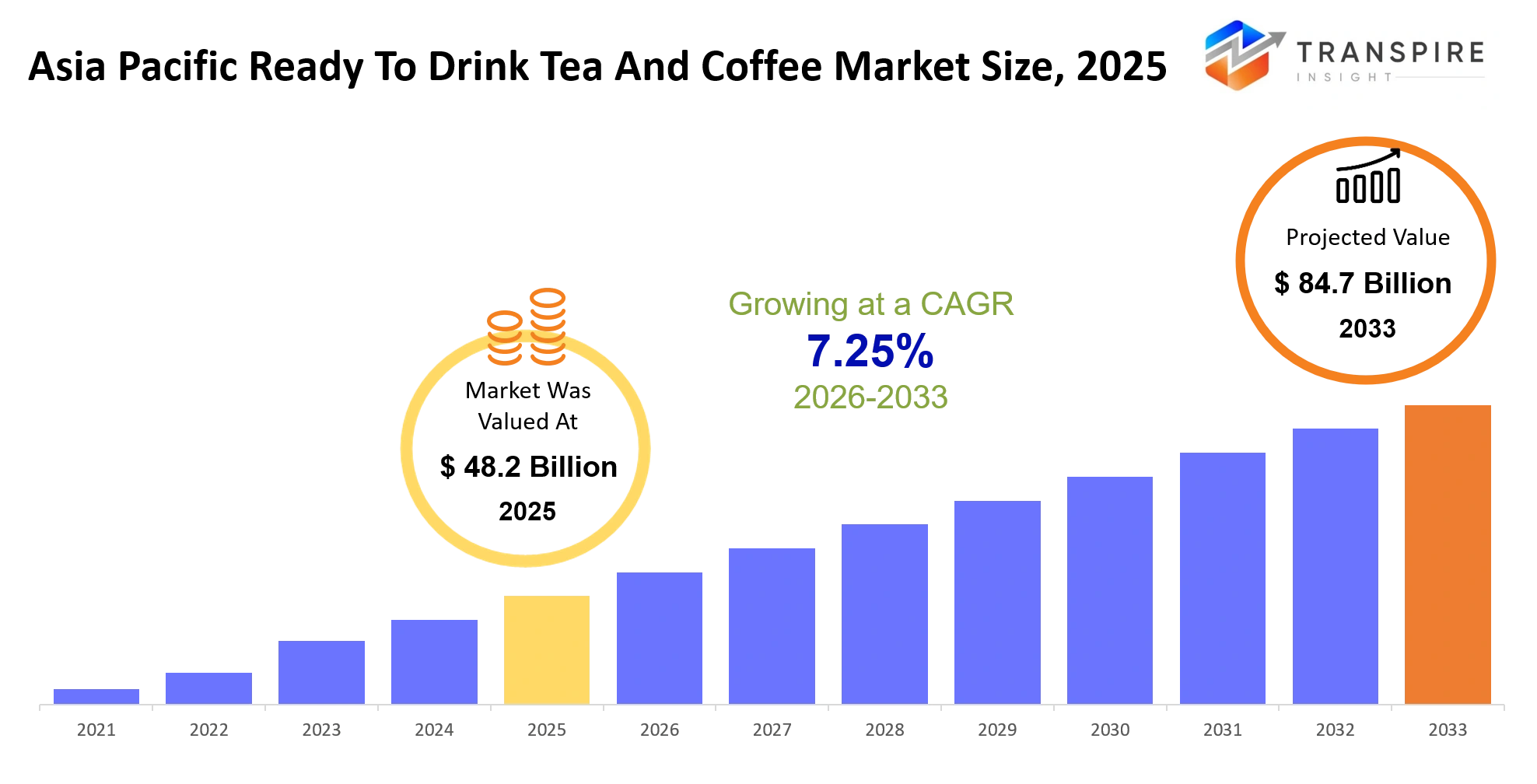
- Asia Pacific Ready To Drink Tea And Coffee Market Size 2025: USD 48.2 Billion
- Asia Pacific Ready To Drink Tea And Coffee Market Size 2033: USD 84.7 Billion
- Asia Pacific Ready To Drink Tea And Coffee Market CAGR: 7.25%
- Asia Pacific Ready To Drink Tea And Coffee Market Segments: By Product Type (RTD Tea, RTD Coffee, Herbal Tea Drinks, Functional Tea Drinks, Cold Brew Coffee, Energy Tea Drinks, Others); By Packaging (Bottles, Cans, Cartons, Pouches, Others); By Distribution Channel (Supermarkets, Convenience Stores, Online Retail, Vending Machines, Others); By End User (Adults, Millennials, Working Professionals, Students, Others).
To learn more about this report,  Download Free Sample Report
Asia Pacific Ready To Drink Tea And Coffee Market Summary
The Asia Pacific Ready To Drink Tea And Coffee Market was valued at USD 48.2 Billion in 2025. It is forecast to reach USD 84.7 Billion by 2033. That is a CAGR of 7.25% over the period.
The Asia Pacific Ready To Drink (RTD) Tea and Coffee Market actually serves people who want convenient, portable drinks that provide refreshment, some lift energy, and even certain functional benefits, all without a whole lot of prep time. Over time these RTD items have sort of become part of urban life, where folks grab them while moving, like at workplaces, along transit networks, in retail outlets, and through digital commerce too.
In the past five years , the market has gone through a noticeable structural change away from more traditional sweetened beverages and toward more premium, health oriented RTD formulations. These include less sugar content, naturally derived ingredients, plant based selections, and different functional add-ons. Then the COVID-19 pandemic, kind of turned into a big trigger, it sped up home consumption and pushed people toward online groceries buying, plus it made manufacturers tweak packaging formats, and rethink distribution routes. So in the end, expectations from consumers moved toward convenience and wellness too, but also toward how effortless it is to obtain the product.
Right now growth is being fueled by how brands can win those higher value consumption moments via premiumization and product innovation. That’s expanding revenue opportunities beyond the usual beverage set, and it helps drive wider adoption across different consumer groups.
Key Market Insights
- East Asia kind of dominates the Asia Pacific Ready To Drink Tea And Coffee Market, bringing in about 45% of the regional revenue, and it’s backed by Japan, China and South Korea.
- China in particular holds a big share thanks to wide-ranging convenience store networks and a really strong take-up of premium RTD beverages.
- India looks like a high potential growth space too, mostly because of urbanization, younger customer groups, and the cold beverage channels that keep expanding.
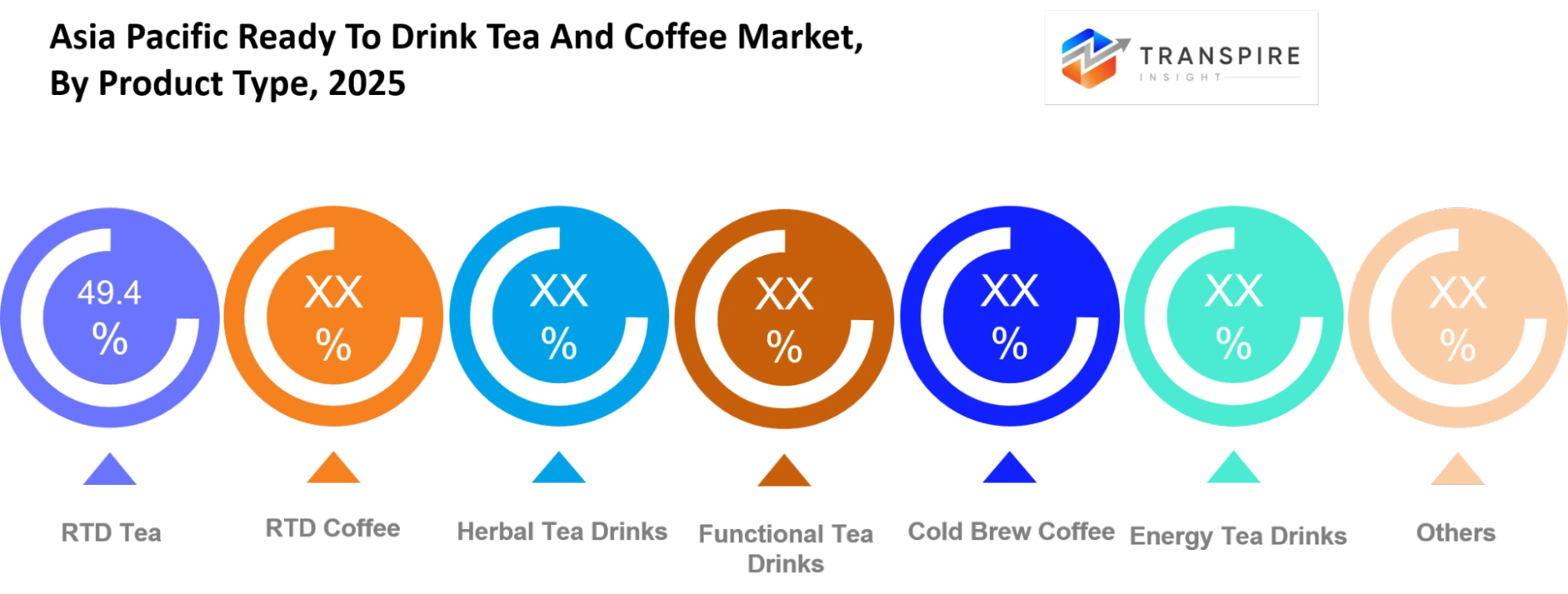
- In general, RTD tea is the main player in the Asia Pacific Ready To Drink Tea And Coffee Market, with almost 60% market share, and it’s helped by long-standing consumer comfort with the product.
- Then RTD coffee sits in the second position, doing well as café culture keeps widening and more premium, ready to consume options show up.
- Functional RTD drinks with protein vitamins and botanical ingredients, are still the fastest-growing slice through 2030.
- And yeah , the on the go kind of consumption is leading, with over 50% of overall sales, which mostly points to busy city living and that convenience-first buying habit.
- Meanwhile, workplace and commuting moments are picking up speed pretty fast across major metro centers too, like it’s becoming a normal thing.
- Young adults (18–35) take the biggest revenue share because they buy convenience beverages quite often.
- Then for end-users, health-conscious consumers are the fastest-growing group, since the whole demand lane is sliding toward low-sugar and functional options.
What are the Key Drivers, Restraints, and Opportunities in the Asia Pacific Ready To Drink Tea And Coffee Market?
The main driver that is pushing growth in the Asia Pacific Ready To Drink Tea And Coffee Market is basically the meeting of urban routines, a stronger appetite for premium drinks, and then the newer retail growth model, all kind of at once. Over the past ten years, convenience stores, quick commerce services, and online grocery channels have boosted access a lot, maybe faster than expected. Meanwhile, shoppers have gradually reoriented their spending toward premium beverage options that promise functional kinds of help, like energy enhancement, hydration support, or lower sugar profiles. Put together, this mix lets manufacturers set higher average selling prices while also keeping purchase frequency up. And that then supports revenue growth plus deeper category penetration.
The biggest obstacle is more of a structural instability tied to agricultural commodity inputs— especially coffee beans, tea leaves, sugar, and packaging materials. Climate swings across major producing areas, plus continuing supply chain disruptions, make procurement costs unpredictable, and they do not get fixed quickly. Because of that, producers often end up dealing with margin pressure. If they try to pass the higher costs to consumers , purchase volumes can drop. So the whole situation limits the revenue upside and slows down expansion into price-sensitive emerging markets, even when demand exists .
There’s a major opportunity hiding in functional, and health oriented RTD mix formulations, a bit like everything is being pushed toward wellness now. Drinks that use protein, probiotic cultures, adaptogen blends, botanical extracts, and natural caffeine sources are pulling in higher spending from consumers. Places like China, South Korea, and Singapore are showing solid take-up for beverages framed around well being and better performance. If brands keep investing in functional beverage innovation, it might unlock the next phase of market growth, by shaping new higher value product categories, with stronger profit margins too.
What Has the Impact of Artificial Intelligence Been on the Asia Pacific Ready To Drink Tea And Coffee Market?
Artificial intelligence and cutting-edge digital technologies are, in a practical sense, reshaping the Asia Pacific ready-to-drink beverage industry . not only by improving manufacturing efficiency, but also by helping with demand prediction and supply chain supervision. Producers are increasingly turning to AI -powered analytics to watch production lines in real time, automate quality checks, and fine tune the filling, packaging, and inventory tasks. There are computer vision systems that can spot packaging defects as well as labeling mismatches much faster than old manual review routines, which means less waste and better throughput, overall.
At the same time, machine learning models are being rolled out to estimate consumer demand at both regional and store level. they look at sales rhythm, weather conditions, promotional efforts, and seasonal signals. so manufacturers can adjust production timetables and allocate inventory more intelligently. the payoff is steadier shelf availability while excess inventory shrinks, and logistics costs tend to drop too. Beyond that, forecasting capabilities also assist procurement work for tea leaves, coffee beans, sweeteners, and packaging materials. that helps companies manage commodity price swings with a bit more discipline, rather than reacting late.
On the operations side, these technologies generally support lower production downtime, higher inventory turnover, better forecast precision, and smoother distribution networks . still, one meaningful snag stays put , the cost of integrating AI across fragmented manufacturing and distribution ecosystems can be quite high. smaller regional producers often do not have the data setup, or the technical knowhow, needed to fully benefit from advanced analytics. so adoption across the market slows down, even when the benefits sound obvious.
Key Market Trends
- Since 2020, a few big beverage brands have been expanding their low-sugar and zero-sugar portfolios, i mean, it feels like governments have tightened sugar reduction initiatives across Asia Pacific markets, pretty strongly.
- From 2021 up to 2025, functional RTD beverages with probiotics, vitamins, and botanical ingredients moved out of the “niche” corner, then they basically ended up on mainstream retail shelves.
- Manufacturers started putting more money toward aluminum cans and recyclable packaging too, after those sustainability commitments became the key part of how corporate growth strategies were judged.
- Since the pandemic, e-commerce and quick-commerce have grabbed a bigger slice of beverage purchases, so there’s been less dependence on traditional supermarket sales, overall.
- Premium cold brew coffee launches seemed to pick up speed after 2022, mainly because consumers showed they were more open to paying for café-like, packed drinks.
- Companies like Suntory Holdings and Nestlé expanded their premium product lines , partly to protect or lift margins instead of going head to head on volume, as first priority.
- Supply chain diversification became urgent after logistics disruptions revealed weak spots in sourcing coffee beans, tea leaves and even packaging materials.
- Starting in 2021, manufacturers have been using AI driven demand forecasting tools more often, so they can cut inventory mismatches and keep product availability more consistent.
- Southeast Asian markets, meanwhile , became strategically important because younger urban consumers are adopting RTD beverages more frequently than earlier generations.
- Product innovation has also leaned toward natural caffeine sources and clean-label formulations, since shoppers became more picky about ingredient transparency, and nutritional value too.
Asia Pacific Ready To Drink Tea And Coffee Market Segmentation
By Product Type :
RTD Tea includes ready to consume tea beverages sold in packaged formats an it stays a widely accepted pick, mainly because it s super convenient and the taste feels familiar. RTD Coffee is made from pre prepared coffee beverages meant for right away drinking, it tends to appeal to people who want quick energy plus convenience, kind of straight to the point. Herbal Tea Drinks are built with herbal ingredients and plant extracts, so you get more pronounced flavor experiences compared to regular tea varieties.
Functional Tea Drinks, meanwhile are formulated with extra elements like vitamins, minerals, or botanical extracts, meant to support particular lifestyle priorities. Cold Brew Coffee gets made using a slow brewing method, which gives a smoother kind of taste and usually less acidity than conventional coffee products. Energy Tea Drinks blend tea based ingredients with components that help with energy, while the Others category covers specialty and emerging beverage formats, designed around shifting consumer preferences and ongoing product innovation.
To learn more about this report, Download Free Sample Report
By Packaging :
Bottles are one of those common packaging things you see all the time, mainly because they're easy to carry, you can actually see the product clearly, and consumption feels pretty straight forward. You’ll find plastic and glass bottle formats showing up across both premium and mass market beverage categories, like they’re just kind of the default choice. Cans, on the other hand, bring durability along with solid product protection and that convenience factor, so they work well for tea and coffee too, especially when products are handled through retail plus vending channels.
Cartons are often picked when a longer shelf life matters and when storage needs to stay convenient , not complicated. Pouches feel lighter overall, they reduce transportation needs, and they also allow more flexibility in terms of serving sizes. The Others section covers different packaging forms, developed for more specific branding ideas, sustainability, or product differentiation approaches that are kinda niche but still intentional. In the end, packaging selection supports product positioning, it affects shelf presence, and it can even nudge consumer purchasing choices.
By Distribution Channel :
Supermarkets kind of act like a major distribution route, they give shoppers a huge range of items ,and lets people compare different brands all in one place. Convenience stores are more about “right now” wants, they pull in people who need quick access to ready-to-drink beverages while they are doing everyday stuff. Also, having strong store networks around towns and cities helps keep products around ,in a pretty steady way.
Online retail has grown a lot because digital commerce platforms make it easier to reach more products and get home delivery. Vending machines do automated beverage distribution in transportation hubs, colleges and universities, offices, plus other public spots. And then the “Others” category covers specialty shops and alternative retail pathways that help the market get deeper in different consumer groups ,and different buying situations.
By End User :
Adults are a pretty big consumer group, mainly since ready to drink tea and coffee products offer convenience and they fit into a lot of different day to day routines. Millennials also matter a lot as buyers, they tend to look for new-ish flavors, better quality options, and items that match their lifestyle preferences. You also see product trial and brand connections pretty often across this segment, kinda like a loop.
Working Professionals often choose these drinks because it’s practical, easy to carry, and you can finish them fast even when your schedule is packed. Students add to the market demand too, from buying around studying, meetups and social scenes, and that everyday, small refreshment thing. Then there is the Others category, it covers extra consumer groups with different consumption patterns, so it gives manufacturers a chance to craft more specific products and broaden their market presence across the Asia Pacific Ready To Drink Tea And Coffee Market.
What are the Key Use Cases Driving the Asia Pacific Ready To Drink Tea And Coffee Market?
Ready-to-drink tea and coffee items are mostly used for quick, on the go refreshment and day to day energy consumption especially among city shoppers. Demand is strongest in convenience retail, at transportation hubs, in offices, and even at educational places, where people just want drinks that need no prep at all. In practice this use case gets the biggest slice of sales because it fits busy routines and those constant, everyday sip moments that happen again and again.
But adoption keeps moving too, sort of into wellness style intake and more premium beverage occasions. Functional tea drinks, with added vitamins, botanical extracts, and other value-added components are slowly picking up traction among health focused adults and working professionals. Meanwhile premium coffee formats are also getting more acceptance, since more consumers want café-like experiences but in packaged forms, not necessarily served at a counter.
Then there are newer use cases, such as personalized nutrition beverages, plus products built for specific lifestyle aims like hydration support, mental focus, and active living. Manufacturers are also experimenting with functional recipes aimed at younger consumers and digitally engaged buyers. These applications are still relatively small, but they are expected to open new growth chances as product innovation and consumer tastes keep shifting across Asia Pacific markets, basically month by month, or so it seems.
|
Report Metrics |
Details |
|
Market size value in 2025 |
USD 48.2 Billion |
|
Market size value in 2026 |
USD 51.9 Billion |
|
Revenue forecast in 2033 |
USD 84.7 Billion |
|
Growth rate |
CAGR of 7.25% from 2026 to 2033 |
|
Base year |
2025 |
|
Historical data |
2021 - 2024 |
|
Forecast period |
2026 - 2033 |
|
Report coverage |
Revenue forecast, competitive landscape, growth factors, and trends |
|
Regional scope |
Asia Pacific (India, China, Japan, Australia, South Korea, Rest of Asia Pacific) |
|
Key company profiled |
Nestle, Coca-Cola, PepsiCo, Suntory, Asahi, Ito En, Kirin, Starbucks, UCC, Ajinomoto, Tingyi, Uni-President, Pokka, Georgia Coffee, DyDo. |
|
Customization scope |
Free report customization (country, regional & segment scope). Avail customized purchase options to meet your exact research needs. |
|
Report Segmentation |
By Product Type (RTD Tea, RTD Coffee, Herbal Tea Drinks, Functional Tea Drinks, Cold Brew Coffee, Energy Tea Drinks, Others); By Packaging (Bottles, Cans, Cartons, Pouches, Others); By Distribution Channel (Supermarkets, Convenience Stores, Online Retail, Vending Machines, Others); By End User (Adults, Millennials, Working Professionals, Students, Others). |
Which Regions are Driving the Asia Pacific Ready To Drink Tea And Coffee Market Growth?
East Asia kind of looks like the main, dominant region in the Asia Pacific ready to drink tea and coffee market, pretty much led by China, Japan ,and South Korea. The market leadership happens because of mature beverage manufacturing know-how, plus all those wide convenience store networks. Also, consumers there really like packaged tea and coffee ,which keeps demand steady. In Japan, the whole ready to drink drink culture has been around for ages, and in China the huge retail ecosystem helps a lot with dependable product turnover and new product ideas. On top of that, there's a strong push into product development, better packaging technologies, and nationwide distribution systems ,so the region keeps showing up as the biggest revenue contributor overall.
Southeast Asia sits in second place, but the growth story feels a bit different. It’s not only about a very mature beverage setup, instead places like Thailand, Indonesia, Malaysia, and the Philippines seem to gain momentum from more middle class spending and wider reach of modern retail formats. Beverage makers keep putting money into localized items, basically to fit local tastes and the actual purchasing power. With that mix of economic steadiness , retail expansion, and a slow move toward premium options, Southeast Asia stays a reliable contributor to regional revenue.
South Asia is emerging as the quickest-growing area, mainly because of India and that whole fast evolving consumer drink scene. Over the last few years, the rise of digital commerce platforms, quick commerce delivery services and organized retail has really made products easier to reach, I mean more accessible. At the same time , manufacturers have rolled out more affordable package sizes plus flavors that feel local, so they can pull in first-time consumers. If growth keeps happening across South Asia it should open big chances for beverage firms, packaging suppliers and investors looking for exposure to high-volume consumption markets between 2026 and 2033.
Who are the Key Players in the Asia Pacific Ready To Drink Tea And Coffee Market and How Do They Compete?
The competitive landscape of the Asia Pacific Ready To Drink Tea And Coffee market kind of mixes big multinational beverage players with regional brands that have real staying power, especially in certain countries. What it really comes down to is product innovation, flavor differentiation, health-forward formulations, distribution coverage, and a more premium stance—not price alone. The established groups keep trying to protect their market share via brand strength and retail ties, while newer players tend to push functional beverages, clean-label choices, and digital-first sales motions.
Suntory Holdings stands out because it has a solid roster of ready-to-drink tea labels, plus real know-how in the Japanese beverage space, where consumers expect quality and ongoing flavor innovation, at a pretty high level. The company keeps growing, doing it through premium product releases and by making targeted investments across Asian markets. Nestlé meanwhile leans heavily into premium coffee offerings, using its research muscle and brand awareness to reinforce its position in ready-to-drink coffee. Its product diversification—along with expansion into functional beverage segments—also helps it reach new groups of consumers, even if those people are searching for something more specific.
The Coca-Cola Company kind of competes by means of deep distribution networks along with strategic alliances that basically hand over wide retail access through several countries, not just one place. PepsiCo leans on portfolio diversification, mixing classic beverage offerings with health-forward and low sugar alternatives, so it can stay flexible. At the same time, Asahi Group Holdings boosts its competitive stance through premium drink development and regional expansion efforts that are pretty targeted. In the end, these approaches help each company catch up with shifting customer tastes while also improving market penetration in both older and emerging Asia Pacific economies.
Company List
- Nestle
- Coca-Cola
- PepsiCo
- Suntory
- Asahi
- Ito En
- Kirin
- Starbucks
- UCC
- Ajinomoto
- Tingyi
- Uni-President
- Pokka
- Georgia Coffee
- DyDo
Recent Development News
In April 2026, Suntory BOSS Coffee launched its new Café range of ready-to-drink iced coffee in Australia and New Zealand. The launch introduced larger 500 mL resealable bottles and expanded the company’s presence in the premium RTD coffee segment by targeting consumers seeking café-style coffee experiences in convenient packaged formats.
Source: https://drinksasia.com/
In April 2025, Nestlé expanded its Nescafé Ready-to-Drink coffee range into India. The expansion strengthened Nestlé’s footprint in one of Asia Pacific’s fastest-growing beverage markets and targeted younger consumers seeking convenient cold coffee products for on-the-go consumption.
Source: https://www.nestle.com/
What Strategic Insights Define the Future of the Asia Pacific Ready To Drink Tea And Coffee Market?
The Asia Pacific Ready To Drink Tea And Coffee Market is kinda moving toward a more personalized, and premium way of drinking over the next five to seven years. Growth will keep pulling from products that somehow manage to blend convenience with specific functional perks, like energy support, cognitive performance, hydration, or nutrition . The deeper push behind this shift is the meeting point of digital commerce, data led consumer insights, and changing daily routines among younger urban people.
There’s also a more quiet risk that is easy to overlook. The market is getting more dependent on agricultural commodities that are exposed to climate volatility. Coffee bean and tea leaf production in major sourcing regions is facing more pressure from shifting weather, this can spark supply instability and margin compression, even if consumer demand stays strong.
At the same time there’s an emerging opportunity that looks pretty interesting. Companies can develop AI enabled personalized beverage recommendations via retail apps and digital commerce platforms, specially in China and Southeast Asia. Market players should start investing early in functional product innovation backed by digital consumer engagement tools, so they can build stronger differentiation and not rely as much on price based competition as the market keeps maturing.
Asia Pacific Ready To Drink Tea And Coffee Market Report Segmentation
By Product Type
- RTD Tea
- RTD Coffee
- Herbal Tea Drinks
- Functional Tea Drinks
- Cold Brew Coffee
- Energy Tea Drinks
By Packaging
- Bottles
- Cans
- Cartons
- Pouches
By Distribution Channel
- Supermarkets
- Convenience Stores
- Online Retail
- Vending Machines
By End User
- Adults
- Millennials
- Working Professionals
- Students
Frequently Asked Questions
Find quick answers to common questions.
The expected Asia Pacific Ready To Drink Tea And Coffee Market size is USD 84.7 Billion in 2033.
Key segments for the Asia Pacific Ready To Drink Tea And Coffee Market are By Product Type (RTD Tea, RTD Coffee, Herbal Tea Drinks, Functional Tea Drinks, Cold Brew Coffee, Energy Tea Drinks, Others); By Packaging (Bottles, Cans, Cartons, Pouches, Others); By Distribution Channel (Supermarkets, Convenience Stores, Online Retail, Vending Machines, Others); By End User (Adults, Millennials, Working Professionals, Students, Others).
Major Asia Pacific Ready To Drink Tea And Coffee Market players are Nestle, Coca-Cola, PepsiCo, Suntory, Asahi, Ito En, Kirin, Starbucks, UCC, Ajinomoto, Tingyi, Uni-President, Pokka, Georgia Coffee, DyDo.
The Asia Pacific Ready To Drink Tea And Coffee Market size is USD 48.2 Billion in 2025.
The Asia Pacific Ready To Drink Tea And Coffee Market CAGR is 7.25% from 2026 to 2033.
- Nestle
- Coca-Cola
- PepsiCo
- Suntory
- Asahi
- Ito En
- Kirin
- Starbucks
- UCC
- Ajinomoto
- Tingyi
- Uni-President
- Pokka
- Georgia Coffee
- DyDo
About the Authors

Chetan Dhatrak
I’m Chetan Dhatrak, a Senior Research Analyst at Transpire Insight, specializing in the Consumer Goods, Foods and Beverages industry. I focus on analyzing market trends, consumer behavior, competitive landscapes, and industry developments to deliver accurate, data-driven insights. My research at Transpire Insight is built on credible sources and in-depth analysis, helping businesses and readers better understand market dynamics, emerging opportunities, and evolving consumer preferences. I’m committed to creating reliable, well-researched content that supports informed decision-making and reflects the latest developments in the consumer goods and food & beverage sectors.

Chakradhar Khansole
Chakradhar serves as the Research Director at Transpire Insight, bringing over 8 years of experience in technology, innovation, and strategic market intelligence. He specializes in transforming complex market data into actionable business insights that enable organizations to make informed, growth-oriented decisions. Recognized for his strategic vision and analytical expertise, Chakradhar leads high-impact research initiatives, delivering comprehensive market assessments, competitive intelligence, and forward-looking industry analysis.
Recently Published Reports
-
Apr 2026
Baby Infant Formula Market
Baby Infant Formula Market Size, Share & Analysis Report By ype (Infant Milk, Follow On Milk, Specialty Baby Milk, Growing-Up Milk), By Ingredient (Carbohydrate, Fat, Protein, Minerals, Vitamins, and Others), By Product Form (Powder, Liquid, and Ready-to-feed), By Distribution Channels (Supermarket/Hypermarket, Specialty Store, Pharmacies, Online Retail, and Others), and Geography (North America, Europe, Asia-Pacific, Middle East and Africa, South and Central America), 2021 - 2031
-
Apr 2026
Edible Insects for Animal Feed Market
Edible Insects for Animal Feed Market Size, Share & Analysis Report By Type (Insect Powder, Insect Meal, Insect Bar, Insect Paste, Insect Oil, and Others), By Insect Type (Beetles, Cricket, Caterpillar, Hymenoptera, Orthoptera, Tree Bugs, and Others), By Application (Livestock, Pet Food, and Aquaculture), By Livestock Type (Poultry, Swine, and Others), and Geography (North America, Europe, Asia-Pacific, Middle East and Africa, South and Central America), 2021 - 2031
-
Apr 2026
Food Industry Disinfection and Bacterial Control Market
Food Industry Disinfection and Bacterial Control Market Size, Share & Analysis Report By Type (Chemical Disinfectants, Physical Disinfectants, and Biocides and Antimicrobials), By Application (Food Processing Equipment Surface Disinfection, Food Preparation Areas Surface Disinfection, Storage Areas Surface Disinfection, Anti-microbial Coatings Food Preservation, and Preservative Solutions Food Preservation), By End User (Meat and Poultry Processing, Dairy Processing, Seafood Processing, Bakery and Confectionery, Restaurants and Commercial Kitchens, and Food Service Providers), By Sales Channel (Online, Offline), and Geography (North America, Europe, Asia-Pacific, Middle East and Africa, South and Central America), 2021 - 2031
-
May 2026
Freeze Dried Food Market
Freeze Dried Food Market Size, Share & Analysis Report By Product Type (Fruits, Vegetables, Freeze-Dried Dairy Products, Freeze-Dried Meat and Seafood, Freeze-Dried Pet Food, and Prepared Meal), By Nature (Organic, and Conventional), By Form (Powdered, Granules, and Diced), By End Use (Breakfast Cereals, Dairy Products, Bakery & Confectionery, Nutritional Bars & Supplements, Powdered Beverages, Snacks, and Retail (Household)), and Geography (North America, Europe, Asia-Pacific, Middle East and Africa, South and Central America), 2021 - 2031