

Asia Pacific QR Code Payment Market Summary
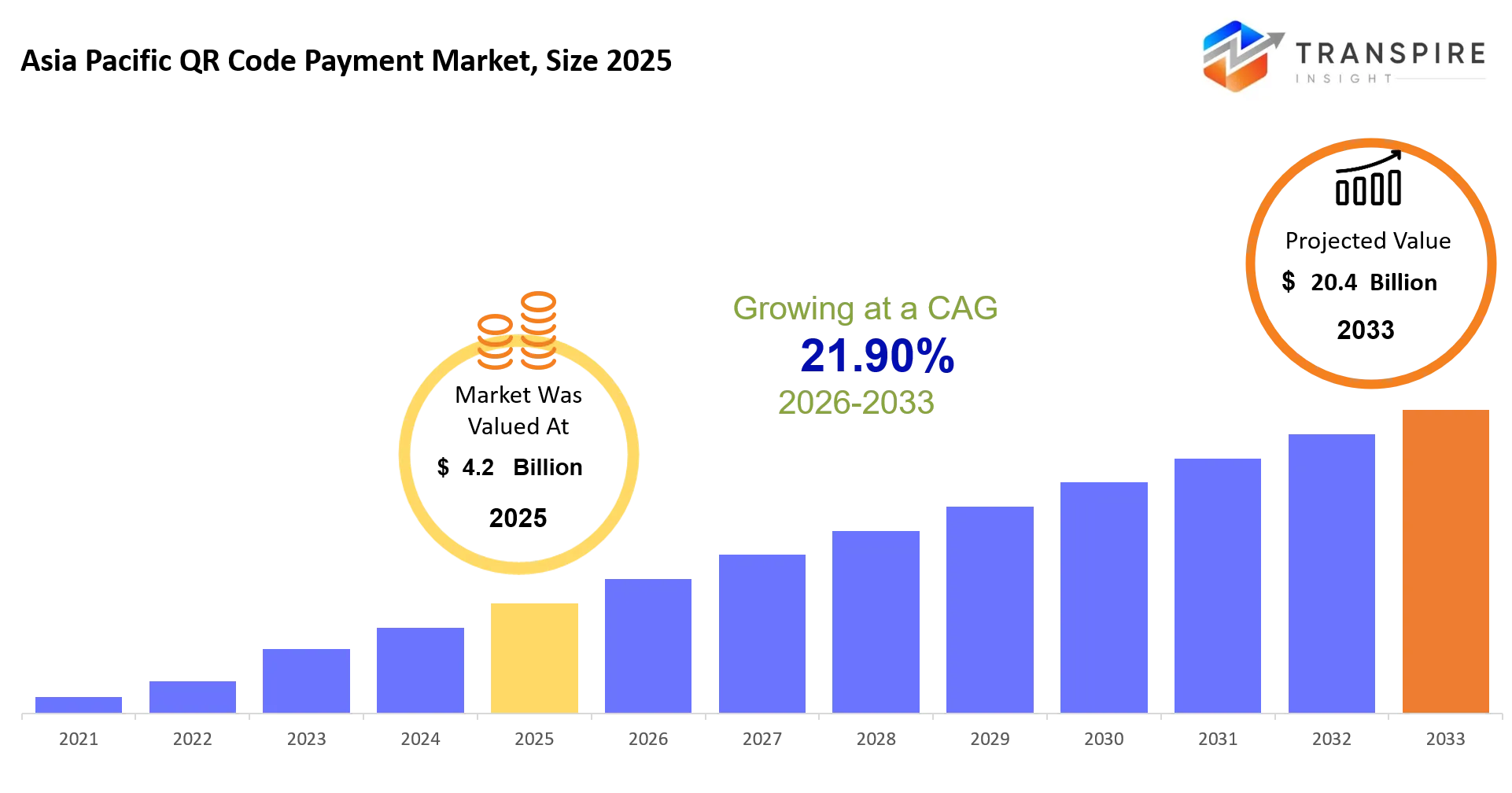
As per Transpire Insight Analysis, the Asia Pacific QR Code Payment Market size is estimated at USD 4.2 Billion in 2025 and is anticipated to reach USD 20.4 Billion by 2033, growing at a CAGR of 21.90% from 2026 to 2033.
The Asia Pacific QR Code Payment Market lets businesses, merchants, service providers and consumers finish digital transactions right away using scannable codes, which ends up lowering the need for cash, and also cuts down on costly card acceptance setups. In day to day use, this approach has turned into a usable payment way across retail outlets, transportation systems, hospitality venues, healthcare environments, public services, and even smaller enterprises because it makes low-cost digital acceptance feel a bit simpler, and less heavy.
In the past five years, the whole market look has been moving away from isolated, homegrown payment ecosystems and toward interoperable real-time payment networks, backed by central banks and national digital payment blueprints. The COVID-19 pandemic, honestly, became a big push factor by speeding up contactless payments, and by persuading merchants to refresh how they take payments. Then as banks, financial institutions, fintech players, and governments kept extending digital payment infrastructure, transaction levels climbed, while merchant onboarding got more streamlined and faster to manage.
This broader ecosystem growth keeps adding revenue chances by pushing wider financial inclusion, trimming transaction friction, and making room for extra digital commerce services across big cities and also emerging regional markets, even where infrastructure used to be thin.
Asia Pacific QR Code Payment Market Size & Forecast:
- Asia Pacific QR Code Payment Market Size 2025: USD 4.2 Billion
- Expected Market Value 2033: USD 20.4 Billion
- Forecast CAGR: 21.90%
- Leading region in 2025: China
- Fastest Growing region: Southeast Asia
- Key Profile: Alipay, WeChat Pay, Paytm, PhonePe, Google Pay, BHIM UPI, GrabPay, LINE Pay, Kakao Pay, UnionPay, Razorpay, Stripe, PayPal, Ant Group, Tencent
Key Market Insights
- China kind of dominated the regional market, with around 58% share in 2025. This was supported by a mature digital payment setup and widespread merchant acceptance, you know, the usual momentum.
- Meanwhile Southeast Asia looks like it will grow the quickest over 2025–2033. The drivers are financial inclusion initiatives plus more people getting smartphones, so yeah.
- For the service side, Consumer-to-Business payments led the segment, with close to 52% in 2025. This suggests strong retail, and service-sector transaction volumes, moving a lot.
- Business-to-Business payments sit as the second biggest segment. Enterprises are expanding digital settlement systems across regional supply chain flows, fairly directly.
- Cross-border QR code payments are expected to be the fastest growing trend through 2033. That growth should be backed by regional interoperability efforts, those payment linkage programs between countries.
- In terms of use cases, retail and e-commerce stayed dominant, with roughly 47% market share in 2025. This is tied to omnichannel commerce expansion, even across channels.
- Transportation and mobility services should see the fastest application growth during the forecast window. Transit operators are integrating unified QR payment platforms, piece by piece.
- For end users, small and medium-sized enterprises accounted for nearly 55% adoption in 2025. The reason is lower payment acceptance costs than traditional card infrastructure, which helps a lot.
- Lastly, hospitality and tourism businesses are predicted to become the fastest-growing end-user category through 2033. This is supported by regional travel recovery and more cross-border payment adoption, overall.
What are the Key Drivers, Restraints, and Opportunities in the Asia Pacific QR Code Payment Market?
The strongest driver tends to come from government-backed instant payment infrastructure and those standardized QR payment frameworks, you know, the kind that make things smoother. With national digital payment policies in place, alongside reduced merchant onboarding costs, the barriers for millions of small business owners get lower, kind of automatically. Banks and fintech firms can now link merchants to real-time settlement platforms within just days, not weeks. When onboarding is faster, transaction volumes expand. Then payment frequency rises and platform revenue follows, not only from payment processing but also from lending and those extra value-added merchant services. So the overall effect is wider commercial adoption across retail, transportation, healthcare, and public services.
The biggest restraint still seems to be fragmented cross border payment standards and uneven regulatory requirements across Asia Pacific economies. Even the technical integration, plus compliance duties, and the different consumer protection rules. They all mean meaningful investment is needed before interoperability can really scale. Per Transpire Insight review of regional procurement announcements and launch schedules, supply chain concentration stays the main execution risk. These structural snags slow down merchant integration, push out regional payment launches, and end up dampening potential transaction revenue, even when domestic adoption is strong.
The biggest opportunity sits in interoperable cross border QR payment networks backed by central banks and regional payment alliances, kind of like a shared lane. ASEAN payment connectivity programs and some bilateral payment linkages make up the right atmosphere for frictionless international transactions. With AI powered fraud detection paired with digital identity verification and embedded financial services , trust should rise even more. These kinds of investments basically place Southeast Asia as the next major growth engine for regional digital payment ecosystems, going forward.
What Has the Impact of Artificial Intelligence Been on the Asia Pacific QR Code Payment Market?
Artificial intelligence is kinda reshaping QR code payment platforms, mainly by automating fraud detection, keeping an eye on transactions, doing customer authentication and handling regulatory compliance across those big, high-volume payment networks. Banks and fintech firms roll out AI models to spot weird transaction patterns in milliseconds, so they cut down fraud exposure while also pushing up payment approvals. Machine learning also does demand forecasting, it sort of studies seasonal spending habits, merchant activity, and consumer behavior, then payment providers can tune their infrastructure capacity before the next rush even hits.
Predictive analytics improves how the network behaves, it reduces processing lag and helps disputes get sorted faster. In practice that means payment operators can lower operating costs, but still keep the service reliable. On top of that, AI chatbots and “smart” merchant onboarding workflows speed up account activation and make customer support feel more efficient, like faster responses and smoother guidance.
Meanwhile, advanced analytics helps banks craft more personalized financial products using transaction insights that come from digital payment ecosystems. Still, AI adoption has limits. Blending older banking infrastructure with modern AI platforms takes serious investment, plus high-quality transaction datasets. Smaller institutions often run into integration expenses, uneven data quality, and cybersecurity demands that are hard to meet, so rollout slows down across multiple emerging Asia Pacific markets.
Key Market Trends
- Between 2023 and 2025 China sort of strengthened national QR payment interoperability, so that payment acceptance got better across banks, merchants, and even those digital wallets people use every day.
- From 2022 onward, ASEAN payment connectivity initiatives picked up pace, and as a result regional QR payment interoperability started working across more participating economies, not just a single lane.
- Since 2024, AI based fraud detection platforms have reduced how much time teams spend on manual transaction reviews, which made payment authorization feel faster and also more operationally efficient.
- During 2023–2025, financial institutions also moved to expand cloud-native payment processing infrastructure, basically to handle higher real time transaction volumes without too much friction.
- After 2024, embedded finance solutions became more common, so merchants could fold lending, loyalty, and payment services into one single application, instead of juggling separate tools.
- Since 2023 tourism recovery helped accelerate cross-border QR payment acceptance across airports, hotels, restaurants, and lots of retail destinations too.
- Alipay+, WeChat Pay, PhonePe, and GrabPay expanded regional partnerships between 2023 and 2025, which improved merchant acceptance and made cross-border transactions a bit smoother.
- Central banks, from 2022 onward, increased their support for standardized QR payment specifications, and that simplified interoperability between domestic and regional payment systems.
- By 2025, small merchant digitization accelerated too, mainly because lower onboarding costs pushed wider acceptance than traditional point of sale card terminals.
Asia Pacific QR Code Payment Market Segmentation
By Payment Type :
Merchant Payments take the biggest slice, because businesses across retail outlets , eateries, pharmacies, and various service desks keep shifting away from cash and older card mechanisms toward QR enabled transactions. The setup costs stay relatively low, confirmation comes fast, and integration is pretty painless with digital wallets, so adoption keeps widening. Also, the growth of organized retail and digital commerce kind of pushes transaction volumes higher in both urban and semi urban areas.
Peer-to-Peer Payments still gets the most everyday use, for person to person transfers, like basically daily money moving. Bill Payments keep climbing, since utility providers , telecom operators, and public service organizations ramp up their digital acceptance. Transit Payments gather momentum with smart mobility programs, and Cross-Border Payments show the fastest expansion too, mainly because regional payment linkages make international transactions less complicated. Then there are the others, meaning specialized payment applications for education, entertainment, and community services.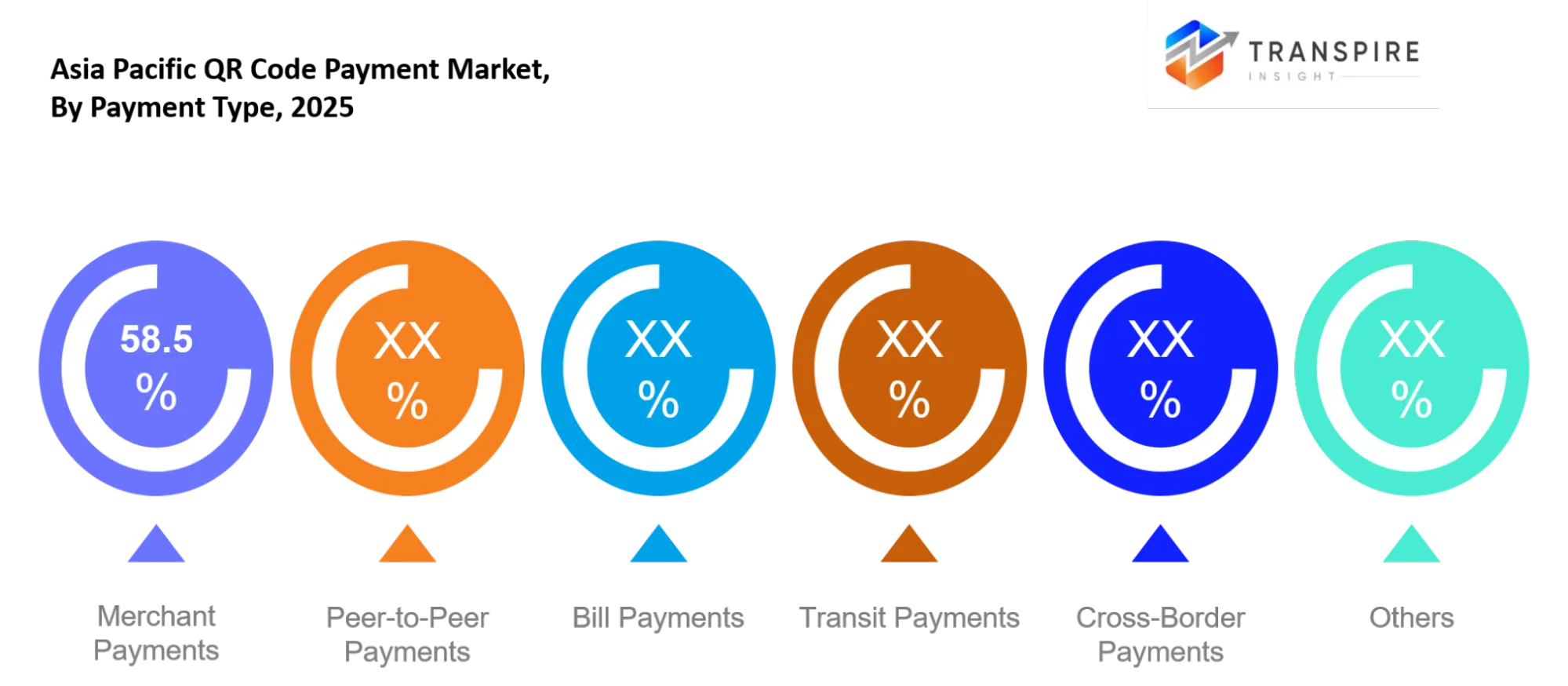
By Deployment :
Static QR Codes make up a large chunk of deployments, since small businesses tend to favor affordable setups with minimal install effort. The idea is pretty straightforward, low upkeep too, so independent retailers and nearby service providers can actually adopt them without much hassle. Static codes are still a great fit when a business has fixed pricing, and also when payments are simple, like predictable, everyday workflows.
Dynamic QR Codes keep growing, mainly because bigger companies want transaction-specific codes that help improve payment accuracy, make reconciliation easier, and add layers of security. Hybrid QR Systems are also getting more traction, because they kind of blend the benefits of both routes , so different kinds of businesses can use what fits best. There are also other approaches, like tailored deployment models created around industry specific operational needs, plus integrated payment ecosystems that connect everything more seamlessly.
By End User :
Retail still acts like the leading end-user block, think supermarkets, convenience stores, malls and online merchants , who keep pushing huge transaction volumes using QR-enabled payments. The point is fast checkout moments, plus wider digital wallet compatibility, which just helps day to day operations run smoother. Ongoing investment in omnichannel commerce also feeds into that retail adoption, almost like it’s just going in a loop.
Hospitality, Healthcare, Transportation, BFSI, and Government orgs keep moving toward more digital payment hookups across services that customers actually see. Transportation is seeing particularly good growth via digital ticketing and fare collection solutions. Government agencies are also nudging broader use with digital public service payments. As for Others, that can cover education, entertainment, and professional service providers , all adopting cashless transaction platforms in their own ways.
By Transaction Mode :
Online Payments hold the largest share, because e-commerce platforms, subscription services, and digital marketplaces are relying more and more on QR enabled payment options. There is fast authorization , secure transactions, and a more convenient checkout experience that sort of pushes regular usage. With the digital retail channels keep expanding continuously, it supports long-term growth of transactions too,
Offline POS Payments stay a major segment across physical retail locations and service establishments. Mobile App Payments are growing the quickest, since digital wallet ecosystems bring extra financial services inside the mobile platforms themselves, which is pretty natural. Web Payments keep supporting browser based transactions, while Others include specialized payment channels, that are built for industry specific operational needs
By Device :
Smartphones kind of dominate how people use devices, mainly because both consumers and merchants widely lean on mobiles for things like scanning, payment authorization, and getting into a digital wallet. With high smartphone penetration, plus internet that actually stays reliable, transaction frequency gets stronger in both developed and emerging markets. And then regular software upgrades sort of keep improving payment security while also making it easier for users, you know.
Tablets and POS terminals keep on supporting commercial payments too, especially across organized retail, hospitality, and different business settings. Wearables are slowly moving in, mostly through contactless payment features that get built into smart devices for everyday buys. Other options show up as well, like specialized connected devices, built for commercial, institutional, and public service payment operations.
What are the Key Use Cases Driving the Asia Pacific QR Code Payment Market?
Retail transactions are still the main use case, because merchants need a quick, low-cost way to pay that actually works across shops of every size. Supermarkets , convenience stores, restaurants , pharmacies, and small businesses lean on QR code payments to shave off queue time, make payment intake more straightforward, and cut back on the amount of hardware they need to invest in
Healthcare and transportation are growing too, more or less at a stable pace. Hospitals and clinics use QR payments to simplify patient invoicing, and for pharmacy collections as well, while public transit operators are folding QR based ticketing in so passenger flow feels smoother and there’s less cash handling across urban mobility lanes
Cross-border travel payments and government digital service collections also look pretty promising as emerging applications. In some regions, payment interoperability programs let international visitors pay using familiar domestic digital wallets, and public agencies are widening QR based options for taxes, permits, and municipal services, which should open up even more chances as digital payment norms continue to mature.
|
Report Metrics |
Details |
|
Market size value in 2025 |
USD 4.2 Billion |
|
Market size value in 2026 |
USD 5.1 Billion |
|
Revenue forecast in 2033 |
USD 20.4 Billion |
|
Growth rate |
CAGR of 21.90% from 2026 to 2033 |
|
Base year |
2025 |
|
Historical data |
2021 - 2024 |
|
Forecast period |
2026 - 2033 |
|
Report coverage |
Revenue forecast, competitive landscape, growth factors, and trends |
|
Regional scope |
Asia Pacific (India, China, Japan, Australia, South Korea, Rest of Asia Pacific) |
|
Key company profiled |
Alipay, WeChat Pay, Paytm, PhonePe, Google Pay, BHIM UPI, GrabPay, LINE Pay, Kakao Pay, UnionPay, Razorpay, Stripe, PayPal, Ant Group, Tencent . |
|
Customization scope |
Free report customization (country, regional & segment scope). Avail customized purchase options to meet your exact research needs. |
|
Report Segmentation |
By Payment Type (Merchant Payments, Peer-to-Peer Payments, Bill Payments, Transit Payments, Cross-Border Payments, Others); By Deployment (Static QR Codes, Dynamic QR Codes, Hybrid QR Systems, Others); By End User (Retail, Hospitality, Healthcare, Transportation, BFSI, Government, Others); By Transaction Mode (Online Payments, Offline POS Payments, Mobile App Payments, Web Payments, Others); By Device (Smartphones, Tablets, POS Terminals, Wearables, Others) |
Which Regions are Driving the Asia Pacific QR Code Payment Market Growth?
China roughly made up about 58% of the regional market in 2025, so it ends up as the biggest driver of transaction value and merchant adoption. A lot of that comes from government backing for digital payments,plus standardized QR payment blueprints, and then the real-time payment setup that basically made it easier for people to say yes and use it every day. Big technology companies, banks, payment processors, and fintech players are still putting money into merchant services, payment safety, and cross-platform compatibility across the whole country. And you can also see why this keeps working—constant innovation, wide merchant reach, and most consumers already know digital payments pretty well. That combination should help China stay at the top for most of the forecast window.
Japan is the next big contributor, mainly because the market likes secure payment systems, keeps pushing regulatory consistency, and leans on long-term investment more than quick, sudden scaling. There are steady financial institutions, dependable telecommunications, and strong consumer trust, all of which support fairly consistent transaction growth across retail, transport, and public services. Companies there keep improving what they take, usually through planned modernization, not with aggressive rollout cycles. Overall, this more careful method provides reliable revenue streams and keeps strengthening long-term commercial uptake across several industries.
Southeast Asia is expected to show the speediest growth between 2026 and 2033, as countries speed up payment interoperability, and roll out more financial inclusion initiatives. Regional payment linkage agreements, digital banking expansion, and smartphone based payment take-up have really boosted access to cashless dealings across Indonesia, Vietnam, Thailand, Malaysia, and the Philippines. At the same time, investments in real-time payment infrastructure, plus merchant digitization, keep widening commercial openings in both city areas and countryside neighborhoods. With all that momentum, the outlook starts to look appealing for payment providers, fintech firms, and tech investors who are aiming to move into , and expand across emerging digital economies during the forecast period.
Who are the Key Players in the Asia Pacific QR Code Payment Market and How Do They Compete?
Competition across the Asia Pacific QR Code Payment Market still looks sort of moderately consolidated, while big digital payment platforms and regional fintech players kinda move side by side with financial institutions. The main thing that really decides who wins usually is technology innovation, ecosystem integration, merchant acceptance, and cross-border payment capability, even if everyone says it in their own way. The older established payment providers keep reinforcing the ecosystems they already have, while the newer fintech companies add more focused services that make merchant onboarding easier, improve digital lending, and streamline payment processing.
Alipay+ kinda stands out because of cross-border payment interoperability, it connects multiple digital wallets across Asia so merchants can accept payments from international visitors with minimal, or almost no, system changes. WeChat Pay leans into deep ecosystem integration by mixing payments with messaging, commerce, and lifestyle services, which tends to boost customer engagement and also increases how often transactions happen. Both of them keep growing regional partnerships, this is the part that helps merchant acceptance go further than only domestic markets.
PhonePe competes by pushing more value-added financial services, plus merchant management tools, and AI-enabled payment security for businesses of different sizes. GrabPay, meanwhile, supports regional expansion by weaving payments into mobility, food delivery, and digital financial services, so it builds a broader consumer ecosystem across Southeast Asia. NETS differentiates in a slightly different way, by investing in interoperable payment infrastructure and teaming up with financial institutions to widen regional QR payment connectivity, which helps enable secure, and efficient, transactions across several participating markets.
Company List
- Alipay
- WeChat Pay
- Paytm
- PhonePe
- Google Pay
- BHIM UPI
- GrabPay
- LINE Pay
- Kakao Pay
- UnionPay
- Razorpay
- Stripe
- PayPal
- Ant Group
- Tencent
Recent Development News
In April 2026, LankaPay, the Sri Lanka Tourism Development Authority (SLTDA), and Alipay+ formed a strategic partnership. The collaboration expanded Alipay+ QR payment acceptance across Sri Lanka to improve digital payment access for international visitors and strengthen tourism-related merchant adoption. Source https://www.alipayplus.com/
In June 2025, Alipay+ launched the world's first smart glasses-embedded payment solution in partnership with Meizu. The technology introduced QR-enabled and wallet-based payments through smart glasses, creating new payment scenarios for merchants and supporting innovation across the Asia Pacific digital payments ecosystem.
Source https://idocs.alipay.com/
What Strategic Insights Define the Future of the Asia Pacific QR Code Payment Market?
The Asia Pacific QR Code Payment Market is going to shift more and more toward deeply integrated digital commerce ecosystems , where payment ability is pretty much embedded across everything from retail, mobility, healthcare, government services, and also cross border transactions. Growth will be pulled along by national digital payment frameworks, real time settlement infrastructure, smartphone penetration, and a stronger push for interoperability between local and international QR standards .
Still, there’s a risk that stays a bit less visible. Market concentration , meaning reliance on just a few dominant payment platforms, could end up shrinking competitive innovation, plus it can leave merchants and consumers exposed to operational hiccups or regulatory disruptions that come out of nowhere.
On the opportunity side , there’s real momentum for interoperable cross-border QR payment corridors across Southeast Asia and nearby economies . This is being enabled by central bank collaboration and a set of regional payment connectivity initiatives, that are designed to knit the systems together.
So market participants should focus investment on interoperable, API based payment infrastructure with improved fraud detection and compliance features. The goal is to allow smooth integration as regulations keep evolving , while also supporting scalable partnerships across banks and other financial institutions, merchants, and digital service providers.
Asia Pacific QR Code Payment Market Report Segmentation
By Payment Type
- Merchant Payments
- Peer-to-Peer Payments
- Bill Payments
- Transit Payments
- Cross-Border Payments
By Deployment
- Static QR Codes
- Dynamic QR Codes
- Hybrid QR Systems
By End User
- Retail
- Hospitality
- Healthcare
- Transportation
- BFSI
- Government
By Transaction Mode
- Online Payments
- Offline POS Payments
- Mobile App Payments
- Web Payments
By Device
- Smartphones
- Tablets
- POS Terminals
- Wearables
Frequently Asked Questions
Find quick answers to common questions.
The Expected Asia Pacific QR Code Payment Market size for the Market will be USD 20.4 Billion in 2033.
Key Segments for the Asia Pacific QR Code Payment Market are By Payment Type (Merchant Payments, Peer-to-Peer Payments, Bill Payments, Transit Payments, Cross-Border Payments, Others); By Deployment (Static QR Codes, Dynamic QR Codes, Hybrid QR Systems, Others); By End User (Retail, Hospitality, Healthcare, Transportation, BFSI, Government, Others); By Transaction Mode (Online Payments, Offline POS Payments, Mobile App Payments, Web Payments, Others); By Device (Smartphones, Tablets, POS Terminals, Wearables, Others).
Major Asia Pacific QR Code Payment Market players are Alipay, WeChat Pay, Paytm, PhonePe, Google Pay, BHIM UPI, GrabPay, LINE Pay, Kakao Pay, UnionPay, Razorpay, Stripe, PayPal, Ant Group, Tencent.
The Current Asia Pacific QR Code Payment Market size is USD 4.2 Billion in 2025.
The Asia Pacific QR Code Payment Market CAGR is 21.90% from 2026 to 2033.
- Alipay
- WeChat Pay
- Paytm
- PhonePe
- Google Pay
- BHIM UPI
- GrabPay
- LINE Pay
- Kakao Pay
- UnionPay
- Razorpay
- Stripe
- PayPal
- Ant Group
- Tencent
About the Authors

Mayur Shinde
I am Mayur Shinde, a Senior Research Analyst at Transpire Insight, specializing in the Automotive & Transportation and Information & Communication Technology (ICT) Industry. My work focuses on analyzing emerging market trends, technological advancements, competitive landscapes, and industry developments to deliver accurate, data-driven insights. I am passionate about transforming complex market information into clear, actionable content that helps businesses, professionals, and decision-makers stay informed and make confident strategic decisions.

Chakradhar Khansole
Chakradhar serves as the Research Director at Transpire Insight, bringing over 8 years of experience in technology, innovation, and strategic market intelligence. He specializes in transforming complex market data into actionable business insights that enable organizations to make informed, growth-oriented decisions. Recognized for his strategic vision and analytical expertise, Chakradhar leads high-impact research initiatives, delivering comprehensive market assessments, competitive intelligence, and forward-looking industry analysis.
Recently Published Reports
-
Apr 2026
3D Optical Profiler Market
3D Optical Profiler Market Size, Share & Analysis Report By Type (Desktop 3D Optical Profiler, and Portable 3D Optical Profiler), By Technology (Confocal Technology, and White Light Interference), By End-Use Industry (Manufacturing, Research Institutions, Automotive, Aerospace and Defense, Medical Devices, and Other), and Geography (North America, Europe, Asia-Pacific, Middle East and Africa, South and Central America), 2021 - 2031
-
Apr 2026
Depth Sensor Market
Depth Sensor Market Size, Share & Analysis Report By Type (Infrared Depth Sensors, Time-of-Flight (ToF) Sensors, Stereo Vision Sensors, Structured Light Sensors, Ultrasonic Depth Sensors), By Application (Automotive, Robotics, Gaming, Consumer Electronics, Industrial Automation, Healthcare, Security & Surveillance, Others), By End Users (Automotive Manufacturers, Consumer Electronics Companies, Healthcare Providers, Industrial Companies, Security Agencies, Gaming Companies, Robotics Companies, Others), and Geography (North America, Europe, Asia-Pacific, Middle East and Africa, South and Central America), 2021 – 2031
-
Apr 2026
Digital Manufacturing Market
Digital Manufacturing Market Size, Share & Analysis Report By Component (Hardware, Software, and Services), By Technology (Robotics, 3D Printing, Internet of Things (IoT), and Others), By Application (Automotive and Transportation, Aerospace and Defense, Consumer Electronics, Industrial Machinery, and Others), By Process Type (Computer-Based Designing, Computer-Based Simulation, Computer 3D Visualization, Analytics, and Others), and Geography (North America, Europe, Asia-Pacific, Middle East and Africa, South and Central America), 2021 – 2031
-
Apr 2026
Digital Visa Services Market
Digital Visa Services Market Size, Share & Analysis Report By Type (Individual Travelers, Group Travelers), By Application (Tourism, Business Travel, Others), and Geography (North America, Europe, Asia-Pacific, Middle East and Africa, South and Central America), 2021 – 2031