

Asia Pacific Pressure Washer Market Size & Forecast:
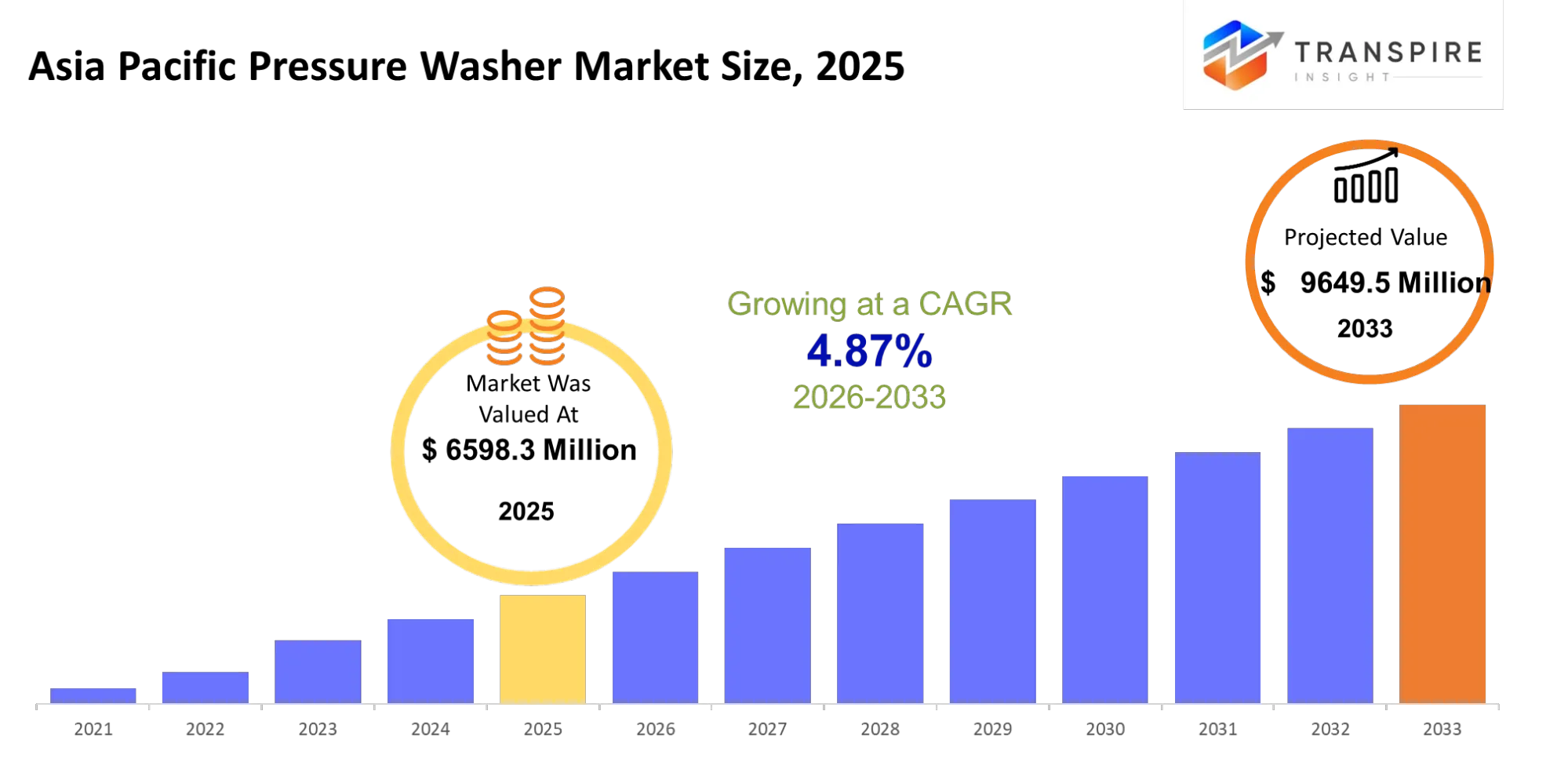
- Asia Pacific Pressure Washer Market Size 2025: USD 6598.3 Million
- Asia Pacific Pressure Washer Market Size 2033: USD 9649.5 Million
- Asia Pacific Pressure Washer Market CAGR: 4.87%
- Asia Pacific Pressure Washer Market Segments: By Type (Electric Pressure Washer, Gas Pressure Washer, Battery-operated Washer, Others); By Application (Residential Cleaning, Commercial Cleaning, Industrial Cleaning, Automotive Cleaning, Agriculture, Others); By End-User (Households, Commercial Users, Industrial Users, Automotive Sector, Agriculture Sector, Others); By Distribution (Online, Retail Stores, Specialty Stores, Others)
To learn more about this report,  Download Free Sample Report
Asia Pacific Pressure Washer Market Summary
The Asia Pacific Pressure Washer Market was valued at USD 6598.3 Million in 2025. It is forecast to reach USD 9649.5 Million by 2033. That is a CAGR of 4.87% over the period.
The Asia Pacific region depends on pressure washers which multiple industries use at ports, shipyards , construction sites and manufacturing facilities to eliminate oil corrosion and salt accumulation and industrial waste from their equipment and work areas so they can maintain safe operations and protect their assets for extended periods. The market has moved away from traditional fuel-powered systems during the past five years because electric systems with high-pressure capabilities and water-saving features have become popular among industrial facilities that require scheduled maintenance.
The implementation of stricter environmental discharge regulations at coastal manufacturing sites and ports throughout China India and Southeast Asia has created a major environmental trigger which satisfies post-pandemic industrial cleaning requirements that demand increased sanitation measures. During the period from 2020 until 2022 supply chain interruptions forced businesses to shift their purchasing practices toward local sources and invest in long-lasting systems which require minimal upkeep. The company has adopted energy-efficient equipment and rental cleaning services as its new business model which generates revenue through premium service-based products instead of selling equipment.
Key Market Insights
- China established itself as the leading force in the Asia Pacific Pressure Washer Market through a market share of 38% which it achieved during 2025 because of its manufacturing capacity and its operational ports.
- The Indian market will experience the fastest growth rate until 2030 because of its industrial development and demand for commercial cleaning services and infrastructure development initiatives.
- The electric pressure washer segment emerged as the top product category in 2025 because industries needed to achieve lower operational expenses and meet emissions standards.
- The gas-powered pressure washer market retained its position as the second largest segment which served heavy-duty construction projects and mining operations and large outdoor industrial work.
- Battery-operated pressure washers are emerging as the fastest-growing category through 2030 because they provide users with mobility and allow for cordless cleaning work.
- The Industrial cleaning applications accounted for almost 42% of the Asia Pacific Pressure Washer Market revenue in 2025 because factories needed their equipment to be maintained.
- The automotive industry and vehicle washing sector experience their highest growth rate because commercial fleet operators now conduct more frequent vehicle cleaning while they invest in automated cleaning systems.
- The maritime and shipyard cleaning industry experienced rapid growth after new coastal pollution regulations forced ship operators to implement stricter equipment maintenance protocols and surface contamination control measures.
- Commercial facilities use high-pressure cleaning systems because they need fewer workers to clean their spaces while these systems enable faster cleaning operations.
- The market for hot water pressure washers expanded because these machines provide better results in cleaning grease and chemical residues and industrial oil deposits from surfaces.
What are the Key Drivers, Restraints, and Opportunities in the Asia Pacific Pressure Washer Market?
The tight industrial hygiene requirements and wastewater discharge standards which manufacturers must follow in China and Japan and South Korea and India function as the primary factor which determines the growth of the Asia Pacific Pressure Washer Market. The past five years have seen new restrictions which require port operations and automotive manufacturing and food production facilities to meet elevated standards for both surface cleanliness and chemical residue handling and their operational upkeep. The industrial sector had to adopt high-pressure automated cleaning systems which eliminated the need for manual cleaning because these systems managed to decrease both cleaning duration and water usage requirements. The industrial sector expanded its preventive maintenance budget to protect itself from both regulatory fines and equipment downtime which enabled pressure washer manufacturers to gain from increased equipment replacement rates and improved ongoing income through maintenance agreements and rental business operations.
The market suffers from its most significant limitation because small industrial operators and local service contractors face challenges with the expensive initial investment which advanced electric and hot-water pressure washer systems require. The market faces this obstacle because numerous economies in the Asia Pacific region still need to develop industrial financing systems and post-sales service networks which provide service outside major city areas. The use of low-efficiency cleaning equipment by businesses has not changed because they continue to delay technology upgrades and this situation leads to restricted access to high-end products.
The logistics and warehouse sectors in Southeast Asia are creating a significant opportunity through their implementation of battery-powered and IoT-enabled pressure washer systems. The automated fulfillment centers in Vietnam and Indonesia are expanding their operations which creates a need for cleaning systems that combine mobile capabilities with low-noise operation to maintain efficiency in restricted industrial spaces.
What Has the Impact of Artificial Intelligence Been on the Asia Pacific Pressure Washer Market?
Artificial intelligence and advanced digital systems are changing how pressure washers work in industrial sites and logistics centers and maritime maintenance areas throughout the Asia Pacific region. Manufacturers use AI-based monitoring systems to control high-pressure cleaning machines because these systems adjust water pressure and detergent levels and work cycles based on what surfaces need cleaning. The connected fleet management systems in large manufacturing plants and port facilities enable real-time tracking of equipment usage and operator activities and maintenance schedules which helps contractors cut down on idle time while they better manage equipment resources.
Machine learning models use vibration pattern analysis together with motor temperature data and pump pressure information and water flow pattern detection to perform predictive maintenance tasks. These systems detect pump wear and nozzle blockage at their earliest stages which helps organizations prevent equipment failures and prolong equipment operational life. Industrial operators from Japan and South Korea have achieved better maintenance response times and reduced servicing expenses through the use of sensor-based cleaning equipment management platforms. Operators use AI-based optimization tools to decrease their water and electricity usage when they conduct their routine cleaning tasks.
The expensive integration costs together with the incomplete development of industrial systems present a significant obstacle which prevents businesses from adopting artificial intelligence technology. Many small and medium-sized operators across Southeast Asia continue using older standalone cleaning systems that lack sensor compatibility and stable connectivity which prevents them from implementing advanced automation technologies at scale.
Key Market Trends
- The period between 2020 and 2025 saw electric pressure washers acquire market share because China and Japan enforced stricter industrial emissions and workplace noise control regulations.
- After 2021 supply chain disruptions made equipment maintenance unpredictable, industrial buyers started using rental and service-based contracts instead of purchasing equipment.
- The food processing and automotive industries adopted hot-water pressure washers because operators required equipment that could remove grease and chemical residues within shorter time periods.
- After 2023 warehouse automation developed rapidly in Vietnam and Indonesia Southeast Asian logistics hubs started using battery-powered mobile cleaning systems.
- The period between 2020 and 2022 showed industrial contractors decrease their use of imported parts because pandemic shipping delays revealed their supply chain weaknesses.
- The procurement process established water recycling and low-flow nozzle technologies as mandatory requirements after multiple Asian manufacturing zones implemented stricter wastewater discharge regulations.
- The commercial cleaning industry adopted high-pressure automated systems as replacements for manual cleaning crews because these systems lowered labor expenses while decreasing the time needed to clean facilities.
- Regional manufacturers in India have increased their local assembly operations since 2024 to match the pricing and service standards of premium European brands.
- Industrial facilities have adopted IoT-enabled pressure washer systems because operators need real-time equipment diagnostics which help minimize unplanned maintenance downtime.
Asia Pacific Pressure Washer Market Segmentation
By Type:
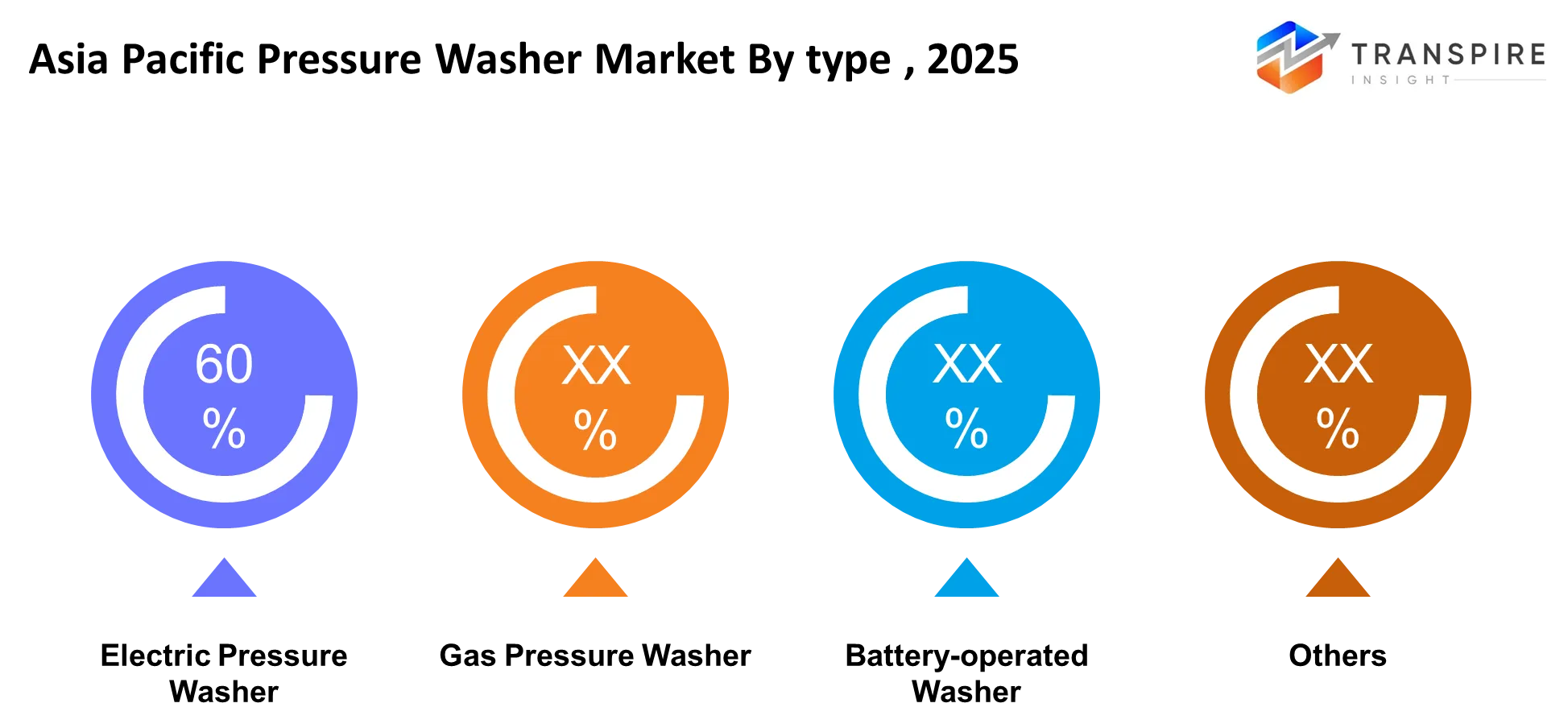
The electric pressure washer segment holds a strong position in the Asia Pacific Pressure Washer Market because residential spaces and small commercial cleaning requirements drive its usage. The product maintains constant demand because it provides easy operation and needs minimal upkeep while handling frequent cleaning activities. The two factors of rising urban housing projects and growing public understanding of easy cleaning methods continue to drive product adoption throughout major regional markets.
Gas pressure washers maintain demand in applications requiring higher power output and longer operational duration. Industrial facilities and large-scale outdoor cleaning operations often prefer this category because of stronger pressure capabilities. The demand for battery-operated washers continues to grow because users want portable equipment to meet their various cleaning requirements. The other category includes hybrid and specialized units designed for niche operational requirements which help the market achieve wider product diversity.
To learn more about this report, Download Free Sample Report
By Application:
The residential cleaning sector serves as a primary market because people throughout Asia Pacific have started to use contemporary cleaning equipment for their outdoor spaces and vehicles and home patios and exterior areas. The growing need for efficient cleaning products developed through rising disposable income and new lifestyle trends has created demand for cleaning tools that minimize physical work while delivering better cleaning results.
Business operations together with manufacturing facilities and infrastructure systems need ongoing upkeep which results in substantial cleaning work requirements for both commercial and industrial cleaning tasks. The automotive cleaning market maintains its significance because both vehicle ownership rates and professional car wash business expansion continue to grow. The increasing agricultural applications of pressure washers support equipment cleaning and facility upkeep while specialized applications continue to expand their operational boundaries.
By End-User:
The demand for compact and user-friendly cleaning equipment which provides effective domestic maintenance solutions has created a large customer base among householders. Urban consumers increasingly value products that save time and improve cleaning outcomes. This trend has encouraged manufacturers to create accessible solutions which fulfill different residential cleaning needs that exist in both developed and developing regional markets.
The hospitality sector and retail centers and service businesses together make up the commercial users who need to maintain their cleaning standards at all times. The industrial sector requires pressure washers which serve two main purposes: they help maintain their machinery and they support facility cleaning. The automotive sector maintains its growth through the expansion of detailing centers and service stations. The agricultural sector is increasing its use of cleaning equipment and operational spaces while institutions and public maintenance departments make up the rest of the end-user market.
By Distribution:
The expanding digital commerce platforms throughout Asia Pacific have resulted in rapid growth for online distribution channels at present time. The ability to compare products and read customer reviews and view promotional offers has made online shopping more convenient for consumers. Digital sales strategies are being developed by manufacturers and distributors to expand their customer reach and increase their market presence.
Retail stores continue to hold importance by offering direct product inspection and immediate purchase options. The majority of buyers prefer to receive face-to-face assistance when they choose their cleaning equipment. Specialty stores maintain relevance because technical advice and product demonstrations and after-sales support create greater buyer confidence. The combination of these channels provides customers with easy access to products while helping regional markets develop at a steady pace.
What are the Key Use Cases Driving the Asia Pacific Pressure Washer Market?
Industrial equipment cleaning remains the dominant use case across the Asia Pacific Pressure Washer Market, particularly in manufacturing plants, shipyards, and automotive facilities. Operators depend on high-pressure systems to eliminate grease and metal particles and chemical residues while they reduce operational downtime and labor expenses.
The logistics and retail and transportation industries are experiencing rapid growth in commercial vehicle washing and warehouse sanitation services. Fleet operators increasingly use automated pressure washer systems to maintain trucks, delivery vans and port handling equipment under stricter operational hygiene and maintenance standards.
Emerging applications include pressure washer integration with robotic cleaning systems in smart factories and battery-powered mobile units for offshore maintenance operations. Demand is also developing in solar farm cleaning projects across India and Australia, where operators require water-efficient systems to maintain panel efficiency in dusty industrial environments.
|
Report Metrics |
Details |
|
Market size value in 2025 |
USD 6598.3 Million |
|
Market size value in 2026 |
USD 6915.8 Million |
|
Revenue forecast in 2033 |
USD 9649.5 Million |
|
Growth rate |
CAGR of 4.87% from 2026 to 2033 |
|
Base year |
2025 |
|
Historical data |
2021 - 2024 |
|
Forecast period |
2026 - 2033 |
|
Report coverage |
Revenue forecast, competitive landscape, growth factors, and trends |
|
Regional scope |
India, China, Japan, and Australia |
|
Key company profiled |
Karcher, Bosch, Stanley Black & Decker, Nilfisk, Makita, Ryobi, Honda, Briggs & Stratton, Simpson, Generac, Lavorwash, Annovi Reverberi, AR Blue Clean, Snow Joe, Craftsman |
|
Customization scope |
Free report customization (country, regional & segment scope). Avail customized purchase options to meet your exact research needs. |
|
Report Segmentation |
By Type (Electric Pressure Washer, Gas Pressure Washer, Battery-operated Washer, Others); By Application (Residential Cleaning, Commercial Cleaning, Industrial Cleaning, Automotive Cleaning, Agriculture, Others); By End-User (Households, Commercial Users, Industrial Users, Automotive Sector, Agriculture Sector, Others); By Distribution (Online, Retail Stores, Specialty Stores, Others) |
Which Regions are Driving the Asia Pacific Pressure Washer Market Growth?
The Asia Pacific Pressure Washer Market is dominated by China because the country has many manufacturing facilities and extensive commercial ports and strict rules for industrial equipment maintenance. The industrial provinces maintain their equipment through automated cleaning systems which enable them to meet wastewater discharge standards while increasing their productivity. The nation operates a robust domestic supply chain which delivers motors and pumps and industrial cleaning equipment, resulting in reduced production expenses and enhanced product distribution. The demand for equipment replacement and technology upgrades remains constant because large shipyards and automotive clusters and export-oriented factories require ongoing equipment updates.
Japan represents the second-largest regional contributor, but its market behavior differs significantly from China’s volume-driven structure. Japan's market demand relies on permanent funding for precision manufacturing and advanced facility maintenance and long-term industrial asset management. Buyers prioritize reliability, energy efficiency, and automated monitoring capabilities over low-cost procurement, which sustains demand for premium pressure washer systems. Manufacturers can expect stable income because of strong regulatory frameworks and advanced industrial systems, which reduce their business risk.
The Indian market experiences its fastest growth because of industrial expansion and logistics infrastructure development and the modernization of manufacturing facilities. Industrial cleaning equipment demand has increased because of recent government infrastructure programs and the expansion of warehousing and automotive manufacturing and commercial transportation sectors. The development of smart industrial corridors and new port construction projects has created a higher demand for advanced maintenance systems. The period from 2026 to 2033 will create substantial market entry prospects for international manufacturers and regional distributors and service-based equipment providers who want to establish their presence in the industry.
Who are the Key Players in the Asia Pacific Pressure Washer Market and How Do They Compete?
The Asia Pacific Pressure Washer Market currently operates as a fragmented market which features global equipment manufacturers competing against regional vendors and local industrial cleaning companies. Companies compete through their ability to integrate new technologies and show energy efficiency and provide fast after-sales support and create custom solutions for industrial environments which include shipyards and automotive manufacturing facilities and logistics centers. Established manufacturers maintain their market dominance through product development and service agreements while new companies enter the market through lower pricing strategies and speedier shipping options. The market has transformed into solution-based competition because buyers now assess equipment based on its total lifecycle expenses and maintenance needs and water usage instead of only its initial purchase cost.
Kärcher. The company has strengthened its Asia Pacific footprint by expanding service infrastructure and targeting large manufacturing facilities that require predictive maintenance support and fleet-level cleaning management. Nilfisk. The company competes by offering cleaning systems which focus on automation and provide operators with platforms that enhance their productivity while minimizing equipment downtime. The company has established itself in Japan and Southeast Asia because it produces industrial-grade products which operate quietly in urban and indoor industrial spaces.
The Makita brand established itself in the market through its battery-operated portable cleaning equipment, which attracts contractors and maintenance workers who handle infrastructure projects and logistics operations. The cordless system from the company enables commercial users to operate multiple industrial tools because of its compatibility across various devices. Bosch develops small energy-efficient systems which contain highly durable motors and advanced precision systems that specifically meet the needs of commercial cleaning businesses and automotive repair shops. Stanley Black & Decker establishes itself as a competitor through its extensive distribution network and its affordable product offerings which enable the company to reach price-sensitive industrial customers and construction workers in India and developing Southeast Asian markets.
Company List
- Karcher
- Bosch
- Stanley Black & Decker
- Nilfisk
- Makita
- Ryobi
- Honda
- Briggs & Stratton
- Simpson
- Generac
- Lavorwash
- Annovi Reverberi
- AR Blue Clean
- Snow Joe
- Craftsman
Recent Development News
In April 2026, Kärcher launched the OC Handy Compact cordless pressure washer in Japan. The battery-powered portable washer, designed for use without direct water or power connections, strengthens Kärcher’s position in Asia Pacific’s growing compact residential cleaning equipment segment by targeting urban Japanese consumers seeking mobility-focused cleaning solutions.Source https://www.newsminimalist.com/
In March 2026, Nilfisk launched its new MH Series hot-water pressure washers. The rollout of the next-generation product line introduces Nilfisk’s dual-line strategy for professional high-pressure cleaning systems, enhancing its technology offering for industrial customers and increasing competitive pressure across Asia Pacific’s commercial cleaning equipment market.Source https://www.ad-hoc-news.de/
What Strategic Insights Define the Future of the Asia Pacific Pressure Washer Market?
The Asia Pacific Pressure Washer Market will transition from equipment-based sales to complete industrial cleaning systems based on automation and predictive maintenance and resource efficiency for the next five to seven years. Manufacturing plants and logistics centers and port facilities face operational pressure to cut labor costs while complying with advanced wastewater treatment and energy management standards which drive this market transformation. Industrial users will choose suppliers with digital monitoring and service-based business models because they value lifecycle efficiency more than upfront equipment expenses.
The rising need for imported electronic components and lithium battery materials and industrial-grade motors in smart pressure washer systems presents an important but overlooked danger. The market faces two dangers which stem from supply concentration because component manufacturers control most of production which leads to price fluctuations and manufacturing delays during geopolitical or trade interruptions.
Autonomous cleaning systems present a significant opportunity to develop in large logistics parks and solar energy facilities located in India and Southeast Asia. Companies should establish their operations in local markets through assembly and digital service networks and long-term equipment maintenance contracts instead of relying on equipment price matching as their business strategy.
Asia Pacific Pressure Washer Market Report Segmentation
By Type
- Electric Pressure Washer
- Gas Pressure Washer
- Battery-operated Washer
By Application
- Residential Cleaning
- Commercial Cleaning
- Industrial Cleaning
- Automotive Cleaning
- Agriculture
By End-User
- Households
- Commercial Users
- Industrial Users
- Automotive Sector
- Agriculture Sector
By Distribution
- Online
- Retail Stores
- Specialty Stores
Frequently Asked Questions
Find quick answers to common questions.
The Asia Pacific Pressure Washer Market size is USD 9649.5 Million in 2033.
Key segments for the Asia Pacific Pressure Washer Market are By Type (Electric Pressure Washer, Gas Pressure Washer, Battery-operated Washer, Others); By Application (Residential Cleaning, Commercial Cleaning, Industrial Cleaning, Automotive Cleaning, Agriculture, Others); By End-User (Households, Commercial Users, Industrial Users, Automotive Sector, Agriculture Sector, Others); By Distribution (Online, Retail Stores, Specialty Stores, Others).
Major Asia Pacific Pressure Washer Market players are Karcher, Bosch, Stanley Black & Decker, Nilfisk, Makita, Ryobi, Honda, Briggs & Stratton, Simpson, Generac, Lavorwash, Annovi Reverberi, AR Blue Clean, Snow Joe, Craftsman.
The Asia Pacific Pressure Washer Market size is USD 6598.3 Million in 2025.
The Asia Pacific Pressure Washer Market CAGR is 4.87% from 2026 to 2033.
- Karcher
- Bosch
- Stanley Black & Decker
- Nilfisk
- Makita
- Ryobi
- Honda
- Briggs & Stratton
- Simpson
- Generac
- Lavorwash
- Annovi Reverberi
- AR Blue Clean
- Snow Joe
- Craftsman
Recently Published Reports
-
Apr 2026
Fiber Optic Faceplates Market
Fiber Optic Faceplates Market Size, Share & Analysis Report By Type (< 300 mm2, 300-350 mm2, and > 350 mm2, By Application (Night Vision, Holographic Imaging, Medical, and Others), and Geography (North America, Europe, Asia-Pacific, Middle East and Africa, South and Central America), 2021 - 2031
-
Apr 2026
High Temperature Superconductors Market
High Temperature Superconductors Market Size, Share & Analysis Report By Type (1G HTS, and 2G HTS), By Application (Power Cable, Fault Current Limiter, and Transformer), and Geography (North America, Europe, Asia-Pacific, Middle East and Africa, South and Central America), 2021 - 2031
-
Apr 2026
Industrial Plugs and Socket Market
Industrial Plugs and Socket Market Size, Share & Analysis Report By Type (Industrial Plugs, Industrial Sockets), By Current (Up to 32 A, 32 to 125 A, Above 125 A), By Protection (Dustproof and Splash Proof, Waterproof, Explosion Proof), By End User (Heavy Industries, Oil and Gas, Chemicals and Pharmaceuticals, Power Generation, Others), and Geography (North America, Europe, Asia-Pacific, Middle East and Africa, South and Central America), 2021 - 2031
-
Apr 2026
InGaAs Avalanche Photodiodes Market
InGaAs Avalanche Photodiodes Market Size, Share & Analysis Report By Type (1100 - 1700 nm, and 1000 - 1600 nm), By Application (Missile Warning System, Muzzle Flash Detection, Wafer Defect Inspection, Laser Rangefinders, and Others), and Geography (North America, Europe, Asia-Pacific, Middle East and Africa, South and Central America), 2021 - 2031