
Asia Pacific Premium Bottled Water Market Summary
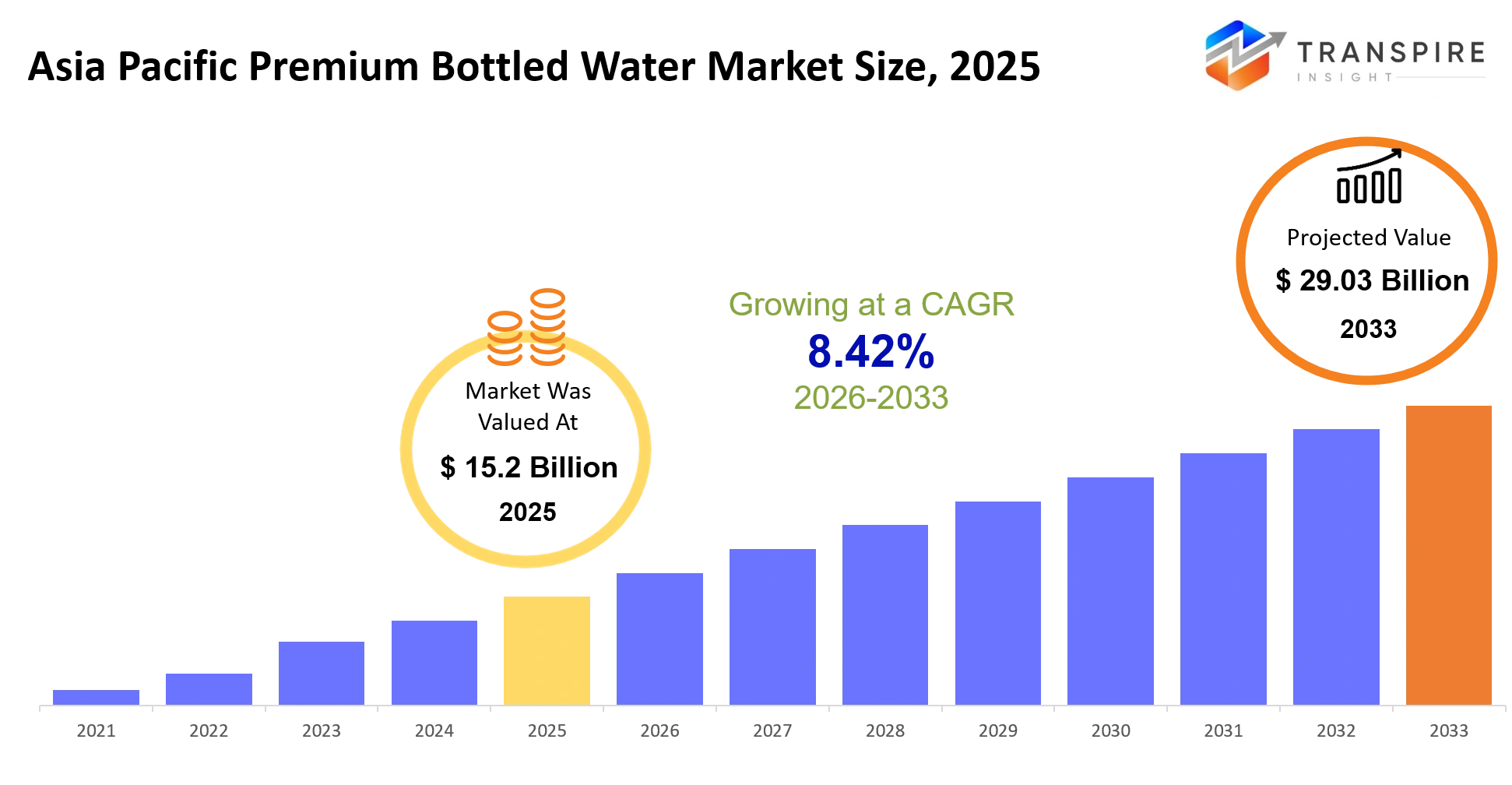
As per Transpire Insight Analysis the Asia Pacific Premium Bottled Water Market size is estimated at USD 15.2 Billion in 2025 and is anticipated to reach USD 29.03 Billion by 2033, growing at a CAGR of 8.42% from 2026 to 2033.
In the Asia Pacific Premium Bottled Water Market there’s this idea of serving people who want solid hydration but also mineral-rich blends, like real trusted sources, and it needs to fit that premium way of life. You see it in wellness habits, hospitality expectations, and even travel routines. Luxury hotels, high-end dining spots, corporate environments, and a lot of well-off city consumers are now treating premium bottled water more like a value-added item, not just a plain drink.
Over the last 5 years, the market has kind of leaned toward functional premium water and more sustainable packaging, plus a stronger pull toward premium glass bottles. Brands are competing with product differentiation, rather than keeping everything about price. After COVID-19, e commerce beverage buying went up fast, and demand rose for trusted packaged drinking water. At the same time, supply chain disruptions pushed manufacturers to tweak how they source materials and to add more regional production.
Because of that, premium brands are now able to reach more customers through modern retail and digital commerce channels. This has built stronger pricing power, deeper brand loyalty, and higher revenue generation across Asia Pacific’s changing beverage scene.
Asia Pacific Premium Bottled Water Market Size & Forecast:
- Asia Pacific Premium Bottled Water Market Size 2025: USD 15.2 Billion
- Expected Market Value 2033: USD 29.03 Billion
- Forecast CAGR: 8.42%
- Leading region in 2025:
- Fastest Growing region:
- Key Profile: Evian (Danone), Nestlé Waters, Fiji Water, Voss Water, Perrier, San Pellegrino, Nongfu Spring, Bisleri International, Tata Consumer Products (Himalayan), Coca-Cola (Smartwater), PepsiCo (LIFEWTR), Nongshim, Wahaha Group, Icelandic Glacial, Acqua Panna.
Key Market Insights
- So the Asia Pacific premium bottled water market is projected to hit around USD 29.03 billion by 2033, and yeah it basically signals long running growth in the premium beverage sector, even if it sounds a little stretched out.
- China still feels like the biggest player, holding roughly 38–40% market share in 2025, because strong premium retail networks and home grown “luxury beverage” brands keep pushing sales.
- India, on the other hand, is expected to become the fastest grower all the way through 2033, mostly from expanding premium hospitality plus tourism, along with affluent city consumers who are buying more often.
- In terms of category, premium mineral water takes the lead with about 48% share, while sparkling premium water stays as the second major slice, not quite catching up.
- The fastest growing product part is functional, and enhanced premium water, meaning water boosted with minerals, electrolytes , and alkaline formulations , which people treat like a sort of upgraded daily choice.
- When you look at where it’s consumed, hotels , restaurants, cafés, and other premium hospitality setups together represent nearly 42% of the premium bottled water use, so that application stays in front.
- Premium retail and online beverage platforms have also expanded a lot since 2021, and that’s changed purchasing behavior across many metro areas , kind of reshuffling how people actually decide.
- Brands like Evian , Nongfu Spring , Perrier , Bisleri International , Tata Consumer Products (Himalayan) and San Pellegrino keep investing in premium packaging , regional footprint expansion, and sharper brand differentiation.
- Manufacturers are increasingly shifting toward 100% recycled PET bottles, lightweight packaging, and carbon reduction initiatives, trying to reinforce premium brand positioning, in a practical way.
- Lastly, strategic collaborations with luxury hospitality chains and premium restaurants are continuing, and they’re improving penetration across Southeast Asia, and Oceania , pretty steadily.
What are the Key Drivers, Restraints, and Opportunities in the Asia Pacific Premium Bottled Water Market?
Premium bottled water has, in a way, started to nest itself inside the wider premium food and drink ecosystem, not so much as a pure stand alone drink category. You can see it with the growth of high end hospitality, organized retail, premium dining and also international tourism after the pandemic related limits… those changes actually drove more interest in bottled water brands that feel “different”. In practice, people now look at mineral makeup, source genuineness, packaging finish, and even brand standing along with the taste. Because of that, producers can usually ask for a higher premium price and improve their revenue, across both modern retail and food service setups.
Still, the tricky part, like the biggest structural hurdle, sits with packaging rules and environmental attention. In Asia Pacific , governments keep rolling out tougher plastic waste frameworks, extended producer responsibility obligations, and recycling requirements that force heavy spending across the whole chain, from production to distribution routes. On top of that, premium players also carry higher logistics costs since bottled water is… well, heavy by nature, which compresses margins and can slow down progress into far away regions, where delivery is not exactly cheap and simple.
If we talk about where it really could go longer term, premium functional water looks like the best opening.Manufacturers are pushing alkaline options , naturally mineralized water, electrolyte strengthened products, and vitamin added premium beverages, at least that’s how it feels, for health minded people who are constantly in motion in busy cities. Places like India, Vietnam, Indonesia , and the Philippines seem especially promising , because premium retail infrastructure keeps growing, modern supermarkets keep expanding, luxury hospitality keeps hiring more demand, and digital commerce keeps spreading. That mix lets premium brands broaden their reach while still keeping that premium pricing they want.
What Has the Impact of Artificial Intelligence Been on the Asia Pacific Premium Bottled Water Market?
Artificial intelligence is really start transforming premium bottled water manufacturing in ways that feel almost invisible, through smarter production planning, automated quality checks, and better digital supply chain tuning. More and more beverage manufacturers are rolling out AI vision systems to catch bottle issues, cap alignment troubles, packaging inconsistencies and label mistakes before the products even leave the production line. After that, machine learning models also watch how the equipment behaves, like vibration signatures, and they compare it against historical production records, so they can anticipate when service is needed for bottling, filtration ,and packaging gear. In other words, it becomes this kind of early-warning thing, rather than reacting late. This cuts down surprise downtime, and it tends to boost plant utilization overall. On top of that, AI also helps with demand forecasting, mixing retail results, weather conditions, tourism movement, and seasonal drinking habits, so manufacturers can fine tune inventory levels while reducing spoilage, and also avoiding those annoying stock shortages.
Alongside all that, more advanced digital tools keep pushing distribution performance forward, like by optimizing transport routes, warehouse routines , and inventory refills across those different regional markets. Some companies go even further and deploy AI to interpret what shoppers tend to buy from e-commerce storefronts and loyalty programs, which in turn helps them shape premium variants and craft personalized promotions. Ultimately, these capabilities usually result in lower operating expenses, smoother production efficiency, and a faster turnaround when consumer preferences shift, kinda like without much delay.
Still, AI adoption doesn’t move freely everywhere, because the setup is expensive, manufacturing infrastructure is fragmented among many regional producers, and operational data quality can be inconsistent. Smaller beverage manufacturers often don’t have the digital maturity, or the investment power, needed to fully integrate AI across both production and distribution networks, so the benefits don’t land equally.
Key Market Trends
- Premium bottled water portfolios, kinda, have grown since 2021 , not just with the usual alkaline angle but also electrolyte offerings and naturally mineralized options aimed at wealthier consumers with a wellness mindset.
- Glass bottle packaging, meanwhile, has been getting more approval across luxury hotels and upscale dining spots as brands push harder on that premium image.
- Between 2022 and 2025 , manufacturers also started swapping out virgin plastic and using recycled PET packaging more often, largely so they could line up with their sustainability promises.
- After the pandemic , e-commerce beverage sales really took off, and that momentum made premium brands lean into direct-to-consumer distribution channels.
- On the regional side, some producers expanded their premium spring water sourcing and set up more localized bottling operations, which helps lower logistics costs and also improves supply resilience , in a practical way.
- Partnerships with luxury hospitality venues are popping up more often, and that gives premium bottled water brands extra visibility in hotels, resorts,and higher-end restaurants.
- Brands like Evian, Nongfu Spring, San Pellegrino, Bisleri International, and Tata Consumer Products keep expanding their higher-end lines across Asia Pacific.
- There’s also smart manufacturing in the mix, with AI-driven quality inspection and predictive maintenance, which improves uniformity in production and helps operations run more smoothly overall.
- When it comes to buying behavior, premium consumers more and more compare things like mineral composition, whether the water source feels authentic , and the sustainability proof before they actually purchase.
- And competitively, the focus seems to be shifting toward limited-edition packaging, stronger premium branding, and regional market expansion, rather than simply trying to win on price.
Asia Pacific Premium Bottled Water Market Segmentation
By Product Type
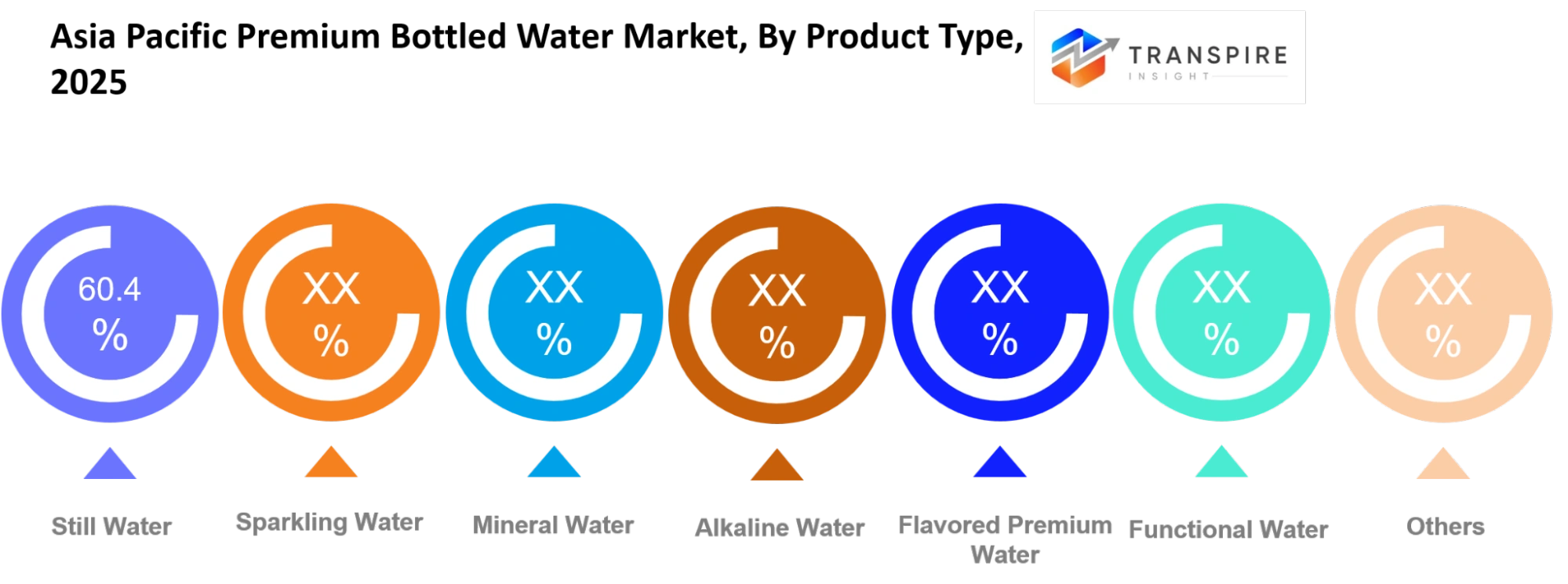
Still Water ends up with the biggest share, mainly because people in premium dining, households, hotels, and corporate environments like a clear, clean taste, plus just everyday convenience. Sparkling Water keeps getting more shelf space, especially in restaurants, cafés and premium retail where shoppers want something refreshing, but not carbonated soft drinks. Mineral Water stays in solid demand thanks to naturally occurring mineral content, and also because of that premium source positioning. Alkaline Water pulls in wellness-minded buyers who are looking for hydration products with added value, you know, the kind that feels more “benefit” oriented.
Flavored Premium Water kinda broadens the interest by blending hydration with soft fruit notes, while steering away from the higher sugar levels you see in many traditional beverages. Functional Water supports the whole active living thing by adding electrolytes, vitamins, or minerals, which feels natural in fitness centers and sports activities too. Other premium water lines also show up as limited edition collections regional varieties that are naturally sourced and then specialty formulations made for narrower consumer tastes.Product innovation will keep showing up with new chances, letting manufacturers differentiate premium offerings across several consumer groups.
By Packaging Type
PET Bottles are still the main packaging choice, mostly because the lightweight build helps with easy transport, store distribution ,and everyday use. At the same time, manufacturers keep dropping new recycled PET materials into the mix, so they can hit their sustainability targets, but still manage to keep product quality steady , and the costs more or less in check. Glass bottles also keeps a pretty important role , especially for luxury hotels, fine dining restaurants, and upscale hospitality locations where appearance and presentation can really sway buying choices.With Premium branding, an elegant package does more than protect ,it helps signal better product quality.
Aluminum Cans keep growing in modern retail too, since recyclability stays strong and the whole can structure is tough, which appeals to people who are eco-minded. Cartons work as yet another option for certain premium products, where lower environmental impact quietly supports the brand image. There are also other formats such as refillable containers, small-batch designs, and fresh sustainable materials being created for premium beverage collections. In general, packaging innovation will remain a big competitive lever across different regional markets.
By Distribution Channel
Supermarkets & Hypermarkets likely generate the highest sales, because broad product availability lets shoppers compare premium brands, different packaging styles ,and price ranges during those normal shopping visits. Convenience Stores, on the other hand ,help with instant purchase situations in busy city areas where ready to drink beverages are basically still a must. Online Retail has been expanding really fast via digital platforms, where you get more choice ,subscription style options, and of course home delivery. Hotels & Restaurants also add a lot to premium brand visibility, with carefully built beverage menus and more overall hospitality experiences.
Specialty Stores pull in customers who are specifically hunting for imported mineral water, wellness driven beverages, and exclusive premium collections that you typically cannot find through mainstream retailers. Other routes include airport retail ,corporate supply partners, premium beverage distributors and a handful of vending solutions that serve business spaces. Retail diversification keeps improving how easy it is to access products across both major metropolitan areas and up and coming urban markets. Distribution partnerships should help support stronger regional expansion throughout the forecast period.
By End User
Households show up as the leading end user segment because premium bottled water now feels like normal part of daily hydration, and it gets consumed by families in a lot of urban locations. The Hospitality Industry keeps buying premium brands, sort of to sharpen the guest experience in luxury hotels, resorts and also fine dining places. Corporate Offices tend to offer premium bottled water during meetings, conferences, executive events, and those workplace wellness initiatives. Usually the premium presentation itself helps, in the sense that it supports the corporate brand image.
Fitness Enthusiasts typically look for premium hydration products with minerals or electrolytes, either before or after physical activity. Travelers pick premium bottled water, mainly because trusted quality stays crucial during both domestic and international journeys. Other end users include educational institutions, healthcare facilities, premium entertainment venues, and event organizers, all of them want dependable beverage solutions. Consumer lifestyle changes should keep expanding premium water consumption across different settings , over time.
By Source
Natural Spring Water kind a dominates this segment, because naturally protected water sources give consumers strong confidence about purity, mineral profile and premium grade. Purified Water still keeps a lot of demand, mainly through advanced filtration techniques that manage to deliver a fairly steady taste and quality even with big scale production. Artesian Water pulls in premium buyers because underground aquifers create a more distinctive product identity, with natural filtration doing much of the heavy lifting. Source authenticity keeps affecting buying choices, across a range of premium beverage categories, in a pretty noticeable way.
Glacier Water stays more niche but still feels premium, largely due to limited availability plus that exclusive brand positioning. Other sources include deep underground reserves and region based natural formations, which are usually marketed via premium storytelling, and geographic uniqueness in the background. Source transparency keeps reinforcing consumer trust and helps build that premium brand value. Investment into certified water sources should back future product differentiation across Asia Pacific.
What are the Key Use Cases Driving the Asia Pacific Premium Bottled Water Market?
Premium hospitality still seems to be the biggest use case, because luxury hotels, fine dining restaurants, and upscale resorts rely on premium bottled water to boost the whole guest experience, and also to bring food beverage standards up. You know, the high-quality look, the origin people can trust, plus really premium packaging—those little things help premium hospitality offerings stand out in major tourism locations.
On the other hand, corporate offices and organized fitness spaces keep growing their premium bottled water use. For executive meetings, conferences, wellness programs, fitness centers, and premium gyms, they are picking mineral, alkaline, and functional water more often. This fits that professional, health-focused vibe. Even the digital retail platforms are backing up regular home refills through subscription buying so, it is basically easier to keep it stocked.
Then there are airports, premium travel lounges, luxury events, and wellness tourism, which are becoming newer areas. These feel like they have strong long-term potential. Things like customized premium packaging, limited-edition water collections, and functional hydration products made for active living should open up more room. Especially as premium consumer spending keeps moving up across Asia Pacific.
|
Report Metrics |
Details |
|
Market size value in 2025 |
USD 15.2 Billion |
|
Market size value in 2026 |
USD 16.48 Billion |
|
Revenue forecast in 2033 |
USD 29.03 Billion |
|
Growth rate |
CAGR of 8.42% from 2026 to 2033 |
|
Base year |
2025 |
|
Historical data |
2021 - 2024 |
|
Forecast period |
2026 - 2033 |
|
Report coverage |
Revenue forecast, competitive landscape, growth factors, and trends |
|
Regional scope |
Asia Pacific (India, China, Japan, Australia, South Korea, Rest of Asia Pacific) |
|
Key company profiled |
Evian (Danone), Nestlé Waters, Fiji Water, Voss Water, Perrier, San Pellegrino, Nongfu Spring, Bisleri International, Tata Consumer Products (Himalayan), Coca-Cola (Smartwater), PepsiCo (LIFEWTR), Nongshim, Wahaha Group, Icelandic Glacial, Acqua Panna. |
|
Customization scope |
Free report customization (country, regional & segment scope). Avail customized purchase options to meet your exact research needs. |
|
Report Segmentation |
By Product Type (Still Water, Sparkling Water, Mineral Water, Alkaline Water, Flavored Premium Water, Functional Water, Others); By Packaging Type (PET Bottles, Glass Bottles, Aluminum Cans, Cartons, Others); By Distribution Channel (Supermarkets & Hypermarkets, Convenience Stores, Online Retail, Hotels & Restaurants, Specialty Stores, Others); By End User (Households, Hospitality Industry, Corporate Offices, Fitness Enthusiasts, Travelers, Others); By Source (Natural Spring Water, Purified Water, Artesian Water, Glacier Water, Others). |
Which Regions are Driving the Asia Pacific Premium Bottled Water Market Growth?
China sits in the lead of the Asia Pacific premium bottled water market , mainly because people have higher disposable income, retail premium channels are already pretty mature, and the country’s domestic beverage manufacturing is well developed. There are national food safety rules, plus tougher quality certifications, which has helped consumers trust premium packaged water more . In return, companies are more willing to invest in upgraded bottling facilities, basically making the whole setup smoother. Both local firms and international brands seem to take advantage of efficient logistics, wide supermarket coverage , and e-commerce that keeps expanding, so the product can reach most places across the country . And don’t forget the hospitality scene, premium dining habits, and the rising taste for wellness drinks, which kind of locks in China’s role as the regional leader.
Japan comes in next as the second-largest contributor, supported by steadier consumer spending, a long standing premium beverage culture, and clear expectations around product quality. In contrast to China, growth there doesn’t depend so much on fast urban growth, but more on long term brand fidelity, premium shelf positioning, and ongoing refinements to the products themselves. Premium bottled water names usually benefit from dependable retail infrastructure, very strict production standards , and a pretty sophisticated network of convenience stores that makes sure the water stays easy to find. With stable economic conditions and continued spending on premium consumer goods, revenue stays predictable for both domestic producers and international suppliers.
India is projected to show the quickest rise in the 2026–2033 window , as demand for premium beverages keeps climbing. This is happening alongside higher household income, more organized retail development, and more luxury hospitality investment , so the market has room to expand , pretty quickly.
Who are the Key Players in the Asia Pacific Premium Bottled Water Market and How Do They Compete?
Competition is still moderately consolidated, but you know how it goes several global beverage players stack up next to really strong regional brands, with that familiar consumer recognition already built in. In practice, success relies less on pure price rivalry, and more on this mix of premium branding product authenticity, packaging quality source differentiation, and also retail reach. At the same time, companies keep putting money into sustainable packaging, digital commerce, and premium hospitality collaborations, in a way that supports their market position while protecting those premium price tags too.
Evian by Danone, stands out via natural Alpine spring water, plus a premium brand heritage, and a long term commitment to recyclable packaging. Because of that, they hold up well in luxury hospitality and premium retail where shoppers expect more. Nongfu Spring, tends to build advantage through broad domestic distribution, localized production, and a more diversified portfolio of premium water types that line up with what consumers in China actually prefer. The ongoing expansion into premium product categories and into modern retail channels then helps its penetration keep growing.
San Pellegrino leans hard into premium sparkling mineral water, and it stays very visible through partnerships with fine dining restaurants, luxury hotels, and hospitality operators across the Asia Pacific region. Bisleri International keeps strengthening its premium line while also widening distribution beyond the typical retail approach, moving into modern trade and hospitality channels across India. Tata Consumer Products for Himalayan, differentiates by naturally sourced Himalayan spring water, premium packaging, and a solid brand credibility, backed by expansion into premium hotels restaurants and even digital retail platforms.
Company List
- Evian (Danone)
- Nestlé Waters
- Fiji Water
- Voss Water
- Perrier
- San Pellegrino
- Nongfu Spring
- Bisleri International
- Tata Consumer Products (Himalayan)
- Coca-Cola (Smartwater)
- PepsiCo (LIFEWTR)
- Nongshim
- Wahaha Group
- Icelandic Glacial
- Acqua Panna
Recent Development News
In April 2025, Nongfu Spring announced investment in additional production capacity and smart manufacturing upgrades for premium bottled water operations in China. The investment enhanced production efficiency and supported growing domestic premium beverage demand.
Source: https://www.nongfuspring.com/en/ (Nongfu Spring)
What Strategic Insights Define the Future of the Asia Pacific Premium Bottled Water Market?
In the Asia Pacific premium bottled water market, I think it will keep moving toward premium hydration solutions that somehow blend verified source authenticity, functional ingredient profiles , sustainable packaging options and yeah, easier digital retail access. Instead of just chasing more volume, premiumization will likely be the main driver behind long-term value, because people are putting more weight on things like product quality, wellness benefits, and even environmental performance.
There’s also a risk that’s less obvious, like packaging rules getting tighter, and recycled material availability becoming less predictable. That can raise production costs and start squeezing profit margins for brands that don’t have strong, flexible supply chains. Still, a real opening is showing up with premium functional water that includes electrolytes, minerals, and naturally derived health components. This feels especially relevant across India and Southeast Asia where organized retail keeps growing, and premium hospitality is expanding too.
If companies invest early in circular packaging systems, build regional production capabilities, offer transparent source certification, and use direct-to-consumer digital channels, they’ll probably be better set to build brand loyalty and win higher-margin growth over 2026–2033.
Asia Pacific Premium Bottled Water Market Report Segmentation
By Product Type
- Still Water
- Sparkling Water
- Mineral Water
- Alkaline Water
- Flavored Premium Water
- Functional Water
- Others
By Packaging Type
- PET Bottles
- Glass Bottles
- Aluminum Cans
- Cartons
- Others
By Distribution Channel
- Supermarkets & Hypermarkets
- Convenience Stores
- Online Retail
- Hotels & Restaurants
- Specialty Stores
- Others
By End User
- Households
- Hospitality Industry
- Corporate Offices
- Fitness Enthusiasts
- Travelers
- Others
By Source
- Natural Spring Water
- Purified Water
- Artesian Water
- Glacier Water
- Others
Frequently Asked Questions
Find quick answers to common questions.
The expected Asia Pacific Premium Bottled Water Market size for the market will be USD 29.03 Billion in 2033.
Key segments for the Asia Pacific Premium Bottled Water Market are By Product Type (Still Water, Sparkling Water, Mineral Water, Alkaline Water, Flavored Premium Water, Functional Water, Others); By Packaging Type (PET Bottles, Glass Bottles, Aluminum Cans, Cartons, Others); By Distribution Channel (Supermarkets & Hypermarkets, Convenience Stores, Online Retail, Hotels & Restaurants, Specialty Stores, Others); By End User (Households, Hospitality Industry, Corporate Offices, Fitness Enthusiasts, Travelers, Others); By Source (Natural Spring Water, Purified Water, Artesian Water, Glacier Water, Others).
Major Asia Pacific Premium Bottled Water Market players are Evian (Danone), Nestlé Waters, Fiji Water, Voss Water, Perrier, San Pellegrino, Nongfu Spring, Bisleri International, Tata Consumer Products (Himalayan), Coca-Cola (Smartwater), PepsiCo (LIFEWTR), Nongshim, Wahaha Group, Icelandic Glacial, Acqua Panna.
The Asia Pacific Premium Bottled Water Market size is USD 15.2 Billion in 2025.
The Asia Pacific Premium Bottled Water Market CAGR is 8.42% from 2026 to 2033.
- Evian (Danone)
- Nestlé Waters
- Fiji Water
- Voss Water
- Perrier
- San Pellegrino
- Nongfu Spring
- Bisleri International
- Tata Consumer Products (Himalayan)
- Coca-Cola (Smartwater)
- PepsiCo (LIFEWTR)
- Nongshim
- Wahaha Group
- Icelandic Glacial
- Acqua Panna
About the Authors

Chetan Dhatrak
I’m Chetan Dhatrak, a Senior Research Analyst at Transpire Insight, specializing in the Consumer Goods, Foods and Beverages industry. I focus on analyzing market trends, consumer behavior, competitive landscapes, and industry developments to deliver accurate, data-driven insights. My research at Transpire Insight is built on credible sources and in-depth analysis, helping businesses and readers better understand market dynamics, emerging opportunities, and evolving consumer preferences. I’m committed to creating reliable, well-researched content that supports informed decision-making and reflects the latest developments in the consumer goods and food & beverage sectors.

Chakradhar Khansole
Chakradhar serves as the Research Director at Transpire Insight, bringing over 8 years of experience in technology, innovation, and strategic market intelligence. He specializes in transforming complex market data into actionable business insights that enable organizations to make informed, growth-oriented decisions. Recognized for his strategic vision and analytical expertise, Chakradhar leads high-impact research initiatives, delivering comprehensive market assessments, competitive intelligence, and forward-looking industry analysis.
Recently Published Reports
-
Apr 2026
Baby Infant Formula Market
Baby Infant Formula Market Size, Share & Analysis Report By ype (Infant Milk, Follow On Milk, Specialty Baby Milk, Growing-Up Milk), By Ingredient (Carbohydrate, Fat, Protein, Minerals, Vitamins, and Others), By Product Form (Powder, Liquid, and Ready-to-feed), By Distribution Channels (Supermarket/Hypermarket, Specialty Store, Pharmacies, Online Retail, and Others), and Geography (North America, Europe, Asia-Pacific, Middle East and Africa, South and Central America), 2021 - 2031
-
Apr 2026
Edible Insects for Animal Feed Market
Edible Insects for Animal Feed Market Size, Share & Analysis Report By Type (Insect Powder, Insect Meal, Insect Bar, Insect Paste, Insect Oil, and Others), By Insect Type (Beetles, Cricket, Caterpillar, Hymenoptera, Orthoptera, Tree Bugs, and Others), By Application (Livestock, Pet Food, and Aquaculture), By Livestock Type (Poultry, Swine, and Others), and Geography (North America, Europe, Asia-Pacific, Middle East and Africa, South and Central America), 2021 - 2031
-
Apr 2026
Food Industry Disinfection and Bacterial Control Market
Food Industry Disinfection and Bacterial Control Market Size, Share & Analysis Report By Type (Chemical Disinfectants, Physical Disinfectants, and Biocides and Antimicrobials), By Application (Food Processing Equipment Surface Disinfection, Food Preparation Areas Surface Disinfection, Storage Areas Surface Disinfection, Anti-microbial Coatings Food Preservation, and Preservative Solutions Food Preservation), By End User (Meat and Poultry Processing, Dairy Processing, Seafood Processing, Bakery and Confectionery, Restaurants and Commercial Kitchens, and Food Service Providers), By Sales Channel (Online, Offline), and Geography (North America, Europe, Asia-Pacific, Middle East and Africa, South and Central America), 2021 - 2031
-
May 2026
Freeze Dried Food Market
Freeze Dried Food Market Size, Share & Analysis Report By Product Type (Fruits, Vegetables, Freeze-Dried Dairy Products, Freeze-Dried Meat and Seafood, Freeze-Dried Pet Food, and Prepared Meal), By Nature (Organic, and Conventional), By Form (Powdered, Granules, and Diced), By End Use (Breakfast Cereals, Dairy Products, Bakery & Confectionery, Nutritional Bars & Supplements, Powdered Beverages, Snacks, and Retail (Household)), and Geography (North America, Europe, Asia-Pacific, Middle East and Africa, South and Central America), 2021 - 2031