
Asia Pacific Polyphenylene Oxide Market Size & Forecast:
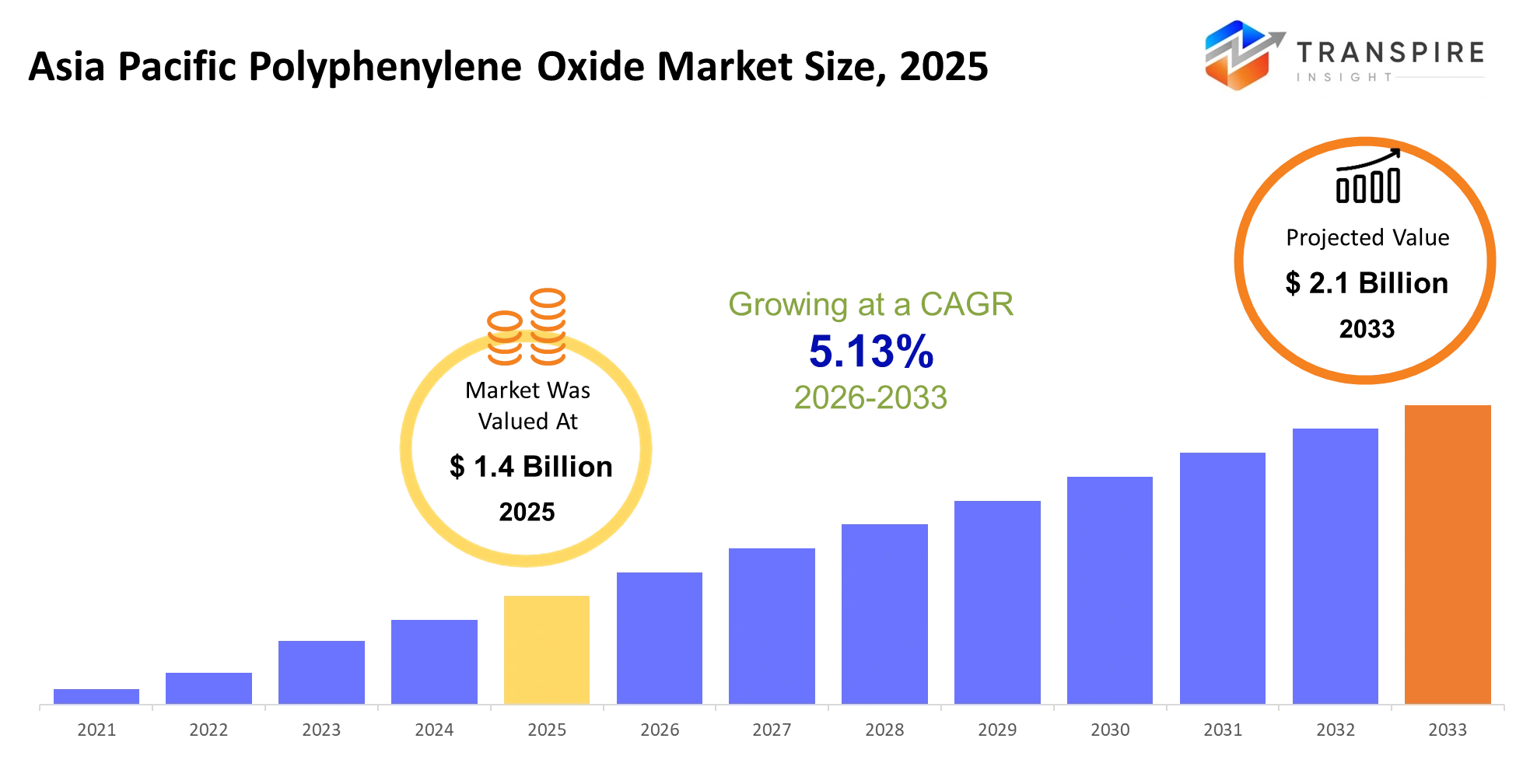
- Asia Pacific Polyphenylene Oxide Market Size 2025: USD 1.4 Billion
- Asia Pacific Polyphenylene Oxide Market Size 2033: USD 2.1 Billion
- Asia Pacific Polyphenylene Oxide Market CAGR: 5.13%
- Asia Pacific Polyphenylene Oxide Market Segments: By Type (Modified PPO, Unmodified PPO, Blends, High Heat PPO, Reinforced PPO, Others); By Application (Automotive, Electrical & Electronics, Industrial, Healthcare, Appliances, Others); By End-User (Automotive, Electronics, Industrial, Healthcare, Consumer Goods, Others); By Form (Pellets, Granules, Powder, Sheets, Compounds, Others).
To learn more about this report,  Download Free Sample Report
Asia Pacific Polyphenylene Oxide Market Summary:
The Asia Pacific Polyphenylene Oxide Market size is estimated at USD 1.4 Billion in 2025 and is anticipated to reach USD 2.1 Billion by 2033, growing at a CAGR of 5.13% from 2026 to 2033. The AP polyphenylene oxide industry in relation to engineering thermoplastics is anticipated to evolve and be further refined in light of the response of various firms as they deal with shifts in their expectations for durability, heat resistance, and weight reduction. Increasing requirements for EVs, miniaturization of gadgets, and smart home appliances are expected to force manufacturers to prioritize developing high-quality plastics while becoming more efficient during manufacturing. At the same time, regulations by regional bodies will tighten regarding recycling and emission standards, resulting in the development of cleaner pathways of production. Consumers will, however, require more durable material for their products.
What Has the Impact of Artificial Intelligence Been on the Asia Pacific Polyphenylene Oxide Market?
The use of artificial intelligence is fast changing the analytical and operational dynamics of the asia pacific polyphenylene oxide market in that the technology can assist the firms to take more proactive decision-making. Artificial intelligence in asia pacific polyphenylene oxide market operations is being used to conduct market research through the analysis of large data sets to detect patterns of consumption and identify new trends in the market for products across sectors like automotive and electronics.
The machine learning models have enabled businesses to carry out demand forecasting with increased precision thereby helping the companies to estimate the changes in their requirements for raw materials and end-user demand. The artificial intelligence technologies are also changing the production environments by implementing smart systems for equipment monitoring thereby minimizing equipment downtime and maintaining the consistency of yields. The tools for predictive analytics have helped the businesses to optimize their supply chains by identifying the areas of disruption and minimizing costs.
In addition to its benefits of efficiency, artificial intelligence is revolutionizing the asia pacific polyphenylene oxide market through its ability to develop custom blends of materials, as well as shorten product development cycles. Firms that make use of artificial intelligence simulations can assess the performance of the materials before physically developing them. This makes it possible to reduce time-to-market while improving competitive advantage.
Key Market Trends & Insights:
- The China region accounts for more than 40% market share in the Asia Pacific polyphenylene oxide market owing to the presence of excellent electronics and automobiles manufacturing bases.
- India is projected to experience highest growth among all regional segments, growing at a CAGR of over 6.5% from 2021 to 2030 on account of increasing industrial activities within the country.
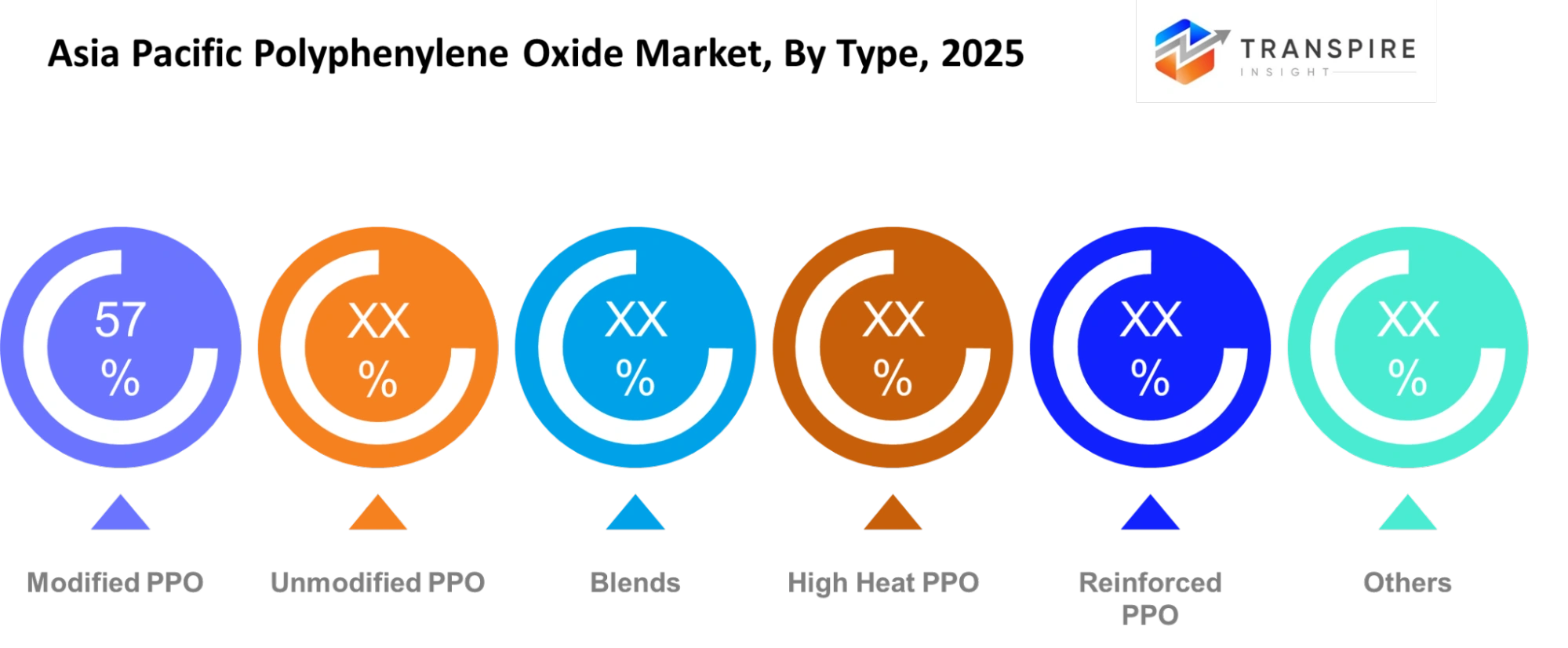
- Modified PPO accounts for nearly 65% market share in 2025 due to its improved thermal stability and mechanical strength properties.
- Blended PPO follows and has significant market share due to its use in mid-tier applications for cost-efficiency.
- The high-performance segment will witness fastest growth until 2030 owing to increasing demands in the electric vehicle and electronics sector.
- Applications in the automobile industry constitute largest share in 2025 at over 35%.
Asia Pacific Polyphenylene Oxide Market Segmentation
By Type
The modified PPO will be favored by its enhanced ability to resist heat and its increased durability, which will enable it to be used effectively in industry. The unmodified PPO will retain its place when there is a need to balance costs and performance. Composites will attract more interest, as manufacturers will have a chance to combine various characteristics of the material in blends.
Reinforced PPO will help ensure structural strength in parts that may be subjected to stress. Other variants of PPO will find use in specialized applications that require certain performance capabilities. Manufacturers will be increasingly looking for products that can provide long lifecycles while offering efficient processing methods.
To learn more about this report, Download Free Sample Report
By Application
Demand for these materials is expected to increase owing to the requirements of lightweight and heat resistant components that are used in automobiles. There will be an increased demand in electrical and electronics industry because of the need for high quality insulating materials in these products. The demand from the industrial sector will continue owing to its utilization in machinery and equipment manufacturing.
They will find usage in appliances for enhanced performance and longevity. There will also be other specialized uses depending on the application requirements. These demands will be influenced by new technological developments and energy conservation trends.
By End-User
The automotive end-user segment will remain dominant because there will always be a need for improved material usage in cars. The electronics end-user segment will increase because devices will reduce in size while gaining power, which will make it necessary to have effective materials. The industrial end-user segment will depend on these materials for durability and strength in their operations.
The healthcare end-user segment will grow due to the need for materials in equipment and tools. Consumer goods end-user segments will experience increased material use due to the need for improved quality and longevity of products by consumers.
By Form
Pellets will continue to be popular because of the convenience that will come with handling and processing them. Granules will enable processes that require even distribution of materials. The powdered form of the material will be suitable for processes that need accuracy. Sheets will be useful to companies that require flat and strong surfaces.
Compounds will increasingly be demanded as customized materials become relevant. Others will suit different purposes depending on the process requirements. Manufacturing techniques will adapt accordingly through technological development. Forms of the material chosen will vary depending on convenience, cost, and suitability in the asia pacific polyphenylene oxide market.
What are the Main Challenges for the Asia Pacific Polyphenylene Oxide Market Growth?
Some of the technical issues that have posed a barrier for consistent use in the asia pacific polyphenylene oxide market include material stability when exposed to extreme temperatures and when exposed to stress for extended periods. The manufacturing process can be a challenge as well, requiring manufacturers to observe stringent temperature requirements for maintaining the desired quality. In addition, there is ongoing uncertainty in the availability of raw materials.
Manufacturing and commercialization are other issues that affect development in the asia pacific polyphenylene oxide market. The manufacturing process involves complex procedures that require costly equipment and stringent quality controls. There are also legal implications that may slow down approval of products for commercial purposes. Furthermore, fluctuations in raw material prices increase cost pressures on manufacturers.
Adoption difficulties constitute another major concern, especially in emerging countries where infrastructure and technological know-how are still in their nascent stages. Lack of knowledge regarding the benefits of more sophisticated materials is another impediment in accepting the technology by end users. In addition, there is a scarcity of trained personnel who could deal with the sophisticated polymers used in the process.
Market competition and future risks are also important factors that will affect the market as a whole. The availability of cheaper and easier-to-process alternative materials creates competition. Price fluctuations and changes in regulations create uncertainty and hence are some of the market limitations.
Regional Insights
There will be wide regional variations within Asia Pacific Polyphenylene Oxide Market based on factors such as industrial growth and robust manufacturing capabilities. China will dominate the region due to its large-scale manufacturing, electronics, and automotive industries. The market in Japan and South Korea is expected to remain stable due to their technological advancements and innovations in high-performance materials.
India and Southeast Asia will register slow expansion because of the presence of active industrial growth coupled with rising demand for polyphenylene oxide as a highly durable material. Factors influencing the conditions in the Asia Pacific Polyphenylene Oxide Market may change in response to regional policies and investment trends.
The Asia Pacific Polyphenylene Oxide Market will keep evolving based on changing trade flows, policies, and production capacity among others. Competitiveness within the market will be based on factors such as cost effectiveness, quality of products, and technological advancements.
Recent Development News
In January 2026, SABIC announced the divestment of its Engineering Thermoplastics (ETP) business to Mutares. The $950 million portfolio optimization deal includes engineering plastics used in PPO-based applications, strengthening SABIC’s strategic shift toward higher-value materials.
Source: https://www.sabic.com
In January 2026, Mutares signed an agreement to acquire SABIC’s Engineering Thermoplastics business across the Americas and Europe, marking its entry into advanced materials and engineering plastics (including PPO-related segments) with a $450 million transaction expected to close in 2026.
Source: https://www.linkedin.com
|
Report Metrics |
Details |
|
Market size value in 2025 |
USD 1.4 Billion |
|
Market size value in 2026 |
USD 1.48 Billion |
|
Revenue forecast in 2033 |
USD 2.1 Billion |
|
Growth rate |
CAGR of 5.13% from 2026 to 2033 |
|
Base year |
2025 |
|
Historical data |
2021 - 2024 |
|
Forecast period |
2026 - 2033 |
|
Report coverage |
Revenue forecast, competitive landscape, growth factors, and trends |
|
Regional scope |
Asia Pacific (China, India, Japan, South Korea, Australia, Rest of Asia Pacific) |
|
Key company profiled |
SABIC, Mitsubishi Chemical, Asahi Kasei, RTP Company, LyondellBasell, BASF, Covestro, Ensinger, Polyplastics, Sumitomo Chemical, LG Chem, Toray, Dow, Evonik, DSM. |
|
Customization scope |
Free report customization (country, regional & segment scope). Avail customized purchase options to meet your exact research needs. |
|
Report Segmentation |
By Type (Modified PPO, Unmodified PPO, Blends, High Heat PPO, Reinforced PPO, Others); By Application (Automotive, Electrical & Electronics, Industrial, Healthcare, Appliances, Others); By End-User (Automotive, Electronics, Industrial, Healthcare, Consumer Goods, Others); By Form (Pellets, Granules, Powder, Sheets, Compounds, Others). |
How Can New Companies Establish a Strong Foothold in the Asia Pacific Polyphenylene Oxide Market?
The entry of new companies into the asia pacific polyphenylene oxide market is possible by concentrating on specialized applications where deficiencies in performance persist. Instead of challenging established giants through volume production, the focus should be on high-value applications such as automotive parts, miniaturized electronics, and biomedical devices. In this manner, the process of entry becomes quicker while being consistent with the dynamics of the industry and present market trends. Product positioning in terms of thermal stability, weight reduction, and long-term durability would enable competitive advantage in the asia pacific polyphenylene oxide market.
Strategic innovation will be critical for differentiation. By incorporating sophisticated compounding processes and customized materials, firms can cater to the unique needs of their clients better. Through collaboration with domestic manufacturers, academic bodies, and original equipment manufacturers, innovative products can be validated and launched efficiently. The entry firm PolyTech Asia could innovate in areas of artificial intelligence-enabled material design, and NanoResins APAC might explore sustainable sources of polyphenylene oxide.
The incorporation of technology will lead to increased competition within the Asia Pacific Polyphenylene Oxide market. Through the use of smart automation, advanced analytics and digital supply chains, operational efficiency will be enhanced along with cost savings. However, through the addressing of specific issues within the respective industries, including heat control for electronics and chemical resistance for healthcare devices, continued demand will arise from potential clients.
A strong foothold within this market space will require a solid regional strategy as well as being prepared to meet relevant regulations. With knowledge of the required standards and the creation of a local supply chain, any company will face fewer barriers. The new competitors that emerge will benefit from their agility and technological knowledge.
Key Asia Pacific Polyphenylene Oxide Market Company Insights
The Asia Pacific Polyphenylene Oxide Market would witness keen competition as a result of the emergence of local manufacturing units amidst the well-established global manufacturers. Big firms would leverage their strength based on superior technological capability, excellent product quality, and extensive distribution networks. The ongoing process of continuous product upgrades would further ensure dominance in the market.
The Asia Pacific Polyphenylene Oxide Market would also experience involvement of midsize firms which would concentrate on effective cost management along with application suitability. Competitive positioning would be aided by strategic alliances, regional diversification, and local manufacturing capabilities.
Company List
- SABIC
- Mitsubishi Chemical
- Asahi Kasei
- RTP Company
- LyondellBasell
- BASF
- Covestro
- Ensinger
- Polyplastics
- Sumitomo Chemical
- LG Chem
- Toray
- Dow
- Evonik
- DSM
What are the Key Use-Cases Driving the Growth of the Asia Pacific Polyphenylene Oxide Market?
The Asia Pacific Polyphenylene Oxide market has started to show some steam owing to the increasing usage of this polymer in automotive applications. The usage of components made of PPO has become widespread among electric vehicles because of its high resistance to heat and lightweight properties. The use of PPO in this manner is propelling market growth in the Asia Pacific region.
When it comes to the electronics segment, the demand for PPO in the Asia Pacific region is due to the requirement of advanced insulation products used in compact electronics devices. This type of material is extensively utilized in connectors, circuits, and other components due to its high dimensional stability and heat resistance. In addition, the demand is stable owing to advances in electronics technology.
Applications in healthcare are also adding impetus to the growth of the Asia Pacific Polyphenylene Oxide market. In healthcare, there is a need for durable materials that are resistant to chemicals and sterilization. PPOs provide such benefits and thus can be used for making medical equipment and surgical instruments.
In industrial production as well as appliance production, PPO finds utility due to its properties of high durability. Its applications can range from making pumps to making kitchen appliances. New trends like energy-saving mechanisms will only help increase the applications in the coming years.
Asia Pacific Polyphenylene Oxide Market Report Segmentation
By Type
- Modified PPO
- Unmodified PPO
- Blends
- High Heat PPO
- Reinforced PPO
- Others
By Application
- Automotive
- Electrical & Electronics
- Industrial
- Healthcare
- Appliances
- Others
By End-User
- Automotive
- Electronics
- Industrial
- Healthcare
- Consumer Goods
- Others
By Form
- Pellets
- Granules
- Powder
- Sheets
- Compounds
- Others
Frequently Asked Questions
Find quick answers to common questions.
The approximate Asia Pacific Polyphenylene Oxide Market size for the market will be USD 2.1 Billion in 2033.
Key segments for the Asia Pacific Polyphenylene Oxide Market are By Type (Modified PPO, Unmodified PPO, Blends, High Heat PPO, Reinforced PPO, Others); By Application (Automotive, Electrical & Electronics, Industrial, Healthcare, Appliances, Others); By End-User (Automotive, Electronics, Industrial, Healthcare, Consumer Goods, Others); By Form (Pellets, Granules, Powder, Sheets, Compounds, Others).
Major Asia Pacific Polyphenylene Oxide Market players are SABIC, Mitsubishi Chemical, Asahi Kasei, RTP Company, LyondellBasell, BASF, Covestro, Ensinger, Polyplastics, Sumitomo Chemical, LG Chem, Toray, Dow, Evonik, DSM.
The Asia Pacific Polyphenylene Oxide Market size is USD 1.4 Billion in 2025.
The Asia Pacific Polyphenylene Oxide Market CAGR is 5.13%.
- SABIC
- Mitsubishi Chemical
- Asahi Kasei
- RTP Company
- LyondellBasell
- BASF
- Covestro
- Ensinger
- Polyplastics
- Sumitomo Chemical
- LG Chem
- Toray
- Dow
- Evonik
- DSM
Recently Published Reports
-
Dec 2024
Healthcare Polymer Packaging Market
Healthcare Polymer Packaging Market Size, Share & Analysis Report By Packaging Type (Syringes, IV Bottles and Pouches, Clamshells, Blisters, Bottles & Jars, Containers, Tubes, IV Parental Packaging, Others), By Type (Regulated, Non-regulated), By Polymer Type (LDPE (Low-Density Polyethylene), HDPE (High-Density Polyethylene), Homo-polymer (Homo), Random Copolymer (Random), Block Copolymer (Block), PET, Polystyrene, Polyvinyl Chloride, Polyamide/EVOH, Others), and Geography (North America, Europe, Asia-Pacific, Middle East and Africa, South and Central America), 2021 - 2031
-
Jan 2025
Hydrophilic Tape (Waterstop) Market
Hydrophilic Tape (Waterstop) Market Size, Share & Analysis Report By Type (Bentonite-Based Hydrophilic Tape, Rubber-Based Hydrophilic Tape), By Application (Residential Buildings, Commercial Buildings, Infrastructure Projects), and Geography (North America, Europe, Asia-Pacific, Middle East and Africa, South and Central America), 2021 - 2031
-
Jan 2025
Metalens Market
Metalens Market Size, Share & Analysis Report By Type (Visible Light Metalens, and Infrared Metalens), By Application (Consumer Electronics, Automotive Electronics, Industrial, Medical, and Others), and Geography (North America, Europe, Asia-Pacific, Middle East and Africa, South and Central America), 2021 - 2031
-
Jan 2025
PBT Resin Market
PBT Resin Market Size, Share & Analysis Report By Type (Reinforced PBT Resin, Unreinforced PBT Resin), By Processing Method (Injection Molding, Extrusion, Blow Molding, Others), By End-User (Automotive, Electrical & Electronics, Consumer Appliances, Industrial Machinery, Medical Devices, Packaging, Others), and Geography (North America, Europe, Asia-Pacific, Middle East and Africa, South and Central America), 2021 - 2031