
Asia Pacific Automotive Metal Pressing Market Size & Forecast:
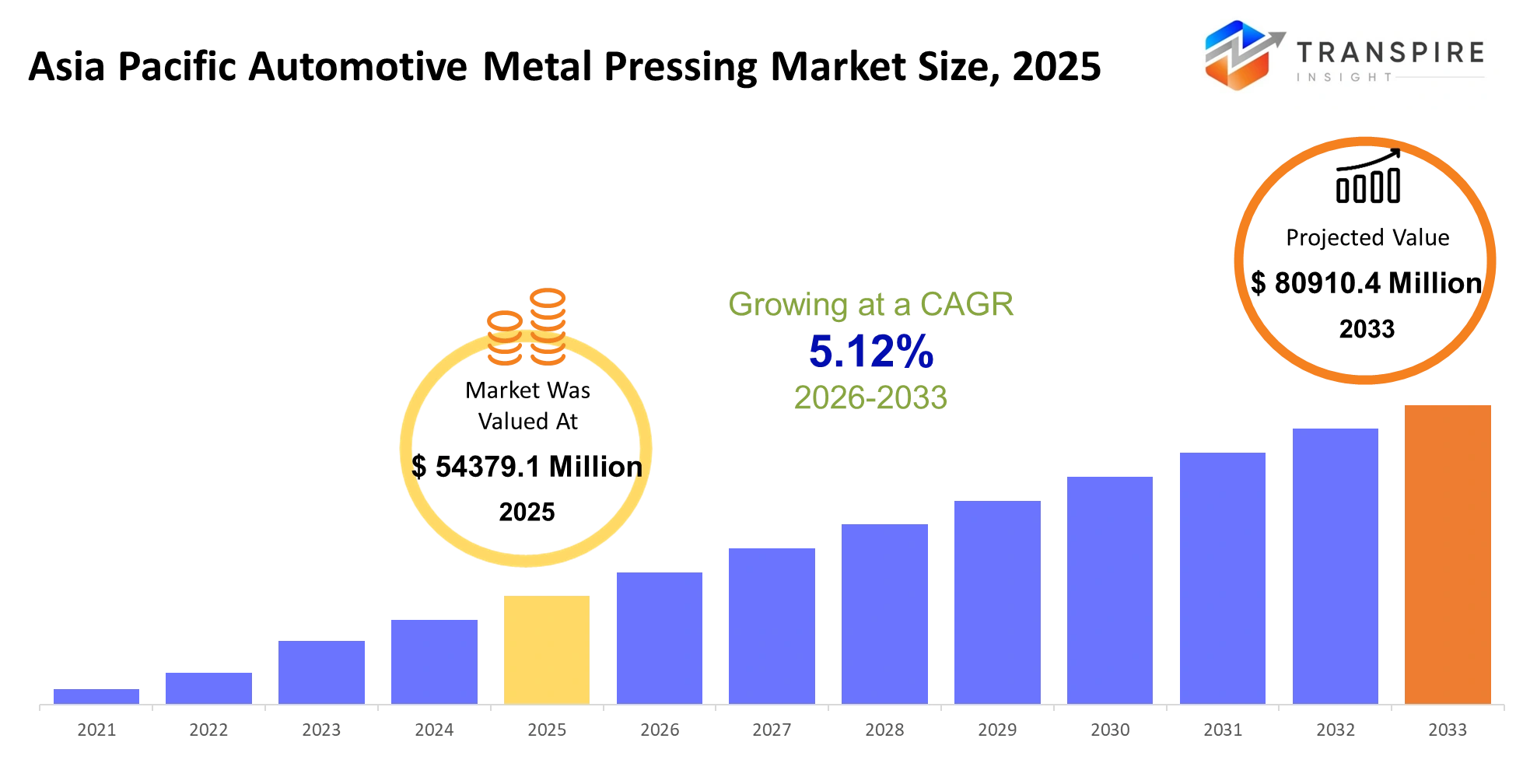
- Asia Pacific Automotive Metal Pressing Market Size 2025: USD 54379.1 Million
- Asia Pacific Automotive Metal Pressing Market Size 2033: USD 80910.4 Million
- Asia Pacific Automotive Metal Pressing Market CAGR: 5.12%
- Asia Pacific Automotive Metal Pressing Market Segments: By Type (Cold Pressing, Hot Pressing, Deep Drawing, Stamping, Forging, Others); By Application (Body Parts, Chassis, Engine Parts, Structural Components, Interior Parts, Others); By End-User (Automotive OEMs, Tier 1 Suppliers, Aftermarket, EV Manufacturers, Commercial Vehicles, Others); By Material (Steel, Aluminum, Copper, Alloys, Composite, Others).
To learn more about this report,  Download Free Sample Report
Asia Pacific Automotive Metal Pressing Market Summary:
The Asia Pacific Automotive Metal Pressing Market size is estimated at USD 54379.1 Million in 2025 and is anticipated to reach USD 80910.4 Million by 2033, growing at a CAGR of 5.12% from 2026 to 2033.The Asia Pacific automotive metal pressing market will act as a crucial backbone in the automotive manufacturing industry for structuring and shaping the vehicle. The demand is expected to be geared towards lightweight metals as consumers prefer fuel economy and electrification. High-speed servo press technology will be used by the automotive manufacturing companies along with precise tooling. Automation and digitalization of processes will revolutionize the manufacturing floor in order to minimize waste and ensure quality. Regulations related to emissions and safety in other countries such as China, India, and Japan will encourage the development of materials.
What Has the Impact of Artificial Intelligence Been on the Asia Pacific Automotive Metal Pressing Market?
There are numerous ways artificial intelligence is changing the asia pacific automotive metal pressing market by injecting precision and smarter decision-making into the business process. AI will significantly improve the ability of market researchers to analyze large volumes of data in order to uncover new demand patterns and make accurate forecasts. AI algorithms will be used to track consumption rates and to adjust manufacturing processes in accordance with the preferences of consumers in the automotive industry, for example, in relation to EV parts.
Another way in which artificial intelligence will change the asia pacific automotive metal pressing market is that it will introduce changes to the factory operation. Metal pressing machines will use AI to monitor the quality of work done to quickly spot defects and avoid machine downtime. At the same time, artificial intelligence will optimize production by maximizing tool efficiency and reducing costs associated with manufacturing. The supply chain network will also be influenced by AI as tools will predict problems and control inventory levels.
In addition to increased efficiency, AI will be crucial for innovation and competitiveness in the asia pacific metal forming automotive industry. The adoption of simulation techniques by companies will be geared towards designing customized metal parts in order to meet the needs of the automotive industry. This trend will result in better responses, increased quality of products, and competition within the region due to technological changes.
Key Market Trends & Insights:
- The China region dominates the Asia Pacific automotive metal pressing market in terms of share with over 38% in 2024, owing to its ability to produce automobiles on a massive scale.
- The India region is expected to grow at the highest rate, recording above 7% CAGR between 2025 and 2030, due to the increasing demand for automobiles.
- Sheet metal pressing takes up the largest share at almost 45% in 2024 because of increased requirements of body and structure pieces.
- Hot metal pressing accounts for the second-largest market share owing to the superior strength of its products in the manufacture of durable automotive parts.
- Precision metal stamping emerges as the fastest-growing segment owing to increasing production of components of electric vehicles.
- Passenger vehicles lead the application sector with over 60% market share in 2024 owing to high production of automobiles.
- Electric vehicles account for the fastest-growing application owing to the growing demand for electric vehicles in Asia Pacific.
- Automobile manufacturers occupy the leading position in the Asia Pacific automotive metal pressing market with about 70% market share in 2024 due to their large production requirements.
- Aftermarket suppliers emerge as the fastest-growing end-user owing to increased life span of vehicles.
Asia Pacific Automotive Metal Pressing Market Segmentation
By Type
Cold forging will continue to be popular for fabricating components with high accuracy but without exposing them to heat. Hot forging will facilitate the fabrication of strong components. Deep drawing will be employed for the fabrication of sophisticated components like fuel tanks and sheets while stamping will be used extensively for mass production. Forging will also be responsible for fabricating strong components.
Every process will have its own application depending on the requirements of the design and the behavior of the materials involved. The choice of processes will vary with costs and volume of production. The need for sophisticated vehicle designs will encourage the use of stamping and deep drawing processes.
By Application
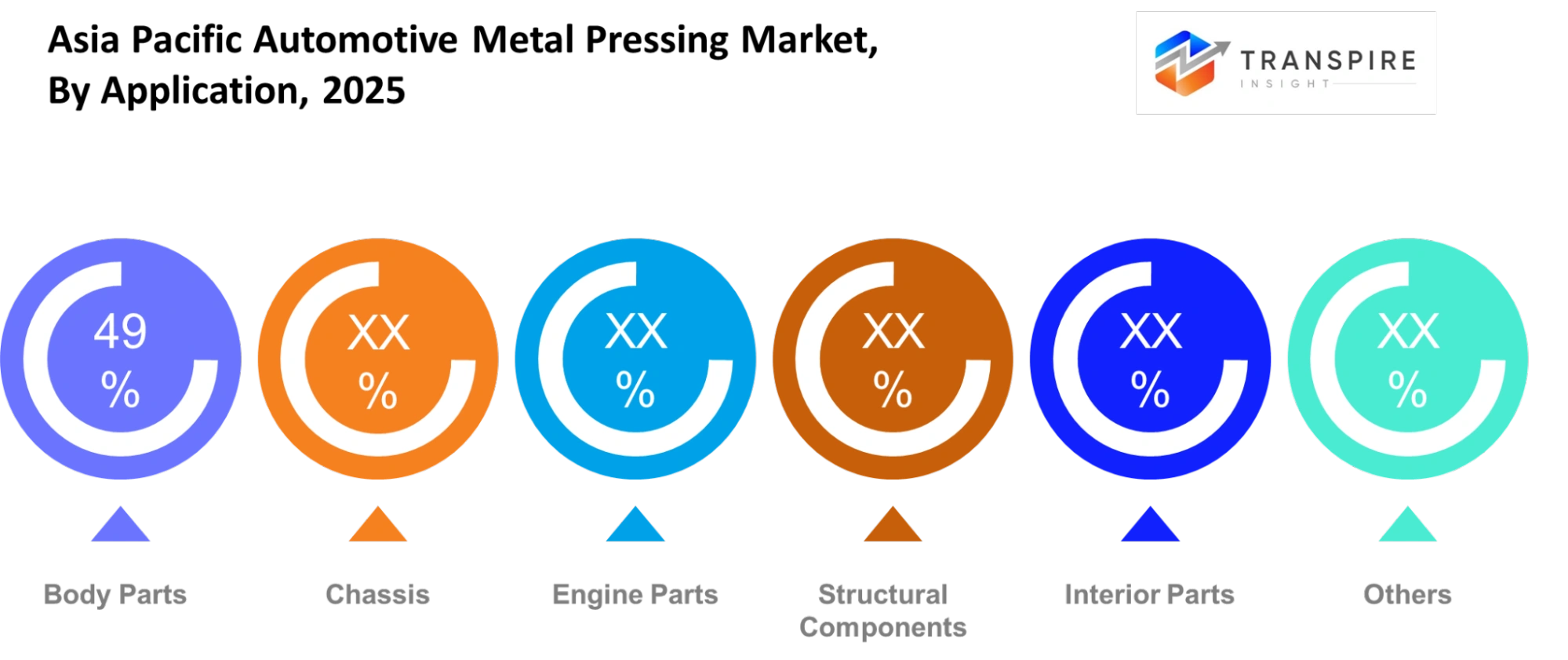
Parts for body will constitute a huge portion because of their continuous demand for panels, doors, and outer frames. Parts for the chassis will be significant because of their role in ensuring stability and loading capacity of the vehicle. Parts for engine will be critical due to their requirement for metal shaping to work effectively.
Interior parts will become more important with the change in design preference towards comfort and aesthetics. Metal pressing will play an important role in providing frames and support structures inside the vehicle. Increase in electric cars will make parts for engine less relevant while making new designs for parts required.
To learn more about this report, Download Free Sample Report
By End-User
OEM automotive companies will be dominant buyers because of the high-volume manufacturing processes and direct sourcing practices. The Tier 1 suppliers will be important participants through providing custom-made components to leading manufacturers. The aftermarket segment is expected to increase gradually because of longevity and maintenance considerations.
Producers of commercial vehicles will need robust components for their applications like trucks and buses. All segments of end-users will affect product development, volumes, and quality demands. Cooperation between OEM companies and their partners will facilitate the supply process and shorten the delivery period.
By Material
Steel will still be the most dominant because of its durability and affordability. Aluminum will be chosen to respond to the call for light materials. Copper will be utilized for some uses which require conductivity and durability. Alloys will see the creation of better-performing materials through the mixture of different material qualities.
Composite materials will slowly emerge and will see usage especially in automobiles. Materials will be selected depending on costs, weights, and strength. Regulation agencies will push for lightweight and efficient materials. Research will continuously make sure that quality materials will be available for forming.
What are the Main Challenges for the Asia Pacific Automotive Metal Pressing Market Growth?
The Asia Pacific automotive metal pressing market is expected to continue facing issues related to precision and consistency in large-scale production operations. Tooling complications and redesigns will add further pressure on operations. The disruption in supply chains, particularly in the supply of raw materials, will impede scalability and production schedules.
Efficiency will continue to be a challenge for the asia pacific automotive metal pressing market due to the need for constant calibration in modern metal processing processes. Equipment breakdowns and inconsistencies in quality will impact production levels.
Production will be affected by higher energy costs, tooling expenses, and safety regulations. Regulatory procedures in various countries will complicate approval and commercialization process.
Companies will have to ensure proper balancing between cost optimization and quality control, thereby affecting finances. Late introduction of innovations will limit the degree of competitiveness among participants. Market limitations will remain due to difficulties for companies to develop their businesses under conditions of regulations.
Asia pacific automotive metal pressing market will face adoption limitations due to lack of developed infrastructure in developing countries. Companies may not be able to introduce advanced pressing equipment due to insufficient availability of qualified personnel. Financial limitations will prevent implementation of innovations.
Difficulties associated with upgrading of pressing plants will prevent smaller manufacturers to adopt new solutions. Industrial development at various stages across countries will be another barrier to adoption. All these factors will affect market development negatively.
Asia pacific automotive metal pressing market will be influenced by competitive forces from other manufacturing processes, including additive manufacturing and composite technology. Increasing pricing pressures will complicate operations.
Rapid technological shifts will require continuous investment, increasing financial risk for manufacturers. Regulatory changes and evolving customer preferences will add uncertainty. These growth barriers will challenge long-term stability and demand strategic adaptation to maintain competitiveness.
Asia Pacific region is expected to be a mixed bag in terms of its industrial setup, with China and Japan leading in terms of manufacturing facilities. The presence of established automotive manufacturing facilities will create the need for metal pressing, and with automation constantly being invested in, efficiency and quality will be improved.
The Indian subcontinent and other Southeast Asian countries will display slow progress in terms of their infrastructural and manufacturing capacity. Establishment of new industrial zones will promote further investment; however, there will also be issues related to uneven development.
Recent Development News
Asia-Pacific Steel Processing Market is expected to grow with more than 2% CAGR from 2024 to 2029Asia-Pacific, led by China, accounts for the vast majority of world steel production. China produces more than half of the world's steel, making it the world's largest producer. Other notable producers in the region include Japan, India, South Korea, and developing countries in Southeast Asia. Asia-Pacific is rapidly industrializing and urbanizing, creating a significant demand for steel products.
Source: https://www.reuters.com/
|
Report Metrics |
Details |
|
Market size value in 2025 |
USD 54379.1 Million |
|
Market size value in 2026 |
USD 57045.2 Million |
|
Revenue forecast in 2033 |
USD 80910.4 Million |
|
Growth rate |
CAGR of 5.12% from 2026 to 2033 |
|
Base year |
2025 |
|
Historical data |
2021 - 2024 |
|
Forecast period |
2026 - 2033 |
|
Report coverage |
Revenue forecast, competitive landscape, growth factors, and trends |
|
Regional scope |
Asia Pacific (China, India, Japan, South Korea, Australia, Rest of Asia Pacific) |
|
Key company profiled |
Magna International, Gestamp, Martinrea, Tower International, Aisin Seiki, Toyota Boshoku, Hyundai Mobis, Benteler, Voestalpine, JFE Steel, POSCO, Thyssenkrupp, Tata AutoComp, Linamar, Cosma. |
|
Customization scope |
Free report customization (country, regional & segment scope). Avail customized purchase options to meet your exact research needs. |
|
Report Segmentation |
By Type (Cold Pressing, Hot Pressing, Deep Drawing, Stamping, Forging, Others); By Application (Body Parts, Chassis, Engine Parts, Structural Components, Interior Parts, Others); By End-User (Automotive OEMs, Tier 1 Suppliers, Aftermarket, EV Manufacturers, Commercial Vehicles, Others); By Material (Steel, Aluminum, Copper, Alloys, Composite, Others). |
How Can New Companies Establish a Strong Foothold in the Asia Pacific Automotive Metal Pressing Market?
Companies hoping to create their footprint in the asia pacific automotive metal pressing market will have to concentrate on niche specialization. Specializing in sectors such as the production of light weight EV component parts and precision engineering will accelerate differentiation. Innovation strategy should be based on cutting-edge technologies such as automation, intelligent automation, and AI quality control, addressing issues such as defects and production holdups. New entrants in the asia pacific automotive metal pressing market will benefit from designs and trends in the automotive manufacturing sector.
Collaboration is central to entering the market successfully. Cooperation between new players in the automotive market in Asia and the Pacific region with OEMs, Tier 1 suppliers and technology companies will give them an upper hand in acquiring contracts and gaining credibility. Creating joint ventures with local producers will help alleviate logistical and regulation problems. Supplier network and local production in the asia pacific automotive metal pressing market will ensure cost efficiency and faster delivery processes.
The differentiation technology will play an important role in deciding the success of the new entrants. For example, companies like AutoForm Asia and PressTech Innovations have begun implementing predictive analytics and digital twin techniques to enhance the efficiency of their metal-forming processes without causing raw-material waste. The emergence of such companies shows how advanced manufacturing through the use of data-driven technologies can help a company achieve efficiency along with maintaining high quality.
Key Asia Pacific Automotive Metal Pressing Market Company Insights
Opportunities will be created in the Asia Pacific automotive metal pressing market by focusing on specialized parts such as EV components and lightweight metal presses. Firms will have less competition due to production specialization in either the high precision or the low volume parts. Positioning in specialized parts will be a key strategy in creating early success.
Entry into the market will be made through a knowledge of demand patterns in the Asia pacific region. Small firms will have a greater chance of success as they will not face the constraints that are found in larger firms regarding responsiveness. They will be more flexible and hence will reduce risk.
The Asia pacific automotive metal pressing market will favor companies that embrace technological advancement in the manufacture of the products. Technologies include artificial intelligence and automation. Companies will use innovative ways of making the processes in metal pressing more efficient.
To access the asia pacific automotive metal pressing market, there will be the need for cooperation with OEMs, Tier 1 suppliers, and distributors within the region. Cooperation will assist emerging firms to enter the current market structure and guarantee consistent orders. In addition, it will allow them to access the market without facing any problems such as logistics.
Cooperation will facilitate technology transfer and knowledge sharing. This way, production capacity will increase significantly. Local cooperation will assist in ensuring efficient logistics and deliveries. This strategy will enhance the reputation of emerging businesses.
The asia pacific automotive metal pressing market will remain competitive owing to the presence of well-established firms within the industry. These firms will concentrate on cost efficiency, precision of products, and prompt deliveries to beat their rivals. Competition will make the firms always improve technologically and production-wise.
Emerging firms will fight against competition using customized production and flexibility in manufacture. Price will play another critical role in allowing consumers to choose.
Company List
- Magna International
- Gestamp
- Martinrea
- Tower International
- Aisin Seiki
- Toyota Boshoku
- Hyundai Mobis
- Benteler
- Voestalpine
- JFE Steel
- POSCO
- Thyssenkrupp
- Tata AutoComp
- Linamar
- Cosma
What are the Key Use-Cases Driving the Growth of the Asia Pacific Automotive Metal Pressing Market?
Strong growth will be seen from the application of asia pacific automotive metal pressing in passenger vehicles, which is essential for the development of safety-focused bodywork with well-formed metal sheets and frames. The manufacture of these components will require the use of complex pressing operations as automakers strive to meet demands for lightweight and efficient cars, including those with electric capabilities.
One of the significant use cases of asia pacific automotive metal pressing will involve the manufacturing of chassis and structural components. The production of chassis will need the use of metal pressing operations as these parts require high levels of durability and strength, as well as resistance to crashes. The development of commercial vehicles and electric vehicle platforms will spur demand for this product type.
In addition to the conventional uses in the automotive industry, the asia pacific automotive metal pressing industry is poised to see growth through its integration into smart manufacturing processes. The application of automation and artificial intelligence in pressing operations and product inspection will ensure higher levels of production efficiency and minimal waste.
Innovative applications in battery housing and thermal control systems in electric vehicles will contribute to the adoption of metal pressing technology. The growing intricacy in design and material requirements will lead manufacturers to explore production techniques that offer greater flexibility.
Asia Pacific Automotive Metal Pressing Market Report Segmentation
By Type
- Cold Pressing
- Hot Pressing
- Deep Drawing
- Stamping
- Forging
- Others
By Application
- Body Parts
- Chassis
- Engine Parts
- Structural Components
- Interior Parts
- Others
By End-User
- Automotive OEMs
- Tier 1 Suppliers
- Aftermarket
- EV Manufacturers
- Commercial Vehicles
- Others
By Material
- Steel
- Aluminum
- Copper
- Alloys
- Composite
- Others
Frequently Asked Questions
Find quick answers to common questions.
The approximate Asia Pacific Automotive Metal Pressing Market size for the market will be USD 80910.4 Million in 2033.
Key segments for the Asia Pacific Automotive Metal Pressing Market are By Type (Cold Pressing, Hot Pressing, Deep Drawing, Stamping, Forging, Others); By Application (Body Parts, Chassis, Engine Parts, Structural Components, Interior Parts, Others); By End-User (Automotive OEMs, Tier 1 Suppliers, Aftermarket, EV Manufacturers, Commercial Vehicles, Others); By Material (Steel, Aluminum, Copper, Alloys, Composite, Others).
Major Asia Pacific Automotive Metal Pressing Market players are Magna International, Gestamp, Martinrea, Tower International, Aisin Seiki, Toyota Boshoku, Hyundai Mobis, Benteler, Voestalpine, JFE Steel, POSCO, Thyssenkrupp, Tata AutoComp, Linamar, Cosma.
The Asia Pacific Automotive Metal Pressing Market size is USD 54379.1 Million in 2025.
The Asia Pacific Automotive Metal Pressing Market CAGR is 5.12%.
- Magna International
- Gestamp
- Martinrea
- Tower International
- Aisin Seiki
- Toyota Boshoku
- Hyundai Mobis
- Benteler
- Voestalpine
- JFE Steel
- POSCO
- Thyssenkrupp
- Tata AutoComp
- Linamar
- Cosma
Recently Published Reports
-
Dec 2024
ATV & UTV Market
ATV & UTV Market Size, Share & Analysis Report By Type (ATV, and UTV), By Variants (Less Than 400 CC, 400 CC To 800 CC, and More Than 800 CC), and Geography (North America, Europe, Asia-Pacific, Middle East and Africa, South and Central America), 2021 - 2031
-
Jan 2025
Automotive Central Gateway Module Market
Automotive Central Gateway Module Market Size, Share & Analysis Report By Type (Ethernet Central Gateway Module, CAN Central Gateway Module, LIN Central Gateway Module, and FlexRay), By Application (Powertrain Control, Body Control, Infotainment System, Advanced Driver Assistance Systems (ADAS), and Others), By End User (Passenger Vehicles, and Commercial Vehicles), and Geography (North America, Europe, Asia-Pacific, Middle East and Africa, South and Central America), 2021 - 2031
-
Jan 2025
Automotive Engine Oil Filter Market
Automotive Engine Oil Filter Market Size, Share & Analysis Report By Filter Type (Fuel Filter, Engine Oil Filter, Hydraulic Oil Filter, and Others), By Filter Media (Cellulose, Synthetic, and Micro), By Sales Channel (OEMs, and Aftermarket), By Vehicle Type (Passenger Cars, Light Commercial Vehicles, Heavy Duty Trucks, Buses and Coaches, and Off-road Vehicles), and Geography (North America, Europe, Asia-Pacific, Middle East and Africa, South and Central America), 2021 - 2031
-
Jan 2025
Automotive Parts Aluminium Die Casting Market
Automotive Parts Aluminium Die Casting Market Size, Share & Analysis Report By Production Process (Pressure Die Casting, Vacuum Die Casting, Squeeze Die Casting, Gravity Die Casting), By Application (Body Parts, Engine Parts, Transmission Parts, Battery And Related Components, Other Application Types), and Geography (North America, Europe, Asia-Pacific, Middle East and Africa, South and Central America), 2021 - 2031
Our Clients