
Asia Pacific Plastic Market Summary
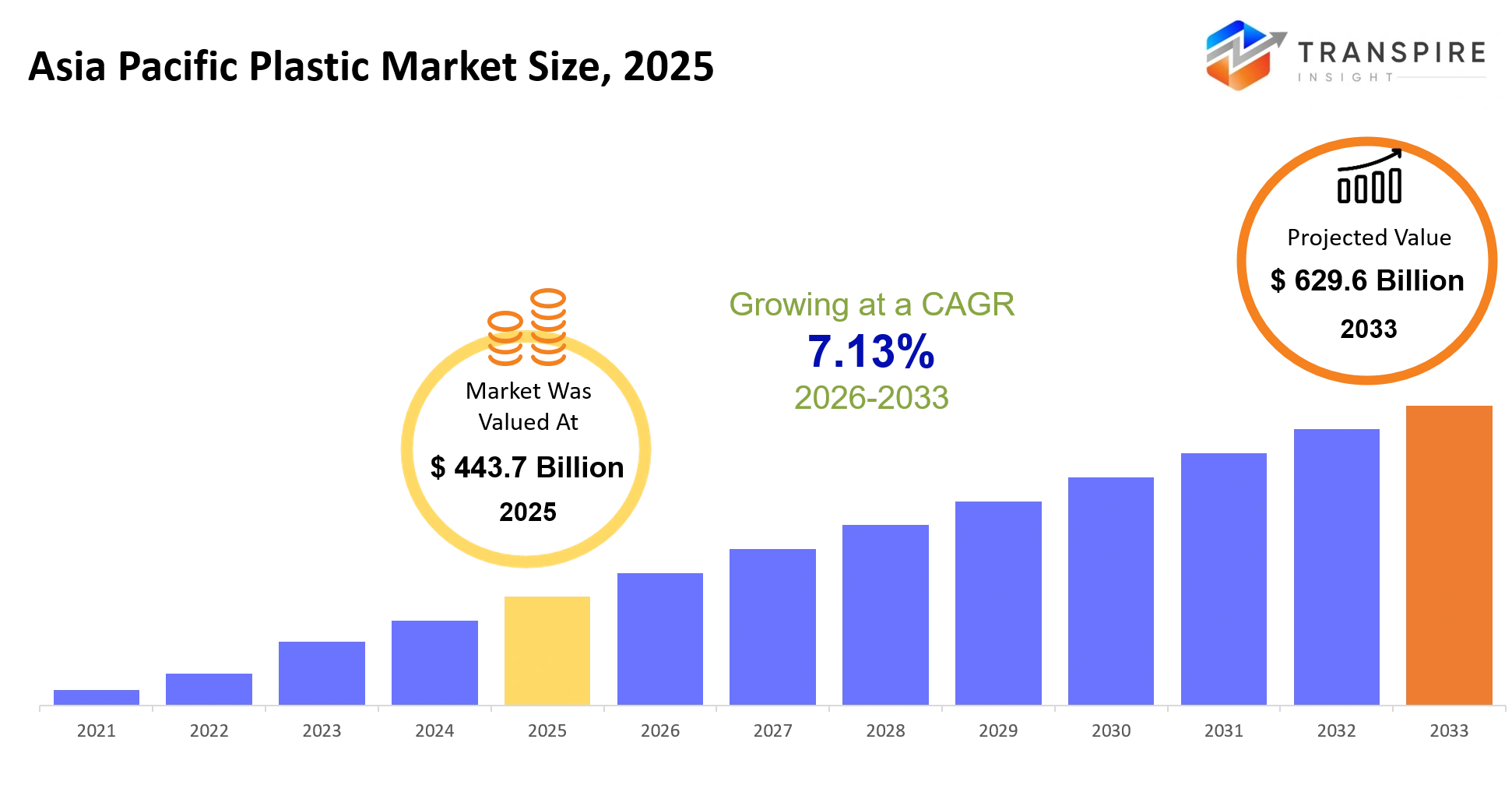
As per Transpire Insight Analysis the Asia Pacific Plastic Market size is estimated at USD 443.7 Billion in 2025 and is anticipated to reach USD 629.6 Billion by 2033, growing at a CAGR of 7.13% from 2026 to 2033.
The Asia Pacific Plastic Market kinda supports industries by supplying lightweight but durable materials, and also cost effective options that get used across packaging, automotive parts, construction products, electronics, healthcare equipment,and various industrial applications. Plastic solutions generally help manufacturers enhance product performance, shave material weight, and keep production systems running efficiently across regional supply chains . Over the last 3–5 years the market has been leaning more toward advanced polymers, recycled plastics, and bio based materials , because companies are trying to meet sustainability goals and handle changing regulations.
One of the bigger structural changes has been this drift toward circular economy practices, which then kinda pushes investment into recycling technologies and material recovery systems . Environmental policies, especially tighter plastic waste regulations across Asia Pacific economies, are also helping speed up the whole transition. As manufacturers redesign their products and reorganize supply networks around recyclable materials, plastic producers are grabbing chances via specialty polymers, more greener solutions, and higher-value applications.
Asia Pacific Plastic Market Size & Forecast:
- Asia Pacific Plastic Market Size 2025: USD 443.7 Billion
- Expected Market Value 2033: USD 629.6 Billion
- Forecast CAGR: 7.13%
- Leading region in 2025: China
- Fastest Growing region: India
- Key Profile: SABIC, BASF, Dow, ExxonMobil, LyondellBasell, LG Chem, Reliance Industries, Mitsubishi Chemical, Formosa Plastics, Sinopec, INEOS, Covestro, Braskem, Toray Industries, Chevron Phillips Chemical.
Key Market Insights
- China kind of dominates the Asia Pacific Plastic Market, with more than 45% share in 2025, largely because it has big manufacturing capacity and polymer production leadership in general.
- India looks like it’s the fastest-growing part during 2025–2033, backed by infrastructure investment, expanding manufacturing, and those domestic polymer demand drivers that keep getting stronger, year to year.
- When it comes to product segments, Polyethylene is the main one, holding roughly 30% share. This is tied to packaging, consumer goods, and industrial uses, kind of all at once.
- Polypropylene stays as the second-largest segment, and it keeps widening across automotive components, healthcare products, and durable goods applications as well.
- Recycled plastics are showing up as the fastest-growing segment through 2033, mainly pushed by sustainability regulations, plus circular economy investments that are gaining traction.
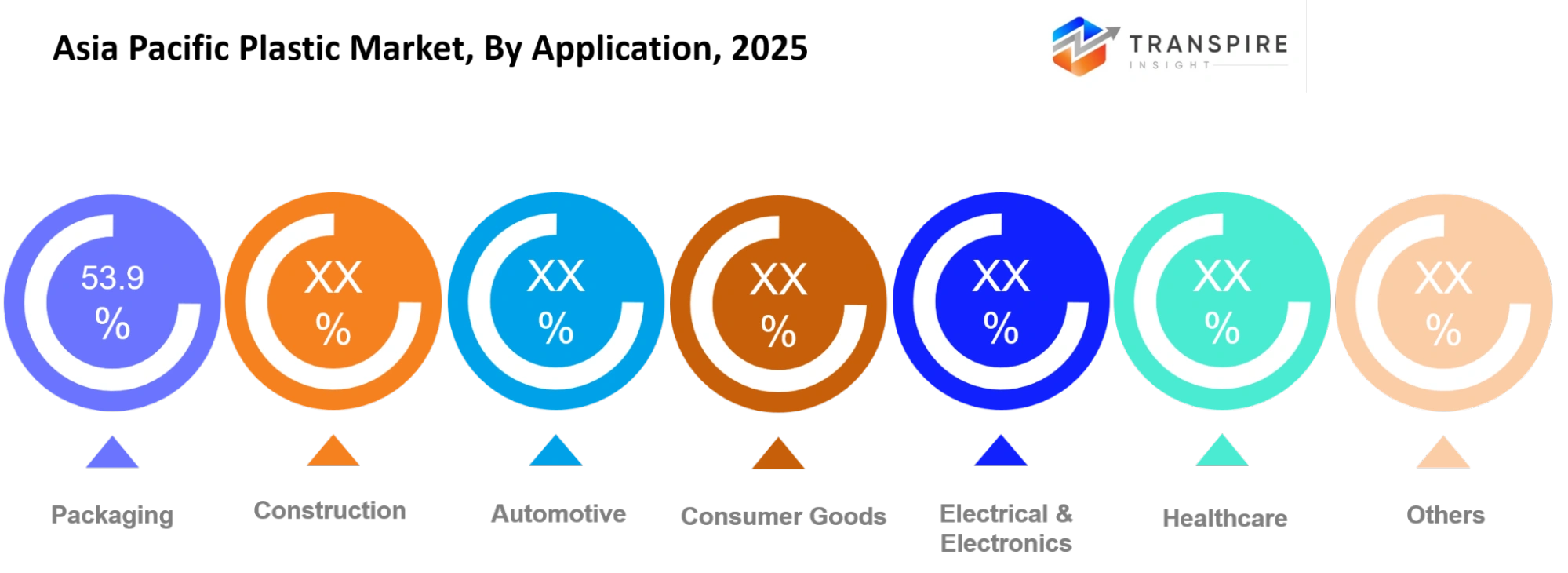
- On the application side, packaging dominates with nearly 40% share in 2025. Food, beverage, and e-commerce supply chains help support that position, fairly directly.
- Automotive plastics are probably the fastest-growing application category, and this is accelerated by lightweight vehicle production , and also by electric mobility adoption through 2030.
- In end-user segments, packaging companies lead with over 35% share. Their focus on flexible packaging, and consumer product requirements, seems to matter.
- Healthcare and electronics become the fastest-growing end-user categories too, mostly due to specialized polymer adoption and advanced manufacturing needs.
What are the Key Drivers, Restraints, and Opportunities in the Asia Pacific Plastic Market?
Plastic consumption across Asia Pacific is being sped up (kinda) by manufacturing expansion, city infrastructure builds, and a tech shift toward high-performance polymers. The main trigger is pretty clearly tighter material efficiency standards and sustainability rules, and that is what pushed firms toward better plastics plus full recycling setups. With that in place adoption of specialty polymers rises, because companies want lighter, tougher, and more reusable materials, and it then basically opens up new revenue lanes for the polymer suppliers.
Still, plastic waste management is the big structural drag. Recycling capacity is fragmented, regulations don’t match up, and collection networks are thin, so the move toward circular plastics goes slow. From a Transpire Insight review of regional procurement notices and launch timelines, supply chain concentration stays the main execution concern. These limits end up delaying sustainable product releases, raising compliance spend, and also cutting down the amount of recycled feedstock manufacturers can actually access.
On the flip side advanced recycling tech looks like the next real growth window. Chemical recycling plus AI enabled sorting, and bio based polymer options kind of can help unlock those higher value uses, like, not just the basics. In India, Japan, South Korea, and in Southeast Asia too there’s this readiness for investment, because local governments back the recycling capacity and also those sustainable manufacturing programs, sorta in tandem.
What Has the Impact of Artificial Intelligence Been on the Asia Pacific Plastic Market?
Artificial intelligence along with digital tech seems to be nudging plastic manufacturing into a different gear, mostly because it makes production control less shaky, improves quality monitoring, and somehow makes resource management a bit more orderly, not totally chaotic. In real life, lots of manufacturers are deploying AI based setups that can keep an eye on extrusion lines, recognize defects a little earlier, adjust energy usage, and run automated reporting for compliance across their polymer production sites. At the same time, digital twins together with linked sensors allow operators to notice process deviations sooner, so overall product quality stays pretty stable, more or less consistent.
On top of that, machine learning models are used for predictive maintenance, where they analyze equipment performance signals, which cuts down on those annoying surprise stoppages and boosts how well assets get utilized. There is also AI driven demand forecasting, which assists producers in lining up polymer output with shifting needs in packaging, automotive, and electronics. Together these methods enable more careful inventory planning and reduce production inefficiencies that otherwise keep accumulating.
Operationally, the gains tend to show up as higher equipment uptime, quicker quality inspections, and less material waste, since automated decision systems can respond in near real time. Still, AI adoption is held back, mostly by high integration costs, not enough historical datasets, and connectivity problems in older plants. Smaller producers in particular often struggle with upgrading legacy systems, and that delays the whole digital transformation across regional plastic value chains.
Key Market Trends
- Circular plastic efforts kind of expanded after 2020, since companies started to invest in recycling infrastructure and these sustainable material development programs too.
- Around 2022 chemical recycling got adopted faster, letting manufacturers take on tangled, complex plastic waste, and turn it into more valuable raw materials.
- China then went further with plastic sustainability policies after 2021 which basically pushed producers toward recycling technologies, and also reduced single-use plastic consumption.
- India’s polymer industry moved ahead during 2023 to 2025, mostly because domestic capacity investments backed packaging and infrastructure use.
- After 2022, automotive manufacturers increased lightweight plastic use, not just for fuel efficiency but also to support electric vehicle production which matters.
- After 2023 digital manufacturing adoption rose as AI monitoring improved production efficiency and cut down polymer processing losses.
- Between 2022 and 2025, big global chemical companies expanded their Asia-based recycling partnerships, so they could lock in circular plastic supply chains, more or less.
- Flexible packaging demand shifted after 2020 toward recyclable formats as brands redesigned products for regulatory compliance and all that.
- Then after 2023, bio-based polymer development picked up momentum thanks to research investments aiming at lower-carbon material alternatives.
- Finally, Southeast Asian markets saw more plastic processing investments after 2022, because manufacturing relocation happened and supply chain diversification trends showed up.
Asia Pacific Plastic Market Segmentation
By Product Type :
Polyethylene is still this big material category, mainly because it shows up everywhere in packaging films, containers, pipes and even those everyday consumer things. A lot of flexible packaging manufacturers lean toward polyethylene too, not just for the lightweight feel, but also because it stays tough and usually costs less, which makes the whole decision kind of simple.
Polypropylene basically carries a wide range of uses, from automotive parts to medical products, and yes household goods, largely due to heat resistance plus mechanical strength. PVC keeps showing up in construction work through pipes, profiles, and insulation materials . PET demand keeps getting supported by beverage bottles and food packaging, while engineering plastics are getting more familiar in electronics, automotive systems and industrial components. On top of that, new specialty polymer development is expected to open fresh opportunities, especially if it keeps improving performance and recycling compatibility, which is where people are paying attention now.
By Application :
Application wise, packaging is the largest area, largely because it is used so often across food, beverages , personal care and e-commerce. Flexible packaging solutions also keep getting more preference, for reasons like using less material, better transport efficiency, and that extra product protection benefit.
Construction demand is supported by pipes, insulation materials, flooring products, and building components. Automotive is expanding too , with manufacturers leaning on lightweight plastics to raise vehicle efficiency, also to support electric vehicle production. Electrical and electronics needs advanced polymers for insulation, durability, and thermal resistance . Healthcare applications use specialized plastics for medical devices, packaging, and lab products.
By End User :
The packaging industry still sits as one of the main end user segments, because there is steady consumption through food processing, retail , and the consumer product supply lines. Manufacturers keep moving toward recyclable packaging materials to satisfy regulatory rules, and also make their overall product sustainability look better.
In construction, plastic materials are used for infrastructure projects, water management systems, plus insulation solutions. Automotive makers are blending in more plastic for lightweight designs , and to push improved vehicle performance. In electronics, the whole field leans on high performance polymers for components , protective cases, and electrical applications. Healthcare organizations use medical grade plastics for equipment, storage products, and those disposable solutions that are practical day to day
By Processing Method :
Injection molding seems important because it supports efficient production for automotive parts, electronic pieces, medical devices, and consumer goods. Companies like injection molding due to precise designs, high production volume, and lower material waste.
Extrusion helps with continuous output of pipes, films, sheets, and profiles across different industrial uses. Blow molding is still a go to for bottles and hollow containers, mostly because it is cost efficient and can move fast. Thermoforming backs packaging work and consumer goods manufacturing, since it allows flexible shaping. Rotational molding shows up in specialized situations where durable, large plastic products are needed, including storage tanks and industrial containers.
By Distribution Channel :
Direct sales channels back large industrial buyers by means of customized supply agreements, technical help, and bulk material procurement, and in practice it helps keep things stable. A lot of major manufacturers lean on direct distribution networks so they can keep a steady relationship with automotive teams, packaging suppliers, and construction companies, because it is more consistent.
Distributors and wholesale suppliers meanwhile have a real part to play, they bridge polymer producers with small and medium manufacturers in a pretty hands on way. Regional suppliers often bring inventory availability , logistics support, and a wider product range across different industries. Digital purchasing platforms are also getting more attention nowadays, since companies want swifter procurement steps and better supply chain visibility. If distribution keeps expanding, it will likely improve access to specialty polymers and recycled materials for more regional industries.
What are the Key Use Cases Driving the Asia Pacific Plastic Market?
Asia Pacific Plastic Market sees a big jump in demand from packaging uses, where food processors , beverage firms, and consumer goods makers buy plastic materials for guarding goods, extending shelf life, and improving transport efficiency. Flexible packaging and rigid containers still look like the main answers, mostly because of cost control, and also because production can scale fast.
In the automotive world , manufacturers are also pushing more plastic into lightweight pieces and electric vehicle systems. Construction teams meanwhile are choosing plastic pipes, insulation products, and more durable materials for infrastructure work. All these areas back up material demand with performance advantages , plus the long term operational savings people want.
Newer uses are coming up too, like chemical recycling feedstock and bio-based polymers that support more responsible manufacturing. Packaging brands and industrial producers are testing newer material approaches as rules push lower-waste production models. The chance to grow will rise along with recycling technology investments, and with better processing capabilities too.
|
Report Metrics |
Details |
|
Market size value in 2025 |
USD 443.7 Billion |
|
Market size value in 2026 |
USD 468.3 Billion |
|
Revenue forecast in 2033 |
USD 629.6 Billion |
|
Growth rate |
CAGR of 7.13% from 2026 to 2033 |
|
Base year |
2025 |
|
Historical data |
2021 - 2024 |
|
Forecast period |
2026 - 2033 |
|
Report coverage |
Revenue forecast, competitive landscape, growth factors, and trends |
|
Regional scope |
Asia Pacific (India, China, Japan, Australia, South Korea, Rest of Asia Pacific) |
|
Key company profiled |
SABIC, BASF, Dow, ExxonMobil, LyondellBasell, LG Chem, Reliance Industries, Mitsubishi Chemical, Formosa Plastics, Sinopec, INEOS, Covestro, Braskem, Toray Industries, Chevron Phillips Chemical. |
|
Customization scope |
Free report customization (country, regional & segment scope). Avail customized purchase options to meet your exact research needs. |
|
Report Segmentation |
By Product Type (Polyethylene, Polypropylene, PVC, Polystyrene, PET, Engineering Plastics, Others); By Application (Packaging, Construction, Automotive, Consumer Goods, Electrical & Electronics, Healthcare, Others); By End User (Packaging Industry, Construction Industry, Automotive Manufacturers, Electronics Industry, Healthcare, Others); By Processing Method (Injection Molding, Extrusion, Blow Molding, Thermoforming, Rotational Molding, Others); By Distribution Channel (Direct Sales, Distributors, Wholesale Suppliers, Others). |
Which Regions are Driving the Asia Pacific Plastic Market Growth?
China is still taking the lead in the Asia Pacific Plastic Market, with an estimated share going past 45% in 2025, mostly because it has big petrochemical capacity, plus manufacturing infrastructure that is already in place. On top of that, government policies keep pushing industrial output, recycling progress, and also local material availability, so regional plastic production keeps moving. There’s also a pretty wide set up of polymer producers, packaging makers, automotive suppliers, and chemical firms, all of which makes continuous funding across the full value chain feel normal. This sort of leadership is expected to run on through 2033 too, as China holds its production scale, export strength, and even the advanced polymer development efforts.
Japan, on the other hand, shows up as a steadier revenue contributor, and its market shape is different, sort of more tuned to high-value materials and advanced manufacturing practices. There are strict quality rules, technology led production systems, and ongoing industrial investment, which together keep demand reliable, especially from automotive, electronics, and healthcare. Instead of chasing pure volume , Japanese producers lean toward specialty plastics that bring performance benefits, not just more tonnage. That attention to precise applications tends to create stable revenue chances, even if the overall volume growth is a bit slower.
India is kinda the fastest growing area because manufacturing expansion is happening, plus infrastructure development, and also the domestic polymer processing capacity is going up. Lately there are more investments, like new production facilities, recycling systems that are actually scaling, and those industrial corridors too. Because of that plastic is getting adopted more and more across packaging, construction, and automotive sectors. Consumer markets keep getting bigger, and government manufacturing initiatives are also there, so this makes fresh chances for suppliers both local and international, kind of all at once. Looking ahead, growth through 2026–2033 will probably pull in investors who want capacity expansion, sustainable material projects, and a few emerging application opportunities that are still kinda opening up.
Who are the Key Players in the Asia Pacific Plastic Market and How Do They Compete?
Competition in the Asia Pacific Plastic Market still looks moderately fragmented , like there are global chemical players moving next to regional producers and it can feel kinda balanced. Basically cost efficiency, polymer innovation, supply chain strength and more specific material development become the real levers for where everyone stands. The established firms tend to guard their market space via capacity expansion and also by investing in sustainable products. Meanwhile newer companies seem more interested in recycled plastics and specialty polymer segments, not just the usual stuff.
SABIC shows up with advanced polymer technologies and circular material ideas, and it helps them meet the sustainable packaging expectations. They also lean hard on recycled and certified materials, so they can separate themselves from conventional producers and keep industrial buyers feeling more confident about long term collaboration. Dow, on the other hand, puts a big emphasis on material innovation plus recycling partnerships. They work on solutions meant to improve packaging performance, but also keep things in line with the rules and regulatory compliance requirements.
Reliance Industries keeps its position using integrated petrochemical operations together with domestic production scale. That combination gives cost advantages across India and into nearby markets. There are also investments going toward polymer capacity and recycling initiatives, which supports regional expansion in a pretty direct way. BASF aims more toward high-performance plastics, digital production technologies, and sustainable chemistry solutions for automotive, electronics, and industrial applications. In the end, these approaches let firms fight through differentiated products instead of relying only on pricing, and that difference matters a lot.
Company List
- SABIC
- BASF
- Dow
- ExxonMobil
- LyondellBasell
- LG Chem
- Reliance Industries
- Mitsubishi Chemical
- Formosa Plastics
- Sinopec
- INEOS
- Covestro
- Braskem
- Toray Industries
- Chevron Phillips Chemical
Recent Development News
In October 2025, Konica Minolta established a partnership with MJ MATERIAL to develop intelligent recycled materials. The collaboration will introduce advanced recycled plastic production technology at MJ MATERIAL’s Kuala Lumpur plant in 2026, improving recycled material quality and supply reliability for electronics and home appliance manufacturers across Asia.
Source: https://www.konicaminolta.com/
In April 2026, BASF showcased sustainable plastic innovations and customer collaborations at CHINAPLAS 2026. The initiative strengthened BASF’s regional materials strategy by expanding sustainable polymer solutions for eMobility, robotics, and industrial applications across Asia Pacific markets.
Source: https://www.basf.com/
What Strategic Insights Define the Future of the Asia Pacific Plastic Market?
The Asia Pacific Plastic Market is expected to edge toward higher-value, circular, and digitally managed polymer systems over the next 5–7 years, pushed mostly by sustainability rules, manufacturing expansion, and the continued demand for advanced materials. There’s also a sort of hidden risk that people don’t always talk about enough, raw material concentration. If producers rely too much on a small number of petrochemical supply hubs, they can get hit by sudden price shocks and supply interruptions even while growth numbers look very strong.
At the same time, an opportunity is starting to show up more clearly: chemical recycling platforms across India and Southeast Asia. With new investments and policy backing, recycled polymer capacity could expand faster than before, and that may open some doors. Industry players should probably focus on working directly with recycling technology providers, and also build flexible feedstock strategies , so margins stay steadier, compliance becomes easier, and they can actually catch the upcoming specialty plastic opportunities.
Plus, additional investment in bio-based polymers and advanced sorting technologies could create new revenue pathways. This matters because many manufacturers are actively looking for lower-impact material options, especially for industrial applications.
Asia Pacific Plastic Market Report Segmentation
By Product Type
- Polyethylene
- Polypropylene
- PVC
- Polystyrene
- PET
- Engineering Plastics
By Application
- Packaging
- Construction
- Automotive
- Consumer Goods
- Electrical & Electronics
- Healthcare
By End User
- Packaging Industry
- Construction Industry
- Automotive Manufacturers
- Electronics Industry
- Healthcare
By Processing Method
- Injection Molding
- Extrusion
- Blow Molding
- Thermoforming
- Rotational Molding
By Distribution Channel
- Direct Sales
- Distributors
- Wholesale Suppliers
Frequently Asked Questions
Find quick answers to common questions.
The expected Asia Pacific Plastic Market size for the market will be USD 629.6 Billion in 2033.
Key segments for the Asia Pacific Plastic Market are By Product Type (Polyethylene, Polypropylene, PVC, Polystyrene, PET, Engineering Plastics, Others); By Application (Packaging, Construction, Automotive, Consumer Goods, Electrical & Electronics, Healthcare, Others); By End User (Packaging Industry, Construction Industry, Automotive Manufacturers, Electronics Industry, Healthcare, Others); By Processing Method (Injection Molding, Extrusion, Blow Molding, Thermoforming, Rotational Molding, Others); By Distribution Channel (Direct Sales, Distributors, Wholesale Suppliers, Others).
Major Asia Pacific Plastic Market players are SABIC, BASF, Dow, ExxonMobil, LyondellBasell, LG Chem, Reliance Industries, Mitsubishi Chemical, Formosa Plastics, Sinopec, INEOS, Covestro, Braskem, Toray Industries, Chevron Phillips Chemical.
The Asia Pacific Plastic Market size is USD 443.7 Billion in 2025.
The Asia Pacific Plastic Market CAGR is 7.13% from 2026 to 2033.
- SABIC
- BASF
- Dow
- ExxonMobil
- LyondellBasell
- LG Chem
- Reliance Industries
- Mitsubishi Chemical
- Formosa Plastics
- Sinopec
- INEOS
- Covestro
- Braskem
- Toray Industries
- Chevron Phillips Chemical
About the Authors

Pankaj Ghogare Patil
I am Pankaj Ghogare Patil, a Senior Research Analyst at Transpire Insight, specializing in the Pharmaceutical, Chemicals & Materials, Healthcare IT, and Biotechnology industry. My expertise lies in conducting comprehensive market research, analyzing industry trends, evaluating competitive landscapes, and translating complex data into actionable insights. At Transpire Insight, I closely follow emerging technologies, regulatory developments, and market innovations to create accurate, well-researched, and informative content that helps businesses and professionals make informed decisions. I am committed to producing credible, evidence-based articles that reflect industry best practices while making technical topics accessible and valuable for a broad audience.

Chakradhar Khansole
Chakradhar serves as the Research Director at Transpire Insight, bringing over 8 years of experience in technology, innovation, and strategic market intelligence. He specializes in transforming complex market data into actionable business insights that enable organizations to make informed, growth-oriented decisions. Recognized for his strategic vision and analytical expertise, Chakradhar leads high-impact research initiatives, delivering comprehensive market assessments, competitive intelligence, and forward-looking industry analysis.
Recently Published Reports
-
May 2026
Healthcare Polymer Packaging Market
Healthcare Polymer Packaging Market Size, Share & Analysis Report By Packaging Type (Syringes, IV Bottles and Pouches, Clamshells, Blisters, Bottles & Jars, Containers, Tubes, IV Parental Packaging, Others), By Type (Regulated, Non-regulated), By Polymer Type (LDPE (Low-Density Polyethylene), HDPE (High-Density Polyethylene), Homo-polymer (Homo), Random Copolymer (Random), Block Copolymer (Block), PET, Polystyrene, Polyvinyl Chloride, Polyamide/EVOH, Others), and Geography (North America, Europe, Asia-Pacific, Middle East and Africa, South and Central America), 2021 - 2031
-
Apr 2026
Hydrophilic Tape (Waterstop) Market
Hydrophilic Tape (Waterstop) Market Size, Share & Analysis Report By Type (Bentonite-Based Hydrophilic Tape, Rubber-Based Hydrophilic Tape), By Application (Residential Buildings, Commercial Buildings, Infrastructure Projects), and Geography (North America, Europe, Asia-Pacific, Middle East and Africa, South and Central America), 2021 - 2031
-
Apr 2026
Metalens Market
Metalens Market Size, Share & Analysis Report By Type (Visible Light Metalens, and Infrared Metalens), By Application (Consumer Electronics, Automotive Electronics, Industrial, Medical, and Others), and Geography (North America, Europe, Asia-Pacific, Middle East and Africa, South and Central America), 2021 - 2031
-
Apr 2026
PBT Resin Market
PBT Resin Market Size, Share & Analysis Report By Type (Reinforced PBT Resin, Unreinforced PBT Resin), By Processing Method (Injection Molding, Extrusion, Blow Molding, Others), By End-User (Automotive, Electrical & Electronics, Consumer Appliances, Industrial Machinery, Medical Devices, Packaging, Others), and Geography (North America, Europe, Asia-Pacific, Middle East and Africa, South and Central America), 2021 - 2031